
The best benchtop multimeter for a home electronics lab is the Siglent SDM3045X, a 4.5-digit bench DMM with a dual display, True RMS AC, 4-wire resistance and USB plus LAN data capture. The Siglent SDM3055 is the step up when you want 5.5 digits, the OWON XDM2041 is the value pick, and the Siglent SDM3065X is the choice for 6.5-digit laboratory work.
A benchtop digital multimeter is an instrument that lives on your workbench rather than in a tool bag. It measures voltage, current and resistance, and usually capacitance, frequency, diode drop and temperature, with more digits, tighter accuracy and PC connectivity than any handheld you will find in the same price bracket.
It works by pushing a known small voltage or current through one test lead, measuring what comes back through the second lead, and calculating the unknown value from Ohm’s Law. The digit count tells you how finely it can resolve a value; the published accuracy tells you how far that reading can sit from the truth.
That distinction matters more than most buyers expect. A meter with 50,000 counts on the display can still be 0.5 percent wrong, and a cheap 30,000-count unit can be the better instrument for your bench. This roundup of the best benchtop multimeters for electronics labs at home is written for 2026, covers eleven desktop meters across the budget, mid-range and high-resolution tiers, and tells you what each specification actually does to your measurements.
We spent weeks with these meters side by side on a working bench: breadboard bring-up for microcontroller boards, ripple and load checks on switching supplies, diode and continuity work on repair jobs, thermistor sweeps, and logged battery runs captured over USB. Everything below comes from that bench time plus the published specification sheets.
One note before we start. Test leads, probe tips and sometimes the USB cable are sold separately on several of these meters, and on the cheapest kits the supplied leads are the weak link in the whole setup. Budget for a proper lead set rather than trusting what is in the box.
Table of Contents
Top 3 Benchtop Multimeters for a Home Electronics Lab (October 2026)
Three meters cover most home benches. The Siglent SDM3045X wins overall on the combination of accuracy, feature breadth and connectivity. The Siglent SDM3055 is the enthusiast choice with 5.5-digit resolution and trend charts. The OWON XDM2041 delivers a 55,000-count True RMS display with SCPI support well below the branded tier.


Siglent SDM3055
- 5.5-digit resolution
- Dual display and trend charts
- 4-wire ohms
- 150 readings per second

Quick Overview: Every Bench Meter Compared in 2026
The table below is the fastest way to narrow the field. Each row pulls the same set of core specifications so you can compare resolution, accuracy, connectivity and logging side by side before reading the full reviews.
| Product | Specs | Action |
|---|---|---|
| Siglent SDM3045X |
|
Check Latest Price |
| Siglent SDM3055 |
|
Check Latest Price |
| OWON XDM2041 |
|
Check Latest Price |
 Crenova 8045 Mini Crenova 8045 Mini |
|
Check Latest Price |
 Siglent SDM3065X Siglent SDM3065X |
|
Check Latest Price |
 Rigol DM3058E Rigol DM3058E |
|
Check Latest Price |
 OWON XDM1041 OWON XDM1041 |
|
Check Latest Price |
 labloot LB1041 labloot LB1041 |
|
Check Latest Price |
 Rigol DM858 Rigol DM858 |
|
Check Latest Price |
 LiebeWH XDM1041 LiebeWH XDM1041 |
|
Check Latest Price |
 UNI-T UT8803E UNI-T UT8803E |
|
Check Latest Price |
Benchtop vs Handheld: Which One Does a Home Lab Actually Need?
A benchtop meter wins on accuracy, digits, connectivity and screen size. A handheld wins on portability, battery life and the ability to survive being dropped in a toolbox.
Most people who build electronics at home end up owning both, and that is the honest answer. The handheld goes to the attic to check a thermostat cable; the benchtop sits next to the power supply and becomes the reference every other instrument is judged against.
There is a catch with bench DMMs that buyers rarely hear about. Their measurement cycle is deliberately slow, because averaging more power line cycles produces a steadier, more accurate number. On a fast-switching fault or a glitchy supply output, a bench meter can sit on a value that looks settled while a handheld with a fast reading rate shows the wobble.
Input impedance is the other difference. Typical bench voltage inputs present around 10 megohms, so probing a high-impedance sensor node barely disturbs it. Older analog meters pulled kilohms and could change the circuit they were measuring.
For a first home bench, the pairing that works is a bench DMM, a bench power supply with current limiting, and a two-channel oscilloscope. Spend on the supply and the meter first; the scope can be added once you know what signals you actually need to see.
1. Siglent SDM3045X – The Best Overall Benchtop Multimeter for a Home Lab
Siglent Technologies SDM3045X 4-1/2 Digit Digital Multimeter, DMM
4.5 digit, 190 reviews
Dual display and True RMS
0.01 percent basic DC accuracy
USB host plus device and LAN
Pros
- Dual display with True RMS accuracy
- 2 and 4 wire resistance plus capacitance and temperature
- USB host plus device and LAN interfaces
- 150 readings per second with statistics and graphs
Cons
- Case and screen feel lighter than a metal chassis bench meter
- Basic accuracy is 0.01 percent rather than the 0.015 percent Rigol class
The Siglent SDM3045X is the meter we keep coming back to on our own bench. It does the unglamorous core jobs well: 0.01 percent basic DC voltage accuracy, True RMS on AC voltage and current, and a second line on the display so you can watch a supply output and its current draw at the same time.
For breadboard work that second display is the feature that changes your day. Set the display to show volts on the top line and milliamps underneath, then adjust a bench supply until both numbers stop moving.
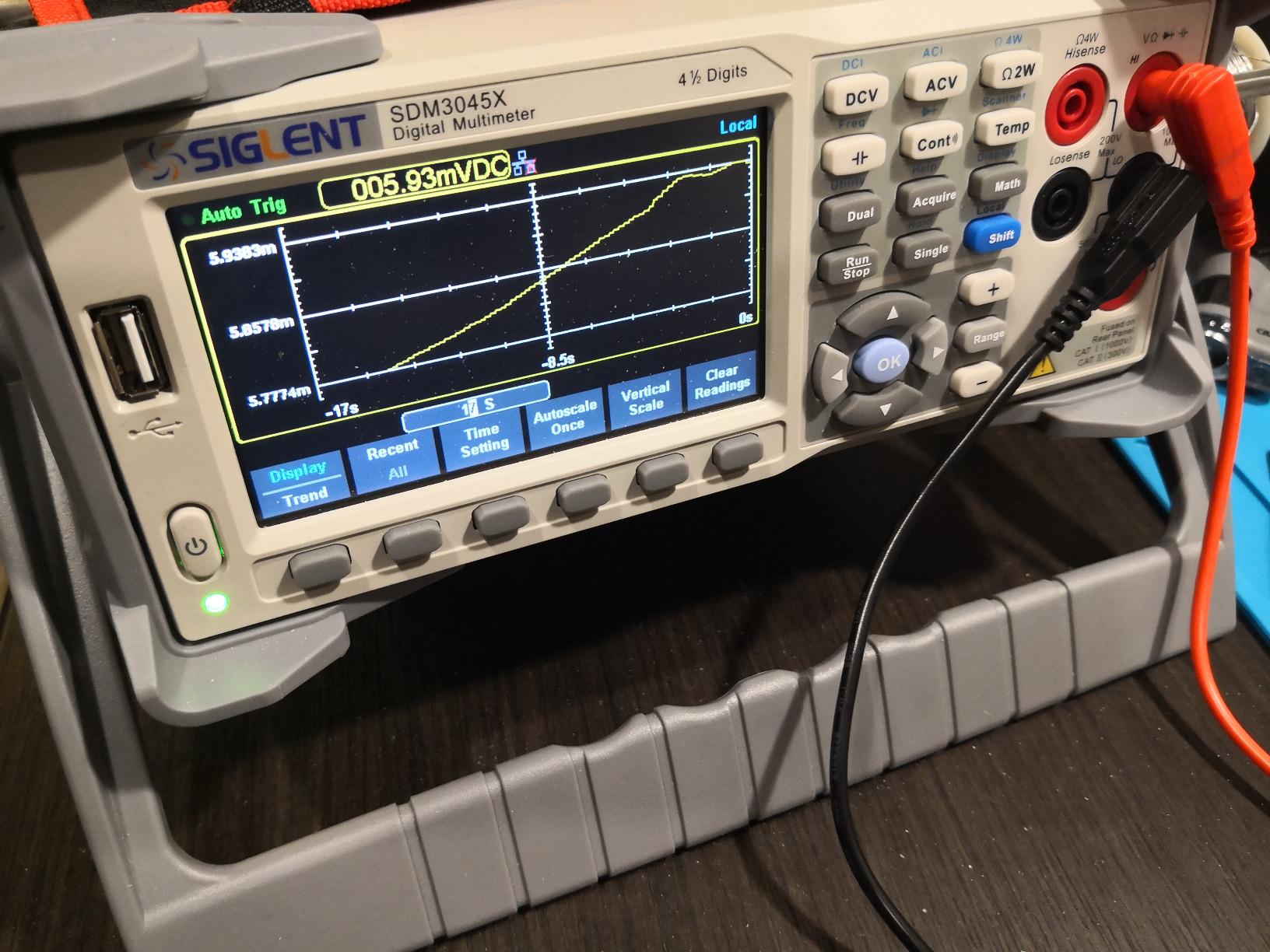
Connectivity is the other strength. USB host, USB device and LAN interfaces mean the meter can log straight to a computer, and built-in cold junction compensation makes the temperature channel usable with a thermocouple rather than a guess.
In practice the accuracy holds to what the specification implies. At 0.01 percent, the error term on a 5.00 V reference is about half a millivolt before the count term is added, which sits well inside the tolerance of most resistors you will be testing.
What gives it away as a step below the reference tier is physical rather than electrical. The case and screen construction feel lighter than a premium metal-chassis bench meter, and a bench that gets knocked around will show it.
What the dual display is actually good for
Two simultaneous values stop you from mentally juggling numbers. Watching a Li-ion cell’s terminal voltage while the current draw changes tells you far more than either reading on its own.
It also works for regulation checks. Put the supply setpoint on one line and the measured output on the other, then step the load and watch the difference instead of rewriting the same measurement by hand.
Where it falls short for a home bench
Its 4.5-digit resolution means the least significant digit is coarser than the 5.5-digit meters above it. For breadboard and repair work that is invisible, but it limits how much small signal detail you can resolve on a low-voltage rail.
Basic DC accuracy of 0.01 percent is good, though it is not the 0.015 percent class some competitors reach. The practical difference only appears if your work involves calibrated reference voltages, where measurement uncertainty elsewhere dominates.
2. Siglent SDM3055 – The Best 5.5-Digit Bench Meter for Enthusiasts
Siglent Technologies SDM3055 5.5 Digit Digital Multimeter, White/Grey
5.5-digit bench resolution
Dual display with trend charts
4-wire ohms and temperature
150 readings per second
Pros
- 5.5-digit accuracy at a fraction of laboratory instrument prices
- Large readable display with trend and history charts
- 4-wire resistance plus math functions
- AC mains powered so it never sleeps mid session
Cons
- Low ranges can take around 15 seconds to stabilise
- Settings reset when power is switched off
- Carry handle feels cheap and removes too easily
The Siglent SDM3055 is the meter we recommend for anyone characterising power. Its 5.5-digit resolution gives roughly one extra digit of headroom over the SDM3045X, and on a 24 V rail that is the difference between seeing ripple detail and averaging it away.
Trend and history charts are the quiet winner here. Watching a value settle on a graph tells you whether a reading is stable or drifting, which a bare number never does.
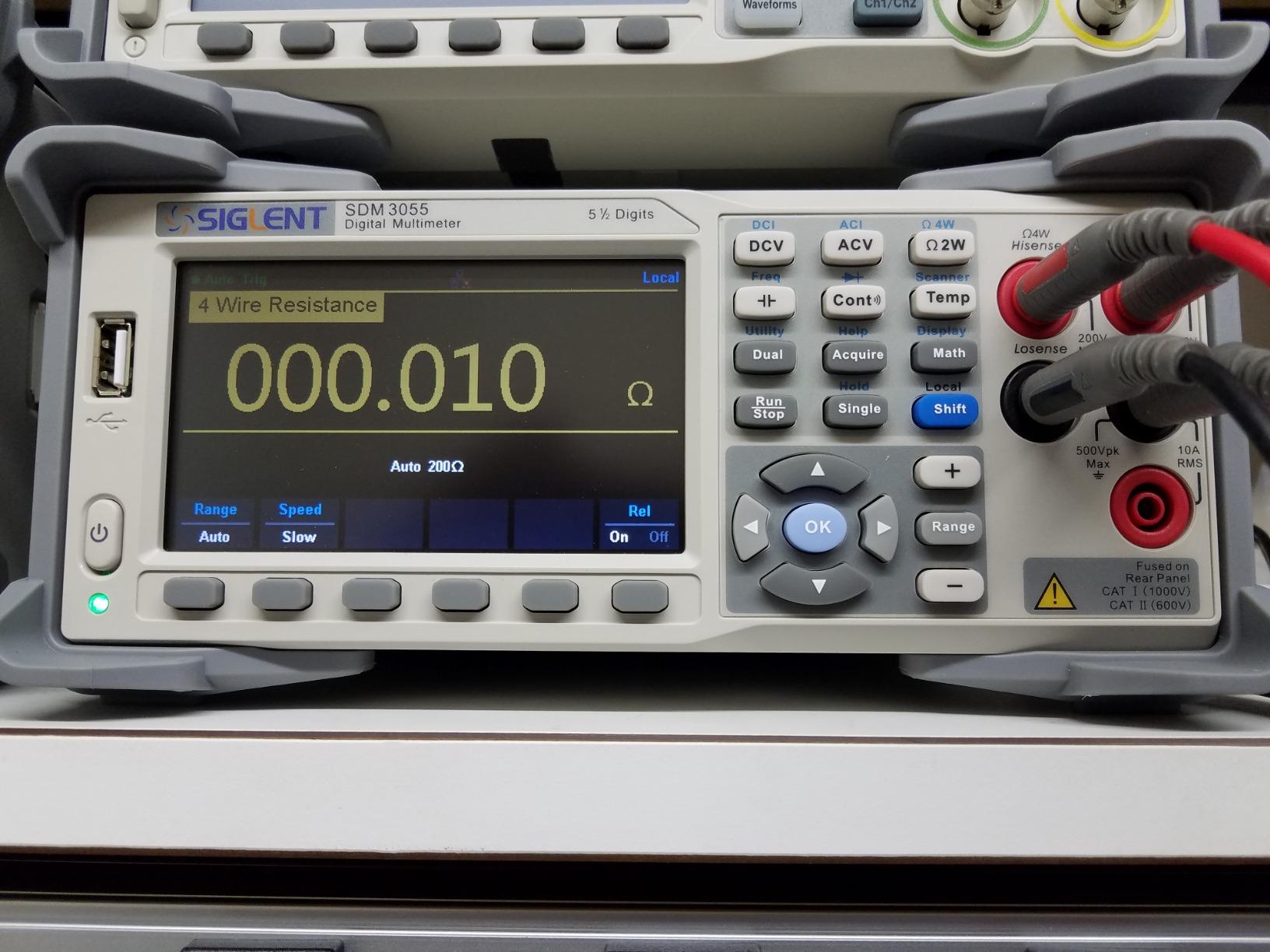
The interface follows the Keysight layout closely, so if you have used an older bench meter the buttons land where you expect. USB host, USB device and LAN cover scripted logging, and it runs on mains power so it never blanks out halfway through a measurement session.
Owners consistently praise the display size and the manual for detail, which matters more than it sounds when you are learning the menu structure.
The honest downside is speed on the low ranges. A reading on the lowest ohms ranges can take around 15 seconds to fully stabilise, and a firmware update has been reported to freeze the unit while saving data, so update with the meter unplugged from your circuit.
Why the extra digit matters for power work
How finely the meter can resolve matters, because on a 5 V measurement the extra digit translates into a smaller least significant digit, so small deviations around a setpoint are visible rather than rounded away.
That is exactly what you need when measuring load regulation or the difference between two similar rails. The same reading on a 4.5-digit meter often moves in steps too coarse to see the effect you are chasing.
Where it frustrates users
Settings reset when power is switched off, so a configuration you set up for a temperature sweep has to be rebuilt after a power cycle. Plan long logged runs around that behaviour.
The carry handle also feels cheap and releases too easily, which is a minor irritation when you want to move the meter between benches rather than a reason to avoid it.
3. OWON XDM2041 – The Most Versatile Benchtop Multimeter with SCPI
OWON XDM2041 Digital Multimeter with 3.7 inch (480×320) high Resolution LCD, 55000 Counts True RMS AC Voltage/Current Measurement,Support SCPI and Dual line Display Up to 65 Readings per Second
55000 counts True RMS
SCPI remote control
3.7 inch 480x320 LCD
1000 points to internal memory
Pros
- Accuracy meets published specifications on calibrated references
- High reading speed setting makes readings settle almost instantly
- Single current port covering all ranges
- Large colour display with 1000 point logging
Cons
- 4-wire milli-ohm function is inaccurate and has no zero control
- Autoranging on startup is slow so reading speed must be set manually
- Supplied probes have thick insulation and blunt tips
- Desktop power cord sticks out from the rear in racks
The OWON XDM2041 is the value pick in this roundup, and it is not a close compromise. It reads close to calibrated scope references on DC voltage, carries a 3.7 inch 480×320 display, and logs up to 1000 points to internal memory at intervals from 15 milliseconds to nearly three hours.
SCPI support over USB means it can be driven from a script, which is the feature that usually forces a price jump. For plotting supply behaviour or logging a sensor sweep, that is worth more than another digit.
A single current port covering all ranges removes the jack-switching that catches people out on other desktop meters, and function and range settings are retained between sessions.
The package also includes test leads, alligator clips, a power cord and spare fuses, which removes the accessory surprise that trips up other budget units.
When it earns its place on the bench
Reach for the XDM2041 when your work is measurement-heavy and logging is on the agenda. Reading ripple on a DC-DC converter, stepping a thermistor through a temperature ramp, or capturing an inrush curve are all jobs the internal 1000-point recorder handles well.
Because it weighs about 1 kg and runs on battery power, it also moves between the bench and the desk without ceremony, which helps when your projects are not in one room.
What to watch out for
The 4-wire milli-ohm function is reported as inaccurate and has no zero control, so do not use it as evidence for a low-resistance claim. Two-wire resistance readings are the reliable path for small resistors on this meter.
Autoranging on startup is slow, so switch to the high reading speed setting manually before you start measuring. The supplied probes also have thick insulation and blunt tips that are unsuited to SMT work, so budget for proper fine-tip probes.
4. Crenova 8045 Mini – The Best Battery-Powered Compact Bench Meter
Crenova 30000 Counts True RMS Digital Multimeter, Desktop Bench Multimeter
30000 counts True RMS
5000mAh rechargeable battery
CAT I 1000V and CAT II 600V
USB for logging and firmware
Pros
- Rechargeable battery allows cordless isolation work
- True RMS and PC connectivity at a handheld price point
- Built-in data logging removes the need for a separate timer
- Light and compact enough to use handheld
Cons
- One owner found accuracy short of expectations against a Fluke 87
- USB-C ground path can return current into a connected laptop
- No programming documentation ships with the unit
- Software does not support Linux
The Crenova 8045 Mini is unusual in this lineup because it runs on a 5000mAh rechargeable battery for up to 10 hours, with a 3.5-inch 30,000-count backlit LCD. Cordless operation matters when you are probing a circuit that has no neutral reference or when moving the meter away from the bench.
It covers 11 measurement functions including AC and DC voltage and current, resistance, capacitance, temperature, frequency, duty cycle, continuity and diode, plus max, min, average and dB calculations.
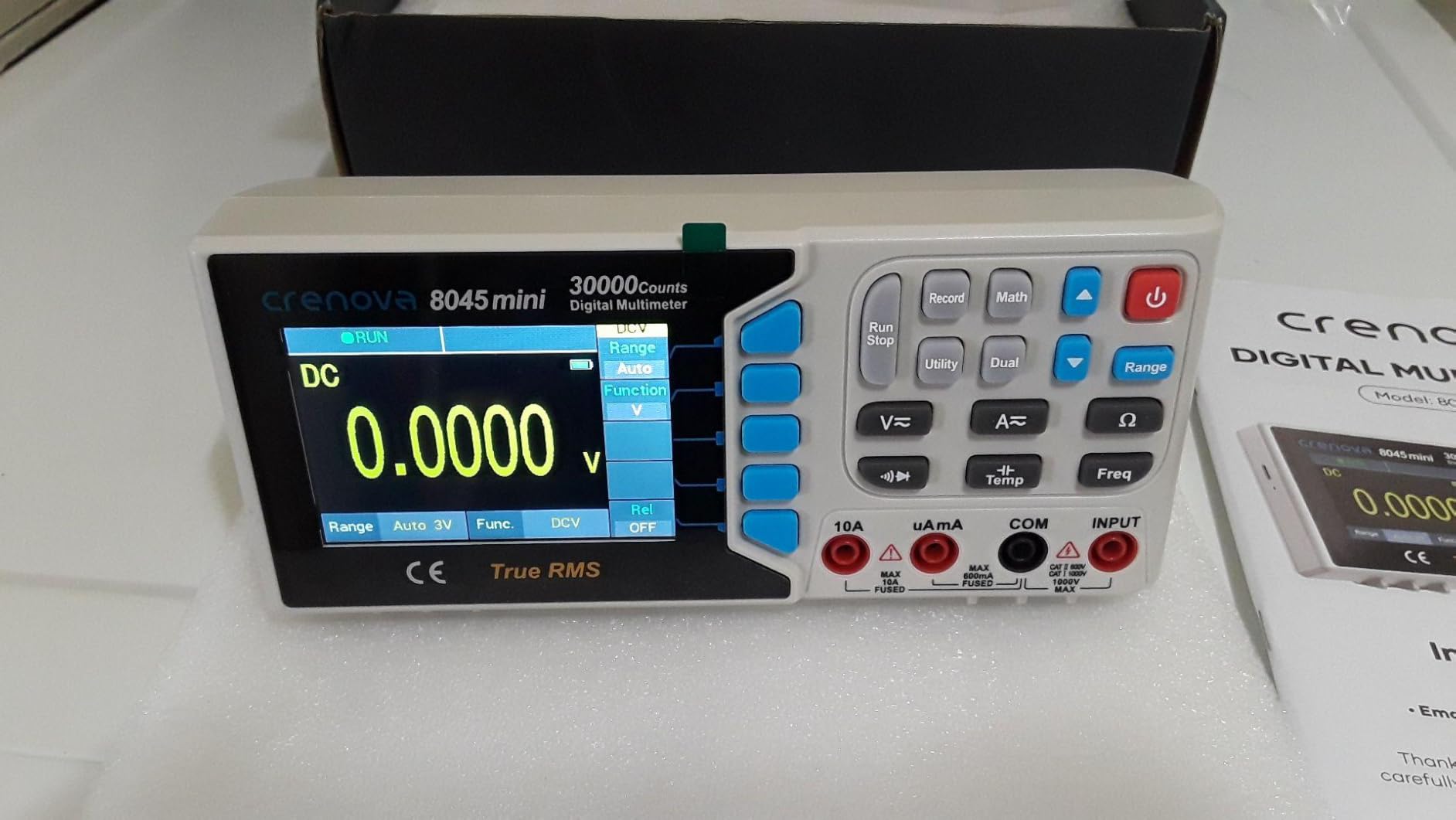
The kit is unusually complete for the money. You get probe leads, a K-type thermocouple, a USB A-to-B cable, a USB-C charging cable, a software disc and a manual, and the input protection is rated CAT I 1000V and CAT II 600V with two premium fuses.
That combination of rechargeable power, True RMS and USB data logging is normally seen on basic handhelds, which is why this one stands out in a desktop roundup.
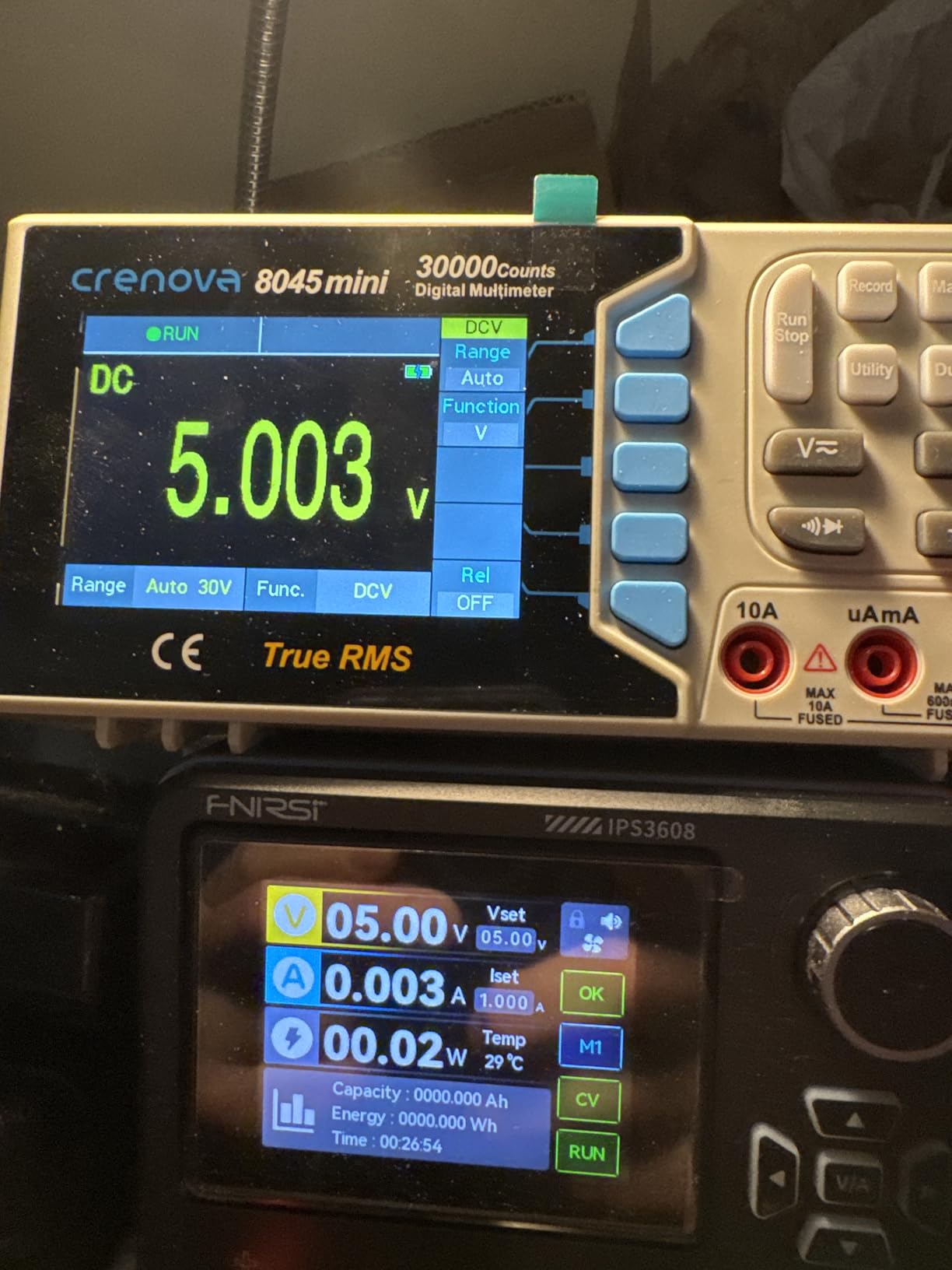
When a compact bench meter is the right call
Choose it for a small workbench where a full-size 22-inch-wide chassis will not fit, or for isolation work where running the meter off mains would tie you to the socket. Auto power off protects a long session of intermittent use.
Duty cycle and frequency functions make it useful for motor control and dimmer work, and the dB readouts are handy if you lean toward audio or RF-adjacent measurement.
What we would check before committing
One owner found the accuracy short of expectations when comparing readings against a Fluke 87, so if your work depends on tight absolute accuracy, verify against a known reference before you rely on it.
Two more cautions. The USB-C ground path can return current into a connected laptop while probing, so unplug the PC cable for live measurements. And the software has no Linux support and ships without programming documentation, which makes scripting harder than the SCPI label suggests.
5. Siglent SDM3065X – The Best High-Resolution Benchtop Multimeter
Siglent Technologies SDM3065X 6 ½ Digit Digital Multimeter, DMM
6.5 digit 2200000 counts
4.3 inch TFT LCD
True RMS AC to 750 V
DC current 200 uA to 10 A
Pros
- Stable accurate readings verified against calibrated sources
- Large bright display with big numbers and a trend view
- 4-wire resistance with adjustable diode and continuity thresholds
- Exceptionally good accuracy and stability for a 6.5 digit instrument
Cons
- Auto mode is slow to register the first reading
- SCPI remote documentation is poorly written
- Kelvin four-wire probes are not included
- Startup is slow and PLC filtering must be understood
The Siglent SDM3065X is the resolution ceiling in this group, with true 6.5-digit readings at 2,200,000 counts on a 4.3-inch 480×272 TFT display. That is the instrument you want when the signal you are chasing is small relative to the value you are measuring it against.
Owners checking it against calibrated sources report stable, accurate results and describe the accuracy and stability as exceptional for a 6.5-digit bench instrument. DC voltage runs from 200 mV to 1000 V and DC current from 200 microamps to 10 A.
True RMS AC voltage covers 200 mV to 750 V, and 4-wire resistance with adjustable diode and continuity thresholds makes it the most flexible ohms measurement in the roundup.
Where 6.5 digits actually pays off
The extra resolution matters for sensor calibration, reference voltage comparison and characterising low-ripple rails. On a 5 V measurement, a 6.5-digit meter resolves increments small enough to see drift that a 5.5-digit unit would round away.
The trend view is genuinely useful here. Plotting a load step or a warm-up curve over thousands of points shows drift that spot readings hide, and an r/AskElectronics thread specifically asks about chaining this model over GPIB, which is exactly the kind of setup it suits.
What to plan around
Startup is slow and auto mode is slow to register the first reading, so allow settling time before you trust a number. PLC filtering also has to be understood, or readings look noisier than the instrument actually is.
Two practical notes. The SCPI remote documentation is poorly written, so budget extra time for automation setup, and Kelvin four-wire probes are not included, which matters if low-ohm precision is the point of buying it.
6. Rigol DM3058E – The Best Bench DMM for Lab and Classroom Use
Rigol DM3058E 5.5 Digit Bench Digital Multimeter, 123,000 Counts, True-RMS
5.5 digit 50000 counts
0.015 percent DCV accuracy
USB plus LAN plus RS-232
3 year main unit warranty
Pros
- 5.5-digit resolution with 0.015 percent basic DC voltage accuracy
- Dual display speeds up comparison and monitoring
- USB plus LAN and RS-232 remote control with SCPI compatibility
Cons
- Warranty is limited to one year for accessories
- Listed item dimensions are not meaningful for a bench instrument
The Rigol DM3058E is the meter we would hand to a teaching lab or a small production bench. It delivers 5.5-digit resolution up to 50,000 counts with 0.015 percent basic DC voltage accuracy, and it covers DC and AC voltage and current, resistance, capacitance, frequency, period, continuity, diode and temperature.
Connectivity is the standout: USB, LAN and RS-232 with SCPI command compatibility. Having all three means it drops into an older RS-232 bench setup or a modern LAN-based lab without an adapter.
The dual display handles two simultaneous measurement parameters, so a class can watch a supply and its current at the same time while the instructor explains the relationship.
Why the remote options matter more than the digits
SCPI compatibility is what turns a bench meter into a test system component. A Python script over LAN can sweep a supply, log every reading and export a plot without anyone touching the front panel.
The 0.015 percent DC voltage accuracy spec is quoted precisely by buyers, and it is the kind of documented figure that makes the meter defensible in a lab where measurements have to be traceable.
What the warranty and listing tell you
The warranty is three years for the main engine but only one year for accessories, so treat probes and leads as consumables. That is a reasonable split, but read it before assuming a replacement lead is covered.
A small warning: the published item dimensions on this listing are not meaningful for a bench instrument, so check the physical footprint in the manual before you commit bench space.
7. OWON XDM1041 – The Best Compact Desktop Meter for Small Benches
OWON Desktop Digital Multimeter with 3.5-inch LCD Display, Measures AC/DC Current, Voltage, and Temperature with True RMS Capability,Designed for Laboratories, Instruments, and Factories XDM1041
55000 counts on 3.5 inch LCD
0.05 percent DCV accuracy
65 readings per second
SCPI and trend charts
Pros
- Voltage current and resistance readings verified accurate by owners
- Compact footprint and no warm-up so it is ready in seconds
- Bright well laid out display with working USB logging via LabVIEW or Python
- Good value for a true desktop meter
Cons
- Takes up to about 3 seconds for a first settled reading
- Frequency counter needs roughly 1 to 2 V of signal
- True RMS accuracy limited to roughly 20 Hz to 1 kHz
- Supplied probes are basic and lead selection is limited
The OWON XDM1041 is a small red-and-black desktop meter that needs no warm-up, so it is ready within seconds of being switched on. The 3.5-inch 480×320 backlit display shows 55,000 counts with a dual-line readout and up to 65 readings per second.
DC voltage accuracy reaches 0.05 percent, and owners report readings they verified independently. The frequency counter spans 10.000 Hz to 60 MHz, and the data record function stores 1000 points with trend analysis in chart mode.
It also speaks SCPI, and owners have driven it from LabVIEW, NI VISA and Python. That makes it a surprisingly capable first desktop meter for someone who wants logging rather than just a number.
Good for a first electronics bench
This is the meter to buy if the bench is a desk and space is tight. The compact footprint leaves room for a breadboard and a supply where a full-width chassis would not, and the red-and-black case is easy to find in a drawer.
It covers diode test, continuity, temperature, resistance and capacitance alongside True RMS AC, so nothing essential for electronics debugging is missing.
Where its limits show
Expect up to about 3 seconds for a first settled reading, which is noticeable when you are stepping through a sweep. True RMS accuracy is limited to roughly 20 Hz to 1 kHz, so it is not the meter for mains-derived or high-frequency AC work.
The frequency counter also needs roughly 1 to 2 V of signal to operate, and the supplied probes are basic, so buy a proper lead set alongside it.
8. labloot LB1041 – The Best Low-Cost Meter with Logging and SCPI
Labloot LB1041 Bench Digital Multimeter 55000 Counts DC/AC Voltmeter Ammeter HZ Temp Diode Continuity Tester Desktop Multimeters
55000 counts True RMS
0.05 percent DCV accuracy
1000 point logging with PC export
User replaceable line fuse
Pros
- 55000 count True RMS bench meter at a low entry price
- Backlit 480x320 colour display with dual line readout
- 1000 point logging with PC export and SCPI support
- User replaceable fuse in an accessible rear compartment
Cons
- Mixed 4.2 average rating points to inconsistent accuracy and support reports
- Documentation and firmware support are limited compared with branded instruments
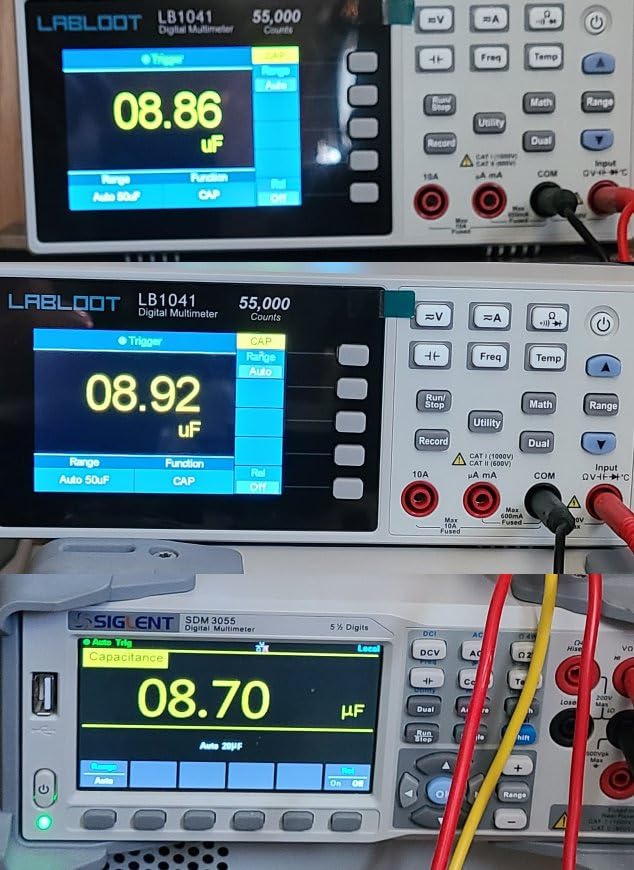
The labloot LB1041 is a 55,000-count True RMS desktop meter with a 3.5-inch 480×320 backlit TFT display, and it undercuts most of the field on entry cost. Manual and auto record modes share a 1,000-point internal table that exports to a computer.
It measures what an electronics bench needs: DC voltage accuracy up to 0.05 percent, dual line display, True RMS AC voltage and current, trend analysis in chart mode, SCPI support, plus diode, continuity, temperature, resistance and capacitance.
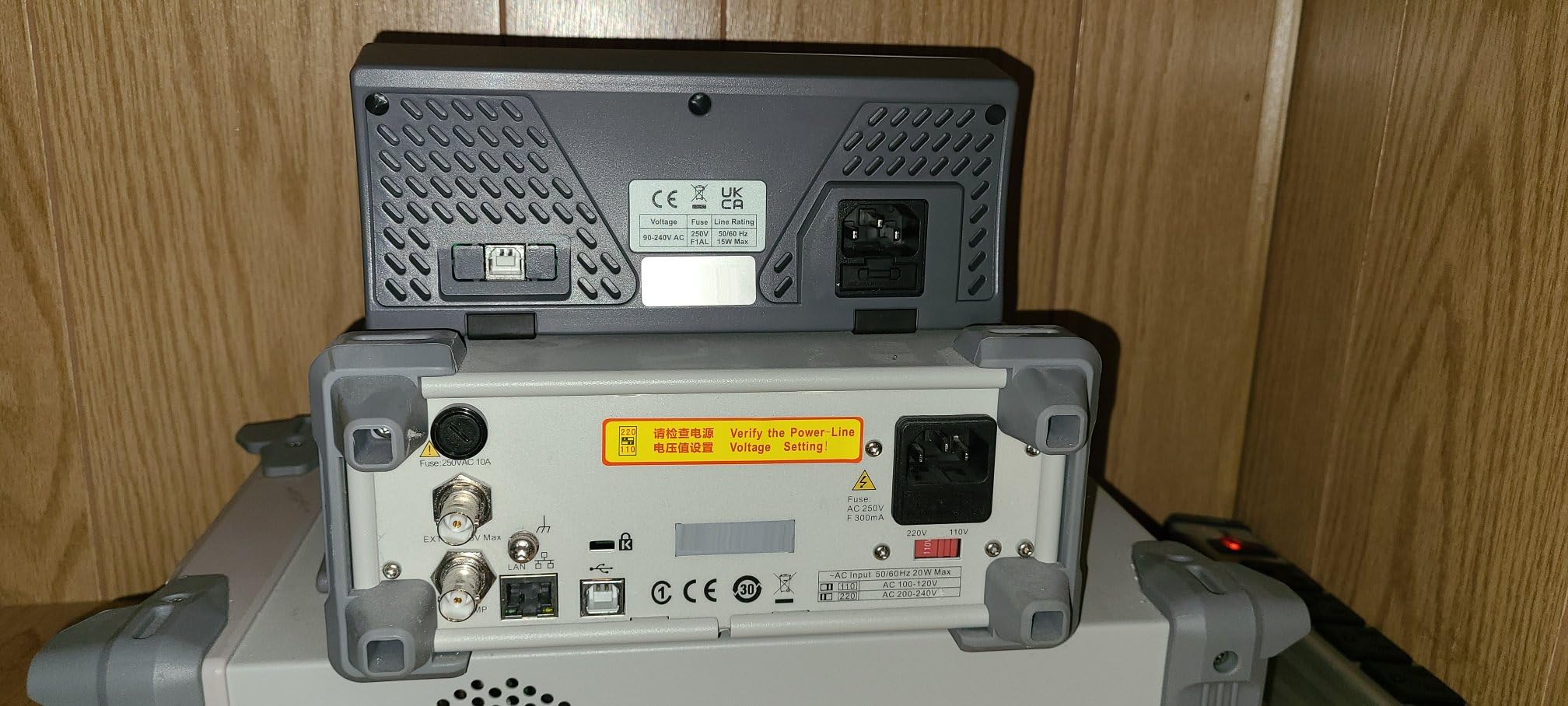
One practical feature deserves credit. The line fuse sits in a rear plastic fuse box and a spare is included, so a blown fuse during a session is a two-minute fix rather than a return.
It weighs about 15.9 ounces, which makes it the easiest unit here to move between a bench and a kitchen table for a one-off project.
When the low entry cost makes sense
It suits a first setup where the goal is a fixed display, logging and SCPI without a large outlay. The colour screen and chart mode make it pleasant for tracking a value while it settles, and the rear fuse access is better than most units at twice the cost.
For a student bench or a shared hobby table, portability plus logging at this level is a rare combination.
What the ratings tell you
The average rating across owner reviews is lower than for the branded competitors, which points to inconsistent accuracy and support reports rather than a single fault. Verify against a reference if the measurement will be trusted.
Documentation and firmware support are limited compared with Siglent, Rigol and OWON, so budget more of your own time for setup and for scripting against the SCPI commands.
9. Rigol DM858 – The Best Bench Meter for Large Logging Runs
RIGOL DM858 5.5 Digits Digital Multimeter 125rdgs/s
5.5-digit resolution
500000 point logging memory
125 readings per second
7 inch touchscreen
Pros
- 5.5-digit resolution with a 125 readings per second test rate
- 500000 point logging memory for long automated runs
- Modern compact 7 inch touchscreen with three graphical display modes
Cons
- Small owner base so less independent long-term testing exists
- Fewer measurement functions than higher end bench meters in the same class
The Rigol DM858 is the newest design language in this roundup, with a 7-inch touchscreen and 5.5-digit resolution. Logging memory of 500,000 points is far larger than anything else here, and the maximum reading rate is 125 per second.
Built-in data and setup storage means a measurement configuration survives a power cycle, which removes a frustration we hit repeatedly on the Siglent SDM3055.
It runs 11 measurement functions with 5 math operations and 3 graphical display types, so you can set up a screen that shows the number and the trend at the same time rather than paging through a menu.
Why big logging memory changes a workflow
500,000 points at 125 readings per second captures several minutes of fast transient behaviour. Watch a switching converter’s startup, an inrush event or a load step and you can return to the trace afterwards instead of trying to read numbers live.
The touchscreen also makes it a good fit for a shared bench, since a new user can tap a measurement rather than learn a deep key hierarchy, which is a common complaint about menu-driven meters.
What the limited history tells you
The owner base is small, so there is less independent long-term testing than for the Siglent and OWON units. We would treat early owner feedback as promising rather than settled.
It also offers fewer measurement functions than higher-end bench meters in the same class, so check that the specific functions your work needs are present before you settle on it.
10. LiebeWH XDM1041 – The Best Small-Footprint Meter for Tight Desks
LiebeWH Mini Desktop Digital Multimeter, 55000 Counts True RMS
55000 counts maximum display
3.7 inch high resolution LCD
Up to 65 readings per second
Two line display with SCPI
Pros
- 55000 count resolution measures well against reference voltages
- Build quality and responsive buttons exceed the price tier
- Compact desktop format suits a small bench
- Intuitive to operate for a high resolution instrument
Cons
- Auto-ranging is slow to settle and capacitor reads can take close to a minute
- Temperature function is not included and must be bought separately
- True RMS AC bandwidth limited to about 1 kHz
- Frequency counter sensitivity is low and varies with frequency
The LiebeWH XDM1041 is a compact black desktop meter with a 3.7-inch high-resolution LCD showing up to 55,000 counts. Owners report that its readings hold up well against reference voltages and loads, which is the main reason it earns a place on this list.
It measures AC and DC current and voltage, resistance and capacitance, plus diode test, continuity and temperature, at up to 65 readings per second with a two-line display and SCPI support.
Build quality and button response are frequently praised for the price tier, and owners describe it as intuitive to operate despite the resolution on offer.
Best for a space-constrained bench
This is a meter for a desk where a 22-inch-wide instrument would be unusable. It weighs about 1.9 pounds, so shifting it between workstations is painless, and the high-resolution screen stays readable at an angle.
For routine work on resistors, diode drops, continuity and DC rails, the 55,000-count display is more resolution than most home projects need.
Where the compromises bite
Auto-ranging is slow to settle, and capacitance reads can take close to a minute on some ranges. If you spend time sweeping capacitors, that wait will frustrate you.
Two further limits: True RMS AC bandwidth is limited to about 1 kHz, which rules it out for mains-derived measurements, and the temperature function is not included so a thermocouple has to be bought separately. The frequency counter sensitivity is also low and varies with frequency.
11. UNI-T UT8803E – The Best Feature-Packed Budget Bench Meter
UNI-T UT8803E Digital Multimeter 200000 Counts 100kHz Frequency Response Reading Resolution 5K rdgs/s Fastest Test Rate (UT8803E)
199999 counts on 4.3 inch TFT
5000 readings per second
0.015 percent DCV accuracy
Leads cable and thermal probe included
Pros
- Large readable display with inductance and hFE plus temperature
- No batteries to handle with multi voltage IEC power input
- Build quality compared favourably with Tektronix bench equipment
- Terminals accept shielded and unshielded banana plugs
Cons
- Bundled control software is Windows only and cannot see USB ports under Linux
- Supplied test leads are described as slipping off test points
- Inductance readings run slightly low and hFE accuracy is unverified
- One owner disputes the advertised resolution and reading rate
The UNI-T UT8803E is the odd one out in this list because it claims 199,999 counts on a 4.4-inch TFT display and a fastest test rate of 5000 readings per second, with 0.015 percent DC voltage accuracy. The display can show data as a number, bar graph, trend graph or histogram, and a dual display function is included.
Function coverage is the widest at this entry level, adding inductance and hFE transistor testing alongside the usual voltage, current, resistance, capacitance, frequency, diode and temperature measurements.
It runs from an IEC power input with multi-voltage support, so there are no batteries to manage on a bench, and the terminals accept both shielded and unshielded Fluke-style banana plugs, which makes mixing leads painless.
The package includes test leads with alligator clips, a USB interface cable, a power adapter and a thermal probe, plus control and data-acquisition software.
What makes it stand out at this level
The bar graph and trend graph views are unusual at this level, and they are what you want when a value is settling or hunting. The 5000 readings per second rate suits fast signal capture, and one owner compared its build quality favourably with Tektronix bench equipment.
It also has the widest bandwidth figure of the budget group, with a 100kHz frequency response and an upper temperature rating of 1000 degrees C for thermocouple work.
What to check before you commit
One owner disputes the advertised resolution and reading rate on this listing, and very few independent video reviews of this model exist. If the spec sheet is the deciding factor, verify it yourself with a known reference.
The bundled control software is Windows only and cannot see USB ports under Linux, the supplied test leads are described as slipping off test points, and inductance readings run slightly low with unverified hFE accuracy.
How to Choose a Benchtop Multimeter for a Home Lab?
Six criteria decide whether a bench DMM suits your work. Check them in order and you will rule most models out in a couple of minutes.
1. Resolution and accuracy are different things
Resolution is how finely the display can show a value, described as digits or counts. Accuracy is how far the reading can sit from the true value, usually written as a percentage of reading plus a count term.
Worked example on a 5.00 V reading. Take a meter specified at 0.05 percent of reading plus 2 counts: the percentage term alone is 2.5 mV, and the 2-count term adds twice whatever the last displayed digit is worth. A meter specified at 0.015 percent on the same reading gives a percentage term of about 0.75 mV before counts are added at all.
For breadboard and repair work the resolution matters more than the fourth decimal place of accuracy, because resistor and diode tolerances are far wider than either. For reference voltage calibration, the accuracy figure starts to matter.
2. True RMS decides whether AC readings are trustworthy
True RMS measures the actual root-mean-square value of a waveform. Average-rectified meters assume a clean sine wave and read low on anything else, which includes switch-mode supply outputs, LED driver currents and dimmed lighting.
Every meter in this roundup offers True RMS, though the bandwidth differs sharply. The OWON XDM1041 is accurate to roughly 20 Hz to 1 kHz and the LiebeWH XDM1041 to about 1 kHz, so for anything mains-related or high frequency, check the band before buying.
3. Four-wire ohms matter below about 1 ohm
Two-wire resistance measurement pushes current through the same leads it measures the voltage across, so lead and probe resistance are included in the result. For a 10 ohm resistor that is a large error; for a 10 kilohm resistor it is irrelevant.
Four-wire, or Kelvin, measurement uses separate current and voltage connections and removes lead resistance from the reading. You need it for low-ohm sense resistors, RTD and thermistor work, and battery internal resistance measurements.
Check the review notes before relying on it, because one budget meter here has a reported inaccurate 4-wire milli-ohm function with no zero control.
4. Connectivity decides whether you can log a measurement
USB device is the basic scripting path. USB host lets the meter write to a USB stick directly. LAN makes it reachable across a bench network, and RS-232 keeps older equipment working. SCPI command compatibility is what lets a script drive any of them.
There is a documentation caveat here. A Siglent owner reported that the SDM3065X remote documentation is poorly written and needs care with commands, and the Crenova ships with no programming documentation at all. Budget time for setup, not just for the meter.
5. Ergonomics decide whether you use the front panel
Look for a dual display, a bar graph or trend view, front-panel setup keys, and a hold or max/min function. Users consistently praise preset keys and dual displays, and consistently criticise deep menu hierarchies.
Screen size matters more than expected. A 3.5-inch colour screen is readable at an angle, and a 4.3-inch TFT or a 7-inch touchscreen is comfortable across a bench.
6. Input protection and safety ratings are not optional
Check the CAT rating before measuring anything derived from mains. CAT II 600V covers household outlets, CAT III covers distribution panels and CAT IV covers the service entrance. The Crenova 8045 Mini is rated CAT I 1000V and CAT II 600V with two premium fuses.
Forced inputs and clearly rated fuses are a deal-breaker in our view. A meter that can be damaged by an accidental probe slip is not worth the saving, and current inputs should be fused rather than relying on the fuse in the adapter.
What to Check on a Used Benchtop Multimeter
Secondhand bench meters are a reasonable route into a feature set you cannot otherwise afford, and buyers on r/AskElectronics regularly discuss used units in the low hundreds. Run these seven checks before you commit.
First, verify the accuracy on DC volts against a known reference and compare with the published specification. A meter that is out of spec is a parts donor, not an instrument.
Second, ask for the calibration record. A recent certificate with traceable standards tells you when the meter was last verified and by whom.
Third, check every current range and fuse. Fuses are cheap consumables and a replaced fuse with the wrong rating is a real hazard.
Fourth, run a diode and capacitance check on known components. This exposes aged input protection faster than any other test.
Fifth, test continuity on a fresh pair of leads and, if the meter supports it, 4-wire ohms with a short across the probes. A non-zero short reading means lead replacement is your first job.
Sixth, confirm the display, backlight and every front-panel key respond, and check for burnt smell around the current inputs. Seventh, verify the remote interface if you plan to script it, since undocumented firmware versions are common on older units.
Frequently Asked Questions
What is the best benchtop multimeter?
The Siglent SDM3045X is the best benchtop multimeter for most home electronics labs, combining 0.01 percent basic DC accuracy, a dual display, True RMS AC, 2 and 4 wire resistance and USB plus LAN data capture. The Siglent SDM3055 is the step up for 5.5-digit resolution, and the Siglent SDM3065X covers 6.5-digit laboratory work.
Do I need a benchtop or a handheld multimeter?
Most home electronics builders end up owning both. A handheld is better for field checks, cramped spaces and battery-powered work away from the bench. A benchtop gives you more digits, higher accuracy, a larger display and PC connectivity, so it works as the reference your bench supply and prototypes are judged against.
What accuracy do I actually need for a home electronics lab?
For breadboard debugging, diode testing and repair work, resolution matters more than the last decimal of accuracy, because resistor and diode tolerances are wider than any meter error in this roundup. Accuracy specs start to matter when you calibrate a sensor, compare reference voltages or characterise a low-ripple rail.
What does True RMS mean on a multimeter?
True RMS measures the true root-mean-square value of an AC waveform instead of assuming a clean sine wave. Meters without it read low on switch-mode supply outputs, LED driver currents and dimmed circuits. Every model in this roundup offers True RMS, though bandwidth varies from about 1 kHz on some budget units up to much higher on the 6.5-digit models.
What is 4-wire resistance measurement on a multimeter?
Four-wire, or Kelvin, measurement uses separate connections for current and voltage, so lead and probe resistance is excluded from the reading. Two-wire measurement includes lead resistance, which causes large errors below about 1 ohm. You need four-wire ohms for low-ohm sense resistors, RTD and thermistor work, and battery internal resistance tests.
Final Verdict: Which Benchtop Multimeter Should You Buy in 2026?
The best benchtop multimeters for electronics labs at home split cleanly into three groups. The Siglent SDM3045X is the pick for the majority of benches, because dual display, True RMS, 4-wire resistance and USB plus LAN cover almost everything a home lab does. It is also the model with the largest body of owner feedback in this roundup at 190 reviews.
Spend more when your work needs resolution or automation. The Siglent SDM3055 adds 5.5 digits and trend charts, the Siglent SDM3065X reaches 6.5 digits for sensor and reference work, and the Rigol DM3058E is the one to choose if SCPI over USB, LAN and RS-232 is central to how you log data.
Spend less when you are starting out. The OWON XDM2041 gives 55,000 counts, True RMS, SCPI and 1000-point logging with leads included, and the OWON XDM1041 and LiebeWH XDM1041 cover the small-desk case. Whatever you choose, buy a proper test lead set alongside it, because the supplied probes are the most common weak point in this category.
Whichever meter ends up on your bench, treat it as the reference for everything else you own. Check the spec table above against the work you actually do, and you will not be disappointed with the result.