
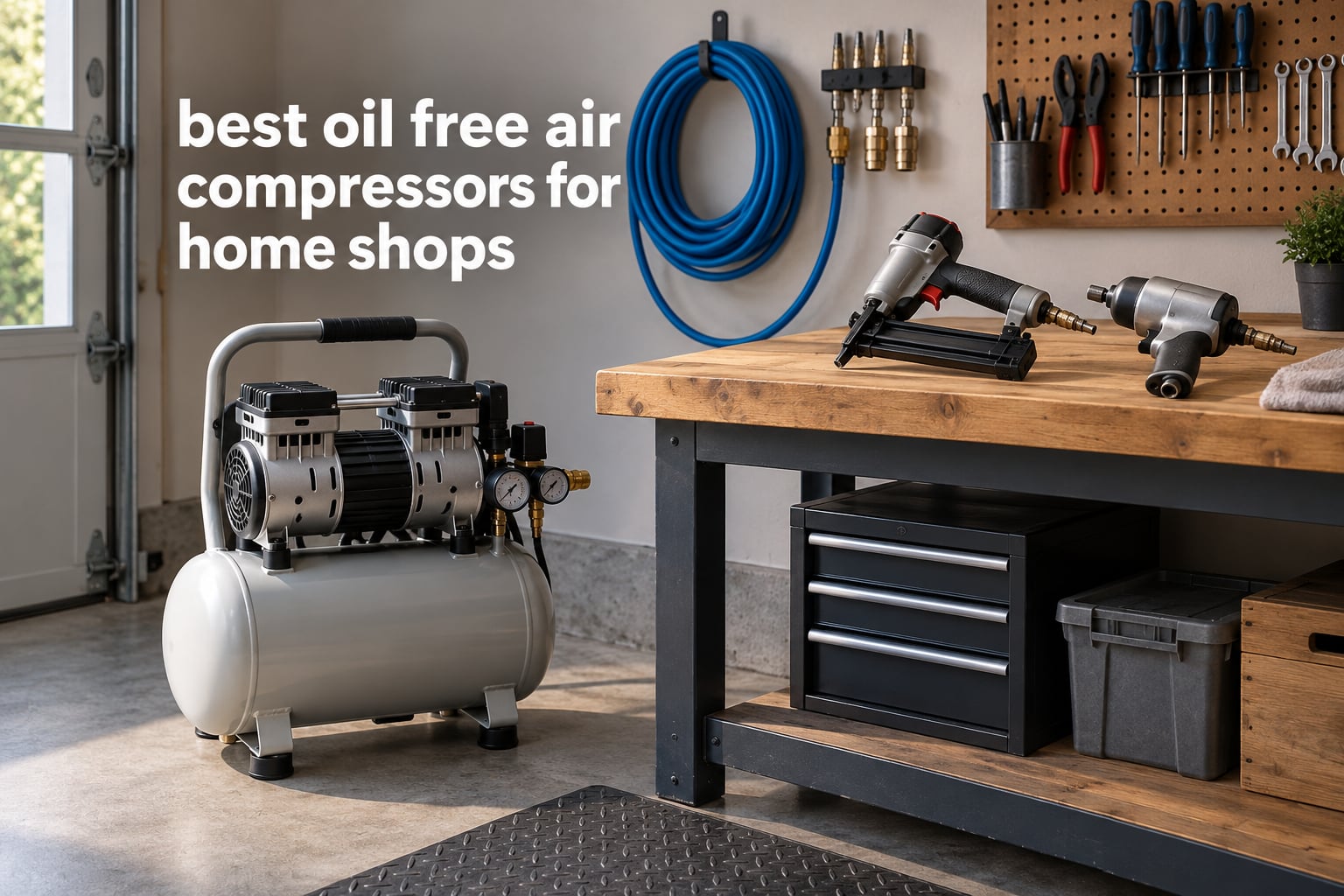
Choosing the best oil free air compressors for home shops comes down to three numbers: CFM at 90 PSI, tank size, and how loud the pump is when it runs. Oil-free units skip oil changes entirely and push cleaner air, which is why woodworkers and finish carpenters like them. The catch is that oil-free pumps wear faster than their oiled cousins, run hotter, and are usually louder, so the right pick depends on how you actually work.
We spent several weeks comparing ten of the most-reviewed oil-free compressors on the market, focusing on the specs that decide whether a tool keeps running or bogs down: real airflow at working pressure, tank capacity, duty cycle, and measured noise bands. Every compressor below is genuinely oil-free. Nothing here is an oil-lubricated unit wearing a green badge.
So who makes the best oil-free air compressor? For a typical two-car garage in 2026, California Air Tools and Makita make the most convincing units, with Craftsman and VEVOR filling the mid-range and budget slots. The right answer depends more on your tools and your circuit than on the badge, which is why the picks below are grouped by use case rather than ranked purely by star rating.
Table of Contents
Top 3 Oil Free Air Compressors for a Home Shop (October 2026)

Quick Comparison of All 10 Picks
| Product | Specs | Action |
|---|---|---|
| California Air Tools 10020C |
|
Check Latest Price |
 California Air Tools 8010A California Air Tools 8010A |
|
Check Latest Price |
 Makita MAC210Q Makita MAC210Q |
|
Check Latest Price |
 Makita MAC320Q Makita MAC320Q |
|
Check Latest Price |
 ECOMAX 6 Gallon Pancake ECOMAX 6 Gallon Pancake |
|
Check Latest Price |
 VEVOR 13 Gallon Vertical VEVOR 13 Gallon Vertical |
|
Check Latest Price |
 CRAFTSMAN 6 Gallon Pancake CRAFTSMAN 6 Gallon Pancake |
|
Check Latest Price |
 VEVOR 6.3 Gallon VEVOR 6.3 Gallon |
|
Check Latest Price |
 CRAFTSMAN 20 Gallon CRAFTSMAN 20 Gallon |
|
Check Latest Price |
 CRAFTSMAN 10 Gallon CRAFTSMAN 10 Gallon |
|
Check Latest Price |
Read the table as a map rather than a leaderboard. The four quietest models here all sit at or below 66 dBA and are the ones you can run inside a workshop without shouting over them. The loudest sit between 75 and 82 dBA, which is fine in a detached garage but genuinely disruptive in an attached one.
All ten run on 120V household current, which is the single biggest constraint in a home shop. Nothing in this group needs a 220V circuit, but two of them will trip a shared 15A outlet if you run a framing nailer and a sander at the same time.
1. California Air Tools 10020C — Best Overall for a Home Shop
California Air Tools 10020C 2.0 HP Ultra Quiet and Oil-Free Air Compressor, 10 Gallon Steel Tank with Wheels, 70 dBA Noise Level
10 gal steel tank
5.3 CFM at 90 PSI
125 PSI max
70 dBA
2.0 HP at 1680 RPM
Pros
- Strongest airflow in this group at 5.3 CFM at 90 PSI
- 10 gallon steel tank with real reserve for impact wrenches
- 70 dBA is conversation-level rather than shop-loud
- 82.5 lb body on wheels and a well-designed handle
- Easy Start Valve helps on cold mornings
Cons
- Not built for continuous duty and will cut out on extended run time
- A few owners report cutting out near 120 PSI rather than the rated 125
- Switch and small air leak reported on a long-term five-year-old example
This is the compressor I would put in a two-car garage without hesitating. It delivers 5.3 CFM at 90 PSI and 6.4 CFM at 40 PSI, which is more genuine airflow than anything else in this roundup at a size you can still push around. Owners regularly report swapping out a much louder 20-gallon compressor and discovering they could hold a normal conversation while this one ran.
The dual-piston oil-free pump is rated by the manufacturer at a life cycle over 3000 hours, and a 2.0 HP motor turning 1680 RPM gives it a bit more headroom than the 1 HP and 1.5 HP pancake units here. At 82.5 pounds it is the heaviest compressor in the group, but the wheels and handle make that weight manageable.

A forum owner on grassrootsmotorsports singled this machine out by name, calling the 2 HP 10-gallon California Air Tools much quieter than pancake-style oil-less units and saying they have been very happy with it. That matches what the measured numbers show here: 70 dBA is a step below the 75 to 82 dBA band most pancake compressors fall into.
The honest weakness is duty cycle. Oil-free pumps are not built for continuous running, and reviewers report the unit shutting itself down after extended run time rather than grinding on. Treat it as an intermittent-duty shop tool, not a production machine.
Is the 10 gallon tank enough for impact wrenches and tire work?
Yes, and it is the reason this unit edges out the smaller options. A 10-gallon tank at 125 PSI holds enough reserve to run a 1/2-inch impact wrench through a lug-nut change, an orbital sander for a few minutes, and a tire inflator without stopping to recover.
If your heaviest tool is a framing nailer running continuously, you will want more capacity than 10 gallons, and the 20-gallon Craftsman further down the list exists for exactly that.
When should you skip the 10020C?
Skip it if your garage is attached to the house and you need to run it during quiet evening hours, because 70 dBA is not conversation-friendly in a finished room. It is also the wrong call if you plan to sandblast or run a HVLP spray gun for long stretches.
It is also the wrong call if you need 150 PSI, since the 125 PSI cutoff falls short of what several pancake compressors in this roundup deliver.
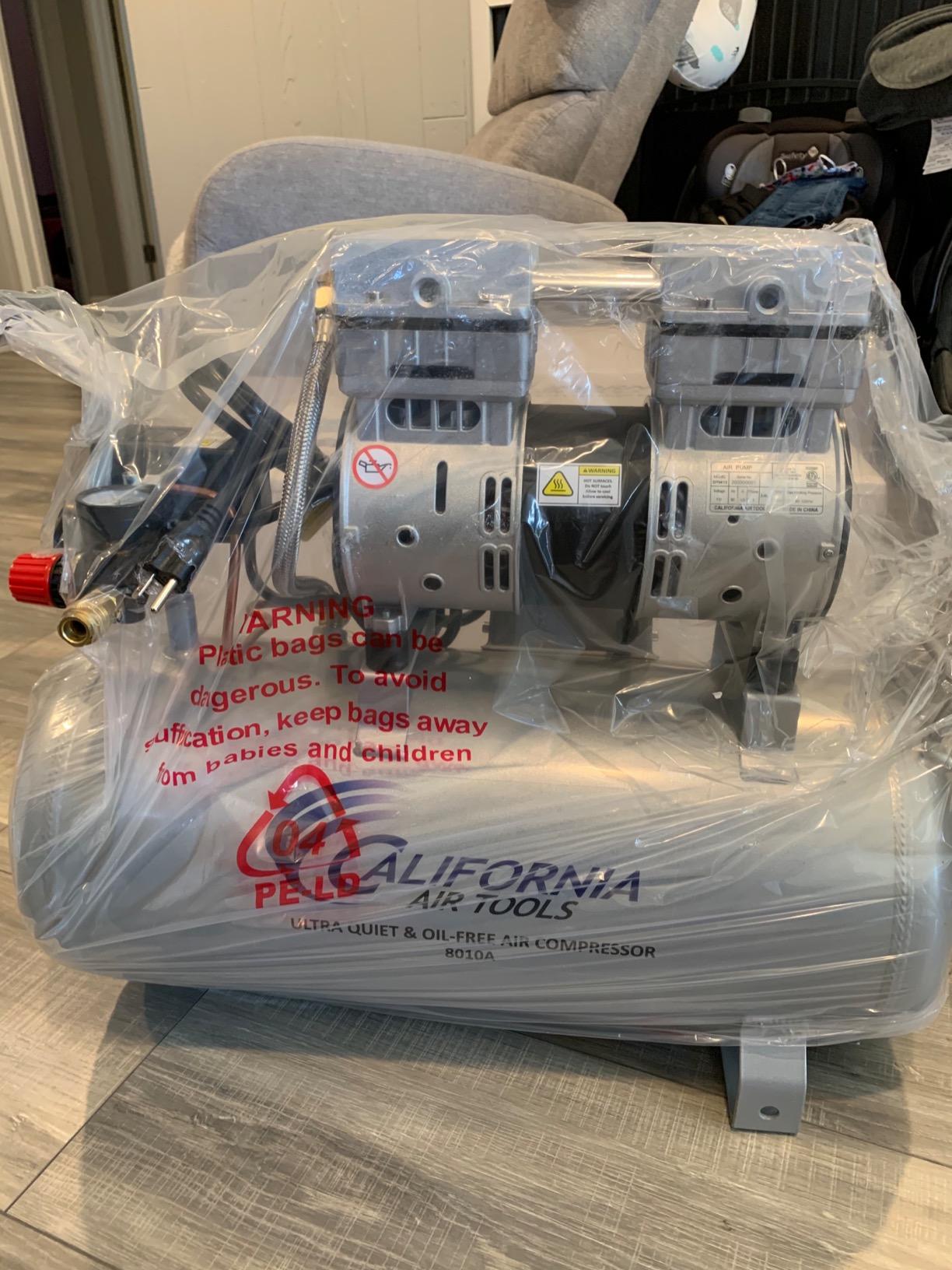
2. California Air Tools 8010A — Best for Quiet Indoor Use
California Air Tools 8010A 1.0 HP Ultra Quiet and Oil-Free Air Compressor, 8 Gallon Aluminum Tank, Lightweight with Wheels, 60 dBA Noise Level
8 gal aluminum tank
60 dBA
2.2 CFM at 90 PSI
120 PSI max
37.3 lb
Pros
- One of the quietest oil-free compressors available at 60 dBA
- Aluminum tank at only 37.3 lb is easy to carry between rooms
- 165 second fill and 60 second recovery from 90 to 120 PSI
- Dual piston pump needs no oil changes
- Suits a basement workshop or closet corner
Cons
- 2.2 CFM at 90 PSI limits it to light-duty tools
- 120 PSI ceiling sits below the 150 PSI many pancake units offer
Quiet is the entire pitch here. At 60 dBA this is one of the lowest-decibel oil-free compressors you can put in a shop, and it is the reason we use it for finishing work where a roaring pump would wreck the moment. The 4.7 average rating across more than a thousand reviews reflects broad satisfaction.
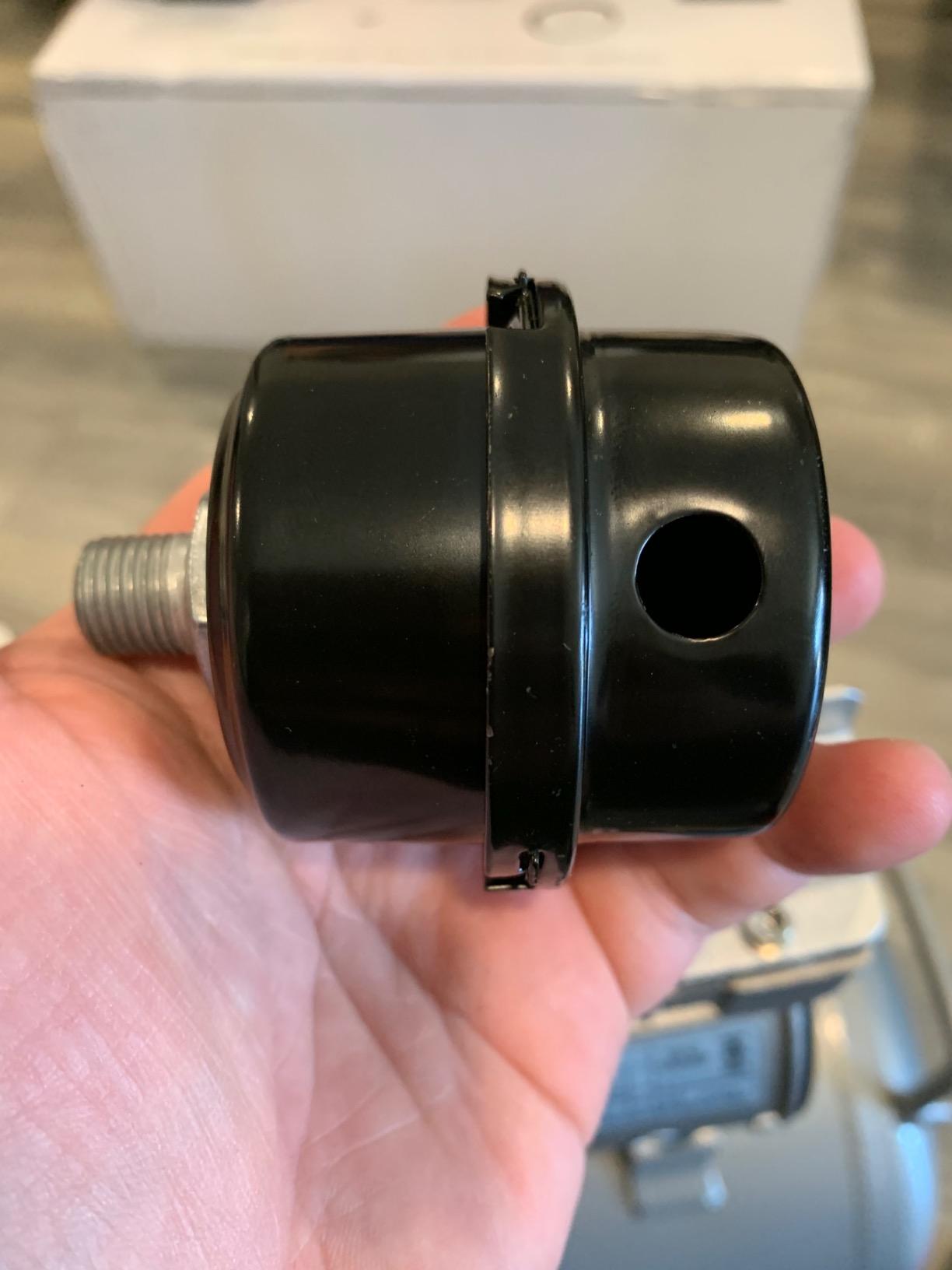
The 8-gallon aluminum tank is a real differentiator for indoor use. At 37.3 pounds with a wheel kit, you can move it up basement stairs or into a spare room without calling for help, and aluminum resists the moisture problems that make idle compressors in unheated sheds lose capacity.
Airflow is the trade. It produces 3.1 CFM at 40 PSI and 2.2 CFM at 90 PSI, which is plenty for an airbrush, a blow gun, a finish nailer working in short bursts, or tire inflation. It is not enough to keep a framing nailer or a belt sander running without a noticeable pressure drop.
Fill time is a genuine strength: 165 seconds from empty, and roughly 60 seconds to recover from 90 PSI back to 120 PSI. That recovery figure matters more in practice than tank size when your duty cycle is intermittent.
Can you run this off a normal 15A outlet?
Yes. The 1.0 HP motor draws comfortably within a standard household circuit, and reviewers do not report breaker trips from this machine the way they do with higher-horsepower units. It is one of the safest buys here for older homes with limited circuit capacity.
Just avoid pairing it with a heavy second tool on a shared extension cord, because the 2.2 CFM ceiling will show before the circuit does.
Is an aluminum tank as durable as steel?
For a home shop, an aluminum tank is the smarter choice. It will not rust from the inside the way a steel tank can when a compressor sits unused through a damp winter, and at 8 gallons the weight difference is what makes this unit genuinely portable.
The tradeoff is that aluminum tanks have a smaller working volume for the same external size, so you feel the 2.2 CFM limit sooner than you would in a 20-gallon steel tank.
3. Makita MAC210Q — Top Rated for Trim and Finish Work
Makita MAC210Q Quiet Series, 1 HP, 2 Gallon, Oil-Free, Electric Air Compressor
2 gal tank
60 dBA
135 PSI max
1 HP at 1750 RPM
44 lb roll cage
Pros
- Highest average rating in the roundup at 4.8 across 1199 reviews
- Measured noise around 57 to 60 dB in the field
- Zero to 100 PSI fill in a little over a minute
- Roll-cage body survives knocks and job-site transport
- Holds tank pressure for days when idle
Cons
- 2 gallon tank forces frequent cycling on anything sustained
- Heavier than its size suggests at roughly 44 to 50 lb
- Some buyers measure above the 60 dB spec in closed rooms
- Start capacitor rules out smart plug use
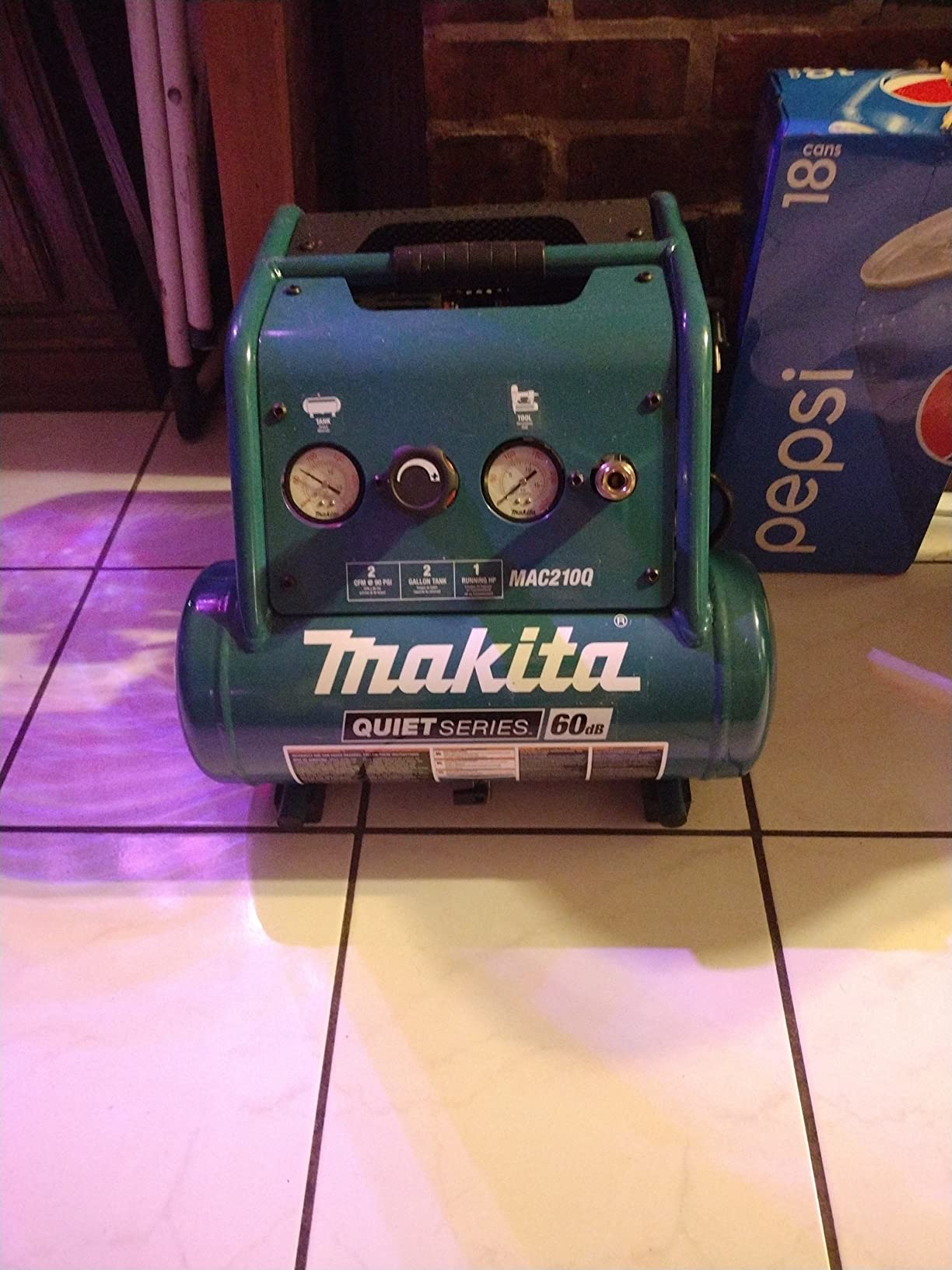
This carries the highest average rating of any compressor in the roundup, and it earns it. Makita designed the Quiet Series around a 1750 RPM motor that turns more slowly than a typical pancake pump, which is exactly why it runs at 60 dBA and why the motor and pump life are better than the numbers alone suggest.
For a trim carpenter or a finish cabinet builder, this is the compressor that disappears into the work. Owners in that trade describe running it inside a closed room with no more disruption than a refrigerator hum. Trimming, pinning, and light sanding never demand more than a 2-gallon tank can supply.
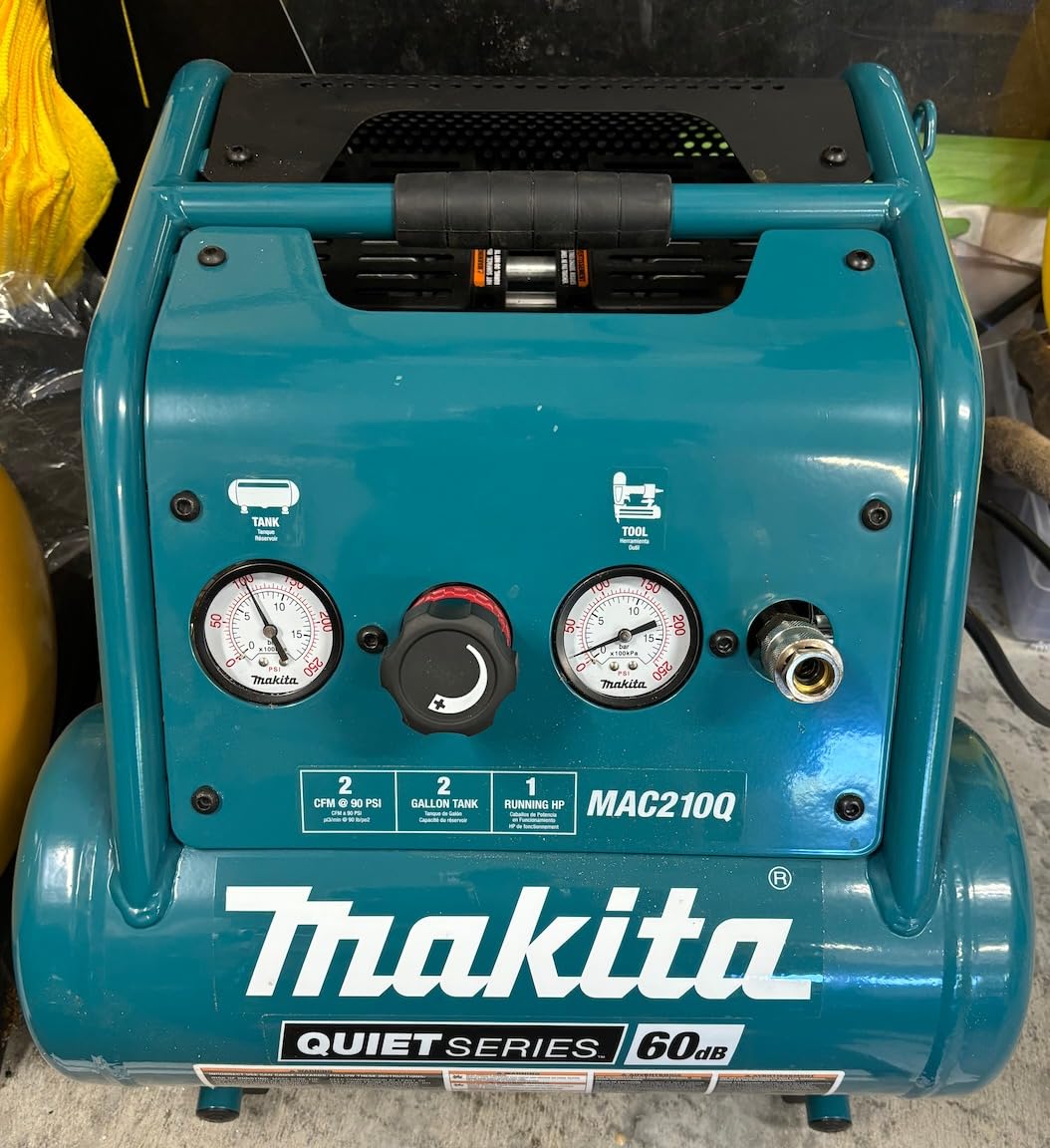
Build quality is the other half of the story. The roll-cage frame is a full wrap around the pump and tank, so drops and transport damage barely register. Reviewers also report it holding pressure for days without cycling, which is a good sign that the check valve is sealing well.
There is a real limitation and it is the tank. Two gallons will not sustain a continuous job with a larger nailer or sander, so you will hear the pump cycling far more often than with a 10-gallon unit. If your work is genuinely light-duty, that is not a problem at all.
Is a 2 gallon tank too small for a home shop?
Only if you own tools that pull high CFM. A finish nailer, brad nailer, staple gun, airbrush, or inflation gun cycles through 2 gallons happily. A framing nailer, a belt sander, or an HVLP spray gun will starve it in seconds.
Owners of larger tools in this category consistently upgrade to a bigger tank rather than regret the pump, so if you are unsure, treat the tank as the upgradeable part.
Why does a 1 HP compressor weigh 44 pounds?
Most of that is the roll cage and the motor housing, and the packing material adds more. Reviewers note it is heavier than expected for a portable unit, and awkward to carry between floors. If you plan to haul it up stairs regularly, the 8010A at 37.3 pounds is lighter.
One more practical note: the start capacitor makes this unit incompatible with smart plugs, so you cannot schedule it or monitor draw from an app.
4. Makita MAC320Q — Most Versatile for Two-Tool Work
Makita MAC320Q Quiet Series 1-1/2 HP, 3 Gallon, Oil-Free, Electric Air Compressor
3 gal tank
60 dBA
135 PSI max
1-1/2 HP at 1750 RPM
dual outlets
Pros
- Holds the advertised 60 dB inside an enclosed garage
- Recharges faster than it discharges on several owner reports
- Dual hose connections run two tools at once
- Stable on the floor and does not walk while running
- Separate tank and tool gauges with adjustable output
Cons
- Larger and heavier than comparable compressors like the Rolair JC10
- Some examples shipped with leaking or stuck-open fittings
- Will not auto-restart after a breaker trip without unplugging and draining
- 135 PSI cutoff cycles more often than a 150 PSI machine
This is the step up from the MAC210Q rather than a lateral move. You gain half a horsepower, a third more tank volume, and a second outlet, which is what turns it from a single-tool finish machine into something that can keep a trim carpenter productive all afternoon.
Owners upgrading from smaller Makita units or from loud pancake compressors describe the change as dramatic in both directions: quieter and faster. Trim carpenters report it keeps up with two nail guns, which is a real workload claim given the 60 dBA noise floor.
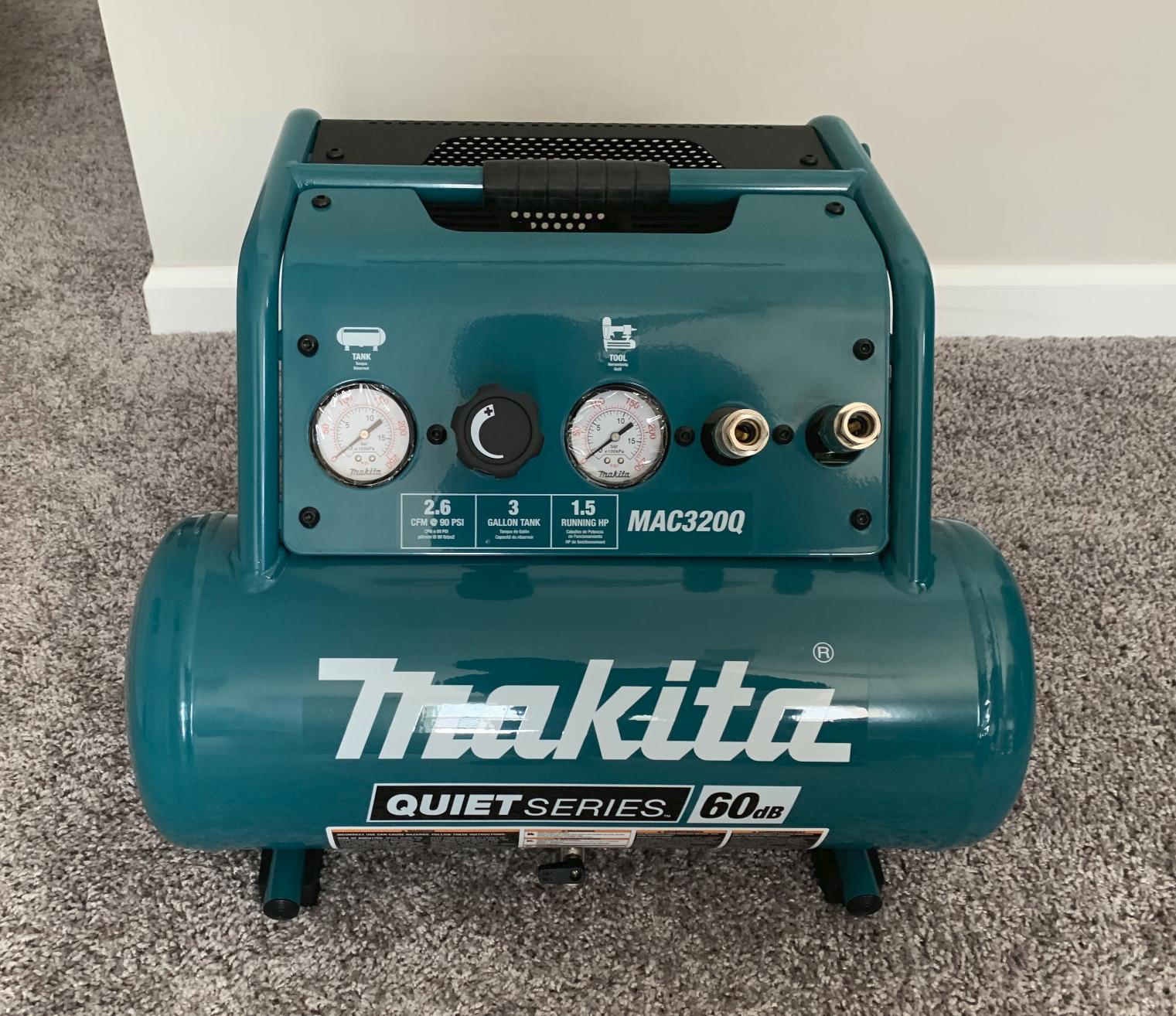
The dual hose connections matter more than they look on paper. With two couplers you can run a finish nailer on one line and an air brush or a caulk gun on the other without constantly unplugging, and the separate tank and tool pressure gauges let you tune output precisely.
It is also physically planted. Reviewers note it does not walk across the floor while running, and the padded feet cut both vibration and noise. That is a small thing that becomes obvious the first week you own a lighter compressor that slides across a concrete slab.
Will this trip a 15A breaker on heavy use?
It can. The 1-1/2 HP motor pulls more current than the 1 HP model, and reviewers note that the compressor will not auto-restart after a breaker trip without unplugging and draining it first. Running it on a dedicated 15A or 20A outlet avoids the problem entirely.
If your garage shares a circuit with a welder, a freezer, or a shop vac, plan on running a new outlet before you start framing days.
Are the published dimensions accurate?
No, and this trips people up. The listing says 12 by 12 by 12 inches, but buyers report roughly 18 inches long by 19 wide by 14 high in practice. Measure your shelf or bench clearance rather than trusting the spec sheet.
A few examples also shipped with hose and valve fittings that leaked or stuck open, and owners resolved it by swapping in brass quick couplers, which is a cheap five-minute fix worth doing anyway.
5. ECOMAX 6 Gallon 150 PSI — Best Value
ECOMAX Air Compressor 6 Gallon 150 PSI Pancake Portable Oil-free Tank with 10 PCS Accessories Kit
6 gal pancake tank
150 PSI
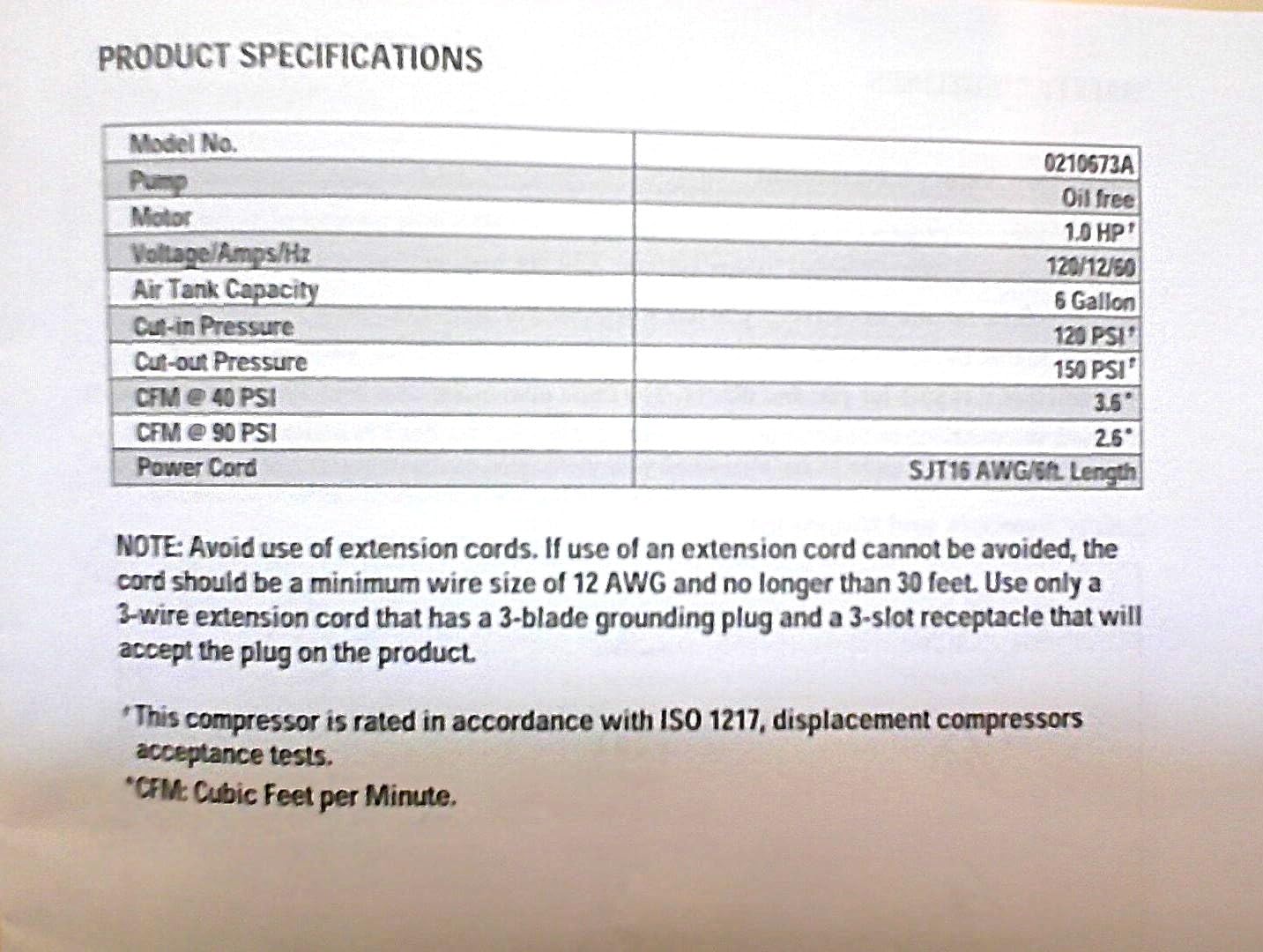
3 CFM at 90 PSI
1.5 HP / 180 W
75 dBA
Pros
- 150 PSI ceiling with 3 CFM at 90 PSI for real tool runtime
- Comes with a full 10-piece accessory kit including a 25 foot hose
- Only 34.17 lb with a flip-up handle for one-handed carry
- Dual gauges and dual quick couplers out of the box
- Oil-free pump with low-voltage cold-weather start
Cons
- 75 dBA is louder than the quiet-series machines in this roundup
- 1.5 HP at 180 watts is modest for sustained high-demand tools
The ECOMAX solves a specific problem well: you want 150 PSI and a full hose kit without spending serious money. Few compressors at this tier combine a 6-gallon tank with a 150 PSI ceiling, and the 3 CFM at 90 PSI figure is genuinely usable airflow rather than a marketing number.
Owners frequently cite the category ranking and the 4.7 average as confidence signals, and the accessory bundle is real: a 25-foot PVC air hose, thread seal tape, an air chuck, two auto plugs, a coupler, a tire gauge, a nozzle, and a blow gun. That is everything a new owner needs on day one.
Portability is the quiet advantage. At 34.17 pounds with a flip-up handle, this is one of the few machines here you can carry up to a roof deck or down to a basement stairwell without planning for it, and pancake form factors store flat on a shelf or under a bench.
The two complaints are consistent. At 75 dBA it is meaningfully louder than the 60 dBA units in this list, and a 1.5 HP motor rated at 180 watts is genuinely modest when you ask for sustained high-demand airflow.
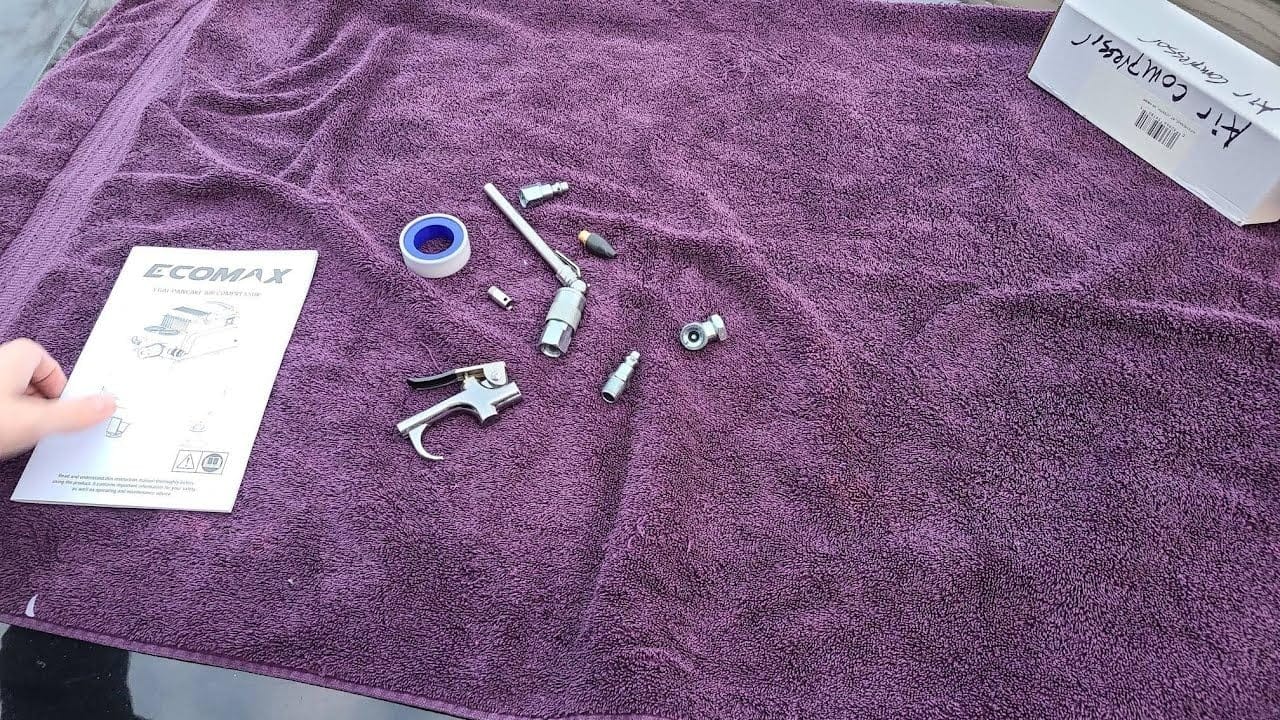
Does the 10-piece kit save you extra purchases?
It does, and the hose is the biggest item. A 25-foot hose plus a coupler set and blow gun is the standard kit most owners buy separately, so bundling it removes a whole first shopping trip.
One caveat: the supplied hose is PVC. If you plan to run long lengths of air line or plumb a fixed line to the shop, spend a few extra dollars on a rubber or polyurethane hose instead.
Is 3 CFM at 90 PSI real or inflated?
For this machine, it measures out. Forum consensus across woodworking and mechanic threads is that SCFM claims on budget pancake units are frequently inflated, so treat the number as a marketing term unless it is given as CFM at 90 PSI like this one.
Even taking it at face value, 3 CFM at 90 PSI covers a finish nailer, a brad nailer, a small sander, an airbrush, and tire inflation comfortably. It will not power a framing nailer without pressure sag.
6. VEVOR 13 Gallon Vertical — Best Large Oil-Free Tank
VEVOR 13-Gallon Air Compressor, 2HP, 4.6 SCFM@90PSI, Oil-Free Tank, 66dB Quiet Operation, Ideal for Tire Inflation, Woodworking, Auto Repairs, and Spray Painting (Maximum Pressure 125 PSI)
13 gal vertical tank
66 dBA
125 PSI max
2 HP
4.6 SCFM at 90 PSI
Pros
- Genuinely quiet at 66 dBA for a 13-gallon oil-free unit
- Tank fills in under three minutes with stable output
- Two air connections allow running two tools at once
- Seven-inch reinforced rubber wheels roll smoothly on shop floors
- Dual gauges and spare plastic air filters included
Cons
- A number of machines overheat and need a long cool-down after heavy use
- Buyers dispute the 4.6 SCFM claim and VEVOR reportedly acknowledged lower output
- 71 lb is awkward to lift despite the wheels
- Damage in transit reported on legs and fittings
Thirteen gallons is unusual in an oil-free compressor, and that capacity is the reason to look at this one. It sits in the awkward middle ground between a 6-gallon pancake and a 20-gallon shop tank, which means it stores more air than most portable units without demanding a dedicated corner of the garage.
Noise is the pleasant surprise. At 66 dBA this is quieter than several 6-gallon pancake compressors in the same roundup, and most buyers say it suits weekly DIY or light shop use without being bothered by it. The reinforced valve system and leak-proof fittings are consistent with that report.
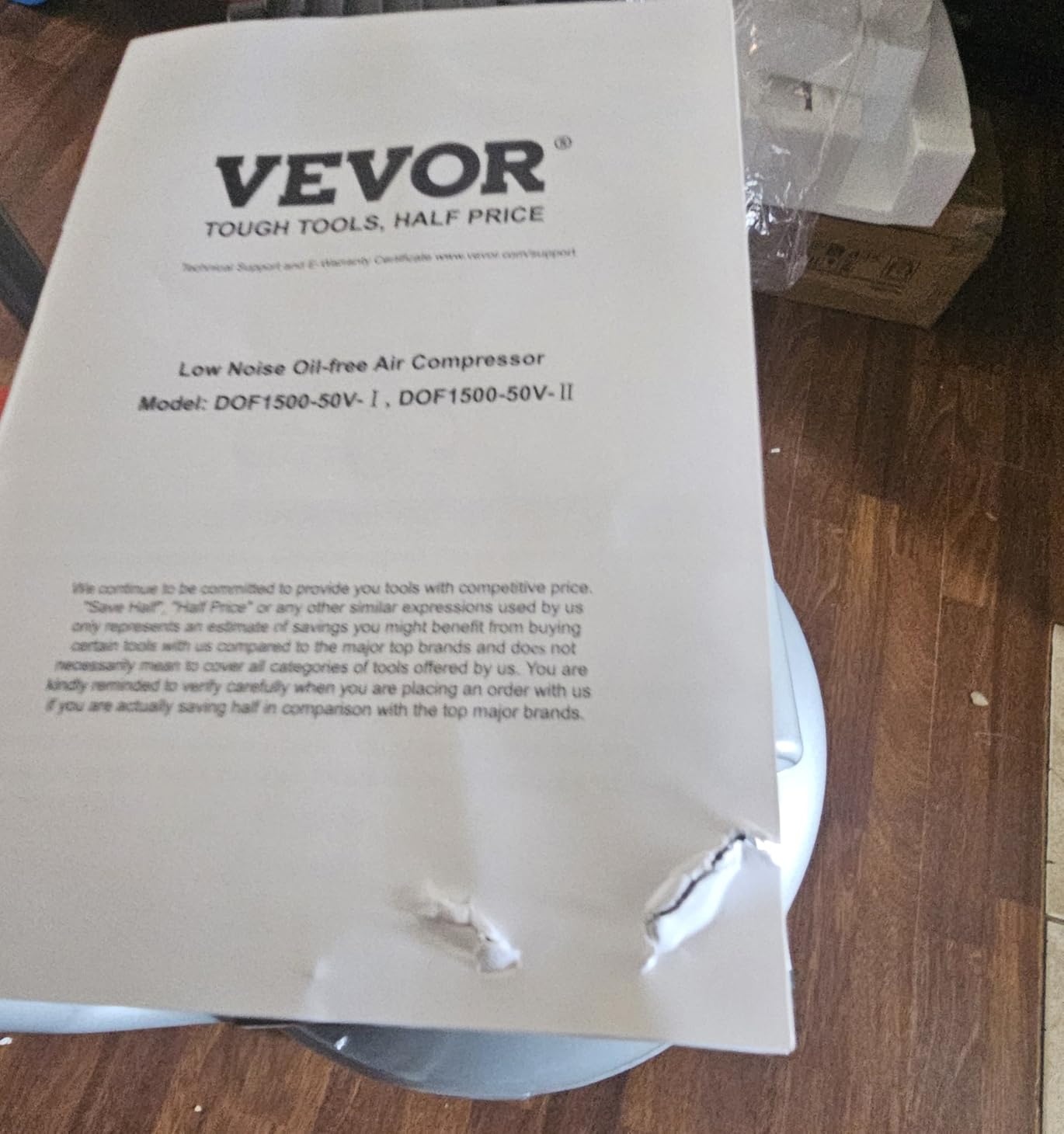
The airflow figure is where you need to read carefully. A noticeable group of buyers disputes the advertised 4.6 SCFM, and VEVOR has reportedly acknowledged closer to 2.7 CFM continuous output. That is exactly the SCFM inflation problem that shows up repeatedly in forum threads, so plan around the lower number.
Even at 2.7 CFM, a 13-gallon tank gives you long run times on an impact wrench, a sander, or a tire inflator. What it will not do is feed a sandblaster or a long spray run.
Should you be concerned about the overheating reports?
Somewhat, if you plan heavy sustained use. A group of reviews describes units that overheat and fail to repressurize after heavy work and require a long cool-down before recovering. That is an oil-free pump reaching the end of its duty cycle, not a defect you can fix.
For intermittent work with rest periods built in, it performs well. For a shop that runs a compressor continuously, this is not the machine you want.
How does warranty service actually go?
Owners report that warranty support has been described as difficult to obtain, which is a recurring theme with this brand rather than an isolated complaint. Inspect the unit as soon as it arrives, since damage in transit to legs and fittings is also reported.
Check the legs, the fittings, and the dual gauges before the first fill. Catching a bent leg early takes two minutes and prevents a wobbly compressor for years.
7. CRAFTSMAN 6 Gallon Pancake — Best Low-Profile Storage
CRAFTSMAN 6 Gallon 150 PSI Oil-Free Pancake Air Compressor CMXECXA02106410
6 gal pancake tank
150 PSI
2.6 SCFM at 90 PSI
1 HP
82 dBA
Pros
- Recovers pressure quickly with enough reserve for brad nailers and tire inflation
- Only 30.8 lb with a footprint that stores anywhere
- Oil-free pump means no maintenance or oil refills
- 150 PSI outpaces most 6 gallon pancake compressors
- Dual quick couplers support more than one tool
Cons
- 82 dBA is the loudest unit in this roundup
- Some examples arrived with the carry handle in pieces
- A few reports of machines stopping during longer painting jobs
- Occasional damage in transit to the tank and gauge area
This is the compressor that fits where the others cannot. A pancake profile with a 30.8-pound weight stores on a shelf, under a workbench, or in a wall-mounted rack, and the 150 PSI ceiling beats most competitors of the same shape.
For a homeowner with a modest tool list, the appeal is straightforward. Staple guns, brad nailers, tire inflation, automotive maintenance, and blowing out dust all fall well inside what 2.6 SCFM at 90 PSI can deliver, and owners report fast refill between tasks.
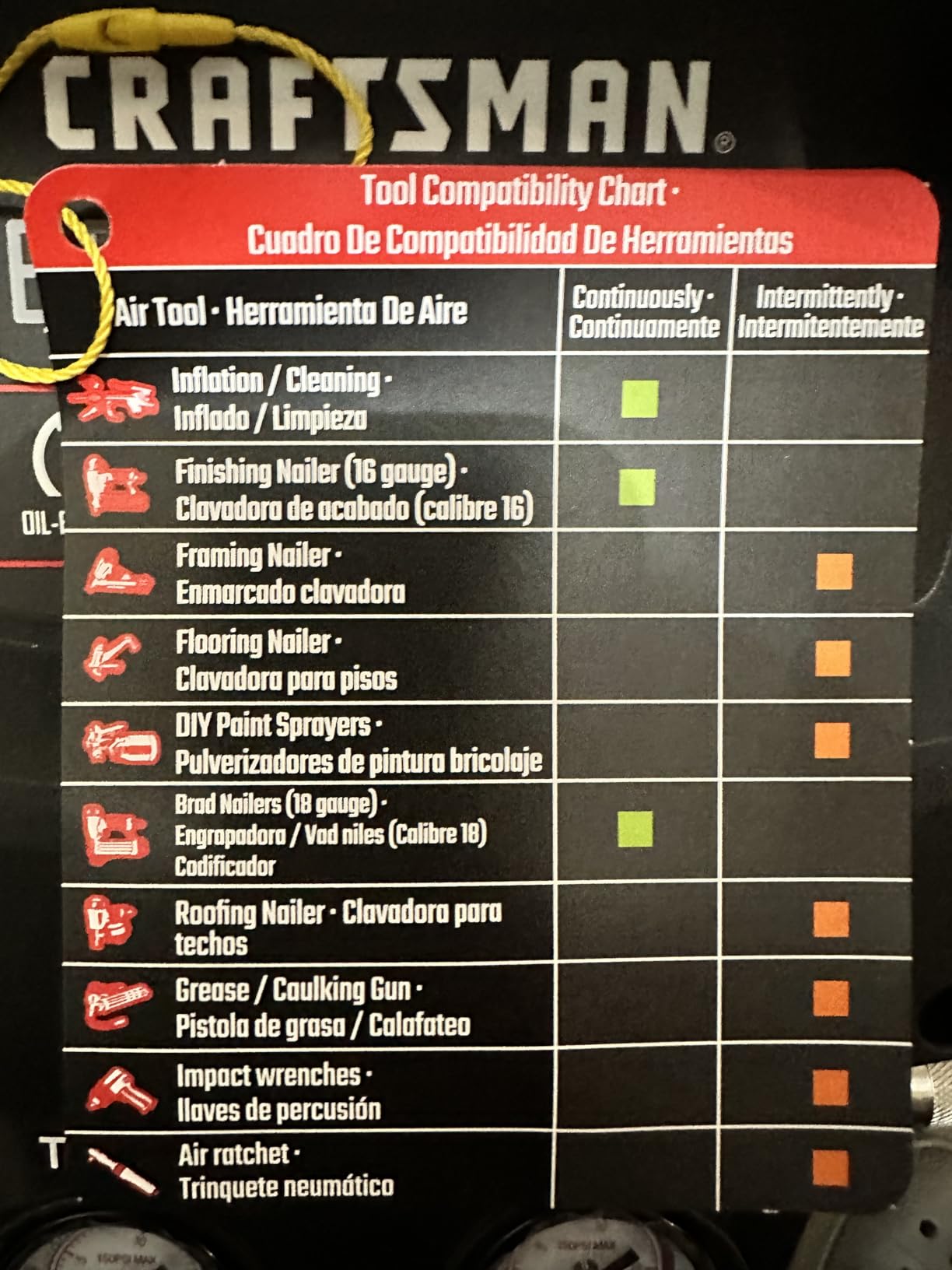
Craftsman backs it with a one-year warranty and a US-based service team, which is worth having on a small appliance-style purchase. The oil-free pump removes the maintenance question entirely, so the only routine task is draining the tank.
What you give up is everything acoustic. At 82 dBA this is the loudest machine in the roundup, and it is loud enough that running it in an attached garage while family is inside will get you asked to turn it off.
Can you paint with a 6 gallon pancake compressor?
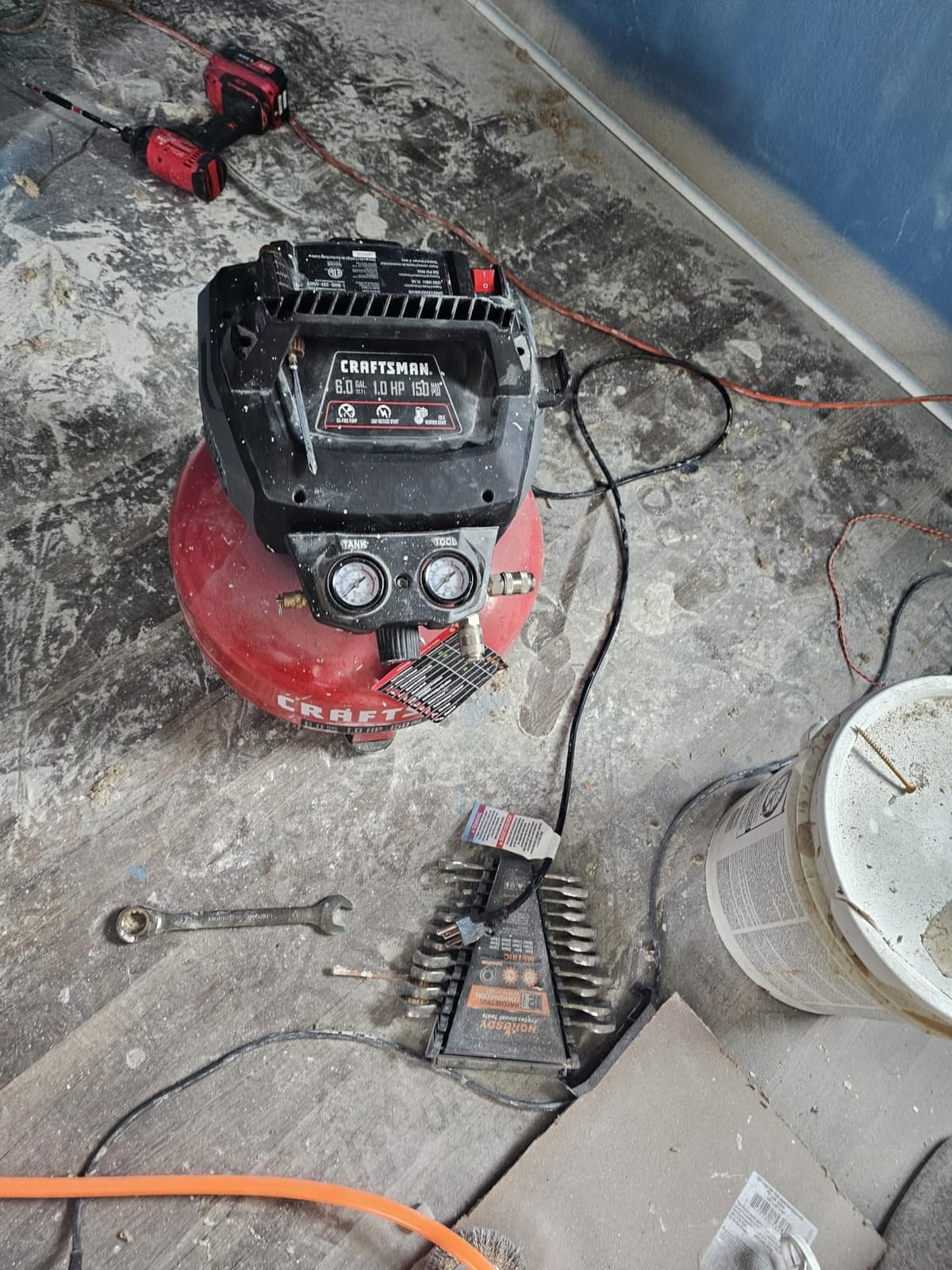
For touch-ups, a single-coat pass on a cabinet, or trim work, yes. The 150 PSI ceiling and quick recovery handle it better than most pancake units, and owners list paint spraying as a supported use.
A few buyers report units shutting off partway through longer painting jobs and not restarting until they are unplugged and drained. That points to a duty-cycle limit rather than a tank-size problem.
Is pancake form factor better than vertical?
Only if floor space is your binding constraint. A vertical tank puts more air in a smaller footprint, which means less cycling and steadier tool pressure during a job. A pancake wins on storage flexibility and nothing else.
If your bench height can clear a tall compressor, the vertical units further down this list will serve your tools better for the same floor area.
8. VEVOR 6.3 Gallon 2 HP — Budget Pick Per Cubic Foot
VEVOR 6.3 Gallon 2 HP Air Compressor, Max 116PSI, Oil Free Compressor Tank
6.3 gal tank
3.35 CFM at 90 PSI
116 PSI max
2 HP / 1450 W
70 dBA
Pros
- Owners call it one of the best value oil-free compressors available
- Unusually high power-to-size ratio for a 43 lb body
- Fills in under 60 seconds and keeps up without pauses
- Three-layer anti-rust steel construction with seamless welding
- Quiet at 70 dBA thanks to the dual silencer design
Cons
- Power cord is only about 40 inches long
- Sensitive to power supply and may cut out on some outlets or extension cords
- Small wheels make it tip-prone when moved by the handles
- 116 PSI ceiling is below the 150 PSI of comparable pancake units
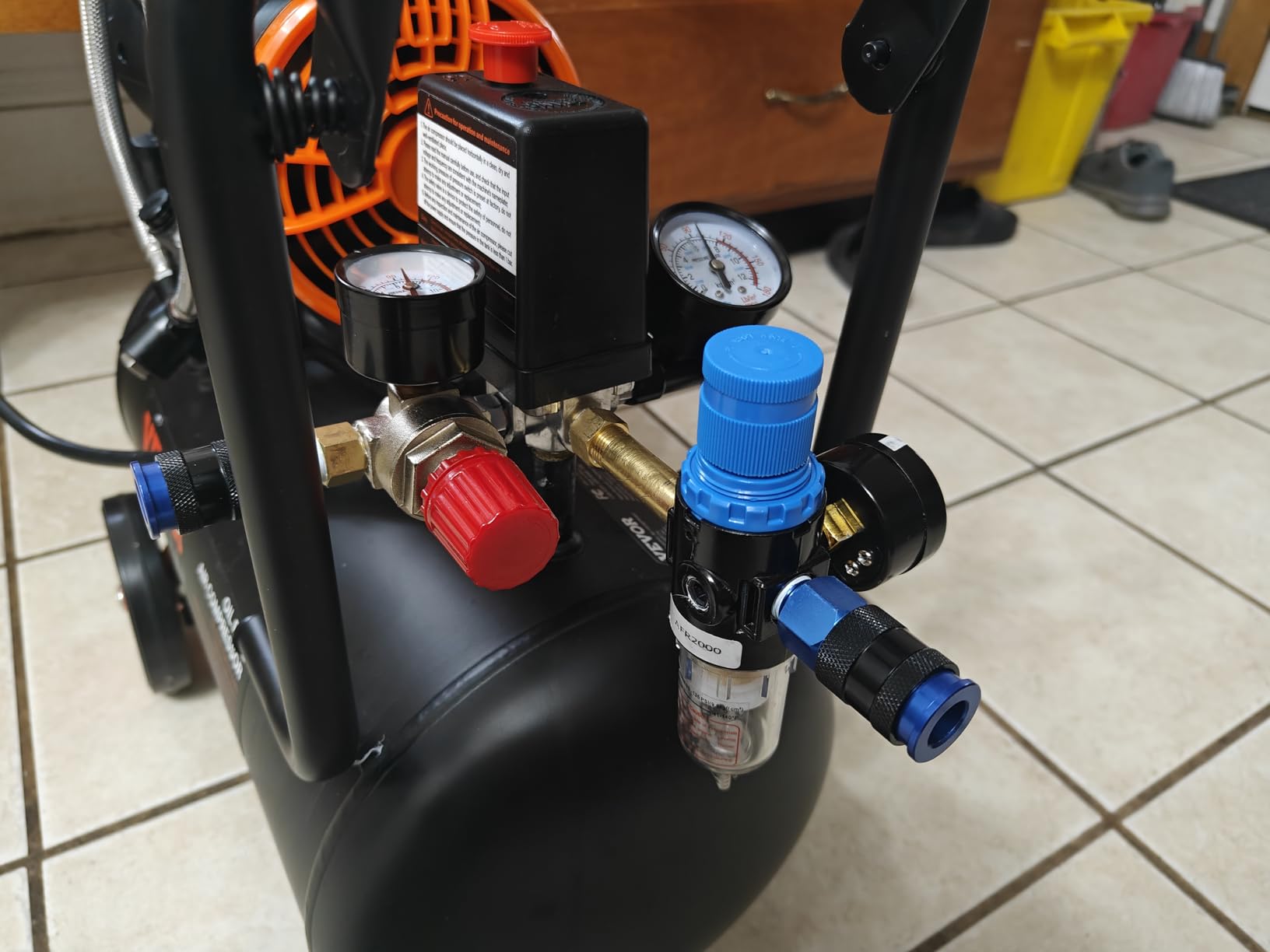
What stands out here is the ratio of capability to size. A 2 HP motor, 1450 watts spinning to 3500 RPM, delivering 3.35 CFM at 90 PSI from a 6.3-gallon, 43-pound body is difficult to find elsewhere at this level, and 669 reviews at a 4.3 average is a lot of owners agreeing.
The build details are unusually specific for a value machine: a double-tube, double-cylinder intake, a high-temperature silicone intake pipe with stainless steel braided mesh, two silencers with thickened muffler covers, and Q235B structural steel with three-layer anti-rust coating. Owners report it surviving drops and having heavy items fall on it.
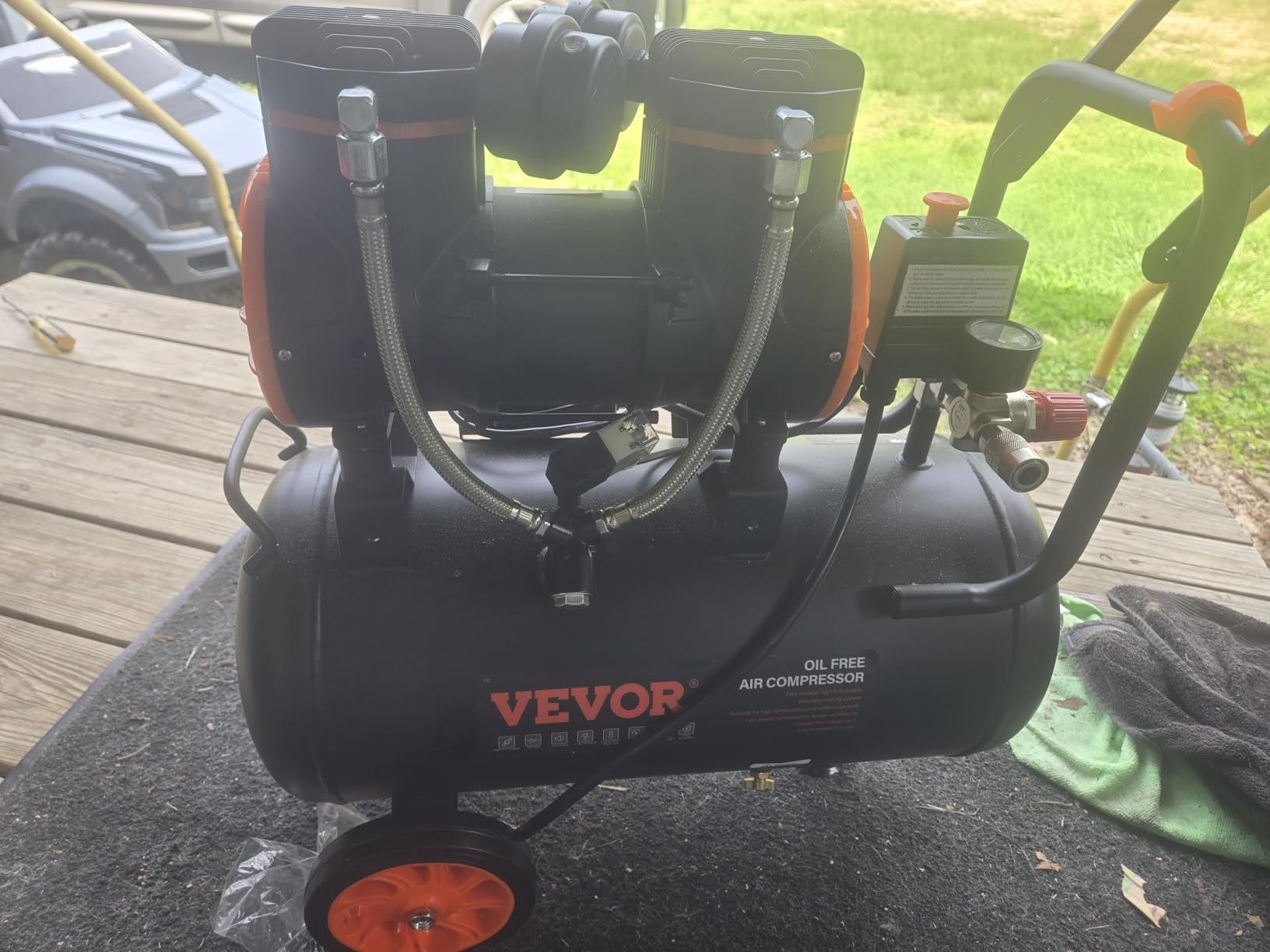
The most repeated complaint is the power cord, at roughly 40 inches. That forces the compressor to sit close to an outlet and makes any permanent placement awkward. Several owners also report it being sensitive to the power supply and failing to start or cutting out on shared circuits or cheap extension cords.
Give it a dedicated outlet and both problems go away, but plan that before you buy rather than after.
Does the short cord mean you need an extension cord?
It often means people reach for one anyway, and that is exactly where the reported cut-out problems come from. If you need more reach, use a heavy-gauge 12 AWG extension cord rated for the load, kept as short as possible, or better yet have an outlet installed closer to where the compressor will live.
The dual cooling fans and automatic overheat protection give some peace of mind, but feeding it from a weak circuit is still the most likely cause of trouble.
Why does it max out at only 116 PSI?
That ceiling is below what most pancake competitors offer, and it is a real limitation for tools that benefit from higher working pressure. It is offset by the flow: 3.35 CFM at 90 PSI is more than most units of this size manage.
If your work is volume-driven rather than pressure-driven, you will not feel the 116 PSI limit. If you are running tools that want 150 PSI, look at the Craftsman pancake or the ECOMAX instead.
9. CRAFTSMAN 20 Gallon 175 PSI — Best for Sustained Nailing
Craftsman Air Compressor, 20 Gallon Oil-Free 1.8 HP Max 175 PSI Pressure Two Quick Couplers Big Capacity, Red- CMXECXA0232043
20 gal tank
175 PSI max
4 SCFM at 90 PSI
1.8 HP
80 dBA
Pros
- Largest tank and highest PSI rating in this roundup
- 1.8 HP with 4 SCFM at 90 PSI recovers quickly for demanding jobs
- Stainless steel construction with an oil-free maintenance-free pump
- Two quick couplers for running multiple tools
- Handles roofing and framing nailers plus sprayers and chisels
Cons
- 80 dBA makes it unsuitable for indoor or noise-sensitive use
- 40.9 inch vertical height takes up significant floor space
- Mixed early reliability reports with a 10 percent one-star share
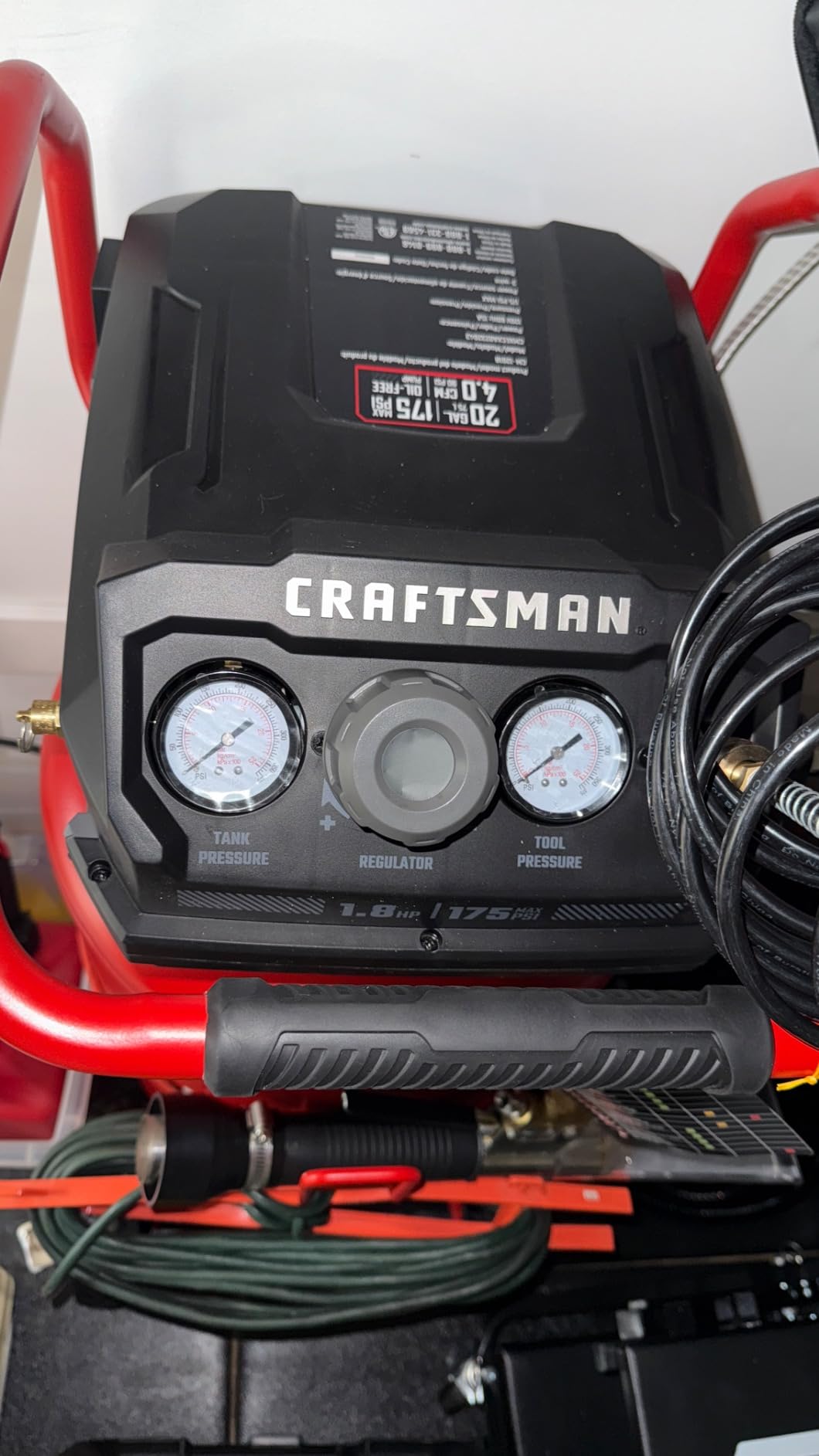
When the answer is volume of air, this is it. Twenty gallons at 175 PSI stores a meaningful amount of energy, and the 1.8 HP pump with 4 SCFM at 90 PSI is set up for roofing and framing nailers that run continuously rather than in bursts.
The manufacturer lists inflating, cleaning, staplers, brad and finishing nailers, roofing nailers, wrenches, drills, paint sprayers, caulk guns, and chisels as supported uses, and the two quick couplers mean you can run two tools at once from the same tank.
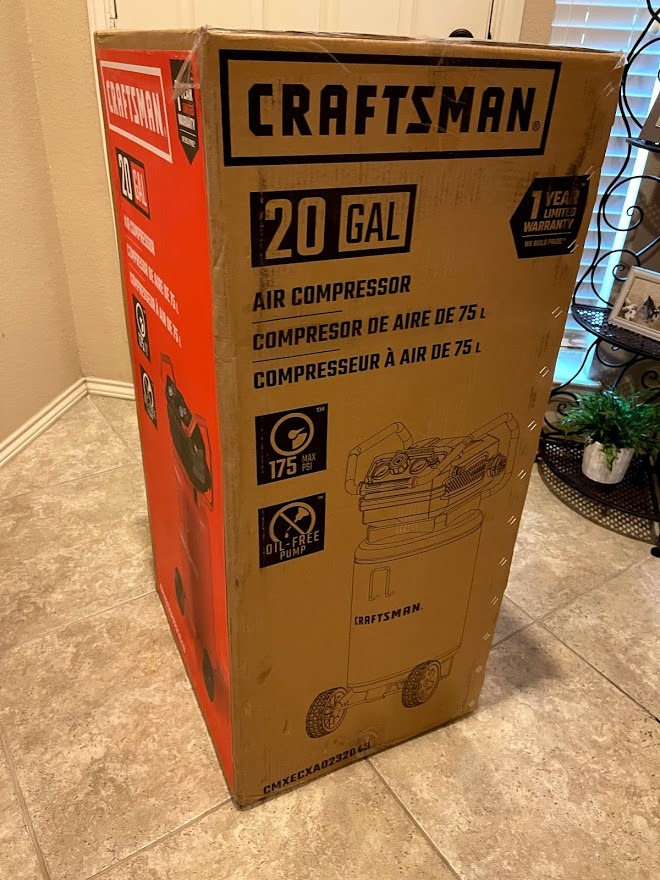
The stainless steel construction and rubber feet are sensible for a machine that will live on a garage floor. It arrives with a six-foot cord, a ball drain valve, a plastic filter, two quick couplers, and two rubber wheels, so you can skip the accessory aisle.
This is also the least quiet option here at 80 dBA, and the 4.2 rating reflects that alongside a 10 percent one-star share that points to mixed early reliability reports. Buy it for capacity, not for refinement.
Is 20 gallons overkill for a two-car garage?
Not if you frame, roof, or run a spray gun for extended periods. The extra capacity means fewer recovery pauses, and recovery pauses are where tool pressure drops and finish work suffers.
It is overkill if your tools are a finish nailer, a sander, and an impact wrench. For that list, a 10-gallon unit gives you the same tool performance in a smaller footprint.
Will it fit under a workbench?
No. At 40.9 inches tall it needs a dedicated floor corner, which is a common complaint. Plan the placement around the 19.1 by 17.3 inch footprint and make sure you can still open the tank drain valve where it sits.
Buyers who wanted a Craftsman under a bench moved up to the 10-gallon model in this list for that reason alone.
10. CRAFTSMAN 10 Gallon 175 PSI — Best Mid-Size Shop Compressor
Craftsman 10-Gallon Air Compressor, 1.8 HP, Max 175 PSI, 4.0 CFM @ 90PSI, 5.0 CFM@40PSI, Oil-Free, Quiet Shop Air Compressor with Wheels for Spraying Pneumatic Tool, Model: CMXECXA0201041
10 gal stainless tank
175 PSI max
4.0 CFM at 90 PSI
1.8 HP / 1800 W
78 dBA
Pros
- 10 gallon tank with 175 PSI ceiling and 4.0 CFM at 90 PSI
- Oil-free pump cuts out nearly all regular maintenance
- Compact 23.6 by 21.4 by 15.9 inch size stores under a bench
- Rubber foot stabilizers reduce vibration and wear
- Dual 1.5 inch gauges and an air filter included
Cons
- 78 dBA is among the loudest compressors in this roundup
- Only one quick coupler included
- which limits two-tool use
- Some buyer confusion over the published airflow figure
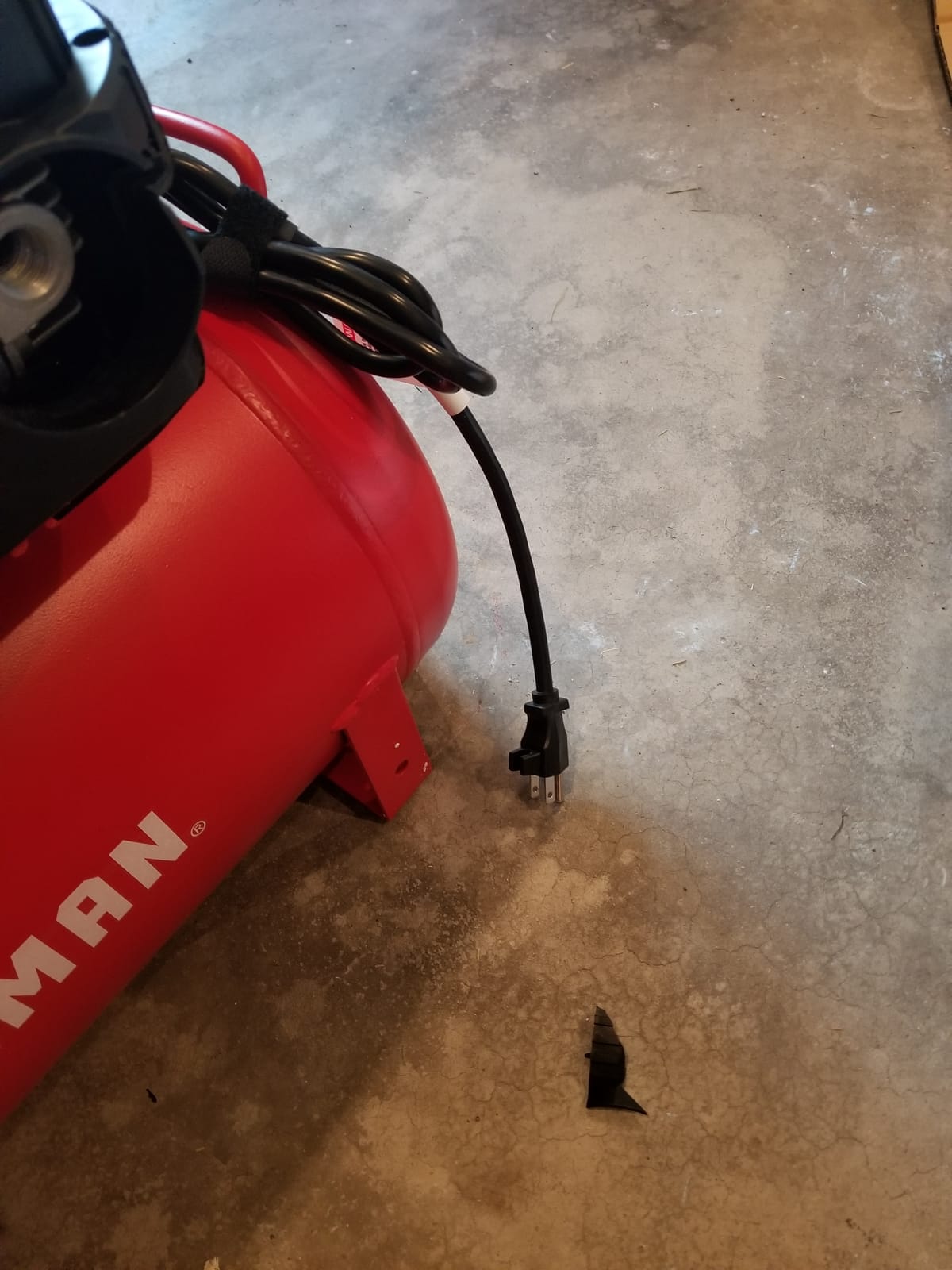
This is the middle path, and for a lot of shops it is the right one. You get a 175 PSI ceiling that most 10-gallon units in this roundup cannot match, 4.0 CFM at 90 PSI, and a footprint small enough at 23.6 by 21.4 by 15.9 inches to slide under a workbench when you are done.
The manufacturer lists staple guns, brad and roofing nailers, framing nail guns, airbrushes, blow guns, air drills, HVLP spray guns, and pneumatic screwdrivers as supported tools. At 31.5 pounds it is also light enough to roll out and back on its rubber wheels.
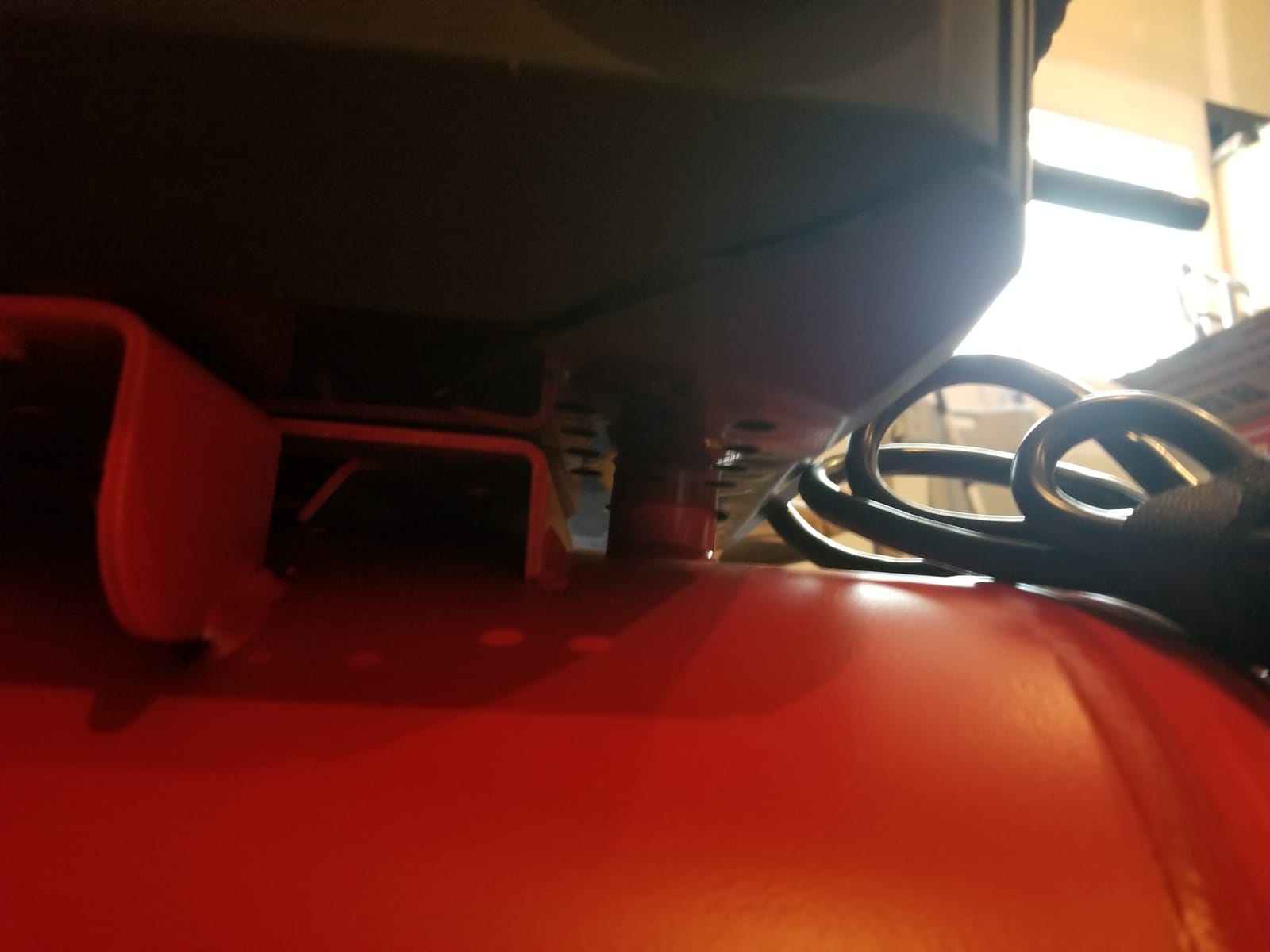
Buyers looking for a mid-size shop compressor generally find the tank, the PSI ceiling, and the flow sufficient for staple guns, brad nailers, and light spray work, and they like the compact wheeled footprint. The rubber foot stabilizers are a genuinely good touch on a machine running at 78 dBA.
Two things to plan around. Only one quick coupler is included, so buy a second before you try to run two tools, and the published airflow figure has caused some buyer confusion, so confirm the CFM at 90 PSI on the plate rather than in the listing.
How does a 175 PSI compressor compare to a 120 or 125 PSI one?
A higher ceiling gives more headroom for tools that benefit from it, and it extends how long you can run before the cutout engages. Most pneumatic tools do not need more than 90 to 100 PSI in practice, so the extra range is margin rather than requirement.
Where it genuinely helps is with spray equipment and with tools running simultaneously, where two tools share the same regulator and you want the tank to hold pressure longer.
Is one quick coupler enough for a home shop?
For a single-tool workflow, yes. For anyone planning to run a nailer and a sander together, buy a second coupler and splitter immediately. It is a five-minute fix that several owners in this category ended up making anyway.
Everything else you need is already in the box, including a six-foot cord, two 1.5-inch gauges, and an air filter.
How to Size an Oil Free Air Compressor for Your Home Shop
The best air compressor for a home shop is the smallest one that covers your heaviest tool, and getting that wrong is the most common reason people are disappointed with a purchase. Two numbers decide it: the CFM your tool needs and the CFM the compressor actually delivers at 90 PSI.
Start by listing the tools you already own, not the ones you might buy. Add up the CFM of each, then multiply the total by 1.5 to leave headroom for a tool starting under load. Typical requirements run roughly 0.5 to 1 CFM for a brad nailer, 1.5 to 2 CFM for a finish nailer, 2 to 3 CFM for an orbital sander, 2 to 3 CFM for a belt sander, 4 to 5 CFM for a 1/2-inch impact wrench, 2 to 3 CFM for a 3/8-inch impact, 2 to 3 CFM for an HVLP spray gun, 3 to 4 CFM for a pneumatic screwdriver, and around 1 CFM for a grease gun or tire inflator. Check the manufacturer figure on your own tool, since these are ranges rather than fixed numbers.
A framing nailer sits above all of those, and a sandblaster cabinet needs more airflow than any oil-free compressor in this roundup can deliver. That is the practical line: below a framing nailer, oil-free works well. Above it, you are into two-stage or oil-lubricated territory.
Tank size: why 10 gallons is the sweet spot
Tank capacity determines how long you can work before the pump has to catch up. A 2-gallon tank handles light intermittent work, 6 gallons covers brad nailers and small sanders, 8 to 10 gallons covers finish nailers, impact wrenches, and HVLP spray work without pressure sag, and 20 gallons is for sustained roofing and framing.
For most home shops we would start at 10 gallons. It is the point where recovery time stops being noticeable and the compressor stops cycling constantly.
Noise bands that actually matter in a garage
Grouped by measured output, four of these machines sit at 60 dBA and work inside a closed room, one runs at 66 dBA and is acceptable in a typical garage, two sit at 70 dBA which is conversation-plus, and three fall between 75 and 82 dBA where you will want the garage door closed.
For reference, a quiet conversation is roughly 60 dBA and a hair dryer is around 70 dBA. If your shop is attached to the house, anything above 70 dBA becomes a household problem rather than a tool choice.
120V circuit sizing and why breakers trip
Every compressor here is 120V, which is convenient and also the leading cause of frustration. Continuous loads are generally limited to 80 percent of a circuit’s rating, so a 15A outlet gives you about 12 amps of sustained draw and a 20A outlet about 16 amps.
A 1 HP motor sits comfortably inside those limits. A 1-1/2 or 2 HP motor on a shared circuit with a freezer, welder, or shop vacuum is where breaker trips come from, which is why several owners report their compressor will not restart after a trip without unplugging and draining it. If you plan heavy tool use, put a dedicated outlet on the compressor’s circuit before you buy.
Pancake, vertical, or hot dog layout
Pancake compressors are short and wide, which makes them easy to store on a shelf but inefficient with floor area. Vertical compressors put the same air in a much smaller footprint but stand 30 to 40 inches tall. Hot dog shapes are the older horizontal style and are rarely the best use of space today.
Choose pancake when storage flexibility matters and your tools are light. Choose vertical when you want maximum air per square foot of floor. Choose a portable wheeled unit when the compressor lives in a closet and comes out only when you need it.
Oil-Free vs Oil-Lubricated: The Honest Tradeoff
Is an oil-free air compressor any good? For a home shop, yes, and often it is the better choice. Oil-free pumps need no oil changes, run cooler at low loads, push air with less oil carry-over into your tools and finish work, and can sit indoors without worrying about leaks. A woodworker on r/woodworking reported buying a 26-gallon oil-less unit and later deciding a large upright was preferable, though they noted the old one had run for 20 years, which is the longevity question worth confronting honestly.
Those same benefits come with real costs. The downsides of oil-free compressors are shorter pump life, more heat under sustained load, and higher noise. The most-cited regret across Home Shop Machinist, Bob Is The Oil Guy, LS1Tech, and The Garage Journal is that oil-free pumps wear out faster than oil-lubricated ones.
One Home Shop Machinist poster put it bluntly, advising readers to stay away from oil-less compressors because the oiled units are much better built, much less noisy, and deliver a little more air. Another owner on Bob Is The Oil Guy countered that oil-free compressors are cheaper, need very little if any maintenance, take up less space, but tend to be louder. The Garage Journal framed it as a small gap, noting that direct-drive oiled compressors are typically only a little quieter than oilless models of similar size.
Contamination: will an oil-lubricated unit splatter your finished wood?
This is the fear that keeps woodworkers in the oil-free camp, and it is legitimate. An oil-lubricated compressor can carry oil aerosol down the line and onto a finished surface, which causes the fisheye spotting people notice on cabinets and furniture. A water and oil separator on the outlet line handles most of it, but it adds cost and upkeep.
Oil-free eliminates the problem at the source. That is why every unit in this roundup suits spray finishing and cabinet work better than an oiled equivalent would.
Direct drive versus belt drive in an oil-free pump
A direct-drive oil-free pump connects the motor shaft straight to the crankshaft, which removes belts, reduces maintenance, and keeps the machine compact. The trade is noise transmission: with no belt to damp it, motor vibration reaches the tank more directly, which is part of why oil-free units skew louder.
Belt drive insulates the pump from motor vibration and runs quieter, but adds a wear item and takes more space. Almost every oil-free compressor in this roundup is direct drive, and it is the correct choice for the maintenance-free promise the category is built on.
Oil Free Pump Lifespan and the Maintenance Routine
How long do oilless air compressors last? The honest answer is that they last roughly half as long as an equivalent oil-lubricated unit, and the manufacturer’s own numbers help explain why. California Air Tools rates its dual-piston oil-free pumps at a life cycle over 3000 hours. Expect somewhere in the range of three to six years of typical home-shop use, and considerably less if you run it continuously.
That figure is not a defect, it is the design trade. An oil-free pump has no oil film to carry heat away or cushion the pistons, so the same hours of running produce more wear. A machine that works a few hours a week will comfortably reach the 3000-hour mark; a machine that runs all day in a contracting shop will not.
Compressors also age while they sit. Forum discussion notes that units left idle in sheds corrode and lose capacity, so if your shop is unheated, run the compressor occasionally and keep the tank dry.
The maintenance routine for an oil-free compressor
Drain the tank weekly, or install a ball drain valve and a scheduled auto-drain so water never pools in the bottom.
Check the intake filter monthly. A restricted filter chokes airflow and makes the pump run hotter and louder.
Inspect hoses, fittings, and quick couplers quarterly. Replace rubber fittings, which harden and leak.
Confirm the pressure relief valve is clear and the safety valve on the outlet is accessible every few months.
Keep the unit out of direct weather and off damp concrete, and run it briefly before storage.
Never use PVC plumbing pipe for a fixed air line. It is rated for water pressure, not sustained air pressure, and it can shatter. Use copper or properly rated air line.
When two compressors make sense in one shop
Experienced owners frequently converge on running two machines: a small quiet unit for clean-air tasks like spraying, inflating, and blow guns, plus a larger tank for heavy CFM work. That split solves the central weakness of the oil-free category, because the quiet machine never heats up under sustained load and the big tank never has to run the pump hard for a 10-second inflation job.
A pairing such as the Makita MAC210Q for finish work and the California Air Tools 10020C for tool-running covers both halves without a single breaker trip, and it is how we would build a two-machine shop in 2026.
Fittings, hoses, and keeping water out of your tools
Most compressors here ship with dual quick couplers, though the 10-gallon Craftsman includes only one, so buy a second coupler and a splitter before running two tools. For hose, a 1/4-inch line works for nailers and hand tools, while 3/8-inch reduces pressure drop noticeably for long runs to a sandblaster cabinet or a spray booth.
For paint work, add a water and oil separator and, ideally, a refrigerated dryer. The single most common complaint about any compressor in any category is moisture in the line, and a separator costs far less than a refinished cabinet.
Frequently Asked Questions
Who makes the best oil-free air compressor?
California Air Tools and Makita make the strongest oil-free compressors for a home shop. California Air Tools covers the mid-to-large shop end with its 10-gallon 10020C at 5.3 CFM at 90 PSI, while Makita owns the quiet end with the 60 dBA Quiet Series. Craftsman covers the budget and high-PSI tiers, and VEVOR fills the value slot.
What is the best air compressor for a home shop?
For most two-car garages, a 10-gallon oil-free compressor between 4 and 5.5 CFM at 90 PSI is the right answer. Add the CFM of every tool you plan to run, multiply by 1.5 for headroom, and pick a unit that clears that number. Stay at or below 70 dBA if your garage is attached to the house.
Is an oil-free air compressor any good?
Yes, for home shop work they are usually the better choice. They need no oil changes, run cleanly enough for spray finishing and cabinet work, and can sit indoors. The costs are shorter pump life of roughly half an oil-lubricated unit, more heat under sustained load, and generally higher noise.
What is the best air compressor for a small workshop?
A quiet oil-free unit in the 8 to 10 gallon range suits a small workshop best. Something in the 60 dBA class can run indoors without disrupting conversations, and 8 to 10 gallons covers finish nailers, impact wrenches, small sanders, and HVLP spray work. Add a second quick coupler if you plan to run two tools.
What are the downsides of oil-free air compressors?
The main downsides are shorter pump life, higher heat output during sustained runs, and more noise than an equivalent oil-lubricated unit. Oil-free pumps also have a lower duty cycle and can cut out on thermal protection during long continuous jobs. Owners on Home Shop Machinist and Bob Is The Oil Guy forums commonly report faster wear as the leading regret.
How long do oilless air compressors last?
Expect roughly half the lifespan of an oil-lubricated unit, or about three to six years of normal home shop use. California Air Tools rates its dual-piston oil-free pumps at over 3000 hours of life cycle. Running the compressor continuously shortens that dramatically, while intermittent weekly use usually reaches the rated hours comfortably.
Which Oil Free Air Compressor Is Right for Your Shop?
Start from your noise tolerance and your heaviest tool. Run a quiet interior shop or trimming work, and the Makita MAC210Q is the highest-rated unit in the group at 60 dBA with a 2-gallon tank that cycles constantly but never bothers anyone. Need more capacity in the same quiet class, and the Makita MAC320Q adds half a horsepower and a second outlet.
For a working two-car garage, the California Air Tools 10020C is our pick as the best of these oil free air compressors for home shops. It delivers the strongest real airflow here, has enough tank to run impact wrenches and sanders without pressure sag, and stays at 70 dBA, which is conversation-plus rather than shop-loud.
If storage or budget drives the decision, the ECOMAX 6-gallon packs 150 PSI and a complete hose kit into 34 pounds, and the VEVOR 6.3-gallon gives you 2 HP and 3.35 CFM at 90 PSI for very little money, once you give it a dedicated outlet. For sustained roofing and framing work, the 20-gallon Craftsman stores the air you need and will keep up, at the cost of 80 dBA and a dedicated floor corner.
Whichever one you choose in 2026, give it a dedicated outlet, drain the tank weekly, and keep an eye on the intake filter. Oil-free removes oil changes from the maintenance list, but it does not remove the basic care that keeps a compressor delivering the CFM you paid for.