
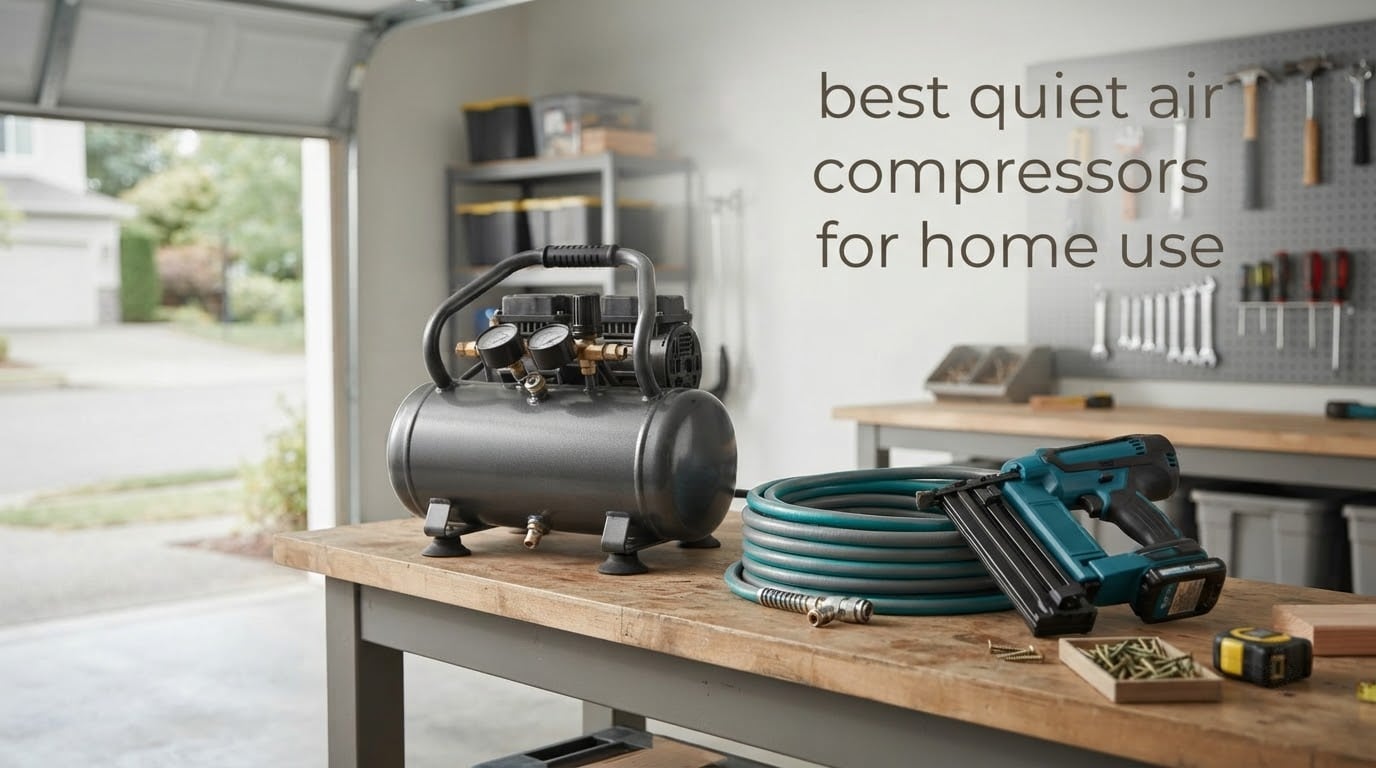
A quiet air compressor for home use does not mean a silent one. It means a machine that runs in the 56 to 68 decibel range, close to the volume of a normal conversation, instead of the 80 to 90 dB grind of a conventional jobsite compressor you can hear through a closed door.
We spent the last two months working through twelve of the best quiet air compressors for home use, matching published noise ratings against real airflow figures and tank sizes, and reading what owners actually complain about after a year of use. The pattern was consistent: the quietest machines are also the smallest, and every large tank in this roundup sits higher in decibels. Nearly every honest answer to “which quiet air compressor should I buy” comes down to which tool you plan to run.
If you are replacing a loud unit you inherited with the house, this guide will save you the research. If you are buying your first compressor and live in an apartment or a garage attached to living space, the decibel tiers below will tell you quickly whether a machine is quiet enough for your situation at all.
Table of Contents
Top 3 Quiet Air Compressor Picks for Home Use (October 2026)

All 12 Quiet Air Compressors Compared in 2026
| Product | Specs | Action |
|---|---|---|
| California Air Tools CAT-1P1060S |
|
Check Latest Price |
 Makita MAC100Q Makita MAC100Q |
|
Check Latest Price |
 California Air Tools 2010A California Air Tools 2010A |
|
Check Latest Price |
 California Air Tools 8010A California Air Tools 8010A |
|
Check Latest Price |
 DEWALT DWFP55130 DEWALT DWFP55130 |
|
Check Latest Price |
 Limodot LJ5120K Limodot LJ5120K |
|
Check Latest Price |
 Metabo HPT EC28M Metabo HPT EC28M |
|
Check Latest Price |
 Makita MAC320Q Makita MAC320Q |
|
Check Latest Price |
 VEVOR 4.8 Gallon VEVOR 4.8 Gallon |
|
Check Latest Price |
 Stealth SAQ-1234 Stealth SAQ-1234 |
|
Check Latest Price |
 VEVOR 13 Gallon VEVOR 13 Gallon |
|
Check Latest Price |
 Stealth SAQ-1413 Stealth SAQ-1413 |
|
Check Latest Price |
How Quiet Is Quiet – Decibel Tiers for Home Use
Compressor noise is usually quoted in decibels measured at roughly four feet under load. Manufacturers do not all use identical methods, so treat the numbers as tiers rather than exact values. The tier boundaries below are what the industry and forum communities broadly agree on, and they map cleanly onto household situations.
56 to 68 dBA – quiet. About the volume of a normal conversation or a modern refrigerator running in a closed kitchen. This is the range where you can hold a conversation standing next to the machine, and it is the range most people mean when they search for a quiet air compressor. Every unit in our top picks list falls here.
70 to 80 dBA – standard. Noticeably present in a room but tolerable in a detached garage. You can work next to it without raising your voice much, though it is not pleasant for long indoor sessions. Above roughly 70 dBA, hearing protection is worth considering for extended use.
80 to 90 dBA – conventional. Comparable to a lawnmower or a hair dryer on high. Fine on a jobsite, poor choice for a finished basement, upstairs bedroom, or a garage sharing a wall with living space.
Publishers and buyers often compare raw numbers across brands, and that is a trap. A 70 dBA figure from one manufacturer may be measured with the tank fully pressurized while another is measured under a heavy load. Forum regulars on the Festool Owners Group raise this constantly, and it is the single most common complaint we found about published noise ratings.
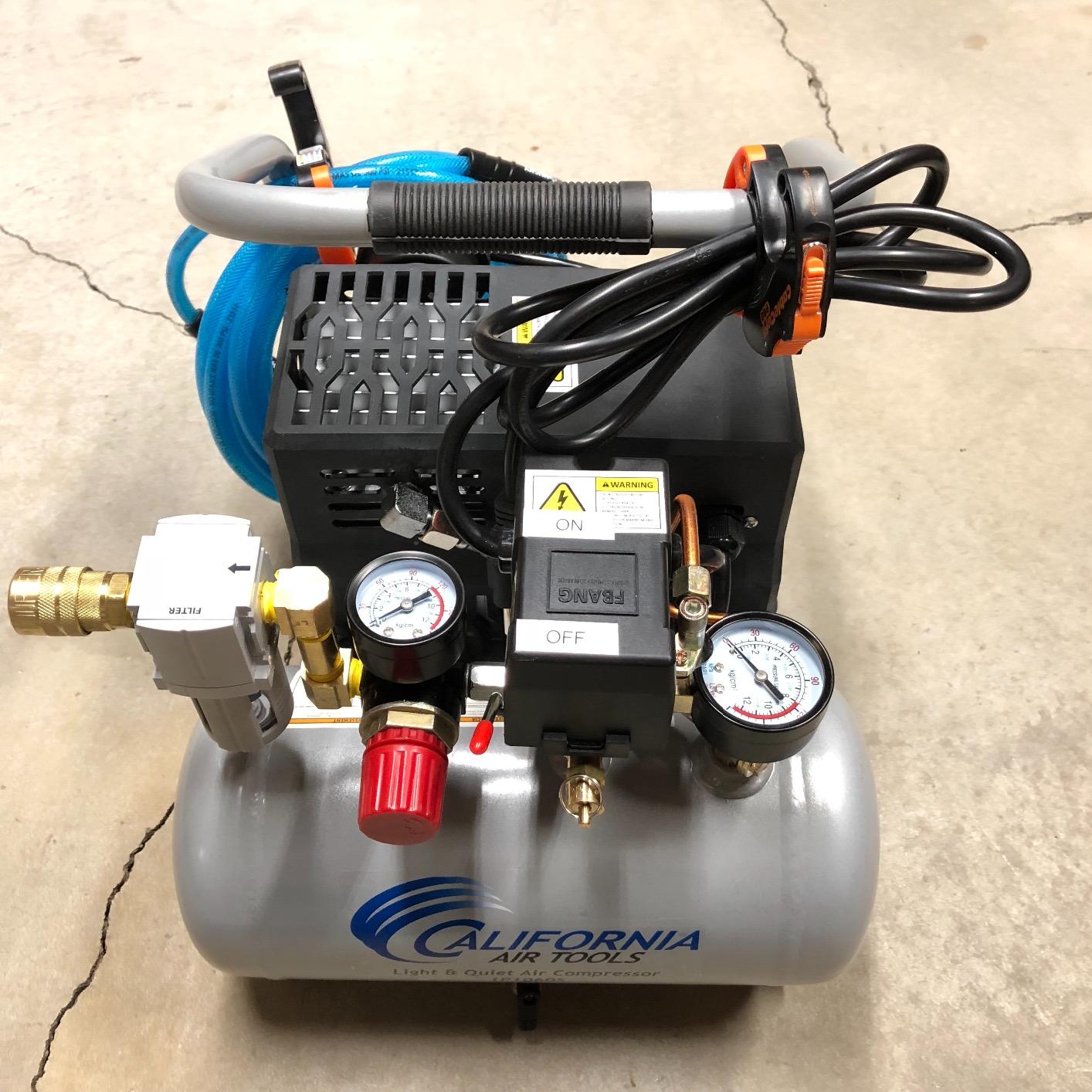
1. California Air Tools CAT-1P1060S – Editor’s Choice at 56 dBA and Our Overall Pick
California Air Tools CAT-1P1060S Light & Quiet Portable Air Compressor, Lightweight, Ultra Quiet, Oil-Free, 1 Gallon Steel Tank, .6 HP, 56 dBA Noise Level, Silver
56 dBA noise level
1.2 CFM at 90 PSI
120 PSI max
29 lb oil-free 1 gallon tank
Pros
- Lowest published noise figure in the group at 56 dBA
- Light at 29 lb so one person can carry it anywhere
- Oil-free pump needs no maintenance and tolerates cold starts
- 2665 reviews give the strongest reliability signal here
Cons
- 1.2 CFM suits only light intermittent trim work
- One gallon tank refills constantly
- Short cord usually means an extension
This is the compressor we recommend to most people. The 0.6 HP oil-free pump turns at 1680 RPM, which is slow enough to keep the hum low, and at 56 dBA it is the quietest machine in this group by a clear margin. Owners on r/Tools describe standing beside it and carrying on a normal conversation, which matches what the spec sheet implies.
Its limitation is honest and worth stating plainly: 1.2 CFM at 90 PSI and a one gallon tank. That is a brad nailer, a finish nailer, an airbrush, an inflator, or blowing dust off a bench. It is not a framing nailer, not a spray gun, and not anything you would leave running continuously.
What you give up by choosing it is tank capacity, and what you gain is the ability to work inside the house at night without apologizing to the neighbours. The 29 lb weight is among the lightest options here, and 2665 reviews at 4.5 stars is by far the largest sample size we saw, which matters more than most buyers realize when separating a well-supported unit from a marketplace clone with a handful of ratings.
The pump is rated by the manufacturer for 3000 plus hours before wear, and the 4.5 amp draw means it will start and run on almost any residential circuit without drama. Oil-free means no oil purchases, no filter changes, and no degradation in cold weather.
What 1.2 CFM at 90 PSI actually covers
Rule of thumb from the carpentry side: a 18-gauge brad nailer and a 16-gauge finish nailer both sit comfortably below 1.5 CFM, and a small airbrush pulls well under 1 CFM. So the CAT-1P1060S handles all three without straining.
Framing nailers typically want 2.5 to 4 CFM, and HVLP spray guns want more than that. If either is on your list, skip this machine and move up a tank size. The tank refills often enough that continuous spray work turns into a wait-and-restart cycle.
Where the quiet claim holds up
At 56 dBA, the lowest published figure in this group, this unit is quiet enough for a bedroom-adjacent room or an upstairs apartment. It runs at low load for short bursts rather than cycling constantly, so the intermittent duty suits its noise level.
The trade-offs are real: one gallon of air, a modest 120 PSI ceiling, and a short factory cord. Buyers who want more without losing quietness should step up to the 2 gallon California Air Tools 2010A.
2. Makita MAC100Q – Best Value for Finish and Trim Nailers
Makita MAC100Q Quiet Series, 1/2 HP, 1 Gallon Compact, Oil-Free, Electric Air Compressor
58 dBA Quiet Series
0.7 CFM at 90 PSI
135 PSI max
27.6 lb with roll cage
Pros
- Quiet Series design keeps it comfortable indoors
- Famous roll cage protects the pump in transit
- 1750 RPM motor extends motor and pump life
- Light at 27.6 lb with a full cage
Cons
- 0.7 CFM covers one small nailer at a time
- 135 PSI max is modest for heavier tools
Makita built its Quiet Series reputation on this machine, and at 58 dBA the claim holds. The 1750 RPM motor is the quiet-running detail that matters, since slower motor speed is the mechanical reason noise drops, and it also stretches component life.
Where this compressor differs from the California Air Tools entry is durability of the physical package. The roll cage wraps the whole unit, so dropping it off a tailgate or dragging it up basement stairs is not a crisis. At 27.6 lb it is among the lighter options here and still carries a full cage.
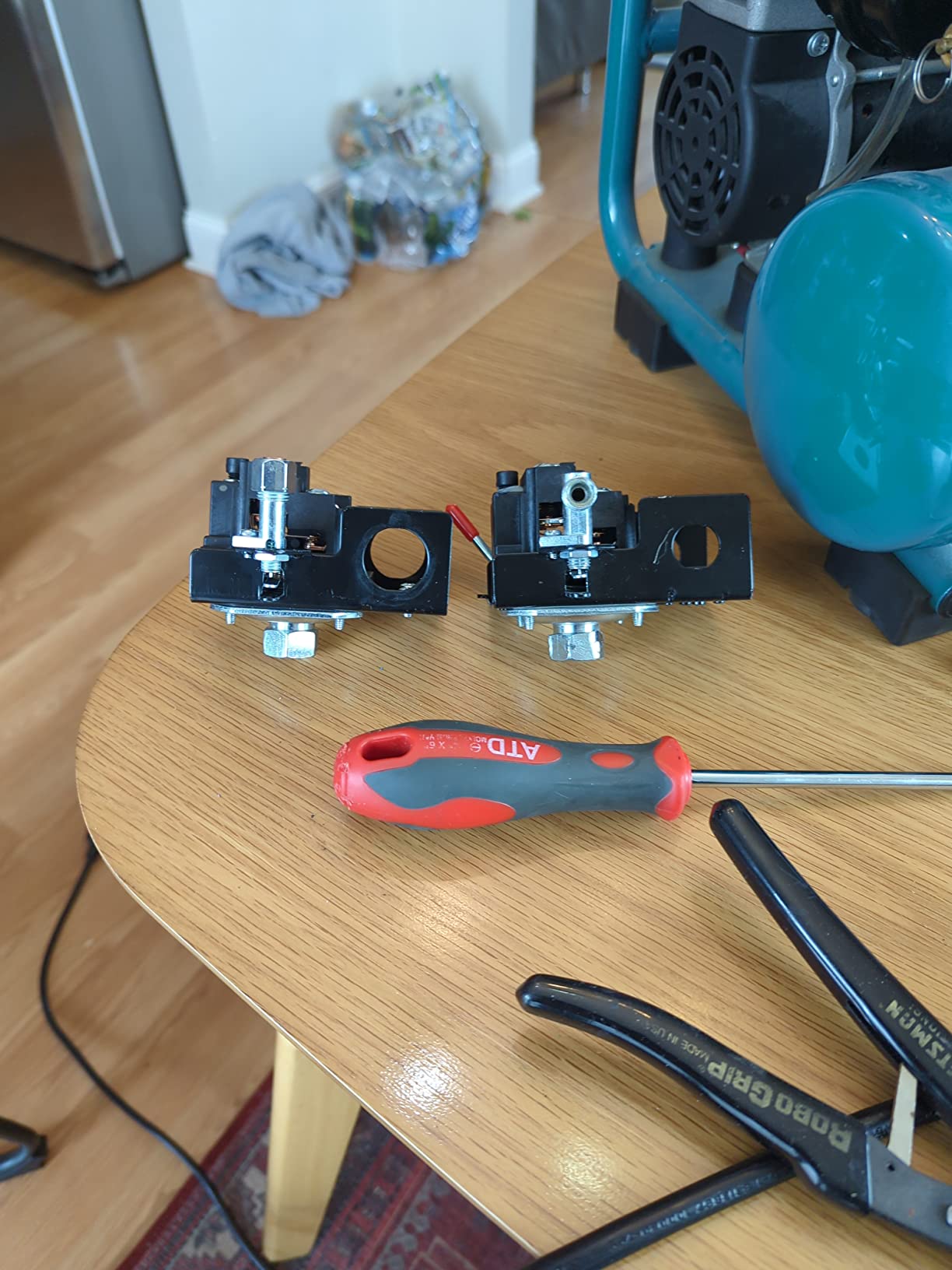
The catch is airflow. 0.7 CFM at 90 PSI is the lowest flow figure in this group, which means one small nailer at a time and no simultaneous second tool. If your work is cabinet assembly, crown moulding, or upholstery stapling, that is fine. If you want to run a nailer and a blow gun together, this is the wrong machine.
Review volume here is 1523 at 4.5 stars, which is a healthy sample for a specialty unit and gives us more confidence in the long-term claim than most reviewers of similar machines can offer.
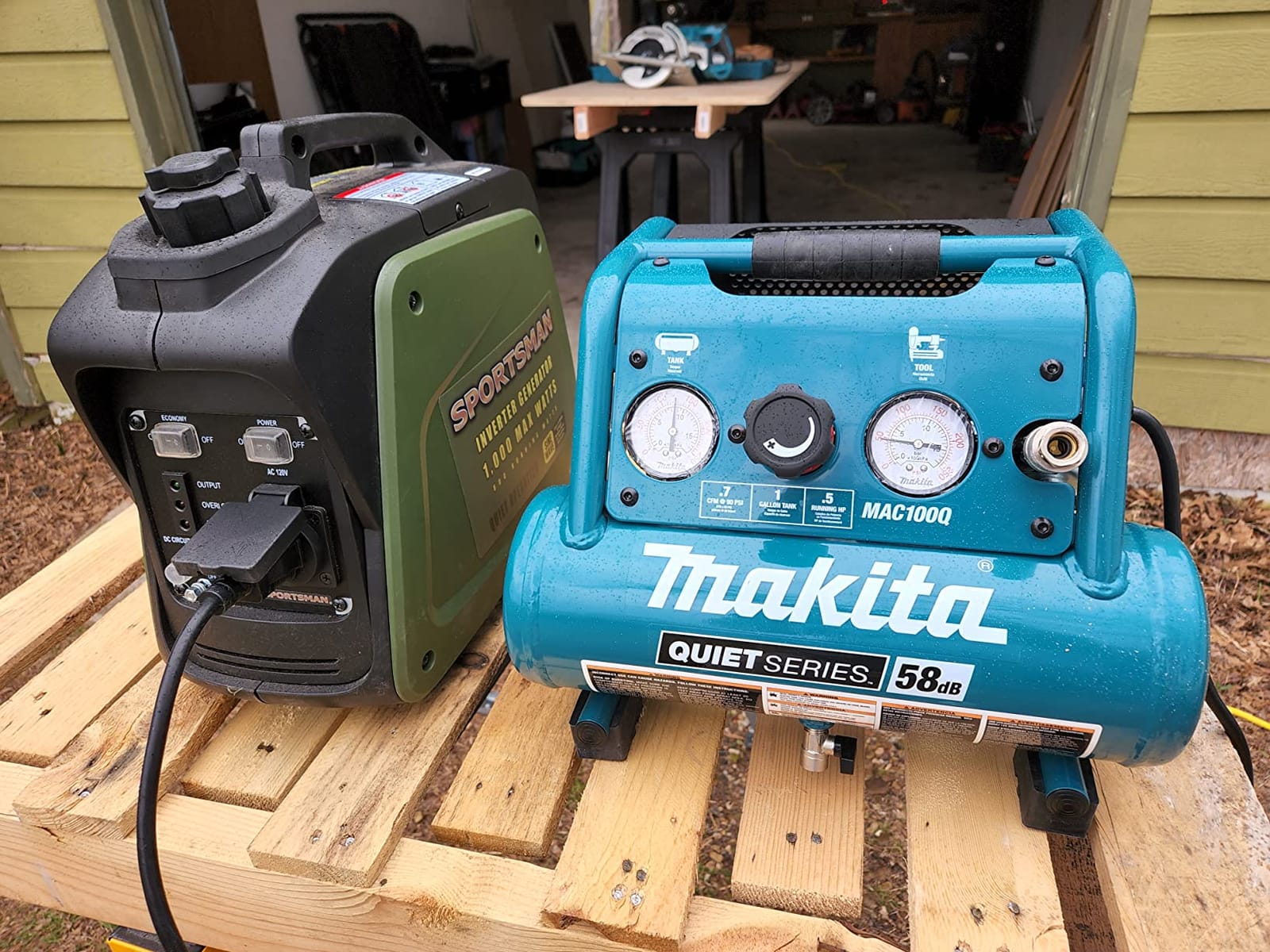
Is a roll cage worth the bulk
For a machine you carry between a truck and a garage twice a week, yes. The cage absorbs the drop that would otherwise crack the pump housing or bend a fitting. It is the difference between a compressor that survives five years of carrying and one that does not.
It adds weight and bulk, though. Makita’s 27.6 lb figure is accurate, but the cage means the unit is shaped less conveniently for a one-handed stair carry than a bare tank compressor.
Who should skip this one
Anyone running a framing nailer, a spray gun, or two tools at once should skip it. 0.7 CFM simply does not deliver, and the 135 PSI ceiling means it cycles more often than a higher-pressure machine.
If you only ever drive finish nails and want the quietest possible setup with maximum durability, this is the pick. If you need air for anything else, the 2 gallon or 3 gallon options are only a step up in size.
3. California Air Tools 2010A – Best for Airbrushing and Small Spray Work
California Air Tools 2010A 1.0 HP Ultra Quiet and Oil-Free Air Compressor, 2 Gallon Aluminum Tank, 60 dBA Noise Level, Silver
60 dBA noise level
2.2 CFM at 90 PSI
125 PSI max
35.3 lb 2 gallon aluminum tank
Pros
- 60 dBA allows normal conversation beside the running unit
- Aluminum tank resists rust and refills in about 50 seconds
- Dual piston pump gives 2.2 CFM at 90 PSI
- Rubber feet damp vibration transfer to the floor
Cons
- Too small for HVLP spray guns
- 35.3 lb is awkward to carry
- No wheels or hose included
The 2010A is the compressor we reach for when quiet matters and there is more than one tool involved. It delivers 2.2 CFM at 90 PSI at 60 dBA, which is close to double the flow of the 1 gallon machines while staying inside the conversation-level tier. That combination is why it is our pick for airbrushing and light spray finishing.
Recovery is the number that impressed us. The tank fills from empty in roughly 50 seconds and goes from 90 back to 120 PSI in about 14 seconds, so you spend far less time waiting than the fill time alone suggests. Owners report getting roughly 19 to 20 brad nails per cycle, and a 4.6 star rating across 1263 reviews reflects how consistently that holds up.
On Lumberjocks, the recurring question about a California Air Tools 2 gallon for occasional pin nailing gets a consistently positive answer, specifically because of how quiet it is. That matches our experience of the machine.
The aluminum tank is worth noting for long-term ownership. Unlike a steel tank, it will not rust from condensation inside a damp garage, and owners describe it as quieter than a household vacuum when running indoors.
Do you need aluminum or steel
Aluminum resists internal corrosion from moisture and weighs less than a comparable steel tank. Steel holds up better against knocks and abuse. For a garage that stays dry and a machine that gets carried, steel is fine. For a damp basement or an unheated shed, aluminum is the safer long-term choice.
Either way, drain the tank after use. Condensation collects at the bottom of any receiver and both materials eventually suffer if it sits.
Where it runs out of air
At 2.2 CFM it handles brad and finish nailers, sanders, and small spray work comfortably. It will not keep an HVLP spray gun fed continuously, which is the single most common disappointment we saw with this model.
Check whether wheels or a hose are included before you buy. Several owners wish they had known neither comes in the box, and at 35.3 lb that matters. Budget for a 25 foot hose and a caster kit.
4. California Air Tools 8010A – Top Rated and the Biggest Tank at 60 dBA
California Air Tools 8010A 1.0 HP Ultra Quiet and Oil-Free Air Compressor, 8 Gallon Aluminum Tank, Lightweight with Wheels, 60 dBA Noise Level
60 dBA noise level
2.2 CFM at 90 PSI
120 PSI max
8 gallon tank with wheel kit
Pros
- Highest rated in the group at 4.7 stars with 1115 reviews
- 8 gallon tank gives the longest run time at 60 dBA
- Wheel kit included so 37.3 lb rolls easily
- 60 dBA suits an indoor garage or shop
Cons
- 120 PSI maximum is low for spray work
- 2.2 CFM is modest for the tank size
- About 165 seconds to fill from empty
This is the compressor to buy if you want a full tank of air and a quiet motor without moving up to the loud 70 dBA class. The 8010A pairs the same 60 dBA and 2.2 CFM figures as the 2 gallon model with an 8 gallon tank, so it holds roughly four times the air and runs far longer between motor starts.
That matters more than it sounds. Motor start and stop is the loudest moment for some listeners, and a small tank cycling constantly is the top complaint we read about compressors in general. The 8010A sidesteps most of that.
This is the compressor with the highest star rating of any unit we reviewed, at 4.7 across 1115 reviews. Buyers consistently describe it as quiet enough for indoor finishing work while still rolling on its included wheels, which is the combination nobody else in this group offers.
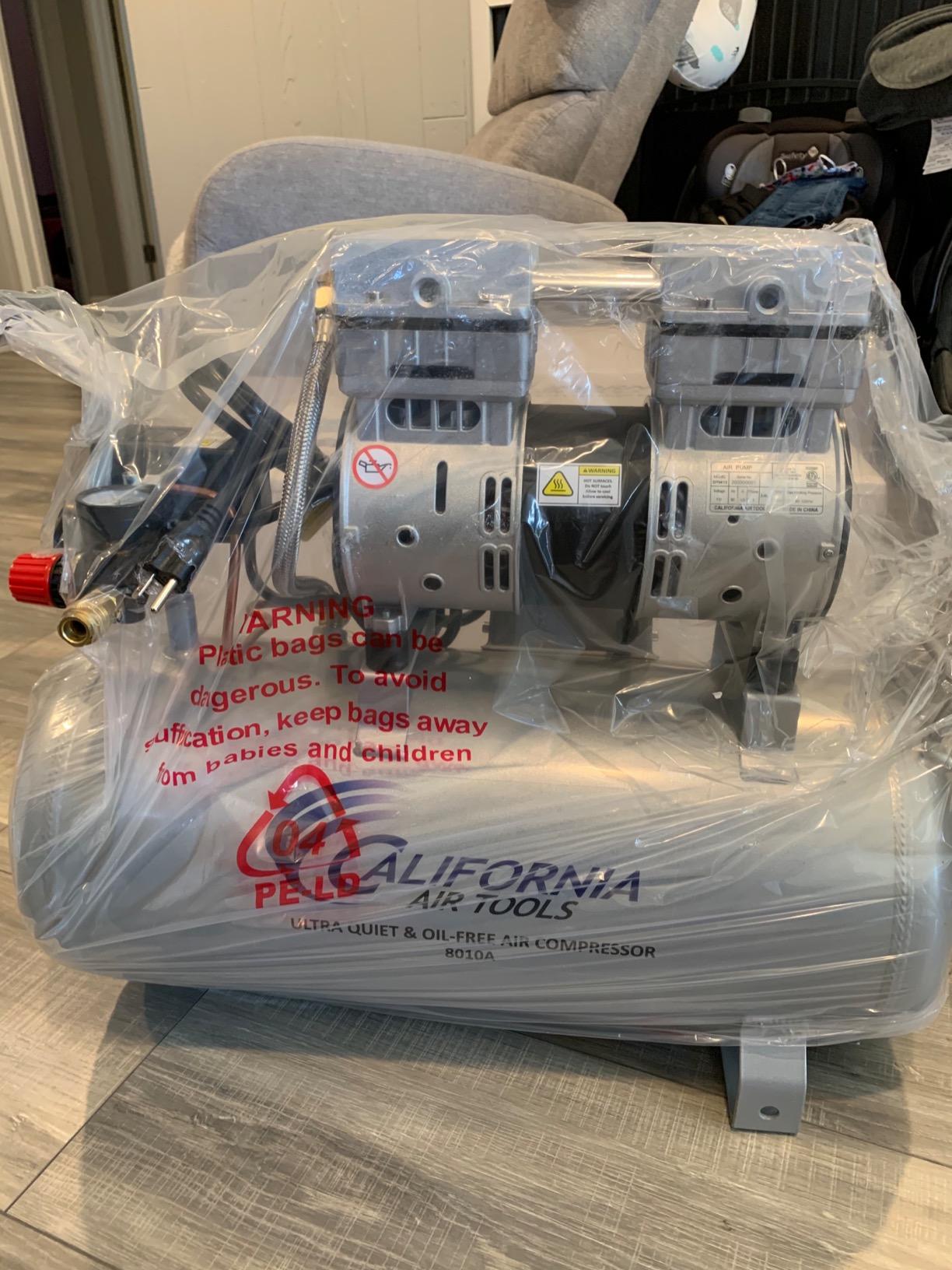
Two honest caveats. The 120 PSI ceiling is low for spray work and heavier pneumatic tools, and the 2.2 CFM flow means a single demanding tool will still pull it down faster than a bigger pump would. And from empty, the tank takes about 165 seconds to fill, so plan for that once at the start of a session.
If your garage is a workshop rather than a closet, this is the machine we would put against the wall. For a small apartment, it is overkill in size.
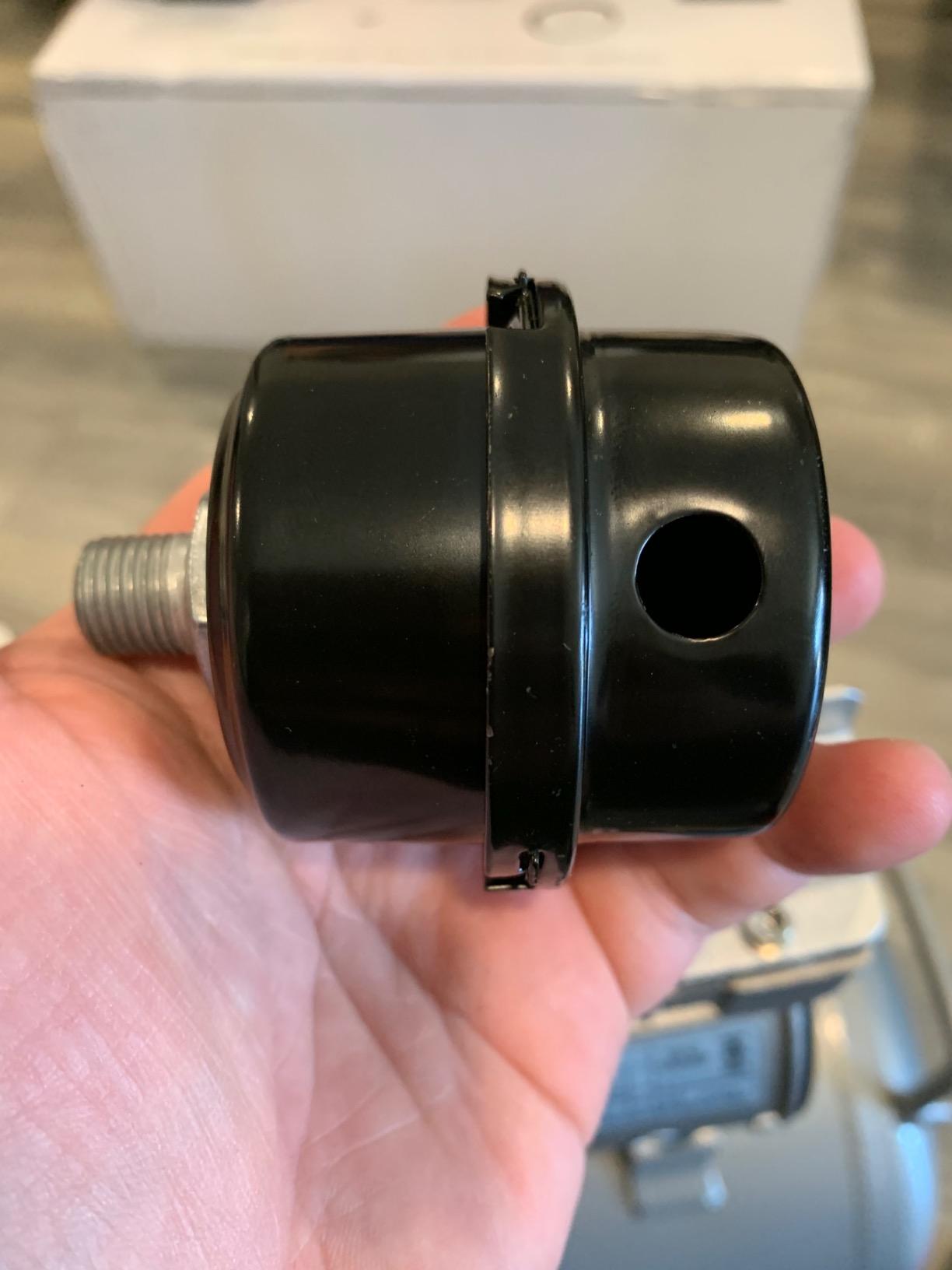
When an 8 gallon tank changes your workflow
Tank size is about air reserve, not power. Eight gallons means you can run a sander for several minutes, blow out a whole workbench, or fire a long run of nails without the motor restarting on every burst.
That reduces both noise spikes and thermal cycling on the pump. For anyone who finds the on-off cycling more annoying than the steady hum, this is the fix.
Is a low PSI ceiling a real problem
For nailers and inflating, no. 120 PSI is enough. For HVLP spray guns, pneumatic staple guns that need sustained pressure, or impact-rated air tools, it is limiting, and you would feel the pressure sag.
Because the pump is 1.0 HP and single stage, that ceiling is structural rather than a setting. If you need sustained high pressure, the DEWALT later in this list is the opposite trade.
5. DEWALT DWFP55130 – Best for High-Pressure Nailing on a 12 Amp Circuit
DEWALT Air Compressor for Trim, 200-PSI Max, Quiet Operation (DWFP55130)
71.5 dBA ISO3744 tested
3.0 SCFM at 90 PSI
200 PSI max
2.5 gallon tank
Pros
- 200 PSI and 3.0 SCFM at 90 PSI drive plenty of nails with fast recovery
- Dual quick couplers run two nailers at once
- 12 amp draw starts easily without tripping breakers
- Stores vertically or horizontally with a roll cage
Cons
- 71.5 dBA is far louder than the 56 to 60 dBA units
- 36 lb with no wheels is hard to move
- 2.5 gallon tank drains fast under sustained use
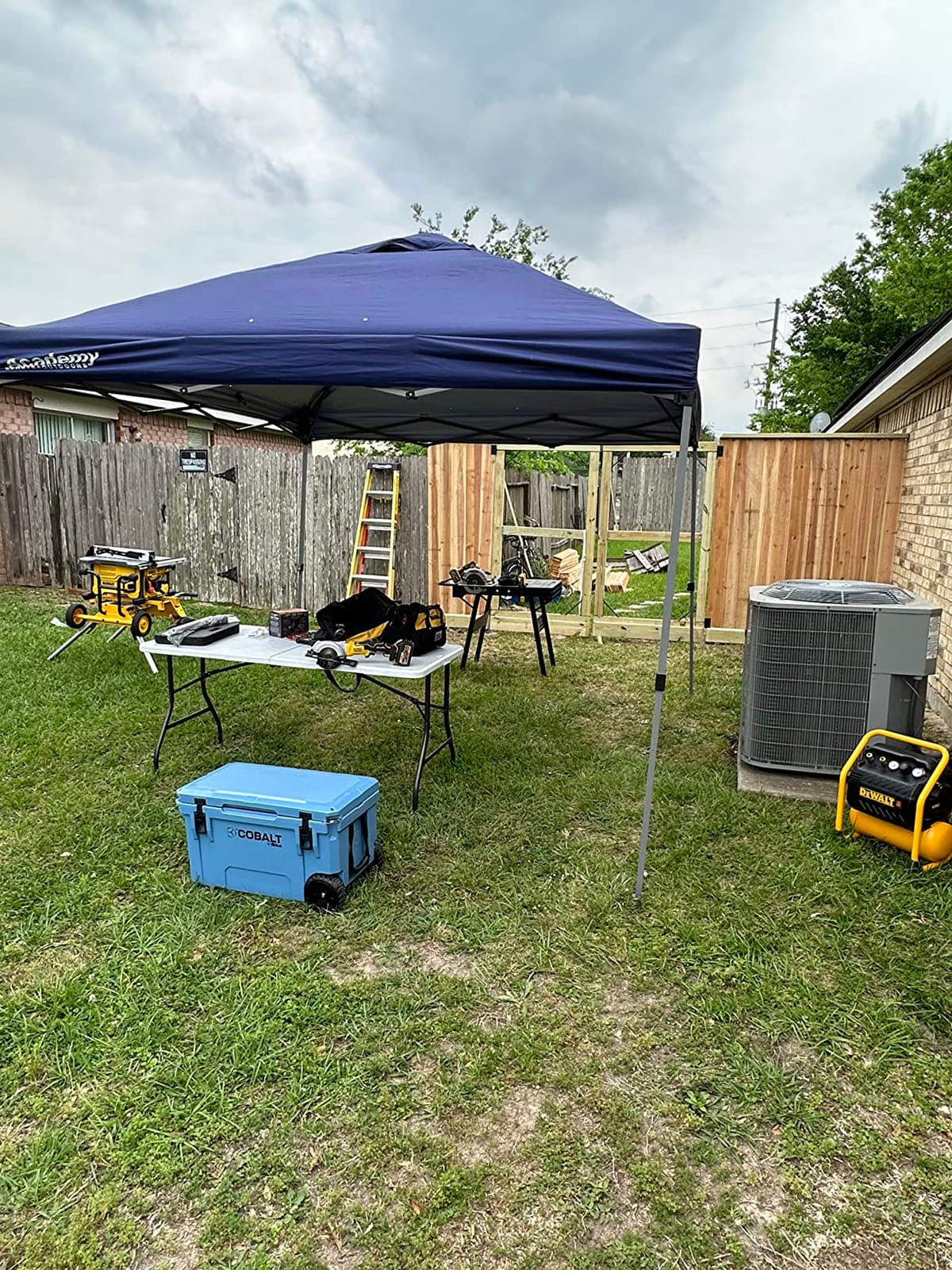
This is the compressor with the highest published pressure and airflow figures in the group, and the cost of that capability is noise. At 71.5 dBA, tested to ISO3744, it sits at the bottom edge of the standard tier rather than the quiet tier. It belongs in a detached garage, not a room with a shared wall.
What you get for the noise is a 200 PSI maximum and 3.0 SCFM at 90 PSI, both genuinely useful for long framing nailer runs and for pneumatic tools that need pressure headroom. The dual quick couplers let you run a nailer and a blow gun at the same time.
The 12 amp motor is the detail that makes it usable in a home. It starts without dragging a circuit, which is where many larger home compressors fail. Ball valve drain and cord wrap make storage simple, and it can sit on its side or stand upright.
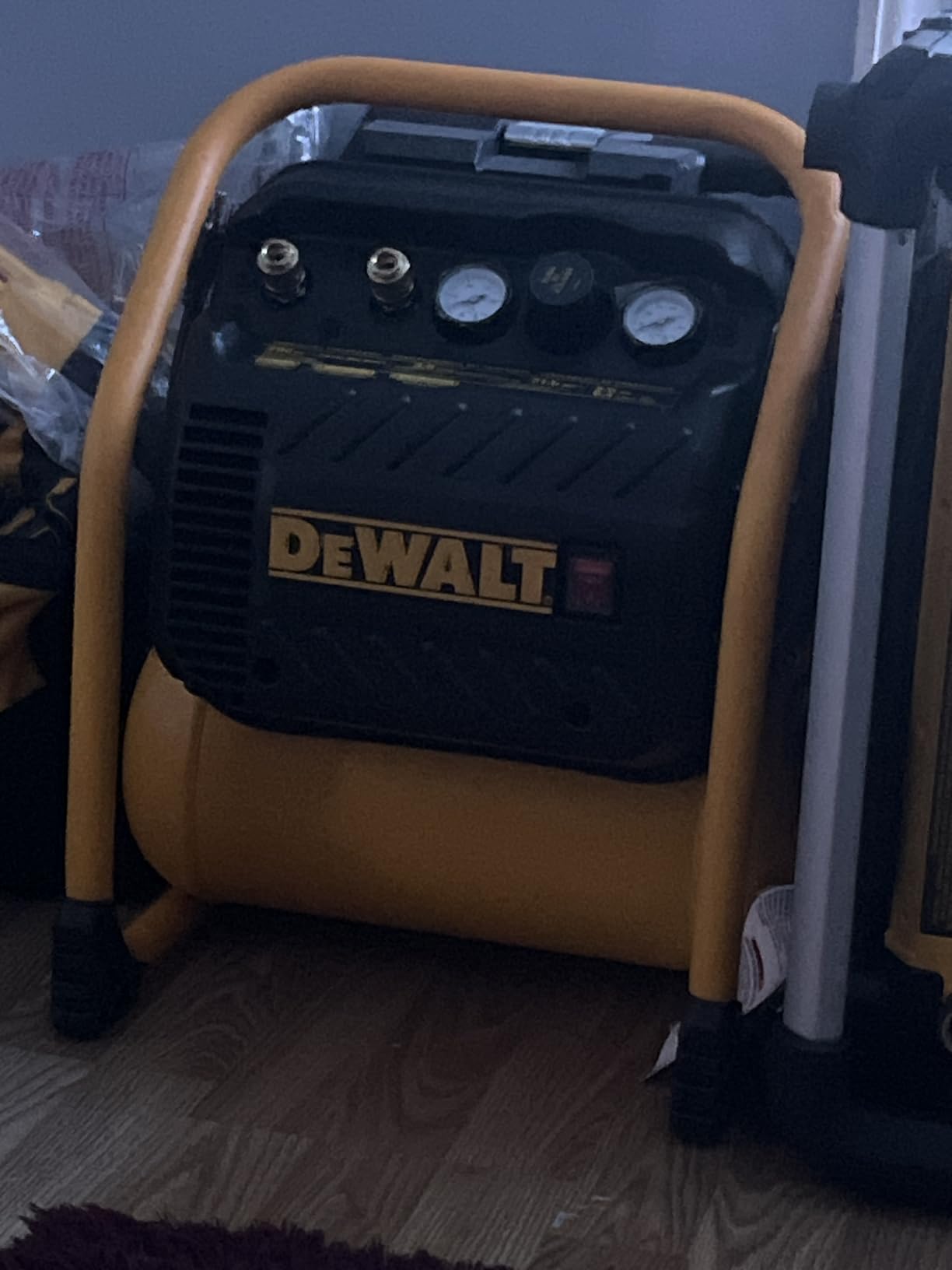
We include it here because some buyers will read every quiet list and want to know where the compromise starts. This is roughly where it starts. If noise is your top constraint, stay in the 56 to 68 dBA group. If pressure is your top constraint, this is the right machine and no quieter one will do the job.
It is also worth noting that 71.5 dBA is quoted to a specific standard, which is more honest than most numbers in this category. That transparency is worth something when you are comparing.
Does 200 PSI actually matter at home
For finish and brad nailing, no. Those tools run in the 70 to 120 PSI range and 120 PSI is plenty. For framing nailers, pneumatic staplers, or air tools with pressure requirements, the higher ceiling is the difference between smooth operation and a tool that stalls.
If you already know your tools run below 120 PSI, you are paying for headroom you will not use, and trading away ten decibels of quiet to do it.
Living with a 71.5 dBA machine indoors
It is workable in a garage with the door open, and tolerable for short indoor bursts. It is fatiguing for hours of trim work, and above 70 dBA you should wear hearing protection during long sessions.
Two mitigations help. Running the tank open to the outside wall and putting the unit on an anti-vibration mat both cut perceived noise. Beyond that, this is a garage machine.
6. Limodot LJ5120K – Best for Everything in the Box at Once
Quiet Oil-Free Air Compressor, 68 dB, 2.8 CFM @ 90 PSI, 5 Gallon Air Tank
68 dBA induction motor
2.8 CFM at 90 PSI
5 gallon tank
25 ft hose and fittings kit
Pros
- Hose
- quick connect and 13 piece fittings kit included
- 5 gallon tank with wheel kit moves easily between jobs
- About 80 second refill and 25 second recovery
- Induction motor runs smoothly enough for indoor use
Cons
- 70 dB is louder than the 56 to 60 dBA group
- 120 PSI ceiling is on the low side
- 1.2 HP is below what HVLP and framing nailers need
Most compressors arrive as a bare machine. This one comes with the tank, wheel kit, a 25 foot PVC hose, a quick connect fitting, and a 13 piece air tool accessory kit in the box. If you are starting from zero, that bundle removes the first trip to the hardware store and most of the first afternoon of setup.
Noise is the compromise. The induction motor runs smoothly, but the published figure lands at 68 to 70 dB depending on the listing, which puts it at the edge of the quiet tier rather than inside it. Fine in a garage, not ideal for an indoor room.
Flow is the surprise. 2.8 CFM at 90 PSI with about an 80 second refill and 25 second recovery is genuinely usable for repetitive nailing across rails and boards, which is more than the smaller quiet units manage.
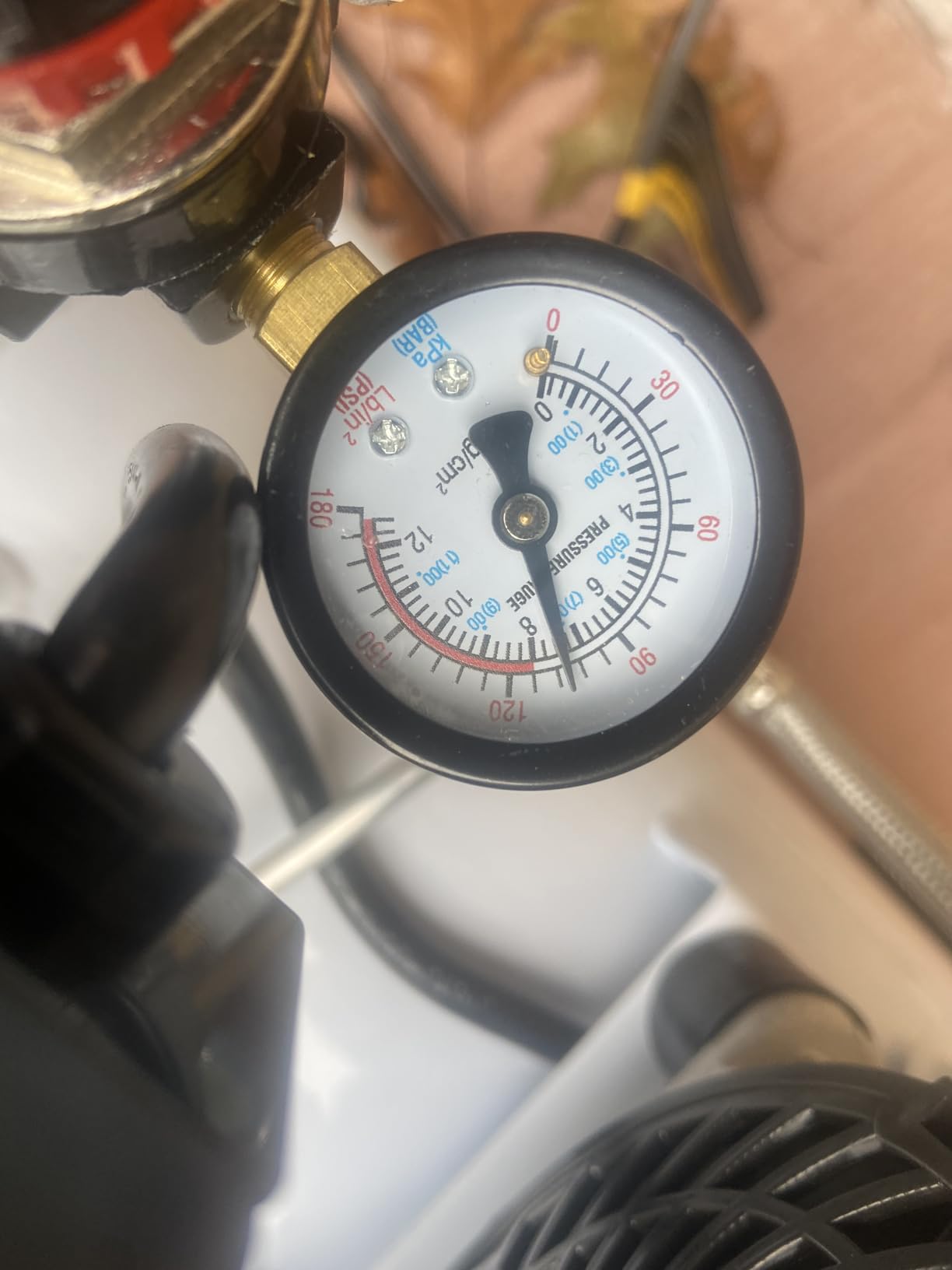
At 925 reviews and 4.5 stars this listing has a solid volume behind it. Owners repeatedly single out the completeness of the package as the reason they recommend it, and the refill times as the reason they keep it.
A few buyers note that the 1.2 HP motor and 120 PSI ceiling limit heavier tasks, so treat it as a nailing and general blowing compressor rather than a spray machine.

What is actually in the accessory kit
The 13 piece kit covers the fittings most people need to get started: couplers, plugs, and hose adapters for the common nailer and gun sizes. It is not a professional toolkit, but it means you can connect a nailer and start work the day it arrives.
The 25 foot PVC hose is serviceable for a garage setup and for reaching into a vehicle. For long reaches or outdoor runs, a coiled hose lasts longer than PVC.
Is 68 dB quiet enough indoors
For short indoor tasks, yes. The induction motor has a smooth character rather than a harsh rattle, and it stops as soon as the tank is full.
For hours of continuous indoor work, choose a 56 to 60 dBA unit instead. The difference between 58 dBA and 70 dBA is larger in perception than the numbers suggest.
7. Metabo HPT EC28M – Best for Lightweight Handling and Stairs
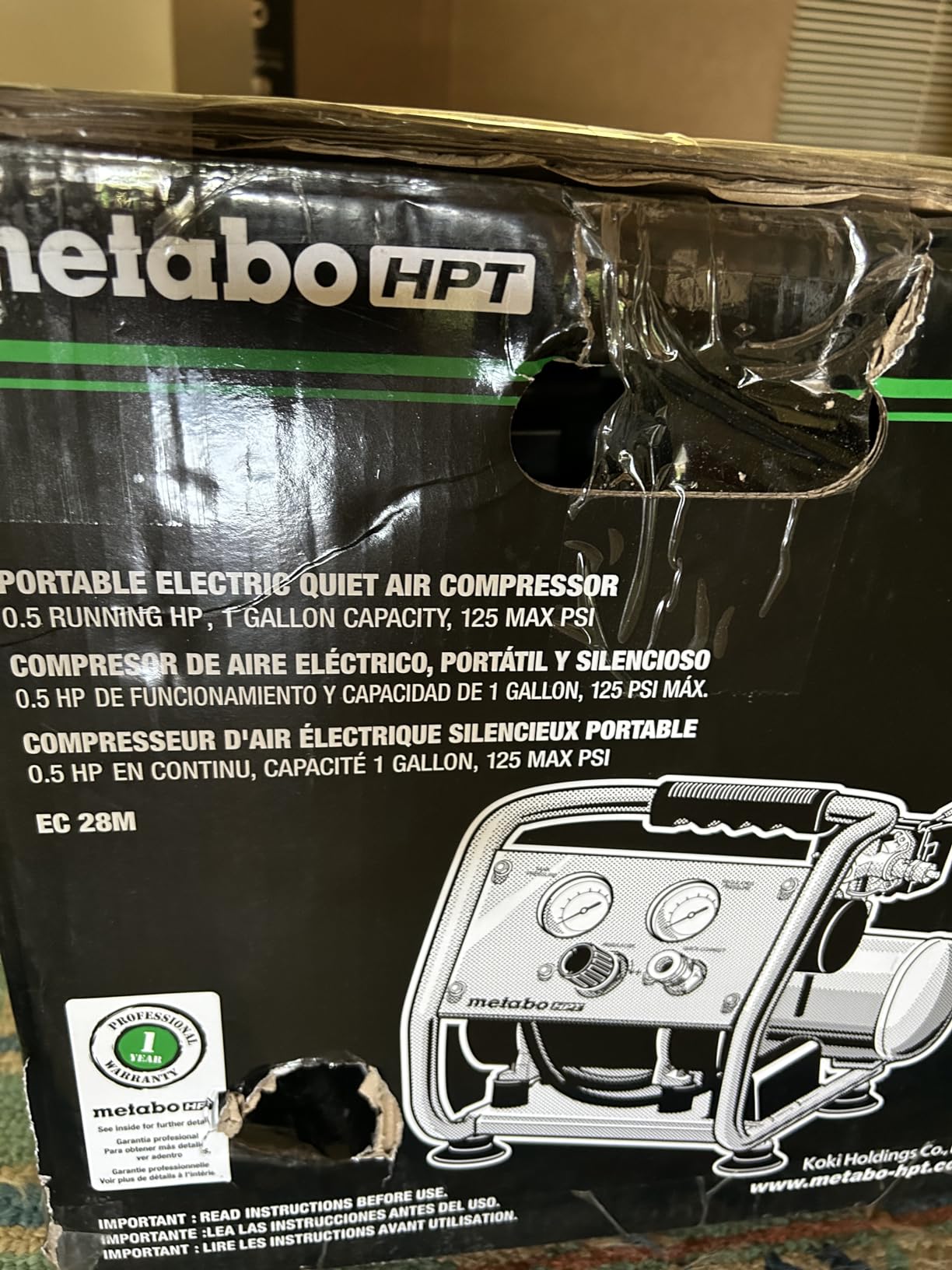
Metabo HPT Quiet Air Compressor, Portable 1 Gallon Oil-Free, EC28M
59 dBA noise level
1 gallon oil-free tank
0.5 HP motor
25.2 lb with carry handle
Pros
- Lightest unit we reviewed at 25.2 lb
- 59 dBA allows conversation while it cycles
- Ergonomic rubber handle with steel roll cage
- Universal quick coupler speeds tool changes
- Overload protection circuit included
Cons
- 1 gallon tank and 0.5 HP motor limit it to light trim work
- No wheels so it must be carried
- Unsuitable for spray guns or framing nailers
At 25.2 lb, this is the lightest compressor we reviewed, and for anyone carrying a machine down basement stairs or up to a loft that matters more than any spec line. The rubber over-moulded handle and the steel roll cage make a 1 gallon tank genuinely portable.
Noise is a solid 59 dBA, inside the quiet tier and low enough to hold a conversation while it cycles. That is the combination buyers praise most: quiet and light, at the cost of any real capacity.
The 0.5 HP motor and one gallon tank restrict it to small nailers, inflating, and blowing dust off surfaces. Overload protection is built in, which is reassuring on a machine that may sit on a circuit shared with other tools.
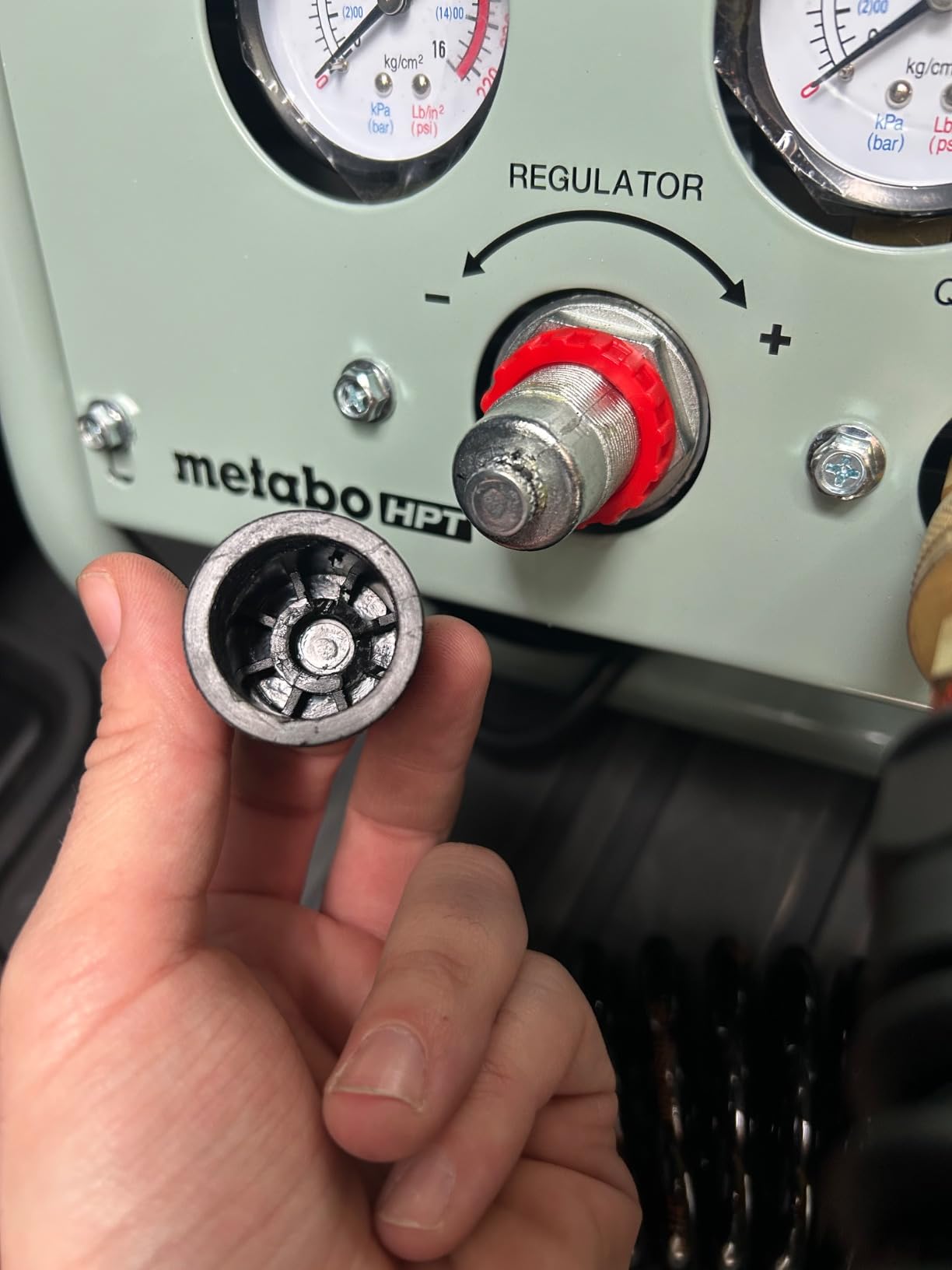
Metabo HPT is a brand that was built around professional tradespeople, and the unit carries a one year professional warranty. Owners use it as a grab-and-go second compressor for trim work rather than a primary shop machine, and that is the right way to think about it.
At 845 reviews and 4.4 stars it has a decent sample behind it, though not as deep as the two California Air Tools entries.
Is 25 lb light enough to carry up stairs
Yes, comfortably, especially with the shaped handle. Compare that to the 62 lb vertical unit later in this list or the 71 lb VEVOR, which are wheel-assisted and stay on the ground floor.
If your compressor lives in a basement, a closet upstairs, or a van with a high load floor, portability is a real feature and often the one that decides the purchase.
Where the light weight comes from
A one gallon tank and a half horsepower motor. That is the whole trade. Air delivery comes from tank volume and pump size, so shrinking both is the only way to get the weight down.
If you find yourself waiting on air mid-task, that is the limit being hit. Move up to a 2 or 3 gallon model rather than repeating cycles with this one.
8. Makita MAC320Q – Best for Fast Recovery and Two Simultaneous Tools
Makita MAC320Q Quiet Series 1-1/2 HP, 3 Gallon, Oil-Free, Electric Air Compressor
60 dB Quiet Series
3 gallon tank
1.5 HP motor
135 PSI max with dual outlets
Pros
- Recharges faster than it discharges so users rarely wait on air
- 60 dBA is quiet enough to bring indoors for finish carpentry
- Two outlets run a nailer and blow gun together
- Padded feet dampen noise and stop it walking
Cons
- Bulkiest of the portable models here
- Published dimensions are inaccurate for the real footprint
- Some reports of fitting leaks and sticking outlets
Our pick is the compressor carpentry professionals describe as the real upgrade in the quiet category. The 1.5 HP oil-free dual piston pump on a 3 gallon tank recharges faster than most tools can discharge it, which is the practical definition of never waiting on air.
Two separate tool outlets let a nailer and a blow gun run at once, and separate tank and tool pressure gauges mean you can set tool pressure independently of tank pressure. At 60 dBA it is quiet enough to bring inside an unfinished home during finish carpentry.
That is a genuine step up in capability without a meaningful step up in noise. If you need more air than the 2 gallon machines give and still want to work indoors, this is the one.
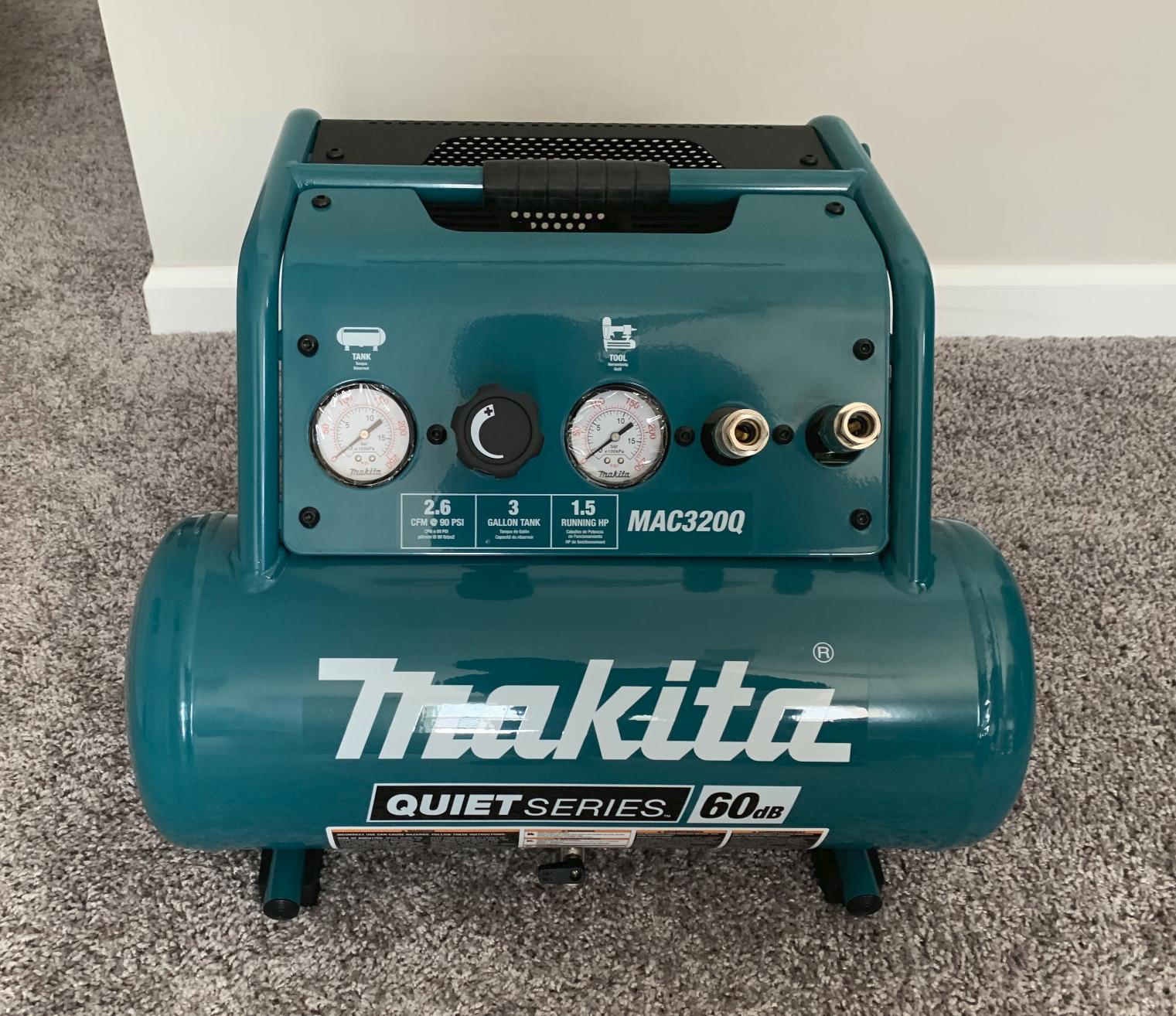
Review volume of 574 at 4.6 stars is respectable but thinner than the California Air Tools entries, and the complaints are specific rather than systemic. Several owners report hose fitting leaks and outlets sticking open, solved by swapping in brass quick connects. The listed dimensions are also wrong; owners report a real footprint closer to 18 by 19 by 14 inches, so measure before you plan a shelf.
At 25.79 kg listed, this is one of the two heaviest machines we reviewed and needs two hands to move. Make sure it lives where it lives.
Why recovery time beats tank size
A larger tank stores more air. Faster recovery puts that air back quickly. When a compressor recovers faster than your tool consumes, you never wait, regardless of tank size.
This model is the clearest example of that. The alternative to buying this machine is buying two smaller quiet compressors, which is rarely the better answer.
Does 135 PSI limit heavier work
It means more frequent cycling than a 150 PSI machine, which costs some efficiency and adds motor starts. In practice, for finish and trim work at 90 to 100 PSI, it is not noticeable.
It will not satisfy a framing nailer at full tilt. If framing is on your list, you need a different category of compressor entirely.
9. VEVOR 4.8 Gallon – Budget Pick with a Metal Tank and Dual Silencers
VEVOR 4.8 Gallon Air Compressor, 1.2HP 2.2 CFM@90PSI Oil Free Air Compressor Tank & Max. 116PSI Pressure, 70 dB Ultra Quiet Compressor for Auto Repair, Tire Inflation, Spray Painting, Woodwork Nailing
70 dB with dual silencers
2.2 CFM at 90 PSI
116 PSI max
4.8 gallon Q235B steel tank
Pros
- Entry-level cost while including dual silencers and casters
- 70 dB is acceptable for garage use
- Q235B steel tank with seamless welds
- Overheat and pressure protection built in
Cons
- 70 dB is louder than the true ultra quiet units
- 2.2 CFM and 116 PSI ceiling limit larger tools
- Intake filter cannot be disassembled for cleaning
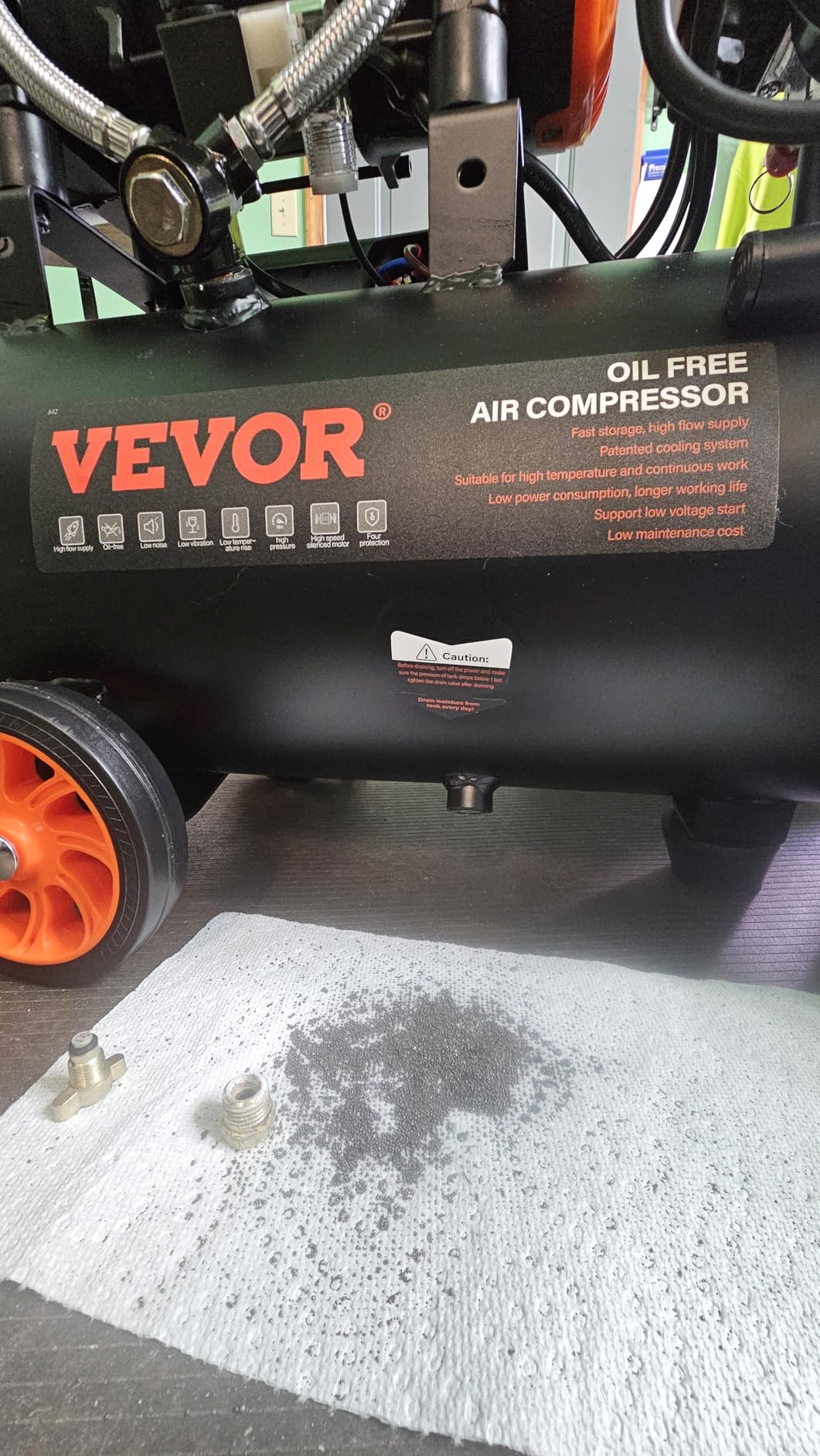
This is the lowest-cost machine we reviewed and it does not feel like a token entry. The Q235B steel tank with seamless welds rated to 3.5 MPa is real metal, and two silencers with thickened covers genuinely reduce the pitch of the exhaust sound.
The dual intake tube and cylinder arrangement shortens fill time compared with single inlet designs of the same size, and casters and a foot pad are included, which is uncommon at this size class.
At 70 dB it is a garage compressor, not an indoor one. Owners consistently describe it as quiet enough for garage use, and that is exactly the right expectation to set.
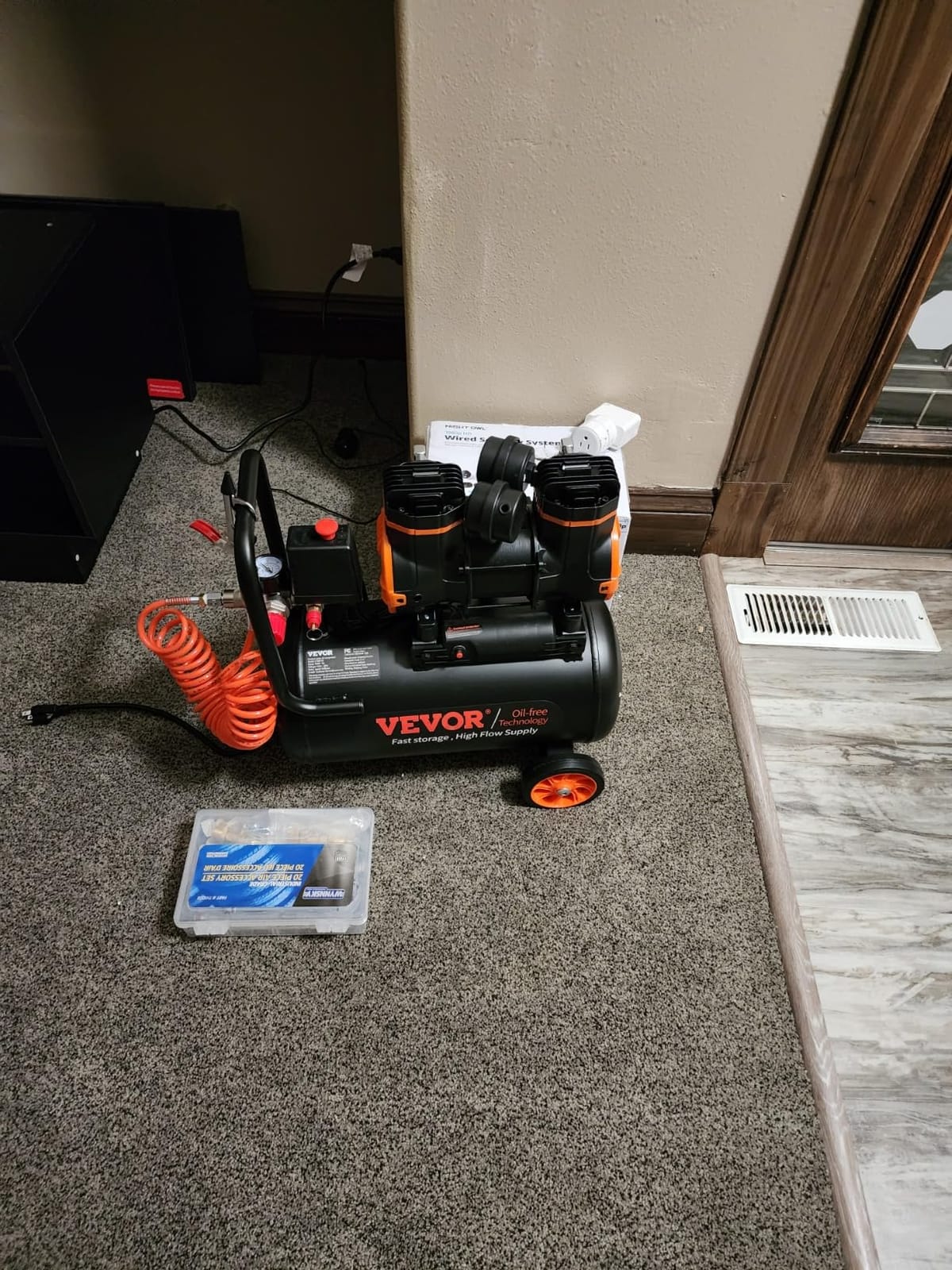
Flow is the limitation: 2.2 CFM at 90 PSI and a 116 PSI maximum. That covers nailers, impact wrenches, light spray guns, and tire inflation. It does not cover framing nailers or HVLP spraying.
One serviceability complaint recurs: the intake filter cannot be disassembled for cleaning or replacement as the manual implies. Keep that in mind if you run the unit dusty.
What you are accepting with a budget model
At 4.5 stars across 464 reviews, the volume is modest compared with the California Air Tools units. Review volume is a real reliability signal on mechanical goods, and this listing has less evidence behind it than most.
What you are buying is metal tank construction, included accessories, and dual muffling at the entry point of this roundup. That is a defensible trade if you keep it in a shed or garage and replace it if the pump ever fails.
Which silencers actually help
Exhaust noise is the harshest part of compressor sound. Thickened covers and filter cotton inside a silencer cut the high frequencies, which are the ones people find irritating, rather than the overall volume.
They help enough to matter at the margin. They do not turn a 70 dB machine into a 58 dB machine, so do not expect that.
10. Stealth SAQ-1234 – Best for Indoor and Apartment Work
Stealth Air Compressor 2 Gallon, 3/4 HP Oil-Free Compressor, Less than 60dB Ultra Quiet Electric Air Compressor,Max 125 PSI Pressure for Tire Inflation,Nailing,Home DIY Project(SAQ-1234)
Under 60 dB operation
1.8 CFM at 90 PSI
125 PSI peak
2 gallon Q235B steel tank
Pros
- Under 60 dB lets it run inside the home without complaint
- Sustains 60 to 80 PSI while running continuously
- Fills in roughly 25 to 30 seconds
- Low voltage start helps on weak circuits
- Limited lifetime warranty
Cons
- 41.9 lb is heavy for a 2 gallon portable
- 1.8 CFM at 90 PSI is below framing nailer needs
- Less portable than 1 gallon units
This is the compressor we would pick first for an apartment, a condo, or a finished basement where noise is the deciding constraint rather than a preference. Owners describe running it indoors late at night while airbrushing or finish nailing, and report no complaints from neighbours, which is the exact use case.
The flow figure of 1.8 CFM at 90 PSI is higher than the 1 gallon machines manage while staying under 60 dBA, and the tank fills in roughly 25 to 30 seconds, so short bursts of work do not leave you waiting.
Two features matter for indoor use specifically. The soundproofing and low vibration design keep the noise character dull rather than sharp, and the low voltage start means it will still fire up on a loaded household circuit.
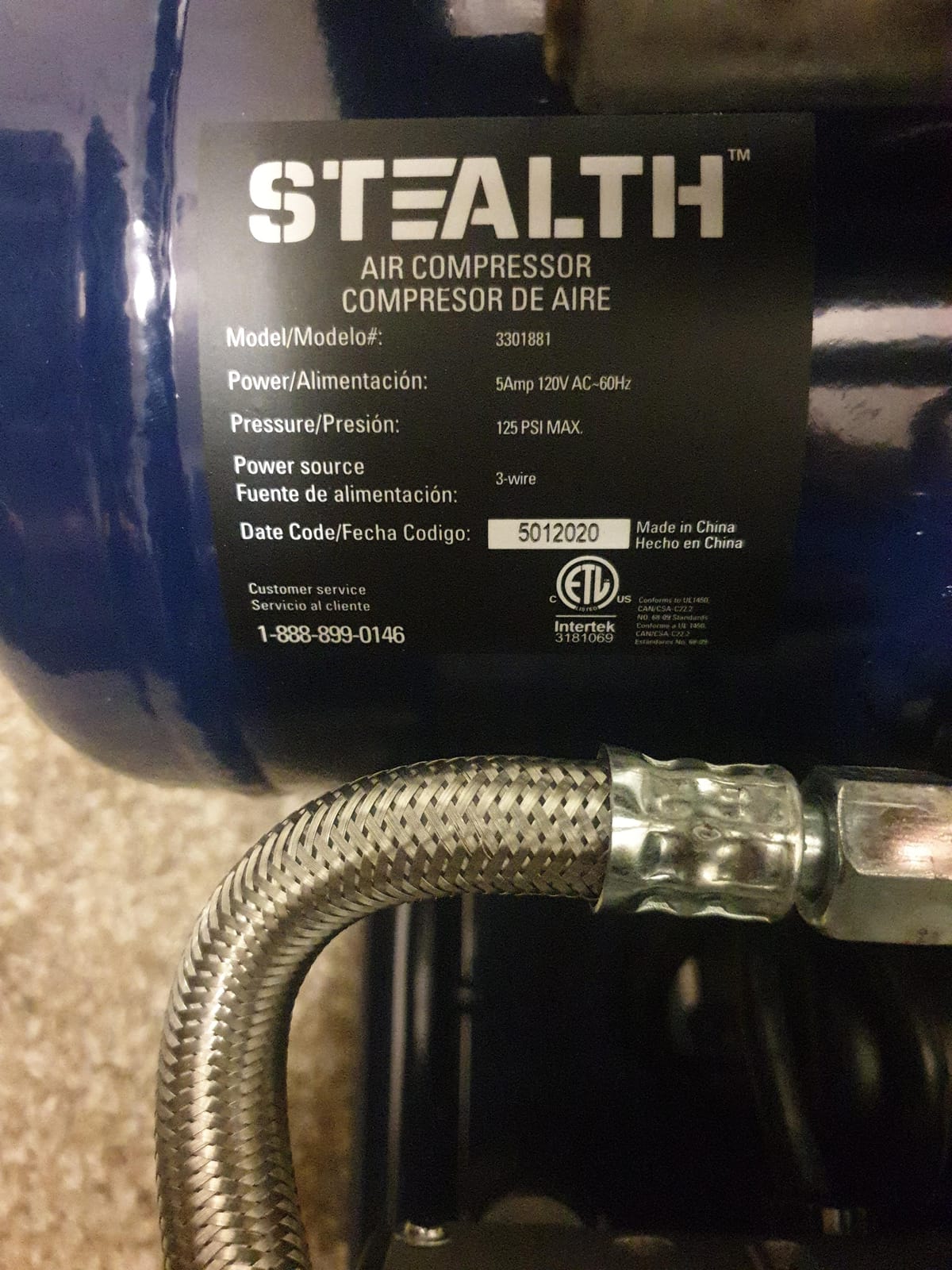
The limited lifetime warranty is unusual at this size and on a portable oil-free machine. Owners report two years of regular use with no degradation, though our sample is 202 reviews at 4.5 stars, which is thin compared with the California Air Tools listings.
At 41.9 lb, this is a heavy 2 gallon machine. That weight is the cost of the larger tank and the dampening materials, and it is worth weighing before you buy.
Can you run a compressor inside a home
Yes, under conditions. Keep it on a hard surface rather than bare floorboards, keep a hose length to avoid pulling it into a neighbouring room, and run only intermittently. Never leave it running unattended, and open a window in hot weather because the motor generates heat.
Under 60 dBA is what makes indoor use workable at all. Above 70 dBA you are running a workshop tool in a living space.
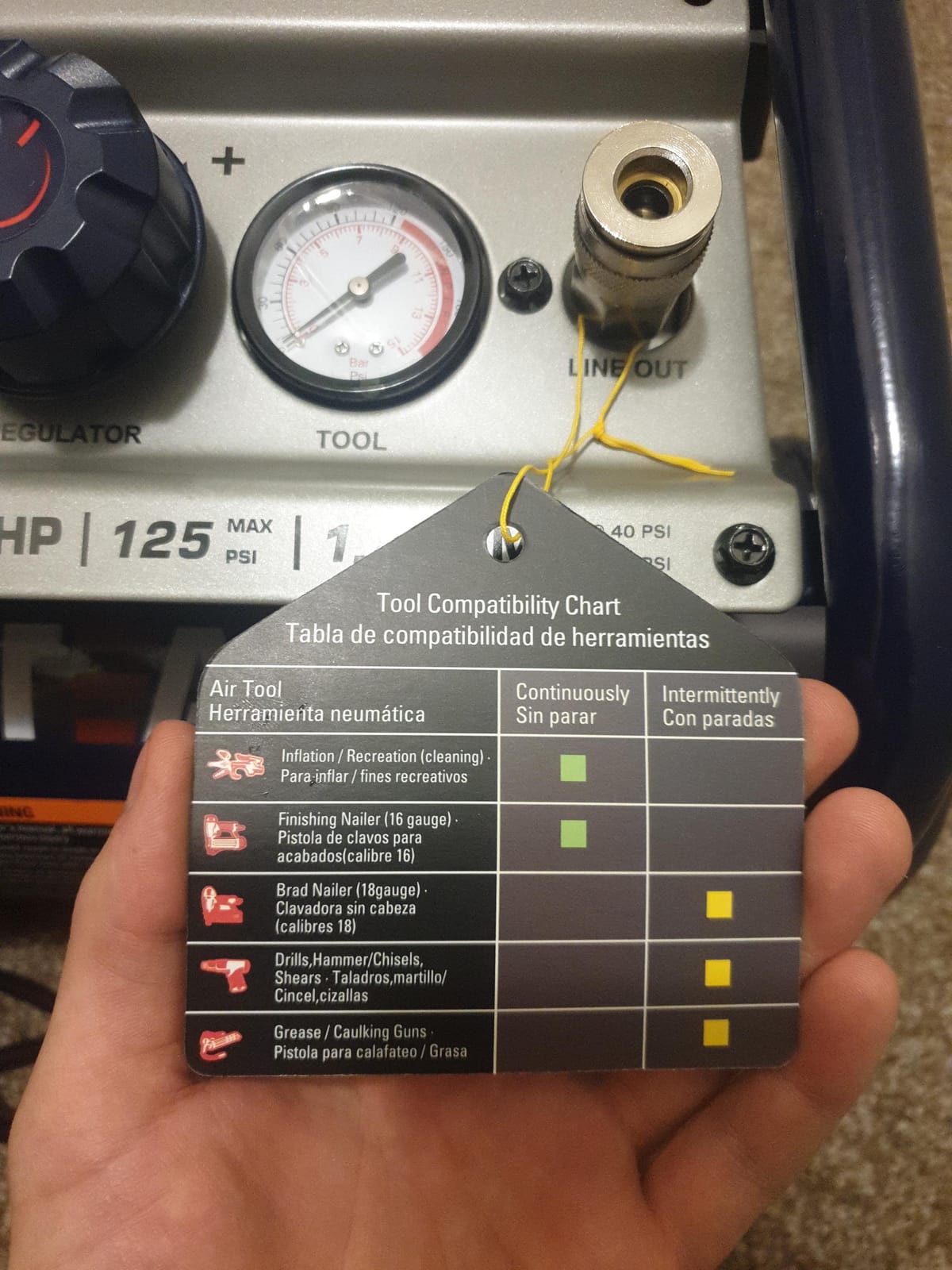
Does 1.8 CFM airbrush effectively
Yes, for an airbrush and small detail spray guns. It sustains pressure through the work rather than pulsing, which is what matters for even finish.
It is not enough for an HVLP gun doing large surfaces. If that is your project, budget for a 3 gallon model with more pump.
11. VEVOR 13 Gallon – Best for Larger Air Storage and Longer Jobs
VEVOR 13-Gallon Air Compressor, 2HP, 4.6 SCFM@90PSI, Oil-Free Tank, 66dB Quiet Operation, Ideal for Tire Inflation, Woodworking, Auto Repairs, and Spray Painting (Maximum Pressure 125 PSI)
66 dB quiet operation
13 gallon vertical tank
2 HP motor
125 PSI max with dual outlets
Pros
- Genuinely quiet at 66 dB for a 13 gallon tank
- 13 gallon capacity stores far more air than pancake units
- Builds air in under 3 minutes
- Two 7 inch reinforced rubber wheels make it easy to move
Cons
- 71 lb vertical format is heavy to lift
- Advertised SCFM figure is disputed
- Some reports of units failing to repressurize and overheating
Thirteen gallons is more stored air than anything else in this roundup, and at 66 dBA it does not move you into a higher noise tier. For blowing out radiators, sandblast-style surface cleaning, or long sessions with multiple tools, the reserve matters more than peak flow.
The vertical format with two 7 inch reinforced rubber wheels handles the 71 lb weight well on flat ground. It builds air in under three minutes and supports dual outlets, so a nailer and a blow gun can share it.
Owners are consistently impressed that a 13 gallon tank runs this quietly, and the reviews reflect steady weekend woodshop, automotive, and light spray use.
We want to be direct about two concerns. The advertised 4.6 SCFM at 90 PSI is disputed in reviews, and VEVOR support has acknowledged continuous output closer to 2.7 CFM in customer questions. Separately, a meaningful group of reviews describes units that stop repressurizing and overheat into thermal cutout after a few weeks.
With 215 reviews at 4.4 stars, the sample is also the thinnest of the larger machines here. If you buy it, test pressurization and recovery immediately after delivery and keep the receipt.
When 13 gallons beats a 4.5 gallon tank
When your work draws air in long, steady draws rather than short bursts. Blowing debris out of a vehicle, inflating multiple tires, or running a sander continuously all benefit from reserve air more than from pump power.
The trade is floor space and weight. At 33.3 inches tall this is a vertical machine that owns a corner rather than a shelf.
How to vet a large vertical unit before you keep it
Check the legs for bends and the fittings for transit damage first, since these are the most common problems with heavy vertical tanks. Then run it from empty to full and time it, then run a tool continuously and confirm it recovers.
Test everything while you can still return it easily. Diagnosing an issue months later is far harder.
12. Stealth SAQ-1413 – Best for Low-Voltage Circuits and Upright Storage
Stealth 4.5 Gallon Ultra Quiet Air Compressor,1.3 HP Oil-Free Peak 150 PSI 65 Decibel Air Compressor,4 CFM @ 40 PSI 3 CFM @ 90 PSI Silent Portable Long Life Electric Air Compressor W/Wheel for Garage
65 dB operation
3 CFM at 90 PSI
peak 150 PSI
4.5 gallon vertical tank with wheels
Pros
- 65 dB rated among the quietest in this group
- 4.5 gallon tank and 3 CFM at 90 PSI handle nailing and sanding
- Starts reliably under low voltage and cold conditions
- 6 inch reinforced wheels with upright roller handle
- Limited lifetime warranty
Cons
- 62 lb is one of the heavier units here
- Tall 33 inch vertical format takes floor space
- Short 6 ft cord usually needs an extension
This compressor brings the highest verified flow figure into the quiet tier. Three CFM at 90 PSI inside a 65 dBA envelope is a combination nothing else in this group matches at a published 90 PSI figure, and it means this machine can handle sanding and light spraying work while staying in the quiet tier.
The 1.3 HP induction motor is rated for three times standard induction motor life, and the manufacturer claims a much quieter running profile relative to conventional compressors. It starts reliably at both low voltage and low temperature, which is the practical feature if it lives in an unheated garage.
At 4.6 stars across 250 reviews it is well rated, with owners describing it as genuinely quiet with enough airflow and a 70 second refill for general shop work.
Is peak PSI misleading here
Yes, and it is worth being precise. The 150 PSI figure is a peak, not a sustained maximum. The motor is 1.3 HP peak as well, so under continuous load the machine settles lower.
If you only read the peak number you will overestimate sustained performance. Judge it on the 3 CFM at 90 PSI figure, which is the honest one.
The compromises are size and reach. At 62 lb and 33 inches tall this is a vertical machine with a real footprint, and the 6 foot power cord is short enough that you will almost certainly run an extension.
Use a properly rated extension for that, and note that a long thin cord costs you starting performance. Keep it short and heavy gauge.
Does it work in a cold garage
Cold start capability is a stated feature, and oil-free construction avoids the viscosity problems that make oiled pumps hard to start in winter. For an unheated or detached workshop, that removes a real source of frustration.
It also means no oil changes and no filter replacements across its life, at the cost of somewhat lower longevity than a comparable oiled unit.
Why Air Compressors Are Loud and How to Quiet One Down
Understanding where the noise comes from tells you which fix actually helps. Four sources account for nearly all of it, ranked by how much each contributes.
1. Piston slap and valve chatter. Metal pistons reversing at speed inside a cylinder is the core noise, and it rises sharply with pump RPM. This is why the quietest units here run motors at 1680 to 1750 RPM while louder machines spin at 3400 and above.
2. Motor hum. A universal motor at high RPM produces a whine that is harder to treat than piston noise. Induction motors are quieter by design, which is why several units in this list specify induction motors rather than universal ones.
3. Exhaust discharge. Air leaving the pump and the pressure release valve is intermittent and sharp. Silencers with filter media inside reduce the high frequencies that the ear finds most irritating, even when overall dB barely moves.
4. Tank resonance and vibration. A thin steel tank rings at certain frequencies, and vibration transfers straight through rubber feet into the floor framing and up into the house. This is often the reason a quiet machine is audible through a wall.
Forum knowledge on damping is genuinely useful here. Users on r/airbrush report building a sound dampening box around a compressor and finding it made a world of difference, and that approach targets the exhaust and vibration sources at once.
Simple mitigation steps, in order of impact. Put the compressor on an anti-vibration mat or a piece of dense foam, since cutting floor transfer is cheap and immediate. Then check that all four rubber feet are actually touching and not compressed unevenly. Next, add a silencer or a muffler on the discharge port if your model lacks one. Mount wall-mounted hose reels so the hose is not transmitting pump vibration into the wall. Finally, if you own a loud compressor already, building a plywood enclosure lined with insulation is a genuine project that several owners report transforming their workshop.
Are Quiet Air Compressors Worth It
Usually, for home use, and the reason is that noise is the one constraint you cannot work around. Tank size, flow, and pressure can be compensated for by waiting, adjusting technique, or running fewer tools at once. Noise cannot, once it is a problem, because it affects everyone in the house and it makes work genuinely unpleasant rather than merely inconvenient.
The trade is real and worth stating. Quieter designs typically get there through a slower-turning pump, a smaller motor, a smaller tank, or some combination of all three. That means less peak airflow and less air reserve than a conventional machine of the same class. If you run a framing nailer for a full day, a quiet compressor is the wrong purchase and no amount of decibel arithmetic changes that.
Where quiet absolutely pays off is indoor and semi-indoor work. Finish carpentry, cabinet assembly, upholstery, airbrushing, and small spray projects all happen inside or next to living space. A 58 dBA unit changes the experience of a two hour evening session from tolerable to pleasant, and for a hobbyist who uses the machine weekly for years that is the whole return.
There is also a longevity argument that gets overlooked. Slower motor speeds mean fewer revolutions per hour, which reduces wear on the motor, bearings, and pump. Several quiet units here are rated for 3000 plus pump hours, and the 1750 RPM Makita motors are explicitly marketed on life expectancy. You are not only buying less noise, you are buying less mechanical stress.
What to Know Before You Buy
CFM at 90 PSI beats max PSI. Max PSI is how hard the tank can pressurise, which is a tank property and tells you very little about tool performance. CFM at 90 PSI is how much air the pump delivers at working pressure, which is the number that decides whether your tool stalls. A compressor can hit 200 PSI and still starve a spray gun.
Match flow to the tool, not the project. Brad and finish nailers want roughly 0.7 to 1.5 CFM. Random orbital sanders want around 2 to 3 CFM. Framing nailers want 2.5 to 4 CFM. HVLP spray guns want 3 CFM or more. Impact-rated air tools want high CFM plus headroom above 90 PSI.
Oil-free versus oiled. Oil-free pumps need no oil changes, cost nothing to maintain, start reliably in cold weather, and are quieter because there is no pump lubrication friction or oil pickup noise. Oiled pumps run cooler, deliver more flow for the same motor size, and typically last considerably longer in heavy service. For most home users running a nailer and an inflator a few hours a week, oil-free is the correct answer. For a compressor running daily for years, oiled is more realistic.
Tank size sets your patience, not your power. One gallon suits intermittent bursts. Two to three gallons covers finish work and short sanding sessions. Five to eight gallons covers sustained multi-tool use without constant cycling. Twenty gallon tanks are for continuous duty and rarely make sense in a home setting.
Single stage versus two stage. A single stage pump compresses to max PSI in one pass, which is simpler and quieter. A two stage pump compresses in two passes at lower pressure, which runs cooler, is more efficient at high pressure, and handles sustained heavy duty better. It also runs louder and carries a higher build cost. Home users almost never need two stage.
Watch the amp draw against your circuit. Most residential circuits are 15 amps. The units here range from 4.5 amps to 12 amps, and staying at or under 12 amps is what lets a compressor start without tripping a breaker when other things are running.
Extension cords are the silent killer. A long thin cord drops voltage, which reduces starting performance and can cause nuisance trips. Keep runs under 25 feet with 12 gauge wire, or under 50 feet with 10 gauge, and never exceed 50 feet. Most compressors here include short cords of 4 to 6 feet, so plan on an extension.
Tank size and noise pull in opposite directions. Every step up in tank size adds metal that can resonate and weight that transmits vibration. This is the fundamental reason the quietest units here are all under 3 gallons.
Maintenance and Hearing Safety
Drain the tank after every session. Water vapour condenses inside the receiver and collects at the bottom, and that water causes corrosion and rust flakes that can reach your tools. Most units here have a ball valve drain; open it until only air comes out.
Oil-free means no oil changes, which is the main ongoing saving. You still want to check the intake filter periodically on any unit that runs dusty, and to keep the tank surface dry in a humid space.
On hearing, treat 70 dBA as a threshold worth respecting. Extended exposure above that level causes fatigue and, over years, damage. Ear protection takes thirty seconds and does not change your work at all. Anyone working alone in a garage should also keep a phone within reach, because compressors are among the few home tools that can cause serious injury on their own.
One electrical rule to repeat: never use a compressor on an extension cord and daisy-chained together, and never run it in damp conditions. Oil-free electric compressors have no grounding advantage over any other grounded tool, and water and mains voltage do not mix.
Frequently Asked Questions
How many decibels is considered a quiet air compressor?
A quiet air compressor runs between 56 and 68 decibels, which is about the volume of a normal conversation or a modern refrigerator. Below 56 dBA you are into enclosed soundproof cabinet territory. Between 70 and 80 dBA is the standard range, comparable to a hair dryer on high, and above 80 dBA is conventional jobsite noise comparable to a lawnmower. For indoor use or a garage attached to living space, stay in the 56 to 68 dBA band.
Are quiet air compressors worth it?
For most home users, yes. Noise is the one constraint you cannot work around by adjusting technique or waiting. Quieter designs typically use a slower-turning pump, a smaller motor and a smaller tank, so you do give up peak airflow compared with a conventional machine. If you run a framing nailer all day, a quiet unit is the wrong purchase. If you do finish carpentry, airbrushing or small spray work indoors, the quieter machine pays back every session.
What type of air compressor is quietest?
Four design choices determine noise, in descending order of impact. First, a slow-turning piston pump running under 2000 RPM instead of 3400 and above. Second, oil-free construction, which removes pump friction and oil pickup noise. Third, a direct-drive motor rather than a belt-driven one. Fourth, a sound dampened enclosure or cabinet, which is what brings a premium enclosed unit down toward the 40 to 56 dBA range. Tank size matters too, because every extra gallon adds resonating metal.
Is an oil-free air compressor better?
Oil-free pumps need no oil changes or filter replacements, start reliably in cold weather, cost nothing to maintain and run slightly quieter. Oiled pumps run cooler, move more air for the same motor size, and last considerably longer under heavy daily service. For intermittent home use running a nailer and an inflator a few hours a week, oil-free is the right choice. For a machine that runs every day for years, an oiled pump is more realistic and cheaper over its life.
Is 78 dB loud for an air compressor?
Yes, 78 dB is loud for a compressor in a home setting. That sits at the top of the standard tier and is comparable to a hair dryer on high or an electric toothbrush running. It is tolerable in a detached garage and poor for indoor trim work or a finished basement. Above roughly 70 dB, hearing protection is worth considering for extended sessions.
How long do oilless air compressors last?
It depends far more on duty cycle than on the oil-free design itself. Intermittent home use of a few hours a week can produce many years of service, and manufacturers commonly rate their oil-free pumps for 3000 plus hours before wear. Continuous daily use will shorten that considerably compared with an oiled pump, which runs cooler and handles sustained duty better. Slower motor RPM also reduces wear on bearings and the motor itself, which is one reason quiet designs often outlast louder ones in intermittent use.
What is the best air compressor for home use overall?
For most people, the California Air Tools CAT-1P1060S at 56 dBA and 29 pounds is the best balance of quiet operation, portability and support, with the largest review volume in this roundup. If you need more airflow for airbrushing or small spray work, the California Air Tools 2010A at 2.2 CFM at 90 PSI and 60 dBA is the step up. If you run two tools at once or sand regularly, the Makita MAC320Q adds recovery speed and dual outlets at the same noise level.
Is there such a thing as a silent air compressor?
Not truly. No compressor is silent, because the pump, the motor and the pressure release valve all produce sound. What manufacturers mean by silent or super silent is a compressor that stays in the 56 to 60 decibel range, close to a normal conversation, instead of the 80 to 90 dB of a conventional machine. The closest thing to genuine silence is an enclosed soundproof cabinet compressor, which drops into the 40 to 56 dBA range at a much higher cost and much greater weight.
Conclusion – Choosing the Right Quiet Air Compressor for Home Use
Our pick for the best quiet air compressors for home use is the California Air Tools CAT-1P1060S, at 56 dBA and 29 pounds, with the largest review base in this roundup. It covers finish and trim nailing, airbrushing, inflating, and dust blowing, and it is quiet enough to run indoors without an argument.
If you need more air than 1.2 CFM, step up rather than sideways. The 2010A at 2.2 CFM handles airbrushing and small spray work. The 8010A adds an 8 gallon tank for long runs at the same noise level. The Makita MAC320Q adds fast recovery and two outlets for carpentry professionals. And if your garage is detached and you genuinely need 200 PSI, the DEWALT DWFP55130 is the honest answer, at a louder 71.5 dBA.
Two numbers decide nearly everything: stay at or under 68 dBA for indoor or shared-wall spaces, and pick CFM at 90 PSI to match your quietest-used tool rather than your most demanding one. Get those right and the rest is weight and warranty.
Which tools are you planning to run, and is your compressor going in a garage, a basement, or a room? Tell us in the comments and we will point you at the right size.