
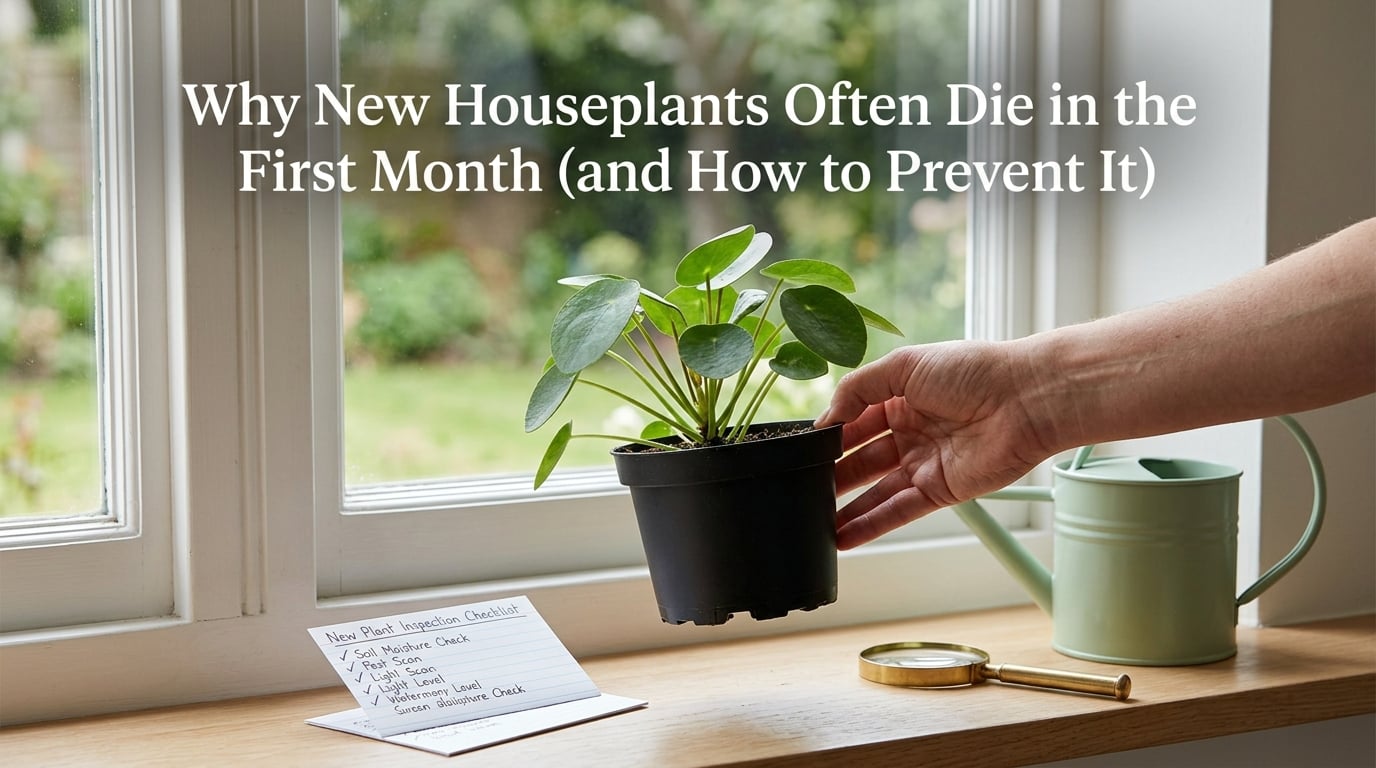
That pothos looked perfect at the nursery. Two weeks later it’s dropping yellow leaves into a soggy pot, and you’re convinced you have a black thumb. Here’s the truth: the number one killer of new houseplants in the first month is overwatering combined with poor drainage, and it’s almost always accidental. Roots sitting in waterlogged soil suffocate and develop root rot within 24 to 48 hours, before you ever see a warning sign above the soil line.
If you keep losing plants in the first 30 days, you’re not cursed. Your plants are reacting to a handful of recurring, avoidable mistakes: overwatering, decorative pots with no drainage, repotting too soon, wrong light placement, and skipped pest checks. I’ve watched friends give up on houseplants after killing three in a row, when a single change to their watering rhythm and pot setup would have saved every one.
In this guide, I’ll walk you through the 30-day acclimation window no one talks about. You’ll get a first-24-hours protocol, a diagnostic table for telling overwatering from underwatering, a printable week-by-week checklist, and a rescue plan for plants already declining. My goal is simple: by the end, you’ll know exactly what your new plant needs from the moment it crosses your threshold.
Table of Contents
What Is the Number One Killer of Houseplants in the First Month?
Overwatering is the single most common cause of new houseplant death, and it almost always happens in the first two to four weeks. According to the University of Florida IFAS Extension, more houseplants die from excess water than from any other single factor, often because owners water on a schedule instead of based on what the soil actually needs. A new plant sitting in constantly wet soil can’t pull in oxygen through its roots, and within days the roots begin to rot.
The pattern is remarkably consistent. You bring home a plant, water it “to help it settle,” then water it again a few days later because the leaves look slightly droopy. The droop was actually a sign of too much water, not too little, but it reads like thirst. By the time the leaves turn yellow or the stem goes mushy, the root system is already compromised.
The other half of the equation is drainage. A pot without a drainage hole traps water at the bottom. The top of the soil looks dry, so you water again, and the lower half of the root ball sits in a swamp. The Missouri Botanical Garden specifically recommends that any container used for houseplants have at least one drainage hole, because standing water around the roots is what creates the anaerobic conditions where rot fungi thrive.
If you remember nothing else from this guide, remember this: when in doubt, do not water. Lift the pot. Stick a finger an inch into the soil. If it’s still damp, walk away.
Your First 24 Hours With a New Houseplant: A Step-by-Step Protocol
The first day sets the trajectory for the entire first month. Most new-plant deaths aren’t really about month one. They start with mistakes made in the first 24 hours that compound for weeks. Here’s the protocol I follow every time I bring a new plant home.
- Quarantine it. Put the new plant in a separate room from your other plants for at least 14 days. New plants frequently arrive with fungus gnats, spider mites, or mealybugs hiding in the soil or on leaf undersides. Reddit’s r/houseplants community calls this “the two-week isolation,” and it’s the single most repeated piece of advice across plant forums.
- Inspect the entire plant. Check the undersides of leaves, the joints where leaves meet the stem, and the soil surface. Look for tiny webs, sticky residue, white cottony fluff, or small flies hovering around the pot.
- Do not repot. I know the nursery pot is ugly. Repot anyway. The plant is already stressed from a change in light, humidity, and temperature. Adding root disturbance on day one stacks the shocks. Wait at least 4 to 6 weeks.
- Find the right light spot. Match the plant tag to a real spot in your home, not the spot you wish you had. A north-facing window is bright indirect for most rooms. Eight feet from a south-facing window is medium, not “bright.”
- Check the soil moisture. Stick a finger an inch down. If it’s damp, do not water. If the plant was just watered at the nursery, it doesn’t need more for at least several days.
- Avoid fertilizing. A stressed plant cannot use fertilizer. Fertilizing a new arrival can burn roots and force soft new growth that the plant can’t support. Wait until you see active new growth before feeding anything.
That’s the whole first day. Six steps, no decorative pots, no fertilizer, no rearranging the living room around it. Restraint is the most underrated plant-care skill.
Transplant Shock Explained: Why the First 30 Days Are Different
Transplant shock is the stress a plant goes through when it suddenly finds itself in a new environment, even when nothing is wrong with its care. A greenhouse-grown pothos has lived its whole life in 70 percent humidity, steady temperatures, and filtered light. Your living room is drier, draftier, and dimmer. The plant has to rebuild internal systems to cope, and that costs energy it would otherwise spend on leaves and roots.
Symptoms of transplant shock look alarming but are usually temporary:
- Drooping leaves that perk up at night and wilt again by afternoon
- Yellowing of one or two lower leaves while the rest look fine
- Sudden leaf drop, especially in ficus, schefflera, and citrus
- A general “sad” look that doesn’t match the watering schedule
Clemson Cooperative Extension notes that most healthy plants recover from transplant shock in 2 to 4 weeks, though some sensitive species like fiddle-leaf figs and citrus can take 6 to 8 weeks. The mistake people make is treating shock symptoms as a problem to fix. They water more, fertilize, move the plant to a new spot, and repot it. Each of those moves resets the clock.
The fix is patience. Pick a spot with appropriate light, water only when the soil is actually dry, leave it alone for a month, and let the plant do its work. Recovery is signaled by new growth, new leaves unfurling, or firming up of stems that were previously soft.
Overwatering and Root Rot: How to Read Your Plant’s Distress Signals
The diagnostic confusion between overwatering and underwatering is the single most common complaint on plant forums. The symptoms overlap, which is why people either water too much trying to fix a drought-stressed plant, or withhold water trying to fix a drowning one. Here’s a side-by-side comparison to keep on your phone.
| Symptom | Overwatered | Underwatered | Root Rot | Transplant Shock |
|---|---|---|---|---|
| Leaf color | Yellow, soft | Yellow, crispy | Yellow then brown, mushy | Slight yellowing at base |
| Leaf texture | Soft, limp | Dry, brittle | Mushy at the stem | Drooping but firm |
| Soil feel | Wet or soggy | Bone dry, pulling from pot edges | Wet, may smell sour | Slightly damp to dry |
| Smell | Musty or sour | Dry, dusty | Rotten, swamp-like | Normal soil smell |
| Stem | Firm but soft | Dry, woody | Black, mushy at base | Firm, upright |
| Recovery speed | Days to weeks after drying out | Hours to days after watering | Requires surgery to save | 2 to 6 weeks, no action needed |
The single fastest diagnostic is the smell test. Slip your nose close to the pot. Healthy soil smells like fresh earth. Root rot smells like a wet sock left in a gym bag. If you smell that, unpot the plant immediately, wash the roots under lukewarm water, and cut away anything brown and mushy with clean scissors. Repot into fresh, dry, well-draining mix and resist the urge to water for at least a week.
The finger test is your friend. For most tropicals, water when the top inch of soil is dry. For succulents and cacti, wait until the soil is dry all the way through. For ferns and calatheas, keep evenly moist but never soggy. Adjust for season: plants use less water in winter when light is low and growth slows.
The Pot and Soil Problem: Why Drainage Matters More Than Aesthetics
The pretty pot is not your friend. Decorative ceramic pots without drainage holes account for a huge share of new-plant deaths, and they’re often the very first thing a new owner buys. The pot looks so good in the store that they bring home the plant, drop it directly into the decorative pot, and never check whether water is escaping the bottom. It isn’t. The plant sits in a slowly accumulating reservoir of stale water, and the roots begin to rot from the bottom up.
If you fall in love with a pot that has no drainage hole, use it as a cachepot, a decorative outer pot that holds the nursery pot inside. Water the plant in its nursery pot over the sink, let it drain for a minute, then place it back in the cachepot. The cachepot catches drips without trapping the roots in standing water.
Pot size matters too. The rule from the University of Florida IFAS is to pot up only 1 to 2 inches larger than the current root ball. Putting a small plant in a huge pot means the soil stays wet for too long because there’s not enough root volume to absorb it. I’ve seen people put a 4-inch pothos into a 12-inch decorative bowl, and within three weeks the entire root system had rotted.
Soil choice is the other half. Most houseplants need a well-draining mix that lets air reach the roots. Standard garden soil compacts in containers and stays wet too long. A good indoor mix contains peat or coco coir for moisture retention, perlite or pumice for drainage, and sometimes orchid bark for chunkiness. For succulents and cacti, go heavier on the perlite, often half perlite to half base mix.
Light, Humidity, and Air: The Three Silent Stressors
Light is the variable plant owners underestimate most. They read “bright indirect light” on a tag, place the plant in their “bright room,” and wonder why the leaves are stretching toward the window within a month. A “bright room” can mean almost anything. Bright indirect light is what you get a few feet back from an east-facing window, or beside (not in front of) a south or west window with a sheer curtain.
A simple light check: hold your hand a foot above the plant at midday. If you see a soft, fuzzy shadow, that’s bright indirect. If you see a sharp-edged shadow with distinct finger outlines, that’s direct light. If you see no shadow at all, that’s low light. Match that to the plant’s tag before you do anything else.
Humidity is the second silent stressor. Most tropical houseplants come from environments with 50 to 70 percent humidity. Average homes in winter run 20 to 30 percent. The leaf edges crisp and brown, the plant drops leaves, and owners reach for the spray bottle. Misting helps for about 15 minutes before the moisture evaporates, so it does very little. The Clemson Cooperative Extension confirms that misting is one of the most over-recommended “solutions” for houseplant problems. A humidifier, a pebble tray, or grouping plants together actually moves the needle.
Air is the third stressor people forget. Heating vents, air conditioners, and drafty windows all create rapid swings in temperature and humidity. A plant sitting directly over a heating register will lose moisture faster than its roots can replace it. So will a plant next to a door that’s opened ten times a day in winter. Move plants at least 3 to 4 feet away from any active air source.
Pest Quarantine: Protecting Your Existing Collection
If you already own houseplants, the new arrival is a potential Trojan horse. Greenhouse conditions are ideal for pests, and most nurseries don’t treat preventively. The two-week quarantine protocol mentioned earlier isn’t paranoia. It’s how experienced plant owners keep spider mites from migrating from one new calathea into a collection of fifty.
The most common hitchhikers on new plants:
- Fungus gnats: Tiny black flies hovering around the soil. Larvae live in the top inch of moist soil and can damage tender roots. Let the soil dry out between waterings and top-dress with sand or decorative gravel.
- Spider mites: Almost invisible. Look for fine webbing on leaf undersides and a stippled, dusty look on the leaf surface. Treat with neem oil or a shower rinse every few days.
- Mealybugs: White cottony tufts in leaf joints. Dab with a cotton swab dipped in 70 percent rubbing alcohol. Repeat weekly.
During the quarantine window, inspect the plant every two to three days. A handheld magnifier or even your phone’s zoom lens makes a real difference. If you spot any pest, treat the plant before it joins the rest of your collection.
5 Common Myths That Kill New Plants
After reading hundreds of forum threads and troubleshooting with friends, I keep seeing the same five myths. Each one sounds reasonable. Each one kills plants. Here’s what to stop doing.
Myth 1: Watering more shows love. Plants don’t experience affection through water. They experience it through stable, appropriate watering that matches their species and environment. More water does not equal more love. It equals rotting roots.
Myth 2: Repot it into a prettier pot right away. A new plant needs time to acclimate before you mess with its roots. Repotting on day one layers transplant shock on top of environment shock. Wait at least four to six weeks, and only repot if the plant is clearly root-bound or the soil is genuinely poor.
Myth 3: Misting creates humidity. Misting raises humidity around the leaf for minutes, then evaporates. It does not meaningfully change the humidity of a room. Use a humidifier, a pebble tray, or group plants together if humidity is the actual problem. Otherwise, save your time.
Myth 4: Fertilizer will revive a struggling plant. Fertilizer is food, not medicine. A stressed plant cannot process nutrients efficiently, and force-feeding it produces weak, leggy growth that’s vulnerable to pests. Wait until the plant shows active, healthy new growth before resuming a normal feeding schedule.
Myth 5: All plants love the same bright window. A south-facing window that suits a succulent will scorch a calathea. A north-facing window that suits a pothos will starve a desert cactus. Read the tag, check the light, and match the plant to the spot you actually have, not the spot you wish you had.
The 30-Day Acclimation Checklist (Printable)
This is the framework no competitor puts together. Save it, print it, or screenshot it. The first 30 days follow a predictable arc, and matching your actions to that arc dramatically improves survival rates.
Week 1 (Days 1 to 7): Quarantine the plant away from other plants. Inspect for pests every 2 to 3 days. Place in the correct light spot. Do not repot. Do not fertilize. Water only if the top inch of soil is dry. Resist the urge to “check on it” more than once a day.
Week 2 (Days 8 to 14): Continue pest inspections. Begin watering on a soil-check basis, not a calendar basis. If leaves are drooping in the afternoon but perking up by morning, that’s transplant shock, not thirst. Leave the plant alone. Do not rotate it, move it, or repot it.
Week 3 to 4 (Days 15 to 30): If the plant is producing new leaves or firming up previously soft stems, you’re past the worst of the shock window. You can begin a light fertilizing routine at half the recommended strength. If the plant is in a clearly undersized nursery pot and is root-bound (roots circling the bottom), this is the safe window for a 1 to 2 inch pot-up with fresh, well-draining mix. If the plant still looks sad, give it more time.
Day 30 check-in: New growth appearing? Pest-free? Light appropriate? Watering matched to soil moisture? If yes to all four, welcome the plant to its permanent home and join it to the rest of your collection. If no, diagnose before taking action. Most first-month deaths come from correcting one problem by creating another.
How to Rescue a Plant That’s Already Declining
If your new plant is already yellowing, dropping leaves, or going limp, the next 48 hours determine whether you save it or lose it. Here’s the decision tree I use.
Step 1: Unpot and inspect the roots. Slide the plant out of its pot and look at the roots. Healthy roots are white, cream, or light tan and feel firm. Rotted roots are brown or black, mushy, and may smell sour. If more than half the roots are rotted, recovery is unlikely. If less than half are rotted, you have a chance.
Step 2: Trim and treat. Cut away every mushy, brown, or black root with clean scissors sterilized in rubbing alcohol. Rinse the remaining healthy roots under lukewarm water. If root rot was present, dust the healthy roots with ground cinnamon, a natural antifungal the University of Florida IFAS notes can help suppress fungal growth on cut surfaces.
Step 3: Repot into fresh, dry mix. Use a clean pot (wash the old one with a 10 percent bleach solution) and fresh, well-draining indoor mix. Do not water for 5 to 7 days. Let the trimmed roots callus over and recover.
Step 4: Provide humidity without overwatering. Place a clear plastic bag over the plant (with stakes to keep the bag off the leaves) to create a temporary greenhouse effect. This reduces moisture loss while the root system rebuilds. Open the bag for an hour daily to prevent fungal issues.
Step 5: Wait and watch. Recovery timelines vary. Some plants show new growth in 2 to 3 weeks. Others take 2 to 3 months. As long as the stem is firm and there are any signs of life, keep going. The moment the stem turns fully mushy and black from the base up, the plant is gone. Compost it, clean the pot, and start fresh.
When to give up: A plant with no firm stem tissue, no live roots, and no green growth for over 60 days is not coming back. Some plants are simply too far gone. Letting go is part of plant care, not a moral failing.
Frequently Asked Questions
What is the number one killer of houseplants?
Overwatering combined with poor drainage is the number one killer of houseplants, especially in the first month. Roots sitting in waterlogged soil suffocate and develop root rot within 24 to 48 hours. The University of Florida IFAS Extension reports that more houseplants die from excess water than from any other single cause.
How long does it take for a plant to recover from transplant shock?
Most healthy plants recover from transplant shock in 2 to 4 weeks. Sensitive species like fiddle-leaf figs and citrus can take 6 to 8 weeks. Clemson Cooperative Extension notes that recovery is signaled by new leaf growth, firming of previously soft stems, and a return to normal watering rhythm. The mistake owners make is treating shock symptoms as problems to fix, when the actual fix is patience.
Why are my newly planted plants dying?
Newly planted houseplants usually die from one of five causes in the first month: overwatering, no drainage hole in the pot, immediate repotting, wrong light placement, or pests brought in from the nursery. Each of these is correctable with a different adjustment, but applying the wrong fix makes things worse. The 30-day acclimation checklist in this guide walks through each cause and the correct response.
How can I prevent transplant shock in my plants?
Prevent transplant shock by following a 7-step protocol: quarantine the plant away from others for 14 days, inspect for pests, do not repot for at least 4 to 6 weeks, place in the correct light spot, water only when the top inch of soil is dry, do not fertilize, and leave the plant in one stable spot without rotating or moving it. Patience in the first 30 days prevents the cascading mistakes that compound shock.
How to keep plants alive while away for 1 month?
Before leaving for a month, move plants away from direct sun to slow water use, water deeply 24 hours before you leave, group plants together to raise local humidity, and ask a friend to check once a week rather than daily. Self-watering pots with reservoirs are the most reliable option for month-long absences. Do not assume your plants need daily watering while you are gone; most need less than you think.
Can houseplants go 2 weeks without water?
Most established houseplants can comfortably go 2 weeks without water, especially in winter when growth slows and light is lower. Succulents and cacti can go 4 to 6 weeks. The plants at risk are newly purchased plants with small root systems and ferns or calatheas that prefer evenly moist soil. The deciding factor is the species, the season, and the size of the pot relative to the root ball.
How long does it take for a dying plant to recover?
A dying plant can begin showing recovery within 2 to 3 weeks after the underlying problem is fixed. Visible new growth typically appears within 4 to 6 weeks. Full recovery, where the plant looks as good as it did at the nursery, can take 2 to 3 months. If a plant shows no improvement after 60 days of correct care, it is unlikely to recover.
Why is my plant dying even though I’m watering it?
A plant dying despite regular watering is almost always a drainage or root rot problem, not a watering frequency problem. The soil may be staying too wet because the pot has no drainage hole, the pot is too large for the root ball, or the soil mix is too dense. Slide the plant out and check the roots. Brown, mushy, sour-smelling roots are root rot, and the fix is trimming affected roots and repotting into dry, well-draining mix.
The Bottom Line
Why do new houseplants die in the first month? Because owners do too much, too soon. They repot into a pretty pot, water to show love, fertilize to help it settle, and place it in a “bright” room that turns out to be too dim or too drafty. Each individual action comes from good intentions. Together, they drown a plant that would have been just fine with restraint.
The framework that saves new plants is boring on purpose. Quarantine for two weeks. Match light to the tag. Water when the soil is dry, never on a calendar. Do not repot for at least a month. Skip fertilizer until you see new growth. Watch for pests. Wait. Within 30 days, you’ll know whether the plant is settling in or struggling, and you’ll have the diagnostic tools to tell the difference. Most first-month plant deaths are preventable. Yours don’t have to be the next statistic.