
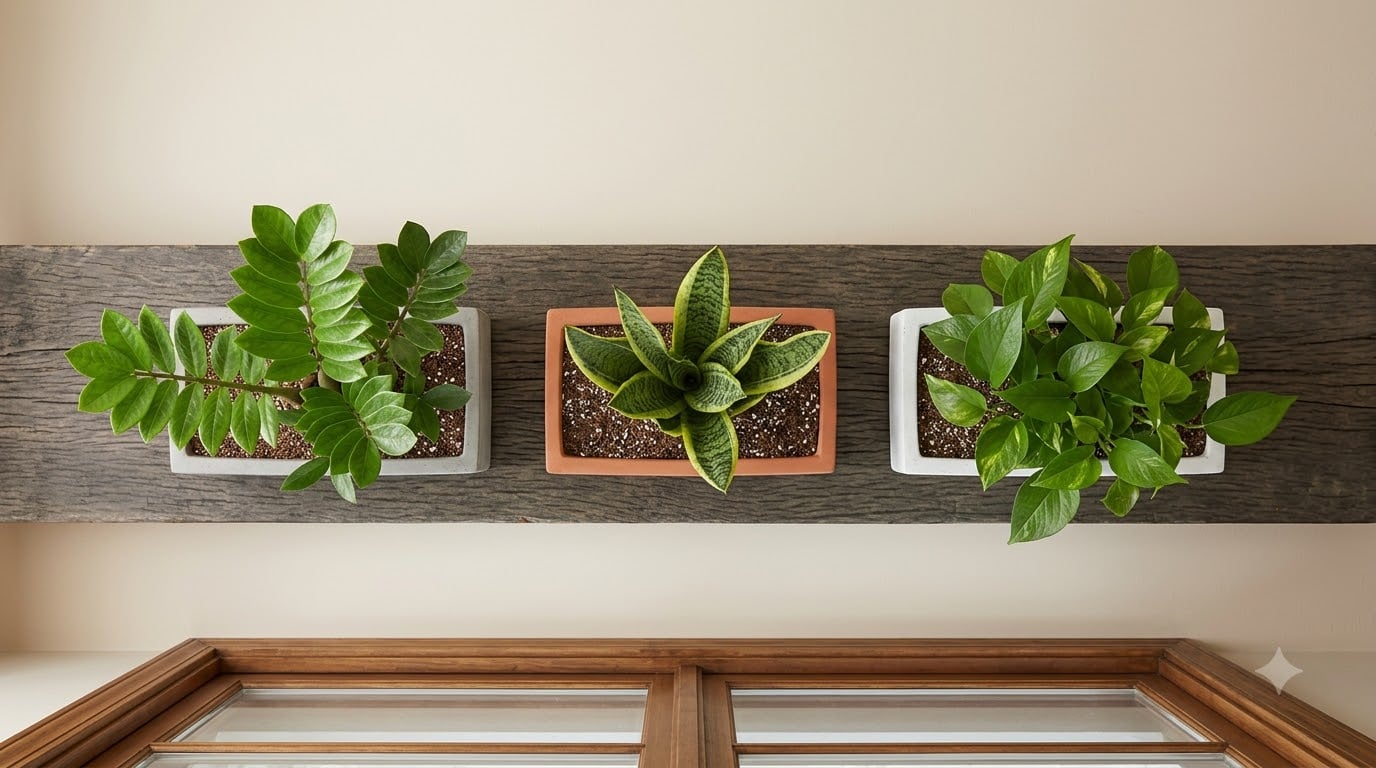
Finding the best low-light houseplants that actually survive dark rooms is harder than it sounds. Most plant guides throw around phrases like “thrives in low light” without telling you what that actually means. I’ve killed more plants in dim corners than I care to admit, and the real issue is that most species marketed as “low-light tolerant” still need far more light than a dark hallway or north-facing bedroom provides.
In this guide, I’m cutting through the marketing noise. I’ll define exactly what “low light” means using foot-candles, share the 10 plants that genuinely survive in dark rooms based on years of grower experience and Reddit community feedback, and give you a realistic timeline for what to expect. Whether you’re dealing with a windowless office, a dim bathroom, or a basement apartment, there are plants that can handle it — you just need the right ones.
Table of Contents
What “Low Light” Actually Means for Houseplants
Low light is one of the most misunderstood terms in houseplant care. Horticulturally, “low light” means 50 to 250 foot-candles (FC) — roughly the illumination you’d get 8 to 12 feet from a north-facing window, or in a hallway with no direct sun at all. For reference, a bright sunny window delivers 1,000+ foot-candles, while an office with overhead fluorescents sits around 300 to 500 FC.
Here’s a practical gauge: if you can comfortably read a book in the spot without turning on a lamp, you’re probably in the 50 to 100 foot-candle range. If you can read but it feels a bit strained, you’re closer to 25 to 50 FC — and that’s essentially “survival mode” for even the toughest plants.
Low light vs. no light matters enormously. A room with a north-facing window still provides usable light. A windowless bathroom or interior closet gets near zero foot-candles. The plants in this guide can handle 50 to 250 FC, but even the hardiest species will eventually decline without some ambient light. If your room has absolutely no windows, you’ll need a grow light — I’ll cover that later.
Etiolation is the key warning sign your plant isn’t getting enough light. You’ll see stems stretching unnaturally long, new leaves growing smaller than older ones, and spacing between leaves widening. The plant is literally reaching for light. If you notice this, move the plant to brighter conditions for a few weeks, then return it — more on rotation strategies below.
Quick-Reference: Low-Light Plants at a Glance
| Plant | Min Foot-Candles | Water Frequency | Pet Safe? | Best Room |
|---|---|---|---|---|
| ZZ Plant | 50 FC | Every 2-3 weeks | Toxic | Office, Bedroom |
| Snake Plant | 50 FC | Every 2-4 weeks | Toxic | Bedroom, Hallway |
| Pothos | 75 FC | Weekly | Toxic | Office, Kitchen |
| Cast Iron Plant | 50 FC | Every 2 weeks | Safe | Hallway, Bathroom |
| Heartleaf Philodendron | 75 FC | Weekly | Toxic | Bedroom, Office |
| Spider Plant | 100 FC | Weekly | Safe | Bathroom, Kitchen |
| Peace Lily | 100 FC | Weekly | Toxic | Bathroom, Bedroom |
| Chinese Evergreen | 50 FC | Every 1-2 weeks | Toxic | Bedroom, Office |
| Satin Pothos | 75 FC | Weekly | Toxic | Living Room, Office |
| Dragon Tree | 100 FC | Every 2 weeks | Toxic | Hallway, Living Room |
The 10 Best Low-Light Houseplants That Actually Survive Dark Rooms
These 10 species are the ones that real growers — and real Reddit users — consistently recommend for surviving in dark rooms. Each profile includes minimum foot-candle requirements, care tips, pet safety notes, and honest expectations for growth speed in low light.
1. ZZ Plant (Zamioculcas zamiifolia)
The ZZ plant is the single best houseplant for dark rooms, period. It thrives at just 50 foot-candles and stores water in thick rhizomes underground, allowing it to go weeks without watering. One Reddit user on r/houseplants reported their ZZ plant surviving for two years in a windowless office with no supplemental lighting.
Growth in low light is extremely slow — expect maybe one or two new stems per year. But slow growth isn’t a problem; it means the plant isn’t suffering, just conserving. Water every two to three weeks, letting the soil dry completely between waterings.
Pet safety: Toxic to cats and dogs if ingested. The sap can also irritate skin, so wear gloves when repotting. Keep it on a high shelf or in rooms pets don’t access.
2. Snake Plant (Dracaena trifasciata)
Snake plants are nearly indestructible in low light, tolerating conditions as dim as 50 foot-candles. They use a special photosynthesis method called CAM (Crassulacean Acid Metabolism) that lets them open their stomata at night instead of during the day, making them extremely efficient in dark environments. One r/houseplants user shared: “I have them in a windowless attic bathroom for 2 years now. Still there, no dead leaves yet.”
Water sparingly — every two to four weeks is plenty. Overwatering is the number one killer of snake plants in low light because the soil stays wet longer without the sun’s warmth to evaporate moisture.
Pet safety: Mildly toxic to cats and dogs. Can cause nausea and vomiting if eaten.
3. Pothos (Epipremnum aureum)
Pothos — sometimes called devil’s ivy — is the trailing vine you see in almost every office building. It handles low light around 75 foot-candles and grows faster in dim conditions than most other plants on this list. The heart-shaped leaves stay green in low light, though variegated varieties like marble queen will lose their white patterns and revert to solid green.
Water weekly, and let the top inch of soil dry between waterings. Pothos is incredibly easy to propagate from stem cuttings, so one plant can fill multiple rooms over time.
Pet safety: Toxic to cats and dogs. Contains calcium oxalate crystals that cause oral irritation and drooling.
4. Cast Iron Plant (Aspidistra elatior)
The cast iron plant earned its name honestly — it handles neglect, low light (down to 50 FC), temperature swings, and irregular watering better than almost any houseplant. Victorian-era homes in England used these in dark hallways with no electric lighting, and they survived for decades. Reddit users on r/houseplants consistently describe it as “indestructible” in dark hallways.
Water every two weeks and use well-draining soil. Growth is slow, but the deep green arching leaves look elegant even without direct light. Unlike many houseplants, the cast iron plant is non-toxic to pets — making it an excellent choice for households with cats and dogs.
Pet safety: Non-toxic. One of the safest choices on this list.
5. Heartleaf Philodendron (Philodendron hederaceum)
The heartleaf philodendron is another trailing vine that handles low light gracefully, growing well at around 75 foot-candles. Its dark green, heart-shaped leaves are naturally adapted to the forest floor, where dappled shade is the norm. In low light, growth slows but the plant stays healthy and full.
Water weekly when the top inch of soil is dry. Like pothos, it’s easy to propagate from cuttings. One difference: philodendron leaves are thinner and more sensitive to cold drafts, so keep it away from air conditioning vents.
Pet safety: Toxic to cats and dogs due to calcium oxalate crystals.
6. Spider Plant (Chlorophytum comosum)
Spider plants need slightly more light than the true low-light champions — around 100 foot-candles minimum — but they’re still one of the best options for dim rooms. They produce arching green-and-white striped leaves and send out baby “spiderettes” that you can propagate into new plants. In very low light, the variegation may fade slightly, but the plant stays healthy.
Water weekly and mist occasionally if your home is dry. Spider plants are sensitive to fluoride in tap water, which causes brown leaf tips. If you notice this, switch to filtered or rainwater.
Pet safety: Non-toxic. A top choice for pet-friendly households.
7. Peace Lily (Spathiphyllum)
Peace lilies handle about 100 foot-candles, putting them at the higher end of “low light” tolerance. What makes them stand out is that they’ll actually bloom in these conditions — white spathes appear even in dim rooms, though flowering is less frequent than in brighter spots. They’re also known for improving indoor air quality.
Water weekly and keep the soil consistently moist but never waterlogged. Peace lilies dramatically droop when thirsty — the leaves will fold down dramatically but perk back up within hours of watering. It’s a helpful visual signal.
Pet safety: Toxic to cats and dogs. Causes oral irritation and difficulty swallowing if ingested.
8. Chinese Evergreen (Aglaonema)
Chinese evergreens are one of the few low-light plants that come in striking color varieties — pink, red, silver, and speckled patterns. The darker green varieties handle the lowest light (around 50 FC), while the colorful cultivars need closer to 100 to 150 FC to maintain their patterns. In truly dim rooms, the colorful varieties will revert to green.
Water every one to two weeks, letting the soil dry slightly between waterings. They prefer humidity, making them a natural fit for bathrooms.
Pet safety: Toxic to cats and dogs.
9. Satin Pothos (Scindapsus pictus)
Satin pothos is often confused with true pothos, but it’s a different genus entirely. Its silver-flecked, velvety leaves add texture that plain green pothos can’t match. It handles about 75 foot-candles, though the silver variegation becomes more subtle in very low light. The trailing habit makes it perfect for shelves and hanging baskets.
Water weekly, allowing the top inch of soil to dry. Satin pothos appreciates slightly higher humidity than golden pothos — a pebble tray or occasional misting helps.
Pet safety: Toxic to cats and dogs.
10. Dragon Tree (Dracaena marginata)
The dragon tree adds vertical drama to dim rooms with its thin, spiky red-edged leaves and tree-like growth habit. It tolerates around 100 foot-candles and can reach 6 feet tall indoors over several years. In low light, growth slows significantly and the red leaf margins may fade, but the plant remains structurally sound.
Water every two weeks and use well-draining soil. Dragon trees are sensitive to fluoride and chlorine in tap water — brown leaf tips are a common complaint. Use filtered water if possible.
Pet safety: Toxic to cats and dogs. Can cause vomiting and loss of appetite.
Best Plants by Room Type
Different rooms create different challenges. Here’s a room-by-room breakdown of which plants work best — and which to avoid.
Bathroom: Bathrooms offer natural humidity but often have no windows. Cast iron plants, peace lilies, and Chinese evergreens handle the humidity and low light combination well. If your bathroom has even a small frosted window, spider plants and pothos also thrive.
Bedroom: Snake plants and ZZ plants are top bedroom picks because they’re low-maintenance and produce no strong scent. A Reddit user on r/houseplants shared: “My zz plant thrives in an office with no windows so definitely that one. I take it out for sun once every 2 weeks for 2 days.” That rotation strategy works great for bedrooms too.
Office or Cubicle: ZZ plants, pothos, and heartleaf philodendrons handle fluorescent-lit offices with no windows. Pothos is especially popular because it trails beautifully along cubicle walls and bookshelves.
Hallway: Dark hallways with no natural light suit cast iron plants and snake plants perfectly. Both have upright, architectural forms that fit narrow spaces and tolerate the dimmest conditions.
How to Care for Low-Light Houseplants
Low-light plants need a different care approach than their sun-loving counterparts. Here are the key principles.
Watering: This is where most people go wrong. Plants in low light use less water because photosynthesis slows down. The soil stays wet longer without sun-driven evaporation. A general rule: water low-light plants about half as often as you would the same species in bright light. Always check the soil with your finger first — the top inch should be dry before you water again.
Overwatering causes root rot, which is the number one killer of low-light houseplants. If the soil smells sour, leaves turn yellow and mushy, or you see fungus gnats, you’re watering too much. Let the plant dry out completely before watering again.
Soil: Use a well-draining potting mix. A standard houseplant mix with added perlite (about 30% perlite to 70% soil) ensures excess water drains quickly. Never let pots sit in saucers of standing water.
Fertilizing: Feed low-light plants at half the recommended strength during spring and summer only. In fall and winter, stop fertilizing entirely. Over-fertilizing in low light causes salt buildup that burns roots.
Humidity: Most tropical low-light plants appreciate 40% to 60% humidity. Grouping plants together, using a pebble tray, or running a humidifier nearby helps. Bathrooms naturally provide this — one reason tropical plants do well there.
Rotation strategy: If possible, rotate plants into brighter light for one to two weeks every month. Many Reddit users on r/houseplants report this extends plant lifespan significantly in dark rooms. Move the plant to a brighter spot, let it photosynthesize and replenish energy stores, then return it to its dark corner.
When to Give Up and Use Grow Lights
Let’s be honest: some rooms are simply too dark for any plant. If your space has zero windows, no glass doors, and no skylights, even the toughest species will eventually decline over 6 to 12 months. In these cases, a small grow light is the answer — not a better plant.
You don’t need a fancy setup. A basic LED grow bulb (10 to 15 watts) in a desk lamp, positioned 12 to 18 inches above the plant, provides enough light to keep most low-light species healthy. Run it for 8 to 12 hours daily on a timer. Many modern grow lights look warm and natural — they don’t give off the harsh purple glow of older models.
A north-facing window with sheer curtains provides roughly 100 to 200 foot-candles — that’s genuinely enough for every plant on this list. A room with no windows provides near zero. Grow lights bridge that gap affordably and reliably.
Common Mistakes That Kill Low-Light Plants
After years of growing plants in dim rooms and reading hundreds of Reddit threads, these are the mistakes I see most often.
Overwatering. I’ve mentioned it multiple times because it’s that important. Low light means slower growth, slower water uptake, and slower soil evaporation. If you water a snake plant in a dark hallway every week like you would in bright sun, it will develop root rot within a month.
Assuming “low light” means “no light.” The garden center label says “low light,” so you put it in a windowless closet. Three months later, the plant is dead. Every plant needs some light — low-light species just need less. Even 50 foot-candles is still measurable light.
Ignoring variegation loss. Variegated pothos, philodendrons, and Chinese evergreens will lose their colorful patterns in low light. The white and cream portions of leaves contain no chlorophyll, so the plant produces more green tissue to compensate. This is normal — not a sign of disease. If you want to keep the variegation, the plant needs brighter conditions.
Using heavy, moisture-retaining soil. Standard potting soil holds too much water for low-light conditions. Always amend with perlite or pumice to improve drainage. A soggy root zone in low light is a recipe for root rot.
Not adjusting care seasonally. In winter, when natural light is even lower and plant metabolism slows, reduce watering by about 30% compared to summer. Resume normal watering in spring when daylight increases.
Frequently Asked Questions
What houseplants are good in dark rooms?
The best houseplants for dark rooms are the ZZ plant, snake plant, cast iron plant, and pothos. These species survive at 50 to 75 foot-candles and have evolved mechanisms like rhizomes for water storage and CAM photosynthesis to thrive with minimal light.
What indoor plants grow well in very low light?
ZZ plants, snake plants, cast iron plants, Chinese evergreens, and pothos grow best in very low light conditions of 50 to 100 foot-candles. Of these, ZZ plants and snake plants are the most tolerant, surviving at just 50 foot-candles.
What houseplant needs the least amount of sunlight?
The ZZ plant needs the least sunlight, surviving at just 50 foot-candles. It stores water in thick rhizomes and grows extremely slowly in low light, requiring watering only every 2 to 3 weeks.
What plants are good for bedrooms with low light?
Snake plants and ZZ plants are ideal for bedrooms with low light. Both tolerate 50 foot-candles, require minimal watering, and don’t produce strong scents. Snake plants also produce oxygen at night through CAM photosynthesis.
Can a ZZ plant survive in a room without windows?
A ZZ plant can survive for months in a room without windows, but it will slowly decline without any light source. For long-term health in a windowless room, add a small LED grow light for 8 to 12 hours daily.
Can I put a snake plant in a room with no windows?
Yes, a snake plant can survive in a room with no windows for several months, but it needs some light eventually. Without any light source, the plant will use stored energy and gradually weaken. A basic grow bulb keeps it healthy indefinitely.
Can a snake plant survive in a dark room?
A snake plant can survive in a dark room at 50 or fewer foot-candles for extended periods. Its CAM photosynthesis allows it to be extremely efficient with light. However, even snake plants need occasional bright light to maintain long-term health.
Can ZZ plants live in a dark room?
Yes, ZZ plants can live in a dark room with as little as 50 foot-candles. They are among the most low-light-tolerant houseplants available. Growth will be very slow — expect only one or two new stems per year — but the plant will remain healthy.
Final Thoughts
Finding low-light houseplants that actually survive dark rooms comes down to choosing the right species and adjusting your care expectations. ZZ plants and snake plants are the undisputed champions at 50 foot-candles, while pothos, cast iron plants, and heartleaf philodendrons handle slightly brighter dim rooms with ease. The key is understanding that low light means slower growth, less frequent watering, and sometimes losing variegation — not that your plant is dying.
Start with one or two from this list, adjust your watering schedule down from what you’d do in brighter conditions, and give them time. Even in the darkest corners of your home, the right plant can survive and add life to the space. And if your room truly has zero windows, a simple grow light turns any dark room into a viable growing environment.