
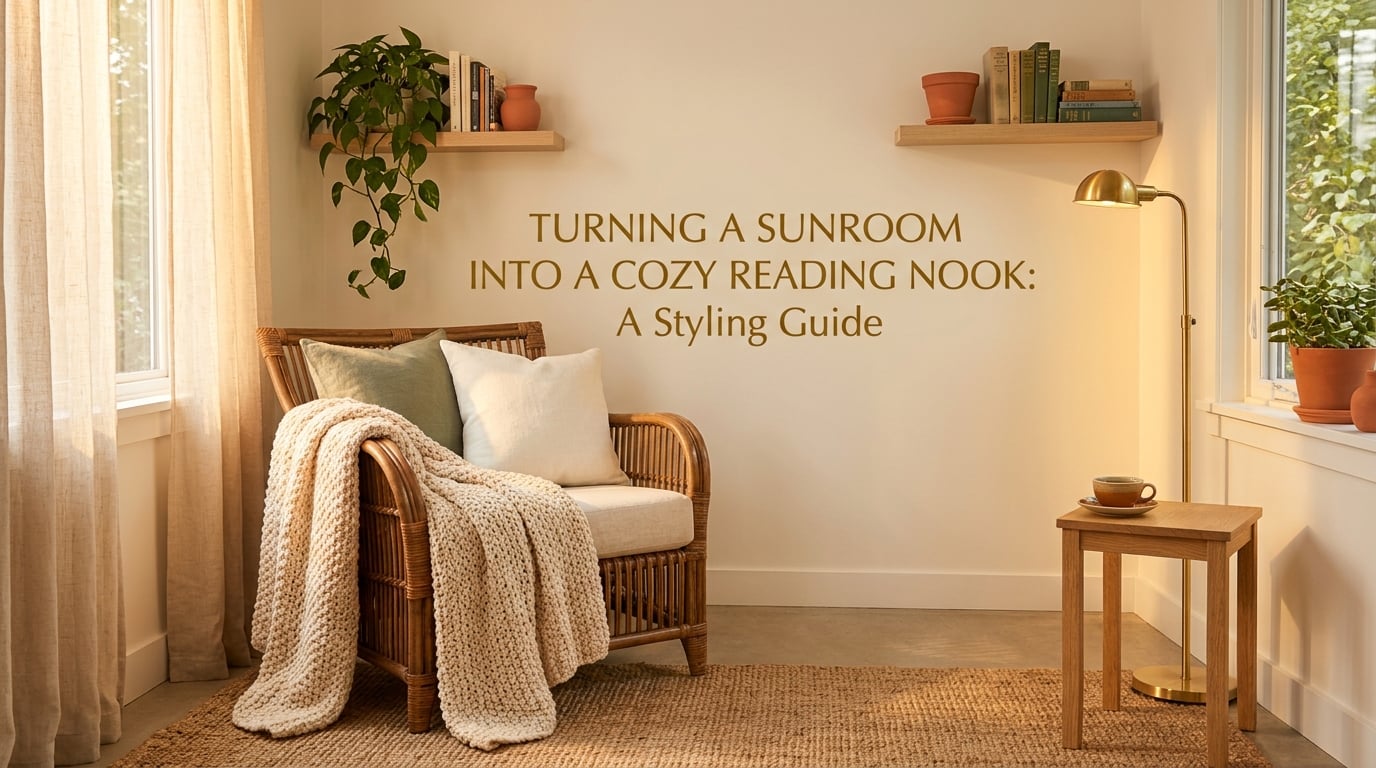
A sunroom reading nook is a dedicated reading corner inside a sunroom, designed around abundant natural light, a comfortable seat with at least 20 inches of seat depth, layered textiles, and warm task lighting around 2700K for evening use. The space typically uses breathable natural-fiber fabrics that handle direct sun better than synthetics, and pairs that daylight with a single anchor chair, a small side table, and bookshelves placed away from harsh UV.
If you have a sunroom, a sleeping porch, or any glass-walled breakfast nook, this guide is for you. Renters building a no-drill floor-cushion setup count too. Over the next few minutes I’ll walk you through the styling order our team uses when we set up a sunroom reading nook: chair first, side table, task lamp, textiles, plants, books, and finally climate control. That sequence is the difference between a finished photo and a nook you actually read in every evening.
Table of Contents
Why a Sunroom Reading Nook Just Works
Daylight through glass walls reduces the eye strain that comes from reading under overhead fluorescents. A sunroom reading nook puts you next to that light all afternoon, which is when most of us finally sit down with a book.
Sunrooms also tend to be the most underused room in the house. They get hot at noon and forgotten by dinner. A deliberate corner with a chair, a lamp, and a throw reverses that pattern – it gives the room a job, which is what turns a glazed pass-through into a daily-use retreat.
There is a long heritage behind the pairing. Victorian conservatories and winter gardens were built around the same idea: bring the outside in, then settle in with a novel. A modern sunroom reading nook inherits that tradition, but skips the dust and the draughts.
The Styling Order: Where to Start
Most sunroom reading nook guides open with a finished photo. Our team flips that. We start with the anchor piece and build outward, because the order you place items in decides how the room actually feels.
Here is the styling order we use, top to bottom:
- Anchor chair. Pick the seat first. Everything else – side table height, lamp reach, rug size – is measured from this piece.
- Side table. Match its surface height to your armrest so a tea and a book both rest easily.
- Task lamp. Position the bulb so light falls over your shoulder, never into your eyes.
- Throw and cushion. Add one wool throw and one linen cushion before the second layer.
- Rug. Place a jute rug under the chair and side table to anchor the zone and absorb echo.
- Plants. Add one large plant and one trailing plant, then step back.
- Books. Curate, don’t decorate. Five favorite spines beat forty random ones.
- Climate control. Add UV-filtering film on the brightest pane last.
That sequence keeps the sunroom reading nook feeling intentional instead of staged. A weekend is enough for the full setup if you start Saturday morning.
Picking the Right Seat
The chair is the only piece of furniture that has to be right. A sunroom reading nook chair needs at least 20 inches of seat depth so your thighs fully rest, an upright enough back for evening reading, and arms at a height that lets your shoulders drop.
Our team has tested most of the popular options over the past year. Here is how the common picks perform in a sunroom:
- Wicker or rattan chair. Breathes well, handles humidity swings, and looks light. Best for east and north-facing rooms.
- Rattan egg chair. Creates a true cocoon. Great for taller readers, but the cushion needs to be washable because direct sun bakes it.
- Bouclé armchair. The cozy classic. Reserve it for north-facing or shaded sunrooms, since bouclé fades faster than linen in direct sun.
- Leather club chair. Ages beautifully, but it can feel sticky in three-season rooms that run hot. Pick an aniline leather, not bonded.
- Papasan chair. Casual and low. Perfect for floor-level reading and renters, since the cushion is one piece and packs flat.
- Daybed or window seat. Best when the sunroom is wide. Lets you stretch out for long sessions and adds hidden storage below.
- Floor cushion setup. The most rental-friendly option. A thick cushion on a jute rug, leaned against the wall, reads as a proper nook.
Whatever you pick, follow the chair orientation pro-tip: position the seat so daylight comes over your shoulder and onto the page, never directly into your eyes. Facing the window full-on looks great in photos but ends the reading session with a headache.
Natural Light and Window Treatments
The sunroom’s biggest asset is daylight, and the biggest threat is uncontrolled daylight. The fix isn’t less glass – it’s better glass.
Start with sheer linen curtains on the brightest exposures. Linen diffuses harsh sun into the soft, even light that photographers love, and it still lets you see the garden. For south and west-facing rooms, layer a thermal curtain behind the sheer so you can drop it mid-afternoon when glare hits the page.
Then add UV-filtering window film to any pane that directly faces the reading chair or the bookshelf. The film is invisible, costs far less than new glazing, and blocks the wavelengths that fade book spines and break down cotton cushion covers. Our team adds it to the back of any open shelf too, by facing the shelf north.
Glare is the silent reason sunrooms go unused at noon. A single sheer linen panel, pulled halfway across the window, usually solves it without darkening the room.
Layered Lighting for Evening Use
Sunrooms die after sunset unless you plan for evening light. Our team treats lighting as three layers: task, ambient, and accent.
Task lighting is the floor lamp beside the chair. A pharmacy floor lamp with an articulating arm is the most useful shape because you can swing the bulb onto the page and away again. Choose a warm bulb at 2700K – cooler blue light tells your brain it’s still midday and keeps you awake.
Ambient lighting fills the rest of the sunroom. A paper lantern overhead, a brass wall sconce on the opposite wall, or a rechargeable lamp on a shelf all do the job. Renters can skip hardwiring entirely: a good rechargeable LED lamp with a USB-C port gives 8 to 12 hours of warm light on a single charge.
Accent lighting is optional but adds depth. A small picture light over a stack of books, or a tea light in a ceramic holder on the side table, gives the sunroom reading nook the glow that makes you want to stay for another chapter.
Textiles, Color Palette, and Layering
Color sets the mood before any other choice. The palettes that work best in a sunroom reading nook are warm and grounded, because direct sun washes out anything cool.
Our team reaches for these combinations first:
- Sage green and warm white. Calming in any sun exposure. Pairs with honey oak and linen.
- Terracotta and oatmeal. Deepens beautifully at golden hour. Works with jute, rattan, and raw cotton.
- Cream, honey oak, and indigo. The Japandi trio. Reads as light and considered.
- Coastal white and driftwood. Best for shaded or north-facing sunrooms, where crisp whites don’t feel stark.
Stick to breathable natural fibers. Linen, cotton, wool, bouclé, and sheepskin all breathe and age well in direct sun. Polyester and acrylic trap heat, fade fast, and pill within a season. The chair cushion, the throw, and the rug should all be a natural fiber if the room runs warm.
Layer three textiles in the seat zone: a jute rug underfoot, a linen cushion on the chair, and a wool throw draped over one arm. That trio absorbs echo from the glass walls – a real sunroom problem – and adds the visual weight that makes the corner feel like a room of its own.
Plants and Greenery That Thrive
Plants are the easiest way to make a sunroom reading nook feel alive. The trick is matching the plant to the exposure.
- South-facing: Fiddle leaf fig, bird of paradise, snake plant, Meyer lemon tree. These love the heat and the brightest light.
- East-facing: Pothos, philodendron, peace lily, parlor palm. They prefer morning sun and softer afternoon shade.
- West-facing: Aloe, succulents, jade plant. They handle the harsh afternoon rays that fade cushions fast.
- Three-season or shaded: Cast iron plant, ZZ plant, ferns. Reliable in cooler and lower-light rooms.
Add a scent element if you can. A potted Meyer lemon tree, a small rosemary pot, or a sprig of eucalyptus in a vase on the side table adds a sensory layer that makes the sunroom reading nook feel more like a retreat than a chair in a window.
Avoid plants that constantly drop leaves or pollen onto book pages. Fiddle leaf figs and citrus trees are fine once you commit to a quick weekly tidy – but skip the bonsai and flowering varieties that shed on every breeze.
Book Storage and Shelving
How you store books in a sunroom reading nook depends on how many you actually want to read. Be honest – a curated stack of ten favorites works harder than a wall of forty unread paperbacks.
For a small stack, a single floating shelf beside the chair at eye height is enough. Add a brass picture light above it for evening glow.
For a fuller library, three options work well. A ladder bookshelf tucks into a corner and leans against the wall without needing anchors. A pair of IKEA Kallax cubes laid on their sides form a low bench-and-shelf combo that holds paperbacks and plants. A single Billy bookcase, painted the same color as the wall, disappears into the room.
Place bookshelves on the north or east walls whenever possible. Direct south or west light fades spines and yellows pages within months. If your only option is a bright wall, run a sheer linen curtain across the shelf during peak hours.
Climate and UV Protection Checklist
This is where most sunroom reading nook guides fall short. Sunrooms swing from cold to hot and back again, and the materials have to handle that.
Our team runs through this checklist on every project:
- UV-filtering window film on any pane that faces the chair or the bookshelf directly.
- Ceiling fan for humidity control and gentle air movement in three-season rooms.
- Thermal curtains on south and west windows, layered behind the sheers.
- Natural-fiber textiles only in the seat zone – linen, cotton, wool, jute. Skip polyester.
- Wood choice: cedar and teak handle humidity swings. MDF and particleboard swell and shed veneer.
- Space heater placement: at least three feet from any textile, on a hard floor, never on a rug.
Run through that list once a season. It takes fifteen minutes and is what keeps the sunroom reading nook looking new after year two.
Small Sunroom and Rental-Friendly Ideas
A small sunroom reading nook works best when the pieces do double duty. Our team has set up corners in 5 by 7 foot rooms – the trick is to commit to one zone and leave the rest of the glass visible.
For small sunrooms, lean into the floor cushion setup. One 30 by 30 inch cushion, two linen pillows leaned against the wall, a single jute rug, and a clip-on reading light is a complete nook that costs less than a single armchair and packs down when guests visit.
For renters, skip anything that needs a drill. Rechargeable lamps with USB-C charging, leaning ladder shelves weighted with books, plug-in wall sconces that hang from a single hook, and tension-rod curtains all leave zero marks on the walls. Take them with you when the lease ends.
Define the zone with a rug, not walls. A 4 by 6 foot jute rug laid under the chair and side table tells every visitor where the reading nook is, even in an open-plan sunroom.
Four-Season Cozy Conversion
A sunroom reading nook can stay useful through winter if you plan for the cold. Three additions cover most climates:
- Layered throws. A wool throw on the chair and a chunky knit folded on the side table let you add warmth without changing the room.
- Thermal curtains. Drop them at sunset in winter to hold the residual heat inside the glass walls.
- Soft floor layer. A sheepskin or faux fur rug underfoot makes cold tile or slate bearable for an evening session.
A small space heater is fine in a sunroom, but keep it on a hard floor and at least three feet from any cushion. Our team prefers oil-filled radiators over fan heaters in glass-walled rooms because they don’t kick dust around.
In three-season rooms, store the linen cushion cover indoors over winter. Direct freeze-thaw cycles shorten the life of any natural fiber.
Common Mistakes to Avoid
Our team has seen the same six pitfalls on every project. Avoid these and your sunroom reading nook will outlast every trend:
- Chair facing the window full-on. Glare ends the session in twenty minutes and fades the cushion cover.
- Polyester and acrylic textiles. They trap heat, fade fast, and pill within a season of direct sun.
- Skipping the rug. Hard floors plus glass walls create real echo. A jute rug absorbs it and warms the feet.
- Chair too small for long sessions. If your thighs hang over the seat edge, you’ll stop reading after one chapter.
- No evening task lighting. A sunroom with no lamp is a sunroom that goes unused after dinner.
- Books on shelves in direct south or west exposure. Spines fade, pages yellow. Move the shelf or run a sheer curtain.
Fix two or three of these on a single afternoon and the sunroom reading nook transforms.
Quick Setup Checklist
If you want the shortest path to a finished sunroom reading nook, work through this list over a single weekend:
- Pick and place the anchor chair.
- Add the side table at armrest height.
- Set up the task lamp with a 2700K bulb.
- Layer one throw and one cushion.
- Roll out a jute rug under the seat zone.
- Add one large plant and one trailing plant.
- Curate five to ten favorite books on a floating shelf.
- Apply UV-filtering film to the brightest pane.
The order is the trick. Build from the chair outward, and the room settles into itself. Our team can usually complete the full setup in a Saturday afternoon, with Sunday reserved for plants and bookshelves.
Frequently Asked Questions
What is a sunroom reading nook?
A sunroom reading nook is a dedicated reading corner inside a sunroom, designed around abundant natural light, a comfortable seat with at least 20 inches of seat depth, layered natural-fiber textiles, and warm task lighting around 2700K for evening use. It pairs daylight with a single anchor chair, a small side table, and bookshelves placed away from direct UV.
What chair works best for a sunroom reading nook?
The best chair is one with at least 20 inches of seat depth, upright back support, and arms at a comfortable height. Wicker and rattan breathe well in humidity, bouclé feels cozy in shaded rooms, leather ages beautifully but can feel sticky in three-season rooms, and papasan chairs work for casual floor-level reading. Position the seat so light comes over your shoulder, never into your eyes.
How do I keep books from fading in a sunroom?
Apply UV-filtering window film to any pane that directly faces the bookshelf, run a sheer linen curtain across the shelf during peak sun hours, and place bookshelves on north or east walls whenever possible. A ceiling fan and steady air circulation also reduce the heat buildup that yellows pages and fades spines.
What plants belong in a sunroom reading nook?
Match the plant to the exposure. South-facing rooms suit fiddle leaf fig, snake plant, and Meyer lemon tree. East-facing rooms suit pothos, philodendron, and parlor palm. West-facing rooms suit succulents, aloe, and jade plant. Three-season or shaded rooms suit ZZ plant, cast iron plant, and ferns.
Can a small sunroom become a cozy reading nook?
Yes. Commit to one zone with a floor cushion, two linen pillows, a jute rug, and a clip-on reading light. A 5 by 7 foot sunroom can hold a complete reading nook if you leave the rest of the glass visible and define the corner with a rug instead of walls.
How do I make my sunroom reading nook cozy in winter?
Layer wool throws and chunky knit blankets, drop thermal curtains at sunset to hold residual heat, add a sheepskin rug underfoot, and run a small oil-filled radiator on the hard floor at least three feet from any textile. Store linen cushion covers indoors in winter to extend their life.
What is the budget version of a sunroom reading nook?
A floor cushion on a jute rug, two linen pillows, a clip-on reading light, a single potted plant, and a small floating shelf with five favorite books. The setup requires no drilling, packs down when you move, and uses the same materials and layering principles as a full setup.
How long does it take to set up a sunroom reading nook?
A focused weekend is enough for a full setup. Saturday covers the chair, side table, task lamp, and rug. Sunday covers plants, books, and UV film. Renters running a floor cushion version can finish in a single afternoon.
Conclusion
A sunroom reading nook is the easiest way to put an underused glazed room to work every evening. Anchor the corner with a chair that fits your body, layer from there, and respect the two real constraints: glare at midday and humidity swings through the seasons.
If you remember one thing from this guide, make it the styling order. Pick the chair first, then the side table, then the lamp, then the textiles, then the plants, then the books, then the climate control. That sequence is what separates a sunroom reading nook you actually use from a sunroom that looks good in a single photo.
Start with the checklist this weekend. Add one layer at a time. By next month you’ll have a sunroom reading nook that pulls you off the couch and into the warmest, brightest corner of the house – in 2026 and for years after.