
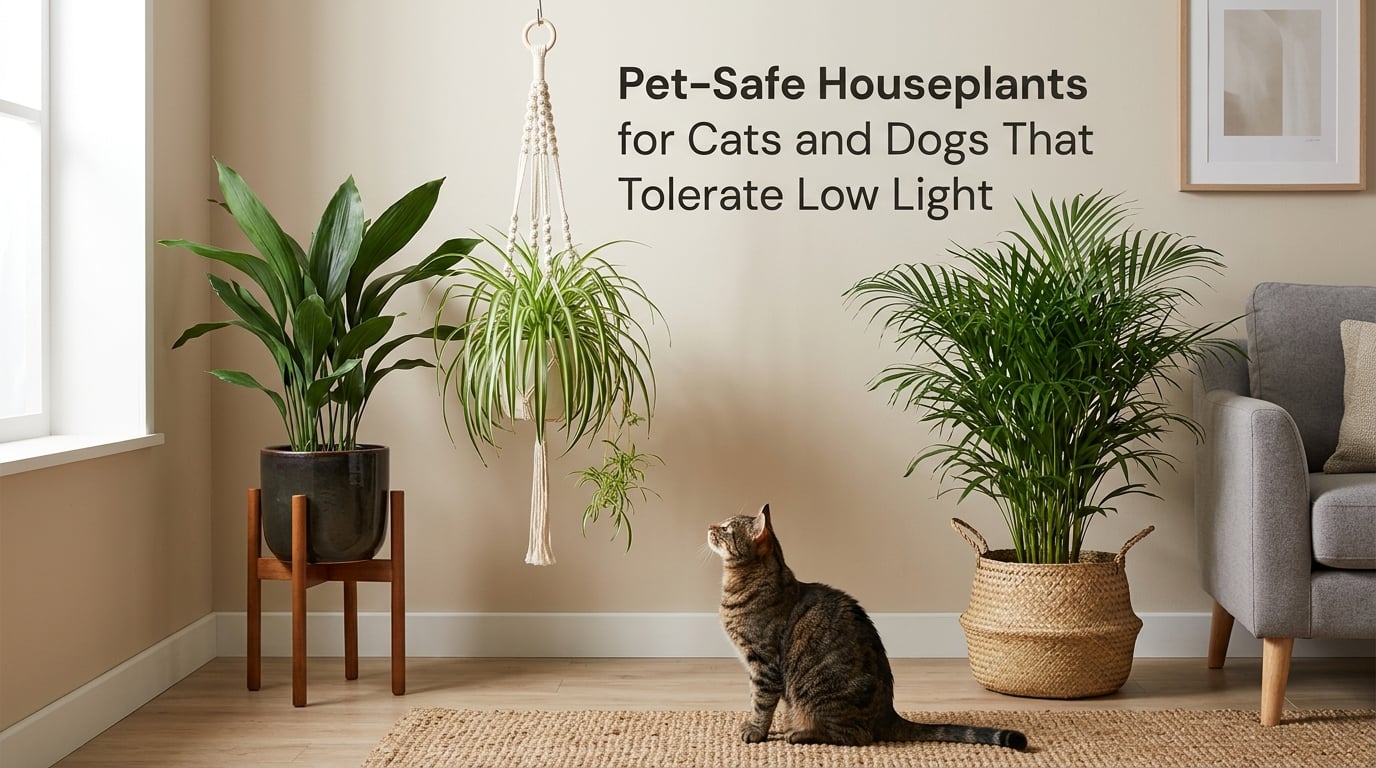
Pet-safe houseplants for cats and dogs that tolerate low light are indoor plants verified non-toxic by the ASPCA Animal Poison Control database that can thrive in shaded, indirect, or dim indoor conditions. Many popular low-light houseplants you see at garden centers, including snake plants, pothos, philodendrons, and lilies, are actually toxic to pets, so choosing the right species matters. Our team compiled this guide to help cat and dog owners in apartments, basements, and north-facing rooms fill their spaces with greenery that is safe, beautiful, and genuinely low-light tolerant.
In the sections below, you’ll find a quick-picks chart, 15 detailed plant profiles with care specs, a warning list of toxic lookalikes to avoid, a room-by-room placement guide, and practical tips for keeping curious pets out of trouble.
Table of Contents
What “Low Light” Actually Means for Indoor Plants
Low light does not mean no light. It means bright, indirect light or shaded conditions – the kind of light you find near a north-facing window, 5+ feet back from an east or west window, or in rooms with frosted glass or skylights. Direct sun is not required.
Most low-light houseplants evolved as tropical understory plants, so their leaves are built to photosynthesize efficiently with filtered light. That same trait – shade tolerance – is exactly what makes them ideal for apartments without south-facing windows, basement rooms with one small window, or interior hallways without natural light at all.
If you can read a book comfortably during the day without turning on a lamp, your room qualifies as low to medium light. If you need a lamp even at noon, you are looking at very low light, and you’ll want to choose from the toughest species we cover below.
Quick Picks: Pet-Safe Plants for Low Light at a Glance
Here is a quick-reference chart of seven top pet-safe houseplants that tolerate low light. Each handles dim conditions, stays non-toxic to cats and dogs, and has been cross-checked with the ASPCA Toxic and Non-Toxic Plants list.
- Cast Iron Plant (Aspidistra elatior) – Best for: dim corners and neglect. Light: very low. Care: very easy. Safe for: cats and dogs.
- Spider Plant (Chlorophytum comosum) – Best for: hanging baskets and shelves. Light: bright indirect to medium. Care: easy. Safe for: cats and dogs (may cause mild GI upset).
- Boston Fern (Nephrolepis exaltata) – Best for: bathrooms and humid rooms. Light: medium indirect. Care: moderate (likes humidity). Safe for: cats and dogs.
- Prayer Plant (Maranta leuconeura) – Best for: bedrooms and offices. Light: low to medium. Care: moderate. Safe for: cats and dogs.
- Parlor Palm (Chamaedorea elegans) – Best for: statement floor plant. Light: low to medium. Care: easy. Safe for: cats and dogs.
- African Violet (Saintpaulia ionantha) – Best for: kitchen counters and tabletops. Light: medium indirect. Care: easy. Safe for: cats and dogs.
- Chinese Money Plant (Pilea peperomioides) – Best for: desks and beginner owners. Light: medium indirect. Care: very easy. Safe for: cats and dogs.
15 Pet-Safe Low-Light Houseplants Worth Bringing Home
Below are 15 indoor plants verified non-toxic to cats and dogs by the ASPCA, each one chosen because it genuinely tolerates indirect or shaded light without becoming leggy or stressed. Where care needs differ for cats versus dogs, we call it out.
1. Cast Iron Plant (Aspidistra elatior)
The cast iron plant earned its name by surviving neglect, dim corners, and fluctuating temperatures for well over a century. It is native to the forest floors of Japan and Taiwan, so a dim living room corner feels like home.
- Light: Very low to medium indirect. Tolerates fluorescent office lighting.
- Water: Water when the top inch of soil is dry. Reduce in winter.
- Humidity: Average household humidity is fine.
- Mature size: 2 to 3 feet tall and wide.
- Pet-safe for: Cats and dogs (ASPCA verified).
We recommend it as the top pick for north-facing hallways or rooms with no windows at all – the species our team has had survive for years with only overhead lighting.
2. Spider Plant (Chlorophytum comosum)
Spider plants are a beginner favorite, and for good reason. They produce arching variegated leaves and small white flowers, then send out baby plantlets on long stems that you can root in water to share with friends.
- Light: Bright indirect preferred, but tolerates medium and some lower conditions.
- Water: Keep lightly moist; let the top inch dry between waterings.
- Humidity: Average to slightly above average.
- Mature size: Up to 24 inches tall; plantlets dangle another 12 to 18 inches.
- Pet-safe for: Cats and dogs, with a caveat. Spider plants are non-toxic but contain compounds that may cause mild GI upset or nausea if a curious cat chews them.
Hang it in a macrame hanger or set it on a high shelf. Many cats love the dangling plantlets – placing the plant out of reach sidesteps that playful nibbling.
3. Boston Fern (Nephrolepis exaltata)
Boston ferns have been parlor staples since the Victorian era. Their feathery fronds and humidity-loving nature make them the perfect bathroom companion, especially in a windowless powder room with regular steam.
- Light: Medium indirect. Tolerates lower light but grows more slowly.
- Water: Keep soil consistently moist; never let it dry out completely.
- Humidity: High – above 60 percent is ideal.
- Mature size: 2 to 3 feet tall and wide when happy.
- Pet-safe for: Cats and dogs (ASPCA verified).
Brown, crispy fronds usually mean the air is too dry. Mist daily or place the pot on a pebble tray with water.
4. Prayer Plant (Maranta leuconeura)
Prayer plants fold their leaves up at night like hands in prayer, giving you a living plant that actually moves. The foliage is heavily patterned in green and red veins, which adds color to dim corners without much direct sun.
- Light: Low to medium indirect.
- Water: Keep evenly moist; use filtered or rainwater if your tap water is hard.
- Humidity: Moderate to high.
- Mature size: 8 to 12 inches tall; trails in a hanging planter.
- Pet-safe for: Cats and dogs (ASPCA verified).
Prayer plants dislike tap water in many regions because fluoride scorches their leaf tips. Filtered water prevents the browning.
5. Calathea (Calathea spp.)
Calatheas are sometimes called “living paintings” for the brushstroke stripes on their oval leaves. They are closely related to prayer plants and share similar care needs. The ASPCA confirms most Calathea species are non-toxic to cats and dogs.
- Light: Low to medium indirect – direct sun fades their patterns.
- Water: Keep lightly moist with filtered, room-temperature water.
- Humidity: High – 50 percent or more keeps leaves looking fresh.
- Mature size: 1 to 3 feet tall, depending on species.
- Pet-safe for: Cats and dogs (ASPCA verified).
Calatheas are not the easiest plant on this list, so if you are a beginner, start with one of the easier picks below and work up.
6. Parlor Palm (Chamaedorea elegans)
Parlor palms deliver a true tropical statement in a small package. They were the houseplant of choice in Victorian parlors because they tolerated the dim gaslight of the era, and they thrive in modern low-light interiors for the same reason.
- Light: Low to medium indirect.
- Water: Water when the top inch of soil is dry; never let the pot sit in water.
- Humidity: Tolerates average household humidity.
- Mature size: Slowly reaches 4 to 6 feet indoors.
- Pet-safe for: Cats and dogs (ASPCA verified).
Do not confuse the parlor palm with the sago palm, which is in the cycad family and is extremely toxic to dogs and cats. Always verify the scientific name on the label.
7. Polka Dot Plant (Hypoestes phyllostachya)
Polka dot plants are small, bushy plants with leaves speckled in pink, white, or red. They add a splash of color to shelves and desks where other foliage plants look flat, and they handle medium light beautifully.
- Light: Medium indirect for the brightest leaf color.
- Water: Keep evenly moist; they wilt dramatically if dry.
- Humidity: Above 50 percent keeps leaves from crisping.
- Mature size: 6 to 12 inches tall.
- Pet-safe for: Cats and dogs (ASPCA verified).
Pinching the growing tips regularly keeps the plant compact and bushy rather than leggy.
8. Peperomia (Peperomia spp.)
Peperomias are a huge family of compact, succulent-tinged houseplants. With over 1,000 species, there is a peperomia for nearly every aesthetic, from watermelon-striped leaves to rippled emerald ovals.
- Light: Medium indirect; some tolerate lower light.
- Water: Allow the top half of soil to dry between waterings – less is more.
- Humidity: Average household humidity.
- Mature size: Most stay under 12 inches tall.
- Pet-safe for: Cats and dogs (ASPCA verified).
Overwatering is the biggest killer. Their semi-succulent stems hold moisture, so skip a watering if you are unsure.
9. Chinese Money Plant (Pilea peperomioides)
Round, coin-shaped leaves fan out on slender stalks from a central stem, giving this plant its nickname. Our team recommends it as the best beginner pet-safe low-light plant because it forgives missed waterings and rarely drops leaves.
- Light: Medium indirect for compact growth; tolerates lower light but stretches.
- Water: Water when the top inch of soil is dry; roughly once a week.
- Humidity: Average household humidity.
- Mature size: 8 to 12 inches tall and wide.
- Pet-safe for: Cats and dogs (ASPCA verified).
Rotate the pot a quarter turn each week so the plant grows evenly instead of leaning toward the window.
10. Baby’s Tears (Soleirolia soleirolii)
Baby’s tears form a dense, soft mat of tiny round leaves. They shine in terrariums, on tabletops, or as a living mulch around the base of a larger plant in a wide bowl.
- Light: Medium indirect is ideal; tolerates low light.
- Water: Keep soil consistently moist – the leaves crisp quickly when dry.
- Humidity: High; perfect for terrariums and bathrooms.
- Mature size: Spreads several inches; stays under 4 inches tall.
- Pet-safe for: Cats and dogs (ASPCA verified).
This is one of the best plants for a closed glass terrarium because it loves the steady humidity.
11. African Violet (Saintpaulia ionantha)
African violets have been bringing color to windowsills since the 1890s. They flower year-round under the right conditions and are forgiving enough for first-time plant owners.
- Light: Medium indirect; an east-facing window is ideal.
- Water: Water from the bottom to keep leaves dry – wick up rather than over the top.
- Humidity: Average; avoid wetting the leaves.
- Mature size: 6 to 8 inches tall and wide.
- Pet-safe for: Cats and dogs (ASPCA verified).
Bottom watering prevents the leaf-spotting that happens when cold water touches warm fuzzy leaves.
12. Friendship Plant (Pilea involucrata)
The friendship plant is a smaller cousin of the Chinese money plant, with deeply textured, bronze-green leaves and pink undersides. It is easy to share because mature plants produce offsets you can pot up for friends.
- Light: Medium indirect; tolerates lower light.
- Water: Keep lightly moist; never let it dry fully.
- Humidity: Above 50 percent keeps the textured leaves looking their best.
- Mature size: 6 to 8 inches tall.
- Pet-safe for: Cats and dogs (ASPCA verified).
Pair it with a calathea or prayer plant in a group planting so all three share the same humidity tray.
13. Bird’s Nest Fern (Asplenium nidus)
Bird’s nest ferns grow as a single, bright-green rosette of wide, wavy leaves that emerge from a fuzzy central crown. They look like living fountains and make excellent floor plants in shaded corners.
- Light: Low to medium indirect – direct sun scorches the fronds.
- Water: Water when the top inch is dry; water into the central rosette.
- Humidity: Above 50 percent ideal.
- Mature size: 2 to 4 feet tall and wide at maturity.
- Pet-safe for: Cats and dogs (ASPCA verified).
They dislike root disturbance, so choose a pot you are happy with for the long haul.
14. Nerve Plant (Fittonia albivenis)
Nerve plants are tiny terrarium stars, with leaves netted in pink, white, or red veins. They are dramatic faders – if you forget to water, they wilt dramatically within hours, then bounce back just as fast when hydrated.
- Light: Low to medium indirect.
- Water: Keep soil consistently moist; never let it dry out.
- Humidity: Very high – they thrive in closed terrariums.
- Mature size: 4 to 6 inches tall; trails slightly in a wide pot.
- Pet-safe for: Cats and dogs (ASPCA verified).
The dramatic wilt is actually useful – it tells you clearly when your pet-safe plant needs a drink before it suffers real damage.
15. Swedish Ivy (Plectranthus verticillatus)
Swedish ivy rounds out the list as a trailing, fast-growing plant that fills a hanging basket quickly. Its scalloped leaves spill over the edges of pots and are easy to root in water for propagation.
- Light: Medium indirect.
- Water: Allow the top inch of soil to dry between waterings.
- Humidity: Average household humidity.
- Mature size: Trails 24 to 36 inches from a hanging basket.
- Pet-safe for: Cats and dogs (ASPCA verified).
One of the easiest pet-safe plants to share – a single cutting in a glass of water roots in a week.
Plants to Avoid: Toxic Lookalikes That Look Like Safe Species
Some of the most popular low-light houseplants are toxic to cats and dogs. Many of them sit on plant stands in living rooms right next to a curious pet, so it pays to know their names and what symptoms to watch for.
- Lilies (Lilium and Hemerocallis spp.): Extremely toxic to cats – even pollen can cause kidney failure. Highly toxic to dogs as well. Substitute with a peace lily (also mildly toxic) or a parlor palm in dim light.
- Snake Plant (Sansevieria trifasciata): Causes nausea, vomiting, and diarrhea in cats and dogs. Substitute with a cast iron plant, which has a similar upright look.
- Pothos (Epipremnum aureum): Contains calcium oxalate crystals that irritate the mouth. Substitute with a peperomia, which has similar trailing foliage.
- Philodendron (Philodendron spp.): Same calcium oxalate issue as pothos. Substitute with a calathea for similar large, patterned foliage.
- Sago Palm (Cycas revoluta): All parts are highly toxic; the seeds are especially dangerous for dogs. Highly toxic to cats as well. Substitute with a parlor palm.
- Oleander (Nerium oleander): Cardiotoxic if ingested. Substitute with a false oleander (Nerium oleander is unrelated) or a hibiscus for similar flowers outdoors.
- Poinsettia (Euphorbia pulcherrima): Mildly toxic – causes drooling and GI upset. Substitute with a Christmas cactus or a red polka dot plant for holiday color.
- Hyacinth (Hyacinthus orientalis): Bulbs are toxic; the bulbs are especially dangerous for dogs who dig. Substitute with a Chinese money plant in dim indoor conditions.
If you suspect your cat or dog has chewed on any plant on this list, call your veterinarian or the ASPCA Animal Poison Control Center at 888-426-4435 right away. There is a consultation fee, but the hotline runs 24 hours a day, every day of the year.
How to Verify a Plant Is Pet-Safe Yourself
Store labels and even some plant websites get pet-safe status wrong. Verifying against the ASPCA’s own database is the safest way to know what you are bringing home.
- Find the scientific name. Common names overlap between harmless and harmful species, so always check the botanical name on the plant tag or seed packet.
- Search the ASPCA database. The ASPCA maintains a free, searchable Toxic and Non-Toxic Plants list at aspca.org/pet-care/animal-poison-control/toxic-and-non-toxic-plants. Search by both common and scientific name, since both are indexed.
- Cross-check with a second source. The Pet Poison Helpline (petpoisonhelpline.com) maintains a similar list. If both sources label a plant non-toxic, you have a strong signal.
- Call the ASPCA hotline when uncertain. Dial 888-426-4435 if you cannot find a plant in the database or your pet is showing unusual symptoms.
- Re-check before introducing a new species. Even experienced pet owners add plants without checking – taking 60 seconds to verify saves an emergency vet visit.
This database-driven approach is what professional horticulturists use, and it takes the guesswork out of plant shopping.
Best Room Placement for Pet-Safe Low-Light Plants
Different rooms in your home offer different combinations of light and humidity. Pairing the right plant with the right room keeps both the plant and your pet happier.
Bathroom
Bathrooms are warm, humid, and often dim – perfect for Boston fern, nerve plant, baby’s tears, and prayer plant. The humidity from showers replaces a daily misting routine.
Bedroom
Bedrooms tend to be medium light with cooler overnight temperatures. Cast iron plant, Chinese money plant, peperomia, and parlor palm all do well here.
Home Office
Offices usually have one window or overhead fluorescent light. Spider plants tolerate fluorescent light well, and a cast iron plant handles the dry indoor air.
Living Room
Living rooms vary, but parlor palm, bird’s nest fern, and African violet give you a mix of foliage, color, and texture in one display.
Hallways and Dim Corners
True low-light zones without a window are the cast iron plant’s home turf. A Chinese money plant or peperomia also survives overhead lighting for years.
Care Tips Specific to Pet-Safe Low-Light Plants (2026)
Low-light plants are generally low-maintenance, but a few adjustments from typical care advice make a noticeable difference.
Water less, not more. In lower light, plants photosynthesize more slowly and use less water. Overwatering is the fastest path to root rot, especially in peperomia, African violets, and pothos substitutes like hoya (which we excluded because it has mild toxicity myths).
Skip the fertilizer during winter. Most pet-safe low-light plants rest in winter and do not need feeding. Resume a diluted houseplant fertilizer in spring and summer only.
Watch humidity, not just light. Ferns, calatheas, and prayer plants collapse in dry winter indoor air. A pebble tray, a small humidifier, or grouping plants together makes a measurable difference.
Use pots with drainage. Every plant on this list prefers well-draining soil. Cachepots without drainage holes lead to root rot, which is the most common cause of indoor plant failure.
Keep all foliage dry. Wet leaves invite fungal issues, especially on African violets, peperomia, and friendship plants. Bottom water or pour at the soil level.
Keeping Curious Pets Safe Around Your Plants
Pet-safe does not mean snack-proof. Even non-toxic plants can cause mild GI upset if chewed in large amounts, and a knocked-over cachepot can be a foot hazard. Here is what works for us at home.
Placement Strategies
Hanging baskets and macrame hangers: Best for spider plants, pothos lookalikes, and trailing peperomia. Choose a hanger with a ceiling hook rated for the pot’s weight.
Plant stands and high shelves: Cast iron plants, parlor palms, and African violets are happy on a 3-foot stand where cats cannot reach. Wipe the stand regularly because cats will use any ledge as a perch.
Closed terrariums: The humidity dome protects baby’s tears, nerve plants, and small ferns from a curious snout. They also work in low-light spots where humidity would otherwise be hard to maintain.
Heavy cachepots: A heavy ceramic or stone cachepot prevents toppling when a 60-pound dog bumps your floor plant. Decorative plastic shells on the outside are fine as long as the inner pot has drainage.
Common Myths Worth Busting
Many owners believe snake plants or pothos are safe “if my pet doesn’t actually eat them.” This is misleading – any chewing leaves residue that can irritate the mouth, and a single bite is enough to cause symptoms in a small animal. If a plant is on the toxic list, keep it out of reach or remove it entirely.
Another myth is that “pet-safe” means the plant cannot upset a stomach. Spider plants, peperomia, and prayer plants can all cause mild vomiting or diarrhea when chewed in quantity. The ASPCA classifies them as non-toxic because they do not contain dangerous compounds, but always monitor your pet after any plant ingestion.
Frequently Asked Questions
What shade plants are safe for cats?
Shade-tolerant plants verified non-toxic to cats include cast iron plant, spider plant, Boston fern, prayer plant, calathea, parlor palm, polka dot plant, and peperomia. Always cross-check the exact species against the ASPCA Toxic and Non-Toxic Plants database before bringing a new plant home, because plant names can overlap and misidentification is common.
Can pet-safe plants still upset a pet’s stomach?
Yes. Pet-safe means non-toxic, not snack-proof. Spider plants, for example, can cause mild nausea or vomiting in cats when chewed in quantity, even though the ASPCA classifies them as non-toxic. Plant compounds, fiber, and unfamiliar taste all can cause temporary GI upset. Always monitor your pet after any plant ingestion and call your veterinarian if symptoms persist.
Which cat-safe plants are good for bathrooms?
Bathrooms are perfect for humidity-loving pet-safe plants including Boston fern, nerve plant, baby’s tears, prayer plant, and bird’s nest fern. The steam from showers provides the humidity these species need, and most bathrooms have medium indirect light at most. Just be sure the pot has drainage because humidity slows soil drying.
Are calatheas safe for cats and dogs?
Yes. The ASPCA lists most Calathea species as non-toxic to cats and dogs. They are a popular choice for pet owners who want patterned, colorful foliage and tolerate low to medium indirect light. Note that calatheas prefer high humidity and filtered water, which makes them less beginner-friendly than cast iron plants or peperomia.
Do low-light houseplants need a window?
Most low-light plants still need some natural light to thrive long-term, but they do not need direct sun. A north-facing window, 5+ feet from an east or west window, or a room with overhead lighting during the day is usually enough. Cast iron plant is one of the few species that survives in rooms with no window at all, though growth is slower.
What pet-safe plant is easiest for beginners?
The Chinese money plant (Pilea peperomioides) and cast iron plant (Aspidistra elatior) are the two easiest pet-safe low-light plants for beginners. Chinese money plant has round, coin-shaped leaves and forgives occasional missed waterings. Cast iron plant tolerates neglect, dim corners, and dry air better than almost any other houseplant, and both are ASPCA-verified non-toxic to cats and dogs.
Final Thoughts on Choosing Pet-Safe Houseplants for Low Light (2026)
Living with cats and dogs does not mean giving up on greenery. Pet-safe houseplants for cats and dogs that tolerate low light are easy to find once you know which species to look for, and our team has curated 15 options above that should cover most homes, from windowless basements to dim hallways. The safest routine is simple: verify every new plant against the ASPCA Toxic and Non-Toxic Plants list, keep the Animal Poison Control hotline (888-426-4435) handy, and choose placement strategies that make chewing less tempting for curious pets. With those habits in place, you can fill your home with thriving, non-toxic greenery without sacrificing peace of mind.