
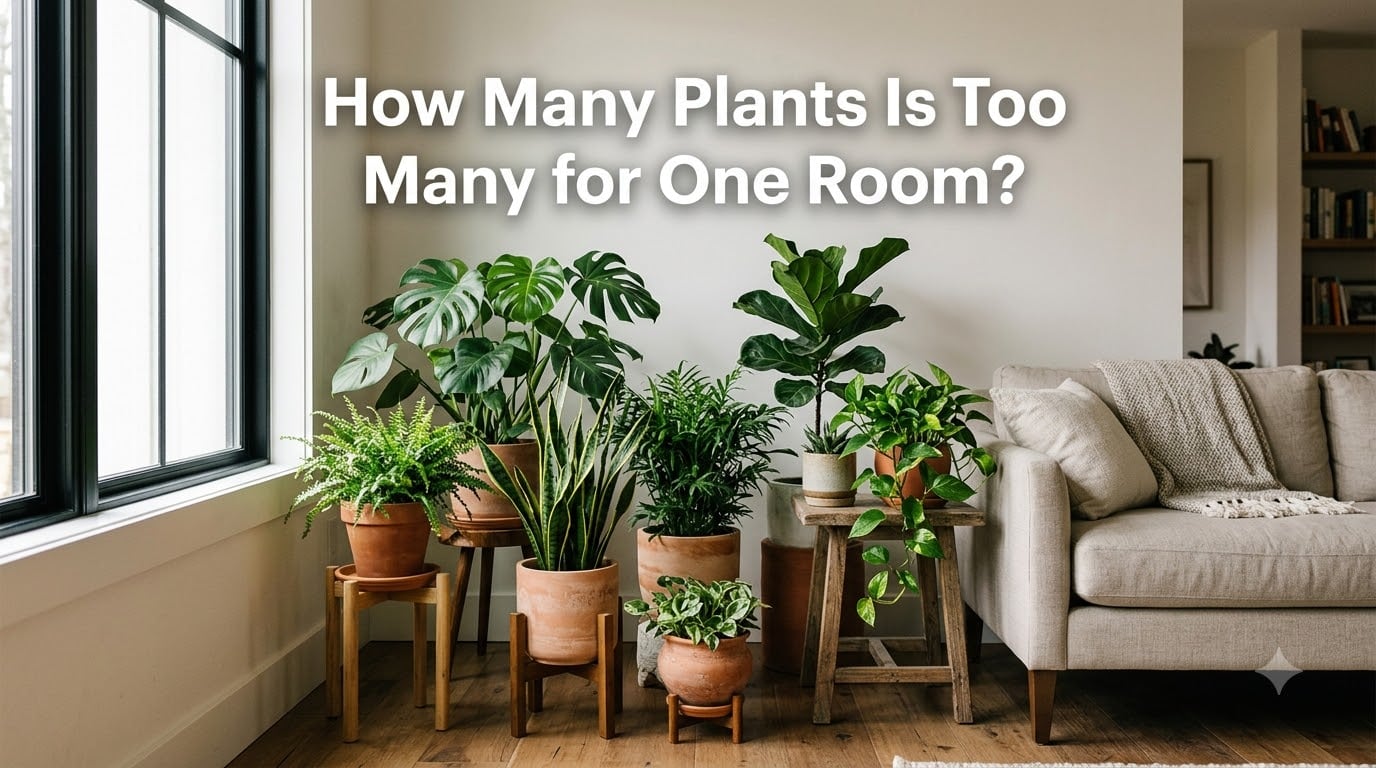
Quick answer: How many plants is too many for one room depends on room size, light, and your weekly care budget, but a sensible rule of thumb is 3-5 plants per medium room (roughly 150-250 sq ft), or about one plant per 100 square feet of floor space (the NASA rule of thumb). If watering, dusting, and pruning start taking more than 20 minutes twice a week, the room is overcrowded.
It starts with a pothos on the windowsill. Then a fiddle leaf fig in the corner. A month later, you are watering 30 plants in a 12-by-12 bedroom and quietly wondering if this is still a hobby or a part-time job. You are not alone. One Reddit user openly admitted, “I’m at 50 plants right now. Space and light issues aside, I feel like if I get more I won’t be able to take care of them properly.”
This guide pulls together rules of thumb from horticulturists, the NASA Clean Air Study, and what real plant parents are saying on Reddit and Permies. I will walk you through the magic-number formula, a room-by-room table I built from the research, seven clear signs you have crossed the line, and a gentle 8-step plan to audit and downsize your collection without the guilt.
Table of Contents
The Magic Number: How Many Plants Should a Room Have?
There is no single perfect count, but most plant experts land in the same range: 3-5 plants per medium-sized room as a baseline, scaling up or down based on floor area, light, and how much care time you actually have.
The most cited guideline is the NASA Clean Air Study rule of thumb: one plant per 100 square feet of floor space. That works out to roughly 9-10 plants for a small apartment living room, and 15-20 for a 1,500 sq ft home spread across multiple rooms.
There is a catch. The American Lung Association and follow-up researchers pointed out that the NASA study was conducted in a sealed chamber, not a real home with open doors and HVAC air exchange. To actually move the needle on volatile organic compounds (VOCs) in a typical home, you would need 10 to 1,000 plants per square meter — an unrealistic density for most rooms. Treat the rule as a reasonable starting density, not an air-purification guarantee.
As a working baseline for our team at Conservatory WeHo:
- Small rooms (under 100 sq ft): 1-3 plants
- Medium rooms (100-250 sq ft): 3-5 plants
- Large rooms (250-400 sq ft): 5-8 plants
- Open-plan spaces (over 400 sq ft): 8-15 plants, grouped in clusters rather than scattered
NYBG curator Marc Hachadourian put it best: “You want to own your plants, not have them own you.” If the collection owns you, you have passed the magic number.
Room-by-Room Plant Count Guide
The number that feels right varies by room. A bedroom has different concerns than a bathroom, and a kitchen window has different light than a north-facing office. Here is a comparison I assembled from horticulturist guidance, NASA research, and forum feedback.
| Room | Sq ft range | Low-maintenance target | Medium-maintenance target | High-maintenance ceiling | Watch-outs |
|---|---|---|---|---|---|
| Bedroom | 100-180 | 2-3 | 3-4 | 5 | Nighttime CO2, mold risk in enclosed spaces, pet/child toxicity |
| Living room | 150-300 | 3-4 | 5-7 | 10 | Light access for floor plants, scale of foliage, dust visibility |
| Kitchen | 80-150 | 2-3 herbs | 3-5 | 6 | Grease on leaves, humidity from cooking, limited light |
| Bathroom | 40-80 | 2 humidity-lovers | 3-4 | 5 | Low light, splash zones, mold on soil surface |
| Home office | 80-150 | 2-3 | 3-4 | 6 | Tripping hazard near desks, allergens, cable clutter |
| Open-plan living/dining | 300-500 | 5-6 | 8-12 | 15 | Visual weight, watering logistics across large footprint |
The “ceiling” column is the point where our team’s research and forum consensus agree you are likely to feel overwhelmed. A Permies user described it this way: even when plants bring joy, when watering and rotation start conflicting with travel or work, the count is too high.
7 Signs You Have Too Many Plants in One Room
Counting plants only tells part of the story. These seven signs are how you actually feel an overcrowded plant room, drawn from The Spruce, Apartment Therapy, and recurring forum complaints.
- Pest outbreaks spread faster than you can treat them. Spider mites, fungus gnats, and mealybugs travel leaf to leaf. The denser the foliage, the faster an infestation moves from one pot to ten.
- Lower leaves are yellowing or stretching. If your plants shade each other and your floor plants start leaning toward the window, you have hit a light-starvation ceiling.
- Watering takes more than 20 minutes twice a week. The Henry and Horse rule of thumb for sustainable care is roughly 10 minutes of watering per session, twice weekly. Above that, the collection is outpacing your time.
- You skip routine maintenance. Dust sits on leaves for weeks, dead foliage piles up, and repotting gets postponed. The plants are becoming furniture rather than living things you tend.
- Humidity and musty smells creep in, especially in bedrooms. Transpiration plus overwatered soil plus poor airflow equals a mold risk. Reddit users in basement bedrooms with 30+ plants often report this combination.
- Tripping, allergens, and dust get worse. Floor plants can become obstacles. Dust on broad leaves is a real issue for people with allergies or asthma.
- Household friction or planning around plants. You find yourself scheduling dinners, guests, and vacations around watering. A spouse or roommate has quietly asked you to “thin it out.” This is the most common forum signal of a collection that has gotten too big.
How Much Time Does a Plant Collection Actually Take?
This is the question every Reddit thread returns to: how many hours a week will this actually need? Here is the framework our team uses to estimate a personal care budget.
A single indoor plant averages 5 to 10 minutes of care per week when things are going well — a quick soil check, a watering, the occasional wipe-down. That figure comes from Henry and Horse Design’s benchmark and lines up with what experienced plant parents describe in forum threads.
- 5 plants: ~25-50 minutes per week (sustainable for most people)
- 15 plants: ~1.25-2.5 hours per week (manageable but noticeable)
- 30 plants: ~2.5-5 hours per week (where travel and busy weeks break down)
- 50+ plants: easily a part-time job, and the threshold where even Reddit regulars admit they cannot keep up
If you travel frequently, work long hours, or share care duties with a partner, cut every estimate in half and treat that as your actual ceiling. Time-budget reality is more honest than any rule of thumb.
Pet and Child Safety When Collections Scale Up
Most reputable plant guides flag a short list of toxic species: peace lilies, pothos, philodendrons, dieffenbachia, and most lilies (dangerous to cats). A collection of 3-5 plants is easy to audit. A collection of 30 is harder.
Three rules our team recommends once a collection grows past 10 plants:
- Keep toxic species on high shelves or in rooms pets and toddlers cannot access.
- Audit floor-level pots monthly and relocate anything risky.
- If you have cats that chew leaves, replace any lily, sago palm, or dieffenbachia with pet-safe alternatives like calathea, peperomia, or Boston fern.
How to Downsize a Plant Collection Without the Guilt
Every forum thread on this topic ends with the same question: what do I do with the extras? Here is an 8-step audit process that respects the plants and your history with them.
- Walk the room and remove anything clearly dead or unrecoverable.
- Set aside any plant you have not enjoyed caring for in the past 60 days.
- Group the “maybe” plants by recipient type: hardy gift plant, swap-trade plant, donation plant.
- Photograph and list them on a local plant-swap group or subreddit (r/houseplants, r/TakeAPlantLeaveAPlant).
- Offer to a neighbor, friend, or coworker who has shown interest.
- Donate healthy specimens to a community garden, church, school, or nursing home.
- Propagate cuttings and keep only what you love as parent plants.
- Set a personal rule (1-in-1-out, or a fixed room ceiling) before you bring the next one home.
Frequently Asked Questions
How many plants should a room have?
A medium room of 150-250 sq ft typically supports 3-5 plants comfortably, scaled up by floor area using the NASA-style rule of one plant per 100 square feet. Add a few more only if light is strong and you can sustain the care time.
How many plants are too much?
Most plant parents and experts say a room feels too crowded when watering and maintenance exceeds 20 minutes twice a week, when pests spread between plants faster than you can treat them, or when household routines start bending around the collection.
How many houseplants are acceptable?
Acceptable is a personal budget, not a fixed number. A good rule is up to one plant per 100 sq ft of floor space in your home, with denser counts only in well-lit rooms with strong airflow and time to care for them.
How many houseplants does the average person have?
Industry surveys and home-decor studies put the typical U.S. household at 2-5 indoor plants, with a smaller group of plant collectors carrying 20-100 plants across the home.
Is it bad to have too many plants in your room?
It can be. Overcrowded plants raise humidity, harbor pests, shade each other, and trigger allergies. Bedrooms in particular can develop musty smells or mold when soil stays wet and airflow is limited.
Can having too many plants kill you?
No. The number of indoor plants itself poses no toxic or fatal risk to healthy adults. Real concerns are allergies, mold in poorly ventilated rooms, and toxic plants reachable by pets or small children.
Is it possible to have too many houseplants?
Yes. Once your collection outpaces your watering time, your available light, or your partner’s tolerance, you have too many for that room. The fix is usually pruning, swapping, or relocating a few plants rather than quitting entirely.
The Bottom Line on How Many Plants Is Too Many for One Room
So how many plants is too many for one room? Start with the formula: roughly one plant per 100 square feet, capped by a realistic weekly care budget of under 20 minutes of watering twice a week. If your collection is pushing past that, the room is telling you. Audit, donate, swap, and keep only the plants that still bring you joy — the rest of the joy is in the curation.
For more room-by-room plant guides and low-maintenance species recommendations, bookmark Conservatory WeHo and check back as we publish new 2026 updates.