
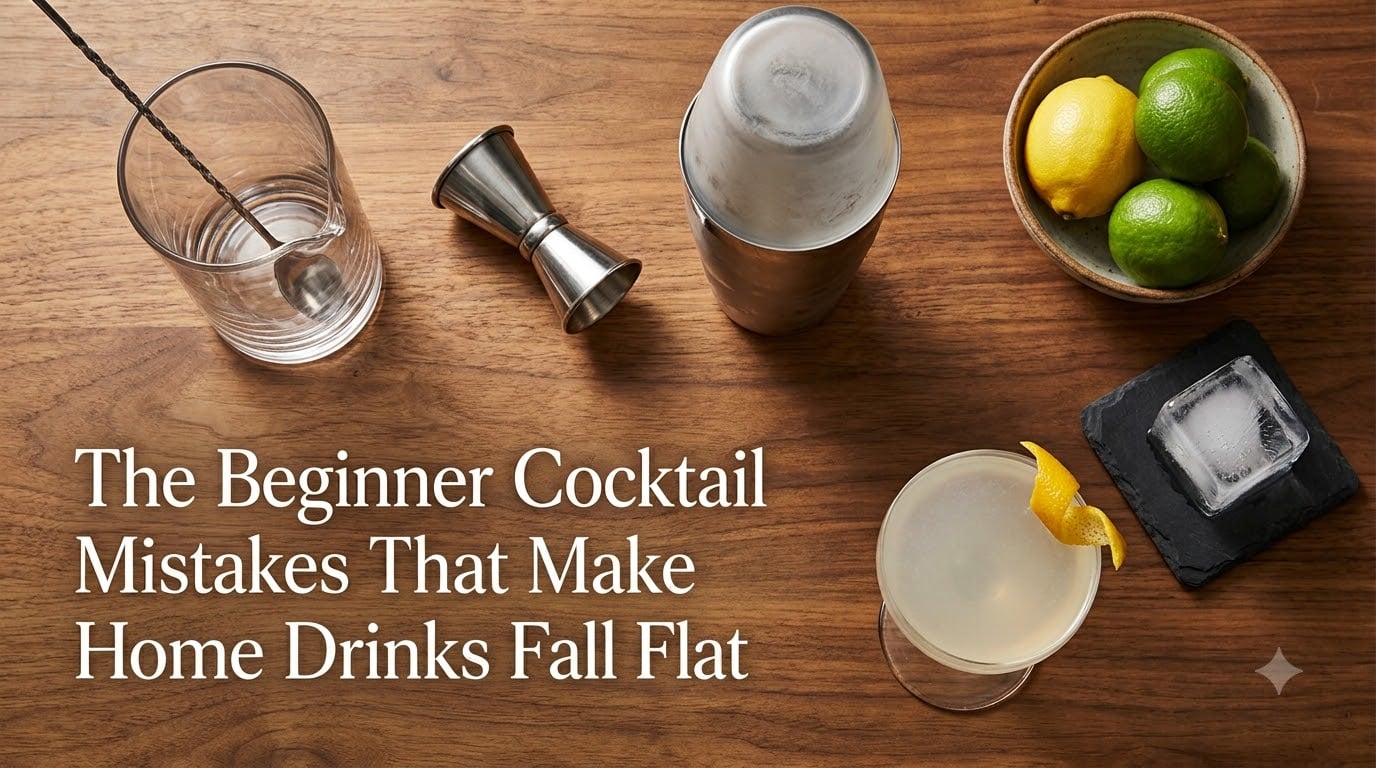
You followed the recipe to the letter. You bought the right bottle, squeezed the lime, gave it a confident shake. You poured it into a glass you actually own. And the drink still tastes flat – thin, sharp, watery, or strangely boozy. Nothing like the one you paid for at the bar. I have been on both sides of that moment, and I can tell you this: the recipe is almost never the problem. The beginner cocktail mistakes that make home drinks fall flat live in the technique, not the shopping list. Two drinks built from the same bottle can taste completely different based on ice shape, shake time, and glass temperature alone.
Our bar team at Conservatory WeHo fields the same five or six questions every week from guests trying to recreate their favorite drink at home. This guide is built from those conversations. Seven mistakes, seven fixes, and one simple ratio that will pull almost any home cocktail back from the edge.
Table of Contents
Beginner Cocktail Mistakes at a Glance
If you only have time to skim, this is the cheat sheet. Each mistake below is covered in depth with the exact fix, the tools that help, and the science behind why your drink fell flat in the first place.
Mistake 1 – Treating ice as an afterthought. Small cloudy ice dilutes your drink in seconds and leaves it watery. Fix: use large, dense cubes for stirred drinks and fresh, hard cubes for shaken drinks.
Mistake 2 – Eyeballing measurements instead of jiggering. A free pour of 30 ml versus 45 ml changes the entire structure of a drink. Fix: buy a jigger and use it every time for the first month.
Mistake 3 – Shaking when you should stir. Shaking aerates and dilutes fast; stirring keeps the spirit silky. Fix: shake citrus, dairy, or egg cocktails, stir everything else.
Mistake 4 – Using bottled juice and pre-made sour mix. Bottled lime juice has been cooked, sweetened, and preserved. Fix: keep fresh lemons and limes on hand and squeeze them the same day.
Mistake 5 – Overcomplicating the recipe. Five flavors fight for attention and none wins. Fix: master the 2:1:1 sour ratio and build from there.
Mistake 6 – Skipping the garnish and glassware. Aroma and presentation drive perception. Fix: match the glass to the drink and finish with one expressive garnish.
Mistake 7 – Ignoring glass temperature. A room-temp glass melts ice and waters your drink before you take the first sip. Fix: chill the glass for five minutes before pouring.
Ready for the full breakdown? Let’s go mistake by mistake.
Mistake #1: Treating Ice as an Afterthought
Ice is the single most ignored ingredient in the home bar, and it is the most important one. A 30 ml pour of spirit over cloudy, half-melted freezer ice will taste like cold water with a rumor of whiskey, regardless of how expensive that whiskey is. Bartenders obsess over ice because ice controls three things at once: temperature, dilution, and texture. If you fix only one thing on this list, fix your ice.
There are three ice rules worth memorizing. Rule one: use a large cube (about one inch square or larger) for any stirred drink – Old Fashioneds, Manhattans, Negronis. The bigger the cube, the slower it melts, the less the drink dilutes before you finish it. Rule two: shake with hard, fresh cubes from a clean ice tray. Cloudy or thin ice melts mid-shake and you end up with a watery margarita. Rule three: never use the last sad remnants of a freezer bin. If the ice clinks together softly or looks frosty, throw it out and refill.
The shape of the cube changes mouthfeel too. A sphere dilutes more evenly than a square because the corners and edges melt first. If you want a clearer, prettier cocktail at home, silicone molds for spheres or large squares cost very little and instantly upgrade presentation. Clear ice is mostly a visual upgrade; what actually matters is size and density.
Mistake #2: Eyeballing Measurements Instead of Jiggering
The single most repeated piece of advice on r/bartenders is also the one home bartenders ignore the most: measure your drinks. Free pouring looks cool on the bar, but it is a learned skill built over years. Without that muscle memory, your “30 ml” pour is anywhere from 20 ml to 50 ml, and that range is the difference between a balanced cocktail and a stiff or watery one.
The fix is mechanical. Buy a jigger – a small two-sided measuring cup, usually 30 ml on one side and 15 ml on the other – and use it on every drink for at least a month. After that, you will have a real sense of what 30 ml of liquid looks like in a glass, and you can start free-pouring with some confidence. The jigger does not make you a beginner. It makes you a consistent one. Consistency is how you taste what a recipe actually does, which is the only way you can start tweaking it.
A second benefit: when a drink tastes off and you used a jigger, you know the variable is the juice, the dilution, or the technique – not your pour. That single fact saves hours of guessing.
Mistake #3: Shaking When You Should Stir (and Vice Versa)
This is the mistake even experienced home bartenders get wrong, because it sounds simple and it is not. Shaking and stirring are not interchangeable. They do different jobs.
Shake a cocktail when it contains citrus juice, dairy, egg white, or any creamy or opaque mixer. The vigorous shake aerates the drink, emulsifies the ingredients, and chills it in roughly 10 to 15 seconds. Margarita, whiskey sour, daiquiri, pisco sour – shake all of these. Aim for a hard, rhythmic shake with the tin locked tight; you should feel the drink slosh and your shoulder should feel the burn after 10 seconds.
Stir a cocktail when it is built entirely from spirits, sugar, and bitters – the classic stirred drinks like the Martini, Manhattan, Old Fashioned, and Negroni. Stirring chills and combines without aerating. A stirred drink is silky and clear, with a heavy texture that lets the spirit’s character show through. Stir for 20 to 30 seconds with a bar spoon and a gentle rotation. If your stirred Martini looks cloudy and foamy, you shook it and lost the silky mouthfeel the drink is supposed to have.
Use this as a one-line rule of thumb: citrus, dairy, or egg equals shake; everything else is stir.
Mistake #4: Using Bottled Juice and Pre-Made Sour Mix
This is the mistake that quietly ruins margaritas and daiquiris across the country. Bottled lime juice, bottled lemon juice, and especially that neon-green sour mix at the grocery store have all been heat-treated, sweetened, and preserved to sit on a shelf. The flavor is a memory of citrus, not the thing itself. When you mix it into a cocktail, your drink tastes like “lime flavor” rather than lime – flat, slightly bitter, and one-dimensional.
The fix is a small daily habit. Keep a bowl of fresh lemons and limes on the counter, and squeeze them the same day you mix. A handheld citrus squeezer pays for itself in about three drinks by extracting more juice with less effort. If you want to prep ahead, juice a batch of citrus and store it in a sealed jar in the fridge for up to 48 hours. Beyond that, the juice oxidizes and starts to taste stale – another beginner cocktail mistake hiding inside the fix.
Simple syrup deserves the same respect. The store-bought stuff is concentrated and can carry a metallic aftertaste. A homemade 1:1 simple syrup (one part sugar dissolved in one part hot water, then cooled) takes five minutes and tastes cleaner. Add a small splash of vodka to a batch of simple syrup and it will keep in the fridge for weeks. This is the trick our team uses behind the bar and it is the easiest upgrade you can make this week.
Mistake #5: Overcomplicating the Recipe
The cocktail world is full of recipes with eight ingredients and three modifiers. Most of them are not for beginners. When you stack five flavors in a drink, each one fights for attention and the result is muddy. Our bartenders at Conservatory WeHo usually train new staff on five-drink menus for exactly this reason: mastering a few classics is faster and more fun than collecting recipes you cannot finish.
The cheat code for almost any sour-style drink (whiskey sour, daiquiri, margarita, pisco sour) is the 2:1:1 ratio. Two parts spirit, one part sweet, one part sour. That is it. Dial the ratio to your taste once you start making the drink regularly – 2:1:1 is balanced, 2:0.75:1.25 leans tart, 2:1.25:0.75 leans rich – but start at 2:1:1 and you cannot go wrong. The ratio is more reliable than memorizing ingredient lists, and it lets you swap the spirit and sweetener without losing the structure.
If a drink recipe lists more than five ingredients including garnish, save it for later. Build your home confidence on three- or four-ingredient classics first. Old Fashioned, Martini, Negroni, Daiquiri, Margarita. Each one teaches a different skill, and each one can be made at home with one bottle, one sweetener, and one citrus.
Mistake #6: Skipping the Garnish and Glassware
Garnish is not decoration. It is part of the drink. A expressed orange peel over an Old Fashioned releases citrus oils that hit your nose before the first sip and prime your palate to taste sweetness and warmth. A mint slap on a Mojito does the same thing with a different set of aromatics. Skipping the garnish is like watching a movie on mute – you get most of it, but you lose the part that makes it feel real.
Pick one garnish that adds aroma or flavor – an expressed peel, a fresh herb sprig, a quality cherry, a citrus wheel – and add it every time. One garnish, done well, beats three tossed on without thought.
Glassware matters for similar reasons. A coupe, a Nick and Nora, a rocks glass, a highball – each one is shaped for a reason. A Manhattan in a highball looks wrong and the dilution is off because there is too much air over the drink. A margarita in a rocks glass feels sticky and heavy. Match the glass to the drink and your cocktail will look and taste like the version you remember from the bar. You do not need a full set; a rocks glass and a coupe will cover most home recipes.
Mistake #7: Ignoring Glass Temperature
This is the quietest beginner cocktail mistake, and one of the most expensive in flavor. A room-temperature glass full of ice melts that ice within a couple of minutes. By the time you finish your drink, you are sipping flavored water. The fix is mechanical: stash your rocks glasses and coupes in the freezer, or fill them with ice and water for five minutes before you pour. Dump the ice water, build the drink, and the chilled glass keeps your cocktail colder and more concentrated for the entire pour.
For stirred drinks like the Old Fashioned, a chilled glass buys you an extra 10 to 15 minutes of proper dilution curve. For shaken drinks poured over ice, a chilled glass keeps the foam from collapsing too fast. It is a small change with an outsized payoff, and it costs nothing.
Tools That Fix Five Mistakes at Once
You do not need a full bar kit to fix most beginner cocktail mistakes. Five tools cover the majority of technique errors at home. Think of this as a small upgrade path rather than a shopping list.
A jigger fixes mistake #2 by giving you exact pours every time. A Boston shaker or cobbler shaker fixes mistake #3 by making shaking safe and effective. A Hawthorne strainer and a fine mesh strainer fix mistake #5 by letting you double-strain shaken drinks for a smoother texture. A silicone large ice mold fixes mistake #1 by giving you slow-melting cubes for stirred drinks. A handheld citrus squeezer fixes mistake #4 by making fresh juice effortless enough to do every time.
Add those five tools to a single mixing glass and a barspoon and you have a functional home bar that handles 90 percent of classic cocktail recipes. Skip the branded kits full of tools you will use twice. Build the kit around the mistakes you actually make, and the kit earns its space.
Frequently Asked Questions
What is the 2:1:1 rule for cocktails?
The 2:1:1 rule is a simple ratio for any sour-style cocktail: two parts spirit, one part sweetener (usually simple syrup), one part citrus juice (usually lemon or lime). Start at 2:1:1 for a balanced drink, then nudge the sweet or sour side up or down to match your taste.
What kind of ice should you use for cocktails?
Use large, dense cubes (one inch or bigger) for stirred drinks so they melt slowly and dilute less. For shaken drinks, use fresh, hard cubes from a clean ice tray. Clear ice is a visual upgrade, but size and density are what actually change the drink.
What is the difference between shaking and stirring a cocktail?
Shaking aerates and dilutes fast, chills hard, and is used for cocktails with citrus, dairy, or egg white. Stirring chills and combines without aerating, keeping the drink silky and clear, and is used for all-spirit cocktails like Martinis, Manhattans, and Negronis.
Why do my homemade cocktails taste weak or watery?
Weak or watery cocktails almost always come from too much dilution or too little spirit. Use a jigger, switch to large dense ice for stirred drinks, and chill your glass so ice melts slower. These three fixes solve most watery-drink problems.
Should you use bottled or fresh juice in cocktails?
Fresh juice is dramatically better for cocktails. Bottled juice has been heat-treated and preserved, which dulls the bright citrus flavor and can add a bitter aftertaste. Squeeze lemons and limes the same day you mix, or store fresh juice in the fridge for up to 48 hours.
Why do bartenders use a jigger instead of free pouring?
Bartenders use jiggers in training and rely on free pouring only after years of muscle memory. At home, a jigger keeps every pour exact, so you can taste the actual recipe instead of guessing whether the drink is balanced. A jigger is the fastest path to consistent, repeatable cocktails.
Conclusion
The beginner cocktail mistakes that make home drinks fall flat are not about the bottles you own. They live in the ice, the jigger, the shake, the citrus, the garnish, and the glass. Fix any one of those seven and your drink improves immediately. Fix all seven and your home cocktails start to taste like the bar versions you have been chasing. That is the work our team at Conservatory WeHo does behind the stick every night, and it is the same work your kitchen can do with five tools and a little patience.
Start with ice and a jigger this week. That is the lowest-effort, highest-impact change you can make. Once you taste the difference, the rest of the list is downhill.