
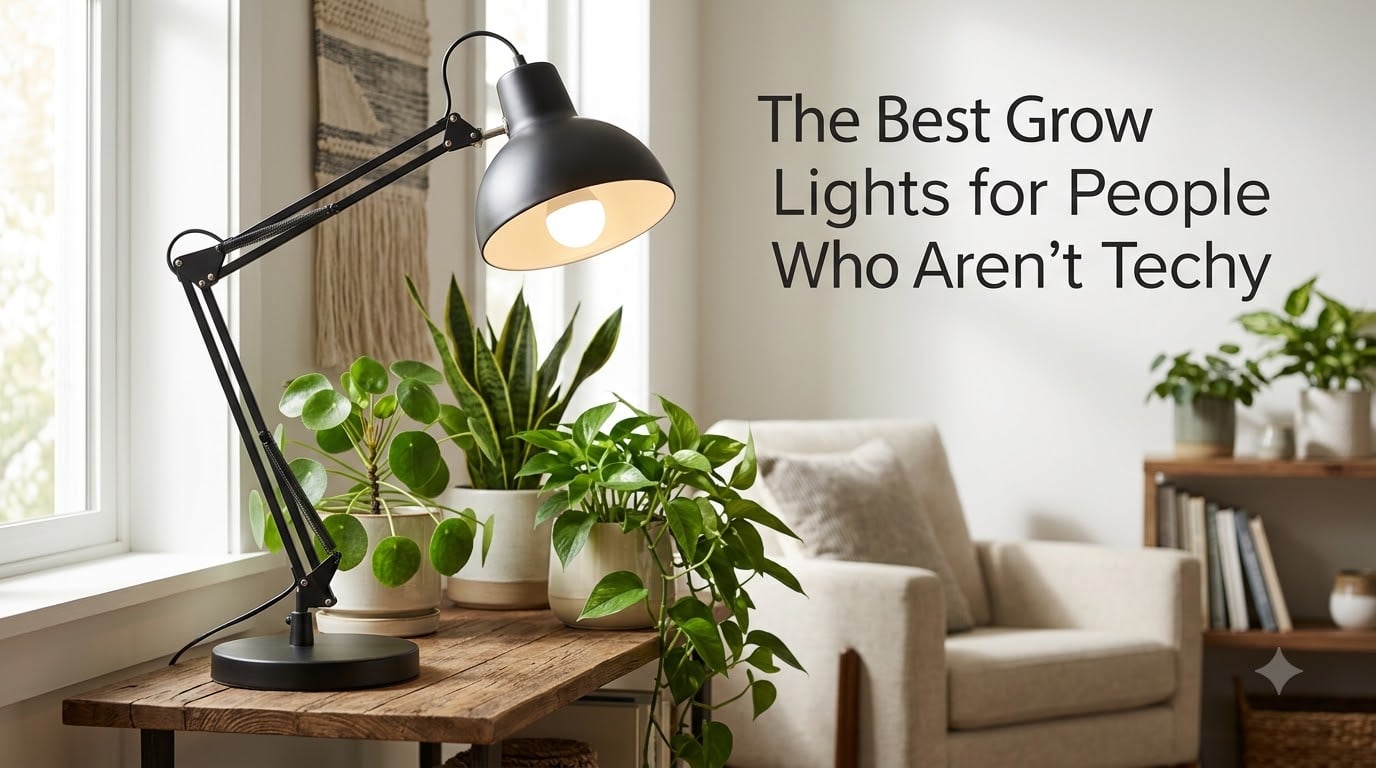
If you’ve ever typed “grow light” into Amazon and immediately felt your eyes glaze over, you’re not alone. The options are overwhelming, the specs look like a chemistry textbook, and half the reviews seem to contradict each other. I’ve been there, staring at pages of PAR values and lumens, wondering if I really need to become a lighting engineer just to keep a pothos alive.
Here’s the good news: you don’t need to understand any of that technical stuff. After helping friends and family set up grow lights in their apartments, I’ve learned that the best grow lights for people who aren’t techy are the ones you barely have to think about. This guide breaks everything down in plain English, no jargon required.
Table of Contents
Do Grow Lights Actually Work?
Yes, grow lights really do work for houseplants. Plants need light to photosynthesize, which is how they make food and energy. If a room doesn’t get enough natural sunlight, a grow light provides the missing light wavelengths that plants use to grow.
I was skeptical at first too. But after putting a simple LED grow bulb above my Monstera last winter, the difference was obvious within three weeks. New leaves unfurled, the color deepened, and the plant stopped reaching sideways toward the window. Real people on Reddit say the same thing repeatedly: plants near grow lights visibly outgrow those without them.
What Does a Grow Light Actually Do?
A grow light is basically a light bulb designed to give plants the specific types of light they need. Regular household bulbs emit light that looks fine to human eyes but doesn’t always include enough of the wavelengths plants actually use.
Think of it like this: plants eat sunlight. When sunlight isn’t available, a grow light acts as a substitute meal. It mimics the useful parts of natural sunlight so your plants can photosynthesize and grow, even in a dim corner or during dark winter months.
The key difference between a regular lamp and a grow light is the light spectrum. Grow lights produce a fuller range of wavelengths, including the red and blue light that plants absorb most efficiently. That’s it. No magic, no rocket science, just better-tailored light.
The 3 Types of Grow Lights, Explained Simply
When you shop for grow lights, you’ll see three main types. Here’s what each one means for you as a non-techy buyer:
LED Grow Lights
LEDs are the best choice for most beginners. They run cool (so they won’t burn your plants or your fingers), use very little electricity, and last for years without replacing bulbs. Most modern grow lights use LED technology. They come as bulbs you screw into a regular lamp, as clip-on gooseneck arms, or as strip lights for shelves.
Pros: Long lifespan, low energy use, minimal heat, lots of style options. Cons: None worth worrying about for houseplant use.
Fluorescent Grow Lights
Fluorescent tubes (especially T5 bulbs) have been the standard for plant shelves and seed starting for decades. They work well and are affordable, but they’re bulky, require a fixture, and the bulbs need replacing every year or two.
Pros: Affordable, proven track record, good coverage for shelves. Cons: Bulky, fragile tubes, need to replace bulbs regularly.
Incandescent Grow Lights
Incandescent bulbs are the old-fashioned kind that get hot. They produce a lot of heat and very little useful light for plants. You’ll rarely see them marketed as grow lights anymore, and for good reason. If someone hands you an incandescent “grow bulb,” politely hand it back.
Pros: Cheap to buy. Cons: Hot, inefficient, short lifespan, poor for plants. Just skip these.
For non-techy buyers, LED is almost always the answer. It’s what most people buy, what most forums recommend, and what you’ll find easiest to use.
What Color Light Do Plants Actually Need?
Plants use mostly red and blue light for photosynthesis. Early grow lights took this literally and made purple-only lights, which is why you see those intense magenta fixtures everywhere. They work, but they give many people headaches and make your living room look like a nightclub.
Today, full-spectrum LED grow lights are the standard. “Full spectrum” means the light includes all the colors plants need, but in a form that looks like natural white daylight to human eyes. Your plants get what they need, and you don’t have to live under a purple glow.
If the light looks white or warm white to you, it’s probably full spectrum and perfectly fine for your plants. The old “purple is the only way” advice is outdated. Planet Houseplant puts it well: you don’t need to stress about exact color ratios. A quality full-spectrum LED covers everything.
One quick note about color temperature, measured in Kelvin (K): daylight white falls around 5000K-6500K. If a product mentions Kelvin at all, anything in that range is what you want. But honestly, most modern grow lights just say “full spectrum” and move on. That’s enough information.
How Far Away Should Your Grow Light Be?
Distance matters because light intensity drops quickly as you move the light further from the plant. Here’s the simple rule of thumb:
For LED grow lights: 12 to 24 inches from the top of your plant is the sweet spot. If the leaves start bleaching or getting brown spots, move the light further away. If the plant is stretching or leaning, move it closer.
For fluorescent lights: 6 to 12 inches works best, since fluorescent lights are less intense than LEDs.
A good non-techy approach: start with the light about 18 inches away and check on your plant after a week. Adjust from there. You don’t need a light meter or a PAR reader, just your eyes and a little patience.
If your light has a gooseneck or adjustable arm, this is easy. If you’re using a bulb in a desk lamp, you might need to stack some books under the plant or choose a lamp with a flexible neck.
How Many Hours Should You Leave It On?
This is one of the most common questions, and the answer is simpler than you’d think. Plants need a rest period in darkness, just like we do. Here’s a straightforward schedule:
Low-light plants (snake plant, pothos, ZZ plant): 6 to 8 hours per day
Medium-light plants (Monstera, philodendron, peace lily): 8 to 12 hours per day
High-light plants (succulents, herbs, cacti): 12 to 16 hours per day
Seedlings: 14 to 16 hours per day until they’re established
The easiest approach is a simple outlet timer. Plug your grow light into the timer, set it to turn on when you wake up and off when you go to bed, and forget about it. Many modern grow lights have built-in timers, which eliminates even this step.
One strategy that works well is “bookending” natural daylight. If your room gets some morning sun, set the grow light to turn on a few hours before sunset. This way your plants get a longer “day” without you thinking about it.
Setup Options: Clamp, Stand, Bulb, or Strip
Grow lights come in several physical forms, each suited to different spaces:
Clip-On/Clamp Lights
These clamp onto a shelf, desk, or table edge. A gooseneck arm lets you aim the light exactly where you need it. They’re great for one or two plants and easy to move around. The downside is they look a bit industrial. Many come with built-in timers.
Stand-Alone Floor or Table Lamps
Some grow lights look like regular lamps. You set them on a table or floor, and they blend into your decor. These are perfect if you want something that doesn’t scream “plant person.” The trade-off is they tend to cover a smaller area.
Bulb-Style (Screw Into Any Lamp)
LED grow bulbs fit into standard lamp sockets. This is arguably the simplest option for non-techy people: just swap your regular bulb for a grow bulb. Reddit users love this approach. “I just use a Sansi bulb in a normal lamp and it’s fine” is practically a mantra on r/houseplants.
Strip Lights / Bar Lights
These mount under shelves or along walls and cover a wide area. Barrina T5 strip lights are the standard recommendation for plant shelves. They’re great for people with lots of plants on shelving units, but require a bit more setup (adhesive mounting or brackets).
For non-techy buyers, I usually recommend starting with either a bulb-style LED you can put in an existing lamp, or a clip-on gooseneck light. Both are plug-and-play with no installation headaches.
Common Mistakes Non-Techy Buyers Make
After reading hundreds of Reddit threads and forum posts, I’ve seen the same mistakes come up over and over:
Buying a purple-only light because it looks cool. Purple lights work, but many people find the glow unpleasant, and it makes your room look strange. Full-spectrum white LEDs do the same job without the aesthetic penalty.
Spending too much on a professional-grade setup. If you’re growing houseplants, not tomatoes, you don’t need a $200 quantum board. A simple LED bulb or clip-on light handles most houseplants perfectly well.
Putting the light too far away. Light intensity drops dramatically with distance. A grow light sitting on a shelf four feet above your plant won’t do much. Keep it close, 12 to 24 inches for LEDs.
Leaving it on 24/7. Plants need dark periods to rest and process energy. Running a grow light all day and all night actually stresses plants. Stick to the hour guidelines above.
Ignoring the timer. Without a timer, you’ll forget to turn it on or off regularly. Consistency matters more than perfection. A simple mechanical outlet timer solves this completely.
What About Electricity Costs?
This is a common worry, and the answer is reassuring. A typical LED grow light for houseplants uses between 10 and 40 watts. Running a 20-watt LED grow light for 12 hours a day costs roughly $1 to $2 per month in most areas. That’s less than a cup of coffee.
LEDs are dramatically cheaper to run than older fluorescent or incandescent options. A 20-watt LED produces roughly the same useful light as a 60-watt fluorescent, using a third of the electricity. If electricity cost is a concern, LED is the only sensible choice.
The Only 4 Terms You Actually Need to Know
If you want to understand the box label without a physics degree, here are the four terms worth knowing:
Full Spectrum: Light that includes all the colors plants use. If it says full spectrum, your plants are covered. Don’t overthink this one.
Wattage: How much electricity the light uses. Higher isn’t always better; LEDs are efficient, so a 20-watt LED can outperform a 60-watt fluorescent. Look at the wattage mainly to estimate your electricity bill.
Kelvin (K): The color of the light. 5000K-6500K is bright white daylight, which is what you want for growing. Lower numbers (2700K) are warm/yellow. If a product doesn’t list Kelvin, don’t worry about it.
PAR/PPFD: These measure how much plant-usable light actually hits your plant. Higher is generally better. Here’s the non-techy shortcut: if a grow light is marketed for plants and has good reviews, the PAR is probably fine. You don’t need to measure it yourself.
Frequently Asked Questions
What type of grow light is best for indoor plants?
A full-spectrum LED grow light is the best choice for indoor plants. LEDs run cool, use very little electricity, last for years, and provide the range of light wavelengths that plants need. They come in simple forms like bulbs you screw into a regular lamp or clip-on gooseneck arms that attach to a shelf or desk.
Do grow lights actually work for houseplants?
Yes, grow lights genuinely work for houseplants. They provide the light wavelengths that plants use for photosynthesis, the process that converts light into energy and food. Many people see noticeable improvements in plant health, growth speed, and leaf color within just a few weeks of adding a grow light, especially during winter months when natural daylight is limited.
How many hours a day should plants be under a grow light?
It depends on the plant type. Low-light plants like pothos and snake plants need 6 to 8 hours. Medium-light plants like Monstera and philodendrons need 8 to 12 hours. High-light plants like succulents and herbs need 12 to 16 hours. Seedlings require 14 to 16 hours daily until they are established. A simple outlet timer makes scheduling effortless.
Can I use a regular lamp instead of a grow light?
You can use a regular lamp if you put a grow light LED bulb in it. Standard LED or incandescent bulbs don’t provide enough of the right light wavelengths for healthy plant growth. A grow light LED bulb fits into a normal lamp socket and is the easiest, most non-techy way to give your plants supplemental light without buying special equipment.
Are grow lights safe for humans?
Yes, modern full-spectrum LED grow lights are completely safe for humans. They produce white light similar to natural daylight and emit minimal heat. The old purple-only grow lights could cause headaches or eye strain for some people due to the intense magenta color, but today’s full-spectrum LEDs avoid that issue entirely. You can comfortably live and work in a room with a grow light running.
Do grow lights use a lot of electricity?
No, modern LED grow lights use very little electricity. A typical houseplant LED grow light draws between 10 and 40 watts, which costs roughly $1 to $2 per month to run for 12 hours daily. That is significantly less than most people expect and much cheaper than older fluorescent or incandescent grow lights.
Conclusion
Finding the best grow lights for people who aren’t techy comes down to simplicity: get a full-spectrum LED, place it 12 to 24 inches from your plants, set a timer for 8 to 12 hours, and walk away. You don’t need to understand PAR values, memorize Kelvin charts, or become a lighting expert. The right grow light works quietly in the background while you enjoy healthier, happier plants.