
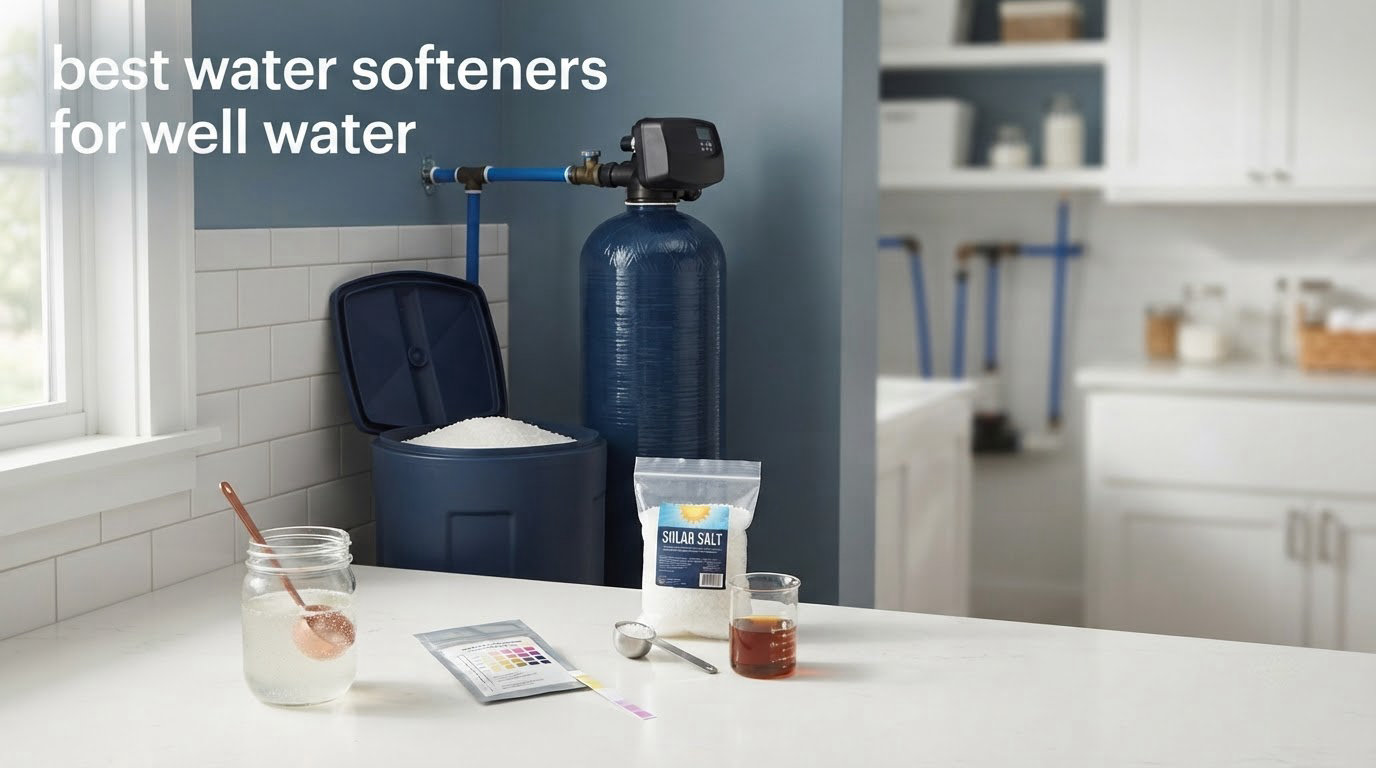
Our pick for the best water softener for well water is the Aquasure Harmony 48,000 Grain. It pairs a metered digital control head with a prefilled resin tank sized for a 3 to 4 bathroom home, and it is the only unit here with a triple-purpose pre-filter built into the mineral tank. It is also the most reviewed system in this roundup, with 3199 owner ratings averaging 4.4 stars.
That does not mean it is right for every well. If your water tests high for iron or carries a sulfur smell, the softener alone is the wrong architecture, and we explain why below. We ranked all 10 systems on the same criteria: grain capacity against real household demand, rated flow rate against typical well pump output, how the control valve meters regeneration, what the resin and media can actually remove, warranty length, and how long the part is likely to be serviceable.
Everything here is a whole house ion exchange system installed at the pressure tank or after the well pressure switch. Do not buy before you have a well water analysis in hand. A panel of hardness in grains per gallon, iron in ppm, manganese in ppm, hydrogen sulfide in ppm, and pH tells you more about which unit to buy than any spec sheet, and it takes a single afternoon to get.
Two things shaped this list more than anything else. First, the honest limits of ion exchange resin: it softens by swapping calcium and magnesium for sodium, and it does not remove sulfur, and it tolerates only a small amount of iron before the resin fouls. Second, the fact that most well owners end up running a softener plus a separate oxidizing iron filter rather than one magic tank, which is why the AFWFilters combo unit earns a place here even though its programming is genuinely fiddly.
Table of Contents
Top 3 Picks for Well Water Softeners (October 2026)

Aquasure Harmony 48,000 Grain
- 48000 grain capacity
- Metered digital control head
- Triple pre-filter
- 12 gpm

AFWFilters Iron Pro 2 Combo…
- Softener plus iron filter
- 6 ppm iron removal
- 6 ppm manganese
- Fleck 5600SXT valve
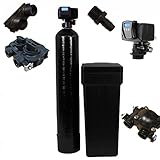
Fleck 5600 SXT Iron Blaster…
- Fine mesh resin for iron
- 48000 grain capacity
- Preloaded resin
- 250 lb brine tank
All 10 Well Water Softeners Compared (October 2026)
Every system below is rated for whole house point of entry treatment. The grain column is the manufacturer’s rated capacity at standard conditions, and the flow column is the maximum rated service flow, which is not the same as the flow your well pump delivers.
| Product | Specs | Action |
|---|---|---|
| Aquasure Harmony 48,000 Grain |
|
Check Latest Price |
| AFWFilters Iron Pro 2 64,000 Grain Combo |
|
Check Latest Price |
 Kenmore 350 32,000 Grain Kenmore 350 32,000 Grain |
|
Check Latest Price |
| Fleck 5600 SXT Iron Blaster 48,000 Grain |
|
Check Latest Price |
| DuraWater Fleck 5600 SXT 48,000 Grain |
|
Check Latest Price |
| DuraWater Fleck 5600 SXT 64,000 Grain |
|
Check Latest Price |
 Aquasana SimplySoft 40K Cabinet Aquasana SimplySoft 40K Cabinet |
|
Check Latest Price |
 iSpring WCSTB45KG 45,000 Grain iSpring WCSTB45KG 45,000 Grain |
|
Check Latest Price |
 PRO+AQUA 80,000 Grain Heavy Duty PRO+AQUA 80,000 Grain Heavy Duty |
|
Check Latest Price |
 Aquasure Harmony Lite 34,000 Grain Aquasure Harmony Lite 34,000 Grain |
|
Check Latest Price |
Why Well Water Needs a Different Kind of Softener
Municipal water is treated at a plant and finished to a hardness and iron specification. A private well is untreated groundwater, so whatever the aquifer holds arrives at your kitchen tap: hardness minerals, clear water iron, manganese, hydrogen sulfide, sediment, and often a low pH. That single fact changes what you should buy.
Ion exchange resin softens by capturing calcium and magnesium ions and releasing sodium in their place. It does not touch iron sulfide, hydrogen sulfide gas, or manganese oxides, and it has a practical ceiling of roughly 3 ppm of clear water iron before fouling starts. Push past that and the resin beds, the brine draw, and your water quality all suffer.
That is the gap the market fills with iron filters. Owners on r/WaterTreatment consistently recommend a dedicated oxidizing filter, using Katalox Light, Filox, or air injection media, upstream of the softener rather than asking the softener to do both jobs. Sulfur needs its own media too, and a pH neutralizer calcite tank is a separate decision if your report comes back acidic.
One r/wellwaterguide user reported a SpringWell WS1 rated to 7 ppm iron and 8 ppm hydrogen sulfide as the system that finally solved their well. No unit in our list is rated to handle that much sulfur, which is exactly why we tell you to treat the report before the shopping cart.
1. Aquasure Harmony 48,000 Grain Softener
Aquasure Harmony Series 48,000 Grains Whole House Water Softener w/High Efficiency Digital Metered Control Head (48,000 Grains)
48000 grain capacity
12 gpm max flow
Backlit digital metered head
Prefilled resin tank
Pros
- Sized for 3 to 4 bathroom homes
- Tripurpose sediment carbon zinc pre-filter
- Programmable backlit digital display
- Fiberglass lined tank with durable bypass valve
- 5 year warranty with lifetime phone support
Cons
- Control head programming has a learning curve
- Drain line and brine fittings may need sourcing separately
We kept coming back to this unit while assembling the list because it is the one most owners in the category have actually lived with. The rating is not a snapshot: 3199 ratings sit behind a 4.4 average, and 76 percent of those are five star. That volume of long term feedback is worth more to us than a spec sheet on an untested model.
In use, owners talk about the same three outcomes. Dishes come out of the dishwasher without the white haze, water heater scale slows down, and skin and hair feel different within a few weeks of the first regeneration. The pre-filter in the head is a genuine extra rather than marketing, handling sediment and chlorine ahead of the resin.
The Harmony ships as a complete package: resin tank, brine tank, prefilled resin, bypass valve, and a programmable backlit head with customizable auto-flush intervals. At 120 pounds and 10 by 10 by 62 inches it is a two person lift with a dolly, and the drain line route needs planning before you start.
The one consistent complaint is the menu system. Owners describe the programming as learnable rather than intuitive, and first week support is where most of the friction sits. Aquasure covers that with a 5 year extended manufacturer warranty and lifetime US based phone support once you activate online.
Where it fits your well
This is the right call for a household of 3 to 4 people on moderately hard water where iron measures at or below about 3 ppm and there is no sulfur odor. The 12 gpm rated service flow covers almost any residential well pump without throttling.
On a well with measurable iron above 3 ppm, add an upstream iron filter or iron reducing additive. Otherwise the resin will load and you will be replacing it long before its useful life.
Where it falls short
The 12 percent share of one star ratings is not nothing. Most of those complaints cluster around setup and durability rather than water quality, so budget an afternoon and a plumber’s number if you are not comfortable with household valves and drain routing.
It also does nothing for hydrogen sulfide. If your water smells like rotten eggs, no amount of extra capacity here will change that.
2. AFWFilters Iron Pro 2 Combo 64,000 Grain
AFWFilters Iron Pro 2 Combination Water Softener Iron Filter Fleck 5600SXT Digital Metered Valve 64,000 Grain – High Flow for Whole House Use – Removes Hardness, Iron, Manganese, Sediment, Rust
64000 grain capacity
Removes iron to 6 ppm
Fleck 5600SXT digital metered valve
Manganese to 6 ppm
Pros
- Softener and iron filter in one tank
- Iron readings reported dropping from 120 ppm to 0 ppm
- Metered Fleck valve saves salt
- Stops orange fixture staining
- Far cheaper than contractor quotes
Cons
- Programming requires setting the clock to 12:01 for setup mode
- Printed instructions are thin
- Resin tank arrives very heavy and needs a dolly
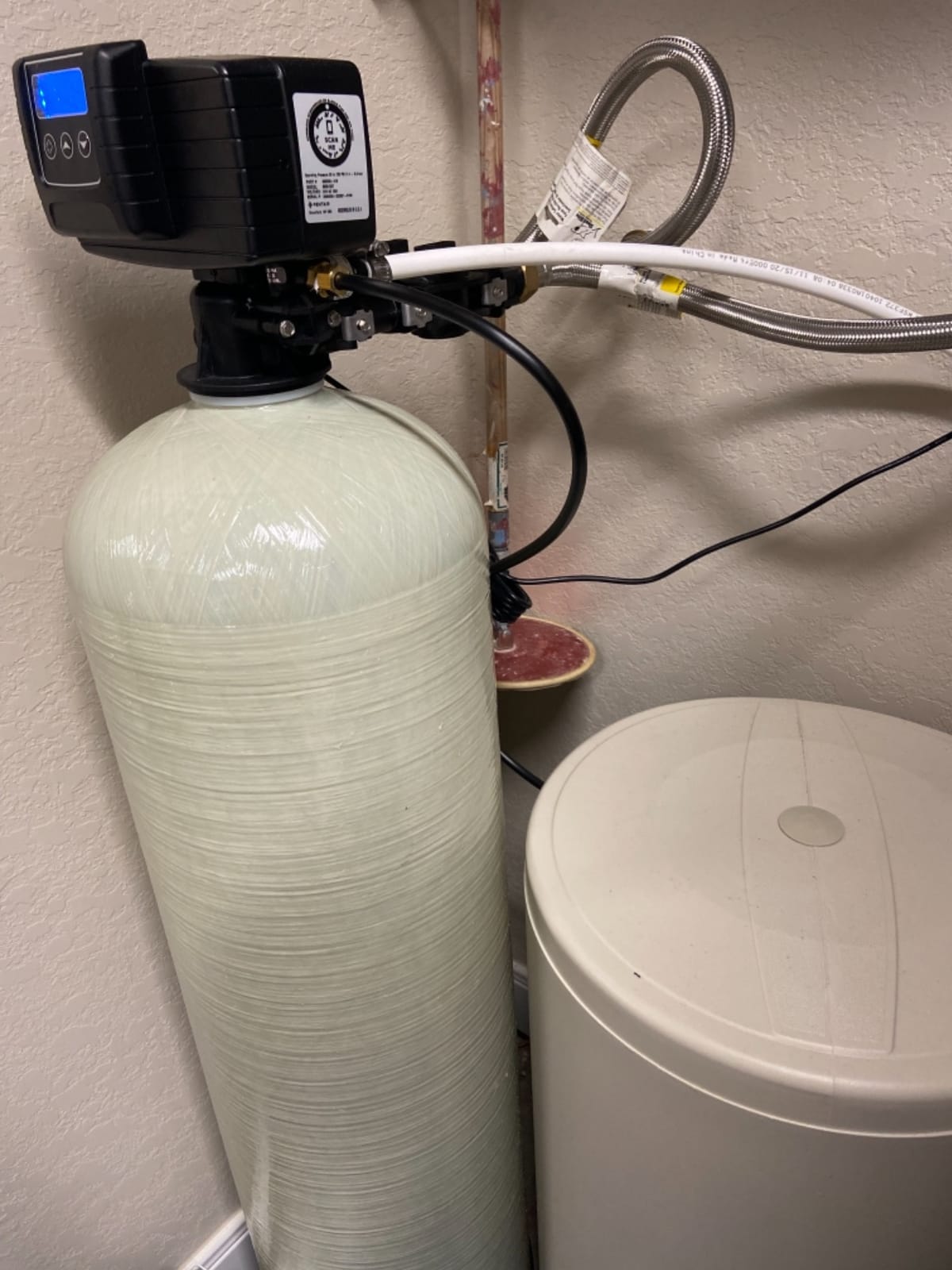
Owners with genuinely bad well water are the loudest advocates for this one. Several reviewers report untreated iron readings of 120 ppm dropping to 0 ppm after installation, and that is the sort of number you only get from a system that pairs a softening tank with iron capable media in the same vessel.
The architecture matters as much as the numbers. Instead of two tanks and two brine lines, you get one mineral tank, one brine tank, and one control head, which halves the footprint and the number of connections that can fail. Reviewers also point out the cost gap against contractor quotes, which they describe as climbing into four figures for a comparable install.
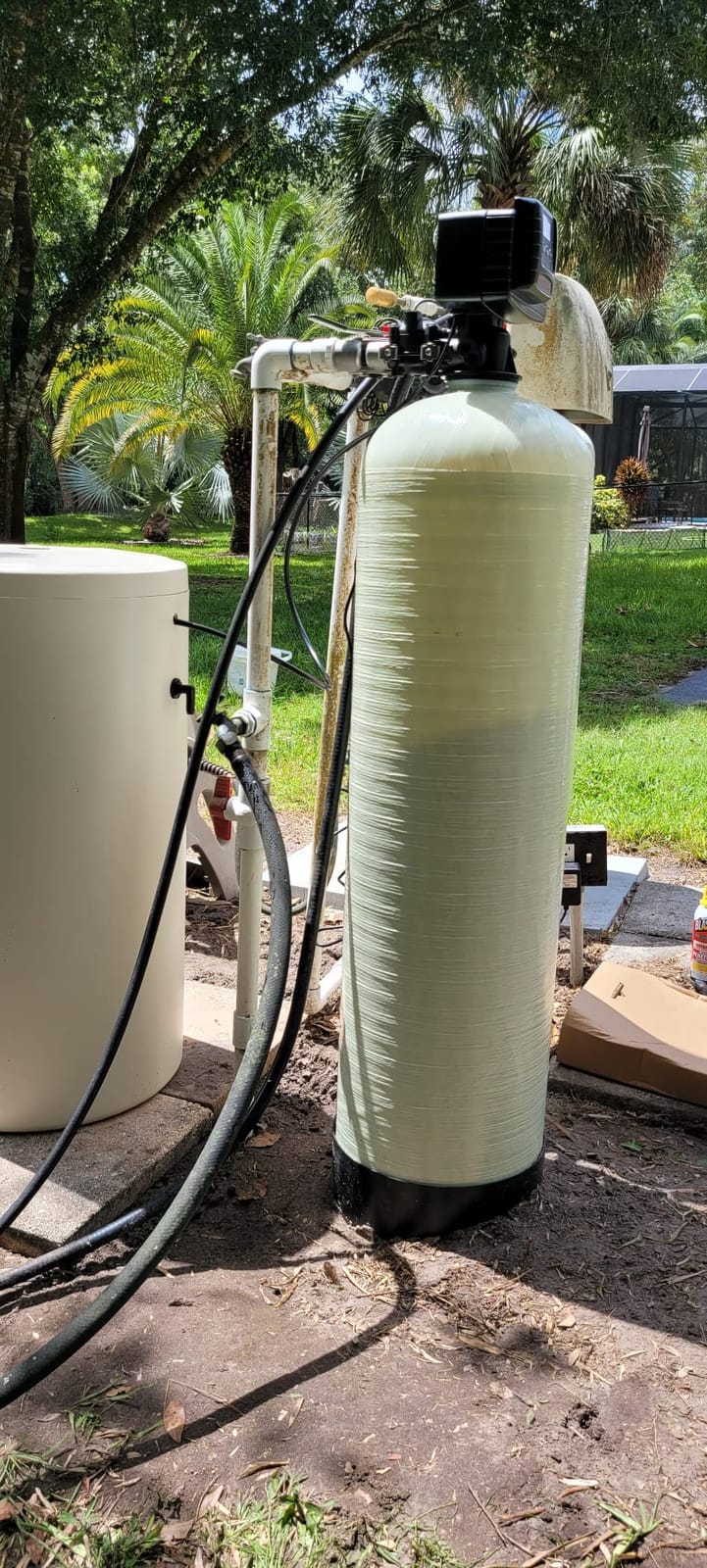
The valve is the Fleck 5600SXT, the same digital metered control that owners on r/WaterTreatment call the most commonly sold in the US, and the reason they choose it is parts availability. That matters more than any feature when your softener is expected to run for a decade.
Capacity is rated at 64,000 grains with a high flow design for whole house demand, and the specification sheet lists iron to 6 ppm and manganese to 6 ppm, well above the 3 ppm ceiling of a plain softener. A 5 year warranty comes with it.
Where it fits your well
Pick this when your iron reads between 3 and 6 ppm and your household runs 4 to 6 people. It is the single most sensible route for a well that has both hardness and iron, without paying a plumber to plumb two tanks together.
It is also the answer for anyone who has already tried a plain softener and watched the resin get coated in rust within two years.
Where it falls short
The programming is the weak point. Owners describe entering advanced setup by setting the clock to 12:01, which is a Fleck tradition nobody explains in the box, and the printed instructions are called thin enough that several buyers added their own sediment filtration upstream.
It still does not address sulfur. Hydrogen sulfide above a couple of ppm needs its own media, and no all in one softener on the market substitutes for that.
3. Kenmore 350 32,000 Grain Softener
Kenmore 350 Whole House Water Softener System, 32,000 Grain, 1-4 People
32000 grain capacity
7.2 gpm max flow
IntelliSoft adaptive regeneration
20 to 125 psi operating range
Pros
- IntelliSoft learns usage and regenerates only when needed
- Compact body fits tight spaces
- 3/4 inch high flow valve holds pressure
- Digital display shows flow and salt levels
- 10 year tank warranty
Cons
- Salt level readings not always accurate
- Occasional drain solenoid failures stop regeneration
- 7.2 gpm is lower than 1 inch valve models
- Premium cost for a 1 to 4 person system
The Kenmore 350 is the odd shape in this list: a smaller unit aimed at households of 1 to 4 people rather than a 3 to 4 bathroom floor plan. At 0.83 cubic feet of resin and a 20.5 by 15 by 48 inch body, it is the unit we would look at first for a couple living on a well in a tight mechanical room.
Its distinguishing feature is IntelliSoft, a control system that learns how the household actually uses water and regenerates only when the resin bed is genuinely exhausted. Owners report lower salt use than their old time clock units, and 70 percent of the 448 ratings are five star.
Flow is rated at 7.2 gpm, which is enough for a two bathroom home but tight if you have a well pump that delivers much more than that. The operating range is 20 to 125 psi and 40 to 120 degrees F, with a supported TDS ceiling of 250 ppm.
Warranty terms are unusual in a good way: 1 year full, 3 years on the control board, and 10 years on the tank. The tank is the part that does not wear out, and 10 years on it is a real commitment.
Where it fits your well
This suits couples, retirees, and small homes on well water where hardness is the only complaint and space is at a premium. The 3/4 inch valve keeps pressure steady through the house without a big plumbed bypass.
It is also a sensible second softener for a cottage or a detached workshop where you do not want to run a full sized system.
Where it falls short
Reliability is the honest weak spot. Several reviewers report a failed drain solenoid that stops regeneration entirely, and one star ratings sit at 10 percent, among the highest shares of one stars in this set. If the solenoid goes, the tank can stay waterlogged until you catch it.
Salt level readings are also called unreliable by a number of owners, so plan on a physical check of the brine tank rather than trusting the display.
4. Fleck 5600 SXT Iron Blaster 48,000 Grain
DURAWATER Fleck 5600 SXT Iron Blaster 48,000 Grain Water Softener
48000 grain capacity
Fine mesh resin for well water
Preloaded mineral tank
14 inch square brine tank
Pros
- Fine mesh resin tuned for elevated iron
- Resin arrives preloaded so no manual filling
- One owner reports six plus years with no staining or odor
- Large brine tank holds about 250 lb of salt
- Online installation manual supports DIY setup
Cons
- Uses a fair amount of salt on high iron wells
- Resin loads with iron and needs periodic replacement
- Does not remove sulfur odor on its own
- Hoses and drain line not included
At 4.5 stars this is tied for the highest rating of any system we looked at, and the reason is unusual for this category: owners describe it as boring in the best way. One detailed review documents more than six plus years of steady service on heavy iron well water, with no orange toilets, no sulfur taste, and no metallic aftertaste.
The resin choice is the technical story. Fine mesh resin has smaller beads than standard bed resin, which increases surface area and pushes more of the iron laden water into contact with the exchange sites. That is the difference between a softener that copes with a marginal iron level and one that fouls in a year.
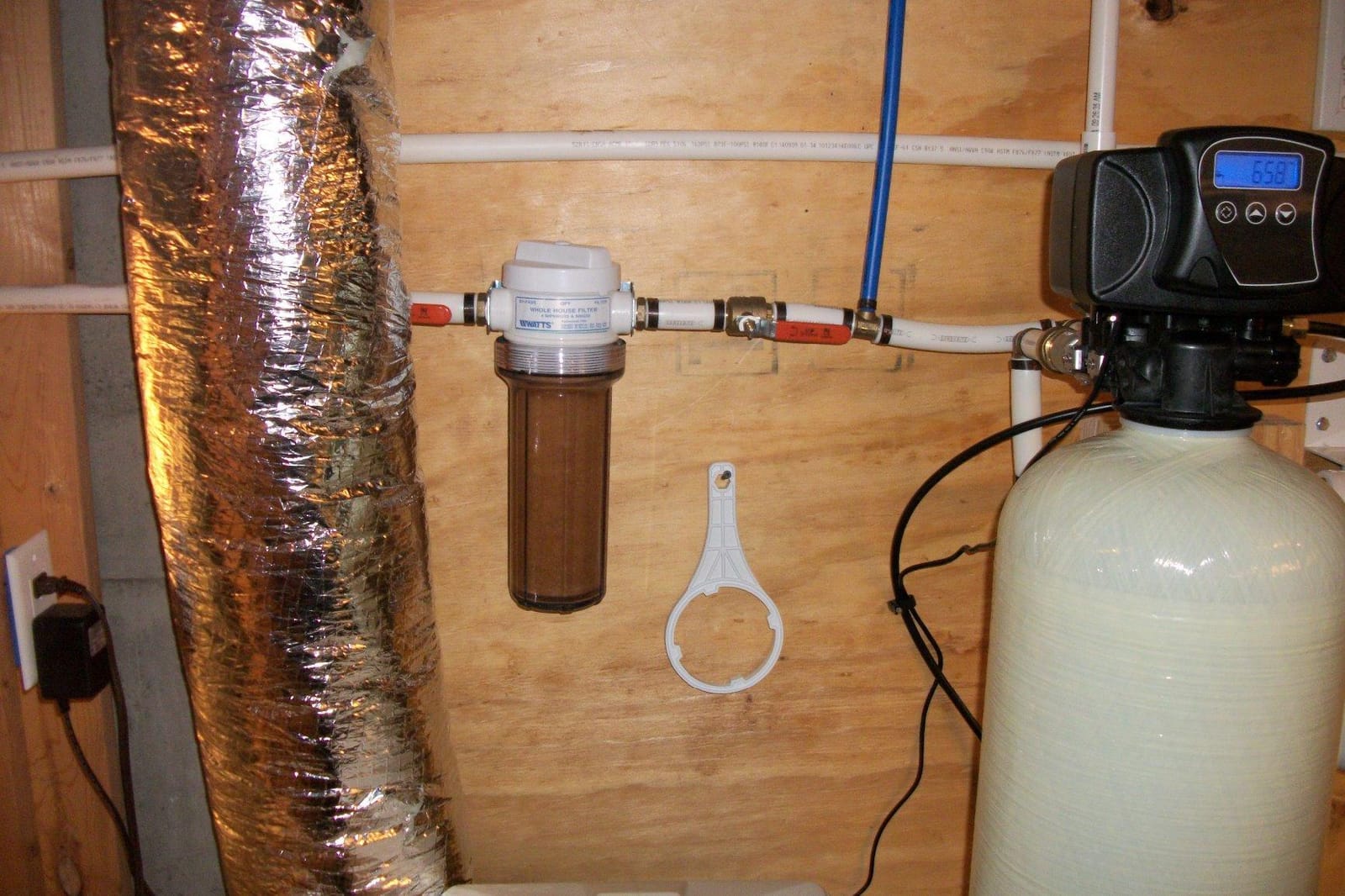
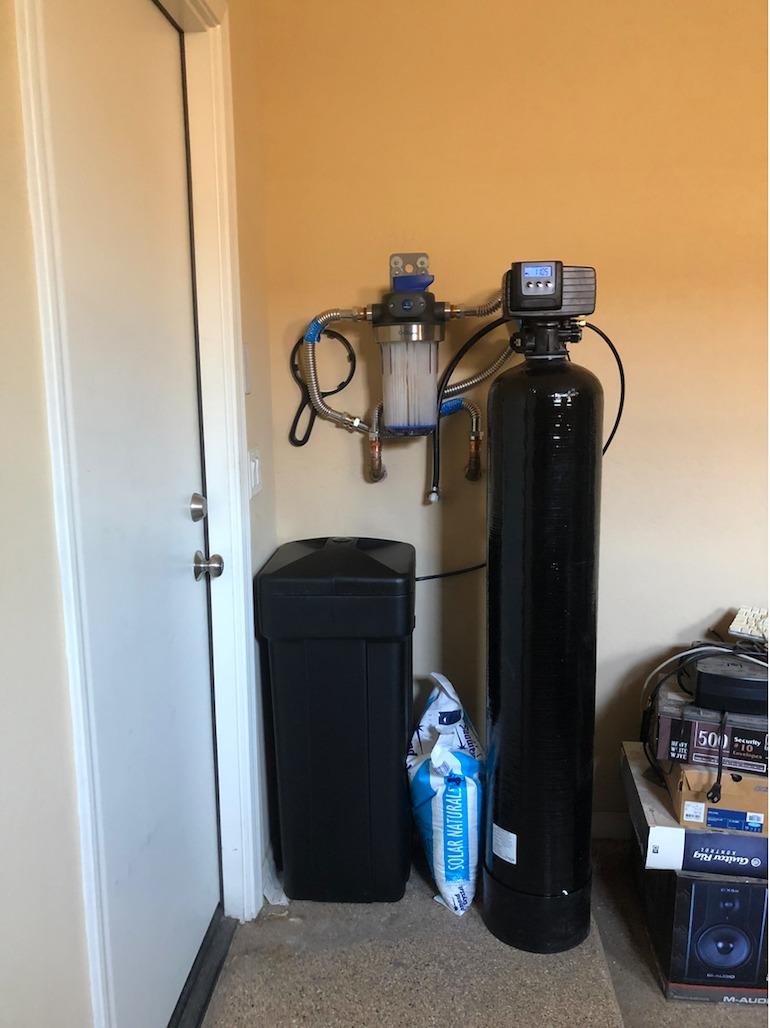
It arrives with the mineral tank already loaded, which removes the messiest part of a DIY install. You get a 10 by 54 inch resin tank, a 14 inch square brine tank with a safety float and overflow protection holding roughly 250 pounds of salt, and an upgraded paddle wheel meter on the Fleck valve.
Regeneration is demand initiated, so the unit backwashes only when the meter says capacity is used up. On a well with low usage that can mean days between cycles, and it is where the salt savings come from.
Where it fits your well
Choose this for a 3 to 4 person home on a well that runs somewhere between 2 and 5 ppm iron, where a standard resin would start loading up within two years. Fine mesh handles the upper part of that range that a plain softener cannot.
It is also a strong pick for anyone who wants the Fleck 5600SXT platform specifically, because that valve is the one the DIY community buys for parts availability rather than for any single feature.
Where it falls short
Salt use is the tradeoff owners name most often, and it makes sense: more regenerations means more salt. On a high iron well you can offset that with an iron filter upstream, which is the configuration that keeps resin alive over a decade.
Hoses and the drain line are not included, and a few reviewers describe a frustrating warranty runaround after two years of use when the control head failed. Budget for fittings and know that the tank warranty is not the same as a whole unit warranty.
5. DuraWater Fleck 5600 SXT 48,000 Grain
DURAWATER Fleck 5600 SXT Whole House Water Softener, 48,000 Grains, Black
48000 grain capacity
1.5 cubic feet resin
On demand metered regeneration
1 inch yoke and plastic bypass
Pros
- Fleck 5600 SXT on demand digital metered control
- 1.5 cubic feet of high capacity resin preloaded
- Complete system with tank resin bypass and brine tank
- 79 percent of ratings are five star
- Black tank finish for visible installs
Cons
- 1 inch port sizing may need reducing to 3/4 inch
- Limited individual owner narratives for this listing
This is the plainest expression of the Fleck 5600 SXT platform in the roundup, and that is exactly why we like it. No gimmicks, no pre-filter, no cabinet. A 1.5 cubic foot resin bed, a metered control, a bypass, and a brine tank, configured the way plumbers have configured that valve for two decades.
It holds a 4.5 average across 369 ratings with 79 percent five star, the strongest rating distribution among the DuraWater listings here. The 48,000 grain rating and 1.5 cubic feet of preloaded resin put it in the sweet spot for a 3 to 4 bathroom household on moderately hard water.
Worth noting: the individual owner narratives for this particular listing were thin in the data we pulled, so our read leans on the aggregate rating plus the shared Fleck platform feedback from the sibling listings. That is exactly the kind of transparency we would rather give you than dress up a thin sample.
Ports are 1 inch with a plastic bypass and a 1 inch yoke, and the brine tank is 14 by 36 inches with a safety float. If your existing plumbing is 3/4 inch you will need a reducing kit, which is a small part and fifteen minutes of work.
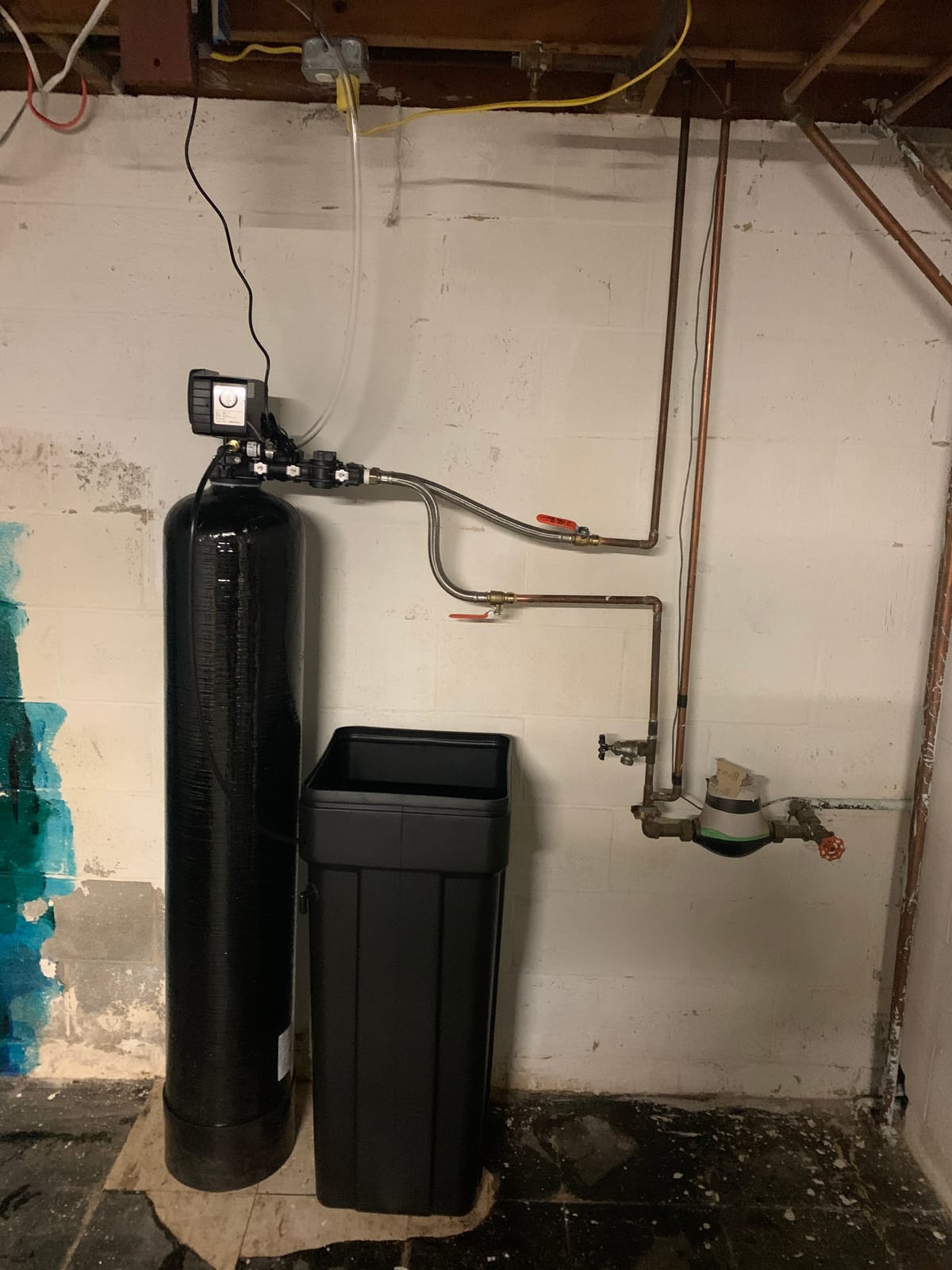
Where it fits your well
Best fit is a 3 to 4 person household with hardness above about 20 gpg and iron at or below 3 ppm, in a mechanical room where floor space is not the constraint. The resin volume gives you headroom if your hardness creeps up over the years.
If you plan to keep the softener for ten years and repair it yourself, the Fleck valve is the reason. Any plumber or supply house will have the parts.
Where it falls short
It is a softener and only a softener. There is no sediment pre-filter, no iron media, and no sulfur capability, so any well with contaminants above the standard resin ceiling needs a second piece of hardware upstream.
At 53 pounds it is the lightest of the Fleck units here, but the 62 inch tank height still needs vertical clearance, and the 1 inch yoke can force a plumbing change on older installs.
6. DuraWater Fleck 5600 SXT 64,000 Grain 10 percent Resin
DuraWater Fleck 5600 SXT Metered 64,000 Grain Water Softener, 10% resin
64000 grain capacity
10 percent crosslink resin
2.0 cubic feet resin bed
Fleck 5600 SXT metered valve
Pros
- Owners use about a third less salt than older units
- 10 percent crosslink resin survives treated water better
- Silent during regeneration
- Tech support fixed a regen leak by phone
- Written and video install guides
Cons
- Connection hoses and drain line not included
- Control head interface is clunky
- Skipping startup flush causes brown water
- One cracked tank report under two years
Salt consumption is the number that comes up first in reviews of this unit. One owner measured roughly a third of what an older system of the same class used, and the metered regeneration on the Fleck 5600 SXT is a big part of why. If your brine tank refills are your main irritation, this is the one to look at.
The other technical differentiator is the resin. At 10 percent crosslink commercial grade cation resin in a 2.0 cubic foot bed, the beads are more durable than standard 8 percent resin, particularly where chlorine is present, and they hold capacity longer between replacements.
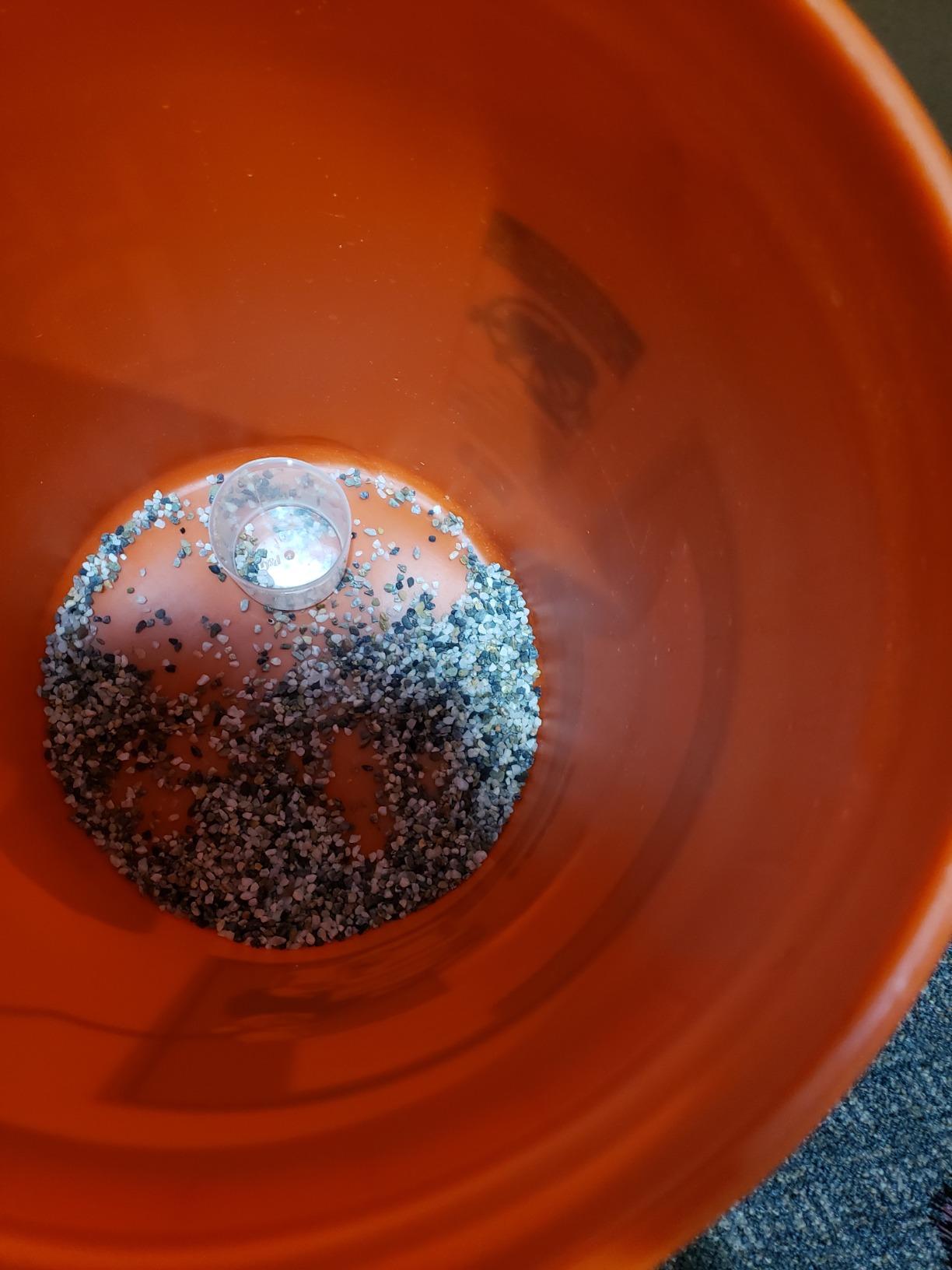
Capacity is rated at 64,000 grains, which puts it in large household territory: 5 to 6 people, or a 4 to 5 bathroom home. The mineral tank is 12 by 48 inches and arrives partially loaded, with a 14 by 36 inch brine tank with safety float and a 1 inch plastic bypass.
DuraWater’s support comes up repeatedly and favorably. Owners report a leaking regeneration cycle diagnosed and resolved on the same phone call, which for a metered valve is exactly the failure you cannot live with.
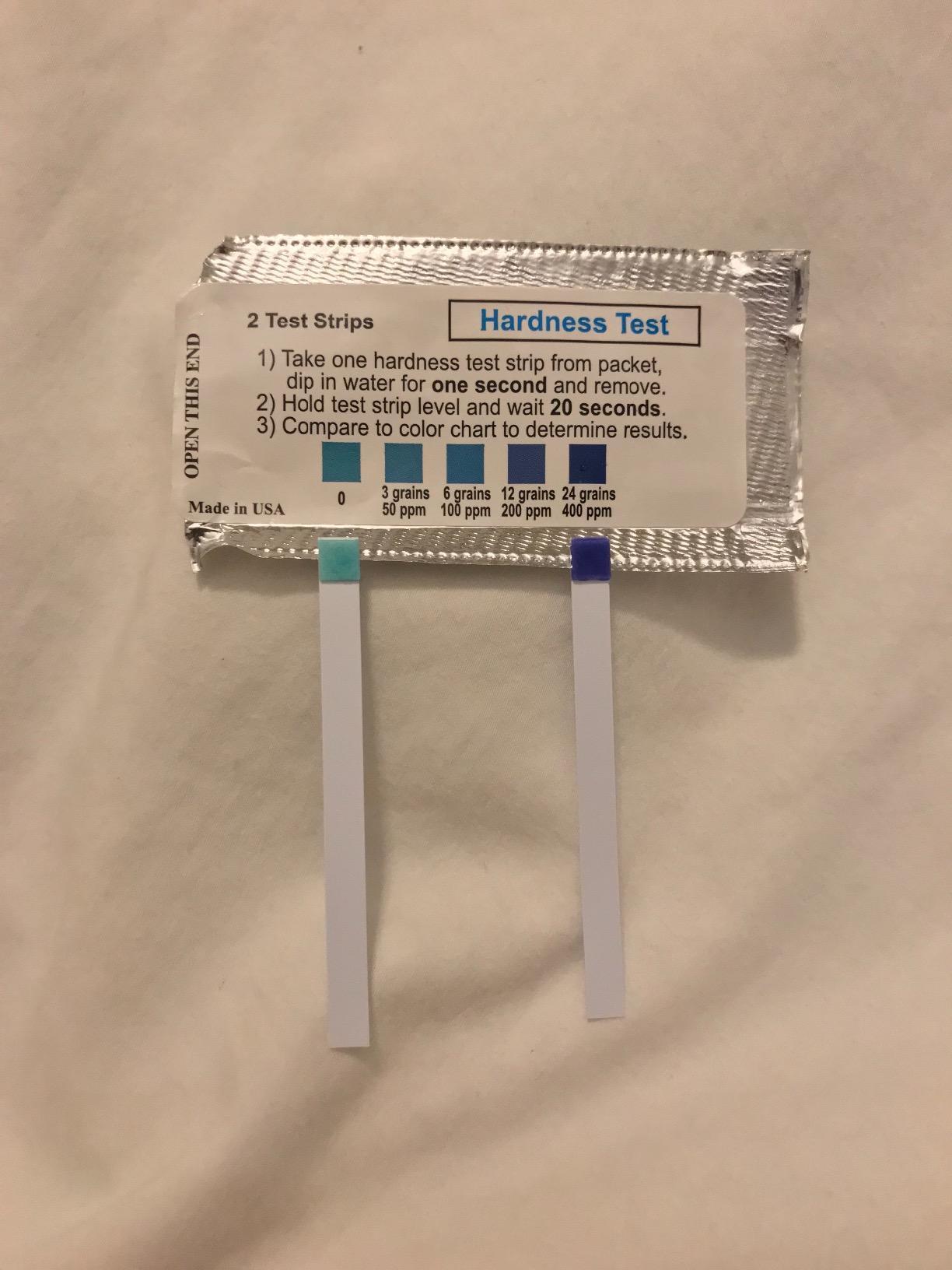
Where it fits your well
This suits a 5 to 6 person household on very hard water where you want maximum capacity per regeneration rather than maximum capacity on paper. The 2.0 cubic foot bed is the largest resin volume in this roundup short of the PRO+AQUA unit.
It also suits anyone who has already replaced resin once and does not want to do it again, because crosslink percentage is the main lever on resin life.
Where it falls short
It arrives without connection hoses or a drain line, so add fittings to your install list. The control head is described as clunky, and one owner who skipped the startup flush steps got brown water from the fresh resin.
Support coverage is a real gap for some buyers: Canadian owners report no local service agents, and one reviewer describes a cracked tank under two years followed by a dispute over replacement parts. Check the warranty terms where you actually live.
7. Aquasana SimplySoft 40K Cabinet System
Aquasana SimplySoft Whole House Water Softener | 40K Grain | WH-SF40-BASE
40000 grain capacity
15.5 gpm max flow
IAPMO certified to NSF ANSI 44
Metered regeneration mode
Pros
- Cabinet design uses about a third less floor space
- Certified to NSF ANSI 44 and CSA B483.1
- Very quiet regeneration
- Resin is replaceable instead of replacing the unit
- 5/10 year limited warranty
Cons
- Manual is online only and contradicts the install video
- Deep cabinet needs long 3/4 inch drain runs
- Regeneration clock offset must be fudged
- One owner reported no hardness reduction
The SimplySoft is the design we would want in a finished basement or a utility room with an unfinished wall. Instead of two exposed tanks, the softener and brine cabinet sit side by side inside one fiberglass enclosure that measures 30 by 16 by 43 inches, roughly a third less footprint than a standard two tank setup.
Under the hood it is a conventional ion exchange system rated at 40,000 grains with a 15.5 gpm maximum flow, the highest rated service flow in this roundup. That headroom matters on a well pump that delivers 12 to 15 gpm, where a lower flow rated unit would become the bottleneck on every shower and appliance draw.
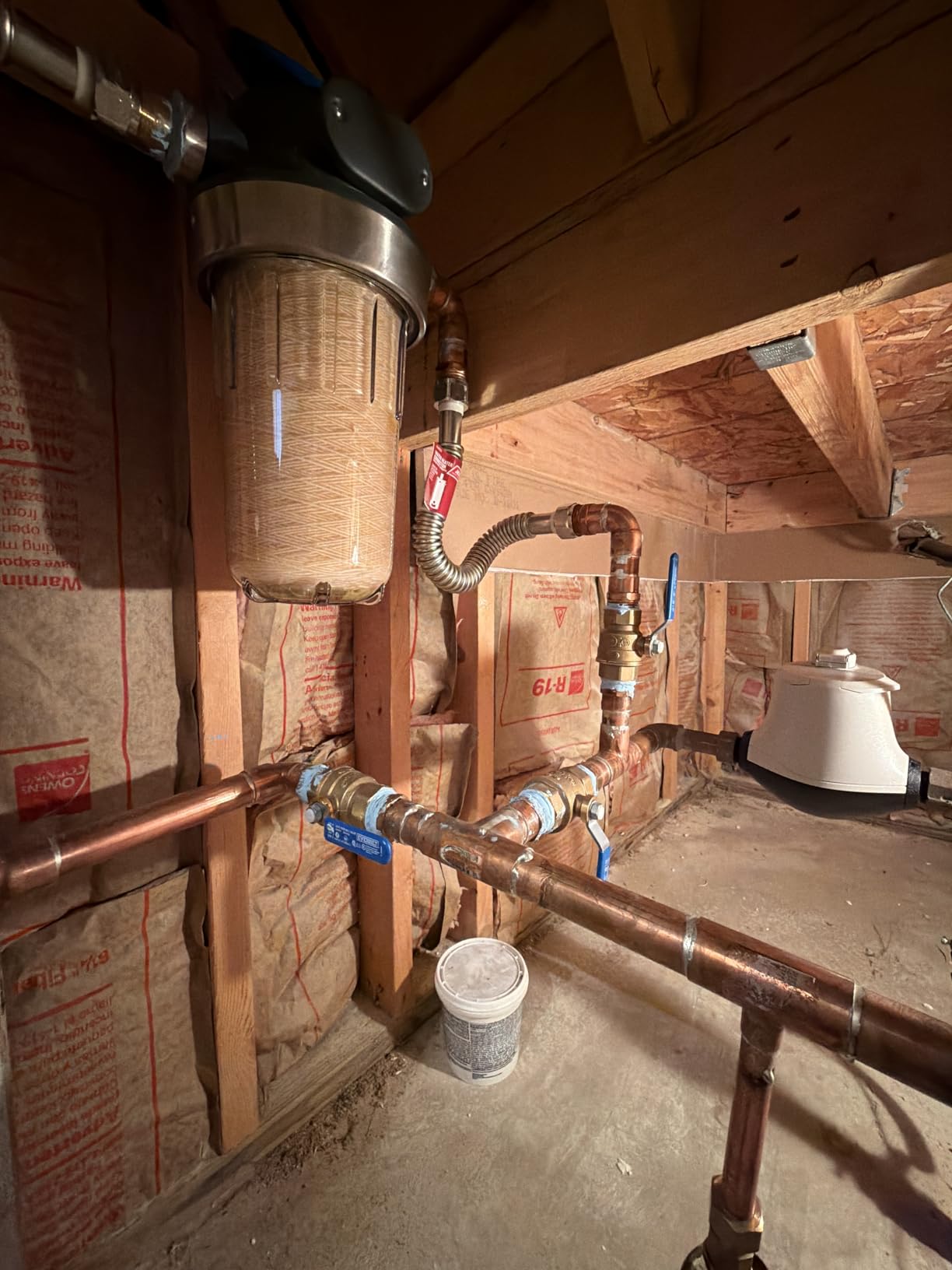
The metered regeneration mode is set to use 50 percent less salt and 28 percent less water than a standard time based softener, and reviewers confirm the unit runs very quietly through a cycle. Certification here is IAPMO to NSF/ANSI 44 for hardness reduction and to CSA B483.1, which is the certification you want to see on any drinking water contact component.
One owner on well water with heavy ferrous iron reported measurable improvement, which is a little surprising given there is no dedicated iron media, and it is worth testing your own water before expecting the same.
Where it fits your well
Best for a home of up to 5 people and 4 bathrooms where the mechanical area is finished, visible, and short on wall space. It is also the easiest unit here to hide behind a door without a builder installing an access panel.
Owners who have had the resin replaced rather than replace the entire unit like other systems appreciate the serviceability, and the 5/10 year limited warranty is backed by phone support for install questions.
Where it falls short
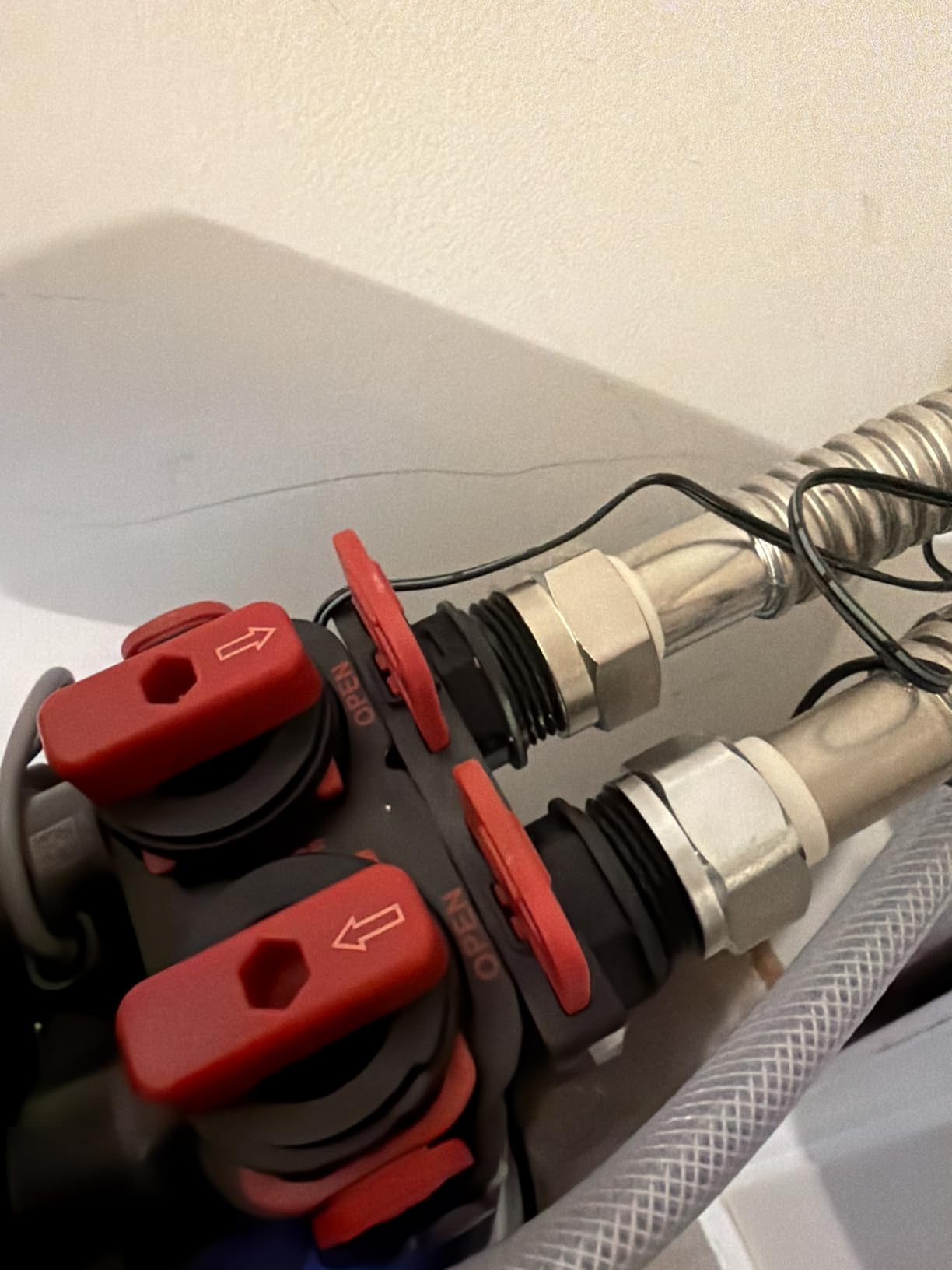
Documentation is the weak point. No printed manual ships in the box, and a detailed long form review found the written manual and the online install video conflict on O-ring silicone lubrication and teflon tape turns. Read both before you start.
Deep cabinets also force long 3/4 inch drain line runs, and the regeneration clock is hardwired, so hitting a 2 a.m. cycle means working out the offset by hand.
8. iSpring WCSTB45KG 45,000 Grain
iSpring WCSTB45KG 45,000 Grains Whole House Water Softener with Brine Tank
45000 grain capacity
99.71 percent hardness reduction tested
Programmable digital control
Automatic backwash
Pros
- 45000 grain capacity at a lower entry point
- Programmable valve calculates regen from usage
- Digital display with real time monitoring
- Automatic backwash extends resin life
- City and well water compatible
Cons
- Only a 1 year manufacturer warranty
- Shortest warranty of the Fleck based alternatives
- Limited owner review volume
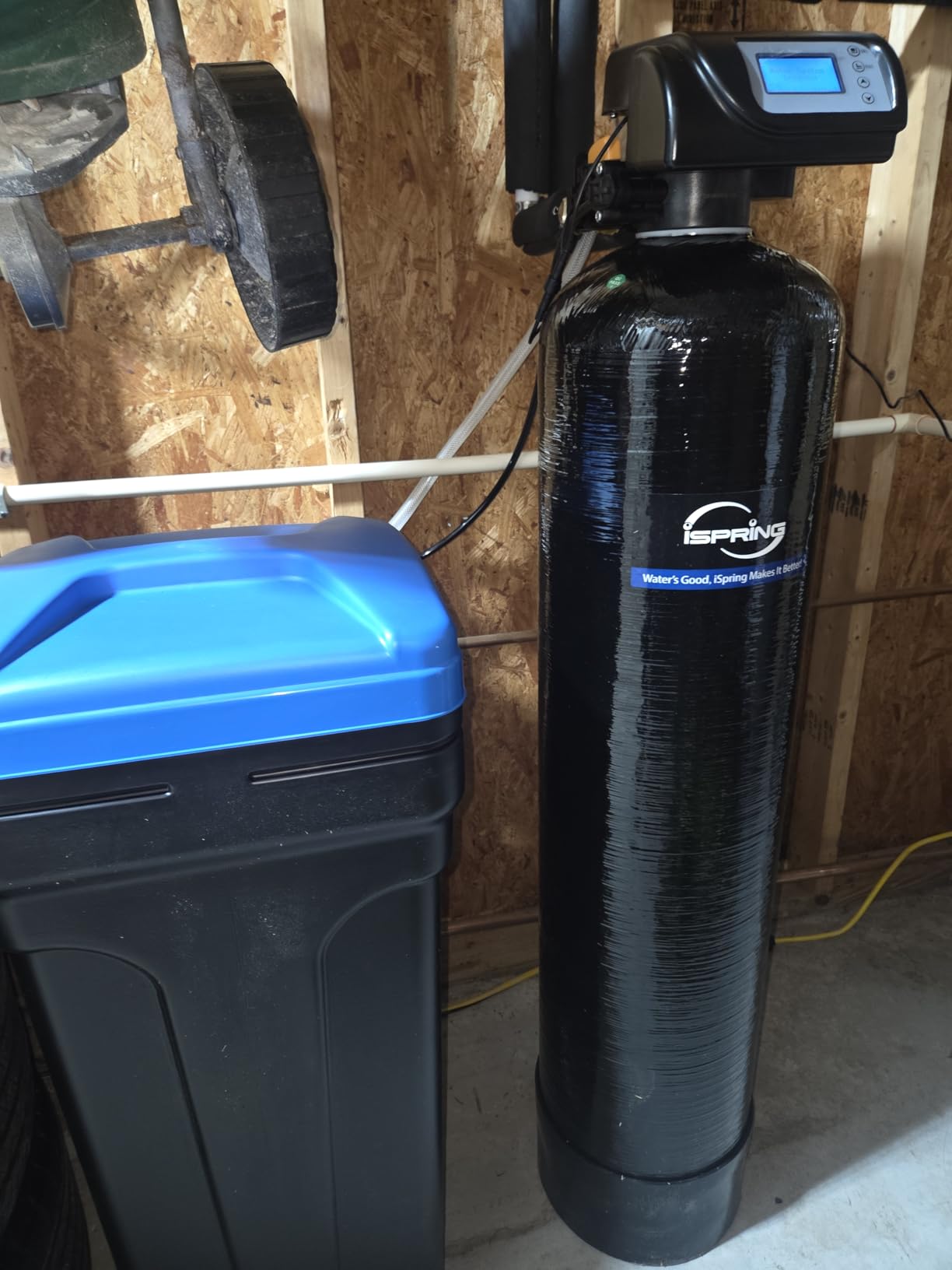
iSpring builds a straightforward 45,000 grain system with a programmable control valve, a fiberglass tank, a brine tank and lid, a power adapter, and the accessories you need to get it running. The capacity figure is third party tested to reduce 99.71 percent of water hardness, and the automatic backwash and regeneration cycle is designed to stretch resin life.
It sits at 4.3 stars across 99 ratings with a 73 percent five star share. For a household of 3 to 4 people on well water under about 3 ppm iron, it does the core job of hardness removal competently, and it is the most compact entry point in the roundup.
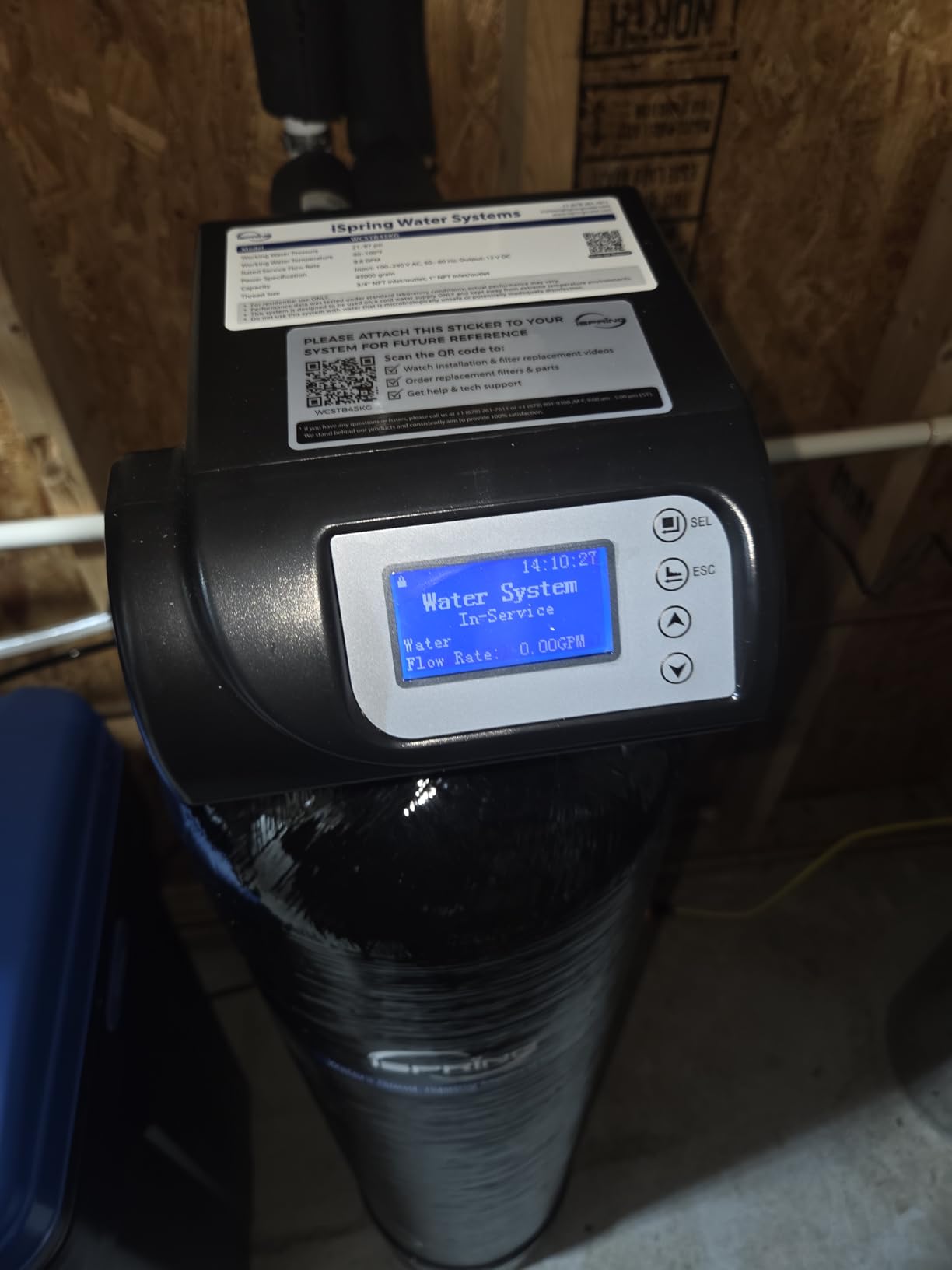
The control valve calculates regeneration from water quality and usage data rather than running on a fixed clock, and the digital display shows real time monitoring with hardness adjustment. That is a better control story than most of the budget tier units, and it is why this is our budget pick rather than a bare tank and a timer.
Automatic backwash on a schedule matters more than it sounds on well water, because periodic reverse flushing keeps suspended sediment from caking the top of the resin bed.
Where it fits your well
Pick this for a 2 to 4 person home on a straightforward well: hard water, no sulfur smell, iron at or below 3 ppm, and a budget you would rather put toward a separate iron filter than toward a premium softener. The system is listed for residential and light commercial use.
It ships with a 1 year manufacturer warranty, a 30 day money back guarantee, and lifetime free technical support.
Where it falls short
The warranty is the number to weigh. One year against the 5 to 10 year terms on the Fleck based units is a real difference over a ten year ownership horizon, because a control valve failure in year four becomes an out of pocket repair.
Review volume is also the thinnest of the mid tier units here, so long term durability data is limited. If you want a system you will not think about for a decade, spend a little more up front.
9. PRO+AQUA Heavy Duty 80,000 Grain
PRO+AQUA Heavy Duty Whole House Water Softener System – 80,000 Grain Capacity, Premium Long-Lasting Resin, 1″ Ports
80000 grain capacity
10 percent resin bed
1 inch inlet and outlet ports
Smart digital control valve
Pros
- Sized for 6 to 8 people and up to 6 bathrooms
- Several owners report years of continued service
- 1 inch ports suit high flow and existing flex lines
- Smart valve manages salt and water automatically
- Widely praised protective packaging
Cons
- One owner reported it made well water worse
- Programming interface gives no confirmation
- Instructions assume 1 inch flex piping
- Refund and seller response complaints are common
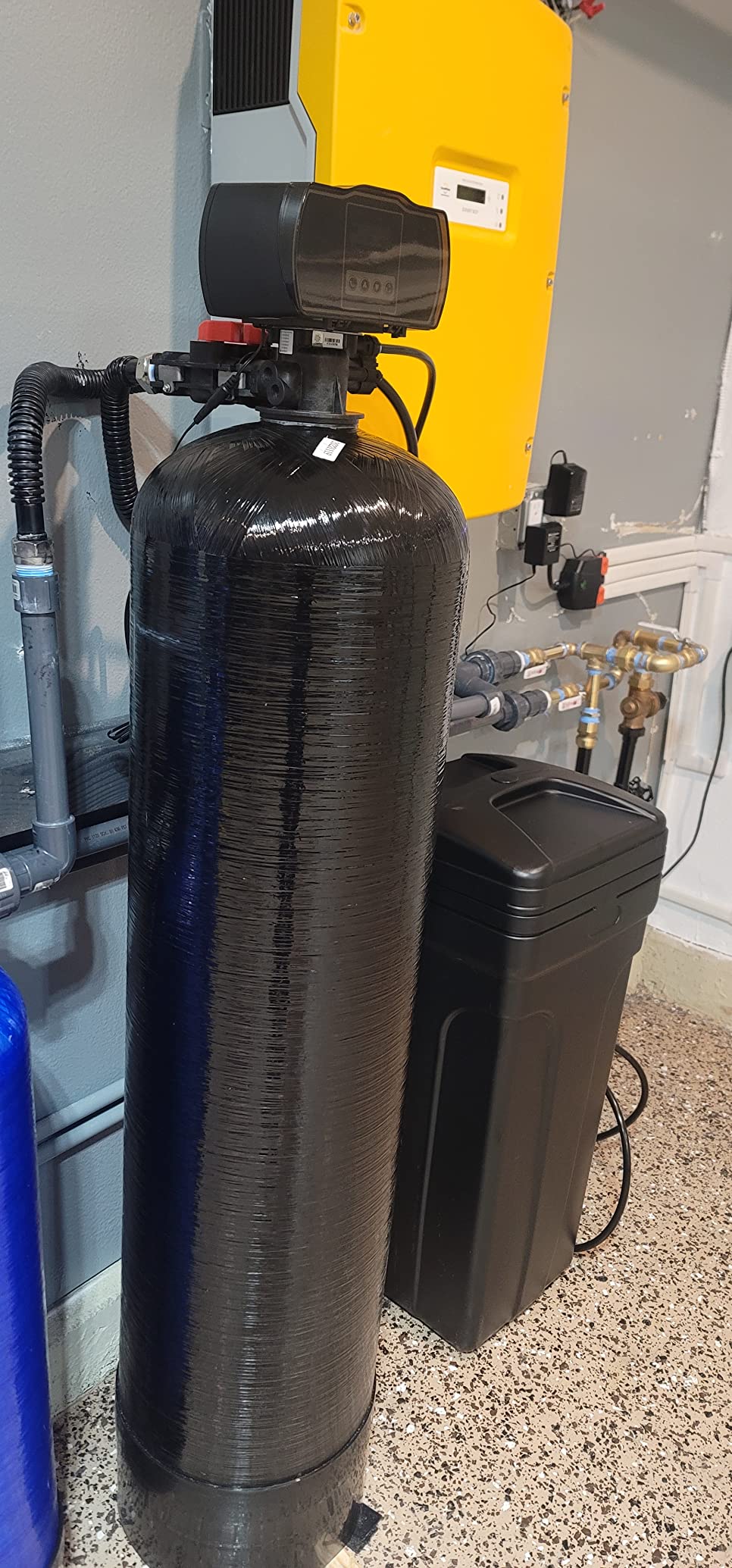
This is the largest system in the roundup at 80,000 grains, and it is built for households of 6 to 8 people with up to 6 bathrooms. The tank is 14 by 14 by 55 inches in fiber reinforced polymer with premium 10 percent resin, and both ports are 1 inch, so it accepts high flow and pairs with existing 1 inch flex lines.
One commercial buyer used it in a winery tasting room and reported much cleaner glassware and fixtures, which is a useful signal about how it handles a high demand, hard water application. Several residential owners also describe several years of continued service.
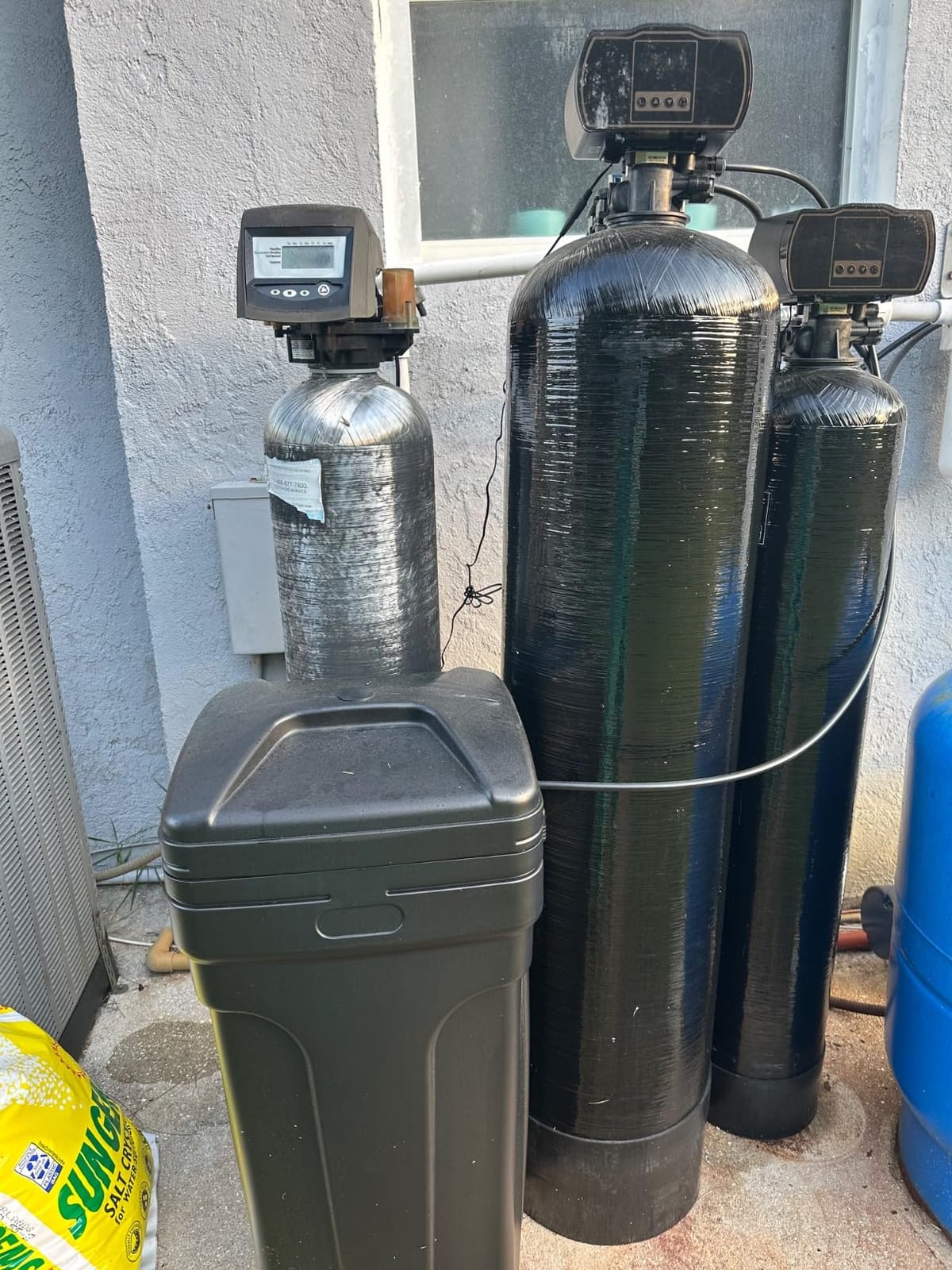
The smart digital control valve calculates salt and water needs automatically rather than running to a fixed schedule. Rated iron reduction is up to 2 ppm of clear water iron, which is a supplement, not a substitute for a dedicated filter on a high iron well.
It is also one of the better shipped units in the set: multiple reviews call out the protective padding and the fact that the unit arrived undamaged, which on a tank this size is not a given.
Where it fits your well
This suits a large household, a farm house with multiple fixtures running at once, or a small commercial well. At 80,000 grains it gives you the capacity headroom that lets you keep the unit sized correctly instead of running a small unit hard.
If your well pump pushes high flow, the 1 inch ports mean you are not immediately throttling the whole house through a 3/4 inch yoke.
Where it falls short
Support is the weak point, and the reviews are blunt about it: several describe slow or absent refunds and copy and paste seller responses, and the warranty is 1 year standard or 3 years with registration, well short of some competitors in this list.
One owner reported the unit made their well water worse than having no softener at all, and the programming interface reportedly gives no confirmation that a setting took. The instructions also assume 1 inch flex pipe, so existing plumbing often needs modification before the install starts.
10. Aquasure Harmony Lite 34,000 Grain
Aquasure Harmony Lite All-in-One 34,000 Grains Whole House Water Softener with Pleated Sediment Pre-Filter System | Reduces Hardness and Improves Water Quality | for 1-3 bathrooms
34000 grain capacity
3.13 gpm max flow
All in one pleated pre-filter
Stainless steel construction
Pros
- Softener and pre-filter in one compact housing
- Pre-filter handles sediment chlorine odors and rust
- 18.5 by 10.5 by 43 inch footprint
- Programmable backlit digital head
- 5 year extended warranty on activation
Cons
- 3.13 gpm is the lowest flow rating here
- Pleated cartridges add recurring replacement cost
- Smallest review base means limited long term data
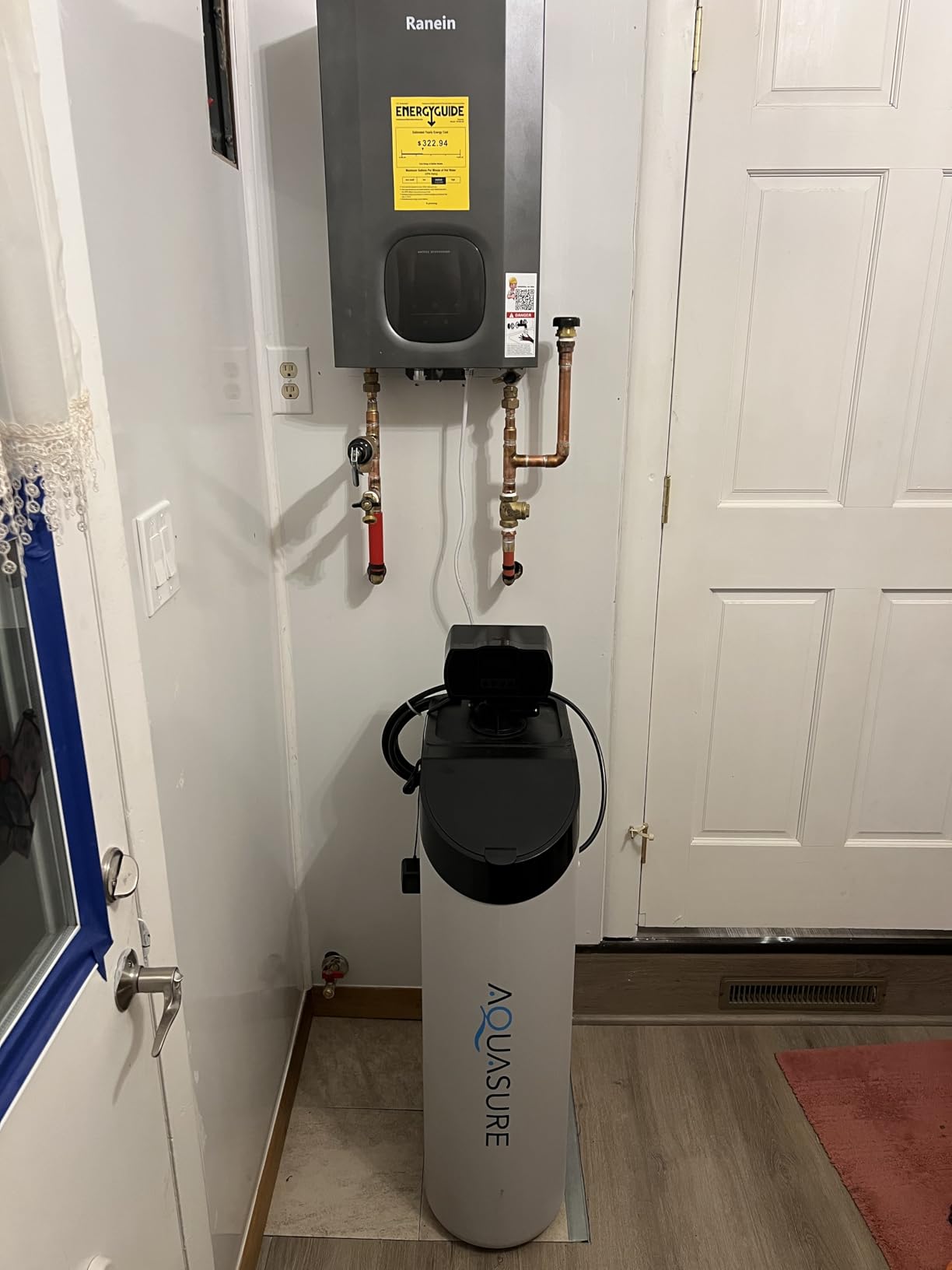
The Harmony Lite is built for a specific problem: a well house, mobile home, or townhouse where there is genuinely not enough room for two tanks. It combines a 34,000 grain softener with a pleated sediment, carbon, and zinc pre-filter in a single housing that measures 18.5 by 10.5 by 43 inches.
That footprint is the whole argument. On a well system serving 1 to 3 bathrooms, the alternative is a standard two tank setup that simply does not fit, and owners confirm the space savings are the reason they bought it.
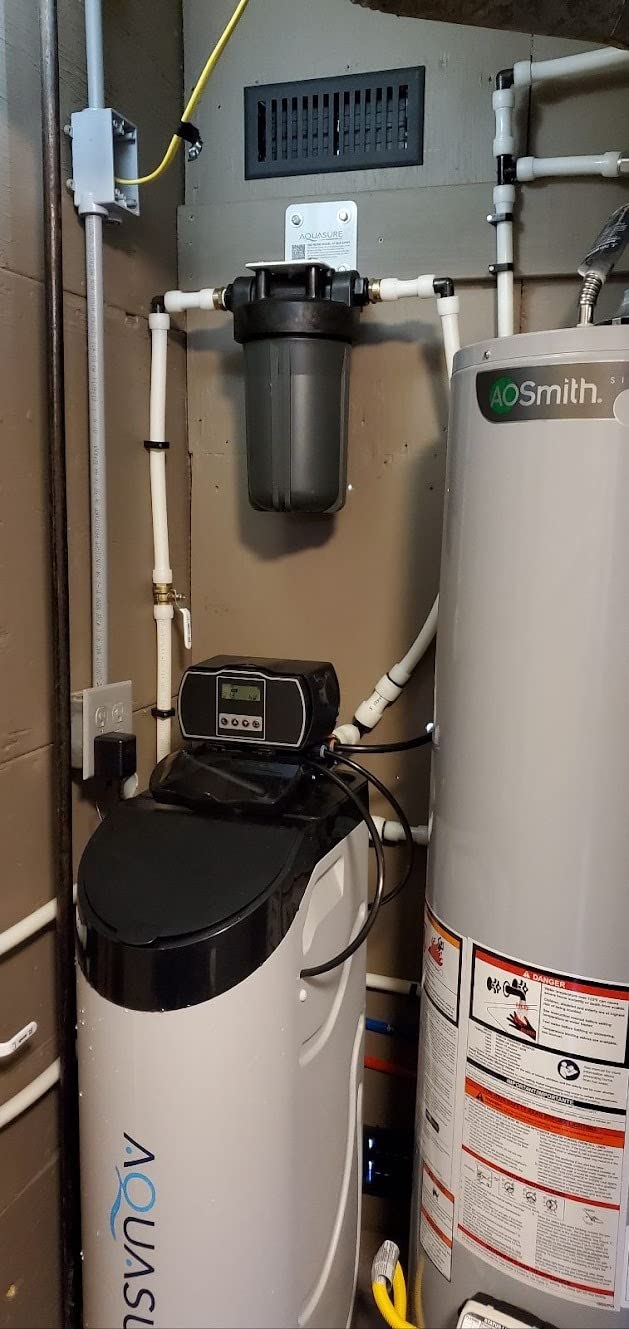
The pre-filter is a real piece of hardware, not a screen. It handles sediment, chlorine, VOCs, pesticides, odors, rust, and sand, which on a well with any sediment load keeps grit from blinding the resin bed and gives the whole system a longer life.
Construction is stainless steel with a durable bypass valve, and the programmable backlit head has adjustable auto flush intervals, with a 5 year extended warranty once activated online within 60 days.
Where it fits your well
This is for 1 to 3 bathrooms on a well, a mobile home, a condo, or a townhouse. It also suits a secondary dwelling, a short term rental, or a workshop where you want sediment and odor control along with softening in one footprint.
If your well carries visible sediment, the pleated pre-filter is doing the job that a separate spin down filter would otherwise handle.
Where it falls short
Flow is the limit, and it is a hard one. At 3.13 gpm maximum, this is the lowest service flow rating of any unit we looked at, and a household that runs two showers and a laundry cycle at once will feel it.
The pleated cartridges are consumables that have to be replaced on a schedule, and the 57 rating review base is the smallest here, so long term performance data is thinner than we would like for a unit you might keep for a decade.
How to Size a Softener for Your Well Water
Sizing is arithmetic, not guesswork, and getting it wrong is the single most common reason owners report hardness breakthrough. You need three numbers: your hardness in grains per gallon, the number of people in the house, and your hardness reading after a full regeneration, not a taste test.
Start with the formula. Required capacity in grains equals the number of people multiplied by 60 gallons per person per day, multiplied by 7 for a weekly regeneration, multiplied by your hardness in gpg. A family of four on 25 gpg water arrives at 4 times 60 times 7 times 25, which is 42,000 grains of capacity needed to keep up with a weekly cycle.
That is why 48,000 grain units show up so often in our roundup, and why the 32,000 grain Kenmore and the 34,000 grain Harmony Lite are the right answers for smaller homes and the wrong answers for a family of five.
Add a margin for real life. Well hardness fluctuates, and if your water is near the top of a range, size up rather than down. A unit run constantly regenerates constantly, and a unit that is too small simply stops softening, which is worse than no unit at all because you think the water is treated.
In practice: one to two people need roughly 20,000 to 30,000 grains. Three to four people need 35,000 to 50,000 grains, which is the range our top pick sits in. Four to five people need 50,000 to 64,000 grains, and six to eight people need 64,000 to 80,000 grains, which only the PRO+AQUA covers in this roundup.
One more sizing variable matters on well water specifically: iron load. A well at 3 to 5 ppm iron will consume resin capacity faster than hardness alone predicts, because the iron fouls beads and reduces active sites. Either add capacity or add an iron filter, and most owners end up doing the second.
Match the Softener to Your Well Pump Flow Rate
Rated flow rate on a softener is not how fast it softens water. It is the maximum service flow the control valve and resin bed can handle before pressure drop and channeling become a problem, and it has to be at or above your well pump output.
Measure your pump the old fashioned way. Put a five gallon bucket under the spigot, open it fully, and time how many seconds it takes to fill. Divide 300 by the number of seconds to get gallons per minute. A 20 second fill is 15 gpm, which is faster than most of the units in this roundup are rated to serve.
If your pump measures well above a unit’s rating, you have three options: pick a unit with a higher flow rating, install a flow restrictor on the softener inlet, or add a pressure tank to slow the draw. Restrictors are the most common and cost almost nothing.
Two flow numbers matter and they are not the same. Service flow is the rate at which water passes through the resin during normal use, and backwash flow is the rate needed to expand and clean the bed during regeneration. The control valve dictates the second one, and a well pump that cannot deliver the required backwash flow will leave you with a partially cleaned bed.
That failure is quiet. Your water tests soft right after a cycle and gets harder as the days pass, which most owners misdiagnose as an undersized unit. Check the valve specification for its minimum backwash requirement against your pump’s measured output.
Softener Alone or Softener Plus an Iron Filter
This is the decision that matters most on well water, and it is the one most vendor bundles are designed to hide from you. The framework is simple enough to run yourself once you have a report.
Step one: read the iron number. Below 3 ppm of clear water iron, a standard softener with good resin will cope. Between 3 and 6 ppm, use fine mesh resin or add an iron filter, and owners on r/WaterTreatment are consistent that a dedicated filter is the cheaper long term answer.
Step two: read the hydrogen sulfide number. Any measurable sulfur means a softener cannot help, because it does not remove gas. You need a media rated for it, and the units that advertise high sulfur limits are specialty systems rather than general purpose softeners.
Step three: read manganese. Standard resin has a low ceiling here, and above 1 to 2 ppm you want an oxidizing filter rather than a softener upgrade.
Step four: read the pH. Below 6.5 and you likely need a pH neutralizer calcite tank, and that belongs ahead of everything else, because acidic water eats metal piping and can shorten the life of a new softener tank.
The architectural takeaway: a single all in one tank like the AFWFilters Iron Pro 2 is a sensible compromise when iron is 3 to 6 ppm and space is tight. When iron is higher, or when you have sulfur, a two piece setup of an iron filter followed by a softener is the answer, and the filter goes first so the resin sees clean water.
One r/drinkingwater thread pattern worth copying: new well owners pairing a whole house softener with an under sink reverse osmosis for drinking water. It handles the sodium concern properly, and several owners on r/WaterTreatment also recommend routing around the softener entirely for drinking and for yards and gardens.
Reliability, Parts Support and Warranty Terms
Reliability in a softener is not a spec, it is a parts question. Ask one thing: will the control valve be on a shelf in ten years? Owners on r/WaterTreatment choose the Fleck 5600SXT for exactly this reason, describing it as the most commonly sold control valve in the US and choosing it mainly for parts availability.
Compare warranty lengths honestly. The 5 year extended terms on the Aquasure units, the 10 year tank warranty on the Kenmore, the 5/10 year limited warranty on Aquasana, and the 1 to 3 year terms on iSpring and PRO+AQUA are not equivalent. A tank warranty is also not a unit warranty, and a control head is usually the part that fails.
Look for a bypass valve on every unit, which is the part that lets you isolate and swap a control head without shutting off water to the house. Every system in this roundup has one, and that is why we left off products that do not.
Finally, read what support actually means. Lifetime phone support that answers on the first call and a seller that responds to refunds with a template are different things. The Fleck 64K owner reports we found had a regeneration leak fixed by phone in minutes, and the PRO+AQUA reviews describe the opposite experience in detail.
Salt, Sodium and the Real Cost of Ownership
Salt usage is the operating cost that catches new owners off guard. Demand initiated metered regeneration helps a lot, because the unit only regenerates when capacity is actually used, and the Aquasana is specced at 50 percent less salt and 28 percent less water than a standard time based system.
Count the full annual picture, not just the unit. You need salt for the brine tank, replacement resin on a multi year horizon, filters, and the electricity for the valve, and you need to think about brine discharge if you are near a stream, a well, or a septic field.
Sodium is the other conversation, and it is reasonable to raise it. Ion exchange softening does add sodium to the water. Owners on r/WaterTreatment commonly recommend not softening drinking water and keeping softened water off plants and gardens, both of which are easy to do with a dedicated drinking tap and a hose bib upstream of the softener.
Salt free conditioners exist and owners debate them constantly in the forums. They do not remove hardness, they reduce it, and they need very high flow rates to work at all. On a well with iron or sulfur, they are not a substitute for any of the systems in this roundup.
DIY Installation: What to Expect
Most of these installs take one to two hours with basic plumbing skills, and the Fleck 64K listing states that plainly. Cutting a main line, adding a bypass, running the drain, and setting the valve are the four jobs, and each one has a failure mode you should know before you start.
Size matters more than difficulty. The Aquasure Harmony and the AFWFilters combo both arrive around 120 pounds, and owners on the AFWFilters listing specifically recommend a dolly. Plan the vertical clearance too, since these tanks are 62 inches tall before the bypass.
Get the drain right. An air gap fitting, a proper slope to the drain, and a plumber’s mate on threaded connections prevent the most common flood. Several reviews across these products mention brown water at startup, which is a skipped flush step rather than a fault, so read the startup procedure and follow it exactly.
Call a plumber when the run is longer than a few feet, when you have no floor drain nearby, or when your well pressure switch shares a pipe with the softener. The money you spend on an hour of professional help is usually less than the cost of a flooded mechanical room.
Frequently Asked Questions
Do you need a special water softener for well water?
You do not need a different softening principle, but you do need a well rated system and a clear plan for the other contaminants in your water. A standard ion exchange softener handles hardness, tolerates roughly 3 ppm of clear water iron before the resin fouls, and does nothing at all for hydrogen sulfide or manganese. So the answer is usually a good softener plus a separate iron filter, ordered so the filter treats the water first.
What is the most reliable brand of water softener?
Reliability comes down to the control valve and whether parts will exist in ten years, which is why owners most often choose the Fleck 5600SXT platform, sold through DuraWater and several other brands. Look for a metered demand initiated valve, a bypass valve, and a warranty of five years or more on the valve rather than just the tank. Fleck 5600SXT units appear three times in this roundup for that reason.
What are the top 10 best water softeners for well water?
Our picks are the Aquasure Harmony 48,000 Grain for most homes, the AFWFilters Iron Pro 2 combo for wells with iron between 3 and 6 ppm, the Fleck 5600 SXT Iron Blaster 48,000 Grain for fine mesh iron capability, the Kenmore 350 for small homes, the DuraWater Fleck 5600 SXT 48K and 64K for capacity and low salt use, the Aquasana SimplySoft 40K for tight mechanical rooms, the iSpring WCSTB45KG as a budget option, the PRO+AQUA 80K for large homes, and the Aquasure Harmony Lite for one to three bathrooms.
How do I know how hard my well water is?
Order a well water analysis that reports hardness in grains per gallon along with iron, manganese, hydrogen sulfide, and pH. A taste test will not tell you, because you can notice hardness long after it has started scaling, and you cannot taste iron or sulfur at low levels. Most of the numbers on that report change which unit you should buy, which is why we tell you to test before you shop.
Can a water softener remove sulfur from well water?
No. Ion exchange resin targets calcium and magnesium, and hydrogen sulfide passes straight through it. Sulfur needs a media designed for it, and owners on r/wellwaterguide report a SpringWell WS1 rated to 8 ppm hydrogen sulfide as a system that worked for their well. Any rot egg smell on your water should be a separate line item in your treatment plan, not a reason to buy a bigger softener.
Is a water softener bad for well water?
No, but it can be useless if sized for hardness alone on a well that also carries iron. Iron fouls the resin, cuts capacity, and shortens resin life, and owners on r/WaterTreatment consistently recommend an upstream oxidizing iron filter such as Katalox Light, Filox, or air injection media. Treat the iron first, size the softener to your actual hardness, and it becomes the best protection your plumbing has.
The Verdict
The Aquasure Harmony 48,000 Grain is our pick for the best water softener for well water overall, because it pairs a metered control head with prefilled resin and a sediment and carbon pre-filter at the highest review volume in the category. If your report shows iron between 3 and 6 ppm, the AFWFilters Iron Pro 2 combo handles hardness and iron in one tank and is the smarter architecture.
Before you buy anything, get the report and measure your well pump with a bucket. Those two hours decide which of these 10 systems is right and which extra filter you need, and they will save you from a unit that fails on day one. Our shortlist is current as of October 2026 and we update it as testing and owner reports come in.