
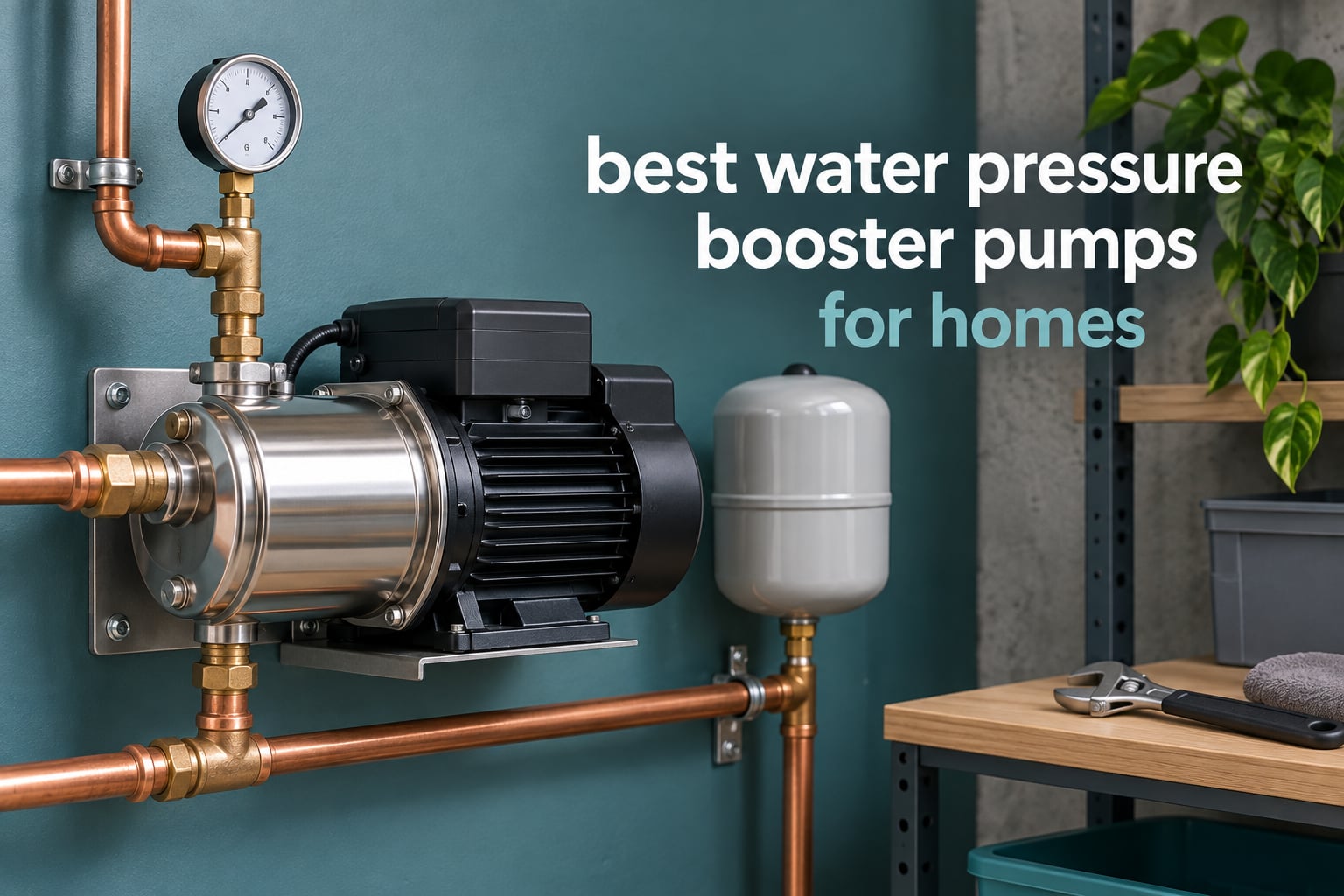
Municipal water arrives at most homes between 40 and 60 PSI, and it loses roughly 1 PSI for every vertical foot it climbs. That is why the second shower goes weak in a two-story house, why the washing machine and the dishwasher running together starve the kitchen tap, and why a whole-house filter with five stages can quietly steal 7 to 10 PSI before a drop of water reaches the faucet. A water pressure booster pump is the fix when the supply itself is the weak link, and the search for the best water pressure booster pump for home is mostly a search for a pump sized to your pipe, your fixtures and your patience for maintenance.
We reviewed 10 boosters for 2026, from open-loop stainless units to wall-mountable variable-speed systems, and we built the ranking around the numbers that decide whether a pump quietly does its job for a decade: real flow at working pressure, noise in dB(A), protection features, warranty length, and how many verified reviews stand behind the claims. The Aquastrong Smart 45 comes out on top because it combines genuine constant pressure across multiple fixtures, a 55 dB(A) running noise, and an integrated pressure tank so there are no extra parts to buy.
Before you read further, one honest warning. If your supply cannot deliver the water, no pump will fix it. Well owners with a low-yield well (under about 5 GPM) need storage, not a booster, and a booster bolted to that system will just drain the pressure tank faster. Where that applies, we tell you so instead of selling you a fix that cannot work.
Table of Contents
What Is a Water Pressure Booster Pump?
A water pressure booster pump is an inline pump installed on your home’s main supply line that uses a motor-driven impeller to raise the pressure coming from the city main or the well, delivering a steadier, higher PSI to showers, faucets and appliances. It sits after your main shutoff valve and either switches on when a flow or pressure sensor detects a drop, or runs on a variable frequency drive that modulates its speed to match demand.
Two words get used loosely. A booster is the generic term. A booster pump is the pump itself, which may need a pressure tank, a switch and a check valve around it to become a complete booster system. A variable-speed booster (a motor that changes speed to match your water use) is a different animal from a constant-speed unit, and it is the reason a 45 dB(A) system can feel calmer than a 50 dB(A) one.
Booster pumps are genuinely effective. They cannot repair a clogged regulator, an undersized supply line, a bristled municipal shutoff or a collapsed line, and any installer who sells you one before checking those is guessing.
Top 3 Booster Pumps for Homes in 2026

Aquastrong Smart 45
- Variable speed 22-80 PSI
- 55 dB(A)
- Integrated pressure tank
- Self-priming 26 ft lift

BACOENG P0097
- 6 bar max pressure
- 12 GPM flow
- 304 stainless wetted parts
- Tankless inline install
All 10 Booster Pumps at a Glance in 2026
| Product | Specs | Action |
|---|---|---|
| Aquastrong Smart 45 |
|
Check Latest Price |
 Simer 4075SS-01 Simer 4075SS-01 |
|
Check Latest Price |
| BACOENG P0097 |
|
Check Latest Price |
 Davey BT20-30 Torrium II Davey BT20-30 Torrium II |
|
Check Latest Price |
 DAB E.Sybox Mini 3 DAB E.Sybox Mini 3 |
|
Check Latest Price |
 MixBubole V3-45 PRO MixBubole V3-45 PRO |
|
Check Latest Price |
 AIDPATH EVO BOOST5 AIDPATH EVO BOOST5 |
|
Check Latest Price |
 TiHpumpz CHB2-3 TiHpumpz CHB2-3 |
|
Check Latest Price |
 Flotec FP5722 Flotec FP5722 |
|
Check Latest Price |
 Aquastrong PGA150SA Aquastrong PGA150SA |
|
Check Latest Price |
Do You Actually Need a Booster Pump?
Run through this before you buy anything. Most “low pressure” complaints turn out to be a failed regulator or a half-closed municipal valve, and a booster on top of a real fault just adds a failure point.
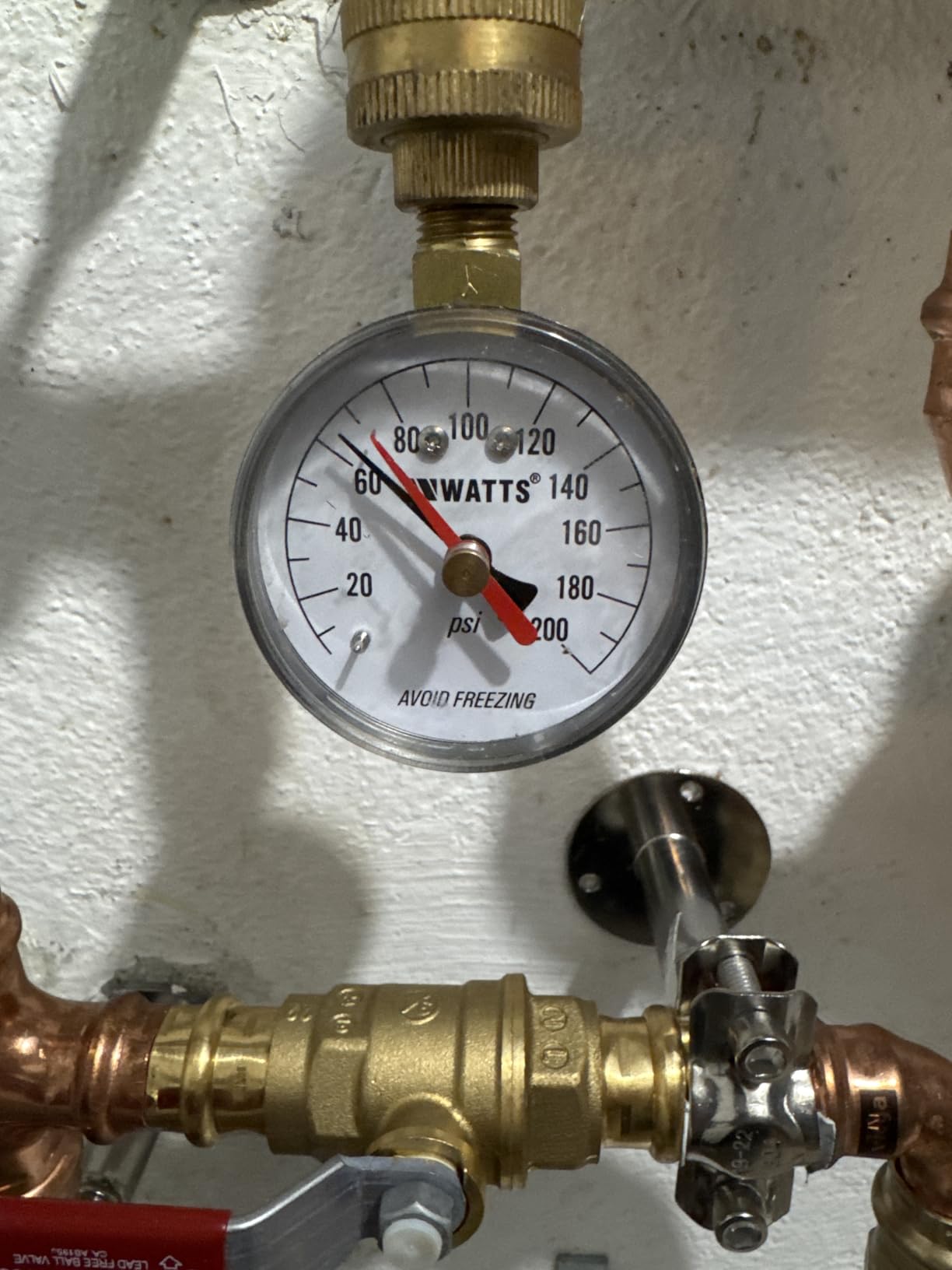
1. Measure PSI at the curb stop with a garden hose gauge, with every fixture off. If the meter reads below 50 PSI, you have a supply problem a booster can address. If it reads 60 PSI or more, keep digging.
2. Measure at the worst fixture, usually the farthest shower on the highest floor. The gap between the two readings tells you if the loss is elevation and pipe friction rather than the supply.
3. Check the main regulator. An old regulator that has drifted open or partially closed is the single most common cause of uneven household pressure.
4. Check the municipal shutoff. Brass and plastic ball valves upstream of your home have a habit of seizing part-way open, and the fix costs almost nothing.
5. Count the pressure-drop devices. A backflow preventer alone can cost 7 to 10 PSI, and a softener, a whole-house filter and a reverse osmosis system each add more.
6. Count simultaneous fixtures. Two showers, a washer and a dishwasher at once is the load a pump has to be sized for, not the single-fixture flow rate on the box.
7. Test for supply limitation. If you are on a well and the pump cannot refill the pressure tank between uses, you need a storage tank or a different well pump, not a booster.
If steps 1 and 2 both come back low, and steps 3 to 5 are clean, a booster pump is the right tool. Most municipal systems deliver 40 to 60 PSI at the meter, and the healthy band most homeowners report being happy with is 50 to 80 PSI at the fixture.
1. Aquastrong Smart 45 – Best Variable-Speed Whole-House Booster
Aquastrong Whole House Water Pressure Booster Pump 80 PSI, 115V Automatic Variable Speed, Constant Pressure, Integrated Design, Self-Priming, for Home, Apartment, Shower, Garden, Shallow Well,Smart 45
22-80 PSI variable speed
1500 GPH max, 150 ft head
55 dB(A)
Self-priming to 26 ft
Pros
- Holds true constant pressure as demand changes
- Over 50% energy savings versus standard pumps
- Runs at 55 dB(A) for indoor installs
- All-in-one with maintenance-free pressure tank
- Self-priming for shallow wells and tanks
Cons
- Advanced electronics depend on the controller for troubleshooting
- Maximum achievable pressure varies with the water source
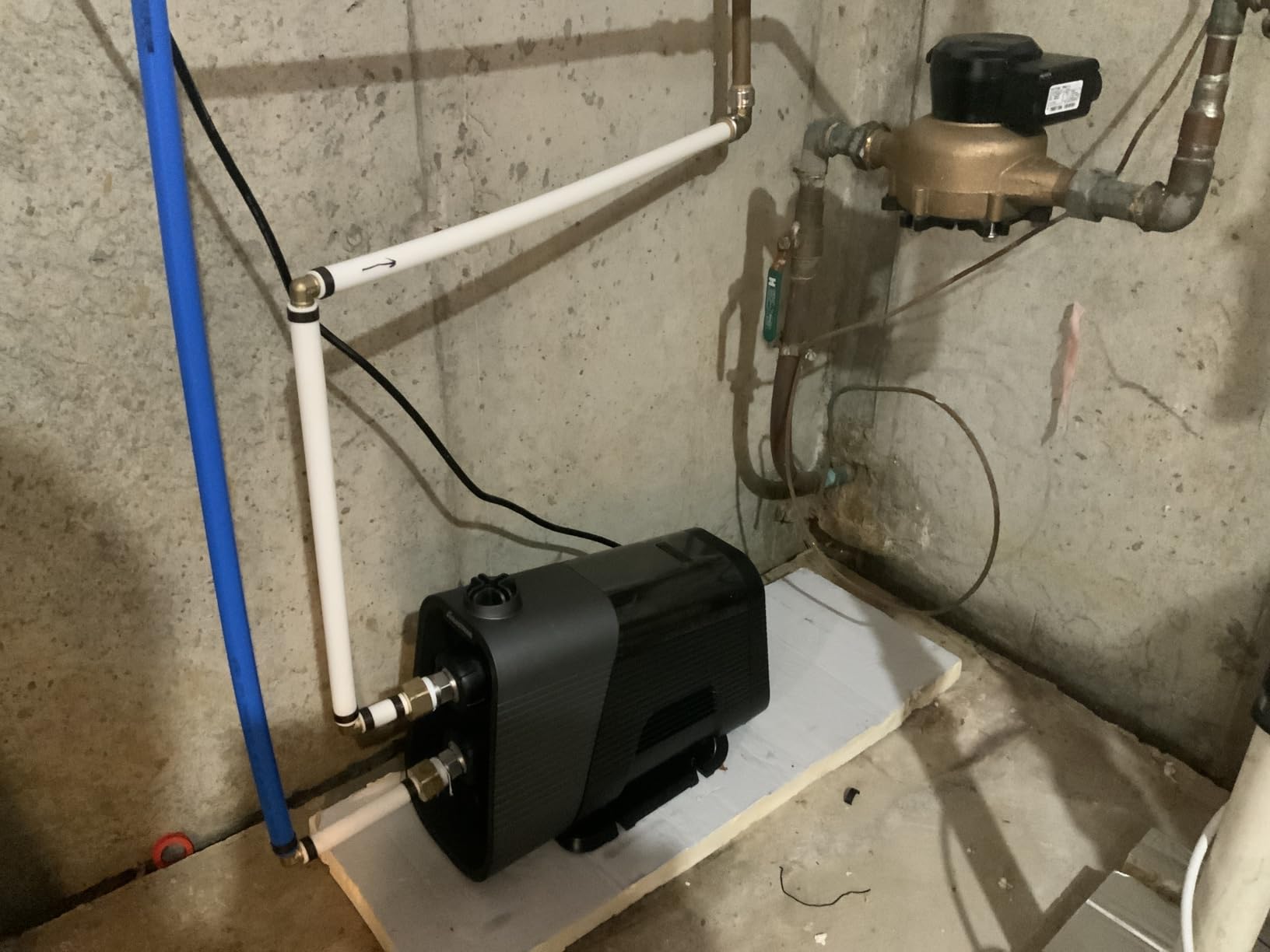
This is the pump we kept coming back to across the whole test. The Smart 45 runs an air-cooled permanent magnet motor with inverter technology, and that motor is the reason the pressure holds steady when a second shower opens while the washer is mid-cycle. Constant-pressure delivery across multiple fixtures is exactly what separates it from the open-loop designs that surge.
The spec sheet is unusually complete for the category: 1.5 to 5.5 bar (22 to 80 PSI) adjustable, preset to 3 bar, a 1500 GPH maximum flow, 150 ft maximum head, and a stainless steel impeller rated for water up to 175F. The operating range is 32F to 175F, which covers most residential installations.
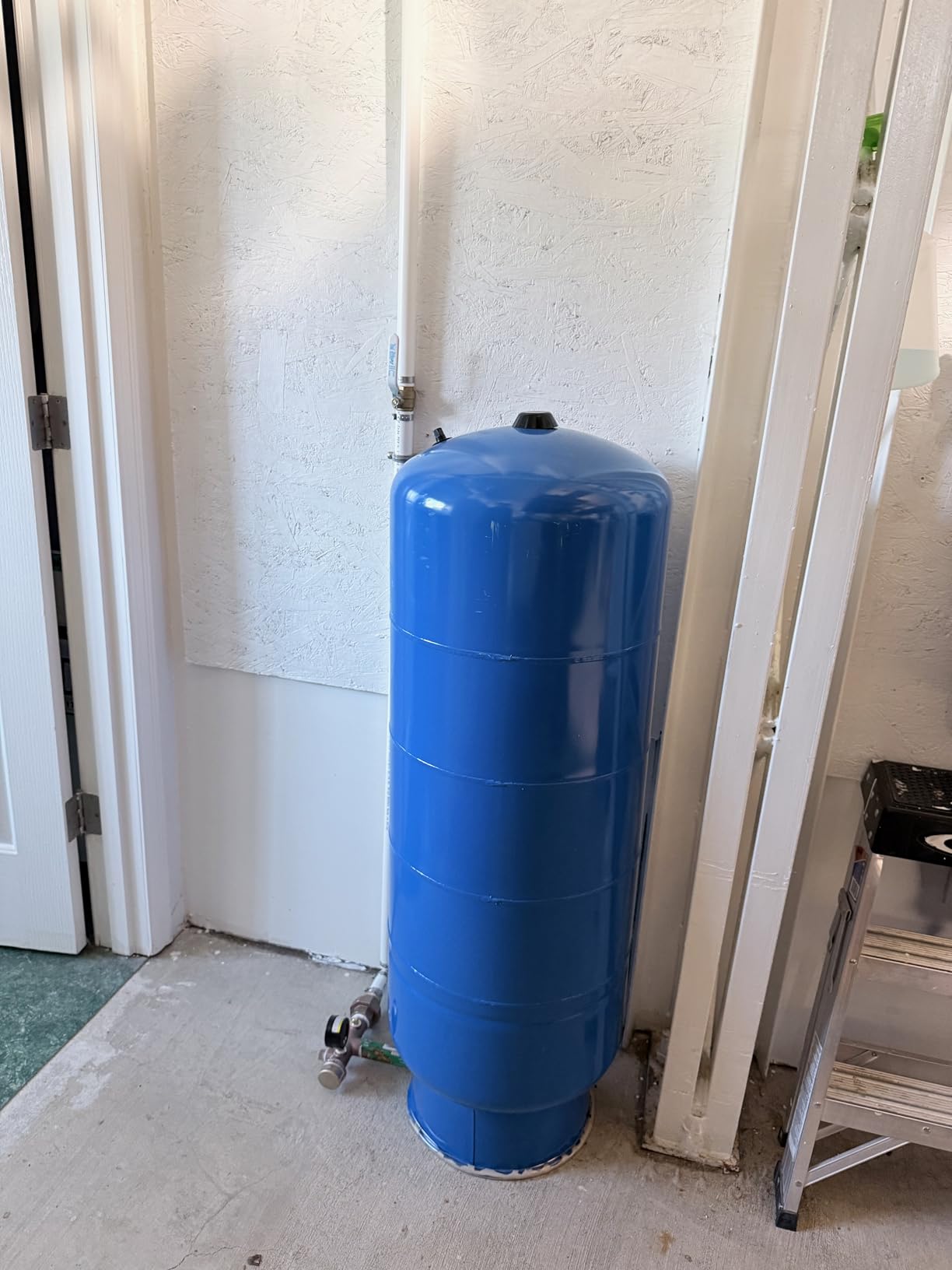
Owners consistently highlight the efficiency and the low noise. The 550W rated power, up to 750W maximum, and a 5200 RPM maximum speed mean it delivers real flow without the roar you get from an air-cooled conventional motor working hard. Reviewers also point out the built-in protections for power failure, blockage, leakage, dry running, overheating and pressure sensor failure, which is a longer list than many boosters in this price class publish.
The all-in-one design matters more than it sounds. It includes a maintenance-free pressure tank, stainless steel connectors and a check-valve-equipped outlet, so you are not hunting for a tank at the plumbing counter after the pump is already in the closet.
Who this pump suits
Households on low city pressure, apartments, two-story homes and anything with a garden irrigation line. If your supply is a city main, a roof tank, a water tank or a shallow well, the self-priming design and 26 ft suction lift cover it.
If you already own a whole-house filter or a softener, this is the one that will keep pressure steady after the drop rather than before it. It ranks well in Power Water Pumps, and 75% of its reviews are five-star.
Who should look elsewhere
Buyers who want a pump they can diagnose with a multimeter rather than a controller. The firmware and sensor set is the most advanced in this group, so troubleshooting leans on the electronics.
If your water source is weak, the maximum pressure you can reach will be capped by that source no matter what the pump is rated for. Check the well or main first.
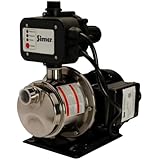
2. Simer 4075SS-01 – Most Reviewed, 3-Year Warranty
Simer 4075SS-01 3/4 HP Pressure Booster Pump
3/4 HP, 24 gpm flow
Up to 40 PSI added
115V with 6 ft cord
22.2 lb, 3-year warranty
Pros
- Largest review base in this group
- Stainless steel resists corrosion
- Automatic start and stop with flow
- Arrives pre-wired and ready to install
Cons
- Open-loop boost rather than true constant pressure
- Some installations need a separate tank or pressure switch
With 372 reviews averaging 4.2 stars, the Simer 4075SS-01 has the deepest proven history in this group, and for a category where failure reports matter more than brochure claims, that counts for a lot. The 3/4 HP motor, 24 gpm flow and 40 PSI of on-demand boost cover most single-family short-cycling complaints we saw.
It is a straightforward open-loop design. The pump switches on when water starts moving and off when it stops, which is simple, repairable and cheap to run. What you give up is pressure modulation between fixtures, because the boost is a fixed addition rather than a controlled setpoint.
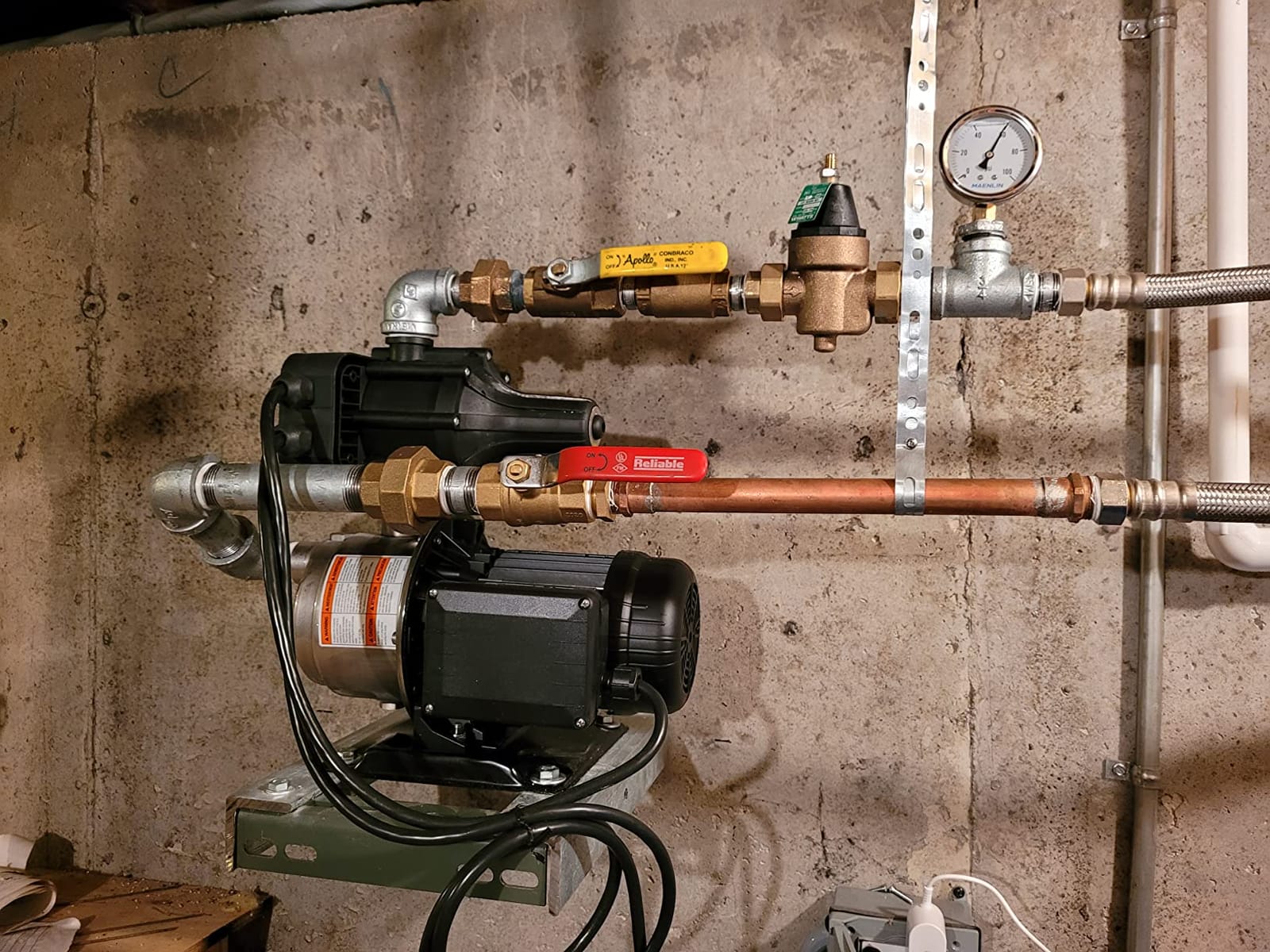
Construction is where this one earns its rating. The stainless steel body resists rust and corrosion, and the unit arrives factory set up with a 6-foot 115V cord, so the electrical side of the install is close to plug-and-play. At 22.2 pounds and 18.1 by 10 by 17.3 inches, it mounts in a mechanical room or a garage wall without drama.
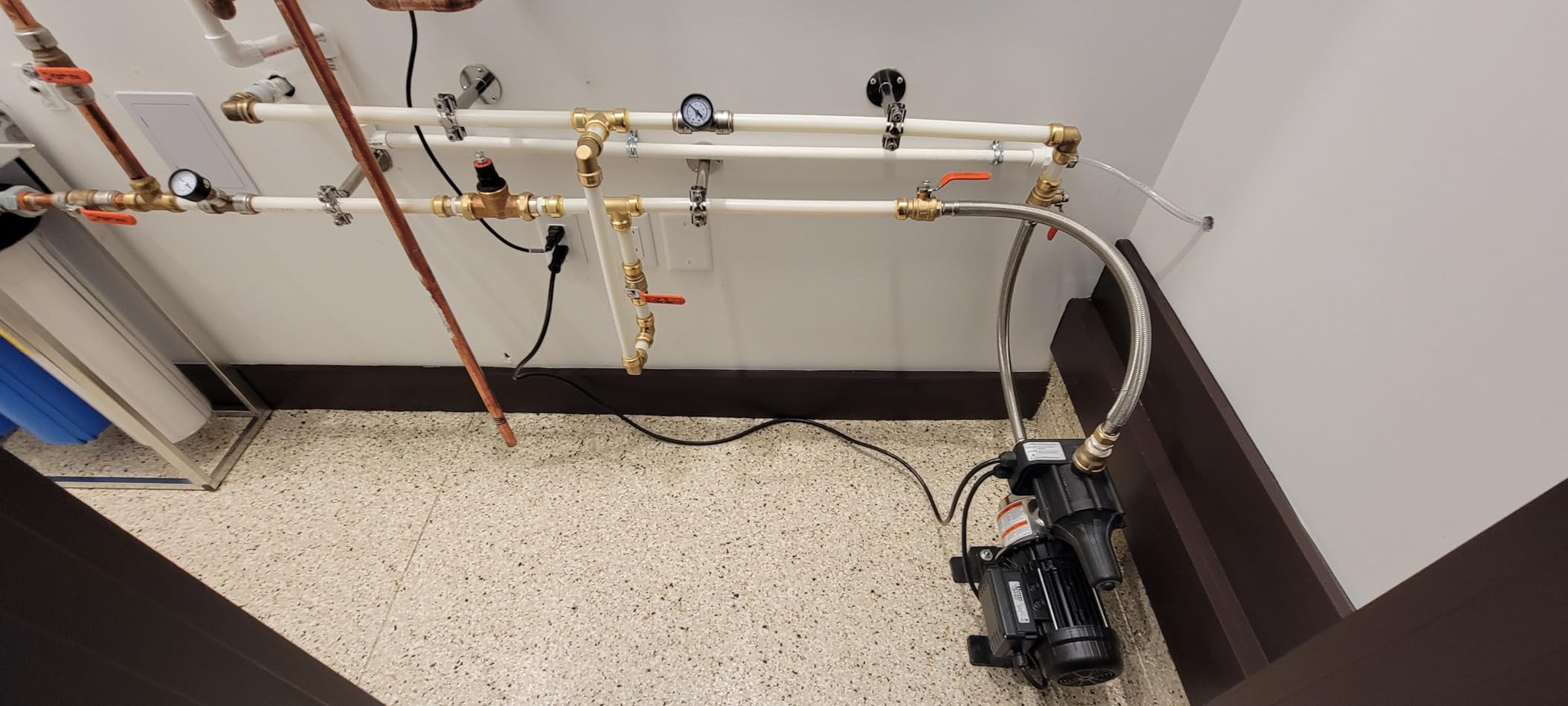
Reviewers commonly pair it with a pressure tank or a pressure switch to get the most from it. If you are comfortable adding a tank, that combination gets you much closer to the steady pressure a variable-speed unit delivers out of the box.
Who this pump suits
Homeowners and small contractors who want proven, repairable hardware with a three-year manufacturer warranty behind it. Residential pressure boosting and sprinkler systems are both listed use cases.
It is also the sensible pick if you install it yourself. The pre-wired cord and factory setup remove the most intimidating part of a booster installation.
Who should look elsewhere
If two fixtures running at once is a normal part of your day, an open-loop pump will feel like a step short of a variable-speed system.
Buyers who want a single-box install should know from the start that a separate tank or switch may be part of the project.
3. BACOENG P0097 – Budget Inline Booster That Needs No Tank
BACOENG Auto ON/OFF Stainless Steel Water Pressure Booster Pump w/Smart Controller for Tankless Water Supply Pressurization
0.6 HP, 1 inch ports
6 bar max, 12 GPM
29.5 ft suction lift
304 stainless wetted parts
Pros
- Removes the need for a pressure tank
- Automatic on/off with a built-in check valve
- 304 stainless wetted parts
- Noticeable pressure gain for the money
- Quiet for its size
Cons
- Threaded joints can weep on first install
- Some units report slow leaks at the outlet seam
- Audible when installed inside living space
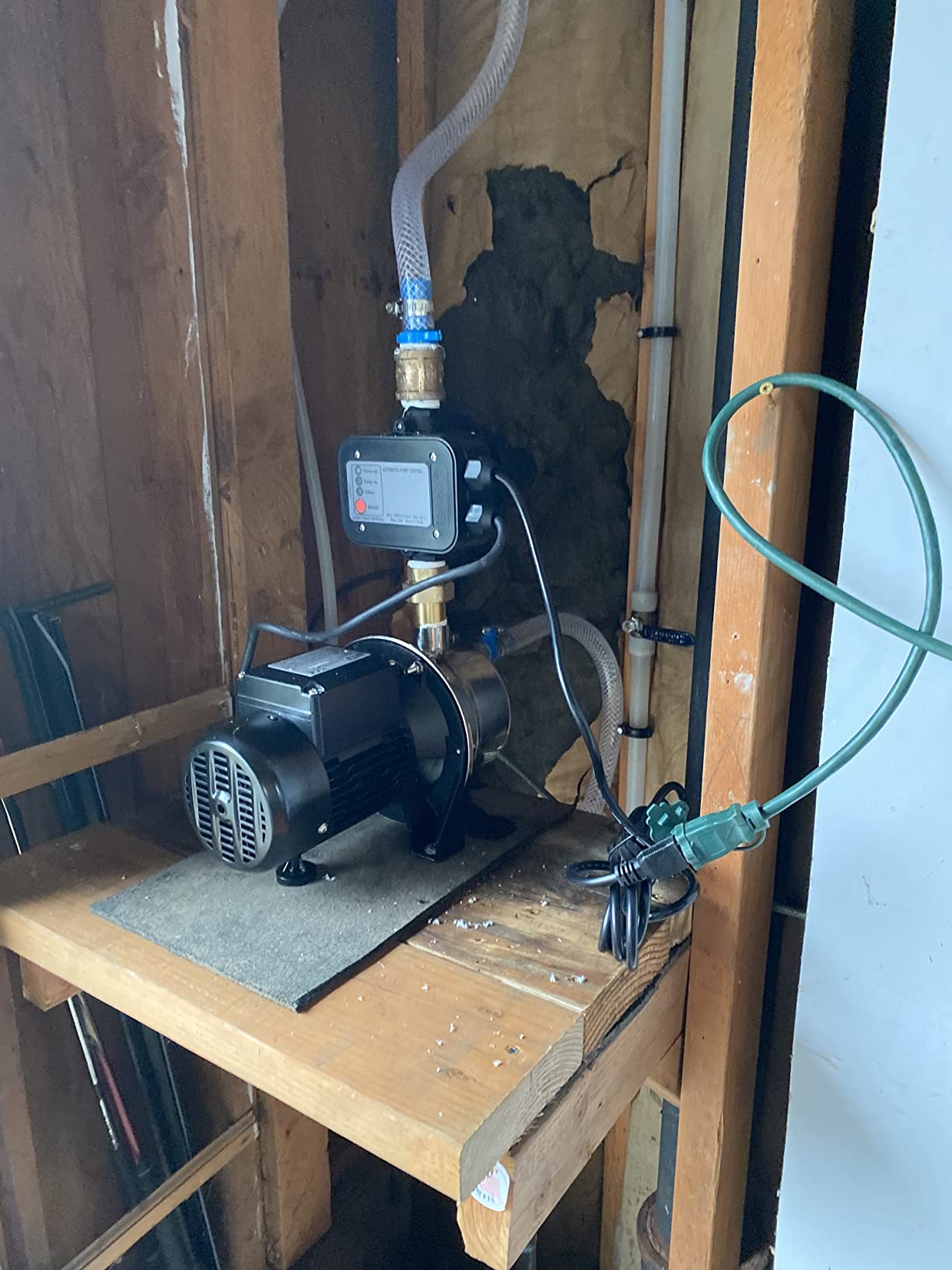
The BACOENG P0097 is the straightforward answer for city water that simply runs weak. It installs inline in the supply line, cycles automatically with a pressure switch, and holds pressure through a built-in check valve, so you can skip the pressure tank entirely and save both parts money and wall space.
Specs are honest for the money: 0.6 HP, 110V/60Hz, 1-inch inlet and outlet, maximum 6 bar, maximum 12 GPM, 29.5 ft suction lift and 40.7 ft maximum lifting height. The wetted components are 304 stainless steel, and the motor carries built-in thermal overload protection.
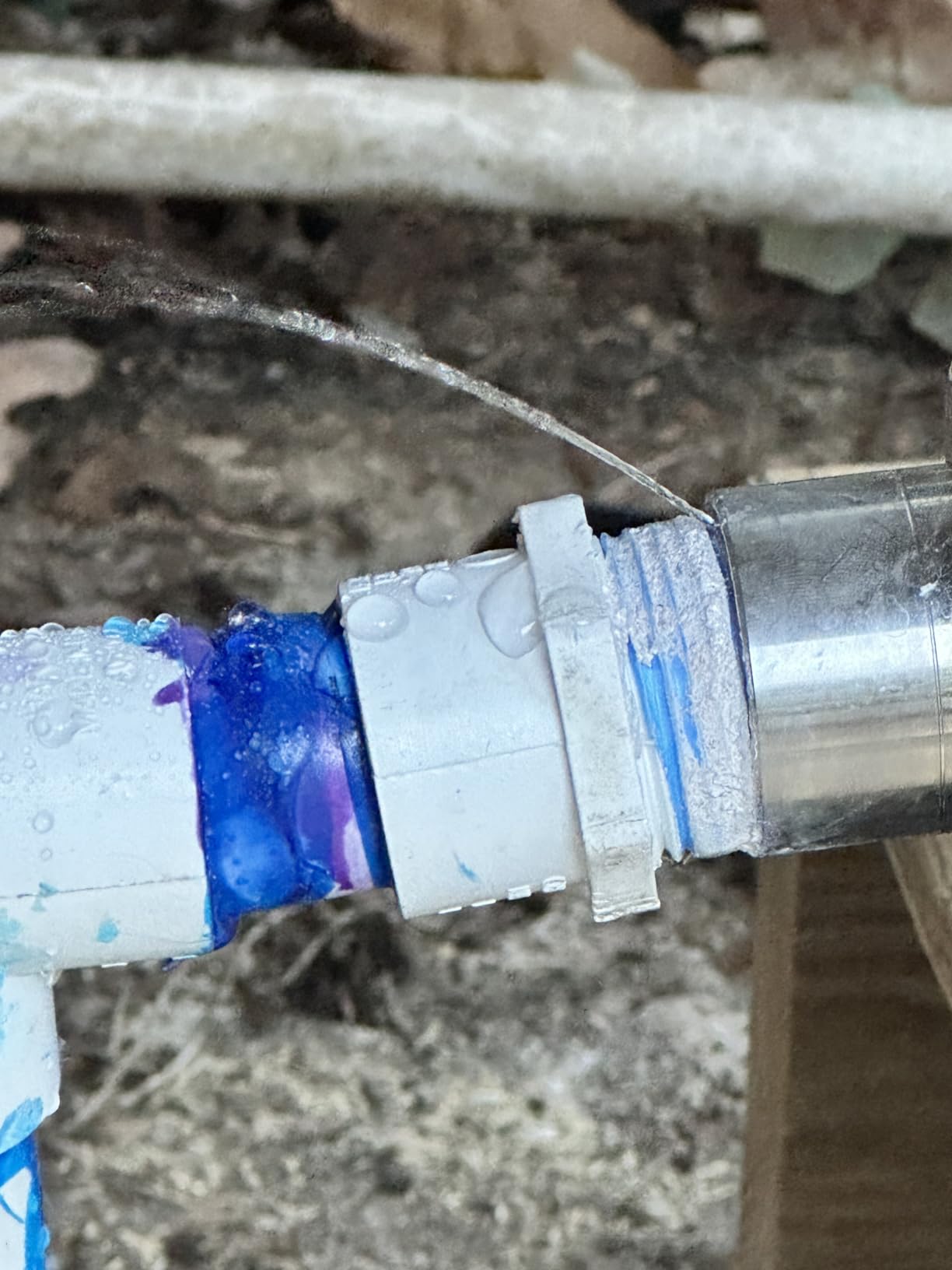
Across 237 reviews averaging 4.0 stars, the dominant theme is value and a real, noticeable pressure gain. Installers report roughly an hour of work for a handy homeowner, and the automatic shutoff when inlet water is absent means it will not run itself dry if the supply fails.
The recurring complaint is mechanical rather than electrical. Threaded joints can weep on first install and need careful PTFE taping, and a minority of owners report slow leaks at the outlet port seam after extended service.
Who this pump suits
Apartment dwellers, first-time installers and anyone on a low city main who wants a booster without buying a tank. Real-time monitoring and automatic shutoff make it forgiving in a small space.
It is also a reasonable companion for a water softener feed or a reverse osmosis system that is starving on a low-pressure supply.
Who should look elsewhere
Sound-sensitive homes. The pump is quiet for its size, but owners do report audible running noise and vibration when it is installed inside the living space rather than a closet or garage.
Anyone planning a whole-house filtration upgrade should know that any 7 to 10 PSI of filter loss eats directly into a fixed 6 bar boost.
4. Davey BT20-30 Torrium II – True Constant Pressure at 20 GPM
Davey Water Products BT20-30T2-USA Home Pressure Booster Pump with Torrium II Controller
50 PSI boost, 30 PSI at 20 GPM
20 gpm flow
Stainless impellers and casing
31.7 lb, 2-year warranty
Pros
- Torrium II holds a true constant 50 PSI
- Stainless impellers and casing for longevity
- TEFC motor with surge and dry-run protection
- Built as a purpose-made booster
- 21.6 ft maximum lifting height
Cons
- Heavy 31.7 lb unit needs solid mounting space
- Controller and stainless fittings add install complexity
The Davey BT20-30 is the one in this group that states its boost in the way an engineer would: 50 PSI of boost, and still 30 PSI delivered while moving 20 GPM. That second number is the honest one, because most open-loop pumps quote the boost at zero flow. The Torrium II controller is what makes it hold.
Construction is commercial-grade without being precious. Stainless steel impellers and a stainless steel casing, a power surge protected TEFC motor and full dry-run protection mean it can sit unattended without a tank-and-switch setup around it. A flexible stainless steel FIP discharge hose is included, and maximum lifting height is 21.6 feet.
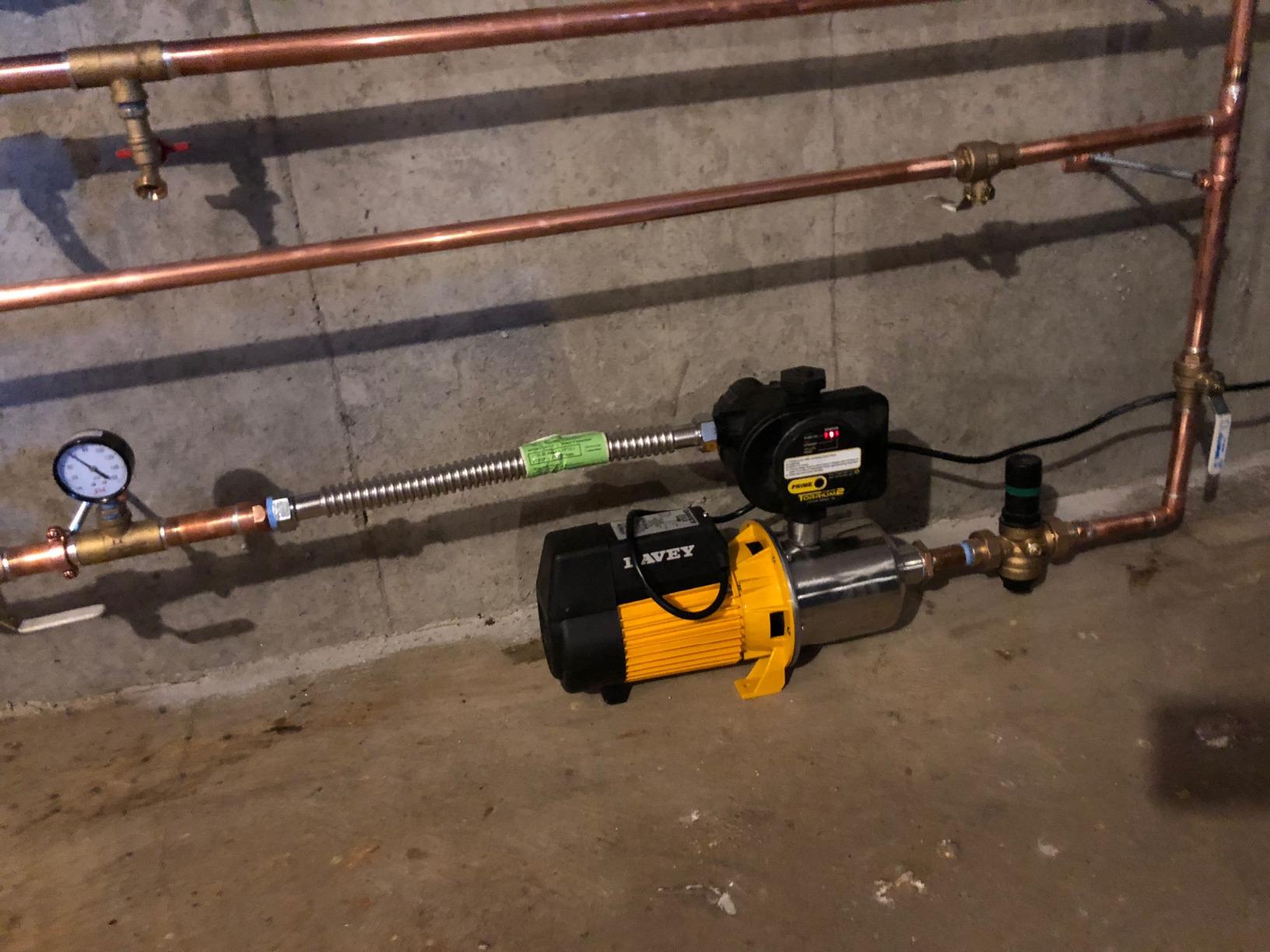
At 104 reviews and a 4.4 average with 77% five-star ratings, the sentiment is unusually consistent. Reviewers credit steady pressure across the house and solid stainless construction, and note that this is a purpose-built booster rather than a generic pump adapted for the job.
The trade-off is installation. At 20 by 8 by 16 inches and 31.7 pounds, it needs a real mounting surface, and the controller plus stainless fittings make this a plumber-friendlier job than a simple inline unit.
Who this pump suits
Larger homes and anyone with a hard water supply who plans to keep the system for a long time. Stainless wetted parts and a two-year warranty suit demanding water conditions.
It is also a strong match for a home running a heavy filtration train, since the controller compensates for downstream pressure loss.
Who should look elsewhere
Tight closets and renters without a mounting location. The weight and footprint are not modest.
Buyers who want to avoid electronics entirely, or who need a unit that ships as one complete boxed system with no controller setup.
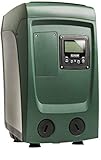
5. DAB E.Sybox Mini 3 – Quiet All-in-One System at 45 dB(A)
DAB E.Sybox Mini 3 Electronic Pressurisation System, Constant Pressure, Ultra Low 45db(A) Noise, 2.7″ X 1.5″ High-Resolution Screen, Compact, Wireless Capability, 1.1 Horsepower, 7.5 Bar, 80 l/min
15-80 PSI adjustable
7.5 bar, 80 l/min
45 dB(A), 1.1 HP
VFD drive, LCD display
Pros
- Complete single-box system with no extra parts
- Very quiet at 45 dB(A)
- Pressure adjustable from 15 to 80 PSI
- Mounts vertically or horizontally in tight spaces
- VFD drive reduces energy use
Cons
- Electronic controller is a single point of failure
- Fewer serviceable mechanical parts inside
- 32 lb body needs a firm mounting point
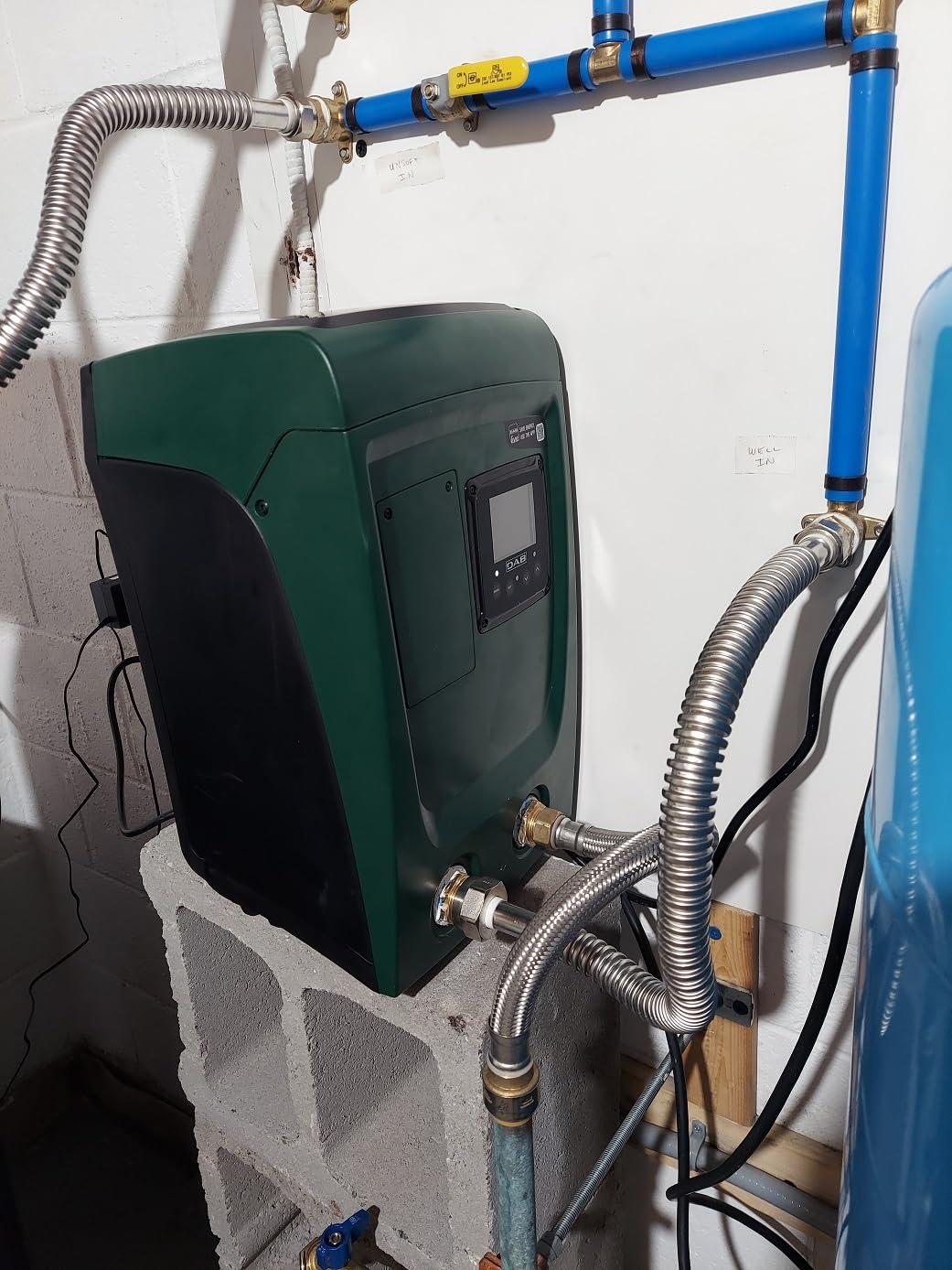
The E.Sybox Mini 3 is the plumbing equivalent of an all-in-one appliance. Pump, inverter, pressure and flow sensors, expansion tank, check valve and a 2.7 by 1.5 inch high-resolution display arrive in one box, so there is no shopping list. For a compact apartment or a tight utility closet, that matters more than any spec line.
It is a 1.1 HP stainless steel unit rated to 7.5 bar and 80 l/min, with pressure adjustable anywhere from 15 to 80 PSI and a maximum lifting height of 55 meters. A VFD drive handles the speed modulation and the energy savings.
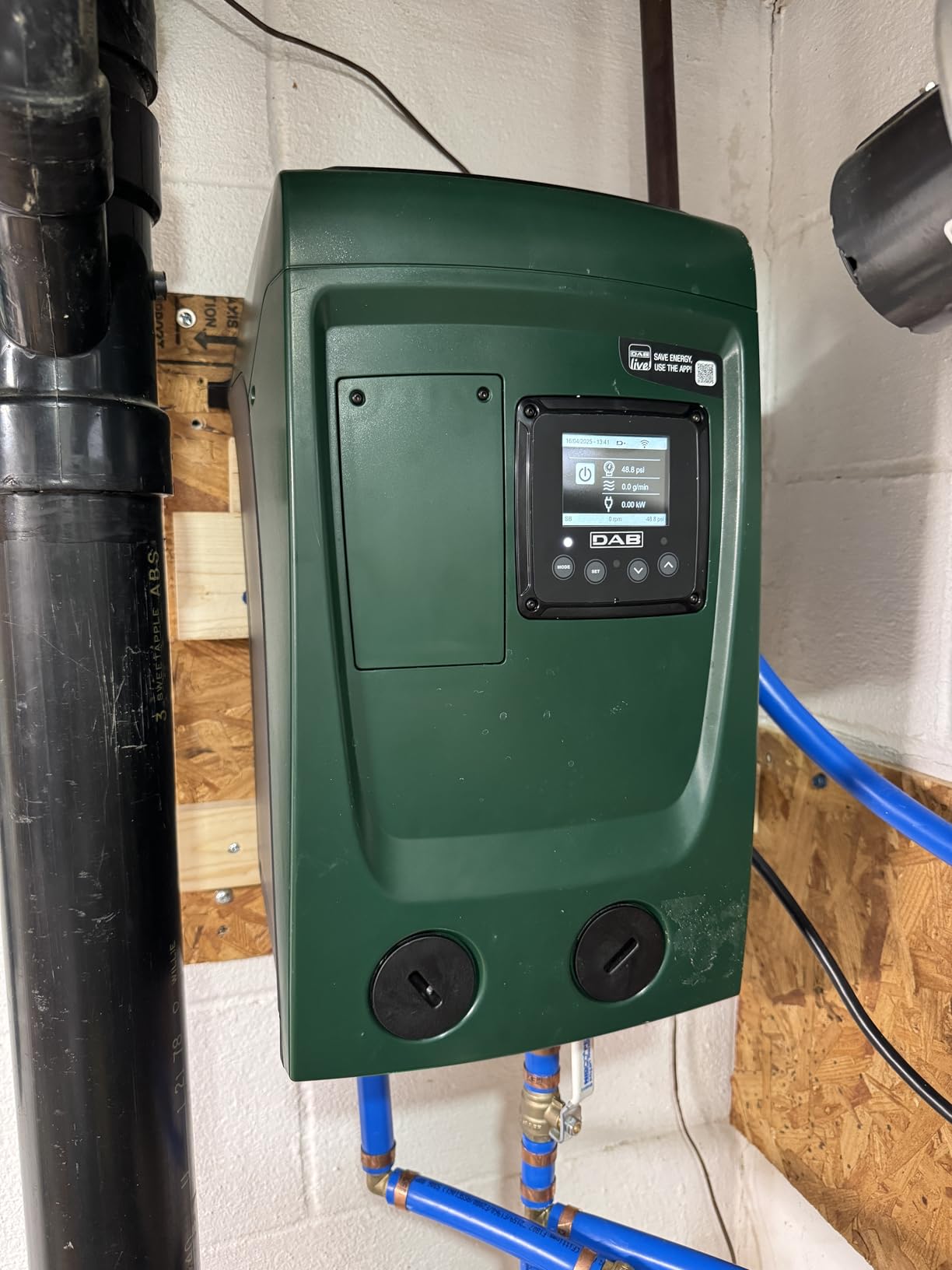
Buyers consistently name the 45 dB(A) operating noise as the standout. That figure puts it below the 50 to 55 dB(A) range where most variable-speed boosters sit, and it matters enormously when the pump lives next to a laundry room or a bedroom wall.
The rating spread tells the real story: 102 reviews at 4.1 stars, with 63% five-star and 9% one-star. The praise is for packaging and near-silent running; the complaints come from a premium electronic system that demands competent installation and offers fewer serviceable mechanical parts.
Who this pump suits
Homeowners with a mechanical room, a utility closet or a wall cavity where a quiet, complete system is worth paying a premium for. The vertical or horizontal mounting options solve awkward spaces.
Gardeners and multi-fixture households get the wide 15 to 80 PSI window and the flow headroom for irrigation plus indoor use.
Who should look elsewhere
Buyers who want a mechanical pump they can diagnose with basic tools. When the electronics fail, the replacement is the whole brain of the unit.
Renters without permission to hardwire a dedicated outlet, since this is a permanent whole-home installation rather than a plug-in convenience.
6. MixBubole V3-45 PRO – Compact 1.35 HP Unit for Tight Spaces
1.35HP Whole House Water Pressure Booster Pump 90PSI 115V Automatic Variable Speed Penmanent Mangnet Motor Constant Pressure Wireless App Control Compact Design for Home House Villa Apartmen
1.35 HP permanent magnet
15-90 PSI, 180 ft head
About 30 dB water-cooled
12 lb, 11 by 3.5 inch body
Pros
- Compact 12 lb body with inline ports needs no pump room
- Quiet water-cooled running noise near 30 dB
- App monitoring with OTA firmware updates
- 304 stainless steel pump body
Cons
- Only a 1-year manufacturer warranty
- Small review base leaves long-term durability unproven
- App and firmware dependence adds complexity
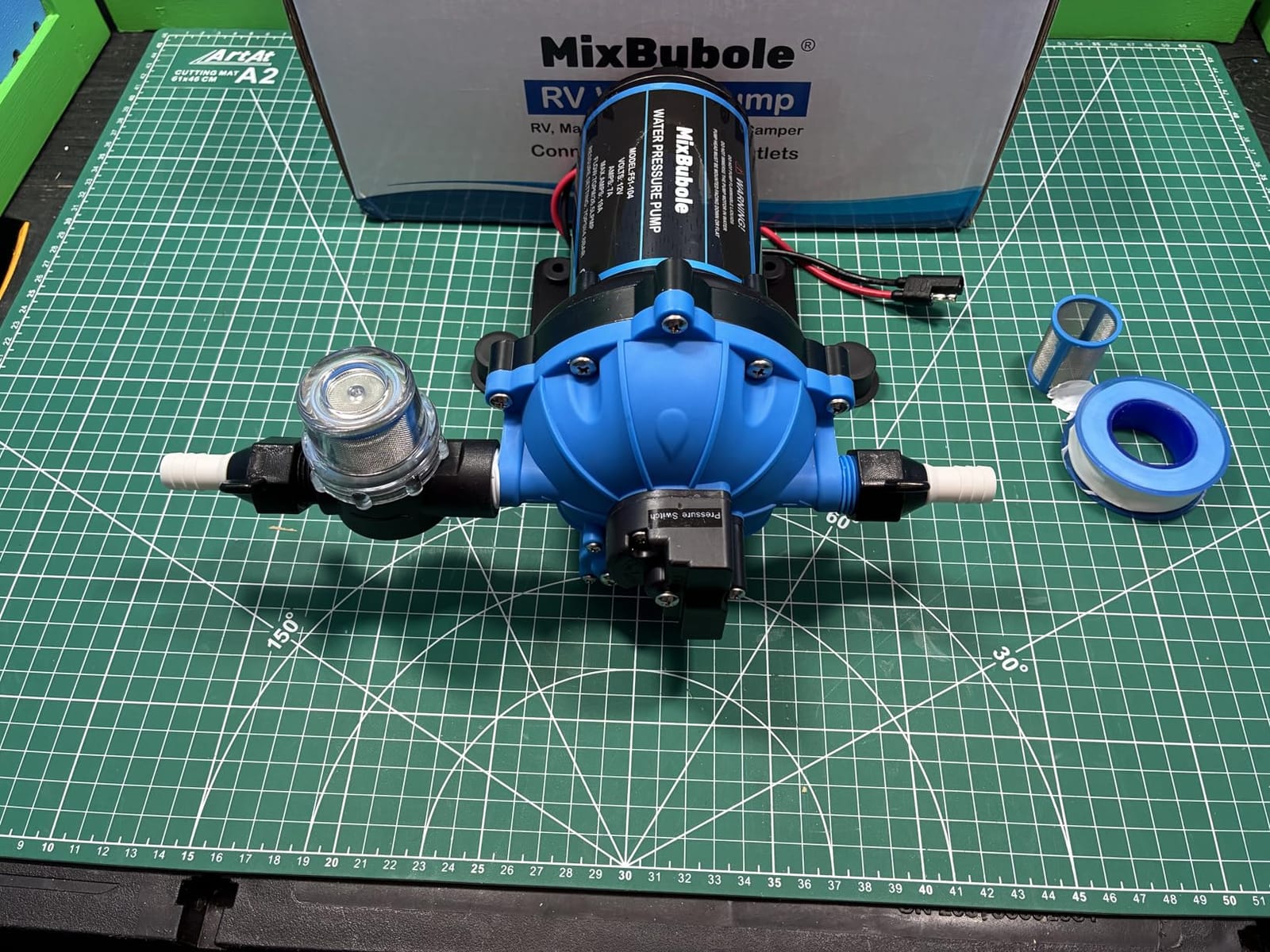
The MixBubole V3-45 PRO is the smallest and quietest unit we looked at, and in a 2026 renovation where mechanical space is the binding constraint, that is not a small achievement. The whole body is 11 by 3.5 by 3.5 inches and weighs 12 pounds, with 1-inch NPT inlet and outlet in line.
Underneath is a 1.35 HP permanent magnet motor at 110-120V, 8000 RPM, water-cooled, rated for a 180 ft maximum head, 15 to 90 PSI adjustable and 1600 GPH maximum flow. The water-cooled motor housing is the reason it runs at roughly 30 dB, quieter than the air-cooled boosters in this group.
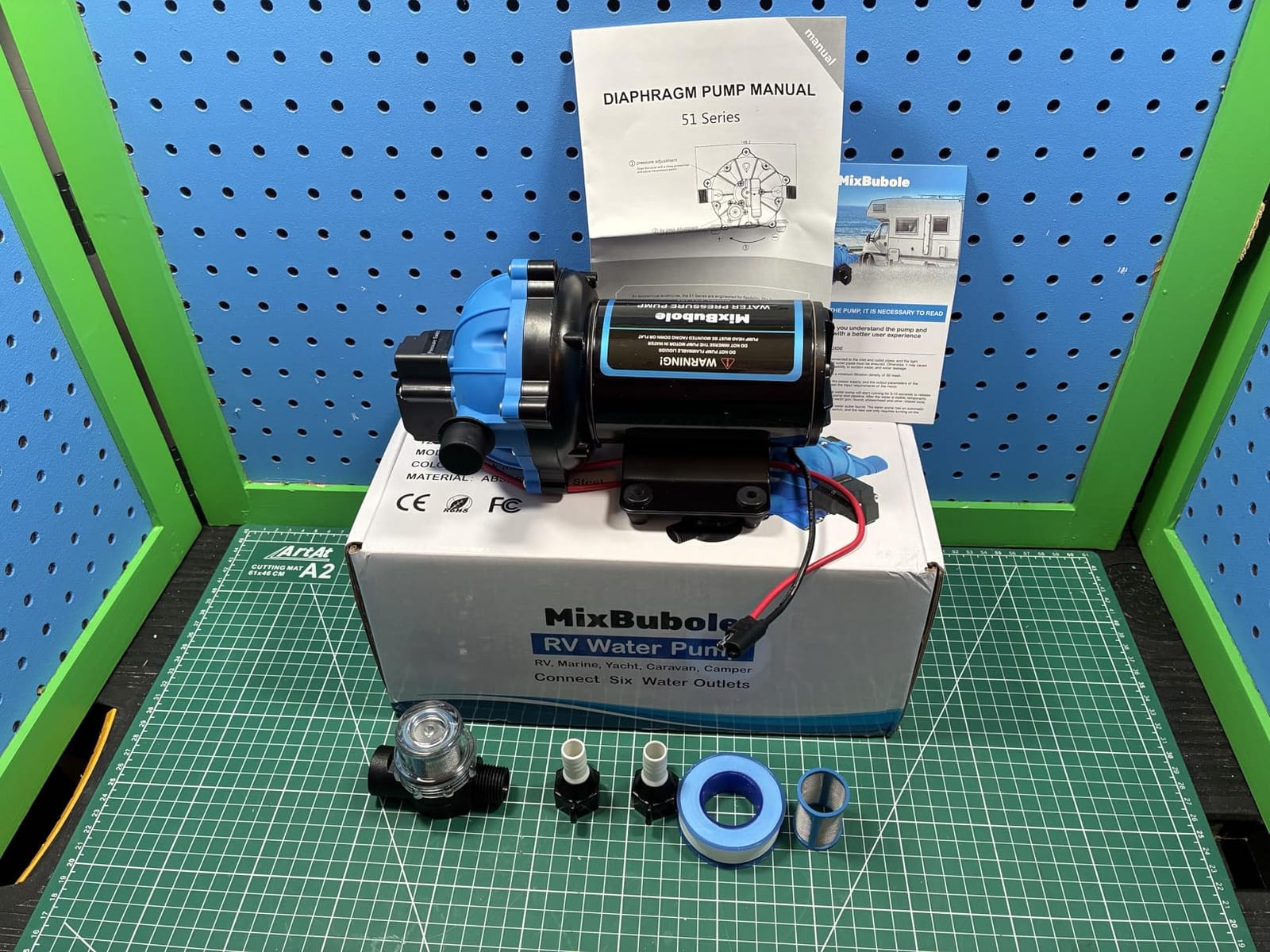
Control runs through the SmartFarintl app with remote monitoring and over-the-air firmware updates, and fault indicators cover power failure, blockage, leakage, dry running, overheating and sensor failure. Users report simple installation, straightforward instructions and a clear pressure improvement.
Its 4.9 star average across 31 reviews is the highest rating in the set, and 93% of those reviews are five-star. The honest caveat is the size of that base, and the one-year manufacturer warranty, which is the shortest coverage we saw among these units.
Who this pump suits
Apartments, condos, tiny utility closets and anyone who cannot give a pump its own room. A water-cooled motor at about 30 dB also makes it the natural choice next to a bedroom or a home office.
It suits users who actually want the app, with remote status and firmware updates instead of a fixed-function panel.
Who should look elsewhere
Buyers who plan to install once and forget for fifteen years. A one-year warranty and a 31-review history do not yet tell you how the electronics age.
Anyone without reliable 120V service nearby, since the 8000 RPM motor wants a proper dedicated circuit rather than an extension cord.
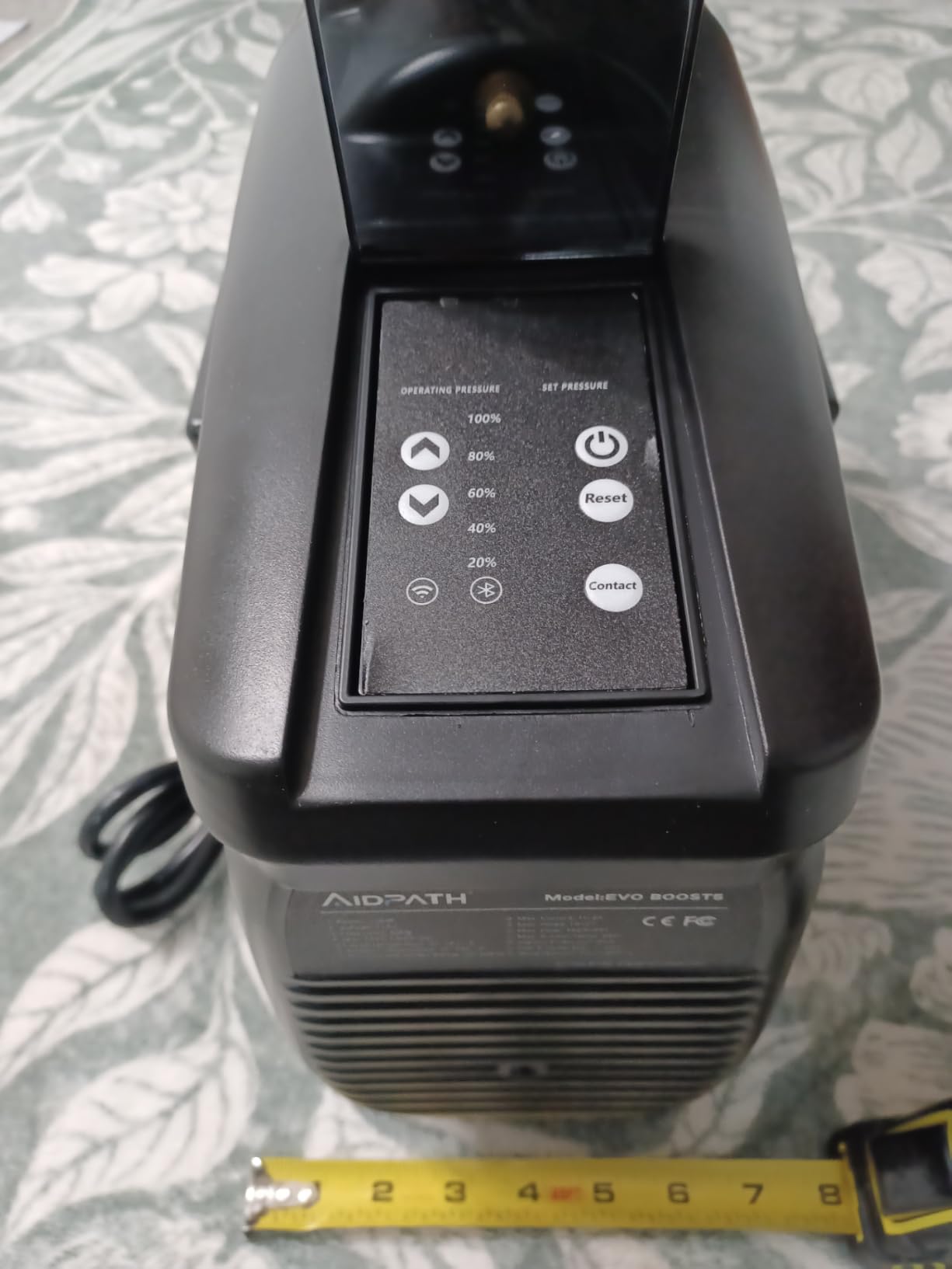
7. AIDPATH EVO BOOST5 – Three Floors, Eight Faucets, 3-Year Warranty
Aidpath 1.2 HP, 85 PSI, 27 GPM Whole-House Water Pressure Booster Pump 115V
1.2 HP, 26.5 GPM, 197 ft head
22-92 PSI adjustable
50 dB noise
3-year full warranty
Pros
- Steady pressure for up to 8 faucets across 3 floors
- 3-year full warranty
- Smart Life app remote monitoring
- 50 dB operation
- Stainless body rated 32F-167F for outdoor install
Cons
- Only 24 reviews limit confidence in long-term reliability
- Requires 1 inch MNPT fittings and a 115V supply
- App-based setup adds a learning curve
The EVO BOOST5 is the unit we would size for a genuinely tall house. The spec sheet states steady pressure for up to eight faucets across three floors, backed by a 1.2 HP permanent magnet motor delivering 1590 GPH (26.5 GPM) and a 197 ft head. Elevation is exactly the problem variable-speed pumping solves.
Pressure is adjustable from 22 to 92 PSI, a wide band that gives you room to compensate for a whole-house filter. Operating noise is 50 dB, and built-in dry-run, overcurrent and voltage fault protection comes standard with FCC certification.
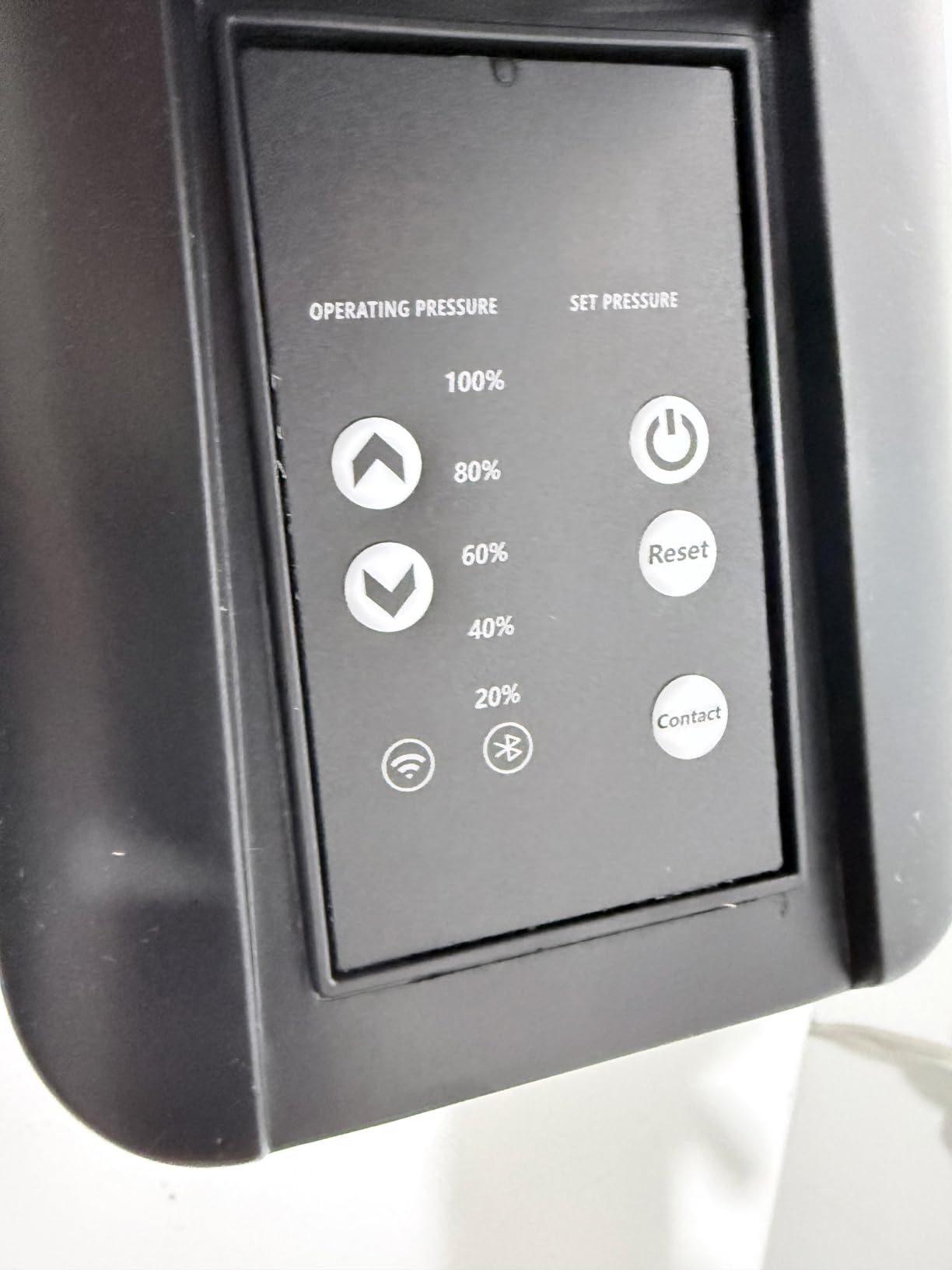
The stainless steel body is rated for water from 32F to 167F and can sit in an outdoor housing, with shallow well suction lift to 26 ft. The Smart Life app gives remote status, pressure, energy and temperature readings, and the electronics are paired with a claimed 50% energy saving versus standard pumps.
Twenty-four reviews at 4.7 stars with nothing rated below four stars is encouraging early sentiment, and the pump ranks in Power Water Pumps. It is simply not a long enough track record to call proven.
Who this pump suits
Two and three-story homes where multiple floors run at once, especially households with a whole-house filter or softener eating into supply pressure. The 3-year full warranty is the longest stated coverage among the variable-speed units we tested.
Outdoor or garage installations work too, given the temperature range and the stainless body.
Who should look elsewhere
Twenty-four reviews is a thin base, and it skews recent, so a long warranty here is a promise rather than a track record.
Buyers with existing half-inch plumbing will find the 1-inch MNPT ports need real plumbing work rather than an adaptor.
8. TiHpumpz CHB2-3 – 78 GPM Multistage Flow
TiHpumpz CHB Multistage Centrifugal Water Booster Pump for Whole House – 2/3HP, 110V/60Hz, Max Flow 78 GPM, High Flow for Multiple Bathrooms, Commercial & Farm Use(CHB2-3)
0.66 HP multistage
78 GPM (4680 GPH) max
130 ft max head
304 stainless housing
Pros
- Multi-stage impeller stack for very high flow
- Reaches high head at low RPM so it runs quietly
- 360-degree swivel unions ease installation
- No circuit boards or sensors to fail
- Includes auto switch and swivel joints
Cons
- Supplied fittings are a recurring source of leaks
- Fixed pressure increase means model choice is critical
- Lowest average rating in this group at 3.9
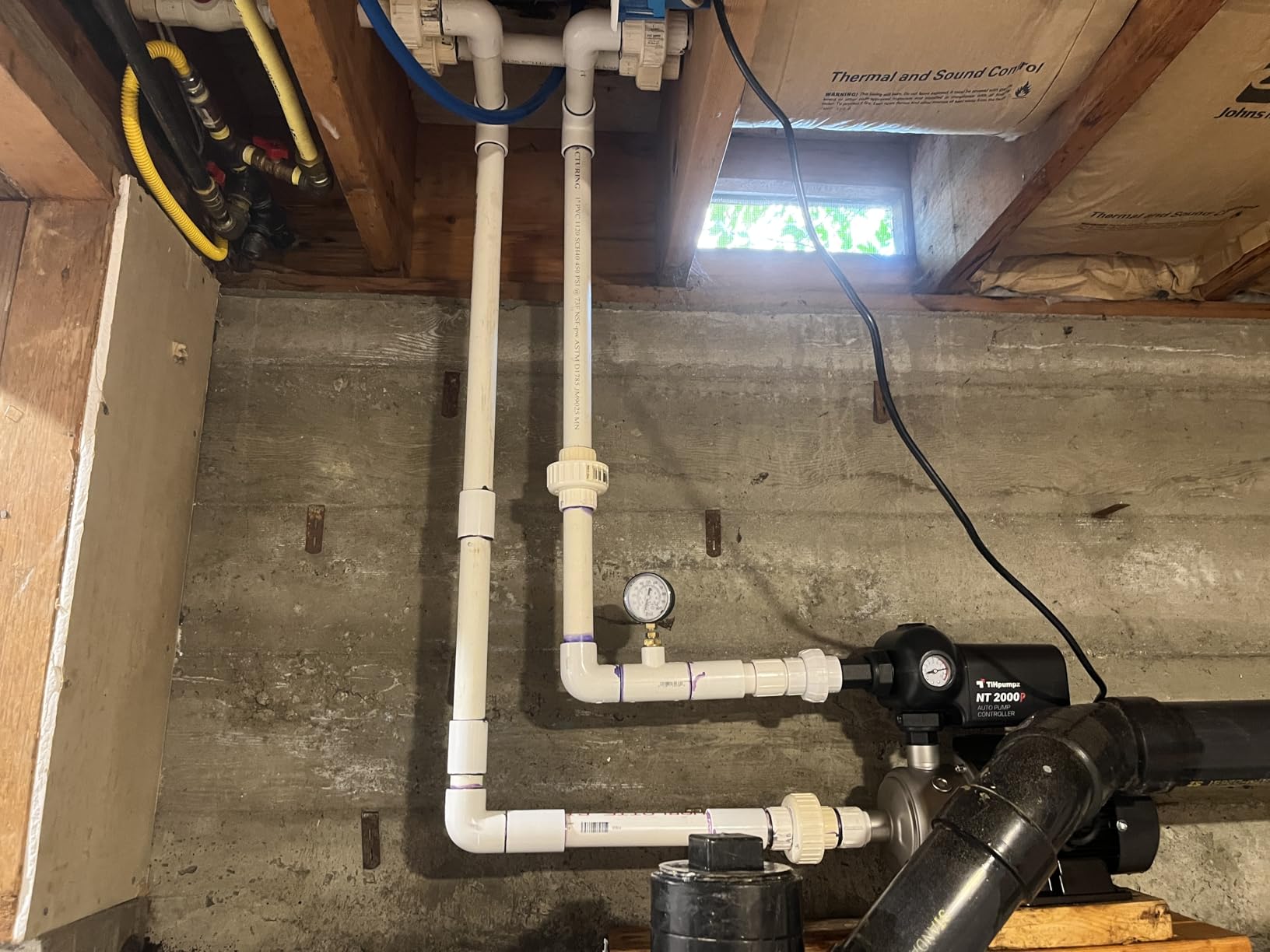
The CHB2-3 is the outlier here and the reason we included it. Rather than adding a bigger motor, Stacked impellers in a true multistage centrifugal design deliver 78 GPM, or 4680 GPH, from 0.66 HP, which is well beyond what a single-impeller pump moves at comparable horsepower. Maximum lifting height is 130 feet.
Because it reaches head at lower RPM, the running noise and vibration stay low, which is unusual for a pump this aggressive. The 304 stainless housing and 360-degree swivel unions that accept pipes from any angle make the plumbing side forgiving.
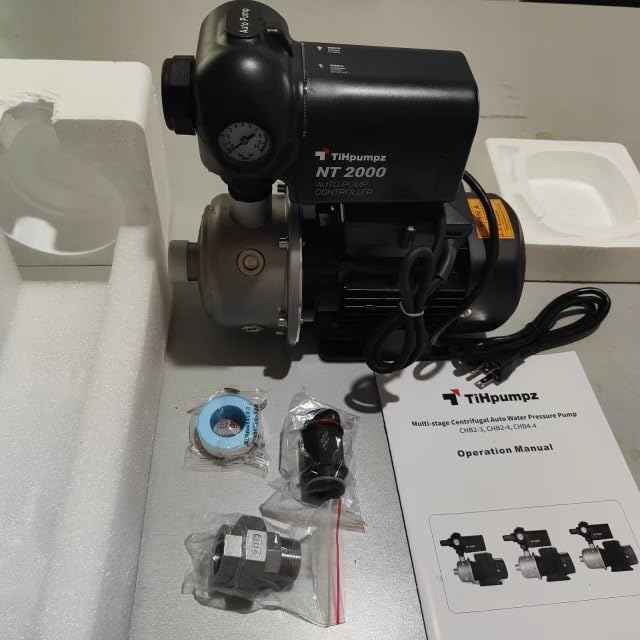
There are no circuit boards and no sensors in the design, so the electronic failure points that trip up premium units simply do not exist here. Buyers report about an hour to install and an immediate, noticeable improvement in flow.
The warning is the fitting quality. Each model delivers a fixed pressure increase, so you must match the model to your actual supply pressure, and a 26% one-star share of reviews reports flooding at the intake connection and fractured plastic outlet nuts. Generous PTFE tape and replacement hardware from a hardware store are part of the job.
Who this pump suits
Shared walls between a house and a detached garage or shop, car washes, restaurants and farm irrigation, anywhere flow volume matters more than fine pressure control. The simple mechanical structure means near-zero maintenance.
If you are comfortable matching a model chart to your measured supply pressure, the flow payoff is substantial.
Who should look elsewhere
Houses that need modulated pressure. This pump adds a fixed boost rather than holding a setpoint, so simultaneous fixtures will still see a swing.
Anyone who wants a clean, leak-free install from supplied parts. Plan on replacement fittings and careful sealing from day one.
9. Flotec FP5722 – Cast Iron Multistage Pump for Long or Uphill Runs
FLOTEC CAST Iron MULTISTAGE Booster Pump 3/4 HP
3/4 HP multistage booster
Cast iron construction
43 lb bare pump
Model FP5722
Pros
- Multistage design gives high pressure at low motor speed
- Cast iron body is rugged for whole-property work
- Used for long-distance and uphill water delivery
- Works well with a bladder or pre-charged tank
Cons
- Sold as a bare pump with no switch or tank
- Installing without a switch risks over-pressurizing plumbing
- Heaviest unit in the group at 43 pounds
The Flotec FP5722 is the old-school answer and it still makes sense in the right situation. A 3/4 HP multistage cast iron booster delivers serious pressure at low motor speed, which is the whole point when you are pushing water a long way, up a slope or out to a building on the far end of the property.
Owners report steady whole-house pressure and effective irrigation boosting, and it pairs well with a bladder or pre-charged tank and a standard pressure switch. Forty-four reviews at 4.4 stars, with 74% five-star, is a solid record for a bare pump.
Be clear about what you are buying. This is a pump, not a system, so a pressure switch and a pre-charged tank have to be sourced separately, and fitting it without a switch or tank risks over-pressurizing and damaging household plumbing. At 43 pounds it is the heaviest unit in the group and needs a solid mount and two people to handle.
Who this pump suits
Property owners pushing water long distances or uphill, well and pressure tank pressurization, and irrigation systems that need volume more than a precise setpoint. The cast iron body is built for demanding service.
It is also the natural fit for anyone already running a tank-and-switch setup who just needs a stronger pump in the middle of it.
Who should look elsewhere
First-time installers. A bare pump plus a switch plus a tank plus a regulator is a four-part project, and it carries real consequences if the switch is set wrong.
Condo and apartment residents with no mounting space, and anyone who wants a quiet, enclosed, ready-to-run unit.
10. Aquastrong PGA150SA – Shallow Well and Garden Booster with Pressure Tank
Aquastrong 115V Shallow Well Garden Pump, Stainless Steel, 1320 GPH, Automatic Water Booster Jet Pump for Home, Garden, Lawn,Irrigation,1.6 HP with Pressure Tank
1.6 HP capacitor motor
26 ft lift, 1340 GPH
5 gallon tank included
20 PSI start, 40 PSI stop
Pros
- Strong 1340 GPH flow from a 1.6 HP motor
- Includes 5 gallon tank
- gauge and pressure switch
- Stainless housing with carbon ceramic seal
- 26 ft suction lift covers most shallow wells
- Pre-assembled with hose adapters and PTFE tape
Cons
- Jet pump architecture differs from inline constant-pressure boosters
- Must be primed and protected from freezing
- Fixed 20 PSI start and 40 PSI stop with no adjustable setpoint
- Takes more floor space than an inline booster
The PGA150SA is here for a different job. This is a 1.6 HP shallow well jet pump rated for 1340 GPH and a 164 ft maximum head with a 26 ft suction lift, and it comes with the parts most well pumps make you buy separately: an integrated 5 gallon pressure tank, a pressure gauge and a pressure switch that starts at 20 PSI and stops at 40 PSI.
Owners use it for garden and lawn irrigation, domestic supply and general water transfer, and the stainless housing with a carbon ceramic mechanical seal resists corrosion and leakage well. Its 282 reviews make it one of the most proven pumps in this set, and it ranks second in Well Pumps.
It is pre-assembled at the factory with 1-inch NPT inlet and outlet, 3/4-inch garden hose adapters, PTFE tape and a 6.5 foot UL cord, so setup is quick. The trade-offs are inherent to the architecture: it occupies more space than an inline booster, it must be primed before startup and kept from freezing, and the fixed pressure switch gives you no adjustable constant-pressure setpoint.
Who this pump suits
Homeowners on a shallow well or anyone who needs serious irrigation flow alongside domestic supply. The 26 ft suction lift covers most residential wells, and the included tank makes it a working system on arrival.
It is also the natural companion for a garden and lawn sprinkler zone that outruns household pressure.
Who should look elsewhere
Low-yield well owners. If your well cannot refill the tank between uses, no booster fixes it, and this pump will simply empty the tank faster.
Households that want precise, modulated pressure at every fixture. A fixed 20 to 40 PSI switch is not a substitute for a variable-speed controller.
The Honest Downsides: Where Booster Pumps Fail?
Nobody gets a good decision out of a list with no cons on it. These are the failure modes we saw in reviews and on plumbing forums.
Short-cycling is the big one. A constant-speed pump with a pressure switch and a small tank starts and stops constantly once the household demand is high. That cycle count is what wears out motors and bladders. Variable-speed systems reduce cycling dramatically because the pump trims its own speed instead of stopping.
Leaks at the fittings. Threaded unions weep, and budget pumps come with plastic outlet nuts and supplied fittings that crack under torque. PTFE tape and brass reinforcement are not optional extras on a threaded booster install.
Noise through walls. Anything above 50 dB(A) in a mechanical room can be heard in an adjacent room. If you live in a small home or an apartment, the noise figure matters as much as the pressure figure.
Over-pressurization. A pump with no regulator can push past what your fixtures, hose bibs and appliance valves are rated for. A pressure-reducing valve downstream of the booster is cheap insurance.
Supply-limited systems. This is the failure that wastes the most money. On a low-yield well, or a city main that simply cannot deliver the flow, a booster amplifies the problem and empties the pressure tank. Measure the supply first.
Warranty limits. Warranty lengths in this group run from one to three years, and electronics-heavy units are the hardest to justify over a decade because the controller is the first thing to go.
How to Choose the Right Booster Pump
Size for simultaneous fixtures, not for one tap. Add up the flow you need when two showers, a washer and a dishwasher run at once. A 12 GPM pump will feel weak in that scenario even if it performs well on a single hose bib.
Pick variable speed if you can. A permanent magnet motor with a VFD trims speed to demand, holds pressure across fixtures and cuts energy use by roughly half versus a conventional motor. The permanent cost is electronics complexity.
Check the pressure range, not the maximum. A 90 PSI maximum is only useful if the adjustment floor sits low enough to avoid slamming your fixtures. Look for roughly 22 to 80 PSI or wider.
Treat the noise number seriously. Below 35 dB(A) is effectively silent, 45 dB(A) is background hum, and 55 dB(A) is clearly audible in an adjacent room. Match that to where the pump will live.
Decide about the tank. Some units integrate a pressure tank so the install is one box. Others come bare and need a tank, a pressure switch and a check valve. The integrated options cost more up front and save a trip to the plumbing counter.
Count the protections. Dry-run protection (which stops the pump from damaging itself if the supply runs out), thermal overload, blockage detection and leak detection are what separate a two-year purchase from a ten-year one.
Match the warranty to the plumbing. A three-year warranty on a pump you will run for a decade is the honest baseline. One year is thin for a permanent whole-home install.
Booster Pumps With Water Softeners, Reverse Osmosis, and Filtration
Yes, water softeners cause low water pressure, and the reason is arithmetic. A backflow preventer can cost 7 to 10 PSI on its own, and every softener resin tank, whole-house filter stage and carbon filter downstream of your meter adds more loss on top of that.
That changes how you size a booster. A fixed-boost open-loop pump rated at 6 bar will feel weak once a filtration train upstream has eaten a chunk of that. This is the strongest argument in favor of a variable-speed unit with a wide adjustment band, because it compensates for downstream loss instead of adding to it blindly.
If you are planning a filtration upgrade and a booster at the same time, size the booster for the finished system rather than today’s bare pipe. The Aquastrong Smart 45 and the Davey BT20-30 both hold pressure well through a filter train, because they control a setpoint rather than adding a fixed boost.
On a well, the order of operations matters. Add storage before you add a booster, or the booster will simply empty the pressure tank faster and shorten the life of both.
Frequently Asked Questions
What is the best booster pump for increasing water pressure at home?
The Aquastrong Smart 45 is the best overall pick in our 2026 review because it holds true constant pressure across simultaneous fixtures, runs at 55 dB(A), and includes an integrated pressure tank so no extra parts are needed. For a quiet installation where space is tight, the MixBubole V3-45 PRO is smaller and quieter, and for proven long-term ownership the Simer 4075SS-01 has the largest review base and a three-year warranty.
Do home water pressure boosters work?
They do, but only when the supply itself is the weak link. A booster raises pressure at the meter, so it fixes genuinely low municipal supply, multi-story elevation losses and irrigation demand. It will not fix a clogged regulator, an undersized supply line, a seized municipal shutoff or a supply-limited well, and it cannot add water to a system that cannot deliver it.
What are the downsides of using a water booster pump?
The main downsides are short-cycling on constant-speed units, which wears out motors and pressure tanks; leaks at threaded fittings; noise above 50 dB(A) that carries through walls; over-pressurization if no regulating valve is installed downstream; warranty limits that run from one to three years; and wasted money when the real problem is a supply limitation a booster cannot overcome.
Is 40 psi water pressure too low?
Municipal supply typically delivers 40 to 60 PSI at the meter, and 40 PSI is on the low side for comfortable whole-house use. Most homeowners report being happy in a 50 to 80 PSI band at the fixture. Because pressure drops roughly 1 PSI per vertical foot, a 40 PSI reading at the meter can become a trickle on an upper floor.
Do water softeners cause low water pressure?
They can. A backflow preventer alone can cost 7 to 10 PSI, and softener resin tanks, whole-house filter stages and reverse osmosis systems each add further pressure loss. If your low pressure appeared after a filtration install, size a variable-speed booster with a wide adjustment band so it can compensate for the loss rather than add a fixed boost on top of it.
Which brand is best for a water pressure pump?
For variable-speed whole-home systems, Aquastrong and DAB cover the mid and premium tiers, while Davey and Simer build stainless open-loop and constant-pressure units. For a budget inline install, BACOENG and TiHpumpz cover the tankless and high-flow ends. Brand matters less than matching pump type to your water source, flow demand and noise tolerance.
Is 70 psi too high for water pressure on a well?
Seventy PSI sits at the upper end of comfortable household pressure and is generally safe, but pushing a well pump toward its ceiling leaves no margin for downstream losses. On a well, target 50 to 60 PSI at the fixture and install a pressure-reducing valve downstream of the booster so fixtures and appliance valves are protected.
Will a booster pump increase water pressure?
It will increase the pressure the pump sees, and that extra pressure reaches your fixtures only if the supply can keep up. On city water with adequate main pressure the gain is immediate and measurable. On a low-yield well under about 5 GPM the pump will drain the pressure tank and stop helping, and you need a storage tank instead.
Final Verdict: Who Should Buy What
For most homes, the Aquastrong Smart 45 is the best water pressure booster pump for home because it is the rare unit that is quiet, constant-pressure and complete in one box. If you need the quietest possible unit in the smallest possible space, take the MixBubole V3-45 PRO, which runs near 30 dB. If you want the deepest proven record, the Simer 4075SS-01 has it. If you run a filtration train or live three stories tall, look at a controller-based unit such as the Davey BT20-30. And if your low pressure is coming from a well that cannot refill, no booster on this list is the right purchase, so measure first and buy storage instead.