
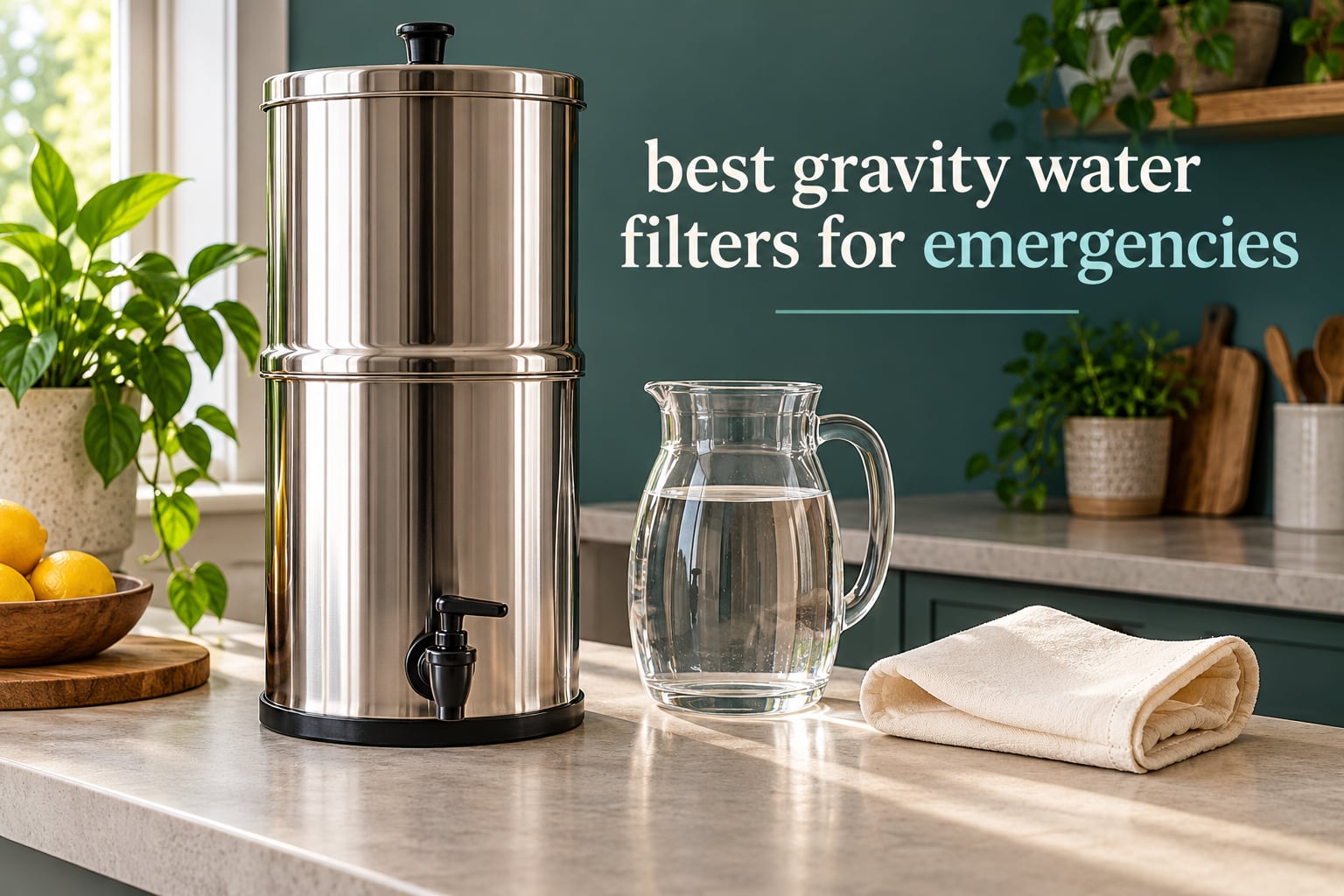
Water is the first utility to go. A power cut, a boil water advisory, flooding or a mains failure all take running water away within hours, and in a real emergency the pipe behind your tap is not an option. A gravity water filter keeps working through all of it because the only thing pushing water through the element is the weight of the water above it. No electricity, no pump, no plumbing, no faucet.
That makes the best gravity water filters for emergencies the most dependable piece of equipment in a preparedness kit: they do not care that the grid is down, and the cartridge can sit sealed in a closet for years and still be there when you need it. I compared ten countertop and portable gravity systems for this guide, weighing published certifications, stated contaminant removal, tank or bag capacity, real-world flow, element lifespan and how each one behaves when it has been in storage.
My methodology: every contaminant claim below is tied to the manufacturer stated specification or an NSF certification number rather than to marketing copy. Where a unit is a filter and not a purifier, I say so. Where reviewers report something that the manufacturer does not claim, I attribute it to reviewers. Last updated for 2026; I revisit this list whenever the product line changes.
Table of Contents
What a gravity water filter is and why the no-power part matters
A gravity water filter is a countertop or portable unit that treats water using nothing but hydrostatic pressure. Water sits in an upper reservoir and seeps downward through a filter element, typically a hollow fiber membrane, a ceramic cartridge or an activated carbon block, into a lower tank or a spigot. The pore size of that element physically strains out sediment, protozoa and bacteria, and the filtered water leaves by gravity.
That mechanism is the whole selling point in an emergency. A pump filter needs electricity, an under-sink system needs a working tap and a working drain, and a reverse osmosis unit needs a pressurized line. A gravity unit can be assembled on a kitchen floor with a flashlight and a bucket of questionable water, and it will do the same work at hour forty as it did at hour four.
The trade-off is honest: gravity filtration is slow. Nothing in this category is fast, and the units that advertise the biggest numbers are usually describing clean water under ideal conditions rather than the real output of a clogged element on turbid stream water. Plan around the slow number, not the fast one.
Do gravity water filters actually work?
Yes, within a well-defined boundary that almost no roundup states plainly. A gravity filter reliably removes sediment, sand, silt, protozoan cysts such as cryptosporidium and giardia, and most bacteria. Adding an activated carbon stage also improves taste, odor and chlorine, and cuts a range of common chemicals. A unit certified as a purifier, rather than a filter, additionally inactivates viruses. Most countertop units on the market are filters, not purifiers.
Here is what a standard gravity filter does not remove:
Viruses, unless the unit is certified as a purifier. A 0.1 micron hollow fiber element will not reliably catch a virus. Only the LifeStraw Family unit in this roundup carries a published virus removal claim.
Dissolved solids and hardness. A maximum TDS rating in the listing tells you what the membrane tolerates, not what it removes. Unless the system is reverse osmosis, the water leaving it is not lower in dissolved minerals.
Chemical contamination. A fuel spill, a pesticide runoff event or an unknown industrial contaminant is outside what any gravity filter on this list can address. Advice in r/preppers discussions of chemical spills is consistent: do not drink the local water if you suspect chemical contamination, distill it instead or have it tested.
Algae, debris and heavy sediment if you pour raw stream or lake water straight in. Pre-treatment is the step people skip, and it is the number one field failure mode.
The rule of thumb I use: a gravity filter is a pathogen and sediment tool. If the water is known or suspected to be chemically contaminated, filtration is the wrong instrument.
Top 3 gravity water filters for emergencies in 2026

Big Berkey 2.25 Gal System
- 2.25 gallon stainless steel countertop system
- Two Black Berkey elements included
- Runs with no power or plumbing
LifeStraw Family 12L Purifier
- Published 99.99 percent virus removal claim
- 18000 liter element life
- 1.5 pounds and bag form factor
Waterdrop Gravity Filter Straw
- Under 5 ounces with the full kit
- Includes 1.5 gallon gravity bag
- Backflushable 0.1 micron element
All ten filters compared at a glance in 2026
| Product | Specs | Action |
|---|---|---|
| Big Berkey 2.25 Gal Gravity Water Filter System |
|
Check Latest Price |
| LifeStraw Family Gravity Water Purifier 12 L |
|
Check Latest Price |
 Purewell 3-Stage 0.01 Micron Gravity System Purewell 3-Stage 0.01 Micron Gravity System |
|
Check Latest Price |
| Waterdrop Gravity Water Filter Straw |
|
Check Latest Price |
 Sawyer SP160 One Gallon Gravity System Sawyer SP160 One Gallon Gravity System |
|
Check Latest Price |
 SimPure Portable Gravity Filter with 3L Bag SimPure Portable Gravity Filter with 3L Bag |
|
Check Latest Price |
 Membrane Solutions 6L Gravity Filter Pro Membrane Solutions 6L Gravity Filter Pro |
|
Check Latest Price |
 Katadyn BeFree Gravity Water Filter 3L Katadyn BeFree Gravity Water Filter 3L |
|
Check Latest Price |
 Doulton Ultra Sterasyl Ceramic Gravity System Doulton Ultra Sterasyl Ceramic Gravity System |
|
Check Latest Price |
 Outback Water Emergency Filter 24 GPD Outback Water Emergency Filter 24 GPD |
|
Check Latest Price |
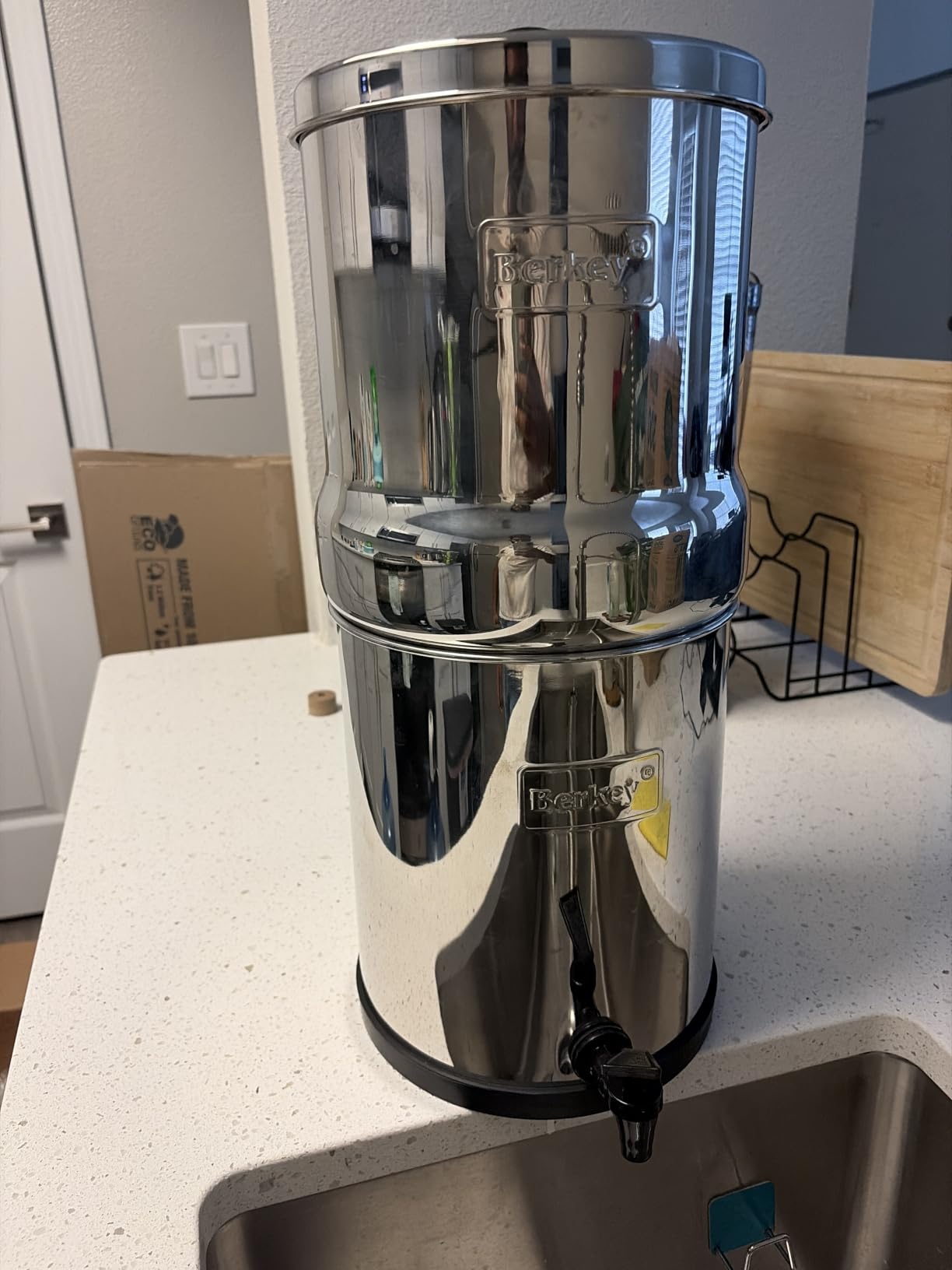
1. Big Berkey 2.25 Gallon Gravity Water Filter for the countertop default
Big Berkey 2.25 Gal Gravity Water Filter System with BB9-2 Filters
8.5 liter chambers
Two Black Berkey elements
0.03 gpm flow
6000 gallon pair life
Pros
- Proven long-term daily use across thousands of reviews
- Polished AISI 304 stainless steel build
- No electricity or plumbing required
- Long element life reduces cartridge planning
Cons
- Slow 0.03 gpm maximum flow rate
- Elements must be primed or flow stays poor
- Priming instructions are unclear
This is the unit most households end up with, and it earns that place by being unremarkable in the best way. The system is two polished stainless steel chambers, a pair of Black Berkey elements and a spigot. You fill the top can, you flip the spigot, and the water takes a few hours to move through to the bottom can while you get on with something else.
What I notice first is how little attention it demands. There is no pump to fail, no tubing to kink, no filter housing that needs a wrench. For daily drinking water it is genuinely set-and-forget, and reviewers consistently describe the taste improvement as the thing that made previously unpleasant tap water drinkable.
The honest weakness is flow, and the listing puts it at 0.03 gallons per minute. That is the ceiling under clean conditions. Once the elements are loaded with sediment from emergency water, the real number is lower, and a household of four planning on this system for drinking and cooking needs to pour early and often.
The second weakness is priming, and this one catches people out. The elements need roughly five minutes of running water before flow settles, and if you skip it the system will feel broken for days. Owners also report that flow drops after storage until the elements are re-primed, which is exactly what happens to a unit that sat in a cupboard for a year.
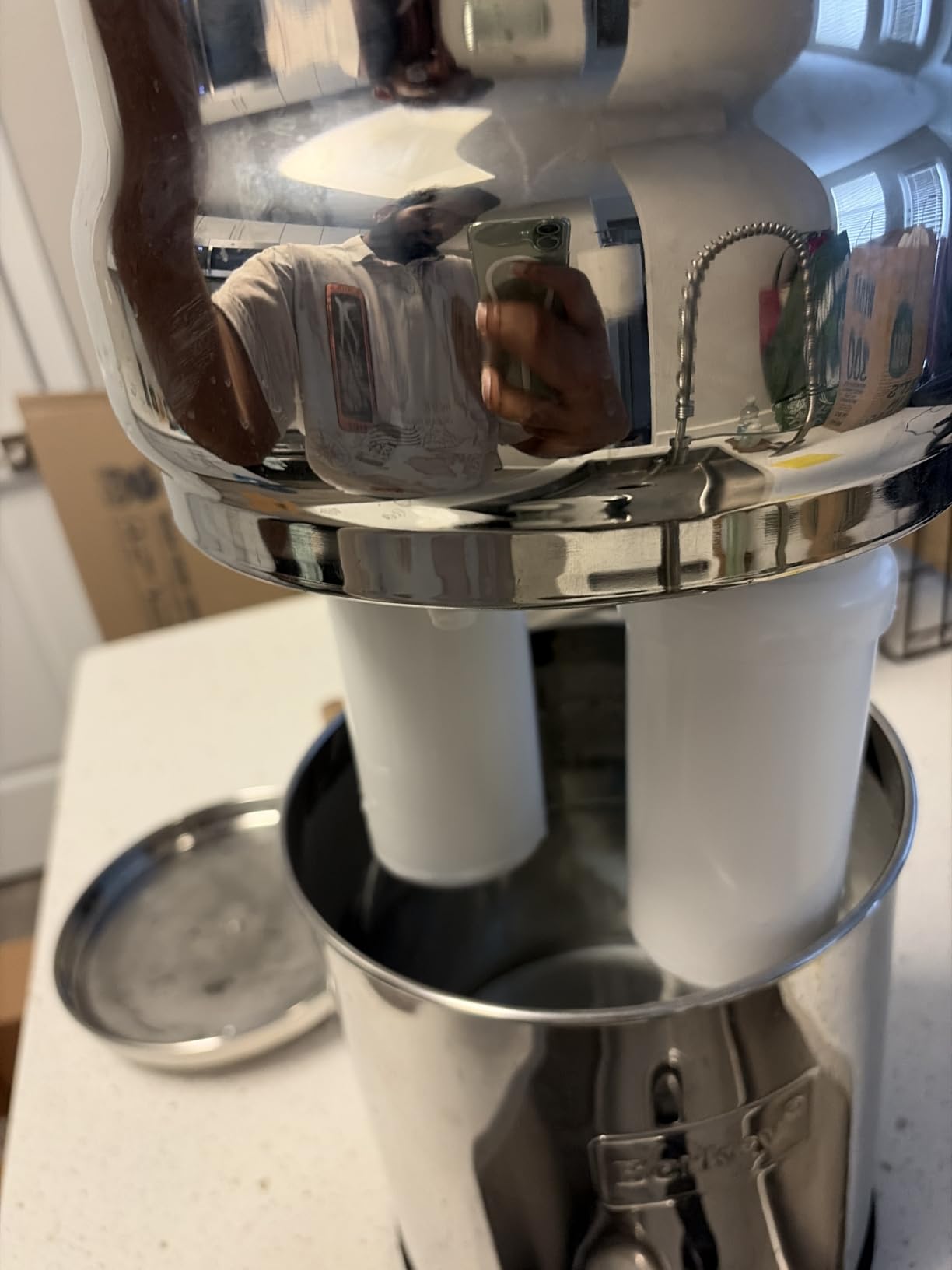
Who this filter suits
A household of one to four people who wants a permanent countertop installation that doubles as the emergency unit. It is the most reviewed system in this roundup, which means parts, advice and replacement elements are easy to find, and r/preppers threads name Berkey among the units people actually keep rather than just store.
It also suits anyone who cares about how the thing looks on the counter, because polished steel ages better than plastic and wipes clean. Each pair of elements covers up to 6,000 gallons before replacement is recommended, so the cartridge burden is light for an emergency asset that is used only in a crisis.
Who should buy something else
Anyone who needs water faster than roughly a gallon and a half over a full day. The flow rating makes it a poor fit for a large household or for group shelter use, and a natural disaster is exactly when several people need to drink at once.
It is also the wrong choice for a go bag. The assembled system is a fixed countertop appliance, not something you carry. For transport, look at the bag and bladder systems further down.
2. LifeStraw Family Gravity Water Purifier 12 L for the published virus claim
LifeStraw Family Gravity Water Purifier with Virus Removal, 12 L, Blue
Removes 99.99 percent viruses to 0.02 micron
18,000 liter life
9 to 12 liters per hour
1.5 pounds
Pros
- Only unit here with a published virus removal claim
- Long 4755 gallon element life
- Weighs 1.5 pounds in bag form
- Doubles as a rainwater filter
Cons
- Included sack is not a storage case
- Spares like bulbs and clamp rings are not sold apart
- Needs several flush cycles before residue clears
This is the answer to the virus question, and it is the reason it sits at number two. The manufacturer states removal of 99.99 percent viruses, 99.9999 percent bacteria and 99.9 percent protozoan cysts down to 0.02 microns, using a hollow fiber membrane with activated carbon. Almost nothing else in the gravity category publishes that claim, because almost nothing else is built to make it.
The form factor is the quiet advantage. At 1.5 pounds in a soft bag, it moves between a kitchen, a vehicle and a shelter without disassembly. Fill the top, hang it, and the filtered water collects in the lower bag at 9 to 12 liters per hour.
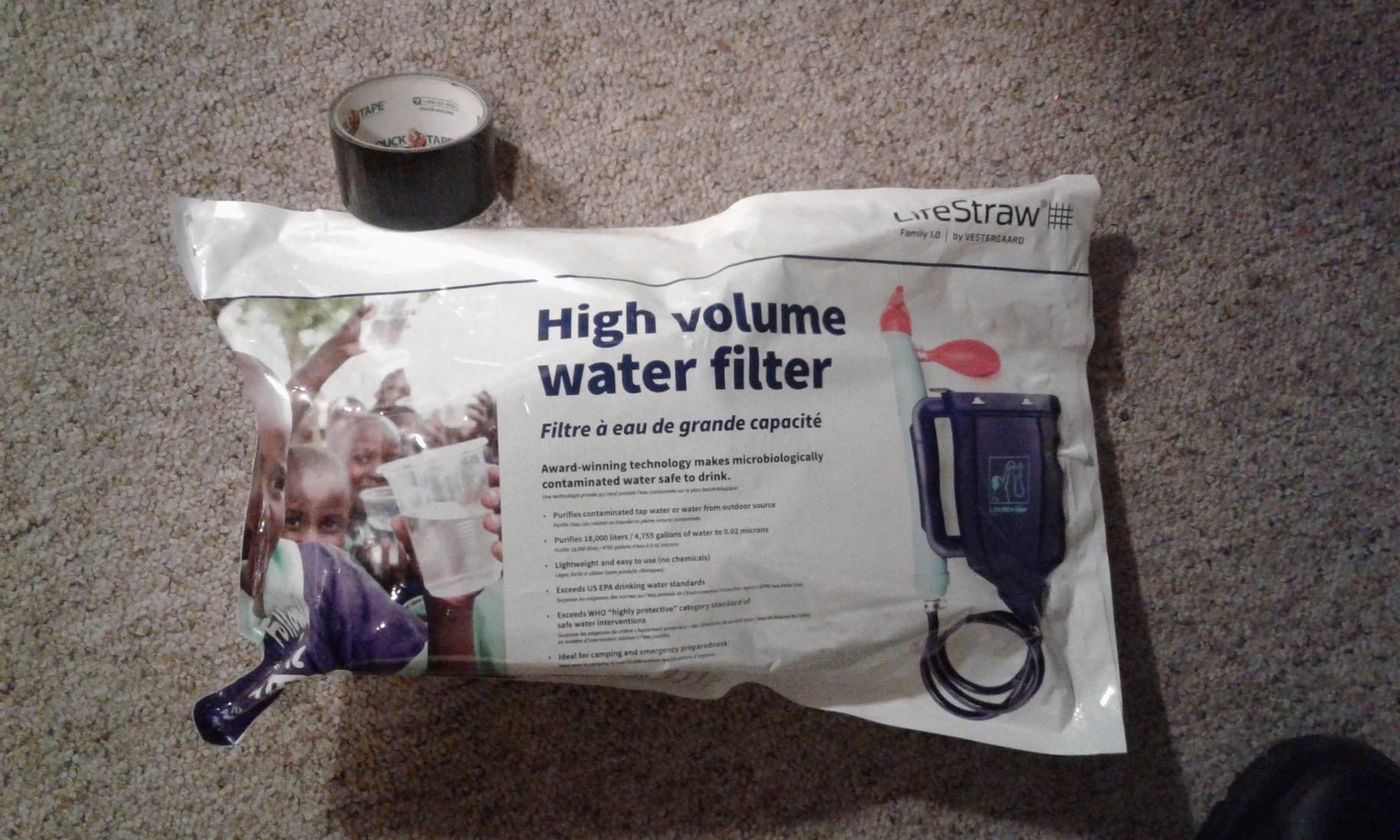
Element life is the number that matters for emergency planning: 18,000 liters, roughly 4,755 gallons, with a stated three year filter lifecycle. For a household that only draws on it during an outage, that is effectively a lifetime element, and reviewers describe it as the best value gravity purifier they have used.
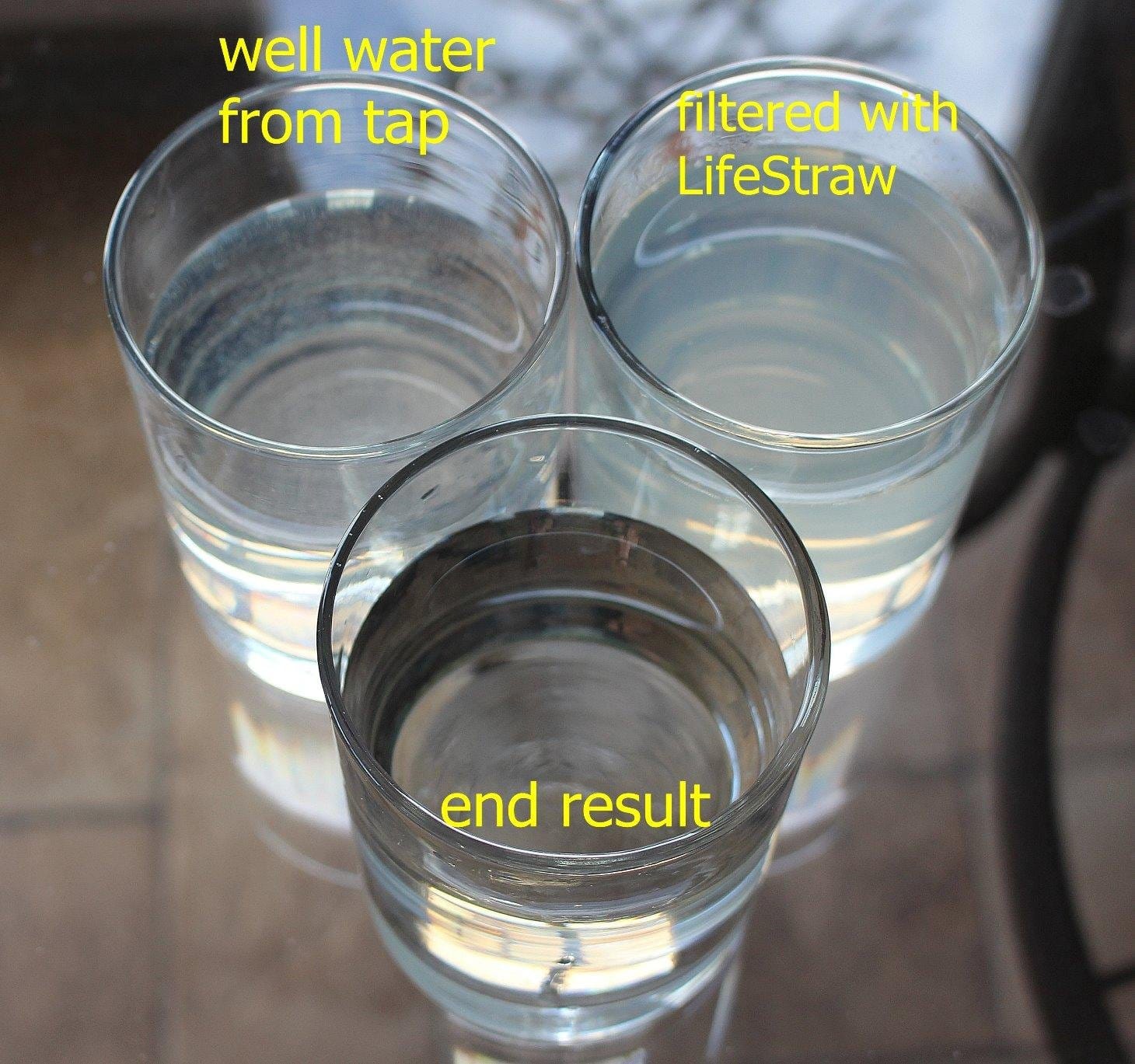
Several owners report testing the output with meters and strips on collected rainwater and finding it clean, and others use it to filter roof runoff for the garden. That dual role means the unit does not sit idle, which suits people who dislike kit that only comes out twice a year.
Who this filter suits
Households that need virus coverage, which means a known sewage or flooding contamination event rather than an ordinary outage. It is also the natural pick for anyone who wants one device to handle both drinking water and rainwater collection without a second system.
A r/preppers poster running a LifeStraw Mission for a family of twelve valued exactly the two things this unit offers: simplicity of operation and throughput for a lot of people. The Family unit is the household sized version of that idea.
Who should buy something else
People who want a hard countertop installation or a sight glass on the remaining water. There is no tank and no level indicator, so you track volume by watching the bag.
The packaging is also a weak point. The bag it arrives in is a simple transport sack rather than a case, and replacement pieces such as the water bulb and clamp rings are not sold separately. Put it in something of your own before you need it.
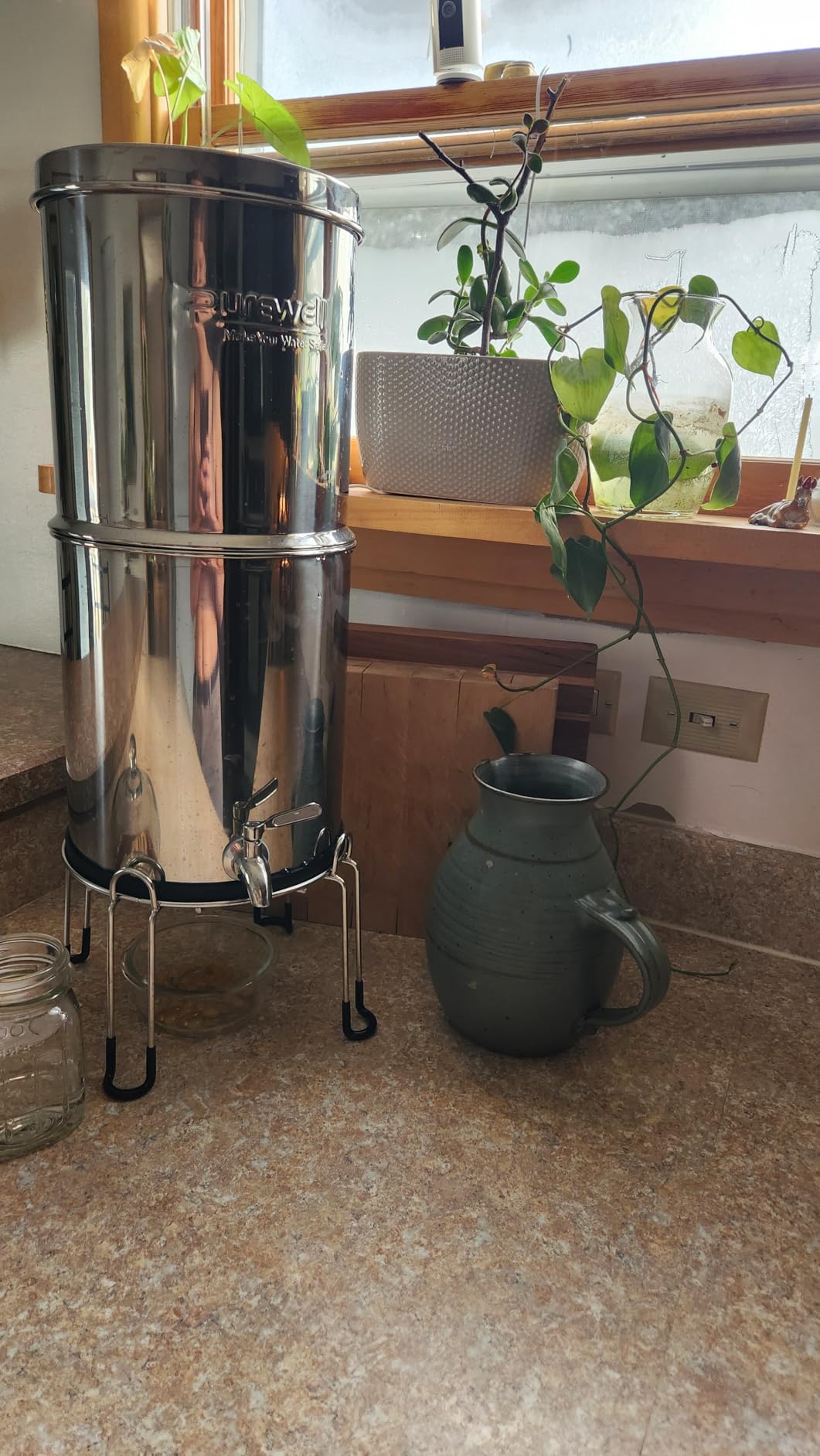
3. Purewell 3-Stage 0.01 Micron System for the fine-pore countertop option
Purewell 3-Stage 0.01μm Ultra-Filtration Gravity Water Filter System, NSF/ANSI 42&372 Certification, 304 Stainless Steel Countertop System with 2 Filters and Stand, Reduce 99% Chlorine, 2.25G, PW-OB
0.01 micron hollow fiber plus carbon
2.25 gallon chambers
4 gallons per hour
NSF/ANSI 42 and 372
Pros
- Finest pore size in the countertop group
- Maintains about 4 gallons per hour anyway
- Includes stand and stainless spigot
- Certification numbers published
Cons
- Does not lower dissolved solids
- Filters need replacing every six months
- Must be stored dry between uses
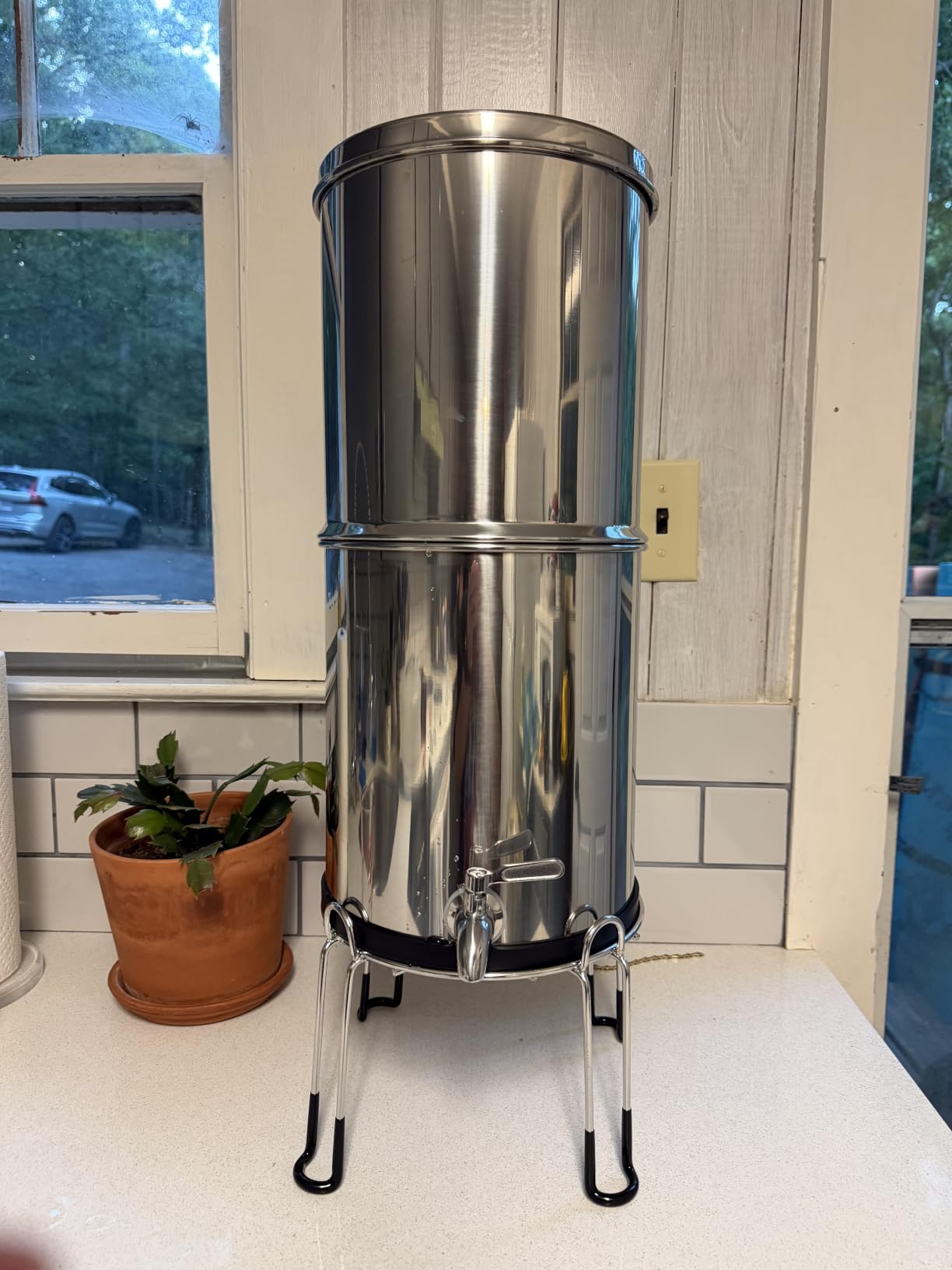
The 0.01 micron hollow fiber membrane is the headline here, and it is unusually fine for this category, where 0.1 and 0.2 micron is more typical. Pair it with a silver ion stage and an activated carbon block and you get a three stage system in a 304 stainless steel housing that measures 8.9 inches square by 20 inches tall.
What stands out in use is that the fine pore size does not destroy throughput. The manufacturer lists a maximum flow of 4 gallons per hour, which is faster than most countertop gravity systems in this roundup, and owners report that the rate holds in practice. The included stand and matching stainless spigot mean nothing extra needs buying before first use.
Certification is stated explicitly: NSF/ANSI 42 and NSF/ANSI 372 for the carbon stage. Forum users consistently say that published third party contaminant data is the deciding factor when choosing between brands, and this unit puts numbers on the box rather than adjectives.
The supplied pair of elements is rated at 3,000 gallons each, and the manufacturer recommends replacing them every six months. That interval matters for an emergency asset, because a cartridge on a fixed calendar will be past its date long before a real event arrives.
Who this filter suits
Homes that want a permanent, furniture grade countertop system and care about the published pore size and certification rather than about the largest possible tank. It looks good enough to leave out and it holds its own in a kitchen that doubles as an emergency room.
It also suits anyone whose normal supply is municipal water with a boil advisory risk. At 4 gallons per hour this is one of the faster countertop options for refilling a set of containers when the advisory lifts.
Who should buy something else
Anyone whose concern is dissolved solids, hardness or total dissolved solids reduction. This system explicitly does not lower dissolved solids, and its listed TDS ceiling of 500 ppm tells you what the membrane tolerates rather than what it strips out.
If you will only draw on it during a genuine crisis, the six month replacement recommendation is a running cost for a unit that is idle most of the year. Element life in calendar terms, not gallons, is the thing to check before you buy.
4. Waterdrop Gravity Water Filter Straw for the complete go-bag kit
Waterdrop Gravity Water Filter Straw, Camping Water Filter, 0.1 Micron
0.1 micron 5-stage filtration
1.5 gallon bag plus pouch
1,400 gallon life
4.64 ounces
Pros
- Whole kit weighs under 5 ounces
- Backflushable to extend element life
- Bag and pouch included at no extra cost
- Fast 700 ml per minute for a straw
Cons
- 0.1 micron media does not remove viruses
- Warranty is only 30 days
- Flow drops when the straw clogs
This is the package you actually put in a go bag, because everything is in the box. You get the filter straw, a 1.5 gallon gravity fed bag and a 16 ounce pouch, and the whole assembly weighs 4.64 ounces. There is nothing to source separately and nothing to leave behind.
Media is a 0.1 micron ultrafiltration membrane across five stages, with a rated life of up to 1,400 gallons. Flow is listed at up to 700 millilitres per minute, which is fast for a straw format. Both ends disassemble, so the same element can serve a bag or a bottle depending on what you are drawing from.

The backwash function is the feature that matters most for storage. Remove the mouthpiece, flush with clean water or attach to a 27.5 millimeter bottle, and you clear the element without carrying spare parts. That keeps a go bag item functional across years of sitting in a drawer, which is when most cheap straw filters are already dead.
Chlorine, sediment, sand, stones, taste and odor are all reduced, and r/preppers threads name Waterdrop units as a positive in the same discussions where people ask about family sized gravity systems. It is a common, well understood recommendation.

Who this filter suits
Anyone building a bug out bag or a vehicle kit where weight and volume are the binding constraints. At under five ounces with the bags, it can sit in a pack, a drawer or a toolbox without anyone rethinking the load.
It also suits a one or two person kit that does not need viruses handled. This is a filter rather than a purifier, and pairing it with purification tablets for questionable water is a normal, sensible arrangement.
Who should buy something else
Households that need more than one or two people served per day, since the 1.5 gallon bag refills from scratch rather than feeding a spigot. And anyone who needs virus coverage, because 0.1 micron media will not deliver it.
The 30 day warranty is also shorter than anything else here. Treat it as a consumable pack rather than a long term asset.
5. Sawyer SP160 One Gallon System for the lifetime-rated element
Sawyer Products SP160 One Gallon Gravity Water Filtration System w/Dual-Threaded Mini Filter, Blue/White/Clear
0.1 micron absolute MINI filter
Rated to 100,000 gallons
One gallon mylar bladder
43 g
Pros
- Element rated up to 100000 gallons
- Individually tested three times before shipping
- Dual threading cap doubles as a valve
- Interchangeable with the rest of the Sawyer line
Cons
- Bladder fill port is awkward from shallow water
- Semi rigid bag crinkles and packs badly
- Bag does not hang flat and must be tilted
The specification that decides this one is the element rating: up to 100,000 gallons. For an emergency asset that you might use for a few hundred gallons across a decade, that is a lifetime component, and it removes cartridge cost and availability from your planning entirely.
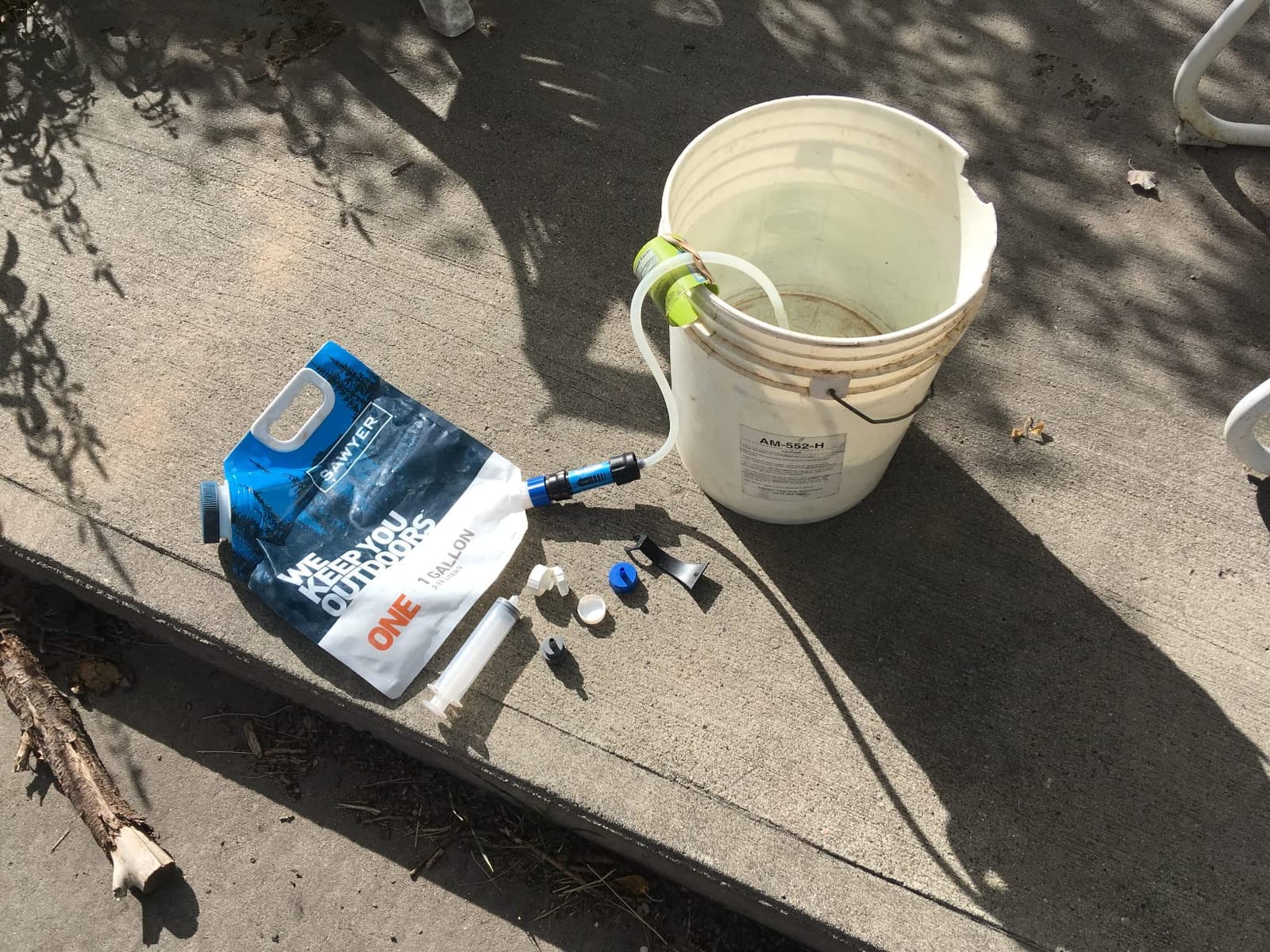
The MINI filter itself is palm sized at 2 ounces, with a 0.1 micron absolute hollow fiber element. Dual threading on the cap means the cap can double as an on off valve, and each unit is individually tested three times by the manufacturer before it leaves the factory, which is unusually strong quality control for a component this small.
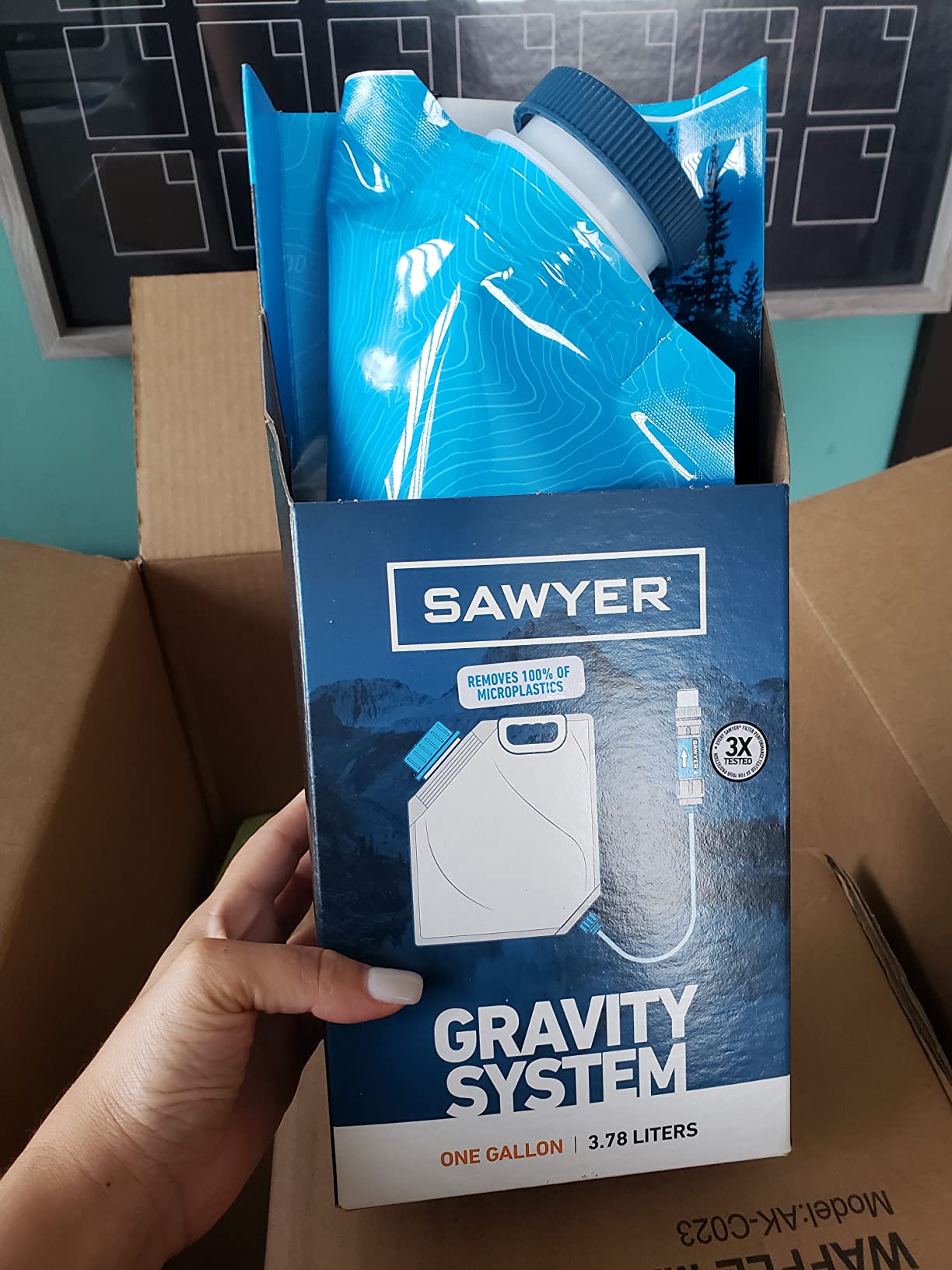
Included is a one gallon wide mouth mylar bladder with a carry handle, a gravity hose, adapters, a cleaning plunger and a cleaning coupling. The bladder is mylar rather than rigid plastic, so it is light and it packs, though it crinkles. Backflushing uses the supplied plunger and coupling, which means the maintenance kit travels with the filter.
Long term campers describe the output as clean tasting and fast for a gravity system, roughly a liter in three minutes. Because the bladder, hose and squeeze filters share the same thread, you can mix and match across the Sawyer range without buying a second ecosystem.
Who this filter suits
People who want a filter they buy once. The 100,000 gallon rating means the most likely reason to replace this is loss or damage, not exhaustion, and that changes how you store it.
It is also a good fit for a vehicle or a go bag, at 43 grams with the bladder, and for people who already own other Sawyer squeeze filters and want one shared thread across the whole kit.
Who should buy something else
Anyone who hates fiddly setup. Owners describe the instructions as thin and the range of configurations as something that takes time to learn, so budget an afternoon with the manual and a phone before the emergency rather than during it.
The bladder is the weak point, not the filter. The fill port is awkward to fill from a shallow stream, and the bag does not hang naturally, so you have to tilt it to drain.
6. SimPure Portable Gravity Filter with 3L Bag for the lightest full kit
SimPure Portable Gravity-Fed Water Filter with 3L Bag
0.1 micron hollow fiber with carbon
27 liters per hour
5,000 liter element life
2.8 ounces
Pros
- Filter weighs only 2.8 ounces
- Fast 27 liters per hour flow
- Works as hanging bag or straw or bottle filter
- Tree strap allows hands free use
Cons
- Bag holds about 2.4 liters despite 3L label
- Some arrivals arrive cracked or leaking
- Clogs fast on open debris laden water
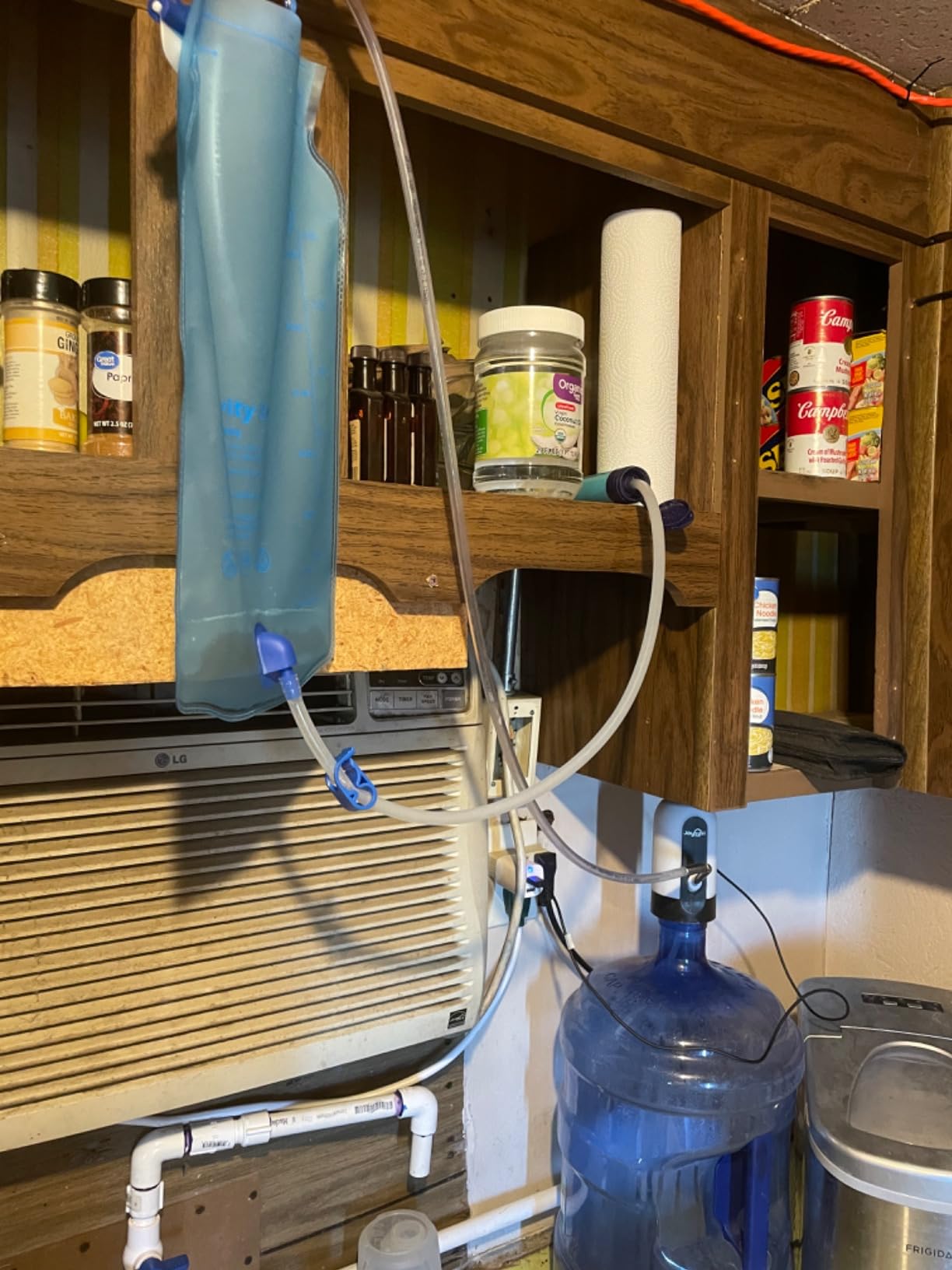
The three stage build is 0.1 micron hollow fiber ultrafiltration paired with a coconut shell granular activated carbon layer and a 0.2 micron polypropylene pre-filter. That pre-filter stage is the part worth noticing, because it is what keeps sediment out of the membrane in dirty source water.
Flow is listed at 27 liters per hour, which is high for a bag unit, and the manufacturer rates the element at 5,000 liters or 1,320 gallons, roughly three and a half years for a family of four. At 2.8 ounces for the filter itself, it is the lightest complete gravity kit here and the easiest to justify packing.
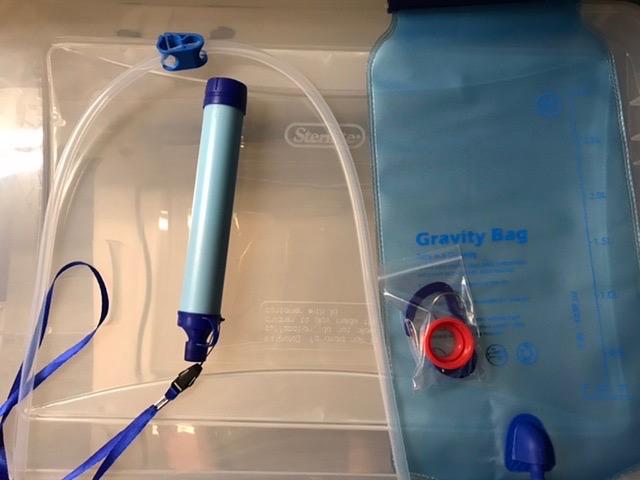
It is also unusually versatile. The included tree strap lets you hang it hands free, a 29.5 inch extension tube turns it into a straw for drinking at a distance, and it will attach to a bottle for squeeze use. Reviewers compare the clarity and taste favourably against more expensive named brands.
Backflushing keeps the element clean without extra parts. That matters more here than in most kits because the polypropylene pre-filter stage will load up quickly if you are drawing from open, debris laden water.
Who this filter suits
Hikers, backpackers and anyone building a kit where every gram counts. Reviewers repeatedly single out the weight to output ratio as the reason to pick it, and r/preppers discussions of portable filtration treat this style of unit as the sensible solo answer.
It also suits people who want one element that adapts to several water sources, because the same filter handles a hanging bag at camp, a straw at a stream and a bottle on a road.
Who should buy something else
Anyone who has to plan around the stated capacity. The bag is labelled 3L but holds closer to 2.25 to 2.4 litres, so you refill it partway through a fill.
Quality control is the other caution. A minority of buyers received cracked or leaking bags, and a few report a persistent plastic or chemical smell in the filtered water. Inspect it before it goes into a kit and run water through it a few times.
7. Membrane Solutions 6L Gravity Filter Pro for groups of three to six
Membrane Solutions 6L Gravity Water Filter Pro for Group Camping
6 liter collapsible TPU bag
NSF/ANSI 42, 372 and 401
0.1 micron hollow fiber
0.5 liters per minute
Pros
- Triple NSF certification is unusual in this class
- 6 litre capacity covers a small group
- Wide mouth scoops from shallow sources
- Intuitive setup without instructions
Cons
- Real world flow can fall below 0.5 litres per minute
- Must be flushed before first use
- Hollow fiber element does not remove viruses
Triple certification is what separates this from most of the bag units. It is independently tested by NSF and SGS and meets NSF/ANSI 42, 372 and 401. Forum readers consistently treat published certification numbers as the most trusted signal in this category, and this is one of the few bag systems that publishes them.
Media is a 0.1 micron hollow fiber membrane with coconut shell activated carbon and dual polypropylene pre-filters, rated at up to 1,320 gallons or 5,000 litres. The dual pre-filter stages are a sensible design for stream water, where sediment is the first thing to eat a membrane.
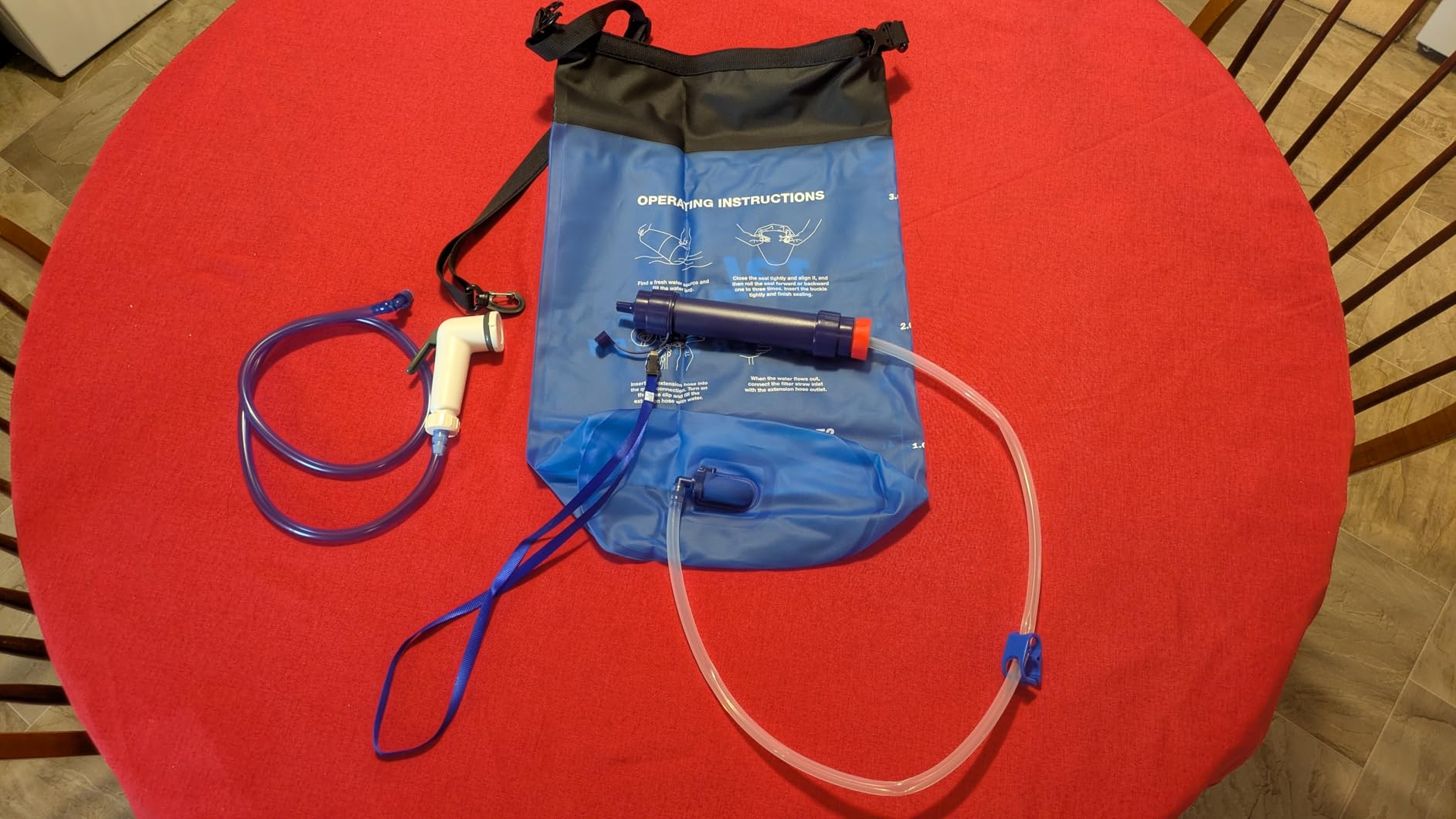
Capacity is 6 litres in a collapsible, puncture resistant, BPA free TPU bag with a reinforced hanging strap. At 12.8 ounces it is heavier than the straw format units but still portable, and the wide mouth opening scoops from a shallow pool where a bottle neck cannot reach.
Owners describe it as strong value for group use and say most of them set it up without reading the instructions, which is a good sign for something you may assemble under stress. It rolls up flat when empty and does not leak in use.
Who this filter suits
A group of three to six people, or a family of two to three with an appetite for volume. At 6 litres this is the largest bag in the roundup, and the certification listing gives you something concrete to check rather than a marketing phrase.
It suits camp and shelter scenarios where people are drawing from a stream or lake rather than a tap, because the pre-filter stages buy the element time on turbid water.
Who should buy something else
Anyone who needs virus coverage. A 0.1 micron hollow fiber element does not handle viruses on its own, and this unit is a filter rather than a purifier.
Be aware of the flow figure. Owners who measure it report rates below the advertised 0.5 litres per minute, and the bag needs a flush before first use. Treat the number as a ceiling, not an average.
8. Katadyn BeFree Gravity 3L for the fastest flow in the group
Katadyn BeFree Gravity Water Filter 3L for Camping, Backpacking & Hiking
0.1 micron EZ-Clean hollow fiber
Up to 2 liters per minute
1,000 liter capacity
6.4 ounces
Pros
- Fastest flow rate in this roundup at 2 liters per minute
- Cleaning needs no tools or disassembly
- Collapsible 3L bag packs flat
- Backed by a 2-year warranty
Cons
- 1000 liter element life is the shortest here
- 0.1 micron hollow fiber does not remove viruses
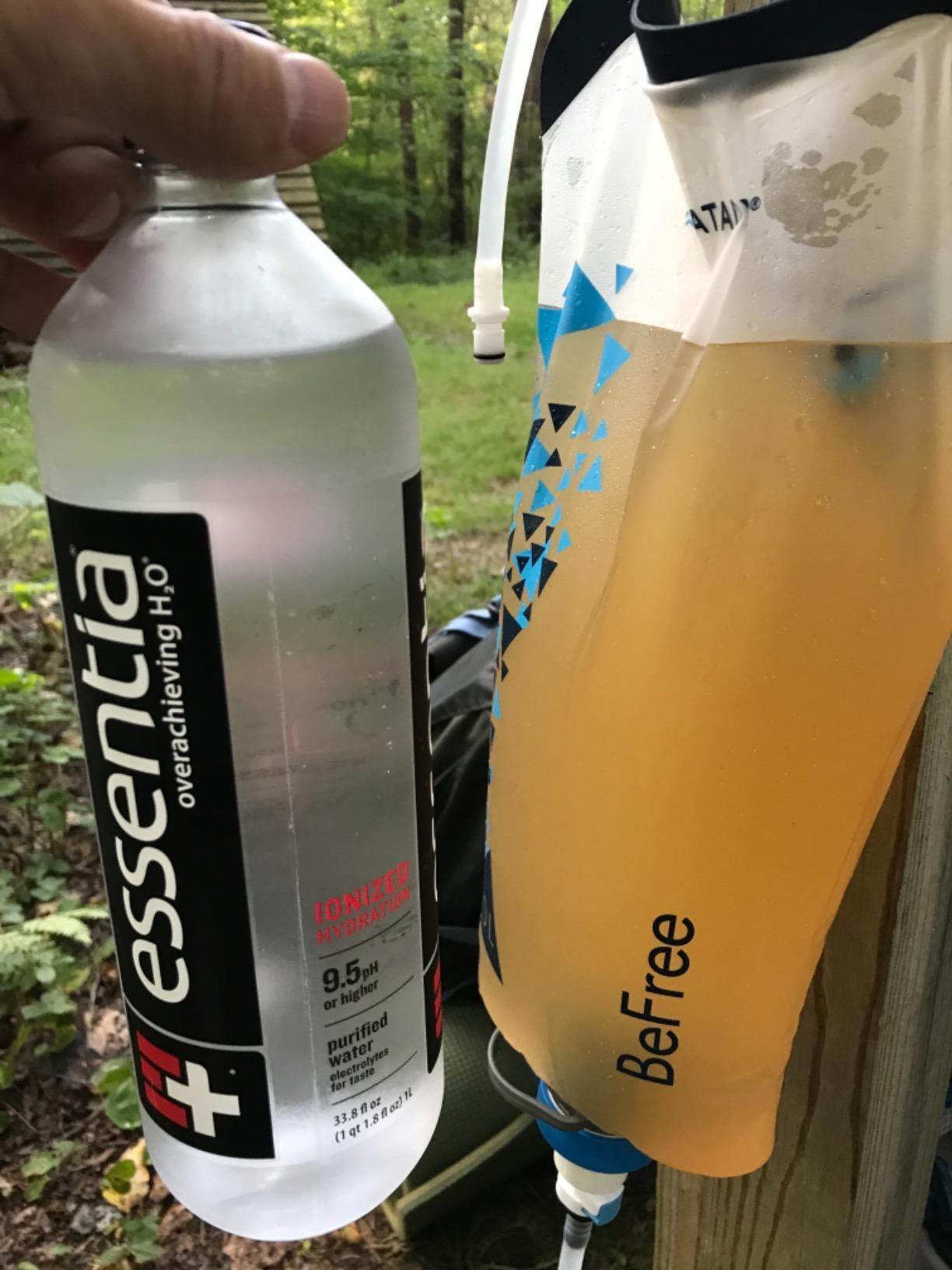
The flow figure is the reason to know this product. Katadyn rates it at up to 2 litres per minute, which is several times faster than most gravity systems in this roundup, and it delivers that through a 0.1 micron EZ-Clean hollow fiber element.
That speed comes with a genuine convenience feature: cleaning is done by shaking or swishing the filter in water. No disassembly, no tools, no spare plungers or couplings to lose. You unhook it, agitate it in the source, hook it back up.

The bag is a collapsible 3 litre unit that packs flat when empty, at 6.4 ounces and BPA free. A two year manufacturer warranty backs it, which is the longest warranty in this group and a reasonable signal on a brand with a long track record in backcountry water.
Hikers rate it as a fast, tool free unit that genuinely runs hands free. Fill, hang, drink, with no pumping and no squeezing.
Who this filter suits
Campers and hikers who move daily and want potable water without stopping to pump. When throughput is the constraint, a two litres per minute system changes what a camping day looks like.
It also suits anyone who does not want a cleaning kit. The shake to clean method removes the usual failure point of lost backflush accessories, which matters when the filter lives in a pack rather than on a bench.
Who should buy something else
Anyone planning on infrequent, long term emergency use. The rated capacity is 1,000 litres, the shortest element life in this roundup, so this is a filter that gets consumed by regular use rather than one that waits a decade.
It is also a filter, not a purifier, so viruses are outside what it handles.
9. Doulton Ultra Sterasyl Ceramic System for the cleanest tasting water
British Berkefeld Doulton 3.17 Gallon W9361137 Countertop Gravity-Fed Water Filtration System Using Ultra Sterasyl Ceramic Filter Candles
Two Ultra Sterasyl ceramic candles
12 litre stainless steel can
Up to 99.99 percent bacteria reduction
Bi-monthly cleaning
Pros
- Cleanest tasting output of the countertop systems
- Ceramic media keeps plastic out of contact with water
- Solid stainless build that survives knocks
- Setup takes under two minutes
Cons
- No sight glass so you lift the can to check level
- Comes with a plastic spigot many owners replace
- Candles on a fixed cleaning and replacement schedule
This is the ceramic option, and it is the one people buy when taste is the deciding factor. The water comes out tasting noticeably cleaner than the plastic-housing systems, and the reason is structural: ceramic media means no plastic contact with the treated water when a metal spout is fitted.
Two Ultra Sterasyl candles sit in a 12 litre stainless steel countertop can, 23.62 inches tall and weighing 2.36 kilograms. The manufacturer states removal of up to 99.99 percent of bacteria, cysts and other waterborne pathogens. Setup is genuinely quick, with owners reporting under two minutes from opening the box to filling the can.
The build is the other draw. This is a solid stainless can that owners say survives being knocked off a counter, and it moves to an RV or a cabin for holiday use. Candles install and replace easily, and the system runs from a tap, a stored supply or collected rainwater.
Forum discussions weighing British ceramic brands against each other keep coming back to taste as the deciding factor, and this is the unit on that side of the argument with the largest capacity in the roundup.
Who this filter suits
Households that are sensitive to plastic taste or that are moving away from single use bottled water and want a counter appliance they will keep for years. The stainless build and ceramic media both age well.
It also suits a household of four to six, given the 12 litre can, and anyone who wants a system that can be moved to a second location rather than installed permanently.
Who should buy something else
People who need to know how much water is left without picking it up. There is no sight glass, so the volume check is lifting a two kilogram steel can.
Also consider the maintenance rhythm before buying. Bi-monthly cleaning and scheduled candle replacement is ongoing, and a few buyers received candles that needed several gallons run through them before the output was acceptable. Fit a metal spout rather than using the supplied plastic one.
10. Outback Water 24 GPD Emergency System for bulk batch filtering
Outback Water Emergency Drinking Water Filter System, Gravity Fed 24 GPD
Gravity bucket system
Nominal 24 gallons per day
90 liters per day listed maximum
Four stage nanofiltration media
Pros
- No electricity pumps or batteries needed
- Large batch format suits household or shelter use
- Handles stored rainwater and natural sources
- Simple to assemble
Cons
- Real world output reported at 1 to 3 gallons per day
- Several stopped working after a few weeks
- Replacement elements cost nearly as much as a new system
This is the one to look at when the emergency is a shelter rather than a household. It is a gravity powered bucket system with four stage filtration including nanofiltration media, rated nominally at 24 gallons per day, and it draws from lakes, rivers, streams or stored rainwater.
The premise is sound. It needs no electricity, no pumps and no batteries, it comes with filters, spigot, containers, connectors, gaskets and a manual, and it weighs 6 pounds.
The batch format is designed for filling containers in volume rather than dispensing a glass at a time.
Here is the important caveat, and it comes from owners rather than the listing. Reviewers report real world output of 1 to 3 gallons per day, far below the advertised 24, and several describe units that stopped working after only a few weeks. Plan capacity around the low number if you buy it.
The other recurring complaints are durability and cost. The polyethylene can feels flimsy for the price, replacement elements cost about as much as a new system, and customer support was reported slow to respond to failures.
Who this filter suits
Anyone planning to filter in bulk for a larger group and comfortable treating the stated figure as a maximum rather than an average. The lift is low: 6 pounds and a bucket format that assembles without tools.
It also suits people who want stored rainwater treated as a primary supply, since rainwater handling is one of the sources the manufacturer names.
Who should buy something else
Anyone who needs a dependable output figure. The gap between the rated and reported throughput is the single biggest concern in the reviews, and a filter that delivers 1 to 3 gallons a day is a backup, not a supply.
The replacement element cost is the deciding factor for most households. Paying near the full system price for a spare part changes the value calculation quickly.
How to choose a gravity water filter for an emergency?
Five decisions decide whether a gravity filter is useful in a crisis: how much water you need, how fast the system can deliver it, what it is certified to remove, what it is built from, and how much the cartridges cost you over its life. Work through them in that order.
How much water do you actually need?
The planning figure most preparedness guides use is one gallon of drinking water per person per day. That covers drinking and nothing else, which is the trap. Cooking, hand washing, pets and sanitation all draw from the same supply, and in warm weather the drinking figure alone can be optimistic.
Convert that into what a filter has to deliver. Work out household size against daily volume, the flow rate you need to refill your storage, and the smallest tank that makes sense. Filter two reservoirs back to back and you can keep filtering while you drink.
One to two people: 1 to 2 gallons a day for drinking. A 2 to 3 litre bag system refilled twice is enough, and a one gallon bladder works.
Family of four: 4 gallons a day for drinking, realistically 6 to 8 with cooking. A 2.25 gallon countertop system refilled three or four times, or a 6 litre bag plus a second container.
Household of six to eight: 6 to 8 gallons a day for drinking alone. This is where you need two systems running, and where the slow countertop units stop being enough.
Twelve or more, or a shelter: 12 gallons a day and up. Plan on multiple units and a storage plan, because no single gravity filter on this list covers that.
A useful sanity check on flow rate: a 4 gallon per hour system refills a 2.25 gallon can roughly every 35 minutes. A 0.03 gallon per minute system takes the better part of a day. Both work. They just do not belong to the same household.
Gravity filter versus every other option
Gravity filtration is one of five ways to treat water without infrastructure, and each handles different problems. Knowing which one you are holding matters more than any brand comparison.
Gravity filter or purifier: no power, no plumbing, no pumping. Removes sediment, protozoa and bacteria, with a purifier also handling viruses. Slower than everything else here.
Pump filter: fast, high pressure, works on mains water with a live tap. Needs electricity, which is the assumption that fails in an emergency.
Straw and squeeze filters: the lightest and most packable, often a sub component of a gravity kit. Small volumes, one person at a time, and typically no virus removal.
Reverse osmosis: the only option here that meaningfully lowers dissolved solids and hardness. Needs pressure, a drain, and typically more than 3,000 gallons of water per gallon produced.
Boiling and disinfection tablets: the complement to everything above, not the replacement. Boiling handles viruses; tablets handle water that is questionable but not heavily contaminated.
What NSF 42, 53 and 58 actually cover
These numbers are the most useful thing printed on any box in this category, and most shoppers read them as a single fuzzy mark of approval. They are separate standards with separate scopes.
NSF/ANSI 42 covers aesthetic and non health effects: taste, odor, chlorine, sediment and particulate. It says nothing about pathogens.
NSF/ANSI 53 covers health effects, principally cysts, protozoa, bacteria and lead reduction. This is the one that matters for untreated water. It still does not cover viruses.
NSF/ANSI 58 covers reverse osmosis systems and dissolved solids reduction. A non reverse osmosis gravity filter holding an NSF 58 rating is not doing what people assume.
NSF/ANSI 372 addresses lead free compliance for the materials in contact with water, and appears alongside 42 on several units here.
NSF/ANSI 401 covers emerging contaminants, and one bag system in this roundup carries it alongside 42 and 372.
If a brand prints no certification number at all, treat its contaminant claims as marketing. Forum readers in this niche reach the same conclusion, and one of them chose a brand purely because it publishes contaminant reduction data.
Ceramic, hollow fiber or carbon block
Filter structure explains most of the trade offs you will read about.
Hollow fiber membrane is the workhorse. It is light, cheap, portable, backflushable and effective down to about 0.1 micron. It does not remove viruses, and it clogs faster on turbid water, which is why units with a polypropylene pre-filter stage last longer outdoors.
Ceramic produces the cleanest tasting water and keeps plastic out of the contact path, but it is heavier, brittle, larger and needs regular cleaning. Absolute pore sizes of 0.2 to 0.5 micron are common.
Activated carbon block is a stage rather than a membrane. It improves taste and odor and reduces chlorine and a range of common chemicals, but it does nothing for pathogens on its own.
Finer is not automatically better. A 0.01 micron membrane clogs sooner and slows the flow. It filters more, and in an emergency the flow you actually get is what keeps people hydrated.
Pre-treat natural water before you pour
Nobody on the results pages covers this, and it is where most emergency filtration fails. A hollow fiber element on raw creek water will clog in an hour and the flow will drop to nothing. Take ten minutes before you start.
Let it settle. If you can, stand the water in a bucket for an hour so silt drops to the bottom, and fill from the top.
Pre-filter through cloth. Run it through a clean cotton or muslin cloth, then through a paper coffee filter. Coffee filters are fine enough to catch most grit and algae and coarse enough not to choke the flow.
Skim the surface. Scoop from below any foam, sheen or floating debris, and avoid water near banks where runoff concentrates.
Then filter. Pour the pre-treated water through the gravity filter at a steady rate rather than flooding the upper chamber, which forces sediment straight past the pre-filter stages.
Disinfect after. A 0.1 micron filter is not a purifier. Pair it with purification tablets or a rolling boil for water from a source you cannot vouch for.
Store the cloth, a stack of paper filters and a pack of tablets inside the same container as the filter. That kit is worth more than the filter alone.
Budget for cartridges, not just the system
Emergency-only units have an awkward property: they sit unused for years and then must work on day one. Two things follow from that. First, buy the replacement element at the same time as the system, because a filter with no spare is a filter with an expiry date. Second, check the replacement interval in time as well as in gallons, since a six month calendar interval has passed long before the element has filtered 6,000 gallons.
Rated element life ranges from 1,000 litres on the Katadyn BeFree to 100,000 gallons on the Sawyer MINI, which is a spread large enough to change the ownership maths entirely. Where life is stated in gallons, divide by your realistic emergency usage. A household using 8 gallons a day for 30 days burns 240 gallons in a month, so a 1,400 gallon straw element is good for several events.
Watch the fixed-interval systems. If the manufacturer recommends replacement every six months regardless of use, your real cost is two elements a year even when the unit never runs.
What to do when the filter fails mid-crisis
Every roundup on this topic stops at the purchase. Here is the part that matters at hour forty, when the cartridge is spent, the tank is cracked or the water is worse than anyone planned for.
If the cartridge is exhausted: if you bought the spare, swap it. The units with front accessible elements, the bag and bladder formats, are the ones you can change in the dark with no tools.
If nothing is left in the kit: fall back to boiling a rolling boil for one minute, or use purification tablets at the stated dose. Both work on water a filter cannot handle.
If the tank cracks: a five gallon bucket, a clean food grade bag and a length of line is a serviceable field setup for most gravity elements. Carry a coupler and a short length of hose for exactly this.
If the source is contaminated beyond filtration: stop drinking it. Distillation or professional testing is the correct response to chemical contamination, and no gravity filter on this list changes that.
Collect rainwater as a parallel supply: a covered roof catchment gives you water the filter does not have to do all the work on, and it works even if every filter fails.
Test the whole setup before you need it. Fill the system from a bottle of tap water, draw it through, backflush it, pack it away and write the date on the lid. Knowing the unit actually works is worth more than any specification on a webpage.
Frequently Asked Questions
What is the best water filter system for emergencies?
For a household of one to four, a countertop gravity system is the best water filter system for emergencies because it runs with no electricity, no pump and no plumbing. Larger households should run two systems or pair a countertop unit with a 6 litre bag system. Group and shelter scenarios need multiple units plus a boiling and tablets fallback, because no single gravity filter on the market supplies a group of ten or more.
Do gravity water filters actually work?
Yes, within a clear boundary. Gravity filters reliably remove sediment, protozoan cysts and most bacteria, and a carbon stage improves taste, odor and chlorine. They do not remove viruses unless the unit is certified as a purifier, they do not lower dissolved solids unless the system is reverse osmosis, and they cannot treat chemical contamination. Chemical spills require distillation or professional testing rather than filtration.
Do gravity water filters remove viruses?
Only if the unit is certified as a purifier rather than a filter. Most countertop gravity systems are NSF/ANSI 42 or 53 certified, which covers cysts, bacteria and lead but not viruses. A 0.1 micron hollow fiber element is physically too coarse to reliably catch a virus. Among the systems reviewed here, only the LifeStraw Family Gravity Water Purifier publishes a virus removal claim, at 99.99 percent down to 0.02 microns.
What is the best gravity water filter for home use?
The best gravity water filter for home use depends on household size and taste preference. A stainless steel ceramic system suits people sensitive to plastic taste, a fine pore countertop system suits municipal water with boil advisory risk, and a large tank system suits a family of five or six. Whatever the choice, select on published NSF certification numbers and stated flow rate rather than on contaminant adjectives.
Can you use a gravity water filter on stream or lake water?
Yes, but pre-treat it first. Let the water settle, then run it through a cotton cloth and a paper coffee filter before it reaches the filter element, and skim surface debris and algae first. Untreated sediment and algae clog a hollow fiber membrane within an hour. Fill the upper chamber slowly and steadily rather than flooding it, and pair the filter with purification tablets or a rolling boil because a filter does not remove viruses.
How much water do you need per person per day in an emergency?
Plan on one gallon of drinking water per person per day as the baseline, which covers drinking and nothing else. Add cooking, hand washing, sanitation and pets, and warm weather pushes the figure higher. A family of four realistically needs 6 to 8 gallons a day in practice, which means refilling a 2.25 gallon countertop system three or four times daily.
How often do gravity filter cartridges need replacing?
Replace cartridges on whichever comes first, stated volume or stated calendar interval. Element life in this category ranges from 1,000 litres to a 100,000 gallon rating, while some manufacturers recommend replacement every six months regardless of use. For an emergency asset that sits idle for years, buy a spare element with the system and check the date on the cartridge before every use.
Conclusion
If you want one answer, install a stainless steel countertop gravity system with a pair of certified elements and put a portable bag filter in the vehicle. That pairing covers the two scenarios that actually happen: a boil water advisory at home, and water drawn from an untreated source while you are away from home. My pick is the Big Berkey system, with the LifeStraw Family purifier alongside it if your water risk includes sewage or flooding.
Whichever you choose, buy the spare element on the same day, store every cartridge dry, and keep boiling tablets in the same box. Those three steps are the difference between a filter and a working water plan. That is the short answer to the best gravity water filters for emergencies in 2026: buy on certification and flow rate, not on contaminant adjectives, and then test the whole setup before you need it.