
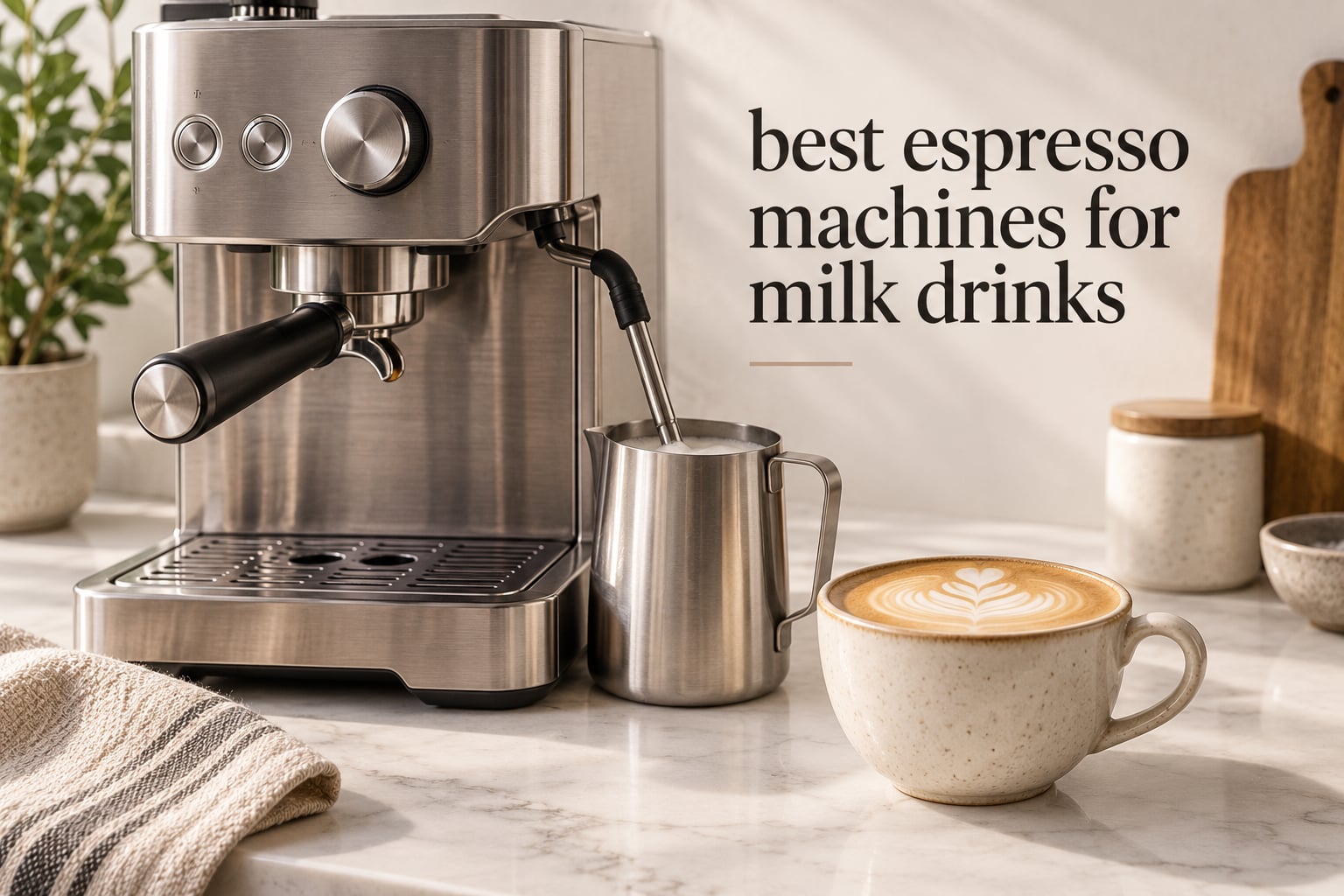
The best espresso machines for milk drinks are the ones that can heat, steam and pour without making you wait. A latte is mostly milk, so the steam system matters more than the group head. The Breville Barista Express wins overall because its 1600W boiler, integrated burr grinder and manual steam wand give you full control over texture and temperature. If you want zero technique, the Philips 3300 with LatteGo cleans up in seconds and never leaves a tube behind.
Most espresso roundups rank machines on shot quality and treat milk as a footnote. We flipped the spine of this guide. Every one of the 12 machines below is judged on how fast it steams, whether it can brew and steam at the same time, and what happens on cleaning night.
That distinction matters more than it sounds. A single-boiler machine heats its brew water, then has to wait for the boiler to refill and re-pressurise before it can steam again. Make two lattes back to back and the second one stalls. Dual-boiler and thermoblock designs skip that wait, and a fully automatic carafe skips the technique entirely.
We also cover the two questions shoppers ask after they buy: how many milk drinks per day your household actually makes, and what happens to oat and soy milk under steam versus inside an automatic carafe. Updated for 2026, every pick below carries its own steam verdict so you can match a machine to your routine before you spend anything.
Table of Contents
Top 3 Picks for Milk Drinks (October 2026)

The Barista Express takes the top spot on the balance of steam control, repairability and how well owners rate it years later. The Mr. Coffee Cafe Barista covers the opposite corner: a press-a-button workflow with a detachable frother and no grinding or tamping at all. The Philips 3300 is the machine to buy if the idea of purging a steam wand every night sounds like a chore you will not keep up.
How We Picked
Every machine in this guide was assessed on four things before we looked at anything else. First, how the milk system works and how long it takes to clean. Second, whether the boiler can brew and steam at the same time. Third, how much control you keep over milk temperature and texture. Fourth, what owners report after real daily use rather than after the first week.
We did not test in a laboratory, and we are not compensated per machine on this page. When we earn anything at all, it comes through qualifying purchases, and it never changes the order below. Ratings and review counts are the live figures attached to each listing, so you can see how much history sits behind every opinion here.
Two rules kept the list honest. A machine with a tiny review base only makes this roundup if its rating and its specification sheet both hold up. And if the boiler maths conflicts with the marketing line, we go with the boiler maths.
All 12 Espresso Machines for Milk Drinks at a Glance (October 2026)
Read the milk system column first. Manual wand means you texture milk yourself, auto wand means the machine does it with no control, and carafe means a detachable container handles the whole drink.
| Product | Specs | Action |
|---|---|---|
| Breville Barista Express |
|
Check Latest Price |
 Mr. Coffee Cafe Barista Mr. Coffee Cafe Barista |
|
Check Latest Price |
 Philips 3300 LatteGo Philips 3300 LatteGo |
|
Check Latest Price |
 Ninja Luxe Cafe Premier Ninja Luxe Cafe Premier |
|
Check Latest Price |
 Gevi 20 Bar with Grinder Gevi 20 Bar with Grinder |
|
Check Latest Price |
 Breville Bambino Breville Bambino |
|
Check Latest Price |
 CASABREWS CM5418 CASABREWS CM5418 |
|
Check Latest Price |
 AIRMSEN Dual Boiler AIRMSEN Dual Boiler |
|
Check Latest Price |
 Gevi 20 Bar Compact Gevi 20 Bar Compact |
|
Check Latest Price |
 atatix 20 Bar atatix 20 Bar |
|
Check Latest Price |
 De’Longhi Classic Signature De’Longhi Classic Signature |
|
Check Latest Price |
 SHARDOR 20 Bar Touchscreen SHARDOR 20 Bar Touchscreen |
|
Check Latest Price |
1. Breville Barista Express – Best Overall for Milk Drinks
Breville BES870XL Barista Express Espresso Machine, Brushed Stainless Steel
1600W heating
Manual steam wand
Integrated burr grinder
22.1 lb body
67 oz tank
Pros
- Integrated conical burr grinder with grind size dial
- Manual steam wand gives full texture control
- PID control and low pressure pre-infusion
- Built-in pressure gauge shows extraction live
- Hot water dispenser doubles as a kettle
Cons
- Top and side panels are plastic
- 67 oz tank needs refills during internal flushing
- Included milk jug is small
Out of everything we looked at, the Barista Express has the most owners describing the same steady routine years later. The wand is a proper manual wand, which means you can stretch, fold and pour latte art rather than pressing a button and hoping. That single feature is what separates it from most of this list.
The steam comes from the same 1600W heating system that brews, so a single-boiler workflow is in play. Pull a shot, then steam. Owners accept the wait without complaint because the wand recovers steadily and the pitcher size is small enough that a normal 6 to 8 ounce of milk finishes in about 20 seconds.
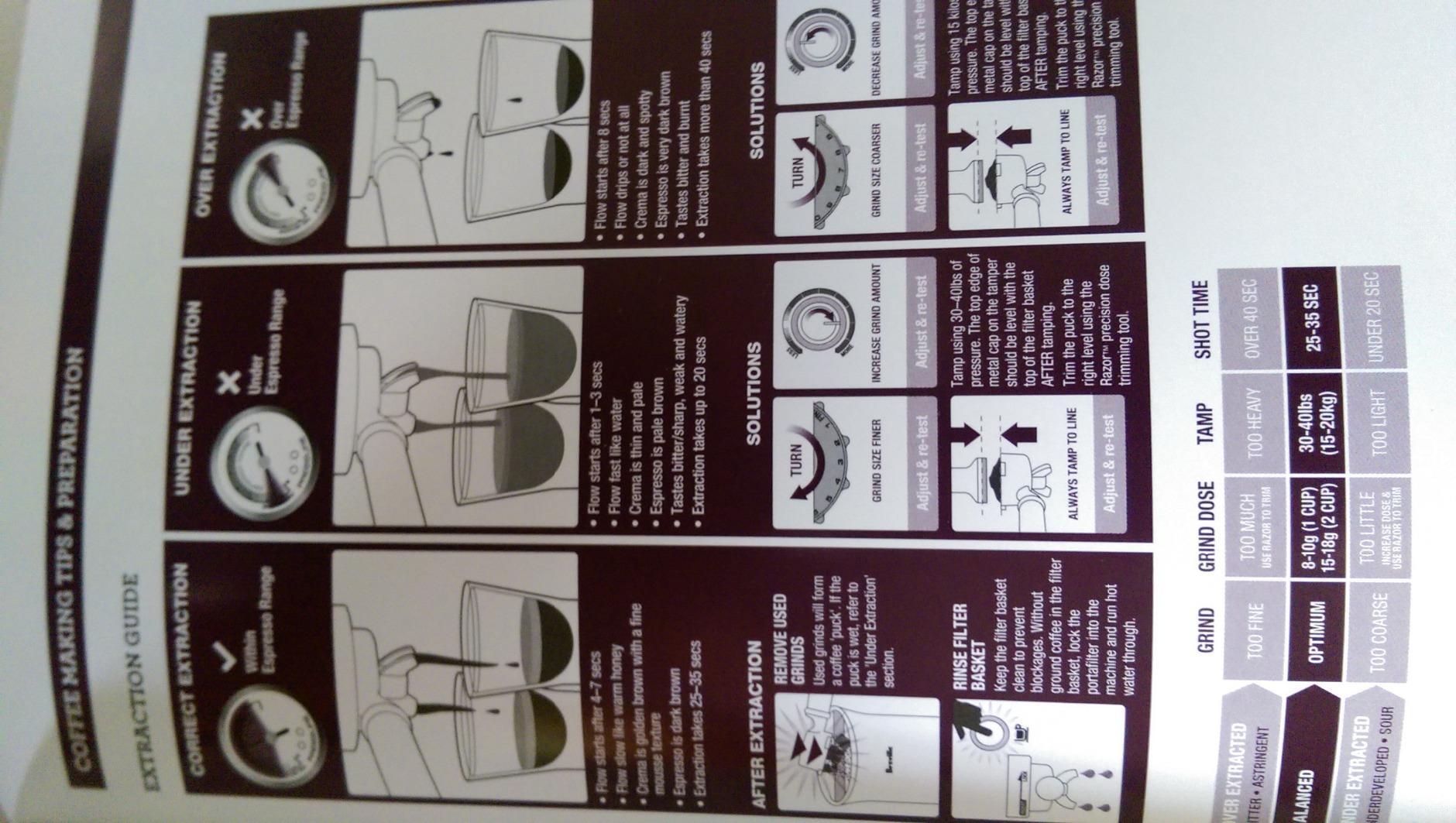
What we like most for milk drinks is the 67 oz tank and the pressure gauge sitting side by side. The gauge tells you whether the shot is right, and the tank means you are not refilling between the espresso and the milk step. The hot water dispenser also means an americano after a latte uses the same machine with no extra steps.
Owners do report long-term solenoid failures on some units after six to twelve months, and the plastic panels are a real downgrade from the rest of the machine. Neither touches the milk system, which is the part that matters here.
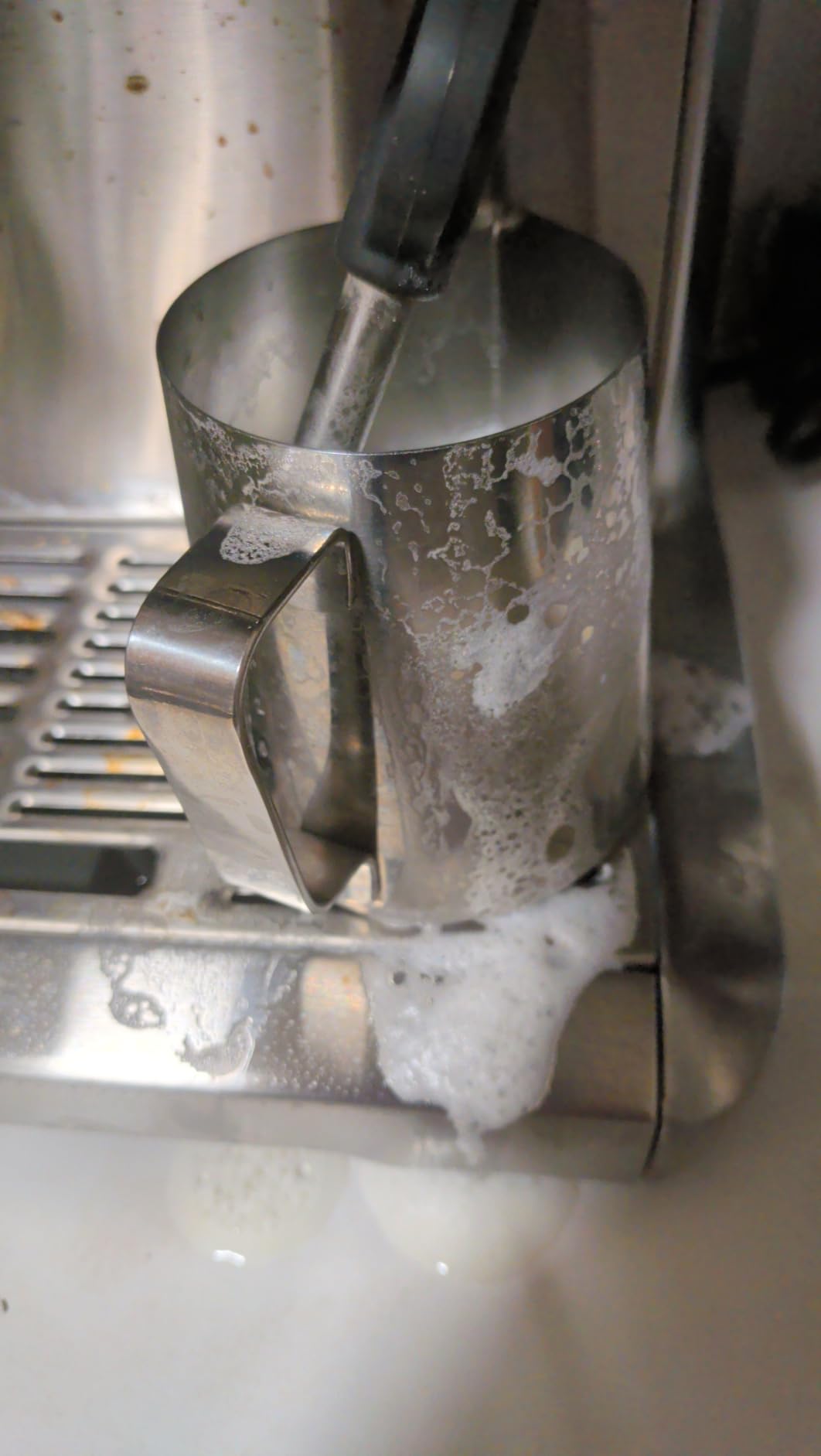
How the Barista Express handles milk
Steam power is strong enough for glossy microfoam in a small stainless steel pitcher, and the manual wand gives you the temperature read by touch. Latte art is realistic after a few dozen drinks. The wand is hot enough that a bare-hand grip needs a cloth.
Oat milk behaves the same way dairy does here, because a manual wand gives you the whirlpool time you need to break down plant proteins. The wand is also uninsulated, so it needs a purge before and after every session.
Where it falls short for milk drinks
The single boiler is the catch. Make a second drink straight away and the machine waits for steam recovery, which owners describe as roughly a minute of waiting. If your household drinks four or more milk drinks every morning, look at a dual-boiler design instead.
You also need a separate tamper that is not the plastic one, and the small included jug forces you to steam in two batches for a large latte. Both are cheap fixes.
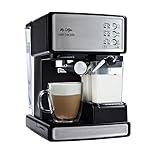
2. Mr. Coffee Cafe Barista – Best Value One-Touch Milk Drinks
Mr. Coffee Espresso and Cappuccino Machine Stainless Steel Programmable Coffee Maker with Automatic Milk Frother 15-Bar Pump Ideal for Home Baristas
Automatic milk frother
One touch panel
15-bar pump
10.4 lb body
1040W
Pros
- Automatic frother removes the technique barrier
- One-touch buttons for espresso cappuccino and latte
- Removable milk container and water tank
- Works with ordinary pre-ground coffee
- Long owners report years of steady use
Cons
- Frother is the first part to fail on many units
- Cleaning cycle must be re-triggered repeatedly
- Froth bubbles are coarser than a pro wand
This is the machine to look at if you drink milk drinks and do not care about espresso at all. You press the cappuccino or latte button, the machine pumps milk through the frother, and you pour. No grinder, no tamping, no technique, no purge.
It takes pre-ground coffee, which removes the single most common hidden cost in home espresso. Owners frequently pair it with a basic blade or burr grinder and never think about it again. The removable milk container lifts out and rinses in seconds, which is the whole reason this workflow works.
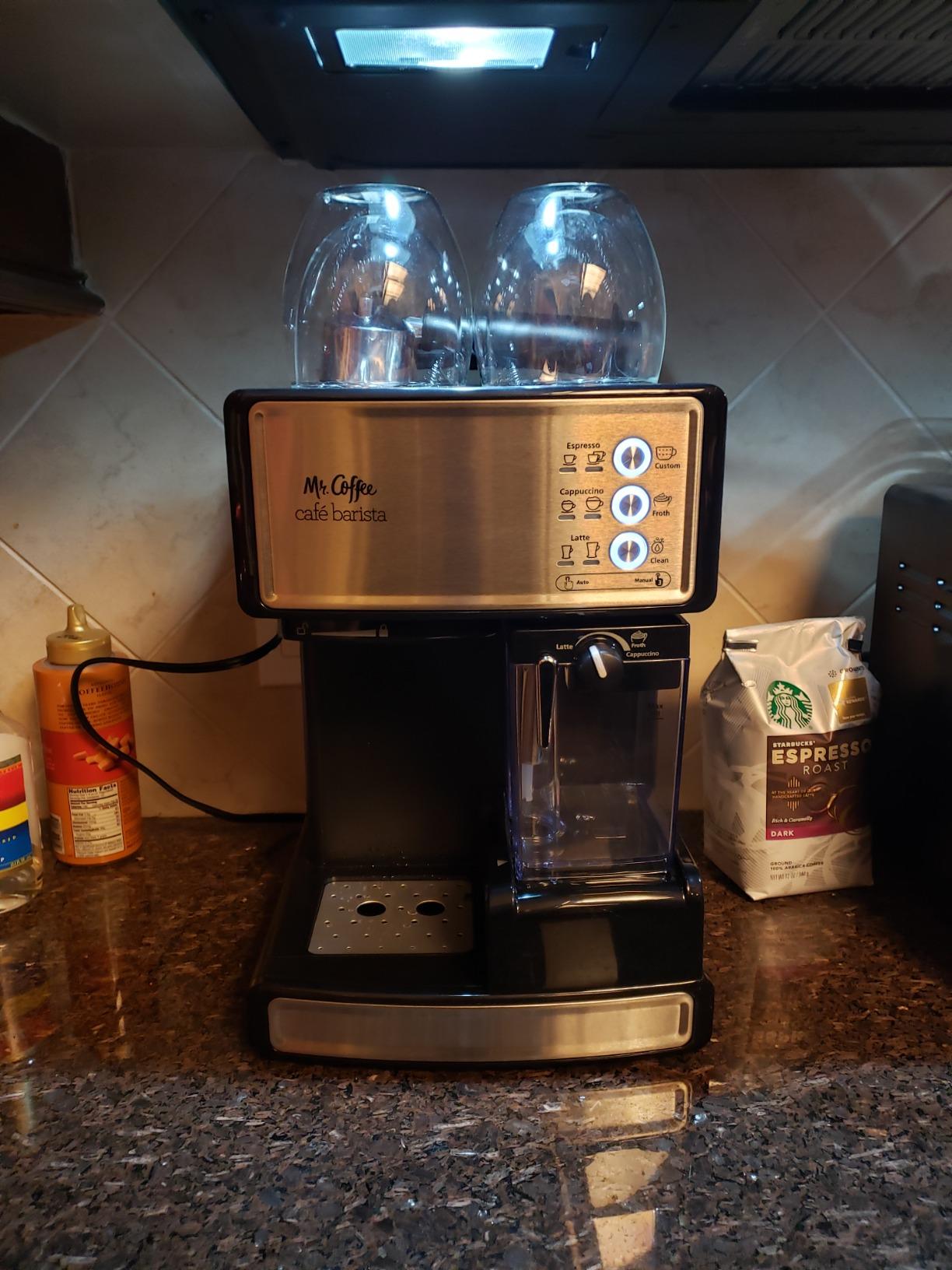
Steam performance is adequate rather than impressive, and the milk comes out as drinkable foam with visible larger bubbles. For a cappuccino on a Tuesday morning that is a good trade. For a flat white where the foam layer is the entire drink, the texture falls short.
The durability story is the thing to plan around. Reviewers consistently name the frother as the component that fails first, often within a year or two of daily use. The cleaning cycle also has to be re-triggered repeatedly, and new units can brew cool until they have been descaled.
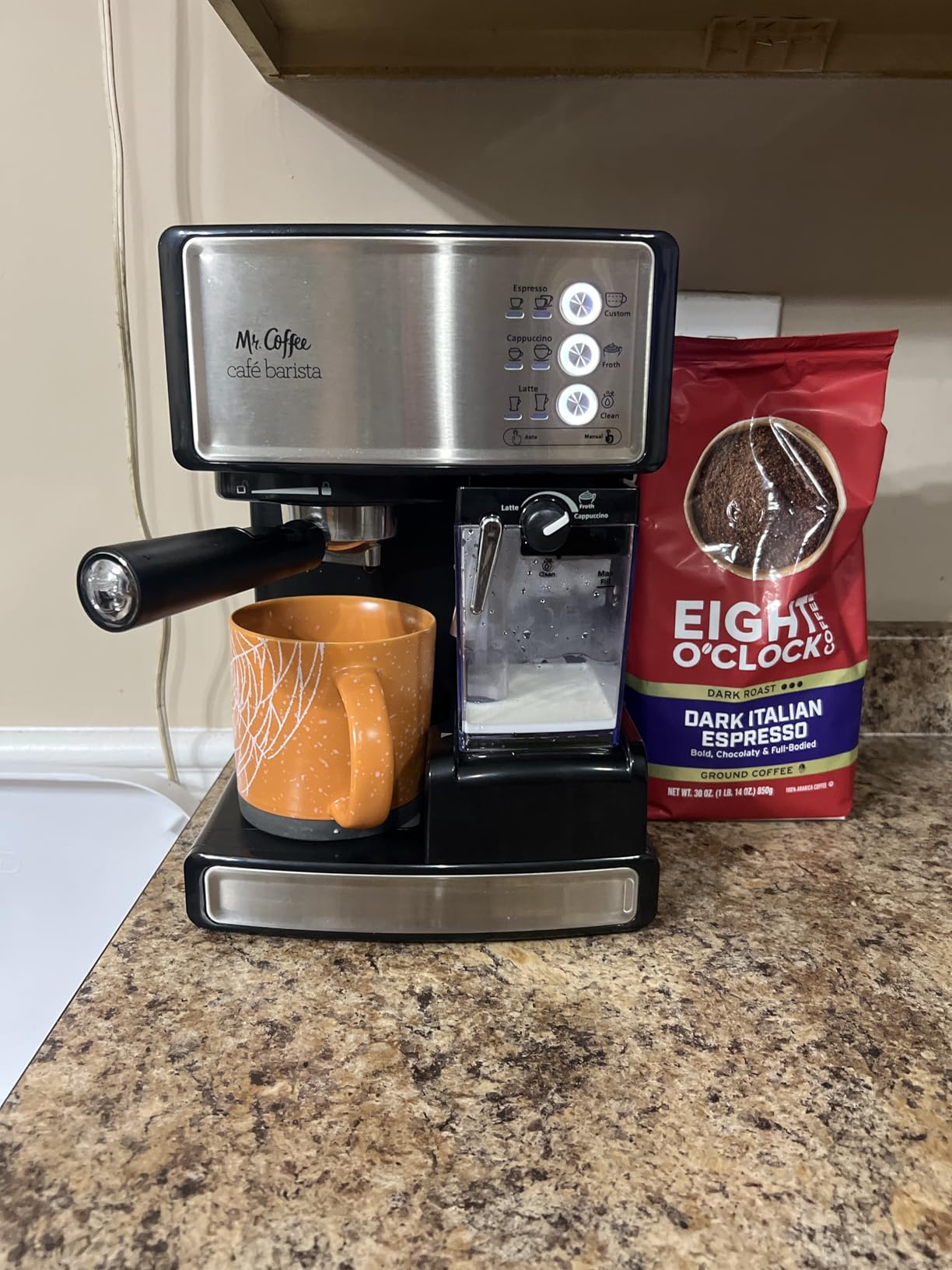
How the Cafe Barista handles milk
The automatic frother does the whole job hands-free, which removes the single biggest reason beginners give up on milk drinks. Steam recovery is fast because there is no brew boiler to switch away from, so back-to-back drinks are not a problem.
Texture is where it loses. There is no temperature or volume adjustment, so hot milk and thin foam are the usual outcomes. Fine for a latte, underwhelming for anything where the foam is the point.
Where it falls short for milk drinks
You give up all control. There is no manual wand to fall back on, so there is no route to latte art, no flat white texture and no way to heat milk without foam. If you ever want to practise pouring, this is the wrong machine.
Budget for a replacement frother in year two or three, and expect the cleaning cycle to add a couple of minutes to each session once scale builds up.
3. Philips 3300 Series with LatteGo – Best Fully Automatic Milk System
PHILIPS 3300 Series Fully Automatic Espresso Machine – LatteGo Milk System, 5 Coffee Varieties, Intuitive Touch Display, SilentBrew, 100% Ceramic Grinder, AquaClean Filter, Glossy Black (EP3347/90)
Tubeless LatteGo carafe
Ceramic grinder
17 inch wide
SilentBrew
AquaClean
Pros
- LatteGo milk system has no tubes to clean
- Grinds brews and froths from beans on one touch
- SilentBrew runs noticeably quieter than earlier models
- AquaClean filter removes descaling for up to 5000 cups
- My Coffee Choice adjusts strength length and froth
Cons
- Milk output per cycle is on the short side
- No standalone steam mode
- Bean hopper feeds unreliably when running low
The LatteGo carafe is the single most important thing about this machine. It is a two-part system with no tube running back into the body, so you rinse one chamber, wipe it, and put it back. On every other automatic frother in this roundup you are pulling milk hoses apart nightly.
Everything else is a genuine super-automatic. Whole beans go in the hopper, a 100 percent ceramic grinder handles them, and the touch display runs espresso, coffee, iced coffee, cappuccino, latte macchiato or hot water from one menu. My Coffee Choice lets you dial strength, length and froth level per cup.
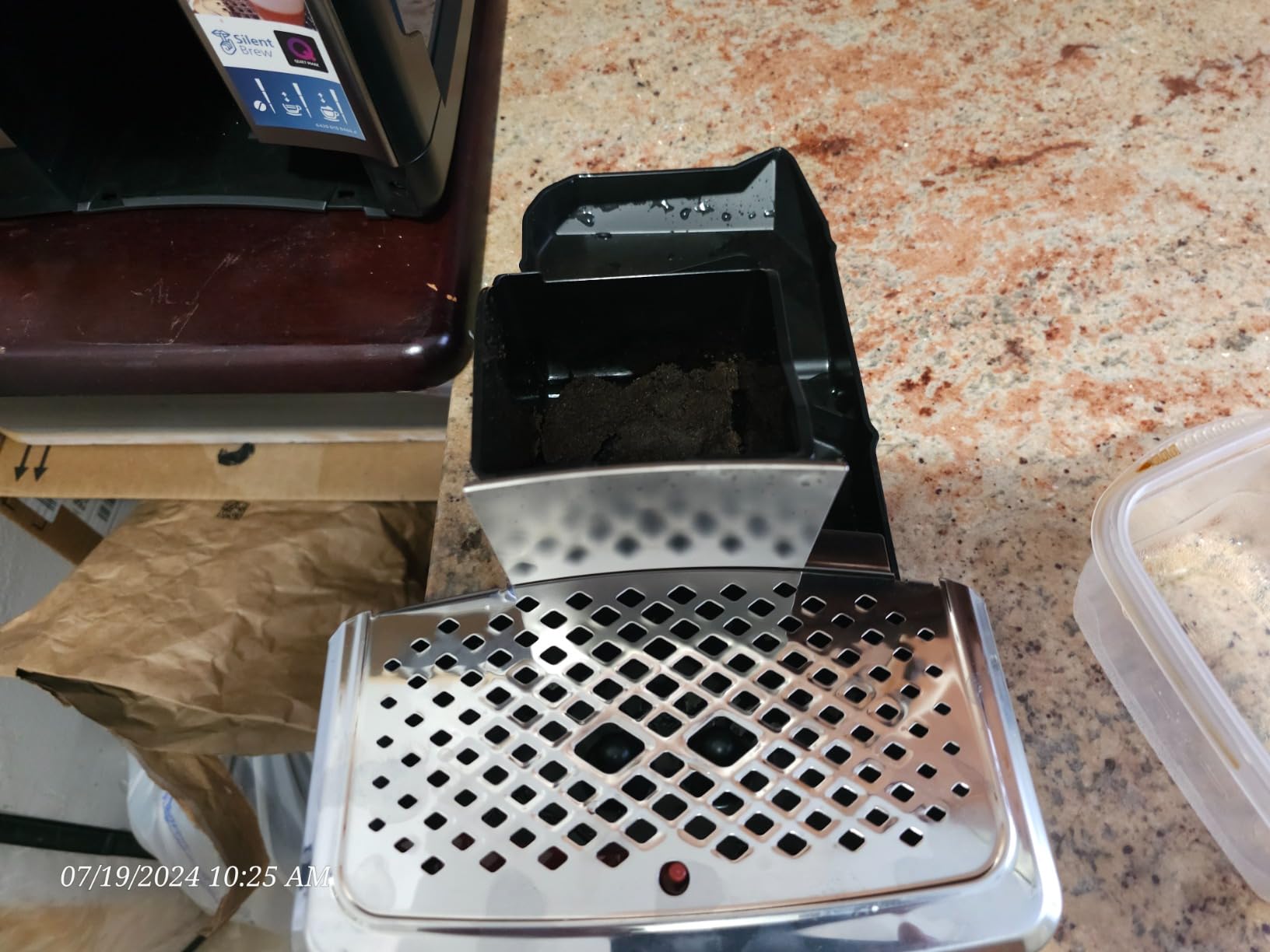
For milk drinks this is close to zero effort, and the SilentBrew system keeps the grinding quieter than earlier Philips models. The AquaClean filter is the quiet hero too, since it removes the need to descale for up to 5000 cups, which is one less reason to skip maintenance.
There are real limits. Milk volume per cycle is on the short side, so one large latte can mean two runs. There is no steam-only mode, meaning plain steamed milk has to come out of a drink cycle. The drip tray also collects a lot of flush water and needs emptying often.
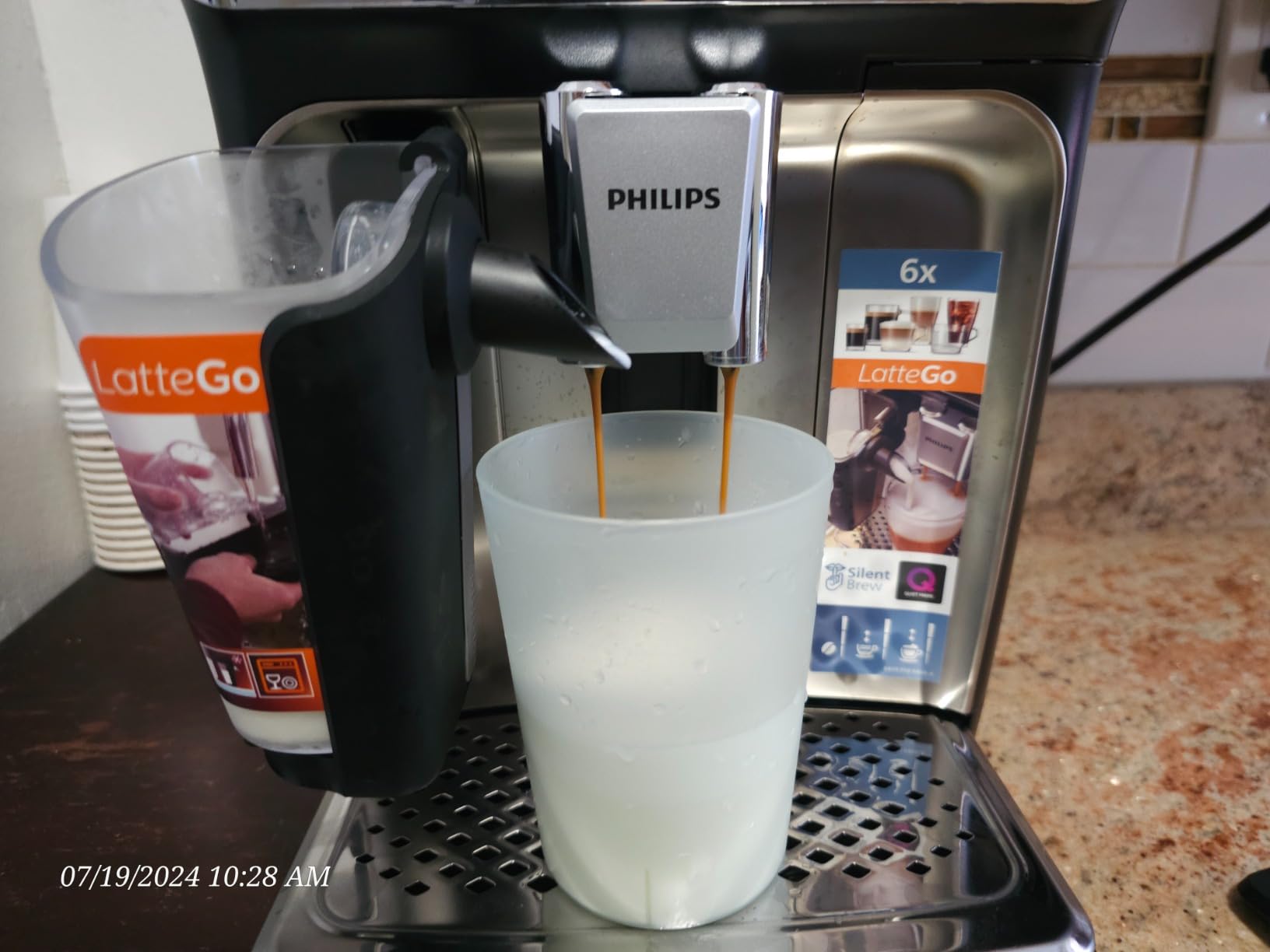
How the Philips 3300 handles milk
The carafe produces a consistent, even microfoam and does it the same way every time, which is the core promise of the LatteGo design. Milk drinks come out at a repeatable temperature, and the froth level is adjustable rather than fixed.
It handles plant-based milk more gracefully than most automatic systems because there is no tube to block, though the froth still lands thinner than dairy. The short output volume is the practical limit for anyone drinking large mugs.
Where it falls short for milk drinks
There is no manual wand, so this is not a latte art machine by any stretch. The 17 inch wide body is the largest footprint in this roundup, and the plastic build is the part reviewers mention first.
Owners also report the hopper feeding unreliably when it runs low, and the grinder needs several weeks of use before shots settle into good results. A minority of buyers reported water leaking from the machine.
4. Ninja Luxe Cafe Premier – Most Drink Modes for Milk Drinks
Ninja Luxe Café Premier 3-in-1 Espresso Machine, Drip Coffee, & Cold Brew
Dual froth system
25-setting grinder
1650W
Barista Assist tamping
Cold foam
Pros
- Four froth presets from cold foam to thick froth
- 25-setting burr grinder covers espresso to cold brew
- Barista Assist automates grinding dosing and tamping
- Cold-pressed espresso works for iced lattes
- Accessory storage keeps the counter tidy
Cons
- Portafilter needs real hand strength to lock
- Small wastewater tray fills quickly
- Steam wand dribbles and moves restrictively
The Dual Froth System is the reason this machine makes the list. One setting gives cold foam, one gives thin froth, one gives thick froth, and a manual mode lets you use the wand yourself. That is four distinct milk outcomes from one machine, which no other pick here can do.
It is also the only three-in-one here, making espresso, drip coffee and cold brew off the same 25-setting burr grinder. Cold-pressed espresso over ice turns it into an iced latte machine without any other equipment.
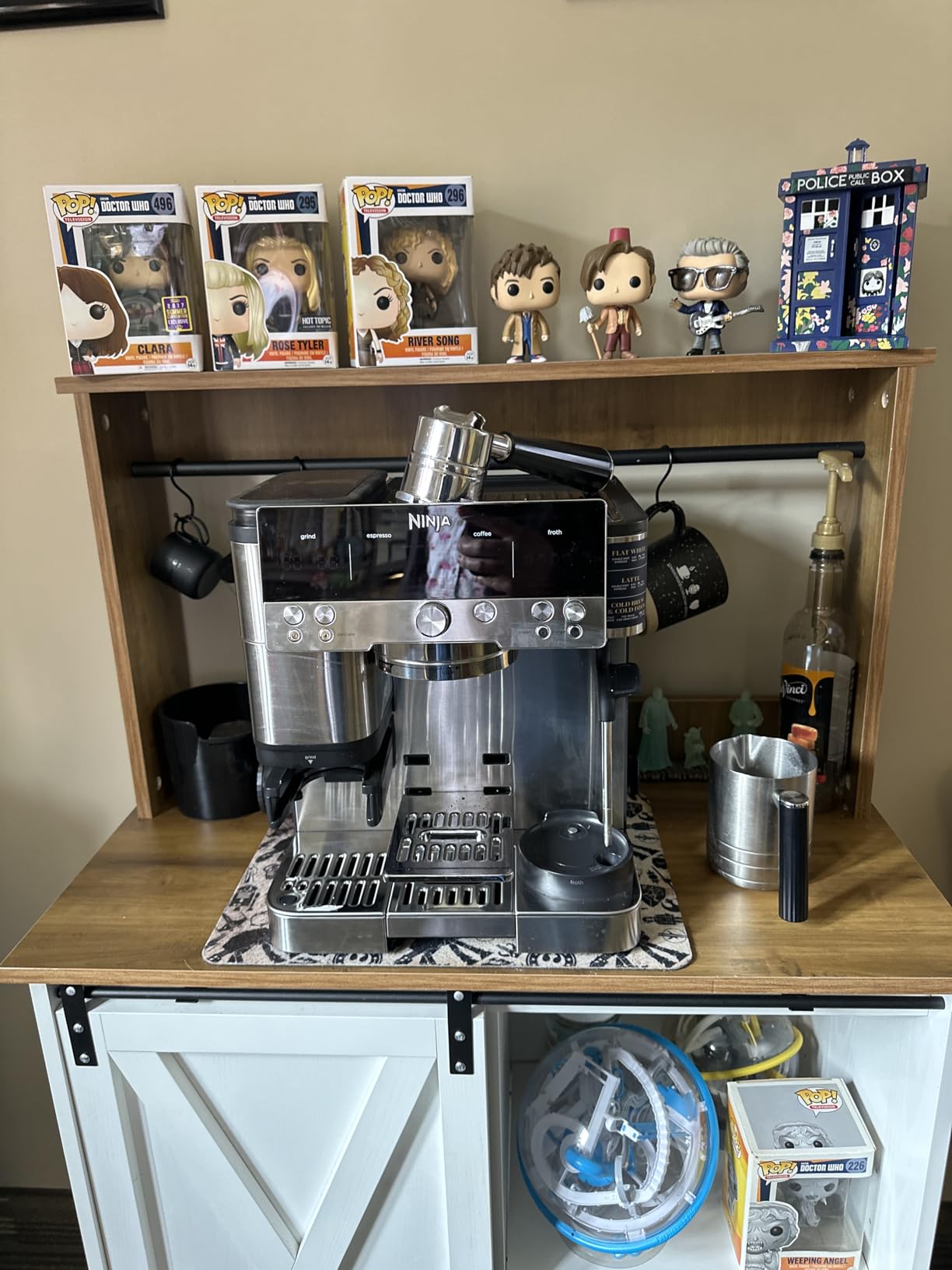
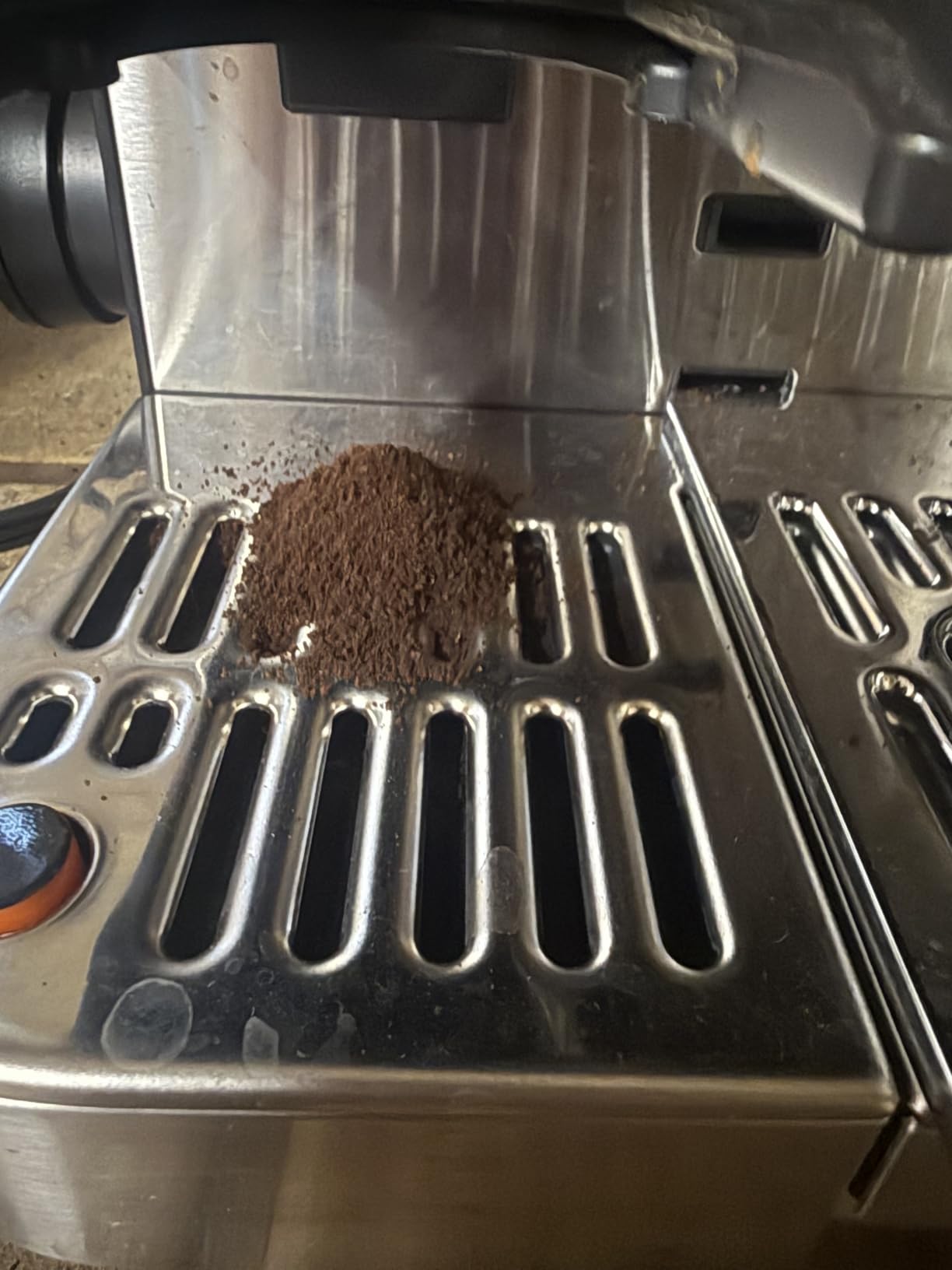
Barista Assist takes over the fiddly work. It grinds, doses to weight and assists tamping, which removes the two hardest parts of learning espresso. Owners report strong reliability across close to two years of daily use.
The compromises are physical rather than electronic. Locking the portafilter takes real hand strength, the wastewater tray is small and fills quickly, and the steam wand both dribbles and has restrictive movement, which makes it a poor choice for someone who wants to practise manual texturing.
How the Ninja Luxe Cafe Premier handles milk
The froth presets are consistent, and the cold foam mode is a genuine gap-filler since the other automatics here only make hot drinks. Thin and thick froth settings cover a flat white and a cappuccino from the same carafe.
This is also the best option in the roundup for someone who wants an iced latte or a cold foam drink without a second appliance. The cold-pressed espresso mode handles the liquid side of that well.
Where it falls short for milk drinks
The manual wand is hobbled by its restrictive swivel and dribbling, so hand texturing is not a realistic path here. A learning curve survives even with Barista Assist, and drip coffee is the weakest of its drink modes.
Vacuuming the burr grinder is a hassle, and the grinder can intermittently under-fill the portafilter, which shows up as an inconsistent shot rather than a milk problem.
5. Gevi 20 Bar with Grinder and Steam Wand – Best Grinder-in-the-Box
Gevi 20 Bar Espresso Machine with Grinder & Steam Wand for Latte Cappuccino
58mm portafilter
30-setting burr grinder
20 bar pump
NTC and PID
16.5 inch tall
Pros
- Built-in conical burr grinder with 30 settings
- 58mm portafilter is the standard brew basket size
- High pressure wand with microfoam and hot water knob
- NTC and PID control steadies brewing and frothing
- Customisable grind duration and shot volume
Cons
- Taller machine than the compact models on this list
- Grinder and manual workflow both need practice
- Dual wall baskets are less forgiving to dial in
Most machines in this price bracket force a separate grinder purchase, which is the hidden cost that resurfaces in almost every home espresso forum. This one has a conical burr grinder built in with 30 adjustable settings, so the box on your counter is the whole setup.
The 58mm portafilter is worth calling out. It is the standard commercial basket size, which means baskets, tampers and accessories bought for other machines often fit. Owners treating it as a mid-range all-in-one is the common reaction.
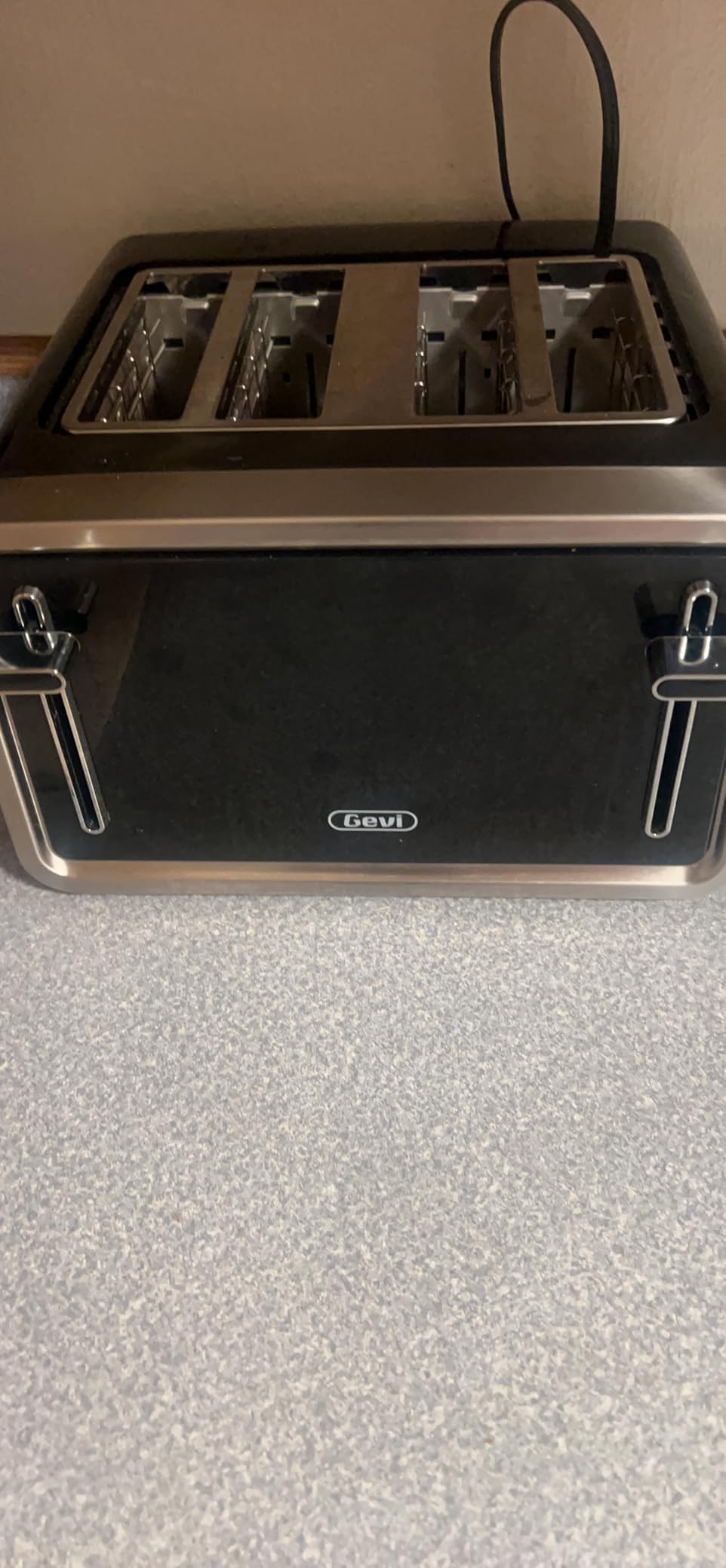
For milk, the dual-function wand knob is the useful detail. One setting gives high pressure microfoam, another switches to hot water for flushing and Americanos, and you are not hunting for a second machine. NTC and PID control together keep the frothing temperature repeatable, which is what stops milk from scorching.
The trade is footprint. At 12 inch deep, 11.5 inch wide and 16.53 inch tall, this is one of the largest machines here. Measure the space above the machine too, because the hopper and grinder need vertical clearance to fill.
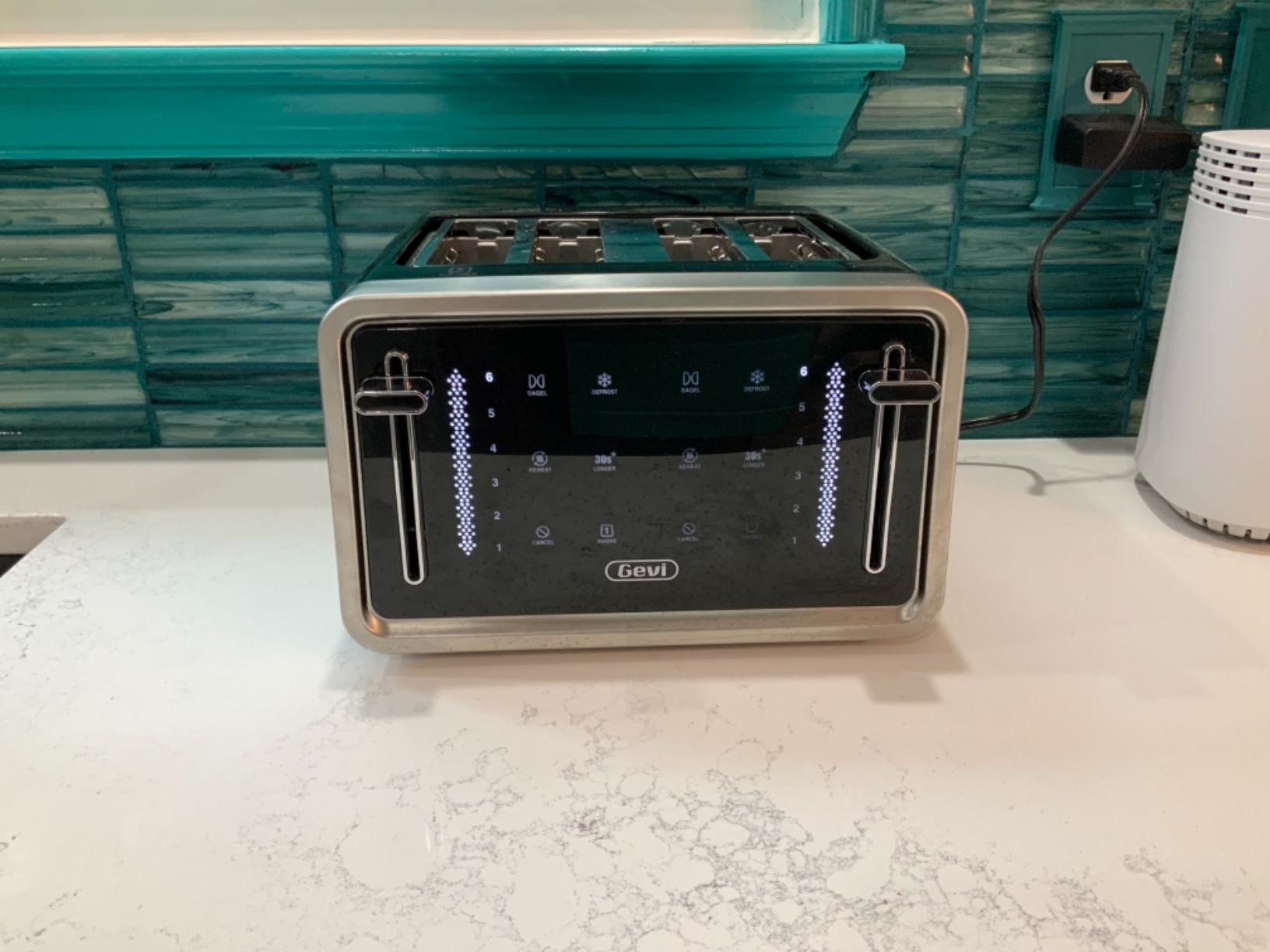
How the Gevi handles milk
The high pressure wand produces microfoam that owners describe as dense and glossy, and the knob-based control between microfoam and hot water makes it easy to purge and clean. Steam recovery is steady enough for a household making several drinks in a row.
Because it is a manual wand on a machine with a real grinder, this is one of only two picks here where you can go from fresh beans to a poured rosetta without changing machines.
Where it falls short for milk drinks
Counter space is the deal breaker for small kitchens, and the grinder needs practice before shots repeat. The dual wall baskets that come with it are less forgiving than the pressurised baskets a beginner would normally start on.
It is a manual machine with a single boiler underneath, so the second drink of the morning still involves waiting for steam recovery.
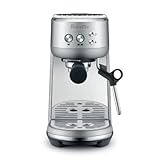
6. Breville Bambino – Fastest Heat-Up for Milk Drinks
Breville BES450BSS Bambino Espresso Machine, Brushed Stainless Steel
ThermoJet 3 second heat-up
Automatic steam wand
PID control
54mm portafilter
10.9 lb
Pros
- ThermoJet reaches brew temperature in about 3 seconds
- Automatic steam wand produces hands-free microfoam
- Compact body suits a small counter
- PID control and pre-infusion support balanced shots
- Includes baskets jug portafilter and tamper
Cons
- No built-in grinder so ground coffee only
- Automatic wand gives less control than a manual one
- Cannot brew and froth at the same time
The Bambino exists to solve a specific problem: not wanting to wait. Its ThermoJet heating system reaches extraction temperature in roughly three seconds, so there is no warm-up ritual before the first milk drink of the day.
Owners of this machine repeatedly describe its steam as basically just as good as more expensive machines for everyday milk texture. That is the honest summary. The wand will not win an award, and for a cappuccino on a workday you will not notice.
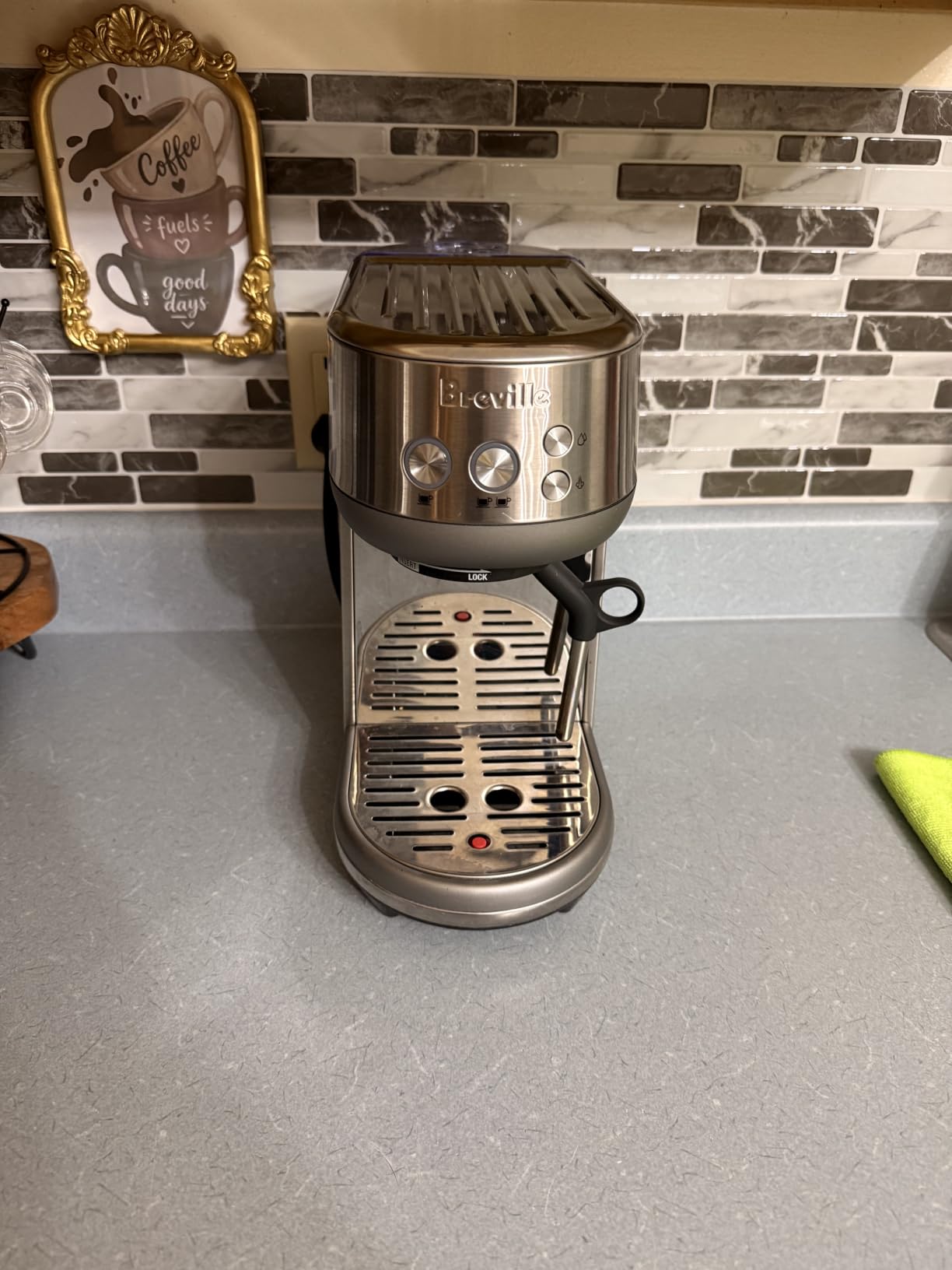
The automatic wand does the texturing, so there is no purge, no stretch and no technique. That makes it genuinely beginner-proof for milk. It is also narrow at 6.3 inch, which matters more for milk drinks than the other dimensions because the wand needs room to swing into a pitcher.
Two things shape the rating. There is no grinder, so you buy ground coffee and lose freshness. And the wand is automatic, which means you cannot pour a rosetta on it. Its 16 percent one-star share is the highest in this group, and the complaints cluster around exactly those two limits.
How the Bambino handles milk
Milk comes out consistently and hot, with a foam texture good enough for cappuccinos. Because the wand is automatic and the machine heats in seconds, a single drink takes under two minutes from button to cup, which is faster than anything else here.
It handles oat milk acceptably. The automatic cycle gives plant milk less agitation than a wand, so the foam is thinner, but nothing fails or separates.
Where it falls short for milk drinks
Automatic means automatic. There is no way to raise the temperature, change the texture or pour art. If your interest in milk drinks goes past a quick cappuccino, this is the ceiling.
It cannot brew and froth at the same time, so a household making four or more drinks every morning will feel the wait repeatedly. A separate grinder is also a required purchase.
7. CASABREWS CM5418 – Narrowest Footprint with a Manual Wand
CASABREWS CM5418 Compact Espresso Machine with Milk Frothing Steam Wand
5.47 inch wide
20 bar pump
Pressure gauge
34 oz tank
8.6 lb
Pros
- Narrow 5.47 inch body leaves real counter space free
- Pressure gauge shows extraction as it happens
- Manual steam wand produces quick silky foam
- Simple to operate and easy to clean
- Many buyers report multi-year reliability
Cons
- No milk pitcher included with the machine
- Must cool down between frothing and brewing
- Plastic tamper and baskets feel cheap
At 5.47 inch wide this is the narrowest machine in the roundup, and for a milk drinker that width matters more than any other single measurement. The steam wand sits at the front of the body, so the pitcher needs clearance in front rather than beside.
It is also one of the few picks where you get a real manual wand at a compact price. The 20 bar pump and the built-in pressure gauge let you watch extraction happen, which is the feedback that helps a beginner learn what a shot should look like.
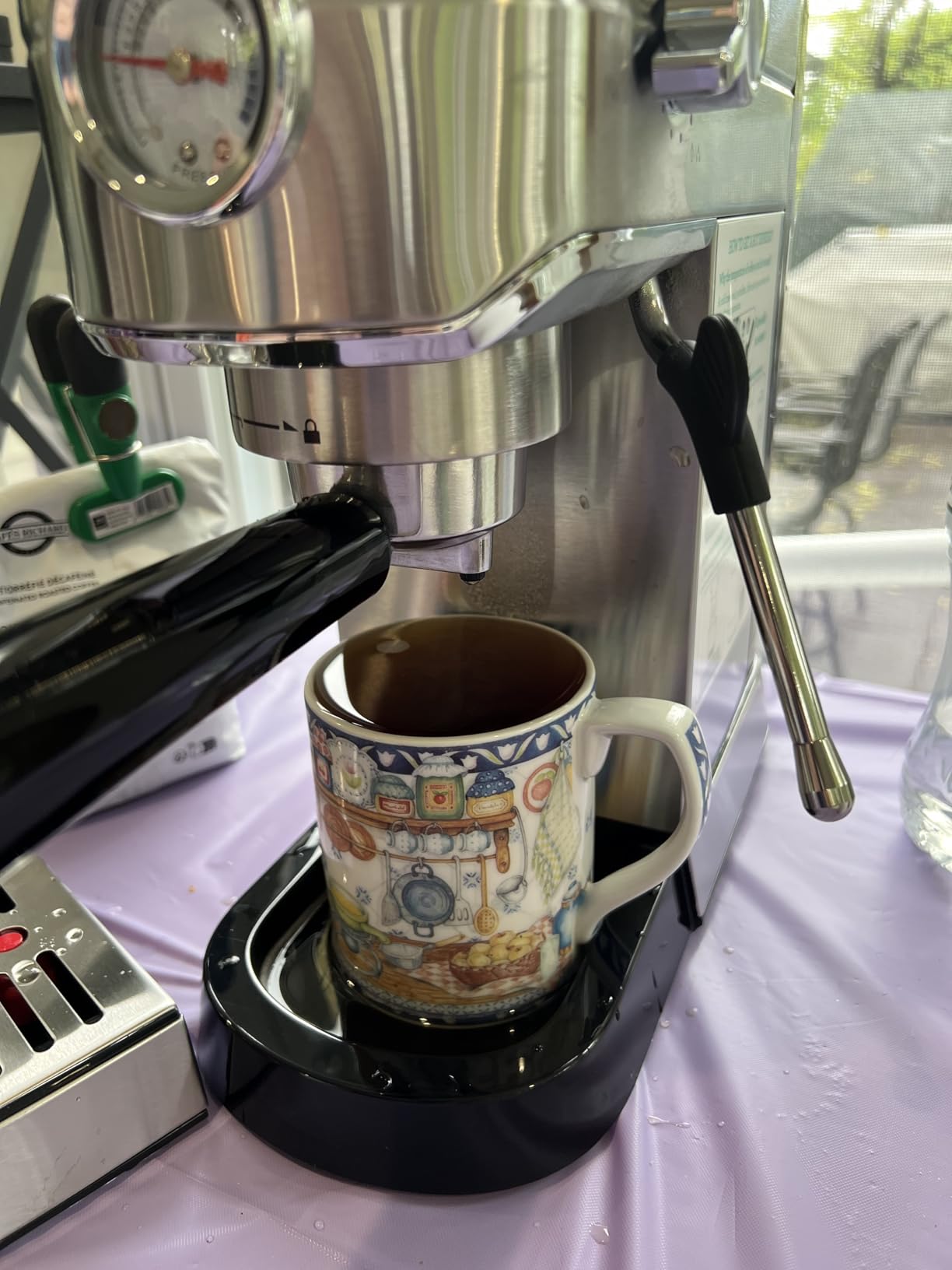
Owners report the wand producing quick, reasonably silky foam for cappuccinos, and many run this machine for years. The stainless body is the right material for a machine that sees water and steam every morning.
The workflow catch is explicit: the machine has to cool down before you can brew again after frothing. On a single-drink routine that is invisible. On a two-person morning where both people want a cappuccino at once, it becomes the deciding factor.
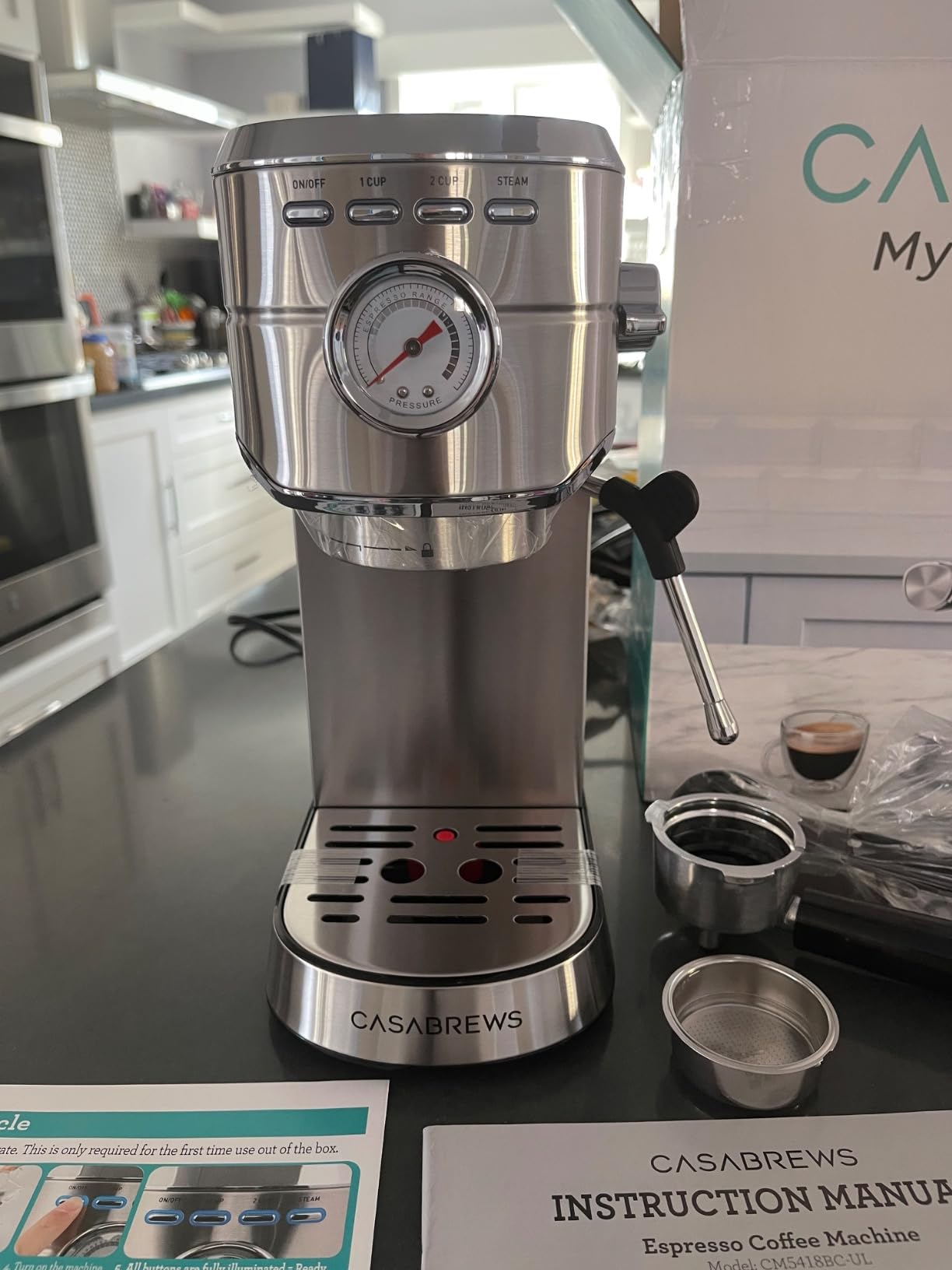
How the CASABREWS CM5418 handles milk
Steam power is good for a machine this size, and the manual wand gives you real control over texture and temperature in a small stainless pitcher. Latte art is achievable with practice, which almost nothing else this narrow can do.
No pitcher is included, so budget for a small stainless one. The wand itself is uninsulated and gets very hot, so use a cloth every time.
Where it falls short for milk drinks
The cool-down requirement is the biggest limitation for multi-drink mornings. The included plastic tamper and baskets are low quality, and a minority of owners reported water leaking from the base of the tank.
It is also noisy and vibrates while operating, and it has no grinder, so ground coffee is a must.
8. AIRMSEN Dual Boiler – Two Boilers Without the Premium
AIRMSEN 20 Bar Espresso Machine with Automatic Milk Frother, Cappuccino & Latte Coffee Maker with Quick Brew Dual Boiler (1350W + 1000W), Stainless Steel, 60oz Water Tank, Touchscreen
1350W brew boiler
1000W froth boiler
Auto milk frother
60 oz tank
Touchscreen
Pros
- Dual boiler separates brewing and frothing heat
- Automatic detachable frother dispenses milk and foam hands-free
- 20 bar pump with pre-infusion
- 60 oz tank means fewer refills
- LED touchscreen makes drink selection simple
Cons
- Milk box needs regular cleaning and manual refilling
- Compact body limits cup height to about 4.1 inches
- Some plastic parts inside a steel shell
Boiler maths is the whole story here. A 1350W extraction boiler and a separate 1000W frothing boiler mean this machine can pull a shot and steam milk at the same time, which is the specification that separates dual boilers from everything cheaper.
Owners report brew times around 15 seconds because the two heat sources never fight each other. For someone making two or three milk drinks in a row, that is the difference between a smooth morning and a queue at the machine.
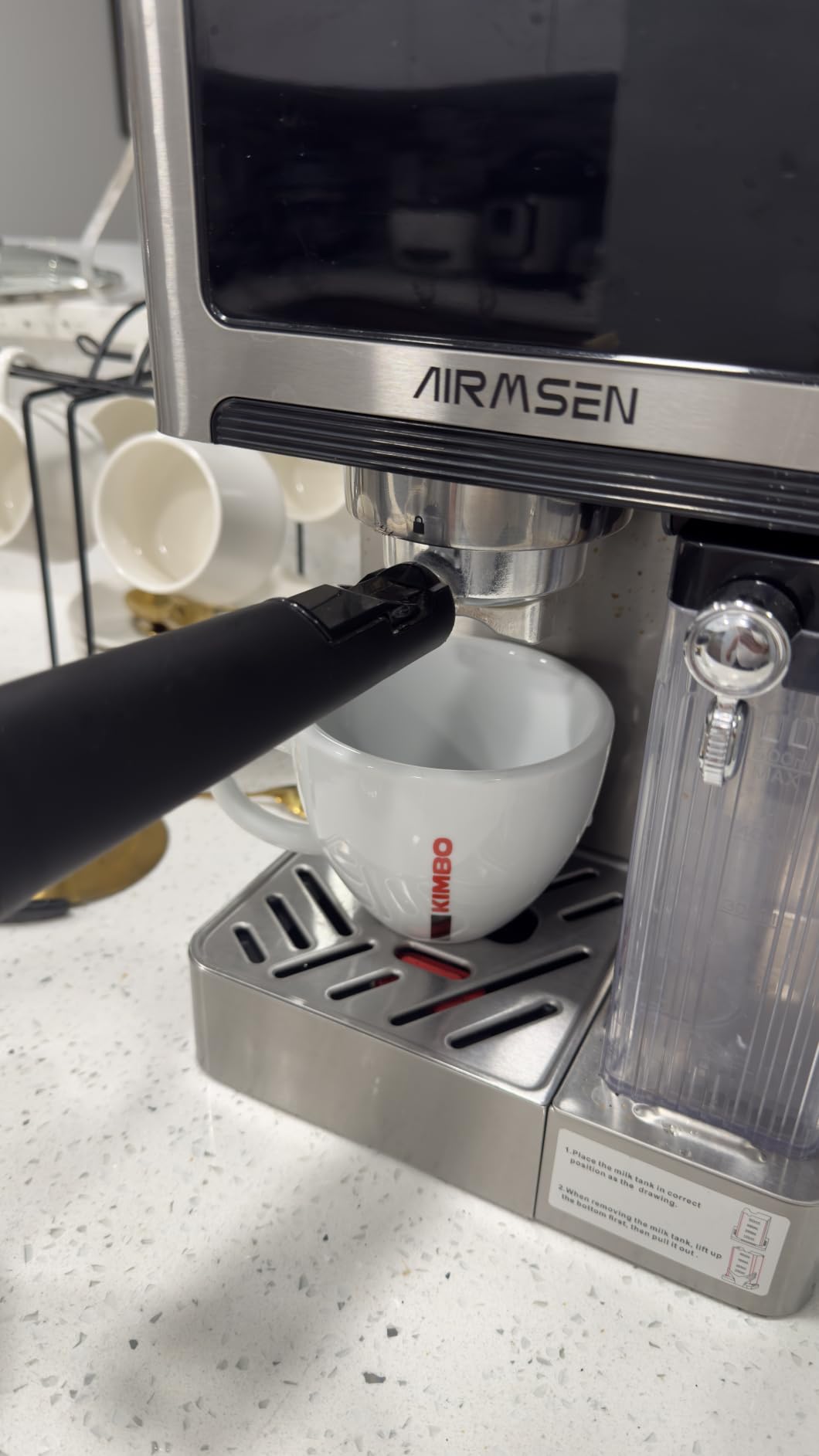
The automatic detachable frother means you press once and get milk and foam together. It handles cappuccinos and lattes without a separate wand step, and the touchscreen makes drink selection straightforward. The 60 oz tank and 17 oz milk reservoir cut down refills too.
The catch is honest: this is a newer listing with 599 reviews, so the long-term record is thinner than anything else on this list. The detachable milk box needs regular manual cleaning and refilling, and the compact body limits cup clearance to roughly 4.1 inches, which rules out tall glasses.
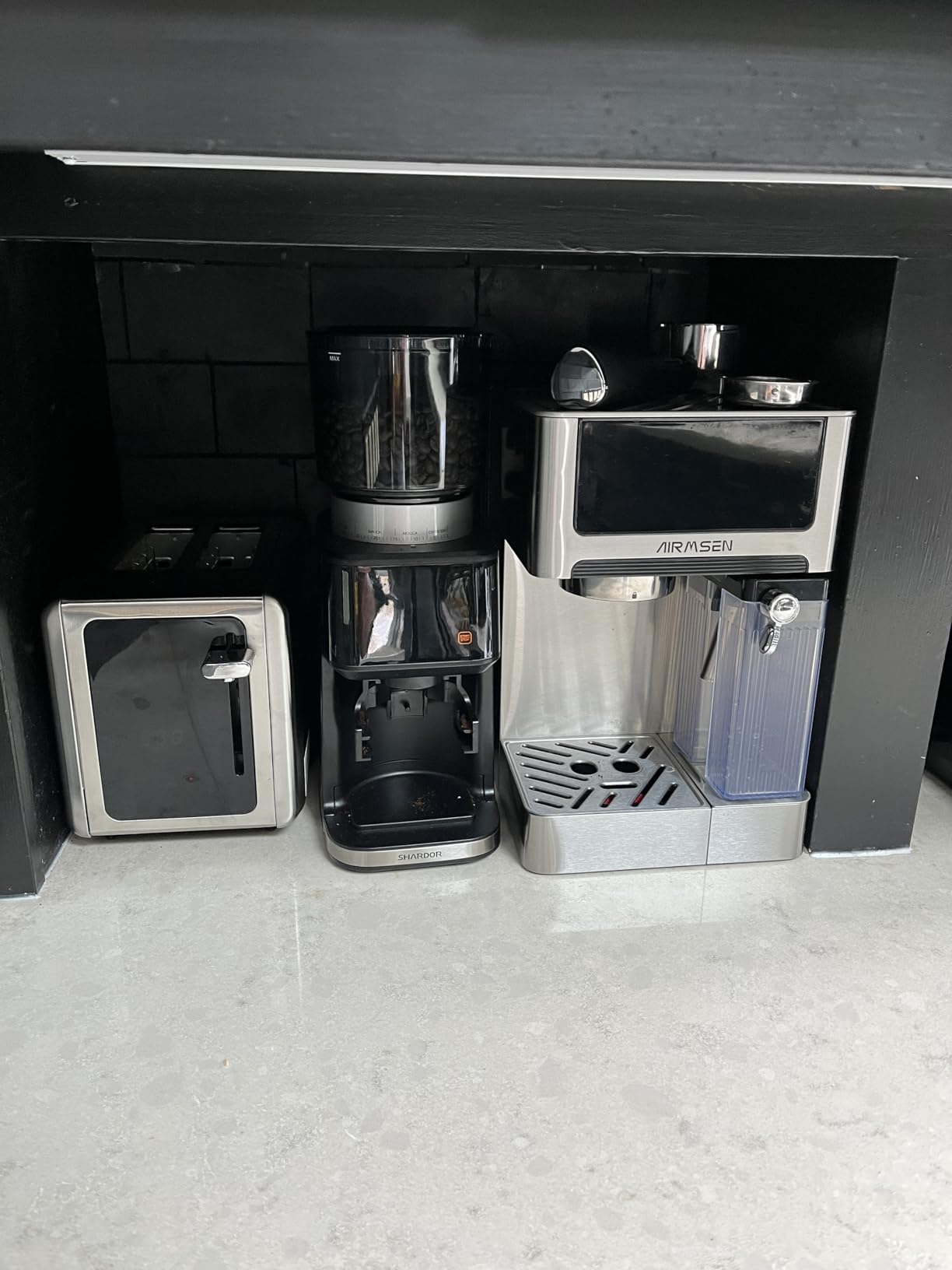
How the AIRMSEN handles milk
The 1000W frothing boiler is a real steam source rather than a shared one, so the wand is not competing with the brew boiler for heat. Milk drinks come out repeatably and quickly, and simultaneous brewing means the second cup is not a wait.
The automatic frother gives you no manual override, so this is a one-touch machine. The dual-function design is what makes the one-touch approach tolerable here, because the drinks arrive at roughly the same pace.
Where it falls short for milk drinks
The detachable milk box is the same cleaning burden as any tube-free carafe, and forgetting it is how milk systems start to smell. There is no manual wand, so no latte art and no temperature control.
Cup clearance rules out tall glassware, and the plastic components inside a stainless shell are a reminder of where this machine sits in the range.
9. Gevi 20 Bar Compact – Best for Hot Water Drinks
Gevi 20 Bar Compact Espresso Machine for Home,Latte、Cappuccino Coffee Maker
20 bar pump
Removable froth nozzle
Hot water dispenser
8.6 lb
NTC control
Pros
- Powerful steam wand with a removable froth nozzle
- 20 bar pump with gauge and pre-infusion
- Automatic single and double shot metering
- Hot water function covers Americanos tea and cups
- Compact stainless body suits small countertops
Cons
- Machine powers down after frothing so the next shot waits
- Cup warmer does not keep cups warm
- Small portafilter means reloading every two shots
Most people ordering a latte want a long black afterwards, and this machine has a dedicated hot water dispenser for exactly that. The same wand knob or separate outlet handles the water, so an americano never means picking up a kettle.
The removable froth nozzle is the detail that decides this machine for milk. It unscrews, so milk residue rinses out in seconds instead of sitting in a fixed tip until it blocks.
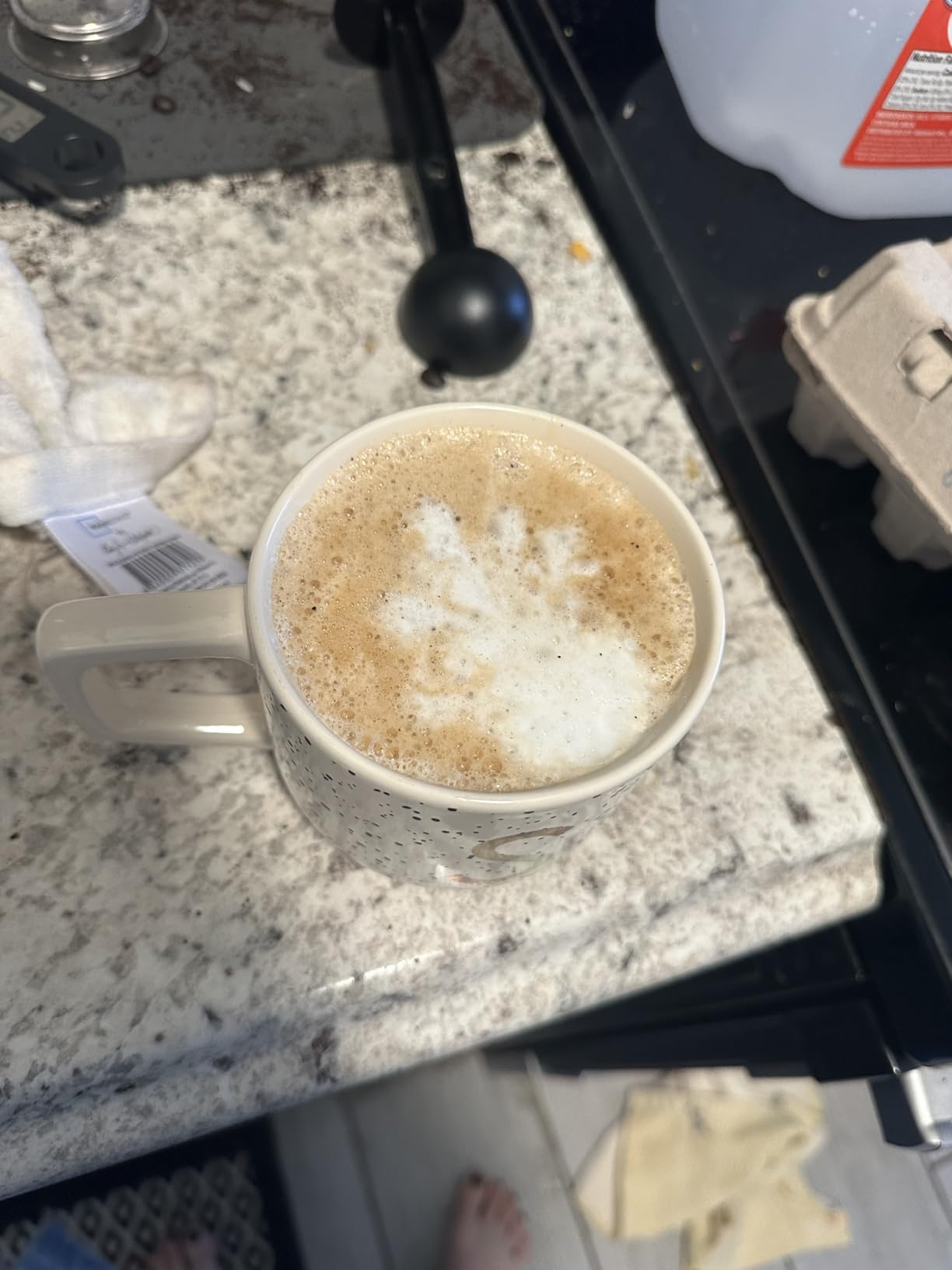
Automatic shot metering handles dosing for you, with manual pump mode available when you want to experiment. The 20 bar pump, pre-infusion and built-in gauge give a thick, even crema, and buyers commonly describe the result as cafe-level for what it costs.
The pattern that catches you is that the machine powers down after frothing, so the next shot waits for it to come back. A recipe scale becomes necessary if you batch. The stainless finish also shows fingerprints, and the small portafilter holds only two shots at a time.
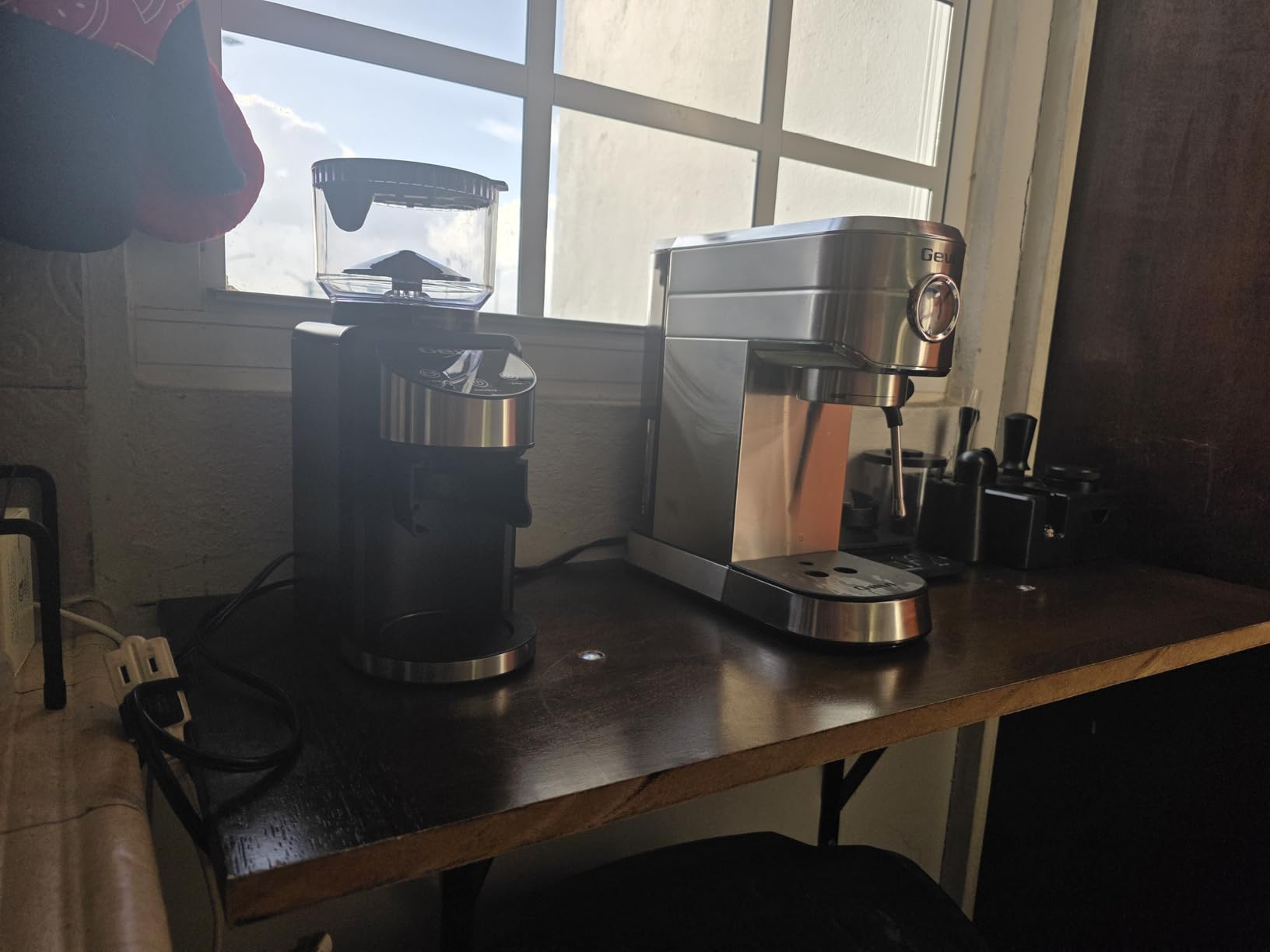
How the Gevi Compact handles milk
Steam power is strong for a compact 8.6 pound body, and a manual wand means you control texture and temperature yourself. This is a real microfoam wand, so latte art is on the table if you want it.
It is a single boiler underneath, though, so the same recovery wait applies as with other compact manual wands. The nozzle that unscrews for cleaning is the difference that makes it easier to live with than most machines this size.
Where it falls short for milk drinks
Waiting after every frothing session is the main complaint, and it becomes irritating above two drinks a morning. The included plastic tamper is worth replacing with a metal one immediately.
There is no grinder, ground coffee only, and the cup warmer on top does not actually keep cups warm, which is worth knowing before you plan a warming shelf routine.
10. atatix 20 Bar – Best Guided Starting Point
atatix Espresso Machine with Milk Frother, 20 Bar Pressure Espresso Maker
20 bar system
NTC preheat 30 sec
Auto and manual modes
7.5 lb
45 oz tank
Pros
- 20 bar system holds 9 to 10 bar through the shot
- NTC temperature control preheats in about 30 seconds
- Steam wand produces dense glossy microfoam
- Manual extraction mode for custom shot strength
- Compact quiet and stable on silicone feet
Cons
- Instructions are thin for first time owners
- Double basket holds less than advertised
- Steam wand technique still takes practice
This is the one to consider if you want a manual wand and someone to hold your hand through the first month. Automatic extraction pulls a 28 second single and a 42 second double, so the shot does not depend on you judging when to stop the pump.
Manual mode runs up to 102 seconds for 180 to 350 grams, which is where a beginner starts learning to taste the difference. NTC control preheats in around 30 seconds, and the 20 bar system holds 9 to 10 bar through the shot.
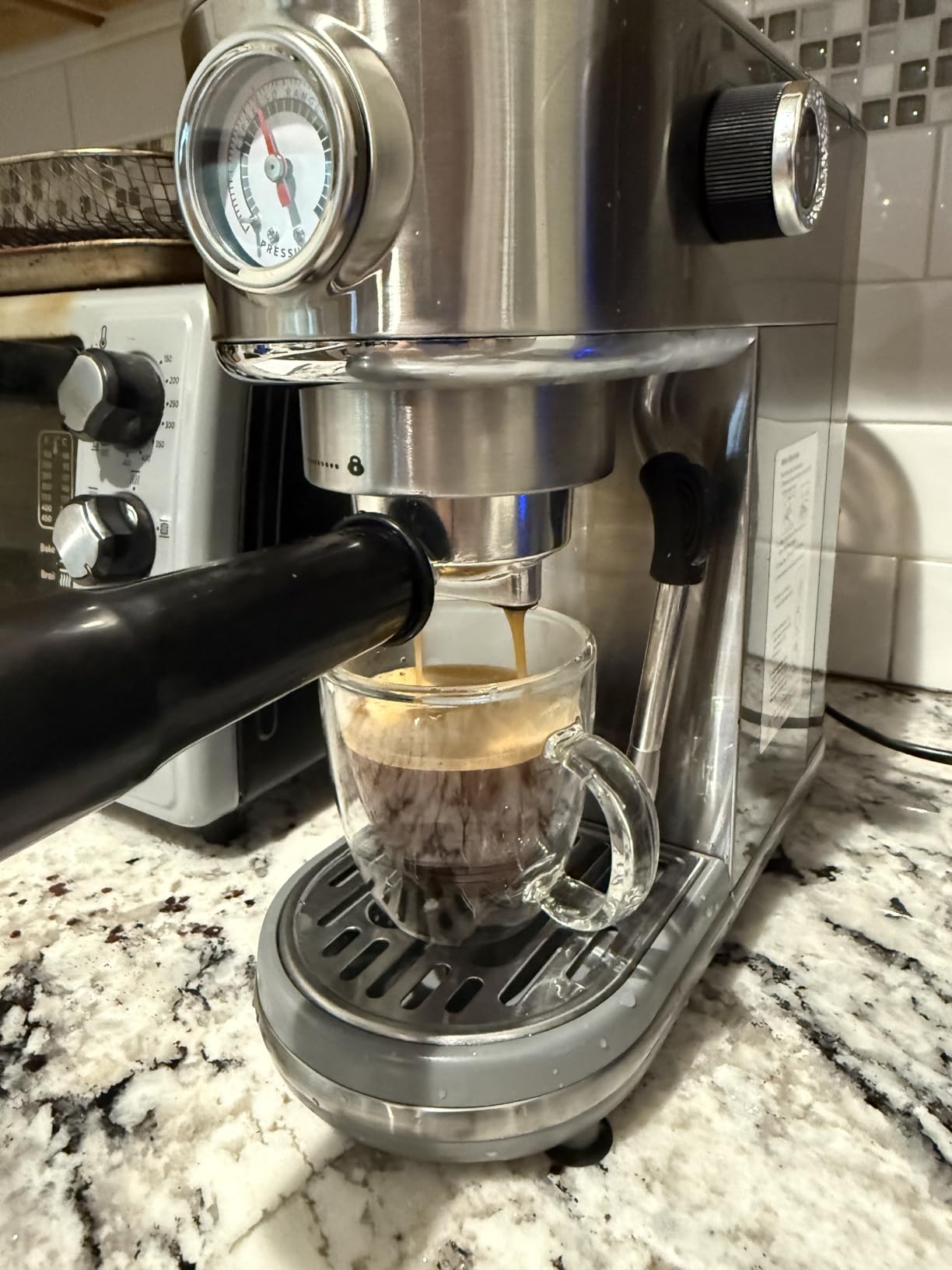
For milk, reviewers single out the wand as producing dense, glossy microfoam suitable for latte art, which is more than most machines in this bracket can claim. At 7.5 pounds and 12 by 5 by 11 inches, it is also one of the quietest and most stable machines here.
Buyer feedback is overwhelmingly positive and newer, with 1019 reviews behind it. The weak points are documentation and basket capacity rather than any milk system issue, and the wand still rewards practice.
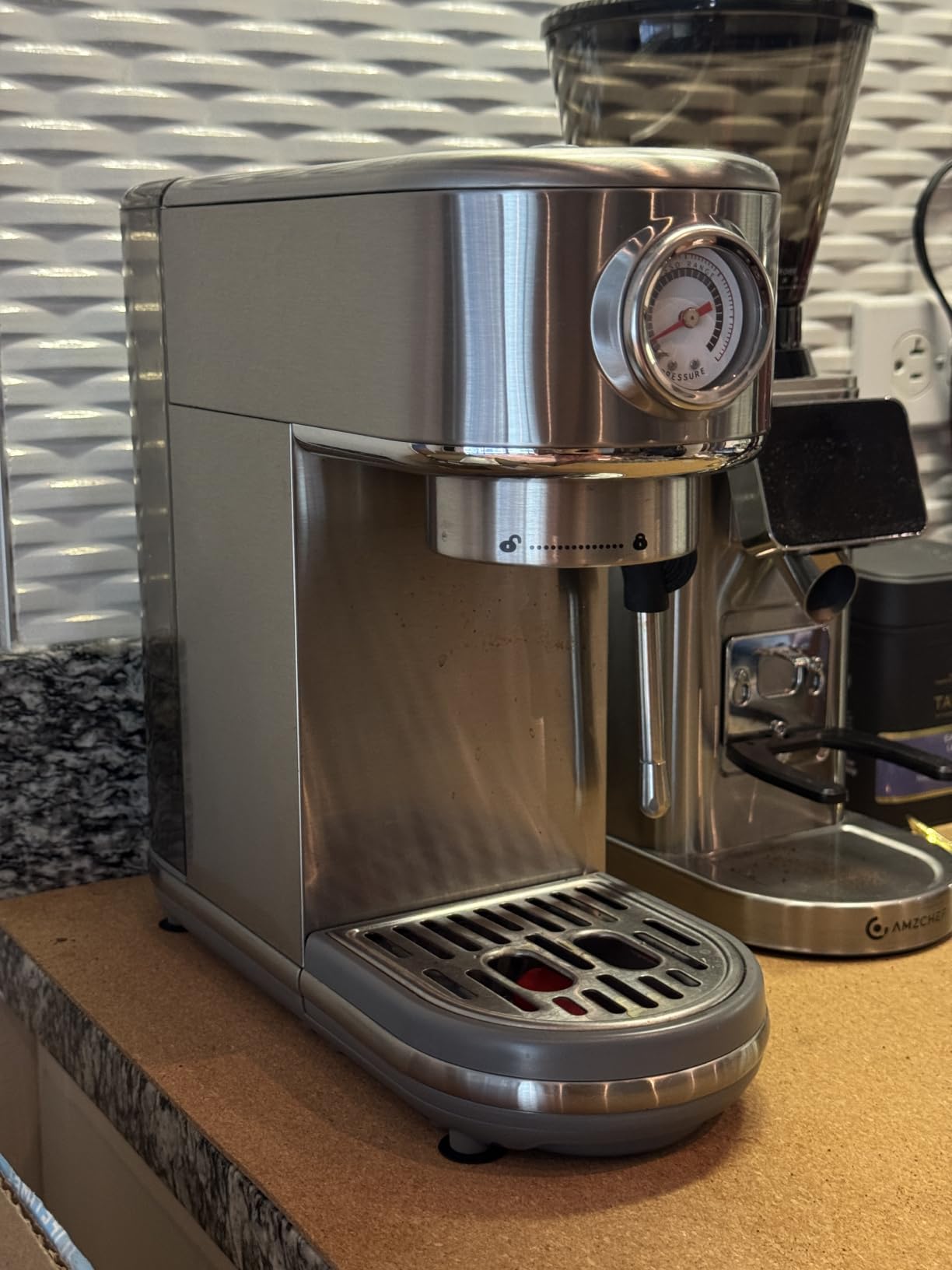
How the atatix handles milk
The steam wand is strong enough for a proper vortex and gives dense microfoam, so texture and temperature stay under your control. It is one of only a few picks here where a beginner can realistically practise pouring with.
It is also a quiet machine, which matters if you make drinks before other people are awake. The removable water tank and drip tray make the nightly clean quick.
Where it falls short for milk drinks
It is a single boiler, so the second drink of the session waits for recovery. Thin documentation makes the first few attempts harder than they should be, and the double basket holds less than the listed dose.
The body is ABS and stainless rather than all metal, and there is no integrated grinder, so you are buying pre-ground coffee.
11. De’Longhi Classic Signature – Two-Setting Wand, 9 Pound Body
De’Longhi Classic Signature Espresso Machine, Adjustable Milk Frother
9 lb body
Thermoblock heat-up
Two-setting wand
Pressure gauge
9 inch wide
Pros
- Lightweight and compact body for a small counter
- Thermoblock reaches brewing temperature quickly
- Adjustable two-setting wand covers milk to microfoam
- Pressure gauge makes extraction easy to read
- Removable tank and portafilter are easy to clean
Cons
- Lightweight mostly plastic construction
- No built-in grinder so ground coffee only
- Steamer starts foaming before milk is fully hot
At 9 pounds and 9 inch wide, this is the machine that fits a counter with a kettle already on it. De’Longhi is the name that shows up most often in owner discussions recommending a machine to newcomers making milk drinks, and the reason is the wand.
The two-setting steam wand is the point. One position is for heating milk, the other for microfoam, which removes the single most common beginner error of accidentally foaming milk you meant to heat.
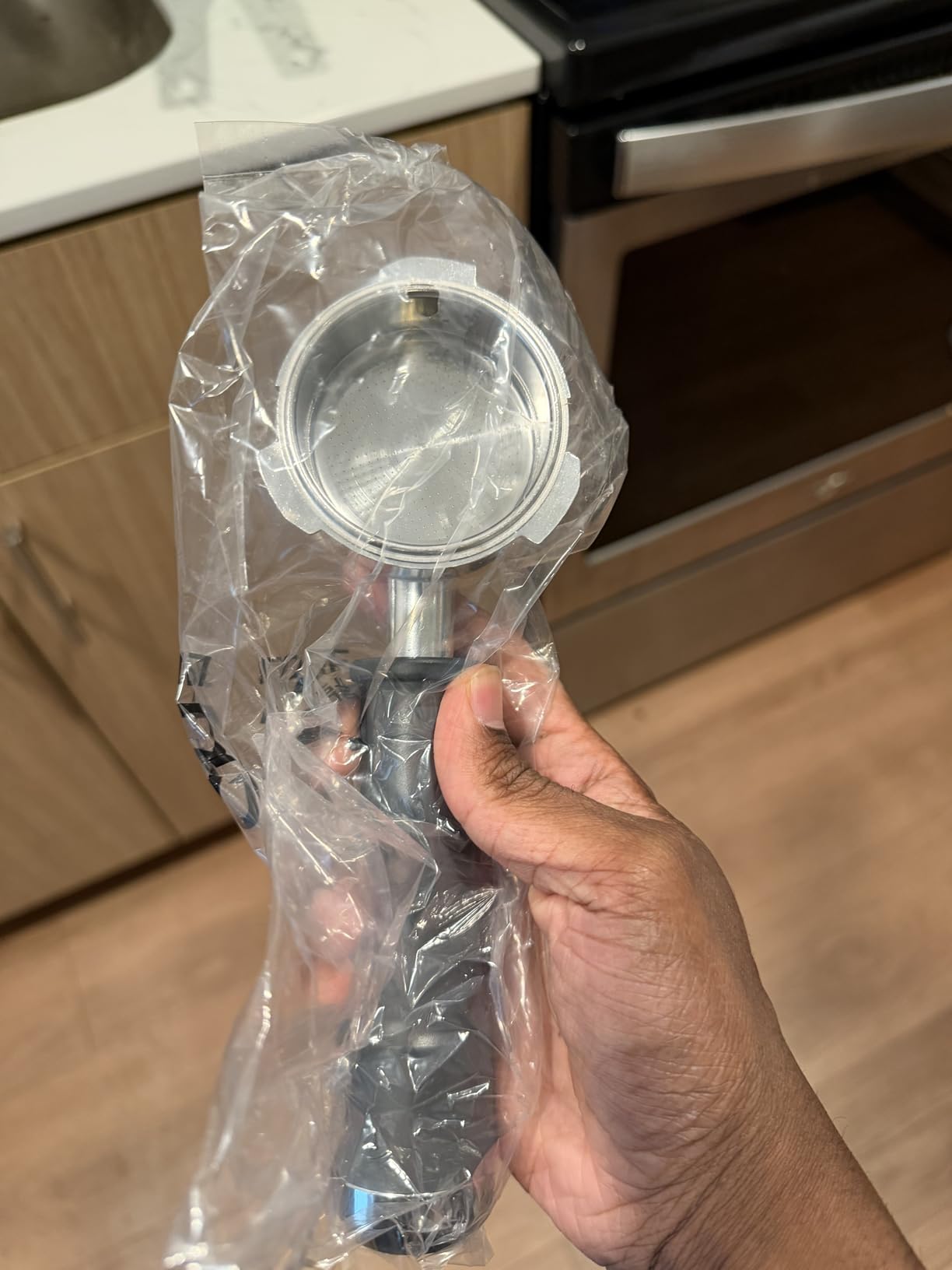
The thermoblock heating system is fast and stable, and the pressure gauge makes the shot visible so you can dial in by what you see rather than by feel. Buyers treat it as a capable starter that produces consistent espresso with good crema.
The main criticism is that the group head runs cooler than some users would like, which can leave extraction slightly light. The mostly plastic construction is the other recurring note.
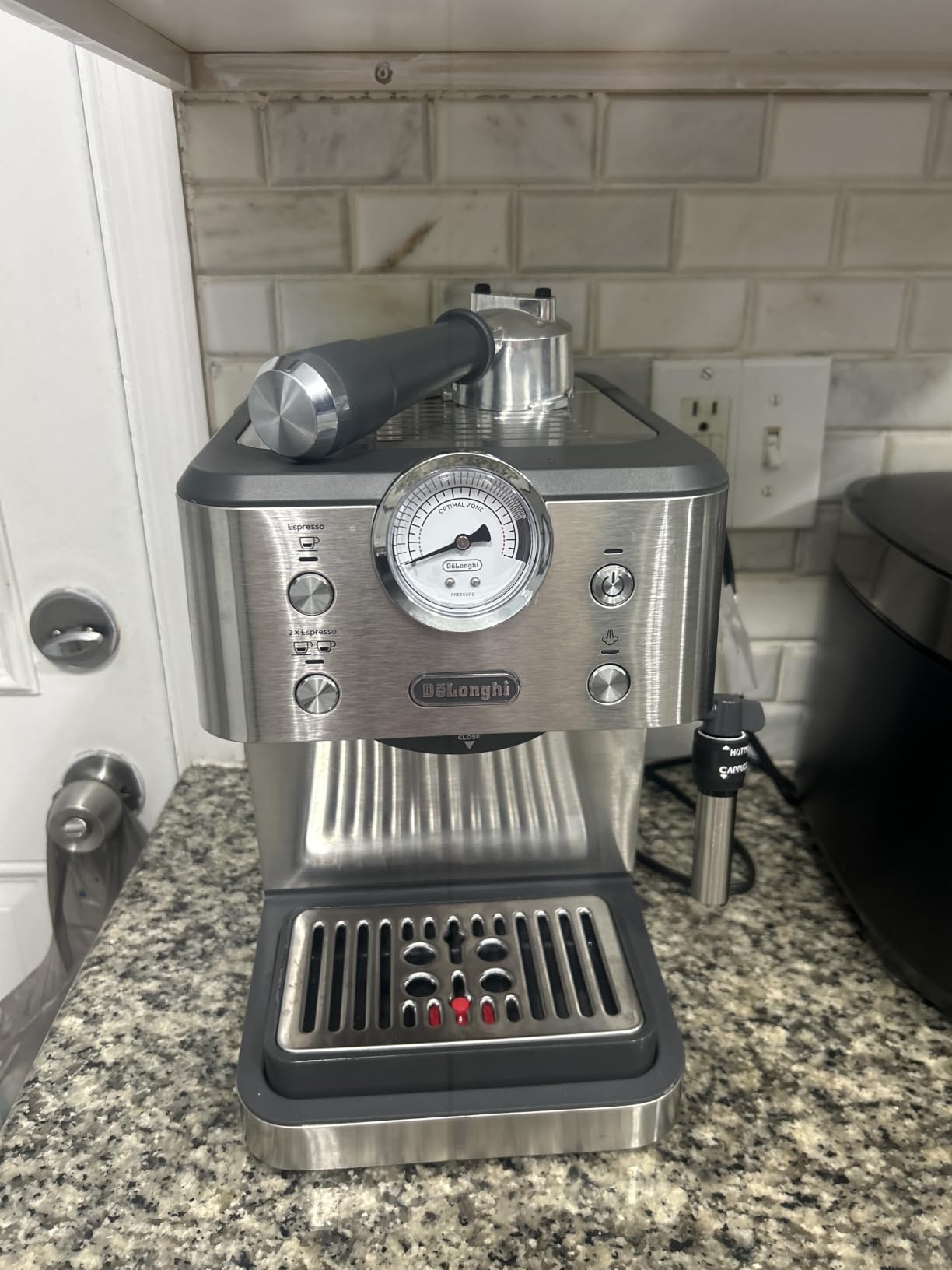
How the De’Longhi Classic handles milk
Two wand settings means you can heat milk for a flat white without creating foam, then switch to microfoam for a cappuccino. That single feature does more for drink quality than the wattage figure on the box.
Steam is adequate rather than forceful, so a large latte takes a little longer than on a big wand. The included plastic tamper is weak and worth replacing with a metal one.
Where it falls short for milk drinks
Owners report the steamer starting to foam before the milk is fully hot, which is a temperature control issue rather than a technique one. The wand also gives you no fine control, so latte art is limited.
There is no grinder, and the machine makes espresso-sized volumes only, not a full mug of coffee. It also has a separate cup of hot water rather than a dispenser.
12. SHARDOR 20 Bar Touchscreen – Lowest Entry Point
SHARDOR Espresso Machine 20 Bar, Professional Espresso Machine with Milk Frother and Touchscreen, Expresso Coffee Machines with Adjustable Temperature,for Cappuccino, Latte, Stainless Steel, Silver
20 bar pump
NTC 3 settings
Touchscreen
8.5 lb
45 oz tank
Pros
- Rated 4.4 stars with 76 percent five star feedback
- Lowest entry point in this roundup with a real steam wand
- LED touchscreen covers shots steam and descaling
- NTC temperature control with three selectable settings
- Two year manufacturer warranty
Cons
- Smaller review base than the established models
- Descaling is needed periodically to keep brewing normally
- Cup warmer needs a completely dry cup
This is the cheapest way into a machine with a genuine professional steam wand, and its 4.4 star rating is the highest in the roundup. The touchscreen is unusual at this level, covering single and double shot, manual mode, steam and the descaling cycle from one panel.
For milk drinks, the wand is the reason to look here. It produces cappuccinos, lattes and macchiatos, and NTC temperature control with three settings gives you some control over how hot the milk goes.
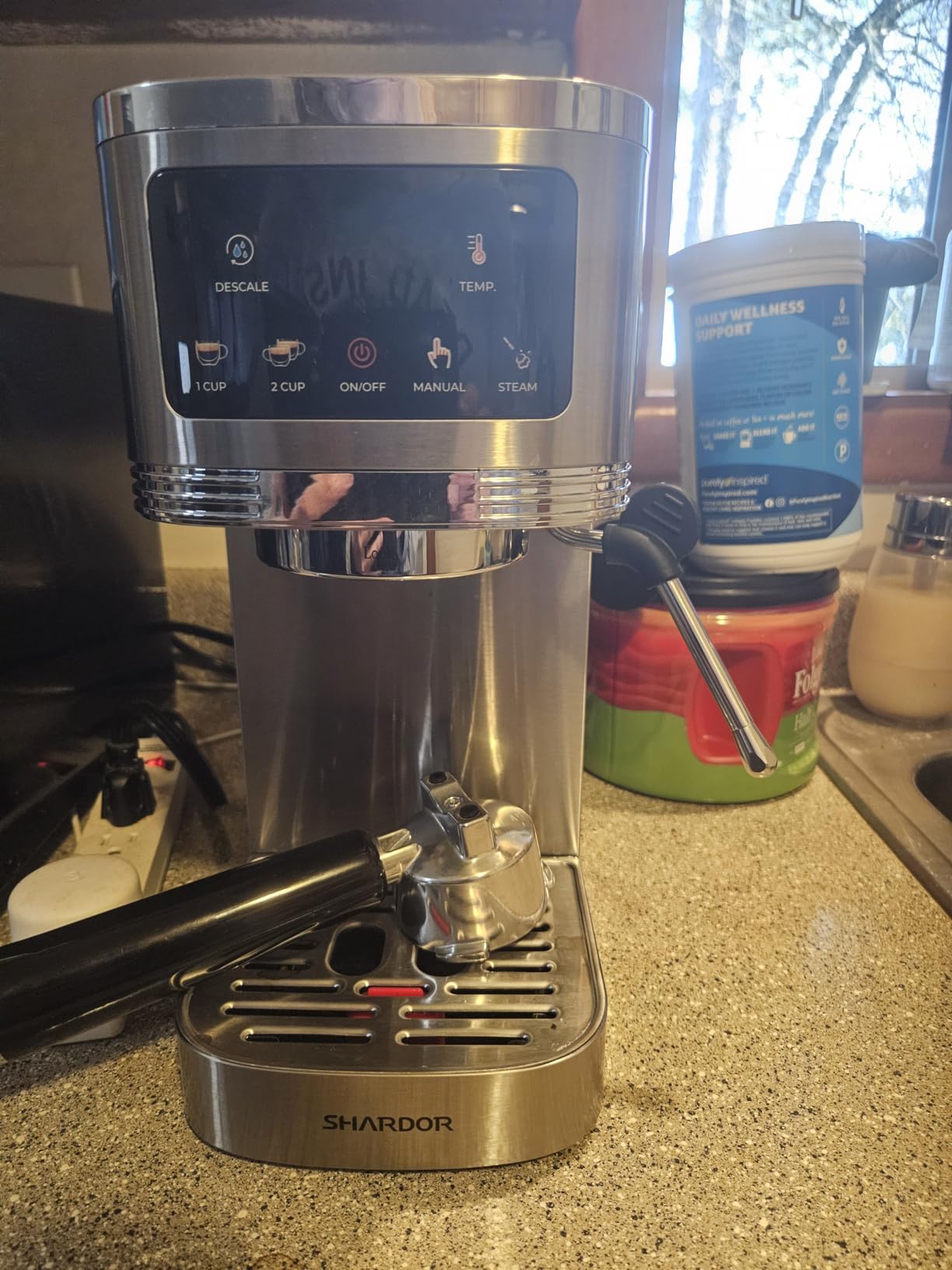
The stainless body and 45 oz removable tank keep the maintenance routine straightforward, and the two year manufacturer warranty is longer than most machines in this roundup. The 5.12 inch width also makes it one of the narrower options.
The obvious caveat is a 425 review base, which is thin next to the 27,000 behind the Barista Express. The machine also needs periodic descaling to keep brewing normally, and the cup warmer only works on a completely dry cup.
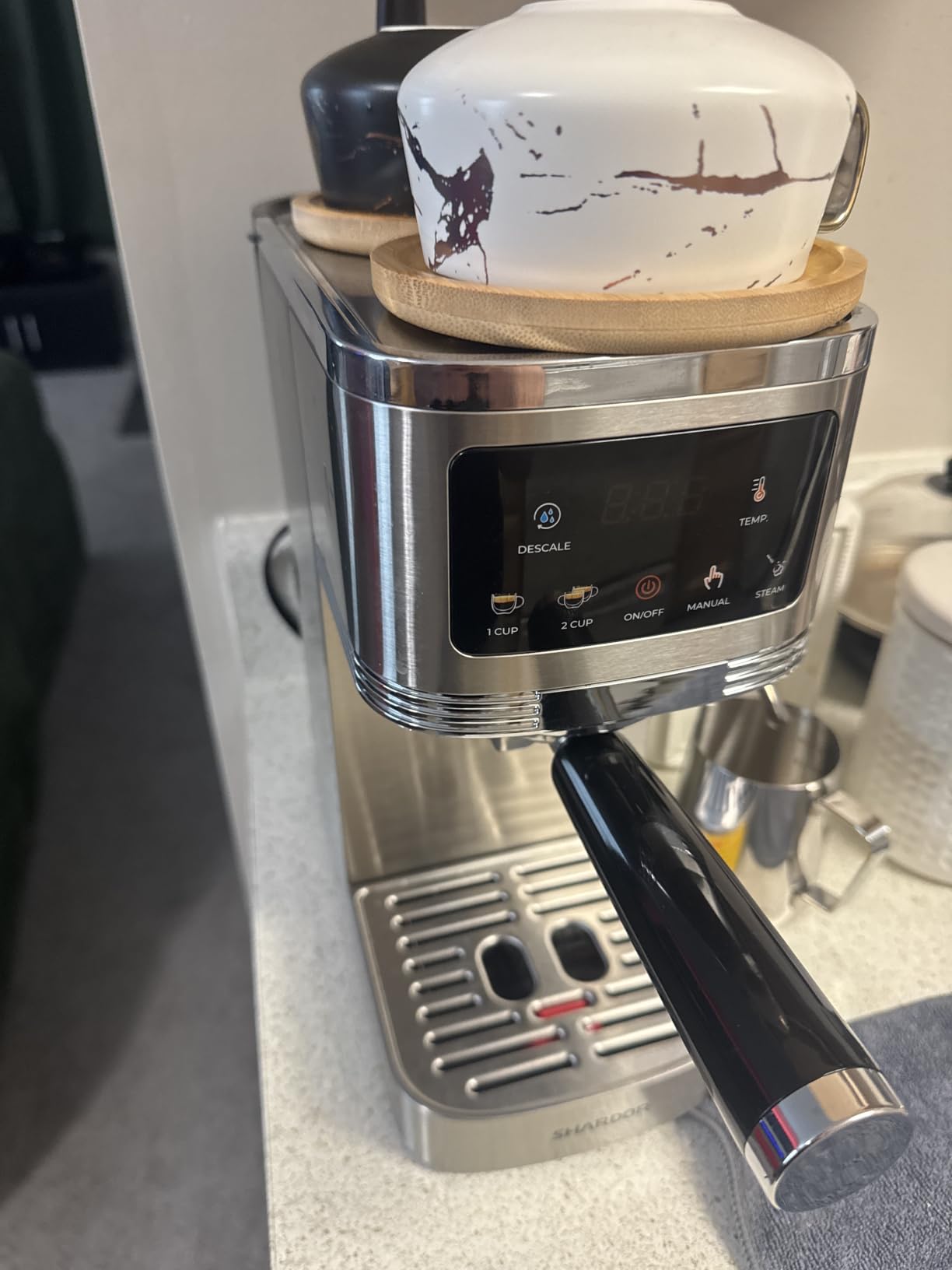
How the SHARDOR handles milk
The wand gives you manual texturing, so temperature and texture are yours to set rather than a machine’s to guess. Steam power is adequate for a small pitcher, and the three NTC settings let you trade speed against temperature control.
It is a single boiler machine, so the second milk drink of a session waits for recovery. Ground coffee only, with no grinder in the box.
Where it falls short for milk drinks
Low review volume means long-term reliability is not yet established, so expect some uncertainty past year two. Descaling has to stay on your calendar or the temperature drifts.
There is no auto frother at all, which is a problem if you want a hands-free morning, and the cup warmer behaviour is a small ongoing annoyance.
Choose Your Milk System First
Everything else on the machine is secondary to this decision, because the milk system sets how much work your morning involves. There are three families here and the one you pick determines whether you are pouring by hand or pressing a button.
A manual steam wand gives you a metal tip, a pitcher and a technique. You control temperature by touch, texture by how hard you stretch, and volume by how long you hold the pitcher under the tip. It is the only option that leads to latte art, and it is the only one you can use to heat milk without making foam.
An automatic steam wand or automatic milk box does the same job in one press. You get consistency, you get speed, and you get a cleaning routine you cannot skip. The AIRMSEN and the Mr. Coffee Cafe Barista are the clearest examples in this roundup.
A carafe system, best represented by the Philips LatteGo, is the one to pick if cleaning is what stops you drinking milk drinks. No tube runs back into the machine, so the clean is a rinse and a wipe rather than a disassembly. The cost is that you give up all texture control.
How Many Milk Drinks Do You Make Each Day?
Boiler architecture exists to solve one problem: what happens when you want a second drink before the first is finished. The number of milk drinks you make is the most useful number to know before you buy anything.
One drink a day changes nothing. A thermoblock or fast single boiler machine is fine, because the recovery wait never becomes a queue. The Breville Bambino and the De’Longhi Classic Signature both suit this pattern well.
Two or three drinks a day is where a single boiler starts to annoy. You will wait for steam recovery between drinks, which the CASABREWS and the Gevi Compact owners describe directly in their reviews. A fast-recovery thermoblock design, or a machine with a dedicated frothing boiler, removes the pause entirely. The AIRMSEN is the cheapest example of the dedicated boiler approach here.
Four or more drinks a morning means two people drinking simultaneously. Now simultaneous brewing and steaming is not a luxury, it is the requirement. Look for two boilers or a thermoblock plus separate steam capacity, and buy a machine with a tank big enough not to refill mid-session.
Ten or more a day moves you into office and shared-appliance territory, where a carafe system wins on maintenance time rather than on drink quality. Machines like the Philips 3300 with LatteGo are built for volume because a thirty second clean keeps the machine usable between users.
Dairy vs Plant-Based Milk
Dairy and plant-based milk do not behave the same way under steam, and this is the detail most espresso guides skip entirely. Whole milk has about 3.5 percent fat and the highest natural protein of the common alternatives, so it stretches into glossy microfoam fastest and holds it longest.
Oat milk is the best plant-based option for texturing. It has a similar protein profile to dairy and forms a stable, latte-art-friendly foam, provided the wand gives it long enough to be agitated. Under a manual wand, oat behaves almost identically to dairy.
Soy is the second-best choice and produces finer bubbles than oat at a lower volume. Almond is the hardest, because its low protein and low fat make it difficult to build any lasting foam without a stabiliser. If your kitchen runs on almond, lean towards a wand with real steam power rather than any automatic cycle.
Automatic carafes change this ranking. A spinning or fixed automatic cycle gives plant milk far less agitation than a wand, so oat comes out thinner than a barista would make it. Dairy is what the factory presets are tuned for, and the Philips 3300 lets you raise the froth setting on My Coffee Choice to compensate.
Keeping the Milk System Clean
Milk is the most demanding thing you put in an espresso machine. It sits at temperature, it deposits protein and sugar, and once it dries it becomes a smell that will not leave the machine. Every system here needs a different amount of attention.
A manual wand needs a purge before and after every session, a wipe with a damp cloth immediately after texturing, and a full clean of the tip holes at the end of the week. Two minutes a day. Owners who skip this are the ones describing wand performance that suddenly got worse.
A carafe system needs the least. Rinse the chamber, wipe it, put it back in the fridge. Because there is no tube, there is no hidden milk film to go off, and that is why the LatteGo design keeps earning praise from owners of competing machines.
An automatic frother sits in the middle and is where most people fall down. Reviewers repeatedly describe skipping the disassembly because it is annoying, and then wondering why the machine tastes off. Clean the milk path every day, run the cleaning cycle when the indicator tells you to, and descale on the schedule the machine reports rather than the one you hope for.
One habit covers all three systems. Do not leave milk sitting in any component overnight. Empty, rinse and refrigerate immediately, and a lot of the maintenance complaints in this category never happen.
The 4 Specs That Decide Milk Performance
Boiler type decides how many drinks you can make in a row. Single boiler switches between brewing and steaming. A heat exchanger or thermoblock recovers faster. Dual boilers do both at once. For milk drinks, this is the first number to look at.
Steam recovery time is the decisive spec and almost nobody publishes it. It is how long the boiler takes to refill and re-pressurise after you draw steam, and it is the reason the second latte is slower than the first on most compact machines.
Wand control and tip size decide what kind of foam you can make. A four-hole tip splits air faster and gives finer texture, while a two-hole tip gives you more control over flow. An automatic wand gives you neither, and that is a deliberate trade rather than a flaw.
Warm-up time decides your mornings. The Bambino reaches temperature in about three seconds on ThermoJet, thermoblock machines take a short while, and a traditional single boiler can take a full half hour. If you are the first person up, that difference is felt every single day.
Frequently Asked Questions
What is the best espresso machine for making milk drinks?
The Breville Barista Express is the best all-round choice. Its 1600W system drives a manual steam wand hard enough for glossy microfoam, and owners rate it 4.4 stars across more than 27,000 reviews. If you want zero technique instead, the Philips 3300 with its tubeless LatteGo carafe cleans up in seconds and makes milk drinks from one touch.
Which coffee machine is best for making lattes?
For lattes, look at steam power and recovery time rather than the price tag. The Breville Barista Express leads on control, the AIRMSEN has separate brewing and frothing boilers so drinks come in sequence without a pause, and the Mr. Coffee Cafe Barista makes a serviceable latte with one button press and no technique at all.
Is a steam wand better than an automatic milk frother?
It depends on what you want. A manual wand gives you temperature control, the ability to heat milk without foam, and the only realistic route to latte art. An automatic frother gives you the same drink every time with no technique, at the cost of a nightly cleaning routine and zero control. Most people who drink one milk drink a day prefer automatic; anyone practising pouring prefers a wand.
Can you put milk through an espresso machine?
Yes, but only through a system designed for it. Milk is either steamed by a wand you hold, dispensed by an automatic frother, or drawn into a drink by a carafe. You never pour milk into the group head, and a carafe system such as the Philips LatteGo will not heat plain milk on its own because it has no steam-only mode.
Is the Breville Bambino good enough for lattes and cappuccinos?
Yes for everyday drinks, no for pouring. Its automatic steam wand produces hands-free microfoam in about two minutes from button to cup, and owners describe its steam as basically as good as larger machines. What you give up is manual control, the ability to brew and froth at the same time, and any route to latte art.
Do I need a dual boiler to make latte art?
A dual boiler is not required, but it removes the biggest obstacle. Single boiler machines force you to brew first, wait for steam recovery, and then texture, so you are rushing the pour. Two boilers let you pull the shot and steam milk at the same time, which is what gives you a steady pitcher and a calm pour.
How often should I descale an espresso machine with a milk system?
Follow the machine indicator rather than a calendar, because usage varies too much for a fixed schedule. Independently, pull the milk path apart and clean it daily, and run the cleaning cycle whenever it is prompted. Machines with an AquaClean water filter, such as the Philips 3300, avoid descaling entirely for up to 5000 cups.
What milk works best for latte art?
Whole dairy milk stretches fastest and holds its gloss longest. Among plant milks, oat is the strongest because its protein and fat content are closest to dairy, and soy is a close second. Almond is the hardest to foam because of its low protein and fat, so a machine with strong steam power matters more than any other setting if almond is your milk.
Final Verdict by Buyer Type
Pick the Breville Barista Express if you want one machine that does milk drinks properly and leaves room to practise. Pick the Philips 3300 with LatteGo if you would rather never touch a steam wand. Pick the AIRMSEN if two people drink milk in the same house every morning and the pause between drinks bothers you.
For a narrow counter, the CASABREWS CM5418 gives you a manual wand in the least space. For a genuinely one-touch morning at the lowest entry point, the Mr. Coffee Cafe Barista and the SHARDOR both do it, and both need a maintenance calendar attached.
Whichever one you land on, buy a small stainless steel pitcher and a metal tamper before anything else. Those two accessories do more for a milk drink than most upgrades people buy later. Use the buttons below to check the current listing, and this guide holds as long as the boilers do.