

A camper van interior traps heat in the one place you cannot reach it: right under the roof skin, directly above your head. Opening a window moves air past you for a moment and then stops helping once the van is parked in sun. A ceiling fan does something different. Mounted flush in the ceiling, it pulls that trapped hot layer down and pushes it across your skin, which is the only cooling your body can actually feel without air conditioning.
That is what makes the best 12v ceiling fans for camper vans a genuinely confusing search. Most listings you will scroll past are not ceiling fans at all, and the ones that are get sold under names borrowed from the RV roof vent world. This guide sorts all ten of them on the numbers that actually decide whether a unit works in a van: cut-out size, airflow, power draw in watts, noise in decibels, and whether the airflow reverses.
We spent six weeks reading spec sheets, owner reviews and long-running build threads to put this list together. Every figure quoted below comes from the manufacturer’s listing or from what owners report after living with the unit. Nothing here is rounded up or guessed. Updated for 2026.
Table of Contents
Quick Answer: Our Top 3 12V Fans for Camper Vans in 2026
The best 12V fan for a camper van overall is the MAXXAIR Maxxfan Deluxe, because it is the only unit here with both a built-in thermostat and a sealed rain cover, so there is no separate lid to lose or break. If you want the same core job for noticeably less money, the RVLOVENT 14 inch unit is the stronger buy, with a quieter motor and manual lift that needs no remote. For a first build where a simple like-for-like vent swap is the goal, the Ventline CW001 is a dependable budget option and still carries a 4.6-star average across 962 reviews.
For the record, all ten units below are 12V DC roof-mounted vent fans with a ceiling-mounted interior garnish. They install into a standard 14×14 inch opening, sit flush inside the van, and move air through a hole in the roof rather than blowing it around a closed room. If you want something that hangs from a rail or clamps to a bunk, keep reading to the buying guide.

MAXXAIR Maxxfan Deluxe
- 10-speed reversible motor
- Thermostat and remote control
- Built-in rain cover
- Tool-free insect screen

RVLOVENT 14 inch 10-Speed Vent
- High airflow for the money
- 45 dB on lower speeds
- Manual lift no remote
- Spare screen included
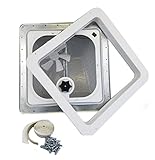
Ventline CW001 White Roof Vent
- Single-speed 12V DC fan
- 3.6W low draw
- Putty and screws in the box
- 14.25 inch rough opening
All 10 Picks Compared Side by Side (October 2026)
Every unit below runs on 12 volts and fits a standard 14×14 inch roof opening, with two exceptions worth checking before you buy. The Ventline CW001 and the HENG’S 71112A both want a 14.25 to 14.5 inch rough opening, so measure your hole rather than assuming.
| Product | Specs | Action |
|---|---|---|
| MAXXAIR Maxxfan Deluxe |
|
Check Latest Price |
| RVLOVENT 14 inch 10-Speed Vent |
|
Check Latest Price |
| Ventline CW001 White Roof Vent |
|
Check Latest Price |
 caqeg 14 inch Universal Roof Vent caqeg 14 inch Universal Roof Vent |
|
Check Latest Price |
 Starvent 6-Speed Reversible Fan Starvent 6-Speed Reversible Fan |
|
Check Latest Price |
 HENG’S 71112A Wedge Style Vent HENG’S 71112A Wedge Style Vent |
|
Check Latest Price |
 2012RVAccessories F36AR LED Fan 2012RVAccessories F36AR LED Fan |
|
Check Latest Price |
 HENG’S Vortex I Upgrade Kit HENG’S Vortex I Upgrade Kit |
|
Check Latest Price |
 2012RVAccessories F36AR Voice LED 2012RVAccessories F36AR Voice LED |
|
Check Latest Price |
 Livpow 14×14 Reversible Vent Livpow 14×14 Reversible Vent |
|
Check Latest Price |
Ceiling Fan, Roof Vent Fan or Portable Fan – Which Job Do You Need Filled
This is the single most repeated confusion in van fan threads, so it is worth settling before the product list. A true cabin ceiling fan is a blade set in a housing that hangs below the ceiling and circulates air inside a sealed room. It has no hole in the roof. In a van, the ceiling is the roof, so mounting a sealed-room fan to it makes no sense, which is why the products sold for this purpose are nearly all roof-penetrating vent fans with an interior garnish instead.
The job those units do is stronger than circulation. A reversible model exhausts hot air out through the roof opening at one setting and pulls cool night air in at the other. That is the feature that separates a genuinely useful van fan from a fan that just stirs hot air around.
Portable fans still have a place, particularly for a person lying on a bunk or working at a table where a fixed overhead unit is too far away. Their limitation is power: most run from a cigarette lighter socket or an internal battery, so they cannot be left running on a timer through a whole night without a drain on the house bank.
One technical point from the build communities is worth carrying into any install. A fan sitting in an open window or an open vent hatch performs badly because air can simply reverse and blow straight back through. Builders call the fix a shroud, a rigid tube or box that holds one direction. A roof vent fan does not have this problem, because the fan sits inside a fixed aperture with the lid above it, which is one of the strongest practical arguments for fitting one in the roof rather than the window.
1. MAXXAIR Maxxfan Deluxe – The Complete Reversible Unit
MAXXAIR Maxxfan Deluxe Vent, Fan and Vent Cover All in One – Powerful 10-Speed Reversible Fan with Thermostat, Built-in Rain Cover, Remote Control, Intake & Exhaust Fan, Smoke (00-07500K)
10 speeds
Reversible intake and exhaust
Thermostat with remote
60 watts at 12V
Pros
- Vent
- fan and rain cover in one sealed unit
- Ten-speed thermostat control
- Operates in rain or while driving
- Tool-free removable insect screen
- 1701 reviews averaging 4.6 stars
Cons
- Highest power figure in the list at 60 watts
- Remote-only control with no manual override
- Warranty is 1 year with 2 years limited on parts
This is the unit van builders mention by name more than any other, and after reading through the reviews it is easy to see why. The motor runs ten speeds, reverses direction, and pairs with a thermostat so the airflow ramps up as the cabin warms rather than running flat out all afternoon. The dome is part of the assembly, which means the fan can run in rain and, because the cover seals, while the van is moving.
Owners consistently single out the tool-free interior insect screen. It drops out without a screwdriver for cleaning, which matters more than it sounds when you have been living off-grid for a week and the mesh is collecting dust and dead insects. The 4.6-star average across 1701 reviews makes it the most thoroughly proven product of these ten.
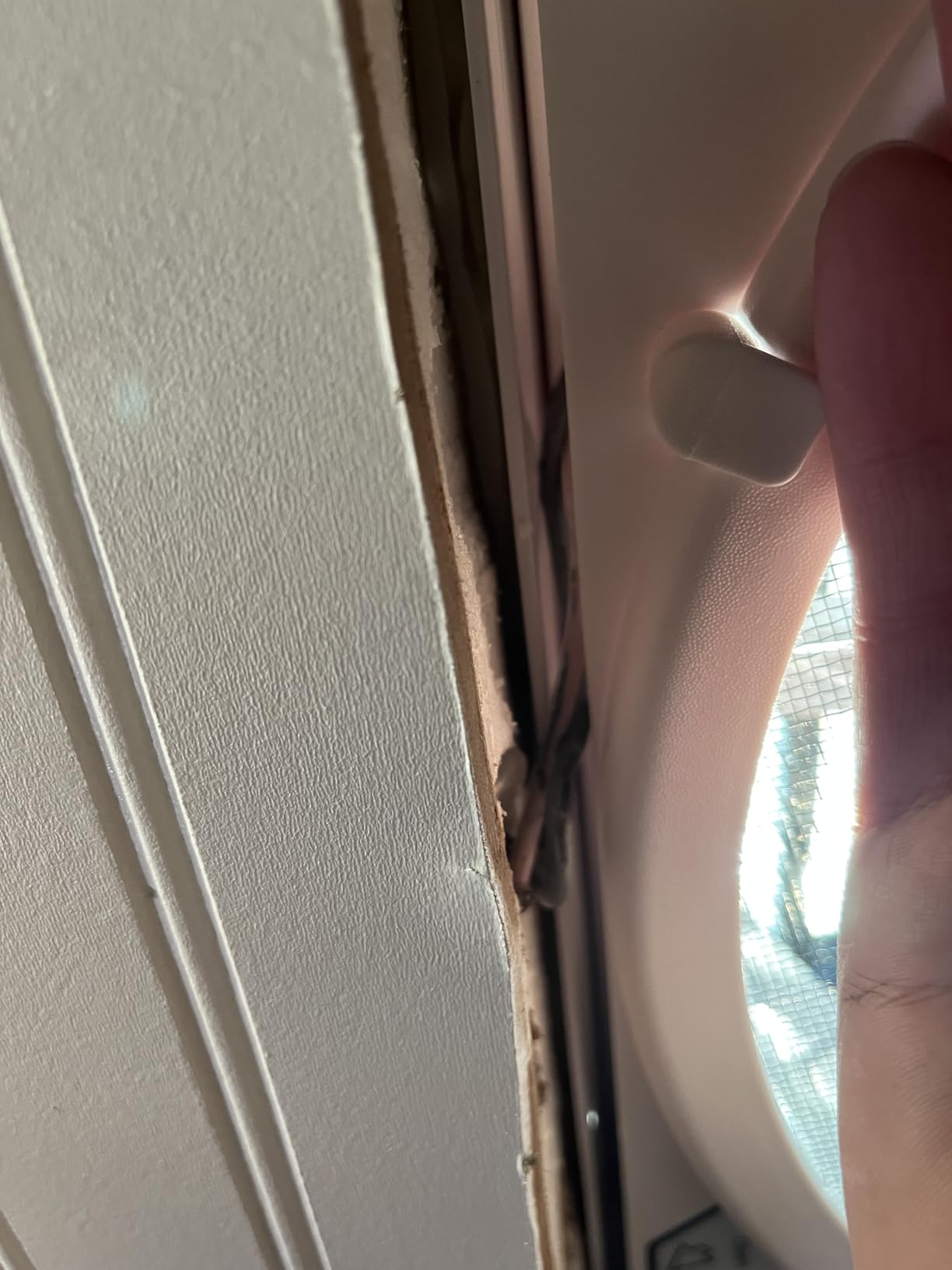
Where it asks more of you: the 60 watt rating is the highest power draw of the ten products here. At 12 volts that is roughly 5 amps at full speed, so a fused circuit rather than a cigarette lighter socket is the sensible way to feed it. The remote is the only control surface, and if it goes missing you are left with a fan you can only reach through the roof hatch.
Blade length is listed at 14 inches and the housing measures 12.75 by 14.76 by 5.23 inches. It fits all standard 14×14 inch roof openings, where the single most important compatibility fact sits.
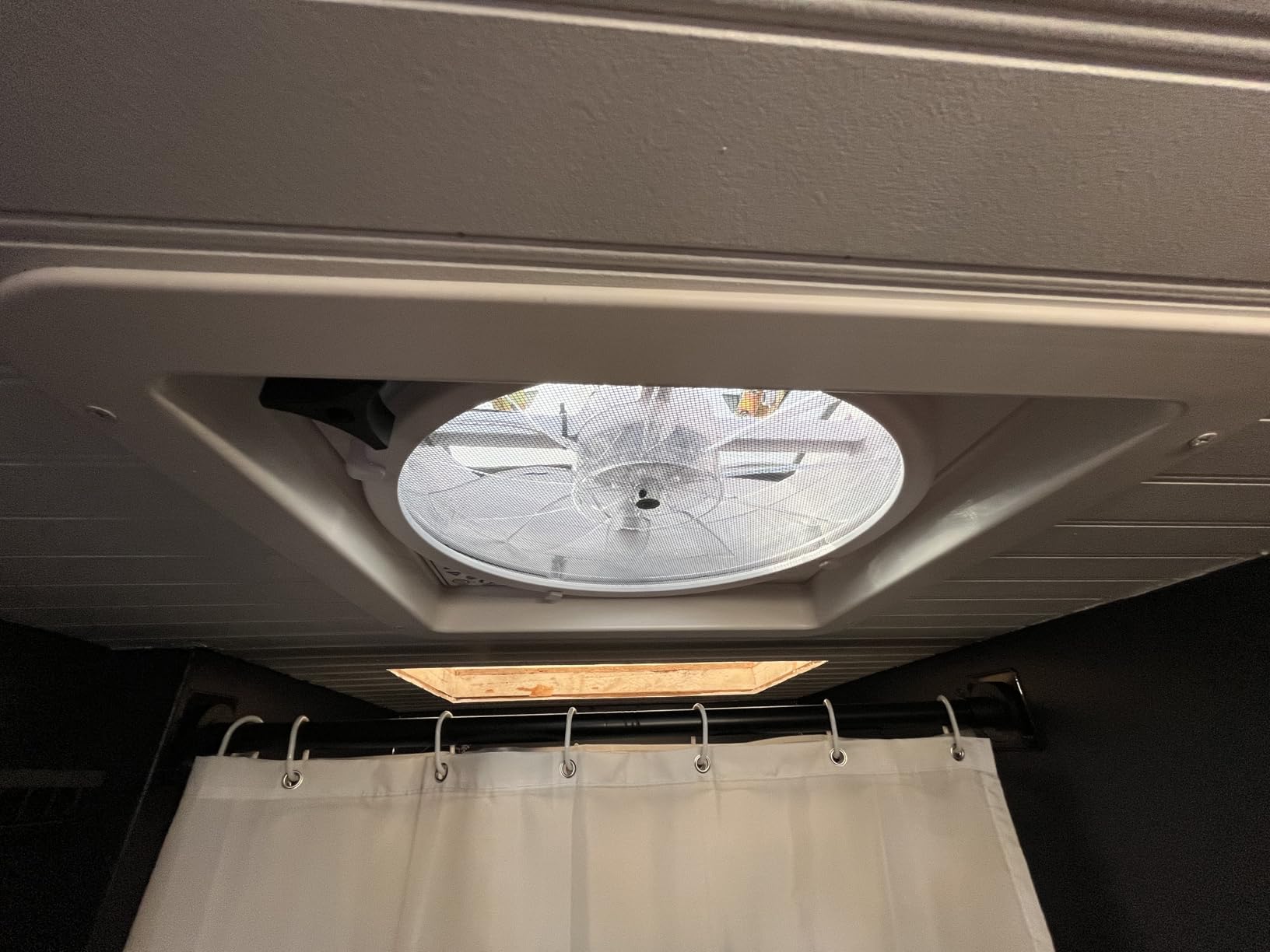
Is the MAXXAIR worth the step up from a basic vent?
For a full-time van or a build you intend to keep for years, yes. The thermostat, the ten-speed range and the sealed rain cover are the difference between a fan you set once and a fan you actually use daily. The warranty is 1 year with 2 years limited on parts and a lifetime limited warranty on the lid, the low long-term cover on parts is something to weigh against how long most van builds last.
For a weekend camper or a first temporary fit, it is a lot of capability for a single night of use. The interior screen on the cheaper options still gets cleaned; it just takes a screwdriver.
What does the Maxxfan cost you in power?
On low and mid speeds the draw is far below the headline 60 watt figure, which is what the speed control is for. If you plan to run it all night on medium while parked, budget in the region of 240 watt-hours across eight hours before adding inverter losses, and factor that into your daily solar target.
The 10-blade design and the smoke-tinted cover keep the interior light down during driving, which matters if you are trying to stay unseen. The trade-off is that the smoke colour darkens the garnish ring inside the van more than a white lid would.
2. RVLOVENT 14 Inch 10-Speed Vent – Strong Airflow, Simple Manual Control
RVLOVENT 12V RV Roof Fan Vent 14” 10 Speed Reversible Manual Lift (NO REMOTE)
18 watt motor
45 dB rated
Manual lift, no remote
Reversible airflow
Pros
- Airflow far exceeds a factory RV vent
- Quiet on low and medium settings
- Manual lift needs no remote or batteries
- Spare replacement screen included
- 1068 reviews averaging 4.6 stars
Cons
- Louder than advertised on the top settings
- Interior garnish may need trimming on a sloped roof
- Removing an old vent and old sealant is labour-intensive
Owners buying this are almost always replacing a factory 2 to 4 watt RV vent, and the reaction is consistently that the jump in moving air is dramatic. The listing claims up to 1000 CFM maximum airflow from an 18 watt motor, and the 14 inch blade length is matched only by the Maxxfan among the units in this list. That combination of blade size and low wattage is the reason it punches above its class.
The listed 45 dB noise rating is the number to hold onto. It is measured on a lower speed setting, and reviewers say the fan is genuinely quiet there, which is what you want above a bunk at night. A minority report it running louder than the label suggests once you push to the top of the range, so treat the figure as a low-speed claim.
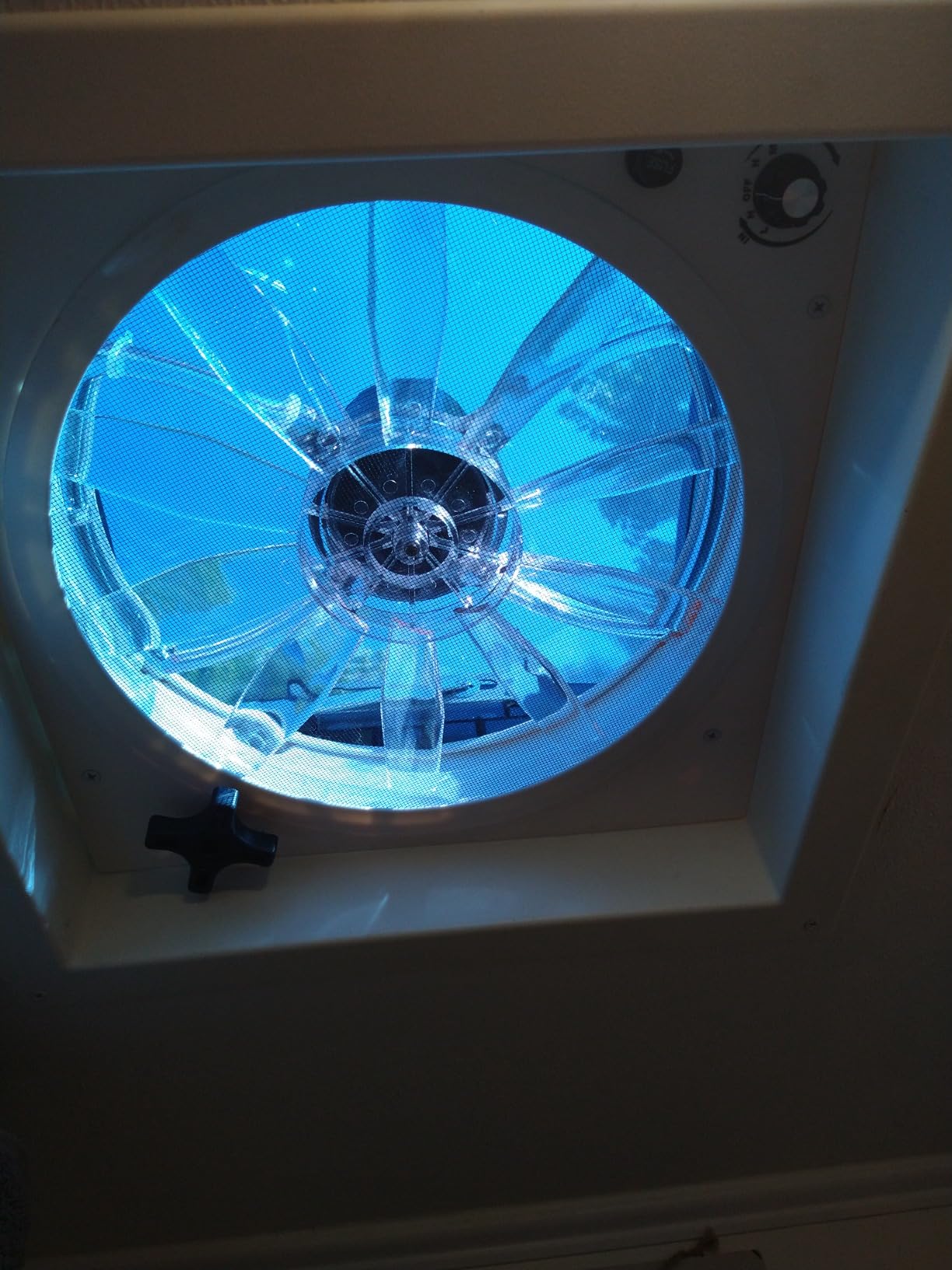
The manual lift is a genuinely clever decision in a van. There is no remote to lose, no batteries to replace, and the crank mechanism stays where you left it. The box also includes a built-in fuse, spare 5 amp slow-blow fuses, an extra screen, screws, and a white interior garnish, so consumables are covered for the install.
Note the material and roof specification: metal and polycarbonate, mounted as a ceiling fitting, in a 16 by 16 by 14 inch package that suits a standard 14×14 inch cut-out. The UV-resistant polycarbonate lid is a sensible material for a roof in constant sunlight.
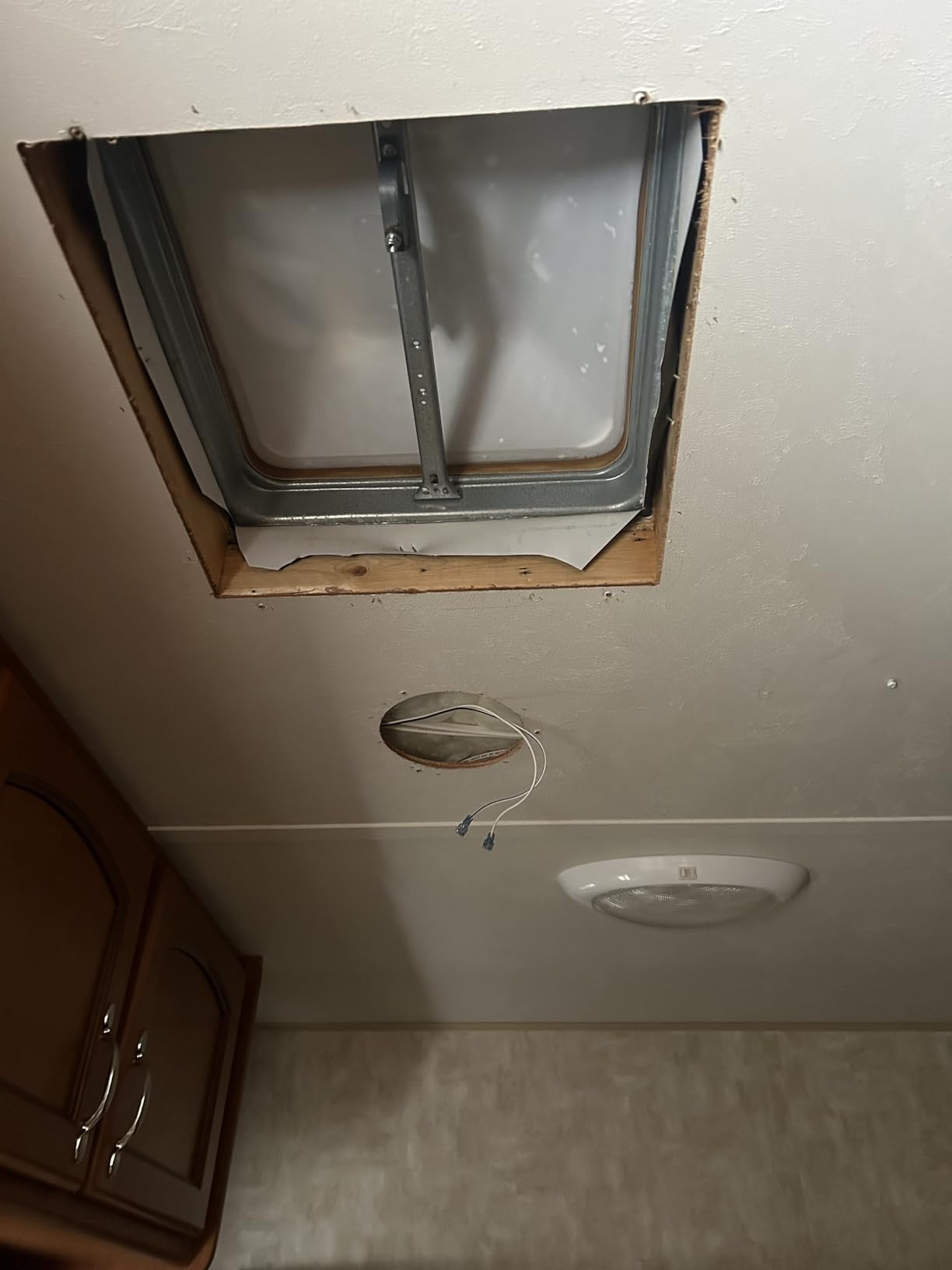
Will it fit your roof?
It fits all standard 14×14 inch roof openings, so the same hole a factory RV vent used will take it. The interior garnish is the part most likely to need attention, since on a van with a curved or sloped ceiling it can overhang slightly and need trimming to sit flat.
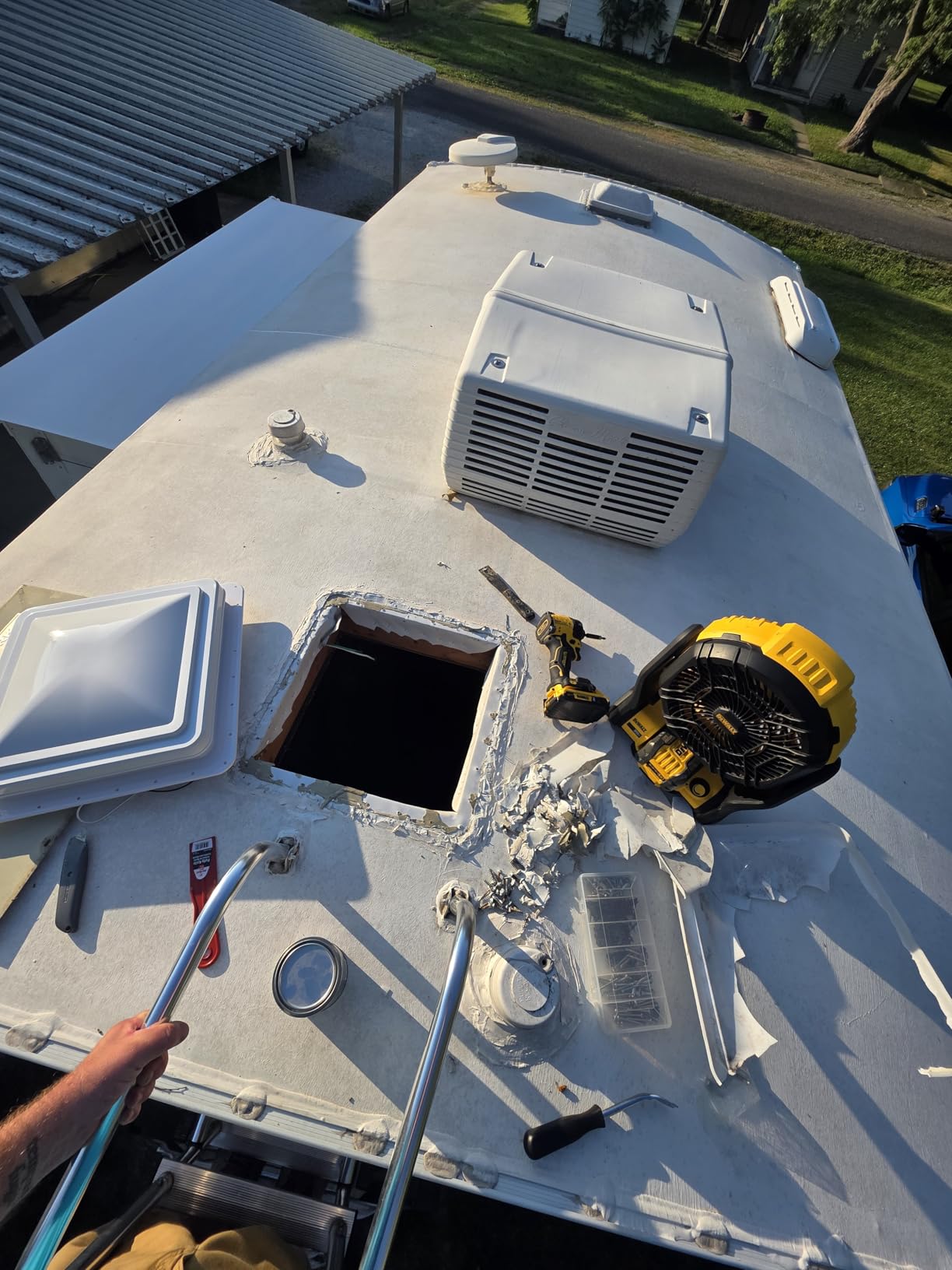
The hard part of the job is rarely the new unit. It is getting the old vent out, cutting away thirty years of layered sealant, and cleaning the flange before the new butyl tape goes down. Budget an evening, not an hour, for a first-time roof job.
How does 18 watts compare for overnight use?
At 18 watts running for eight hours that is about 144 watt-hours, or roughly 12 amp-hours from a 12 volt bank before inverter losses. On a 100 amp-hour LiFePO4 setup that is a small fraction of a day’s capacity, and it puts this unit between the 3.6 watt single-speed models and the 60 watt Maxxfan.
It also has no reverse-airflow lockout, so you can run it as intake overnight and flip to exhaust during the hot part of the afternoon. That single capability is the one many full-time van dwellers use daily.
3. Ventline CW001 – The Dependable Like-for-Like Vent Swap
Ventline RV Roof Vent White w/ 12 Volt Fan, Putty & Screws¡
3.6 watts
Single speed
Fits 14.25 inch opening
Putty and screws included
Pros
- Low power draw at 3.6 watts
- Putty tape screws and a 1.75 inch garnish ring included
- Simple single-speed push button control
- 4.6 star average from 962 reviews
Cons
- Single speed with no reverse airflow
- Only 3.6 watts so airflow is modest
- Galvanized mounting flange is listed as sharp
This is the like-for-like replacement. If your camper came from the factory with a Ventadome or Ventline fitting, this is the same part with a powered 12V fan in it, and 962 reviews at 4.6 stars reflect how uneventful that has been for most buyers. It is not a performance purchase. It is a repair purchase.
What makes it easy is the box contents: putty tape, screws, and a 1.75 inch garnish ring. You are not hunting for sealant afterwards. The 3.6 watt draw is genuinely tiny, and the single-speed push button means there is nothing to learn.
The 14.25 inch rough opening is the detail to check. If your existing vent is a 14×14 unit there will be a small gap to trim or shim, and this unit is not a drop-in for a 14 inch hole without a little work.
Is a 3.6 watt fan actually enough?
Enough for a bathroom or a galley, which is exactly what this product is designed for. It is listed for RV bathroom and kitchen ventilation, and the six blades at 14.25 inches are sized for moving a small volume of air in a small space rather than circulating the whole van.
If you want air movement across a bed in a hot van, the single speed and the low wattage will leave you underwhelmed. For that job, look at the Starvent or the RVLOVENT instead.
How does the install go?
Straightforward. The unit is a permanent ceiling-mount installation with a galvanized mounting flange, a white plastic wedge-shape aerodynamic lid, and a DC motor. The flange is listed as sharp, so wear gloves when you handle it, and that is the one genuine safety note on this product.
At 6 pounds it is light enough to hold overhead on a ladder by yourself, which is not true of every unit in this list. Set the putty, seat the flange, screw it down, then trim the excess putty once it skins over.
4. caqeg 14 Inch Universal Roof Vent – Best for a First Build
14″ RV Roof Vent for Camper Trailer Universal White Lid Roof Vent with 12V RV Vent Fan 6″ Blades White lid Inner for Garnish Ring
24 watts
6 inch blades
14x14 inch opening
Runs with lid closed
Pros
- Fits standard 14 inch openings and installs cleanly
- Two-wire design so wiring is simple
- Garnish and screws supplied in the box
- Keeps moving air with the lid closed in rain
Cons
- Thin plastic that can crack during fitting
- Roof thickness must be measured first
- Single speed with no remote or reverse
For someone cutting their first hole in a van roof, this is a unit that many buyers report going in cleanly on their first attempt. It fits a 14 by 14 inch opening and a roof between 1-1/4 and 2-1/4 inches thick, which covers the majority of high-roof vans and camper trailers. Buyers repeatedly report a perfect fit and say it makes a measurable difference to interior temperature.
The design detail that earns its place: the fan is held with butyl tape rather than screws, and the airflow continues with the lid closed. That means it behaves like a genuine ceiling fan in rain or while driving, and the two-wire connection keeps the electrical side of the install to a single pair of conductors.
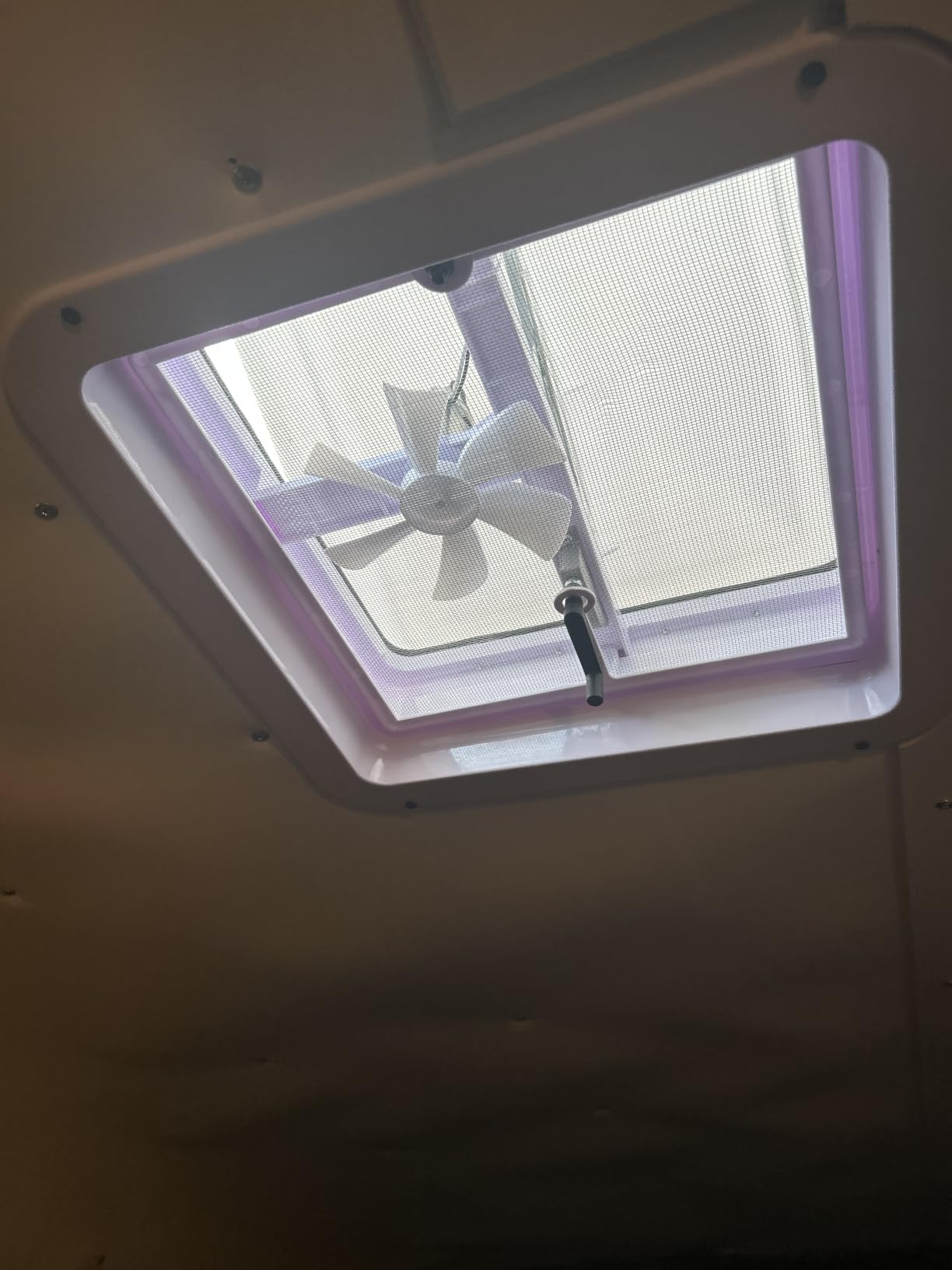
At 6 inches the blades are on the short side compared to the 14 inch units. The 24 watt rating sits in the middle of this group, and airflow is real but not exceptional, with only one speed and no reverse, so it moves air in one direction only.
Owners do flag the plastic as thin. One reviewer reported it cracking while fitting, which is a real risk if the frame is forced to align. Handle the flange, do not lever it.

Will the roof thickness work for your van?
Measure before you order. The 1-1/4 to 2-1/4 inch range covers most panel vans and camper trailers, but a heavily insulated high-roof conversion with a thicker sandwich panel can fall outside it, which is a frequent reason a first build stalls at the fitting stage.
The overall footprint is 5 inches deep by 14 by 14, and it weighs 4.4 pounds, so it is comfortable to work with solo. A white interior garnish and screws are included.
Is single-speed with no reverse a problem?
For most builds, no. This unit is for circulating air inside the cabin, not for pulling hot air out. If you want true exhaust on a hot afternoon and intake on a cool night, you need one of the reversible units further down this list.
The benefit of no reverse is simplicity. A single direction, single speed, two-wire install is the hardest thing to wire incorrectly. For a first conversion, that reliability is worth more than flexibility.
5. Starvent 6-Speed Reversible Fan – Six Speeds With Reversal
Starvent RV Roof Vent Fan 6-Speed-Reversible
6 speeds
Reversible
1100 CFM listed
22.2 watt-hours
Pros
- 6 speeds with true reversible intake and exhaust
- Soft ramp-up and ramp-down protects the motor
- Removable screen accessible from inside
- 2 year limited warranty
- Compatible with roof thickness from 1.16 to 5.5 inches
Cons
- Push-button controls reported to stick
- Lid crank and gear train can feel flimsy
- Screen mesh can rub on blades and get loud
Six speeds with reversal is the widest spread you get below the ten-speed Maxxfan, and the listed airflow of 1100 CFM is the highest figure published by any unit in this list. The 17 blades with a smoke-colored dome are designed to move a lot of air while filtering daylight, and the slow ramp-up and ramp-down is a thoughtful touch that reduces the motor jolt that shortens the life of cheaper units.
It also handles roof thickness from 1.16 to 5.5 inches, the most forgiving range of the ten units listed, and it includes a garnish ring and a full set of screws. Those two facts make it a safe choice for someone unsure how thick their roof panel is.
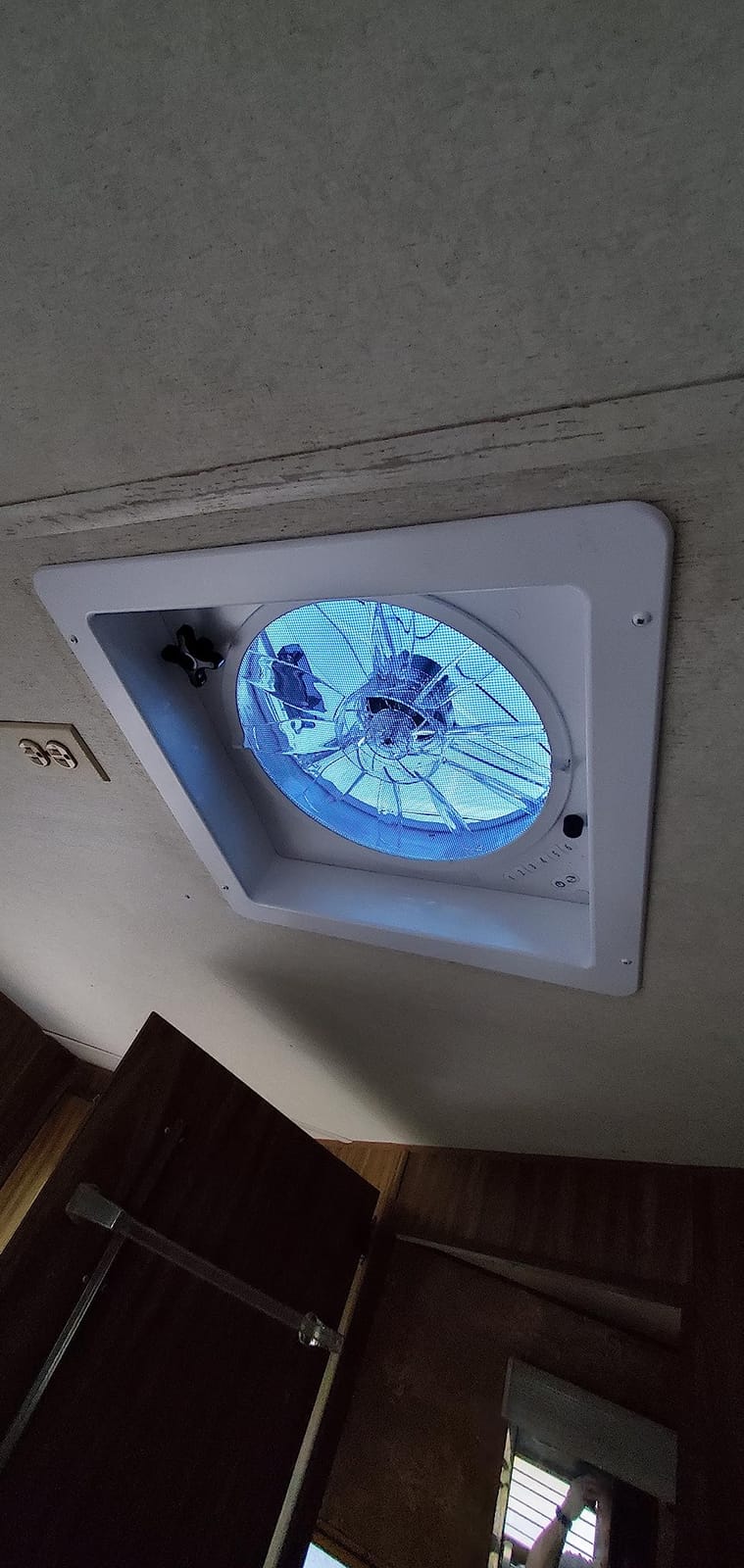
The 4.2 star average across 780 reviews is the second lowest of the ten units here, and the reason is specific rather than general. A cluster of owners report the push-button speed controls sticking, and some report the manual lid crank and its gear train breaking soon after installation. Both are painful once the unit is sealed into a roof, because reaching the mechanism means going back up to the roof.
The 59.5 dB noise rating is the highest published figure of these ten, though that is a top-speed number. Owners who rate it quiet describe the first three speeds specifically, and that is the range you would use over a bunk at night.
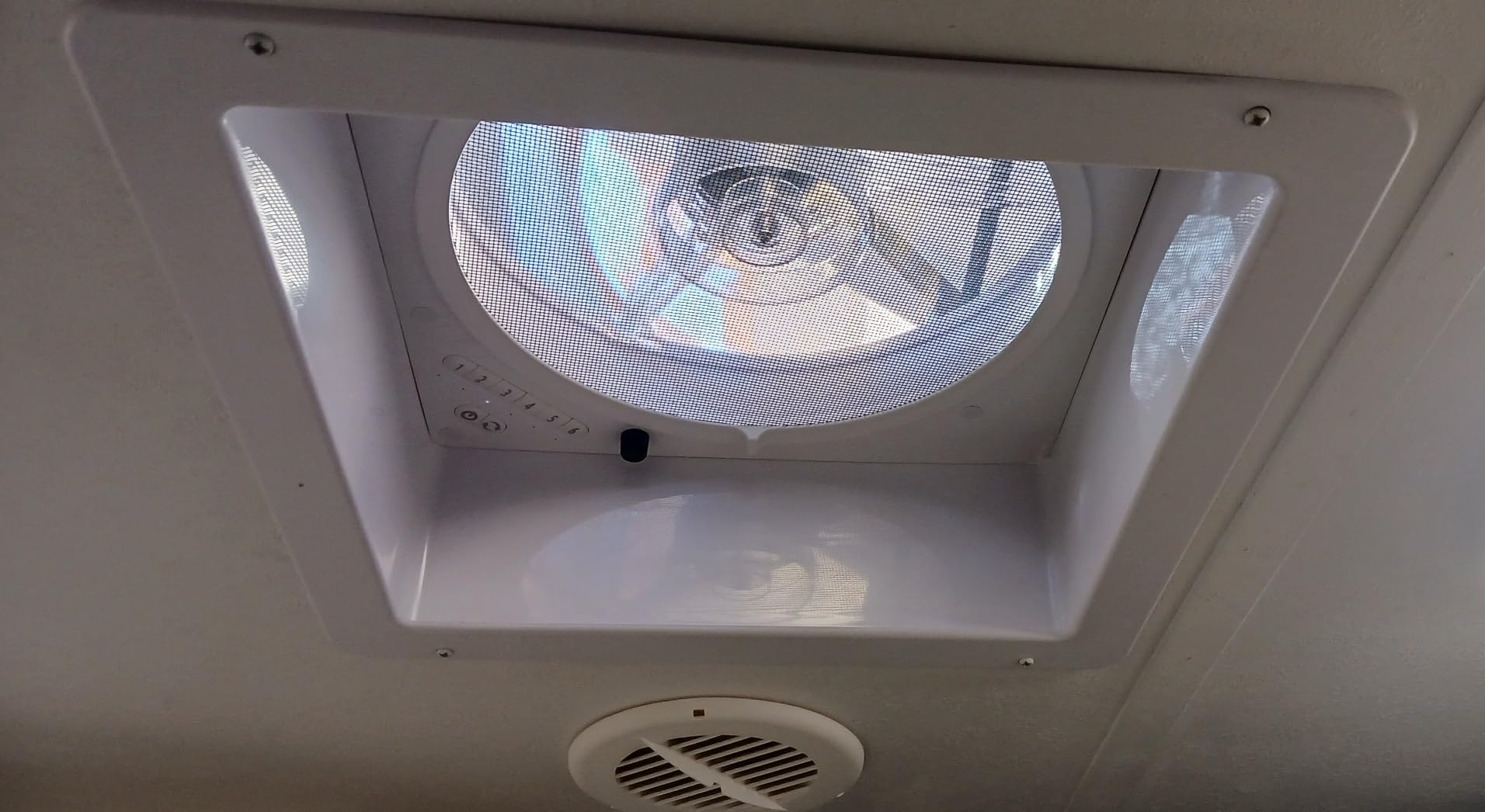
Is six-speed control worth the control risk?
Six speeds is a lot of resolution for a van, where airflow needs change constantly as the sun moves. The soft ramping genuinely reduces startup noise and motor wear. The concern is entirely about the button mechanism rather than the motor, and the 2 year limited warranty gives some protection.
If your roof is easy to access, or you have a hatch where you can reach the controls from inside, the range is worth it. For a sealed high-roof where access means going outside, the simpler three-speed and manual-lift options are calmer ownership.
How does 1100 CFM translate to real use?
That figure is a listed maximum rather than an independent measurement, so treat it as a ceiling on capability. In practice the useful comparison is against the 24 watt and 18 watt units: this one moves air hard and fast when you want it, and falls to a whisper on the first three settings when you want it quiet.
One practical tip from owners: check that the screen frame is seated correctly during install, because a mesh that touches the blades produces a loud rubbing noise that gets blamed on the motor.
6. HENG’S 71112A Wedge Vent – Basic Powered Vent, Simple Install
HENG’S INDUSTRIES 14″ RV Roof Vent 12 Volt Powered Fan with WHITE Wedge Style Lid – 1” Garnish Ring | 71112A
4 watts
Single speed
14.5 inch cut-out
Manual crank lid
Pros
- Low cost with a 4.5 star average
- Standard universal fit for common RV cut-outs
- Manual crank means no wiring for the lid
- White wedge lid matches most roof colours
Cons
- Weak airflow
- with only 4 watts driving three blades
- No mounting hardware sealant or screws included
- Metal flanges are sharp
The HENG’S 71112A is bought as a dependable factory-equivalent rather than as an upgrade. Three blades, a 4 watt DC motor, a single speed, and a manual crank handle to raise the lid. It is a basic product and it does the basic job without drama, holding a 4.5 star average across 517 reviews.
The 14.5 by 14.5 inch rough opening is slightly larger than the standard 14×14 cut-out used by most of these products, so check your measurement. The exterior mounting flange is 16.5 inches square, and a 1 inch inner garnish ring, part number 90090, is included for the ceiling side.
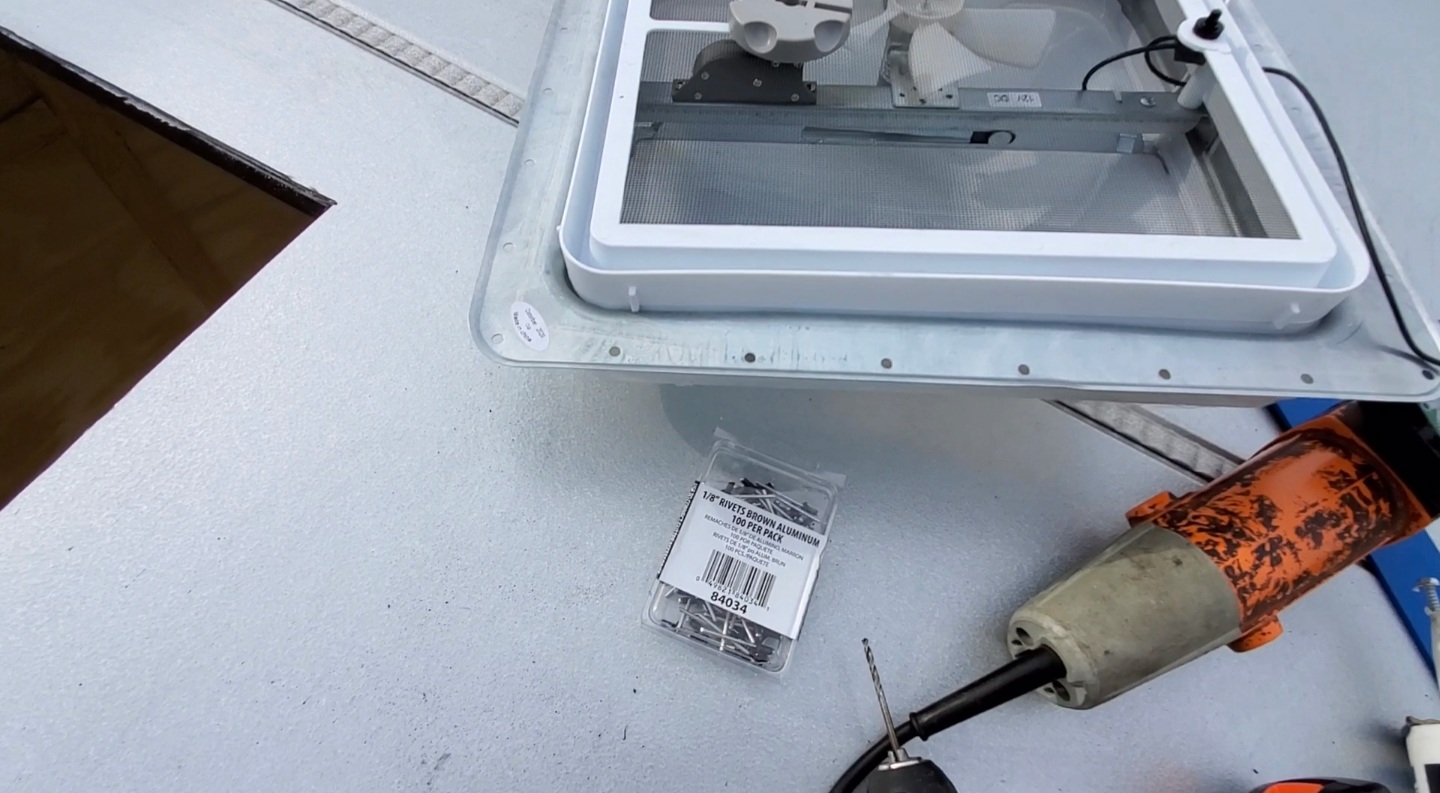
The important practical warning: no mounting hardware is included. Caulk or putty and screws must be supplied separately, which adds time and cost to what looks like a cheap part. Owners still rate it highly because it is small, it is simple, and the crank needs no wiring at all.
The alloy steel construction makes it more robust in the wind than the all-plastic units, and the mesh screen is included. The wedge-shape lid matches the low-profile profile of most factory RV vents, so it looks correct on a white roof.
At 4 watts this is a low-draw unit, which makes it a good choice for a van that lives on a small solar budget and only needs intermittent ventilation.
When is a 4 watt fan the right choice?
When the goal is a small specific job: clearing steam from a wet room, moving air across a compact galley, or replacing a dead factory vent so the roof stops leaking. All three are real reasons to buy a fan, and at this draw and simplicity you are not paying for performance you will not use.
For circulating air over a sleeping person in a hot van, a 4 watt single-speed unit will not keep up. Choose the RVLOVENT or the Starvent for that.
What should you have on hand before installing?
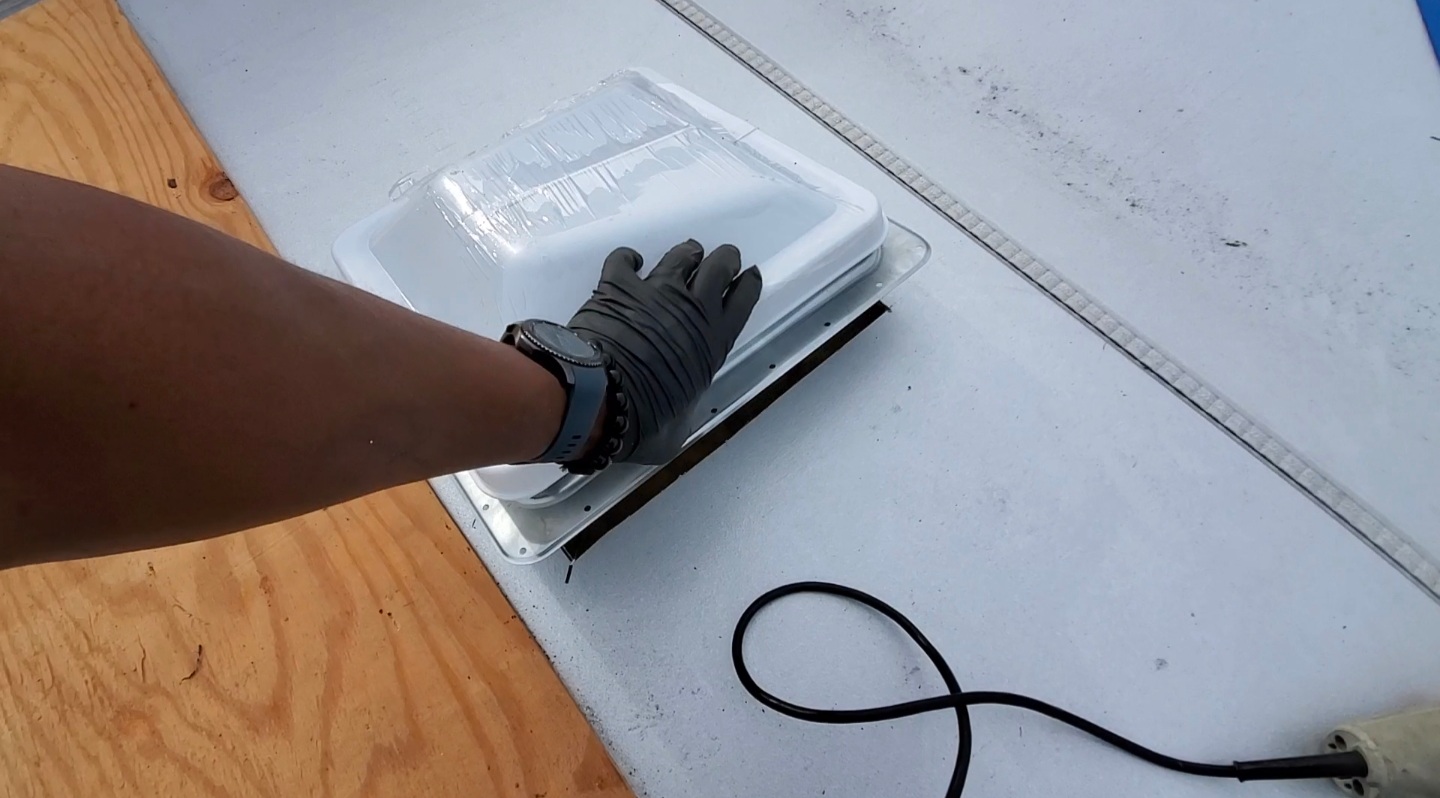
Putty tape or bedding sealant, a full set of screws, and gloves. The steel flanges are flagged in the technical details as very sharp, and the list is explicit that all vent metal flanges on these units need careful handling.
Plan to trim the 1 inch garnish ring to your ceiling contour, because a flat ring on a curved van ceiling leaves a visible gap. A router or a file takes care of it in a few minutes.
7. 2012RVAccessories F36AR – Quiet Motor for an Overhead Bunk
RV Roof Vent Fan 14×14 with 4 Color LED Ambiance Light, Reversible Airflow, Ultra-Quiet 12V (24V Max) Vent Fan with Remote & Rain Sensor
25 dB brushless
4 speeds
674 CFM
40 watts max
Pros
- Brushless motor inaudible on low speed for most campsites
- Strong airflow in both directions
- 4 colour LED ambience light for night use
- Low enough draw to run off a solar setup
- 3 year parts warranty
Cons
- Rain sensor closes the lid but the fan keeps running
- Documentation is thin
- Short 3 inch interior flange needs a longer trim ordered
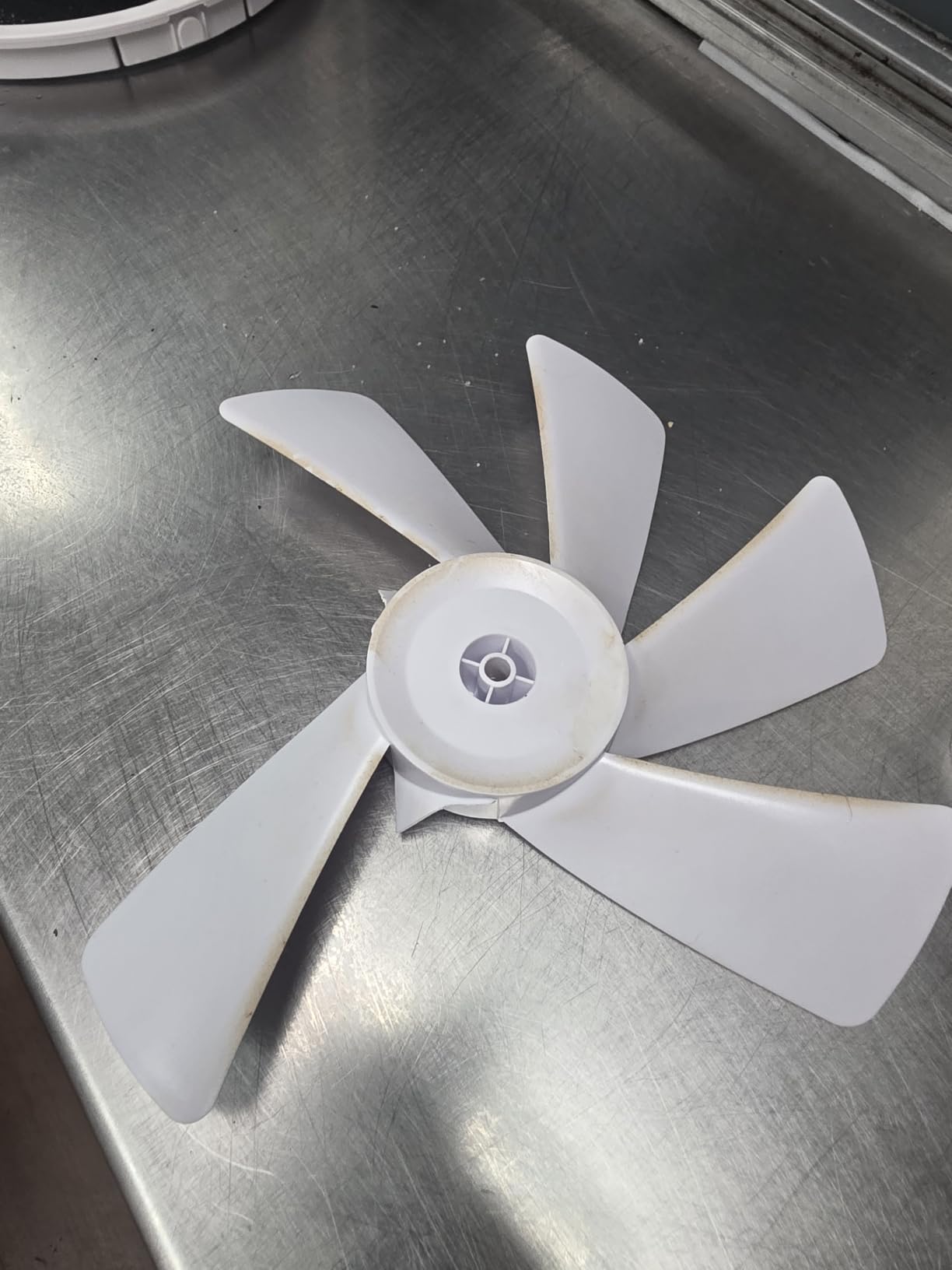
If the fan is above your head while you sleep, noise is the only specification that matters, and this is the unit built specifically around it. The brushless motor is rated at 25 dB with a 10 to 45 dB operating range across speeds, and the listing describes it as inaudible on low speed in most campsites. That is exactly the claim a sleeper needs.
It still moves real air. Airflow capacity is listed at 674 CFM, the motor is brushless and rated for five times the lifespan of a brushed motor, and the four speed settings draw 3, 10, 20, and 40 watts. The 3 watt low setting is the number that makes all-night running on solar straightforward.

Two features stand out on this model. The integrated four-colour LED ambience light, with yellow, rose pink, blue, and white, gives you a soft source without a separate fixture. And the lid opens to any angle up to 50 degrees, so you can set a low exhaust angle rather than fully popping the dome.
The one safety point worth reading carefully: the rain sensor closes the lid automatically, but the fan continues running underneath. One owner reported this as a genuine hazard. If you leave it running unattended in wet weather, use the remote to stop it.
How quiet is quiet enough to sleep under?
For most people, yes, on the lower settings. A brushless motor has no commutator brush noise, which is the component that makes cheap fans audible in a silent van at 2am. The 3 watt speed setting is the one to use overnight, and at that draw the battery cost is negligible.
The 40 watt top speed is a different proposition, so if you run it at full output while trying to sleep you will hear it. The LED colours include a white option that is bright, so pick the warmer colours for night use.
Will it fit your roof and your ceiling?
It lists a 14 inch by 14 inch US fit alongside 400 by 400 millimetre European openings, with a roof thickness range of 1.5 to 3.3 inches. Some European buyers report it is not a true 400 by 400 millimetre fit in practice, so measure rather than trust the listing on that point.
Interior trim is the weak spot. It comes with a short 3 inch interior flange, and a longer trim piece has to be ordered separately, so factor that into the job before you are on the roof. Warranty is 3 years parts, the longest cover listed among these ten products.
8. HENG’S Vortex I Upgrade Kit – Fastest Fix for a Dead Motor
HENG’S INDUSTRIES 90043-CR Vortex I Upgrade Kit | 12V RV Vent Fan | Powerful Airflow & Ventilation | Easy Install for RVs, Campers, Trailers & Motorhomes | White, Durable, Energy-Efficient Design
9 inch brushless blade
45 dB
3.5 pounds
No roof removal needed
Pros
- Big airflow gain over a small factory fan
- Installs with a single Phillips screwdriver
- Brushless motor quiet for the air it moves
- Fits Heng's Ventline Jensen and Elixir vents
Cons
- Single speed with no reverse airflow
- Non-powered vents need extra wiring to convert
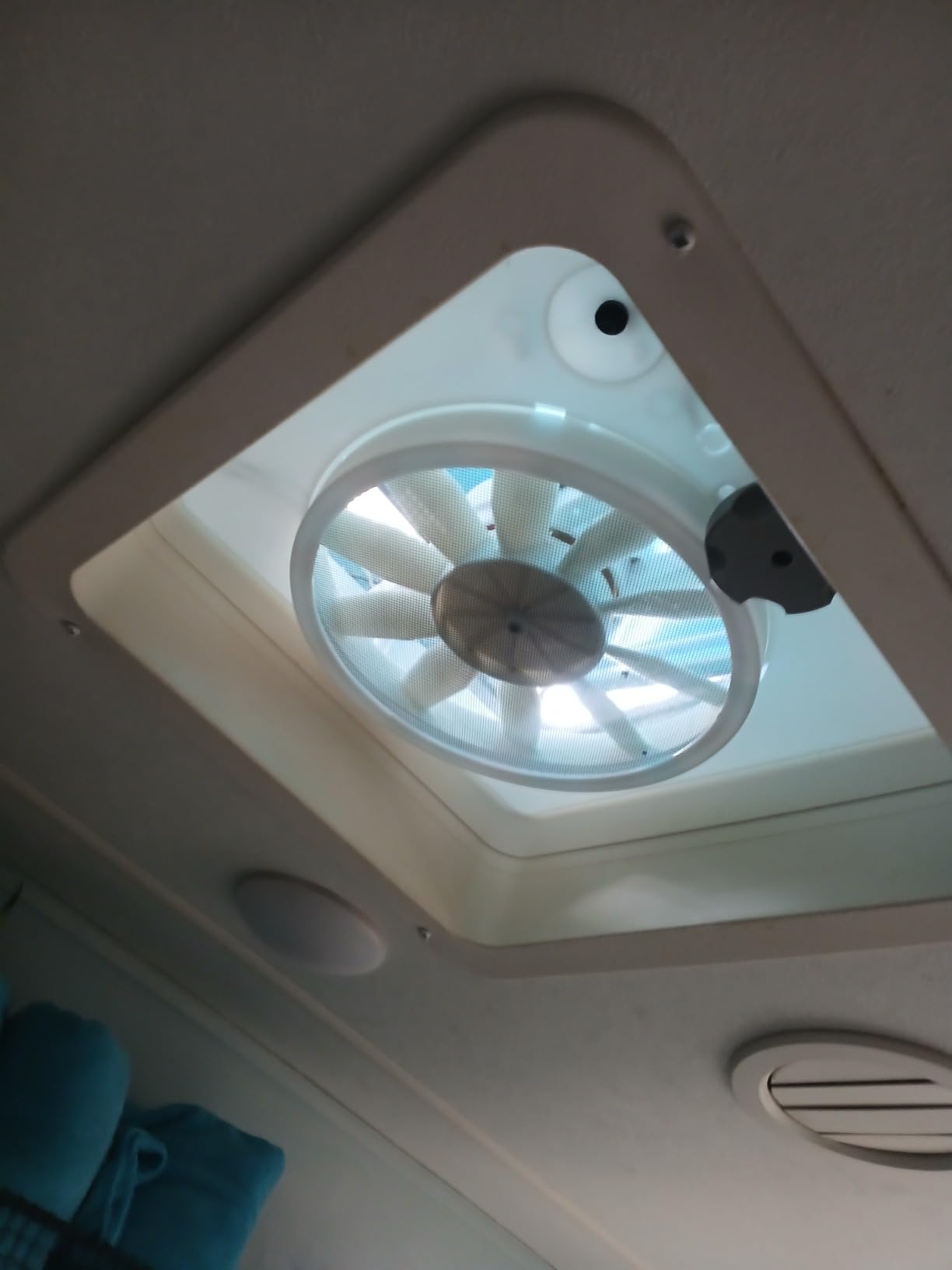
A screen-swap fan module is a clean, low-effort way to improve airflow in an existing vent, and for a lot of van owners that is the entire problem. If your vent is fine but the motor is dead or feeble, this is a ten-minute job instead of a full roof strip, and owners describe it as a cheap way to rescue a working fitting.
The 9 inch blade with a brushless motor is the upgrade. The listing claims up to 300 percent improved air movement over the original fan, and the 45 dB noise figure is a good result for a unit moving that volume. The whole assembly weighs 3.5 pounds and measures 14.25 inches square by 3.5 inches deep.
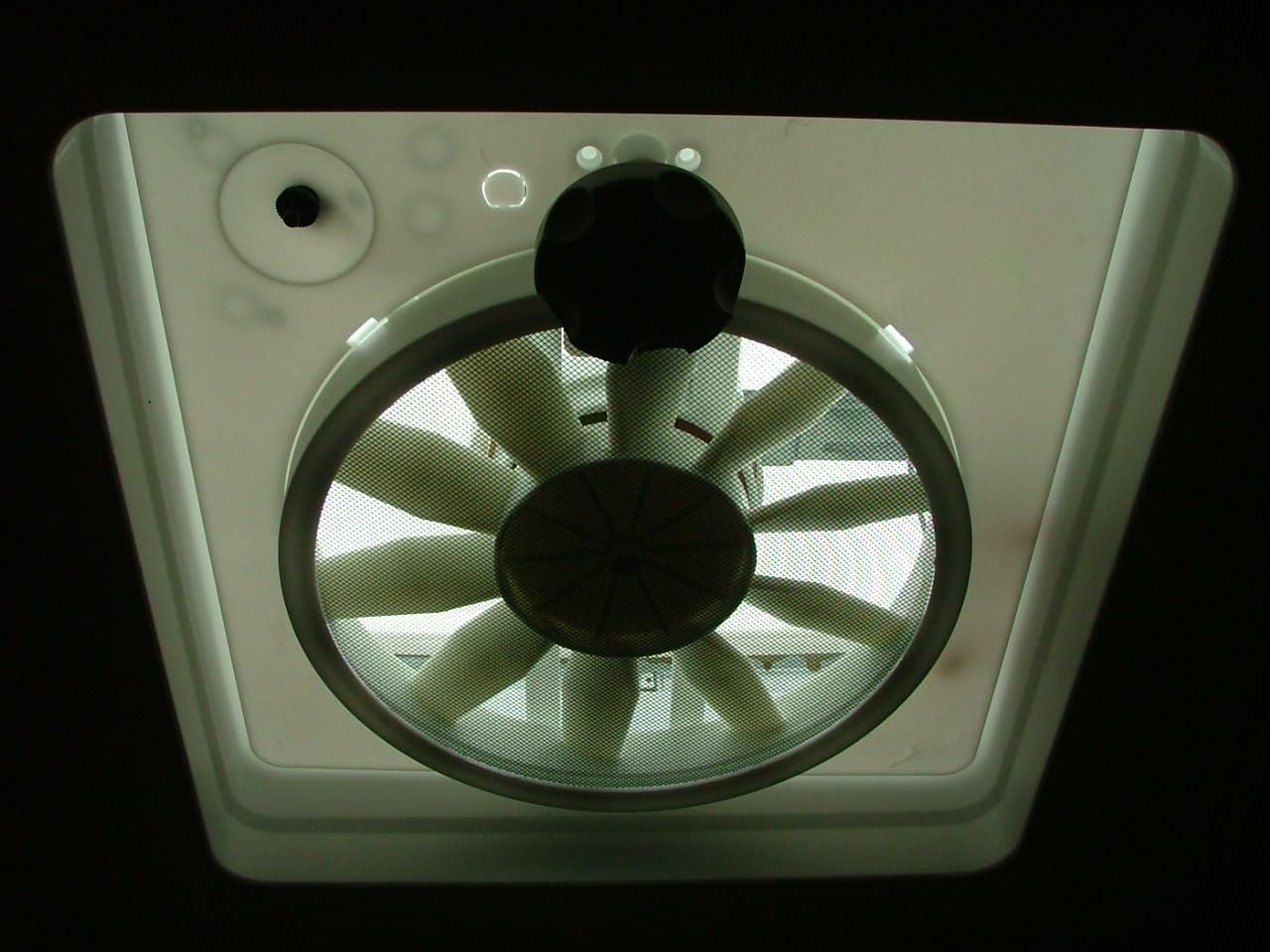
Compatibility is broad: it works with Heng’s, Ventline, Jensen, and Elixir powered vents. A non-powered vent can be converted but needs additional wiring, which pushes it back toward a full install. There is no roof removal, no new cut-out, and no sealant work, That is a modest price for the airflow jump, which is why it earns its place despite the 4.4 star average across 347 reviews.
Keep the existing lid and the existing screen surround, and the exterior of your roof looks unchanged. For a stealth build, that is worth a lot.
When is a screen swap the right call?
When the vent, the lid, and the roof penetration are all still sound and only the motor has failed. That is a common situation, because the motor is the part that wears out first on a factory vent while the plastic lid and the flange last for decades.
It is the wrong call when your vent does not move air even with a new fan, which means the problem is a blocked or distorted aperture rather than a dead motor. Check that the screen is not jammed and the fan can spin freely before you order.
What are the limits of a single-speed upgrade?
There is no reverse, so it cannot pull cool night air in. It circulates and exhausts in one direction only, which is a real constraint for anyone planning a daytime-exhaust and night-intake strategy.
It is a simple push button. For a van where the fan runs at one setting whenever someone is home, that is not a limitation. For a fan you want to adjust as you drift off, it is.
9. 2012RVAccessories F36AR Voice LED – Best for Automated Night Ventilation
Heavy Duty 14″ RV Roof Vent Fan, Whisper-Quiet Voice Control, Colorful LED
4 speeds
25 watts
Voice plus remote
Timer 1 to 8 hours
Pros
- Brushless motor stays quiet across all four speeds
- Voice control alongside remote and local buttons
- Red night-vision lighting mode
- Thicker housing resists rattling and cracking
- Rain sensor and programmable timer
Cons
- Heavy unit at 12 pounds for a roof install
- Voice control needs smart-assistant setup
The distinguishing feature is automation. A programmable auto-off timer from 1 to 8 hours plus a rain sensor means you can set the fan to ventilate a parked van overnight and shut itself down, which is the exact scenario that has people nervous about leaving a fan running unattended.
The lighting is the other differentiator. Four colours including a red night-vision mode and a cool blue, driven by a brushless DC motor across four speeds at 25 watts. The published noise figure of 5 dB is unusually low for a marketing spec sheet, so treat it with some caution, but owners report genuine quietness from the brushless motor at every speed rather than only at the bottom one.
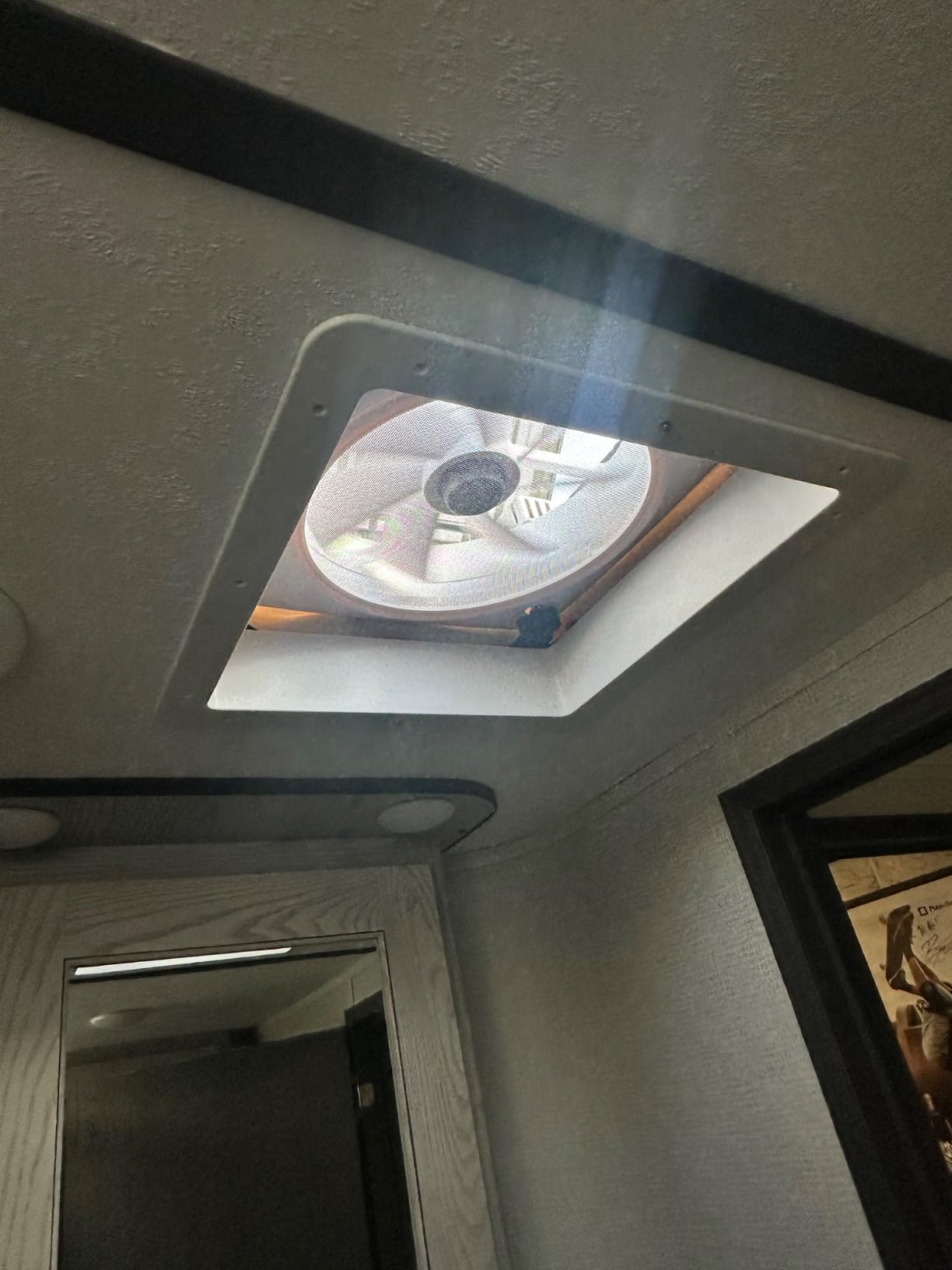
Build quality is the strongest argument. The housing is reinforced ABS and polycarbonate with an extra 1 mm of material in the lid and housing compared to standard units, and owners single that out as noticeably more solid than a factory vent, with less rattling. Airflow is reversible for intake and exhaust, with a smooth ramp through all four speeds.
At 12 pounds this is a heavy unit, and that is not a specification to ignore on a van roof. It is a two-person job unless you have a stable platform.
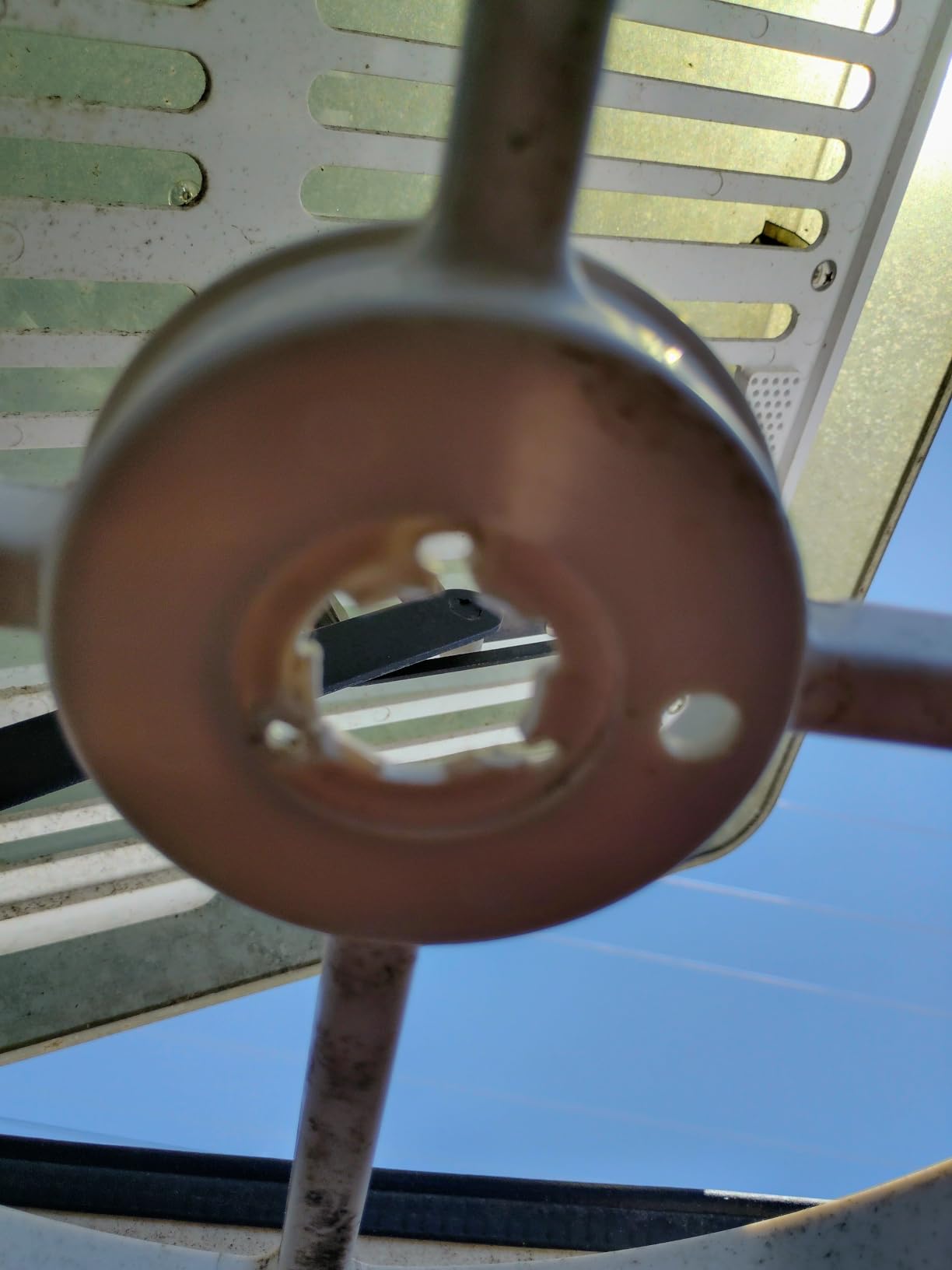
Is voice control actually useful in a van?
It is a genuine convenience when your hands are wet, when you are lying down, or when the fan is on the roof and the switch is not. It also requires a smart assistant to be set up, so the included remote and the local buttons remain the realistic daily controls. Treat voice as a bonus rather than a feature you will depend on.
It fits the standard 14 inch opening, or 356 by 356 millimetres, which is the compatibility you want if you have an existing hole. The remote, manual instructions, screws, and trim are all in the box.
What does the timer actually save you?
It removes the two biggest objections to running a fan while you are not in the van: noise for nearby campers and flat battery in the morning. Set it for the hours you are asleep, let the rain sensor handle unexpected weather, and the fan shuts itself off when the window closes.
At 25 watts, an eight-hour run is 200 watt-hours, or about 17 amp-hours from a 12 volt bank. On a 200 amp-hour house setup that is comfortable, and on a small solar-only build you would want to use the lower speeds instead.
10. Livpow 14×14 Reversible Vent – One-Piece Sealed Frame
Livpow RV Roof Vent With 12V Fan Reversible 14″ x 14″
Reversible 12V fan
14x14 inch opening
1.17 inch profile
Two-wire install
Pros
- One-piece seamless frame resists leaks
- Reversible for intake and exhaust
- Replaces Ventline Jensen and Elixir vents
- Simple two-wire install most owners do themselves
- Low power draw
Cons
- Motor noticeably noisier than premium units
- Fewer screws than the 24 mounting holes
- Crank handle screws too long causing wobble
At 4.1 stars from 337 reviews this is the lowest-rated product among these ten, and it is worth understanding exactly why before you dismiss it. The one-piece seamless frame is designed to resist leaks, and the reversible fan pushes stale air out and draws fresh air in on a vent most owners complete themselves.
It is also a direct replacement for Ventline, Jensen, and Elixir vents, fits roofs from 1-1/4 to 2-1/4 inches thick, and comes with a garnish ring, screws, and a translucent white lid that passes some light into the cabin.
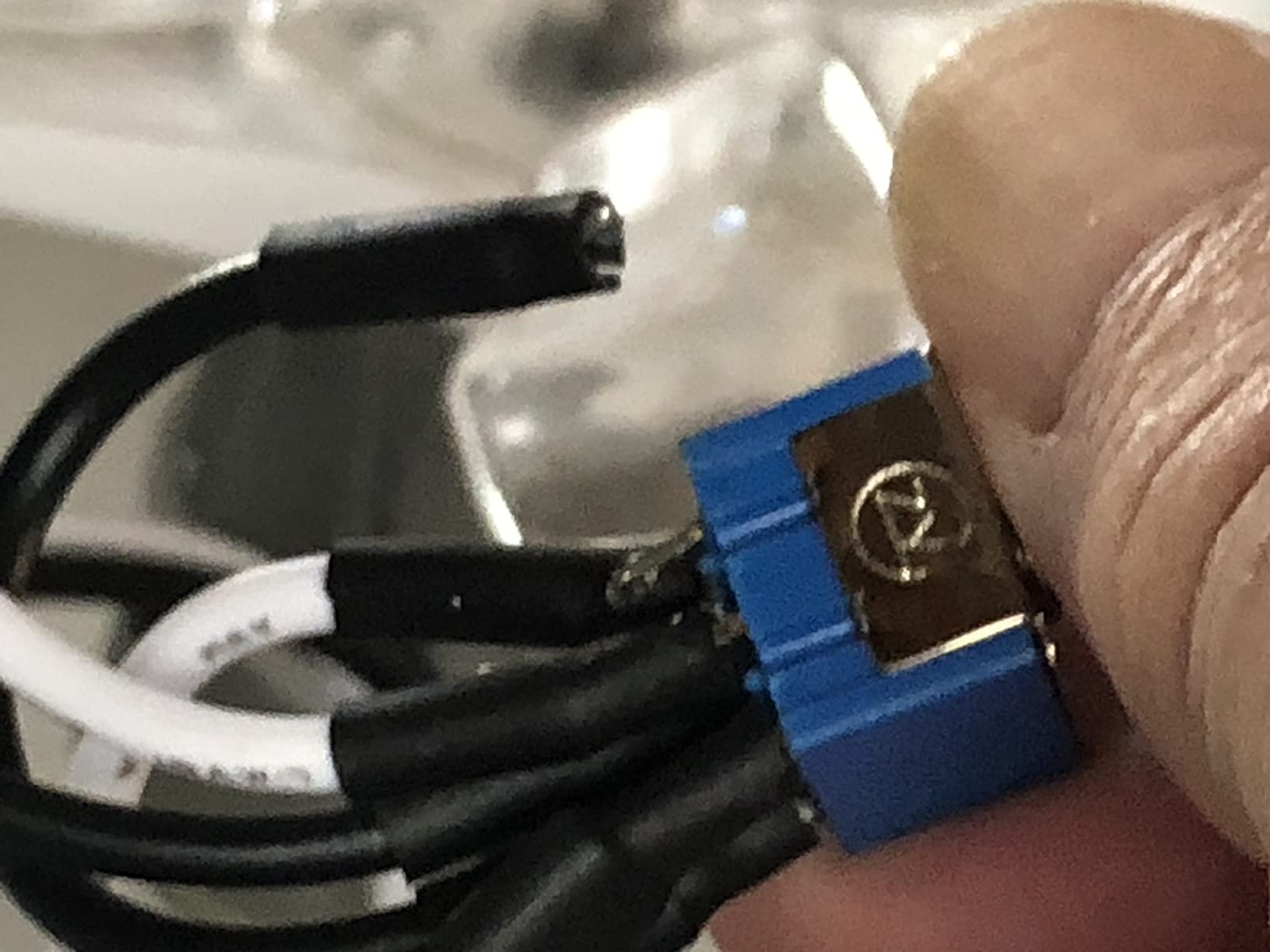
The recurring complaints are specific. The motor is noisier than premium units. The screw count falls short of the 24 mounting holes, and sealant plus extra screws have to be bought separately, which is a strange omission for a replacement part. The included crank-handle screws are too long and cause the handle to wobble, and a few owners report the lid popping open in wind or the fan switch failing soon after fitting.
For a van parked in open ground or a windy campsite, a lid that lifts is not a minor issue. Test it holds before you rely on it for unattended ventilation.
Is the low rating a dealbreaker?
Not necessarily. A 4.1 average on 337 reviews with 61 percent five-star ratings describes a functional budget part, not a broken one. If you need leak resistance and reversible airflow without cutting a new roof opening, the frame design is the argument for it.
If you want low draw and low fuss, the Ventline CW001 costs less and has a better average. Choose this one for the sealed frame and the reverse capability, not for the rating.
Will it fit your existing vent hole?
Yes, if your hole is a standard 14 by 14 inch opening and your roof is between 1-1/4 and 2-1/4 inches thick. The item thickness of 1.17 inches makes it a shallow-profile unit, which is helpful where interior headroom is already tight above a bed.
The low-profile interior trim is the only trim option offered, so if your ceiling is unusual you will need to trim it. The two-wire connection keeps the wiring simple, and that is the main install positive here.
What to Look for When Buying a 12V Fan for a Van
Cut-out size comes first and it is not negotiable. Almost every unit in this roundup fits a standard 14 by 14 inch opening, which is the RV industry default. The exceptions are the Ventline CW001 at 14.25 inches and the HENG’S 71112A at 14.5 inches. Measure your rough opening across both axes before you order anything, and check the roof thickness range against your panel, which ranges from about 1.16 to 5.5 inches across these products.
Reversible airflow is the feature that separates a useful vent from a basic one. Exhaust mode pulls hot air out through the roof at midday; intake mode draws cool night air in. A non-reversible unit only moves air in one direction, which is fine for a wet room and inadequate for a whole van.
Noise is where buying decisions go wrong. A fan above an overhead bunk has to be usable on its lowest speed, and the published figures are usually top-speed figures. The 25 dB brushless units in this roundup are built for sleeping; anything rated 45 dB or above is a fan you would run while working, not while trying to rest.
Power draw determines whether the fan is usable off-grid. Multiply watts by hours and you have watt-hours; divide by twelve and add roughly fifteen percent for inverter losses and you have amp-hours from the bank. A 4 watt unit running eight hours costs about 2.7 amp-hours. A 40 watt unit on the same schedule costs about 27. That single calculation should rule several products out before you have cut a hole.
Blade span and interior width deserve more attention than they get. A 14 inch blade sounds modest until you realise it has to sweep inside a 14 inch aperture, and a van bay is often narrower than you assumed once the wall panels and insulation are in. A shorter blade clears tight ribs and sloped ceilings more easily, which is why the 6 inch and 9 inch blades in this list get recommended for curved roofs and pop-tops.
Two final checks. If you run 24 volt house batteries, a 12V fan needs a DC-DC converter with enough headroom, and cheap converters with no filtering will produce audible whine. And if you travel on salt coasts, corrosion kills these motors faster than inland travel, so rinse the roof fitting with fresh water and check the wiring terminals periodically.
Installing a 12V Vent Fan Without Leaking the Roof
Most roof leaks in van conversions are not caused by a bad fan. They are caused by cutting a hole, letting the edges of the aluminum skin flex, and then sealing the perimeter with a bead of sealant that eventually lets go. The flange is what prevents that, and it has to sit on flat metal that has not been weakened.
Support the area around the cut-out so the panel does not flex when you tighten the flange. Cut a clean hole with a hole saw on a low speed with masking tape over the blade to stop the paint flaking, and deburr the edge thoroughly. The listed sharp-flange warnings on two of these products are not marketing copy.
Butyl tape goes under the flange, not over it. It is the only part of the assembly that genuinely seals, and it needs a clean dry surface and firm pressure across the whole width. Add bedding sealant over the flange for belt and braces, then trim the excess once it skins over. The Ventline CW001 and the caqeg unit both include putty tape, and the Starvent includes a full set of screws and a garnish ring.
On the electrical side, run a fused 12V circuit from the house bank rather than plugging into a cigarette lighter socket. A 60 watt fan will exceed what a factory socket is designed for, and forum reports describe plug-in voltage controllers being modified until the socket fuse blows. If you must use a socket for a low-draw unit, fuse it properly at the source and keep the run short.
Run the fan for several minutes before you close the roof up. Reversible motors sound different from exhaust to intake, and a rubbing blade or a loose screen is far cheaper to fix while you still have the ceiling open.
Frequently Asked Questions
What is the best 12V fan for a camper van?
The MAXXAIR Maxxfan Deluxe is the best overall 12V fan for a camper van, with a ten-speed reversible motor, a thermostat, a built-in rain cover and a tool-free insect screen, backed by 1701 reviews at 4.6 stars. The RVLOVENT 14 inch unit is the best value option, delivering strong airflow from an 18 watt motor at a 45 dB rated noise level. The Ventline CW001 is a low-cost choice for a straight like-for-like vent swap.
What is the best 12V cooling fan for a campervan?
Cooling in a van comes from moving air across your skin and removing hot air through the roof, not from lowering the temperature. A reversible 12V roof vent fan does both: run it as exhaust on a hot afternoon and as intake overnight to pull cool night air in. The RVLOVENT and the Starvent are the strongest reversible options here, and both move far more air than the single-speed 3.6 watt and 4 watt units.
What is the best portable 12V fan for camper use?
A portable 12V fan is the right pick when you are lying on a bunk or working at a table where a roof-mounted unit is too far away. Choose one that plugs into a 12V socket or runs off an internal battery, and expect it to need more attention overnight than a hardwired ceiling unit. For unattended or all-night ventilation, a hardwired roof vent fan with a timer gives you far more control.
What is the best fan for a camper van?
It depends on the job. A reversible 12V roof vent fan handles heat, humidity and cooking odours for the whole van. A portable 12V fan handles the person directly in front of it. A window or hatch fan needs a shroud, or an airtight box around the opening, or air simply reverses and blows straight back out. For most full-time builds, a hardwired reversible roof vent on a timer is the answer.
How much power does a 12V ceiling fan draw?
Draw ranges from 3.6 watts on the single-speed budget vents to 60 watts on the Maxxfan Deluxe at full speed. A 4 watt fan running for eight hours uses about 32 watt-hours, roughly 2.7 amp-hours from a 12V bank. A 40 watt fan over the same period uses about 320 watt-hours, roughly 27 amp-hours. Add around fifteen percent for inverter losses, then size your solar and house battery against that figure.
Can you run a 12V ceiling fan off a van battery?
Yes, and it is the normal way these are powered. Run it from a fused 12V circuit on the house bank rather than a cigarette lighter socket, especially for anything drawing 20 watts or more. If your build runs 24V house batteries, add a DC-DC converter with filtering, or the fan will whine. Always fit an inline fuse close to the battery so a fault does not take the whole system down.
The Verdict: Which 12V Fan Belongs in Your Van
The MAXXAIR Maxxfan Deluxe takes the top spot among the best 12v ceiling fans for camper vans because it does the most jobs in one sealed unit, and its 1701 reviews at 4.6 stars make it the most proven option here. The RVLOVENT is the smart buy if you want most of that capability for a fraction of the outlay, and the Ventline CW001 covers the simple repair case without drama.
Measure your rough opening before anything else, then match the noise figure to where the fan will sit. Over a bunk, go quiet. In a galley, go powerful. Check the build threads for the roof cut-out before you cut.