
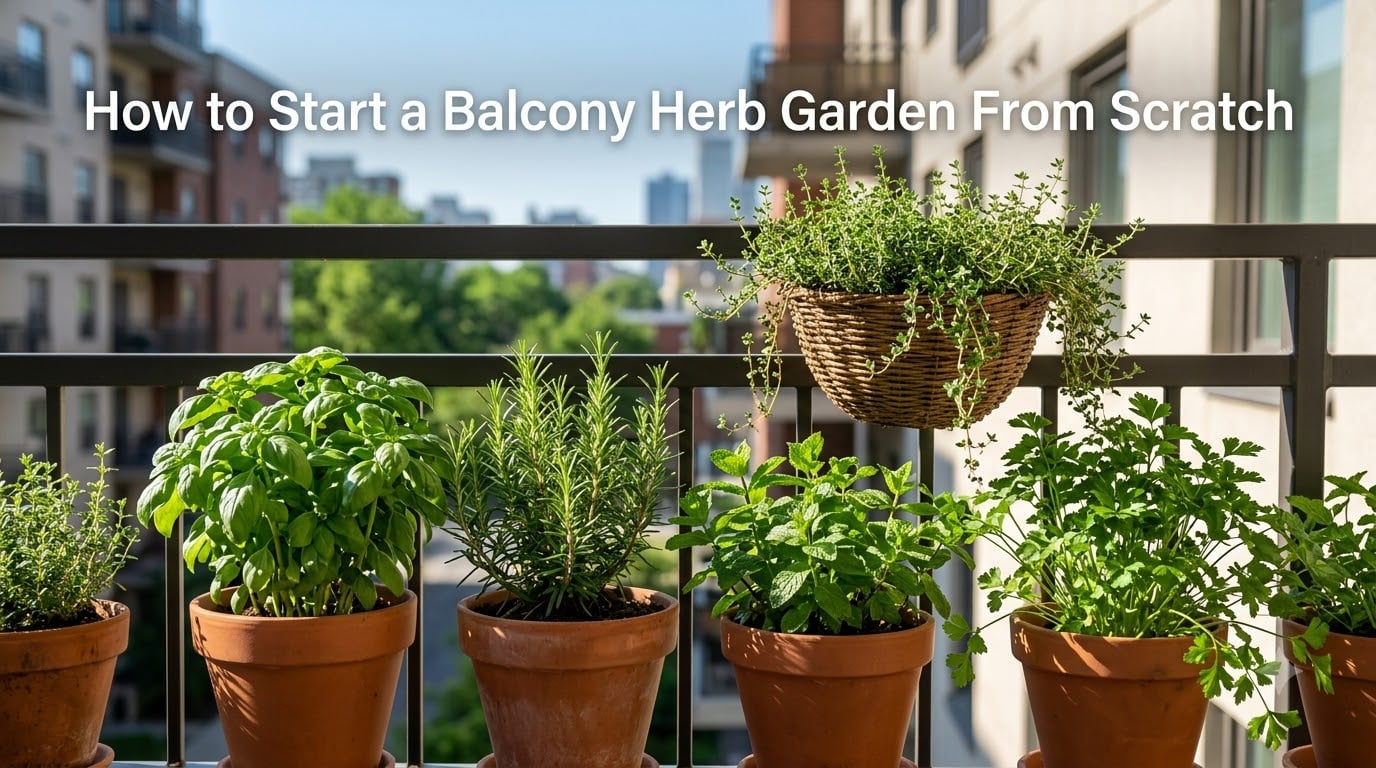
If you have ever wanted fresh basil on a Tuesday night or mint for your mojito without racing to the store, learning how to start a balcony herb garden from scratch is one of the most satisfying weekend projects I know. A few pots, a bag of potting soil, and a sunny corner of your railing can turn a forgotten slab of concrete into a year-round source of flavor, scent, and greenery.
I started my own balcony setup three years ago with two mismatched terracotta pots and a flat of supermarket basil. Since then I have expanded to nine containers holding everything from rosemary to Thai basil. The whole hobby runs on a handful of basic rules, and I will walk you through every one of them. By the end of this guide, you will know exactly how to start a balcony herb garden even if you have never kept a plant alive longer than a week.
This guide draws on beginner-friendly advice from horticultural forums, university extension materials, and my own trial-and-error over three full growing seasons. Whether your balcony faces south and bakes in summer or stays shaded against a north wall, there is a balcony herb garden setup that will work for you. Let us dig in.
Table of Contents
What Is a Balcony Herb Garden and Why Start One
A balcony herb garden is a small-space container garden that grows culinary or aromatic herbs in pots, railing planters, or vertical setups on an apartment or condo balcony. It does not require soil in the ground, a yard, or even a green thumb to begin. Everything you grow sits in containers you control, which makes a balcony herb garden one of the easiest entry points into gardening.
Yes, you can grow herbs on almost any balcony. I have seen thriving setups on balconies as small as 3 feet by 6 feet. What you need is light, water, drainage, and a few containers. If your balcony has at least four hours of direct sun, you can grow a meaningful herb garden. If it is shadier, you can still grow mint, parsley, chives, and a handful of shade-tolerant herbs.
Why bother at all? Fresh herbs are wildly expensive at the grocery store, and they wilt in the fridge within days. A single basil plant can produce a fistful of leaves every week for an entire summer. Herbs also attract pollinators if you let a few of them flower, they smell good when you brush past them, and the act of watering them is its own small stress-reliever. There is a reason container gardening is one of the fastest-growing hobbies in urban areas.
Beyond the practical benefits, a balcony herb garden gives you a relationship with what you eat. When I snip chives off my own plant, I taste them within five minutes. That is a flavor you simply cannot buy. This guide is built for anyone who wants that experience but does not know where to begin.
Step-by-Step: How to Start a Balcony Herb Garden From Scratch
How do you actually start a balcony herb garden as a beginner? Follow these eight steps in order. Most people can complete the setup on a single Saturday morning and have seedlings in the soil by lunch.
Step 1: Observe Your Balcony’s Light
Spend two to three days watching how the sun moves across your balcony. Note which hours are in full sun, which are in shade, and which are in partial sun. Most culinary herbs want at least six hours of direct sunlight, but a few tolerate less. Knowing your light zones lets you match the right herb to the right spot. Mark north, south, east, and west exposure with a sticky note on the wall so you do not forget.
Step 2: Pick Five Beginner Herbs
Do not plant twenty herbs on day one. Pick five: one or two annuals (basil, dill, cilantro), two perennials (mint and oregano or thyme), and one flavorful evergreen (rosemary or sage). This combination gives you variety without overwhelming you. You can always add more in month two.
Step 3: Buy Containers with Drainage Holes
Every pot you buy needs a drainage hole at the bottom. Without one, water pools, roots rot, and your herbs die. Get one container per herb or pair compatible herbs in larger pots. Terracotta breathes well, plastic is lightweight, fabric grow bags are forgiving. Pick whatever fits your balcony weight limits and aesthetic.
Step 4: Fill Containers with Quality Potting Soil
Do not use garden soil in containers. It compacts, holds too much water, and brings weeds. Buy a bagged potting mix labeled for containers. Mix in a handful of perlite or vermiculite to improve drainage, especially for Mediterranean herbs like rosemary and thyme that hate wet feet.
Step 5: Choose Between Seedlings and Seeds
For your first season, I strongly recommend buying small seedlings (also called starts or transplants) from a nursery or farmers market. They give you a months-long head start over seeds and dramatically improve your odds of success. Reserve seed-starting for basil and cilantro, which germinate fast and grow quickly enough to keep up.
Step 6: Plant and Water In
Water each seedling an hour before planting. Dig a hole slightly larger than the root ball, set the plant in at the same depth it grew in its nursery pot, firm the soil around it, and water deeply until water runs out the drainage hole. This settles the soil and eliminates air pockets around roots.
Step 7: Set Up a Watering Routine
Check your pots daily for the first two weeks. Stick a finger one inch into the soil. If it feels dry, water. If it feels damp, wait. Most balcony herbs want consistently moist (not soggy) soil. Setting a phone alarm for the same time each morning turns watering into a habit you do not forget.
Step 8: Begin Light Harvesting After Three Weeks
Resist the urge to harvest for the first three weeks. Let plants establish roots. After that, pinch off the top few inches of each stem, just above a leaf pair. This triggers branching and gives you a fuller, bushier plant. Never remove more than one-third of the plant at a time.
Choosing the Best Herbs for Your Balcony
What are the easiest herbs to grow on a balcony? The short answer: basil, mint, parsley, chives, and rosemary. These five tolerate a wide range of conditions, forgive watering mistakes, and give you flavors you will actually cook with. Let us break the rest down into annuals (which you replant each year) and perennials (which come back).
Best annual herbs for containers: basil (sweet, Thai, lemon), cilantro, dill, Italian parsley, summer savory. Annuals grow fast, produce heavily for one season, and then set seed and die. They are perfect for first-year gardeners.
Best perennial herbs for containers: mint (spearmint, peppermint, chocolate), oregano, thyme, sage, chives, rosemary, lavender, French tarragon. Perennials return for several years in the same pot, though you will need to divide or replace them every two to three years when they get root-bound.
When you are choosing plants, think about what you actually cook with. There is no point in growing dill if you never make pickles. I keep a “pasta pot” cluster (basil, oregano, thyme) and a “tea and cocktail” cluster (mint, lavender, lemon balm). Pick a flavor theme and the choices get easy.
For shadier balconies, prioritize mint, parsley, chives, cilantro, and lemon balm. These tolerate four hours of sun, which is what most north-facing balconies receive. For sunny south-facing balconies, lean into Mediterranean herbs: rosemary, thyme, oregano, sage, and lavender. They love heat and will reward you with intense fragrance.
Light Requirements by Herb
How much sun does a balcony herb garden need? Most herbs want six or more hours of direct sunlight, but a surprising number tolerate partial shade. Matching the herb to the light is the single biggest factor in success. Here is how the popular picks break down.
| Herb | Sun Need | Tolerates | Notes |
|---|---|---|---|
| Basil | Full sun (6+ hrs) | Light afternoon shade in heat waves | South-facing ideal |
| Rosemary | Full sun (6+ hrs) | Drought once established | Mediterranean classic |
| Thyme | Full sun (6+ hrs) | Lean, dry soil | Loves terracotta |
| Oregano | Full sun (6+ hrs) | Heat and dry spells | Cuts back well |
| Sage | Full sun (6+ hrs) | Dry conditions | Woody stems over winter |
| Mint | Partial shade (3-5 hrs) | Almost anything | Aggressive, give its own pot |
| Parsley | Partial sun (4-6 hrs) | Some shade in summer | Slow to germinate, buy starts |
| Chives | Full sun to partial shade | Cold and heat | Perennial, comes back yearly |
| Cilantro | Partial sun (4-6 hrs) | Cool weather | Bolts in summer heat |
| Lemon balm | Partial shade (3-5 hrs) | Spreads like mint | Containment recommended |
If your balcony gets less than four hours of direct sun, focus on mint, parsley, chives, and cilantro. If you get more than six, the full Mediterranean lineup will thrive. East-facing balconies (morning sun) suit leafy herbs well. West-facing balconies (afternoon sun) suit Mediterranean herbs.
Containers, Soil, and Drainage Essentials
The three biggest infrastructure decisions in container gardening are container material, container size, and the growing medium inside. Each choice influences how often you water and how happy your herbs stay.
Picking the Right Container
Container size matters more than people think. Most herbs need at least six inches of soil depth to develop a healthy root system. Smaller herbs like thyme and chives do fine in six-inch pots. Basil, parsley, and oregano want eight to ten inches. Mint, rosemary, and lavender want a twelve-inch pot or larger. A root-bound plant struggles to absorb water, even if you water it every day.
Material matters too. Terracotta pots breathe and look beautiful, but they dry out fast and are heavy. Plastic pots are lightweight and cheap, but they can heat up in summer sun and cook roots. Fabric grow bags air-prune roots, drain well, and fold flat for storage. Glazed ceramic holds moisture longer and comes in colors that match your decor. There is no single best answer. Pick what fits your climate and routine.
Why Drainage Holes Are Non-Negotiable
Every container needs at least one drainage hole at the bottom. Without drainage, excess water has nowhere to go. Roots sit in a swamp, oxygen-starved, and the plant develops root rot. I have killed more herbs with overwatering than with any other cause. If a decorative pot you love has no hole, drill one, keep it as a cachepot, or use it only with a nursery pot inside.
Place a saucer under each pot to catch runoff. Empty the saucer within 30 minutes of watering so roots do not sit in standing water. On a balcony, this also keeps the floor or the neighbor below you dry.
Potting Soil, Not Garden Soil
Potting soil is a soilless mix designed for containers. It is light, drains fast, and contains peat moss, coconut coir, perlite, or vermiculite to hold some moisture without compacting. Garden soil, by contrast, compacts in containers, drains poorly, and introduces weed seeds and pathogens. For container gardening, always start with a bagged potting mix labeled for pots or containers.
For Mediterranean herbs like rosemary and thyme, I mix in extra perlite or coarse sand. Roughly 70% potting mix to 30% perlite gives the fast-draining conditions these herbs evolved to love. For basil and parsley, plain potting mix works fine.
Watering, Fertilizing, and Pruning Basics
Daily care is where a balcony herb garden becomes a habit. Watering, fertilizing, and pruning are three routines you will repeat weekly. Once they click, the whole thing runs on autopilot.
Watering: The Finger Test
The finger test is the simplest watering rule in gardening. Stick your index finger one inch into the soil. If it feels dry at the tip, water. If it feels damp, wait. Check pots daily in summer, every two or three days in spring and fall. In deep winter, water sparingly.
Water in the morning whenever possible. Morning watering lets foliage dry before nightfall, which reduces fungal disease. It also means the plant has access to water during the hottest part of the day. Water at the base of the plant, not over the leaves, to keep foliage dry.
Common signs of overwatering: yellow lower leaves, soft stems, soil that smells sour, fungus gnats hovering around the pot. Common signs of underwatering: wilting, crispy leaf edges, soil pulling away from the pot sides. When in doubt, lift the pot. A dry pot is dramatically lighter than a wet one.
Feeding with Fertilizer
Container-grown herbs run out of nutrients faster than in-ground plants because watering leaches fertilizer out the drainage hole. Every four to six weeks during the growing season, I water with a diluted liquid fertilizer. Look for a balanced N-P-K like 10-10-10, or an organic fish emulsion if you prefer to keep things natural.
Yellow leaves can mean a nitrogen deficiency. Slow growth despite good light and water can mean phosphorus or potassium issues. A light monthly feeding solves most of these. If you are an organic gardener, refresh the top inch of soil with compost every spring.
Pruning and the Cut-and-Come-Again Rule
Cut-and-come-again is the harvesting technique where you snip the top few inches of a stem just above a leaf pair, and the plant branches into two new stems from that point. Repeat every week or two, and a single basil plant becomes a leafy bush.
The rule: never remove more than one-third of the plant at once. If you cut more, the plant struggles to photosynthesize and recover. For basil, pinch off flower buds as soon as you see them; flowering makes the leaves bitter and slows leaf production.
Companion Planting: What to Pair and What to Keep Apart
What herbs should never be planted together? The short version: mint should almost always live alone, and herbs with very different water needs do not pair well. Beyond that, most culinary herbs play nicely together. Here is a quick pairing guide.
| Pair These Together | Keep These Apart |
|---|---|
| Basil + Parsley + Oregano | Mint + Anything (mint invades) |
| Rosemary + Thyme + Sage | Rosemary + Basil (water needs conflict) |
| Chives + Parsley + Cilantro | Sage + Basil (sage likes drier soil) |
| Lemon balm + Mint (separate pots only) | Fennel + Most herbs (allelopathic, inhibits growth) |
| Lavender + Rosemary + Thyme | Dill + Caraway (cross-pollinates, weakens both) |
The most common beginner pairing mistake is putting mint in a mixed herb pot. Mint sends out underground runners that take over the container within one season. Anything sharing that pot suffocates. Always give mint its own pot, even a small one.
Another pairing rule: match moisture lovers together (basil, parsley, chives) and drought lovers together (rosemary, thyme, sage, oregano). When you put a moisture lover and a drought lover in the same pot, one of them will be unhappy no matter how you water.
Design Ideas for Small Balconies
Even a small balcony can host a thriving herb garden if you use vertical and railing space. Here are four layout strategies I have tested personally or seen work well on real balconies.
Vertical Herb Garden
A vertical garden uses wall-mounted planters, stacked pocket planters, or a freestanding tiered shelf to grow upward instead of outward. This is ideal for a 3-foot by 6-foot balcony where every square foot counts. Pocket planters made of felt work well because they are lightweight and drain easily.
Railing Planters
Railing planters hook over the top of a balcony railing and put herbs at eye level. They are great for trailing herbs like thyme or for herbs you harvest daily like chives and parsley. Make sure the planter is securely fastened if you live somewhere windy. Falling planters are a real liability in high-rise buildings.
Hanging Baskets
Hanging baskets free up floor space entirely. Mint, cascading thyme, and trailing nasturtiums all look beautiful and grow well overhead. Hang them from ceiling hooks rated for the weight of a fully watered basket, which is heavier than you would expect.
Edge and Floor Cluster
If you have floor space, group your pots along the balcony edge where they get the most sun. Cluster them in odd numbers (3, 5, 7) for visual appeal. Use pot feet or risers to lift containers off the deck so they drain cleanly and air circulates underneath.
5 Common Beginner Mistakes (and How to Avoid Them)
I read through years of beginner threads on Reddit’s r/gardening and r/UrbanGardening to surface the mistakes that come up again and again. Here are the five most common ones and exactly how to avoid each.
Mistake 1: Overwatering and Root Rot
The single most common beginner mistake is watering on a schedule instead of by need. Herbs in containers dry out at different rates depending on sun, wind, and pot size. Water only when the finger test says so. If you have already overwatered, repot into fresh dry soil, trim any black mushy roots, and withhold water until the plant recovers.
Mistake 2: Sharing a Pot with Mint
As I mentioned in the companion planting section, mint takes over. Reddit users repeatedly post photos of mint that swallowed basil and parsley within one season. Give mint its own container, ideally its own corner of the balcony. If you want mint in a mixed pot, choose a variety like mint-in-a-pot with a root barrier or accept that you will be repotting constantly.
Mistake 3: Pots That Are Too Small
Undersized containers are a leading cause of stunted growth, wilting despite daily watering, and root-bound plants that never thrive. A general rule: choose a pot one size larger than the nursery pot the plant came in, and go bigger for fast-growing annuals like basil.
Mistake 4: Black Plastic Pots in Direct Sun
Black or dark plastic pots absorb solar heat and can cook root systems on hot summer afternoons. If you live in a hot climate or your balcony faces south, choose terracotta, fabric grow bags, or light-colored containers. Or shade the pots with a lattice, tablecloth, or grouping arrangement.
Mistake 5: Forgetting About Wind
Balconies on higher floors or exposed corners can be brutally windy. Wind desiccates leaves, dries out soil, and snaps stems on tall herbs like dill and cilantro. A simple windbreak (a tall reed screen, a piece of lattice, or a row of denser plants) reduces damage overnight. Stake or cage tall herbs if your balcony is a wind tunnel.
Winter Care and Overwintering Herbs on a Balcony
Can you keep a balcony herb garden alive through winter? Yes, with some planning. The key is understanding what your climate can handle and what each herb can tolerate. Here is a quick hardiness reference for popular herbs.
| Herb | Cold Hardy To (USDA Zone) | Winter Strategy |
|---|---|---|
| Rosemary | Zone 7-10 (some cultivars to Zone 6) | Outdoor if mild; bring inside if freezing |
| Thyme | Zone 5-9 | Outdoor, mulch the crown |
| Sage | Zone 4-8 | Outdoor, light mulch |
| Oregano | Zone 5-10 | Outdoor, dies back then returns |
| Mint | Zone 3-8 | Outdoor, dies to ground in cold, returns |
| Chives | Zone 3-9 | Outdoor, very cold-hardy |
| Parsley | Zone 4-9 (biennial) | Outdoor with protection or bring inside |
| Basil | Annual (any frost kills it) | Bring inside or treat as annual |
| Cilantro | Annual (cool season) | Sow in fall, harvest before frost |
| Lemon balm | Zone 3-7 | Outdoor, dies back then returns |
If you live in a cold-winter climate (USDA Zones 3-6), bring your most tender herbs indoors before the first frost. A sunny south-facing window or a basic grow light keeps basil and rosemary going all winter. Reduce watering and stop fertilizing through the darkest months, when growth slows. Cut back woody herbs like rosemary and thyme by about a third before bringing them in to encourage compact regrowth.
In milder climates (Zones 7-10), many perennial herbs stay outside year-round. Mulch the soil surface with straw or shredded leaves to insulate roots, group pots together against a wall for shared warmth, and water sparingly when the soil is not frozen. Hardening off seedlings before you transplant them outside in spring is the same principle in reverse: gradually expose them to outdoor conditions over a week so they do not shock.
Frequently Asked Questions
What are the easiest herbs to grow on a balcony?
The easiest herbs for a balcony are basil, mint, parsley, chives, and rosemary. Basil and mint grow quickly from small seedlings and forgive beginner watering mistakes. Parsley and chives tolerate partial shade and cooler weather. Rosemary is drought-tolerant once established and produces clippings year-round. Start with two or three of these and add more varieties as you gain confidence.
How do I start a balcony herb garden as a beginner?
Start by observing how much sun your balcony gets, then choose five beginner herbs, buy containers with drainage holes, fill them with bagged potting mix, plant small seedlings rather than seeds, water with the finger test (one inch down), and begin light harvesting after three weeks. Most setups can be completed in a single morning and the plants will be productive within a month.
Can I grow herbs on my balcony?
Yes, you can grow herbs on almost any balcony as long as you have at least three to four hours of direct sunlight, access to water, and containers with drainage holes. Shadier balconies can grow mint, parsley, chives, and cilantro. Sunny balconies can grow the full Mediterranean lineup including rosemary, thyme, oregano, sage, and basil.
What herbs should never be planted together?
Mint should never share a pot with other herbs because it sends out runners that take over. Rosemary and basil have conflicting water needs and should be in separate containers. Sage prefers drier soil than basil, parsley, or cilantro. Fennel is allelopathic and inhibits the growth of most other herbs nearby. Pair Mediterranean herbs together and moisture-loving herbs together, and give mint its own dedicated pot.
What are common herb growing mistakes?
The five most common mistakes are overwatering, sharing a pot with mint, using containers that are too small, choosing dark plastic pots that heat up in sun, and forgetting about wind exposure. Other common issues include forgetting to harden off seedlings before transplanting, harvesting too aggressively too soon, using garden soil instead of potting mix, planting herbs that need full sun in shade, and skipping drainage holes entirely.
How much sun does a balcony herb garden need?
Most culinary herbs need at least six hours of direct sunlight, especially Mediterranean herbs like rosemary, thyme, oregano, sage, and basil. Partial-shade herbs like mint, parsley, chives, and cilantro can grow with three to five hours of direct sun. If your balcony faces north or is heavily shaded, focus on the partial-shade herbs and consider a small grow light to extend the season.
What is the 70/30 rule in gardening?
The 70/30 rule in gardening generally refers to foliar feeding, where you spray leaves with a diluted nutrient solution that is about 70% water to 30% nutrient mix. Some gardeners also use it loosely to mean that 70% of plant problems come from either overwatering or underwatering, with the remaining 30% from other causes like pests, disease, or nutrient deficiency.
Bringing It All Together
That is how to start a balcony herb garden from scratch in 2026, from the first sunny observation through every week’s watering, harvesting, and care routine. The whole project is built on five foundational choices: matching herbs to your sun, choosing containers with drainage holes, using bagged potting mix, watering with the finger test, and harvesting with the cut-and-come-again rule. Master those and the rest is patience.
If I had to give a brand-new gardener one piece of advice, it would be this: start small, start with seedlings, and start with herbs you actually cook with. You will harvest more often, learn faster, and stay motivated. Five pots in year one is infinitely more rewarding than twenty abandoned pots in year three.
Pick a sunny weekend, grab five herbs and five pots, and put them on your balcony. In three weeks you will be snipping fresh basil for pasta and wondering why you waited so long. Container gardening rewards consistency, and the best way to learn is to begin. Your future self will thank you every time dinner needs a little something fresh.