
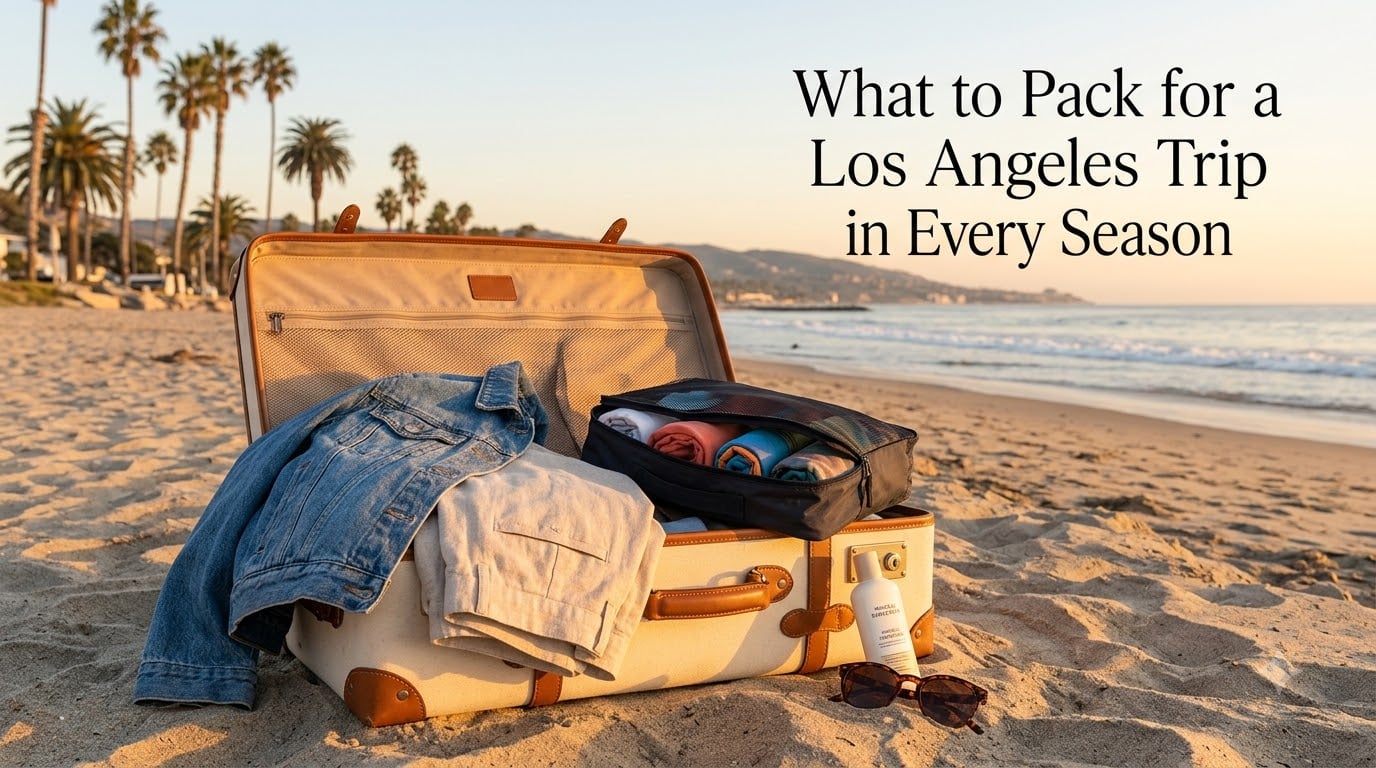
Los Angeles is one of the easiest cities in the world to visit and one of the trickiest to pack for. The sun is strong almost every day of the year, but the temperature can swing 15 to 20 degrees between a Santa Monica morning and an afternoon in the San Fernando Valley. Locals will tell you to bring layers, and they mean it: a single day in LA can start with marine-layer fog, burn off into 80-degree sunshine, then drop back into the 60s by dinner.
In this guide, I walk you through what to pack for a Los Angeles trip in every season, drawing on the same weather patterns locals use to plan their own weeks. You’ll get a month-by-month temperature and rainfall reference, a year-round essentials checklist, four season-specific packing lists, footwear breakdowns, and the packing-rule frameworks (the 5-4-3-2-1 and the 3-3-3) that answer the most-asked questions on Reddit and Tripadvisor. Whether you’re flying in for a long weekend or a two-week stay, the goal is the same: one suitcase, no stress, and outfits that work from a Beverly Hills rooftop to a Malibu beach.
Table of Contents
LA Weather at a Glance: Why Microclimates Change Your Packing List
Los Angeles has a Mediterranean climate, which means mild, wet winters and warm, dry summers. On paper, that sounds simple. In practice, LA’s microclimates make it one of the most weather-variable major US cities. The coast (Santa Monica, Venice, Malibu) sits 10 to 15 degrees cooler than the Valley (Studio City, Burbank, Sherman Oaks) on most afternoons, and the Hollywood Hills often run a few degrees warmer than downtown after sunset.
The phrase you’ll hear most from locals is June Gloom: a pattern of overcast, cool, gray mornings that arrives in late May and lingers through June along the coast. Mornings can feel like 58 degrees with drizzle, then burn off into 75-degree sunshine by 1 p.m. After that, July through September is reliably hot and dry inland, with the occasional Santa Ana wind event in October and November that pushes temps even higher and drops humidity into single digits.
So when you pack for LA, you’re really packing for three things at once: warm afternoons, cool marine-layer mornings, and dinner evenings where the breeze off the Pacific can cut through a sundress. The strategy that works is layering with breathable fabrics and always carrying one extra layer in your day bag.
Month-by-Month LA Weather and Temperature Reference
This table gives you the average high, average low, average rainfall, and a one-line packing note for every month in Los Angeles. Temperatures are based on downtown LA / LAX averages; expect 5 to 10 degrees warmer in the Valley and 5 to 10 degrees cooler on the immediate coast.
| Month | Avg High (F) | Avg Low (F) | Avg Rainfall (in) | Packing Note |
|---|---|---|---|---|
| January | 68 | 50 | 2.7 | Light jacket, jeans, one umbrella |
| February | 69 | 51 | 3.0 | Layers and a rain jacket |
| March | 70 | 53 | 1.7 | Denim jacket, breathable tops |
| April | 72 | 55 | 0.7 | Light layers, sun hat ready |
| May | 74 | 59 | 0.3 | T-shirts, one cardigan for evenings |
| June | 77 | 62 | 0.1 | June Gloom mornings, warm afternoons |
| July | 83 | 65 | 0.0 | Heat inland, sun protection essential |
| August | 85 | 66 | 0.0 | Hottest month, linen and SPF 50 |
| September | 83 | 64 | 0.1 | Warm days, cooler nights |
| October | 78 | 60 | 0.4 | Light jacket returns, Santa Ana risk |
| November | 73 | 54 | 0.7 | Transitional, pack one sweater |
| December | 68 | 50 | 1.8 | Rain likely, knitwear and waterproof layer |
Two takeaways from the table. First, even LA’s coldest winter month averages a daytime high of 68 degrees, so a heavy coat is overkill for most visitors. Second, the rainy season runs November through March, but even peak rainfall months only deliver a handful of real wet days. A compact umbrella and a packable rain jacket handle 90 percent of weather surprises.
Year-Round Essentials Every LA Trip Needs
No matter what month you arrive, these are the items I never leave home without on an LA trip. They cover about 70 percent of what you’ll actually wear, leaving room in your bag for season-specific pieces.
- SPF 30+ sunscreen, broad spectrum, reef-safe if you plan to swim
- UV-protection sunglasses, ideally polarized for driving
- Lip balm with SPF, because the sun is strong even in February
- One lightweight jacket (denim, trench, or thin puffer) for cool evenings
- Two pairs of comfortable walking shoes: sneakers for hills and one slip-on for casual dinners
- A crossbody day bag or anti-theft backpack for the metro, Runyon, and crowded tourist spots
- Reusable water bottle, because dehydration sneaks up on you in dry LA air
- Phone charger / portable battery pack, since you’ll use Google Maps constantly
- Compression packing cubes to fit everything into a carry-on
- A sun hat or baseball cap for midday beach and rooftop hours
This core set works for a carry-on-only trip and gives you room for two or three seasonal pieces. The rest of this guide tells you what to add for each season.
What to Pack for Los Angeles in Spring (March, April, May)
Spring in LA is the city’s sweet spot. Wildflowers bloom in the hills, temperatures hover in the low 70s, and rain is mostly behind you. Mornings still carry a chill, especially on the coast, so layering is the theme of the season.
For a week-long trip in spring, I pack five short-sleeve tops, two long-sleeve tees, one light cardigan, one denim jacket, two pairs of jeans, one pair of linen or wide-leg pants, and one casual dress. Add a swimsuit and a beach cover-up because spring water temps at Santa Monica are usually swimable by late April.
Footwear for spring is sneakers, sandals, and one pair of low boots for the rare rainy day. Skip anything waterproof unless you’re visiting in early March, when a surprise storm is still possible. One umbrella folded into your day bag covers the rest.
Color palette-wise, spring in LA leans toward pastels, cream, white denim, and the occasional floral. If you’re visiting West Hollywood, Silver Lake, or Abbot Kinney, you’ll fit right in with a relaxed-but-polished elevated-casual look.
What to Pack for Los Angeles in Summer (June, July, August)
Summer is the season locals complain about and visitors underestimate. The Valley regularly hits 95 to 100 degrees in July and August, the sun is relentless from 11 a.m. to 4 p.m., and the only true break is the marine layer in the morning. By afternoon, that fog has burned off and the temperature climbs fast.
For summer packing, swap your denim jacket for a single lightweight cotton cardigan. Bring linen pants, two pairs of shorts, breathable cotton or technical tees, and one pair of wide-leg trousers for dinners. Light-colored fabrics matter: black absorbs heat, and you’ll feel every degree. Add one sundress or matching set for rooftop bars in West Hollywood and Beverly Hills.
For the coast, a swimsuit, a quick-dry cover-up, and reef-safe sunscreen are non-negotiable. Inland, prioritize a wide-brim sun hat and at least SPF 50 for your face. Locals swear by a refillable water bottle and an after-sun aloe gel for the days you forget to reapply.
Even in August, coastal evenings drop into the mid-60s. Pack one long-sleeve layer for night, especially if you’re dining outdoors in Santa Monica, Malibu, or along Abbot Kinney. June Gloom mornings can be genuinely chilly, so if you’re an early-bird beach walker, throw a hoodie in your day bag through late June.
What to Pack for Los Angeles in Fall (September, October, November)
Fall is technically LA’s warmest month in early September, then cools steadily through November. The trade-off is Santa Ana winds, dry offshore gusts that can spike temps 10 degrees above normal in October and increase fire risk. Most days are still warm and sunny, but you’ll want a light jacket ready by 6 p.m.
Pack three short-sleeve tops, two long-sleeve tees, one lightweight sweater or cardigan, one light jacket (cotton trench or unlined canvas works), two pairs of jeans, one pair of chinos or trousers, and one transitional dress. Footwear stays the same as summer for most of September, then shifts to closed-toe sneakers and one pair of ankle boots for late November.
Fall is also when LA locals bring back their leather jackets and dark denim, so if you want to look like you’ve been in the city a while, this is the season to swap your linen for a merino wool sweater and a pair of ankle boots. Just remember, fall in LA is still 70 to 80 degrees most days, so anything heavier than a mid-weight jacket will leave you sweating by lunch.
Rain is unlikely but possible in November. A packable rain jacket weighs almost nothing and earns its space if a forecast turns wet. Umbrellas are easy to find at any corner pharmacy if you get caught without one.
What to Pack for Los Angeles in Winter (December, January, February)
LA winters surprise visitors who expect snow or freezing weather. Daytime highs sit in the upper 60s, lows dip into the upper 40s, and rain falls in short bursts rather than week-long storms. A heavy coat, snow boots, or thermal layers are unnecessary for any LA neighborhood, including the Valley.
For a week-long winter trip, pack five long-sleeve tops or sweaters, two short-sleeve tees for warmer afternoons, two pairs of jeans, one pair of trousers, one merino or cashmere sweater for layering, and one casual dress with tights. Add a rain jacket or packable waterproof shell, since December through early March is your highest chance of wet days.
Footwear is closed-toe sneakers, waterproof ankle boots, and one pair of flats or loafers for dinners. Sandals still work on sunny December days but pair them with jeans rather than shorts to avoid the tourist look. Locals in West Hollywood wear boots, denim, and a leather or wool jacket almost every night from December through February.
One common mistake visitors make in winter is assuming they need a heavy parka. You don’t. The coldest week of the year in LA is still warmer than an average November day in Chicago or Boston. A medium-weight jacket plus layers will keep you comfortable from Malibu to downtown.
Footwear Breakdown: What Shoes to Pack for LA
Shoes take up the most suitcase space, so it pays to be strategic. For most trips, you can get away with three pairs: walking sneakers, sandals or slip-ons, and one dressier pair. Here’s how that lineup shifts by season.
Walking sneakers are non-negotiable. LA has hills (Runyon Canyon, Griffith Park, Silver Lake streets) and long stretches of sidewalk that punish flimsy shoes. Stick to a broken-in pair with good cushion; white leather sneakers are the local staple.
Sandals or slip-ons cover the coast, the beach, and casual daytime errands. Birkenstock-style slides, leather sandals, or canvas slip-ons all work. For dressier settings, swap to a clean pair of leather sandals.
One dressier pair: for spring and summer, that’s a flat sandal or loafer. For fall and winter, it’s ankle boots, Chelsea boots, or leather loafers. Heels are rare in most LA neighborhoods outside Beverly Hills and West Hollywood, and even there block heels are more common than stilettos.
Skip flip-flops outside the beach and the pool. Most restaurants, even casual ones in WeHo and Silver Lake, will turn you away at the door in flip-flops, especially at dinner. Several Reddit threads confirm this is a recurring frustration for first-time visitors.
Sun Protection and Skincare for the LA Sun
LA sun is stronger than most visitors expect, even on cloudy days. UV index hits 8 to 11 from April through September and stays around 4 to 5 even in winter. Skincare is part of your packing list, not an afterthought.
Bring at least one full-size broad-spectrum SPF 30+ for body and one SPF 50 for face. Mineral sunscreen is gentler on sensitive skin and reef-safe for ocean swims. Reapply every two hours when you’re outdoors, especially at the beach, on hikes, or at rooftop pools.
Add a lip balm with SPF, an after-sun aloe vera gel, and a hydrating moisturizer. The dry air pulls moisture out of your skin faster than humid climates do. A small facial mist is a nice-to-have for flights and long days of walking.
Sunglasses with UV protection are a daily essential, not just a beach item. Polarized lenses make driving easier on bright afternoons. A sun hat with a 3-inch brim protects your face, ears, and neck better than sunscreen alone, especially during midday hours.
Tech, Travel Docs, and Day-Bag Essentials
Beyond clothing, a handful of tech and document items will save you stress on an LA trip. These fit in any carry-on and take up almost no space.
- Portable charger (10,000 mAh minimum), because you’ll be on Google Maps, Uber, and Yelp all day
- Offline Google Maps download of LA and any neighborhood you’re staying in
- Phone car charger, since rideshares and rentals both rely on your phone
- ID, credit card, and a backup card stored separately in case of loss
- Printed or screenshot copies of hotel reservation, car rental, and any prepaid activities
- Universal adapter if you’re visiting from outside North America
- Reusable shopping bag, useful for groceries, farmers’ markets, and Melrose shopping
- Anti-theft crossbody or backpack for tourist-heavy areas like Hollywood Walk of Fame and Santa Monica Pier
LA is a car-centric city, but parking is expensive and traffic is real. Many visitors use a mix of rideshare, the Metro rail, and the occasional rental car. Plan to keep your day bag light, with the essentials above, and leave valuables in your hotel safe.
Packing Strategy: The 5-4-3-2-1 Rule and 3-3-3 Rule Explained
Travel forums keep asking about two packing frameworks that simplify the suitcase problem. Here’s exactly what they mean and how to apply them to an LA trip.
The 5-4-3-2-1 Rule for Packing
The 5-4-3-2-1 rule is a carry-on-friendly packing method that gives you five tops, four bottoms, three dresses or layering pieces, two pairs of shoes, and one accessory set (belt, bag, hat, jewelry). It works for trips of 7 to 10 days when you can do laundry mid-trip, and it scales up by adding one or two of each category for longer stays.
For LA specifically, I’d anchor on five tops (mix of short and long sleeve), four bottoms (two jeans, one trouser, one linen or short), three layering pieces (denim jacket, cardigan, light sweater), two pairs of shoes (sneakers plus one other), and one accessory set. Add a swimsuit and one dress and you’ve covered every LA activity from the beach to a Beverly Hills dinner.
The 3-3-3 Rule for Packing
The 3-3-3 rule is the strict version: three tops, three bottoms, three pairs of shoes. It’s designed for a three-day trip and forces a tight capsule wardrobe. Each piece should work with at least two others, and shoes should cover casual, walking, and one dressier situation.
For an LA weekend, I’d pick three tops (one tee, one blouse, one sweater), three bottoms (jeans, trouser, shorts), and three shoes (white sneakers, sandals, ankle boots or loafers). The math guarantees nine outfits from nine pieces, all mixable.
The 3-3-3 Rule for Outfits
There’s also a 3-3-3 rule for outfits, which is different from the packing version. It means three tops, three bottoms, and three layering pieces (or three shoes), where every combination creates a complete outfit. The trick is to choose pieces in a tight color palette so everything works together. Neutrals plus one accent color is the easiest formula.
The 3-5-7 Rule for Packing
The 3-5-7 rule is a longer-trip variant: three tops, five bottoms, seven accessories, often paired with three pairs of shoes and one or two layering pieces. It’s useful for a 10 to 14 day LA trip where you want more variety without checking a bag.
Day-Trip Packing Variations: Beach, Hike, Theme Park, Dinner
Beyond your base suitcase, certain days call for specific add-ons. Here’s how I’d adjust for the four most common LA day trips.
Beach day (Santa Monica, Malibu, Venice): add a quick-dry towel, a larger refillable water bottle, an extra swimsuit, and a soft-sided cooler if you want snacks. Reef-safe sunscreen, sunglasses, and a wide-brim hat are essential.
Hike (Runyon Canyon, Griffith Park, Eaton Canyon): swap your day bag for a small hydration backpack, pack 2 liters of water minimum, bring trail sneakers or hiking shoes, a hat, sunscreen, and a light long-sleeve layer for shaded canyon walls. Leave the sandals at home.
Theme park (Disneyland, Universal Studios): pack a small crossbody that meets bag-size rules, a portable charger, sunscreen, a refillable bottle, a light layer for air-conditioned rides, and comfortable closed-toe sneakers. Compressed packing cubes help if you’re staying off-site.
Beverly Hills or West Hollywood dinner: bring one elevated outfit, swap to leather shoes or ankle boots, and leave the backpack at the hotel in favor of a small clutch or crossbody. Most upscale restaurants enforce a no-athletic-wear policy, so keep athleisure out of the rotation after 6 p.m.
What NOT to Pack for Los Angeles
Equally important is what to leave behind. Locals consistently point to these overpacking mistakes.
- Heavy winter coat: a mid-weight jacket plus layers handles even January
- Formal eveningwear: LA is casual even at nice restaurants; one elevated outfit is plenty
- Multiple beach towels: rentals and hotel towels cover this
- Full-size toiletries: pack travel sizes and restock at a Target or CVS if needed
- Expensive jewelry: not necessary, and harder to insure on the road
- Brand-new shoes: broken-in pairs prevent blisters on hilly sidewalks
- Hairdryer or straightener: most hotels and Airbnbs provide these
The one exception to the no-heavy-coat rule: if you’re combining LA with a drive to Big Bear, Mammoth, or Yosemite, plan for real cold and pack a parka in your trunk. Otherwise, leave it home.
Frequently Asked Questions
What is the 5-4-3-2-1 rule for packing?
The 5-4-3-2-1 rule is a carry-on-friendly packing method: five tops, four bottoms, three dresses or layering pieces, two pairs of shoes, and one accessory set. It works best for 7 to 10 day trips where you can do laundry mid-stay, and it scales by adding one or two of each category for longer visits.
What is the 3-3-3 rule for packing for a trip?
The 3-3-3 rule is a strict three-day packing framework: three tops, three bottoms, three pairs of shoes. Each piece should mix with at least two others, and shoes should cover casual, walking, and one dressier setting. For an LA weekend, pair three tops, three bottoms, and three shoes in a neutral palette with one accent color.
What is the 3-3-3 rule for outfits?
The 3-3-3 rule for outfits means three tops, three bottoms, and three layering pieces (or shoes) where every combination creates a complete look. The trick is choosing pieces in a tight color palette so everything pairs easily. Neutrals plus one accent color is the simplest formula.
What are the essentials to pack for a trip to Los Angeles?
The essentials for any LA trip include SPF 30+ broad-spectrum sunscreen, polarized sunglasses, lip balm with SPF, a lightweight jacket, two pairs of comfortable walking shoes, a crossbody or anti-theft day bag, a reusable water bottle, a portable charger, packing cubes, and a sun hat. These items cover roughly 70 percent of what you’ll need year-round.
What should I pack for a trip to Los Angeles?
Pack for LA by anchoring on year-round essentials: SPF, sunglasses, a lightweight jacket, comfortable walking shoes, and a crossbody day bag. Then add season-specific pieces: linen and a swimsuit for summer, knitwear and a rain jacket for winter, and denim plus a cardigan for spring and fall. Layering is the core strategy because coastal mornings and evenings run 10 to 15 degrees cooler than inland afternoons.
What is the 3-5-7 rule in packing?
The 3-5-7 rule is a longer-trip variant: three tops, five bottoms, and seven accessories, often combined with three pairs of shoes and one or two layering pieces. It’s useful for 10 to 14 day LA trips where you want variety without checking a bag. Choose a tight color palette so the seven accessories (belts, scarves, hats, jewelry) all work across the three tops and five bottoms.
Final Thoughts on Packing for a Los Angeles Trip in Every Season
The simplest version of what to pack for a Los Angeles trip in every season comes down to three things: a lightweight layer you can wear year-round, sun protection you reapply every two hours, and shoes that handle hills and long walks. From there, you add season-specific pieces, a smart day bag, and a packing framework that matches your trip length.
Whether you’re here for a long weekend, a two-week carry-on-only adventure, or a multi-city Pacific Coast loop, the principles hold: layer for microclimates, anchor on a neutral palette, and save room in your bag for whatever you pick up on Melrose or Abbot Kinney. Have a great trip.