
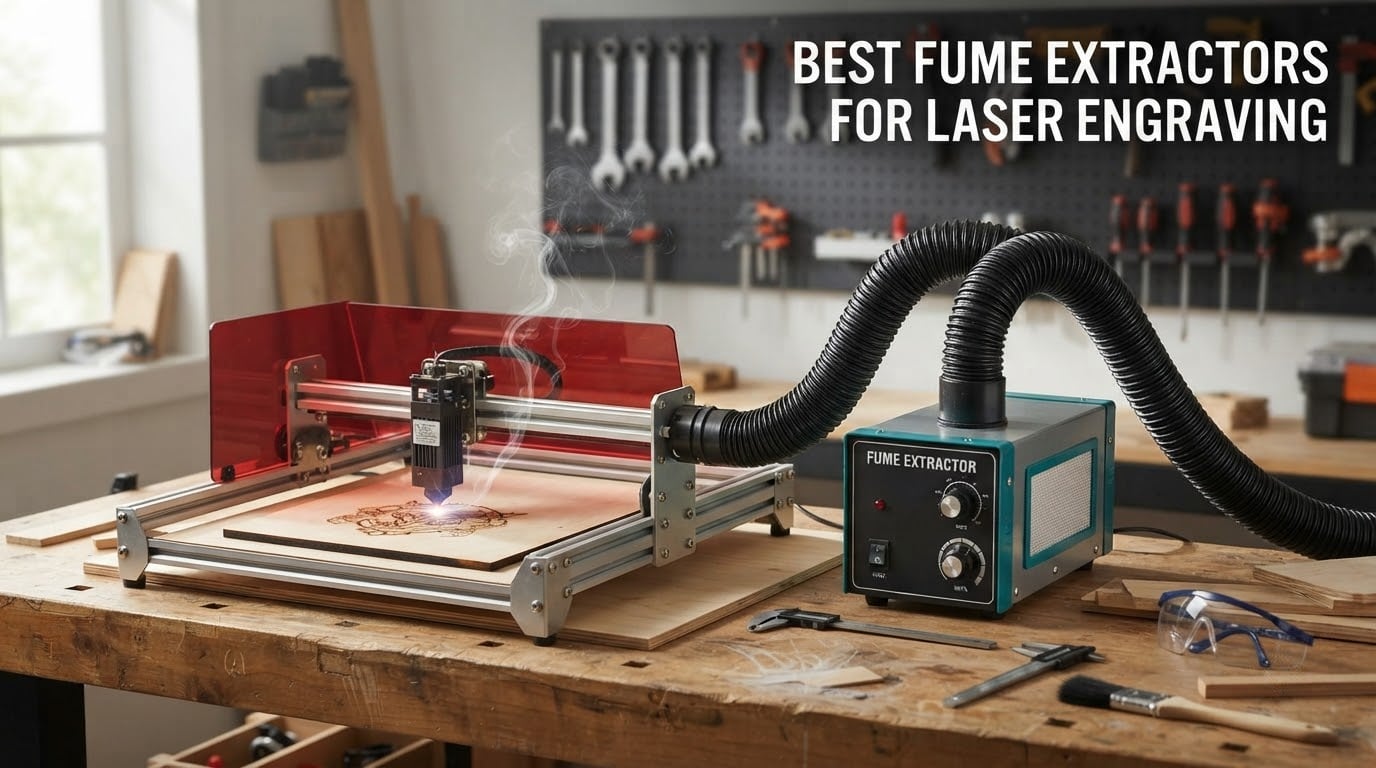
A laser fume extractor is a portable filtration unit that pulls smoke and vapour out of a laser engraver’s or cutter’s exhaust port, runs that air through a pre-filter, a HEPA stage and an activated carbon bed, then returns the cleaned air to the room. Finding the best fume extractors for laser engraving means matching filtration depth to the materials you actually cut, not just reading the airflow number on the box.
Laser work vaporises material instead of burning it, and what comes off the bed is a mix of fine particulate and chemical vapour. Cut wood and plywood and you get glue-derived compounds. Cut acrylic and you get a heavy acrid odour that will not settle. Cut leather or cardboard and you mostly get dust and some organic odour. A bare household air purifier handles none of that properly, which is why the machines sold here all combine particle filtration with carbon media.
We compared ten dedicated units across the price ladder, from a compact desktop purifier to a wheeled 300W machine built for an 80W CO2 cutter. We looked hard at the number of filtration stages, the airflow figure, the port size, the noise rating and, just as importantly, at how owners describe real jobs. We also weighed the reviews with the largest sample sizes most heavily, because a five-star score from two buyers tells you very little.
Two honest caveats before the picks. First, an extractor captures at source only if the hose actually seals to your machine’s exhaust port, and port sizing is the single most common source of buyer frustration in this category. Second, no filter unit removes 100 percent of laser odour, and an oversized carbon bed will do a far better job than a thin one. Both points come up repeatedly in owner discussions, and both shape our recommendations below.
Table of Contents
Top 3 Fume Extractor Picks for Laser Engraving (October 2026)

xTool SafetyPro AP2
- 6-layer SuperCyclone filtration
- 150 m3/h for lasers
- 55 dB
- app and Bluetooth sync

Genmitsu 5-Layer Purifier
- 35 dB desktop unit
- three speed modes
- adapters for 2.5 and 3 inch hose

FumeClear FC-2004
- 420 m3/h suction
- triple filtration
- high-iodine carbon
- 10 spare pre-filters
The xTool SafetyPro AP2 takes our top slot because it is the only unit here with a six-stage stack, a washable cyclone pre-separation stage and the largest body of owner feedback in the roundup. The Genmitsu five-layer purifier wins on practicality for anyone without a dedicated floor space. The FumeClear FC-2004 is the suction heavyweight for anyone driving a diode, fiber or CO2 machine in the 20W to 80W range.
All 10 Fume Extractors Compared Side by Side in 2026
| Product | Specs | Action |
|---|---|---|
| xTool SafetyPro AP2 |
|
Check Latest Price |
| Genmitsu 5-Layer Smoke Purifier |
|
Check Latest Price |
| FumeClear FC-2004 |
|
Check Latest Price |
 KQZ 150W Fume Extractor KQZ 150W Fume Extractor |
|
Check Latest Price |
 BlazeX 3-Stage Fume Extractor BlazeX 3-Stage Fume Extractor |
|
Check Latest Price |
 FUMEGO XF250 FUMEGO XF250 |
|
Check Latest Price |
 G-WEIKE 300W Smoke Purifier G-WEIKE 300W Smoke Purifier |
|
Check Latest Price |
 OMTech 60W 2-Stage Extractor OMTech 60W 2-Stage Extractor |
|
Check Latest Price |
 Creality Falcon AP1 Mini Creality Falcon AP1 Mini |
|
Check Latest Price |
 OMTech 300W 4-Stage Extractor OMTech 300W 4-Stage Extractor |
|
Check Latest Price |
Two figures in that table do most of the work. Airflow in cubic metres per hour tells you how much contaminated air the unit can move, and filtration stage count tells you how much of what it moves actually gets removed. Everything else, from the number of carbon layers to the port adapters in the box, decides whether the unit fits your machine.
1. xTool SafetyPro AP2 Smoke Purifier: The Deepest Filtration Stack We Tested
xTool SafetyPro AP2 Smoke Purifier for Laser Engraver, SuperCyclone System 6-Layer Filtration for Dust & Odors, Quiet Operation for Diode Fiber Laser Engraving Machine and CO2 Laser Cutter
6-layer SuperCyclone filtration
36 cyclones plus carbon mesh
150 m3/h
55 dB
Pros
- Six-stage stack removes dust and odour with no lingering smell
- Washable cyclone stage extends filter life
- Bluetooth sync with xTool lasers and per-layer filter status
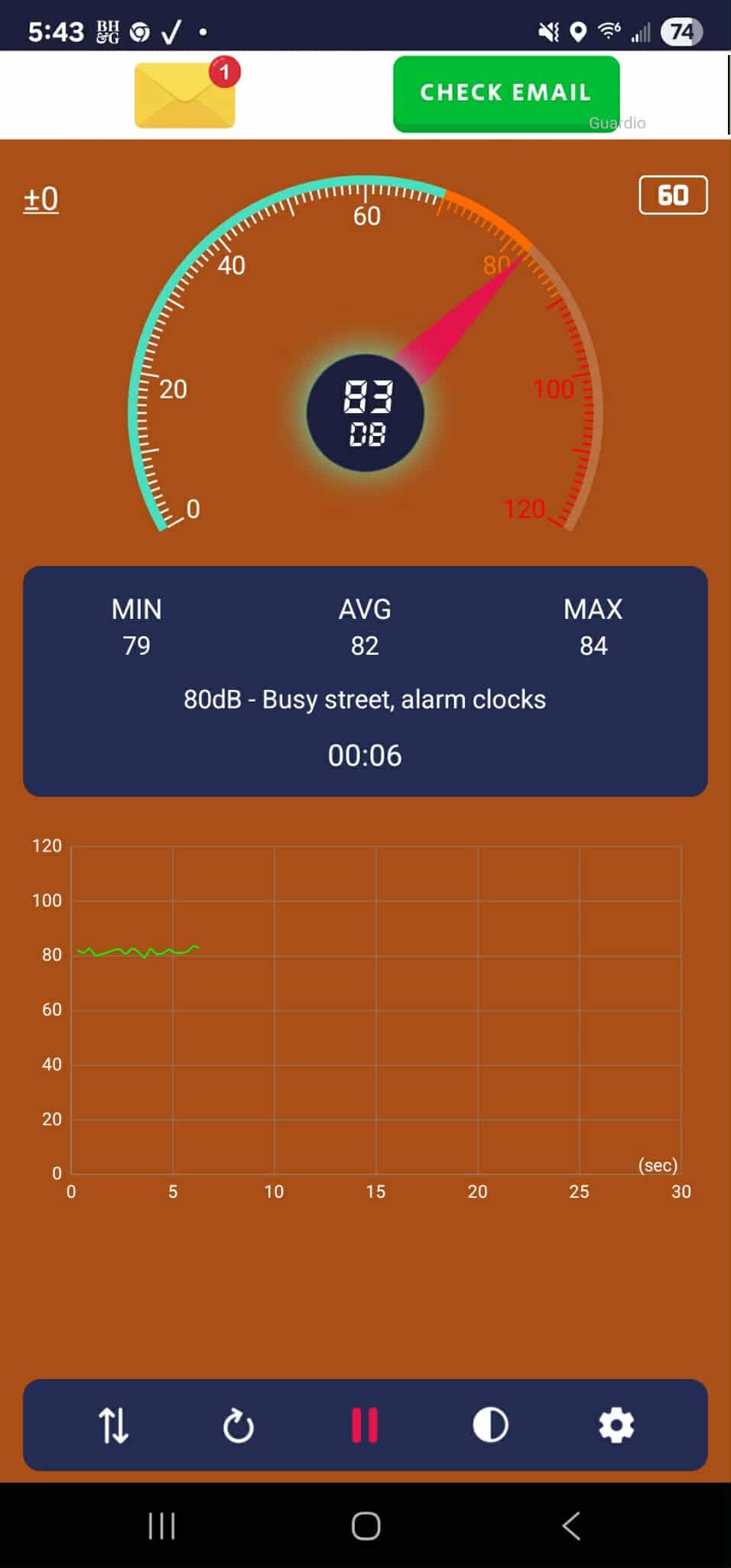
- Quiet enough for a shared room at 55 dB
- Casters and fittings included
Cons
- Smart features only pair with xTool machines
- Some units report a stubborn airflow-clogged warning
- Replacement filters sold direct from xTool only
The SuperCyclone idea is the part that matters here. Thirty-six small cyclones strip out the larger particles before air ever reaches the filter media, which means the expensive stages downstream clog far more slowly than they would in a conventional stack. Owners report filter longevity and build quality as the standout positives across the rating set, and the magnetic pull-out door makes swapping layers a genuinely quick job.
At 55 dB it sits at the quieter end of the category, which matters if the machine lives in a craft room or a shared space. The unit handles wood, acrylic, metal and stone work according to owner reports, with no lingering odour in the room after a job. It is also rated for diode and CO2 lasers drawing up to 150 m3/h, which covers most hobby and small-shop machines.
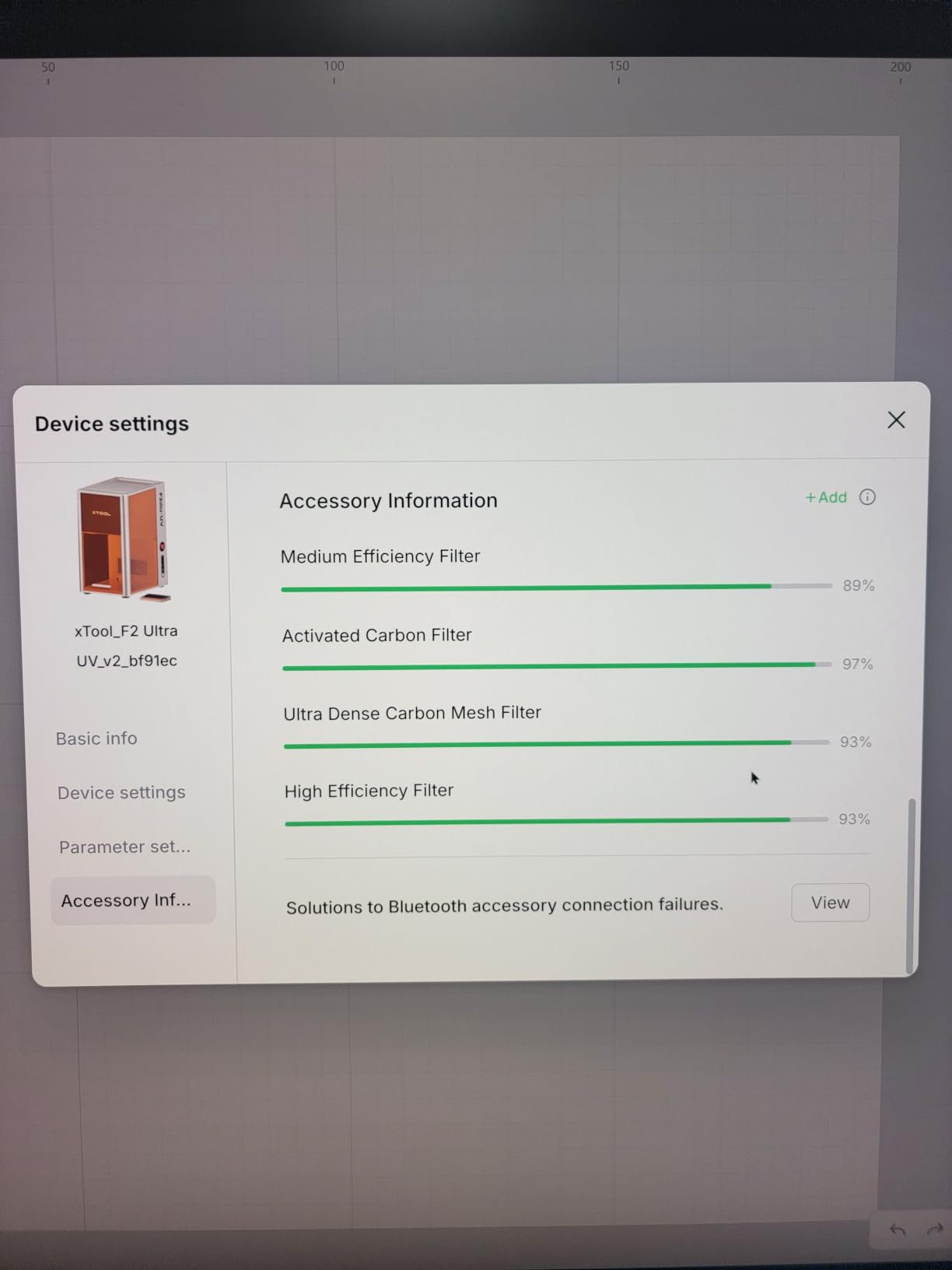
The catch is the software. App control, Bluetooth pairing and per-layer filter monitoring only reach their full potential on xTool machines, and owners running other brands report dropping down to manual mode. Some units also throw a false airflow-clogged error that support has not fully resolved. Filters are sold directly through xTool rather than on the marketplace, so plan the replacement supply before you need it.
Who this suits and who it wastes money on
This is the pick for a maker who already runs an xTool engraver or cutter, or who wants the deepest filtration stack available and has floor space for a 20.9 kg cabinet. For wood, acrylic, leather and mixed hobby work in a home shop, the six layers handle both the particulate and the odour without much fuss.
Skip it if your machine is something other than an xTool unit and you care about the smart features, or if you need it to sit on a desk. At this weight it is a floor unit by design, and the software advantage disappears the moment you pair it with a non-xTool machine.
What to check before you commit
Confirm your laser draws under 150 m3/h, since that is the stated capacity ceiling, and measure the exhaust port before you buy. The unit works as a room purifier as well as a ducted unit, so if you cannot seal the hose you still get filtration, just with more airflow demand on the fan.
Confirm replacement filter supply from the manufacturer. Direct-only filter sales are the single most common complaint in the owner feedback, and a unit you cannot refill in a week is a unit that ends up switched off.
2. Genmitsu 5-Layer Smoke Purifier: The Best Desktop Value for Indoor Machines
Genmitsu Smoke Purifier for Kiosk Kortek Laser Cutter, Portable Fume Extractor with Five-Layer Filtration, Adjustable 3-Speed Control, Air Purifier for Laser Engraver, Soldering Station, Welding Tool
Five-layer filtration
0.3 micron retention
Three speed modes
35 dB
1.8 kg
Pros
- Compact and light enough to perch on the machine
- Quiet on the lower speed settings
- Adapters fit 2.5 inch and 3 inch shop vac hose
- Filter status light with reset
- Effective for wood and leather at modest airflow
Cons
- Weak on gaseous fumes and strong chemical odours
- Cannot keep pace with high-flow machines
- Filter can arrive sealed in plastic
At 1.8 kg and a footprint smaller than a hardback book, this is the purifier that solves the basement problem. Owners running desktop engravers describe it as an excellent budget solution that clears visible smoke and most ordinary wood and leather odour, sometimes in rooms where opening a window was simply not an option. For a craft room or a classroom corner, that is exactly the job you need done.
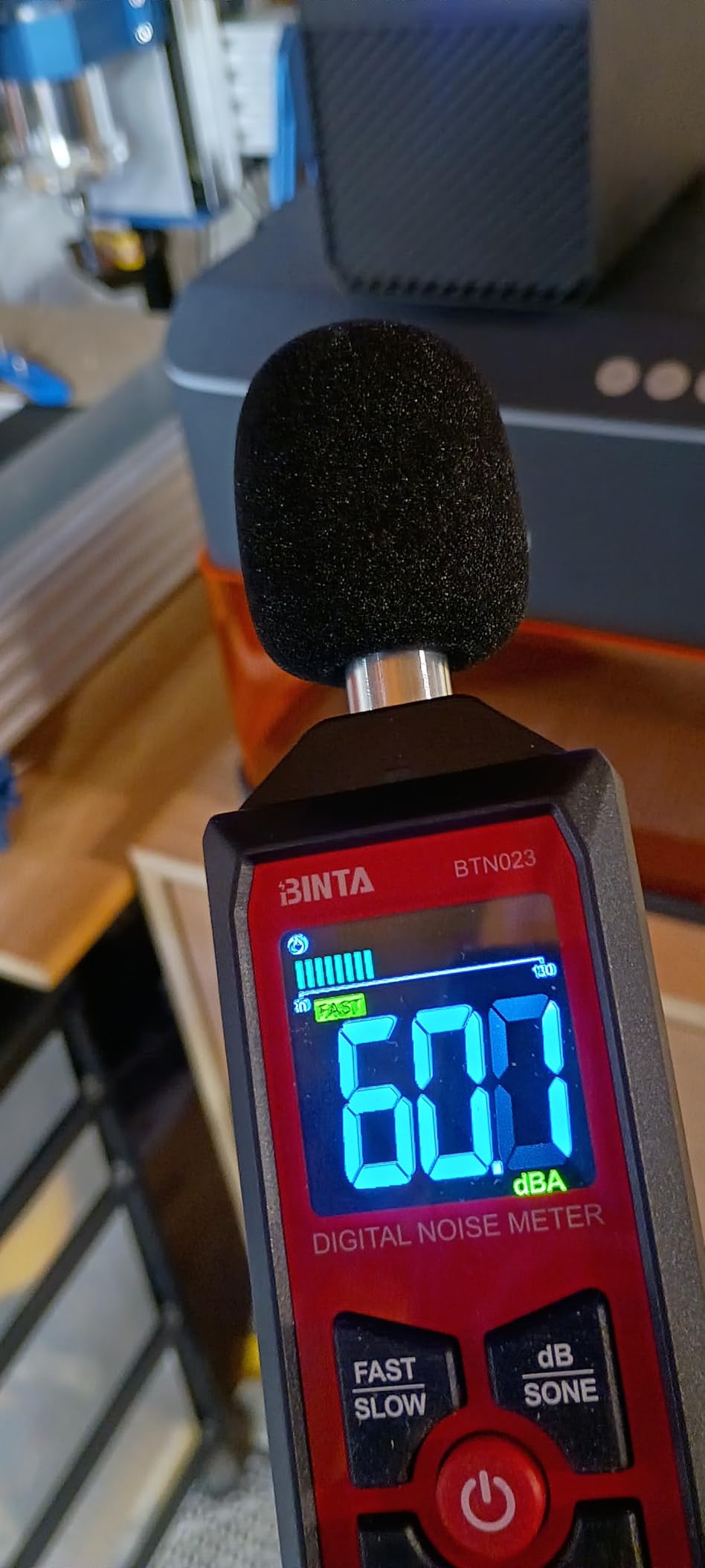
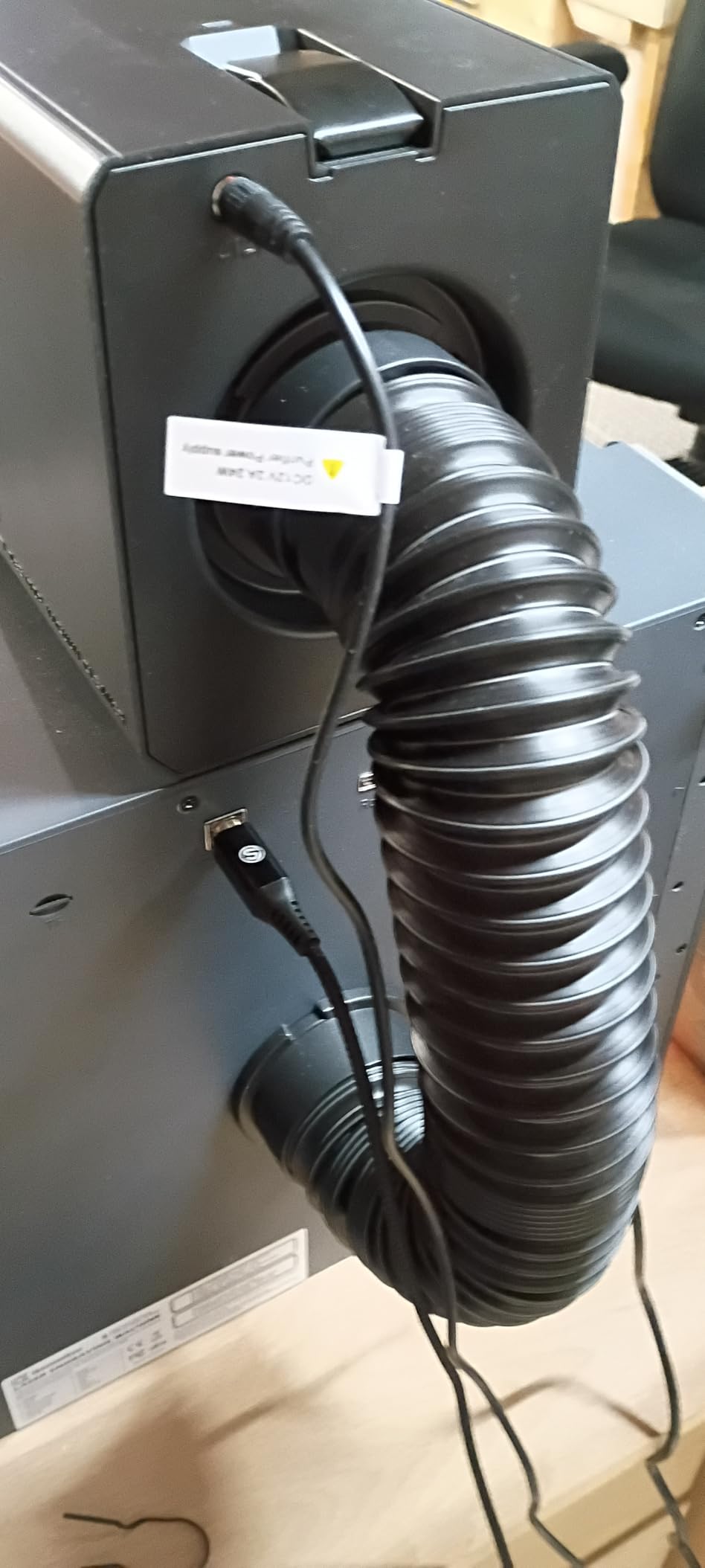
The 35 dB rating is the standout number here, and owners confirm it is quiet on the lower two speed settings. Three modes let you trade noise against suction, and the expandable hose plus universal adapter cover the 2.5 inch and 3 inch shop vacuum hose sizes that most desktop machines use. That adapter kit alone resolves the port sizing question that trips up a lot of first-time buyers.
The honest limitation is gaseous fumes. Carbon in a unit this small has a limited bed volume, so pungent chemical smells from acrylic linger longer than the visible haze does. Owners also report that it cannot keep pace with high-airflow machines even on the top setting, and one recurring complaint is a filter arriving sealed in plastic, which chokes airflow until you remove the wrapping. Check that before first use.
Who this suits and who it wastes money on
Pick this if you own a small diode engraver, work mostly in wood, leather and cardboard, and have nowhere to vent. It also works as a second machine for a soldering bench, which is how several owners use it. The size means you can move it between rooms rather than building a fixed installation around it.
Pass on it if you cut acrylic heavily, run a 40W or larger machine, or work somewhere where residual chemical odour is a deal breaker. Below about 100 m3/h of effective airflow, high-flow machines simply outrun the intake and the smoke ends up in the room anyway.
What to check before you commit
Check your exhaust port diameter first. The included adapters cover common sizes, but a machine with an unusual port will need a reducer you will have to source separately. Also look up filter replacement pricing before you commit, since the carbon bed is what you will replace most often.
Open the filter housing on arrival and confirm the filter is out of its packaging. Several owners in the feedback describe restoring airflow in seconds after doing exactly that, and it saves an unnecessary support call.
3. FumeClear FC-2004: The Suction Heavyweight for 20W to 80W Machines
FumeClear FC-2004 Fume Extractor For 20-80W P/S/M/F Laser Engraver & Cutter
420 m3/h suction power
Triple filtration, high-iodine carbon
Standard 120 mm filters
52.9 lb
Pros
- Suction visibly beats cheaper alternatives
- Triple stack handles gases and fine dust
- Carbon rated for 4000 plus hours of service
- Ten spare pre-filters and two hoods included
- Responsive support resolved a missing hose quickly
Cons
- Loud on the highest setting
- Replacement filters not sold on the marketplace
- Filters clogged quickly during deep brass engraving
Nothing else in this roundup pulls like the FC-2004. Owners running 20W to 80W diode, fiber and CO2 machines describe seeing smoke visibly drawn toward the duct faster than the machine produces it, and suction that holds up even on the lower, quieter settings when the filters are fresh. For thick plywood or repeated acrylic jobs, that raw capture power is the difference between a clean room and a hazy one.
The filtration side is a conventional triple stack, which is exactly what laser work needs: a pre-filter, a HEPA filter and a high-iodine coconut shell carbon main filter. The carbon is rated at two to three times the adsorption of ordinary activated carbon, with a service life of 4000 hours or more. The claimed performance is 99.98 percent removal of harmful gases and filtration of dust and smoke below 0.2 microns.
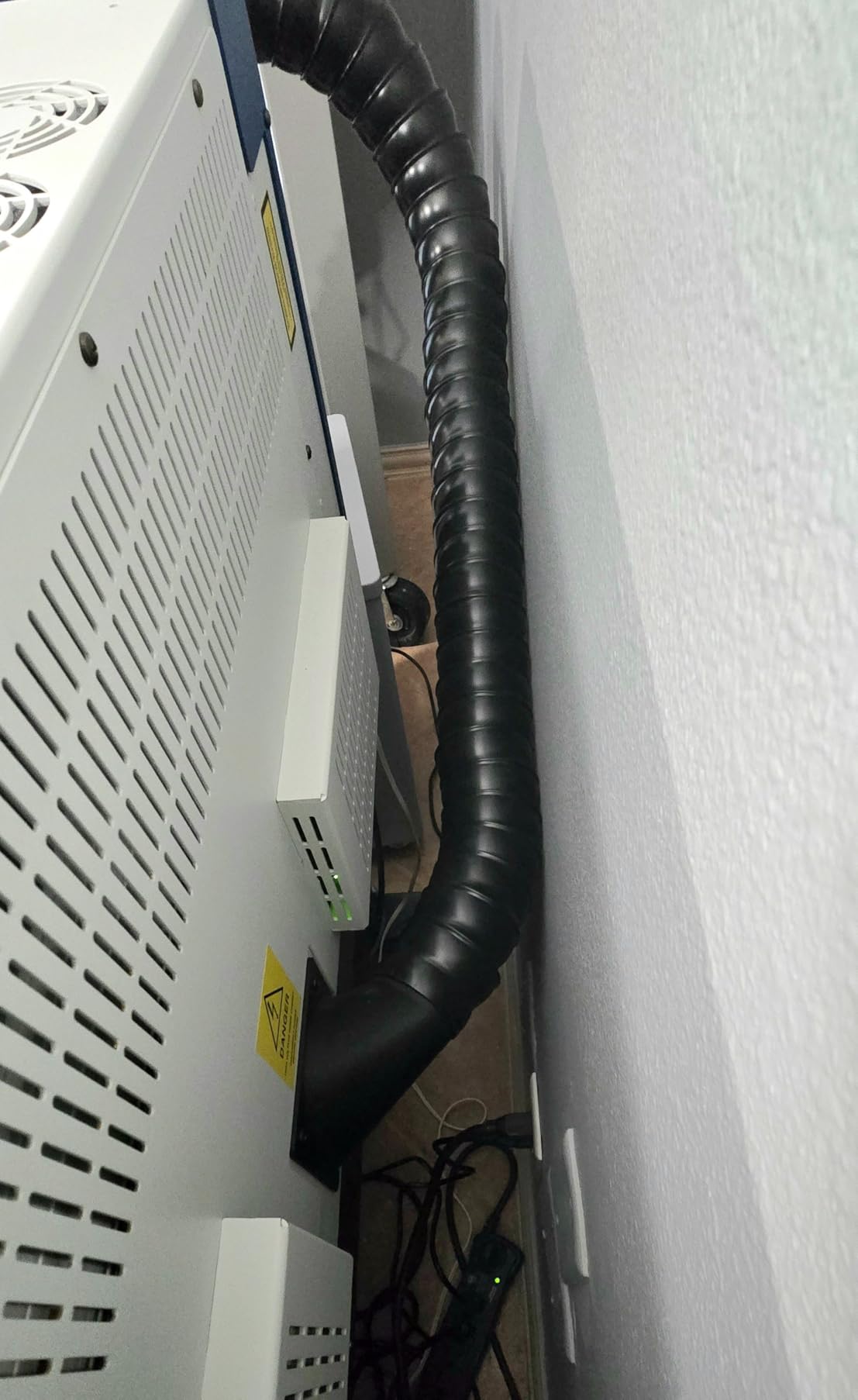
Two complaints recur. Sound level is the first, with owners reporting that the highest setting drowns out nearby equipment and that the lowest mode misses a lot of the fume, so the useful range sits in the middle where it is still audible. The second is filters: they are not sold on the marketplace, they arrived in mixed sizes for some buyers, and all three stages clogged quickly during deep engraving of brass. The housing takes standard 120 mm filters, which helps once you know the size.
Who this suits and who it wastes money on
This is the right call for a shop running a single mid-to-high power machine, particularly if you cut plywood, acrylic or composite board. The rotating neck, dual hoods and desk-sized footprint let you keep it beside the machine rather than in a corner. Several owners also use it around a soldering bench as a second job.
It is heavy and loud enough that it will not suit a bedroom or a quiet craft room at full tilt. If your machine draws less than about 60 m3/h and you only engrave occasionally, you are buying suction you will never use at full power.
What to check before you commit
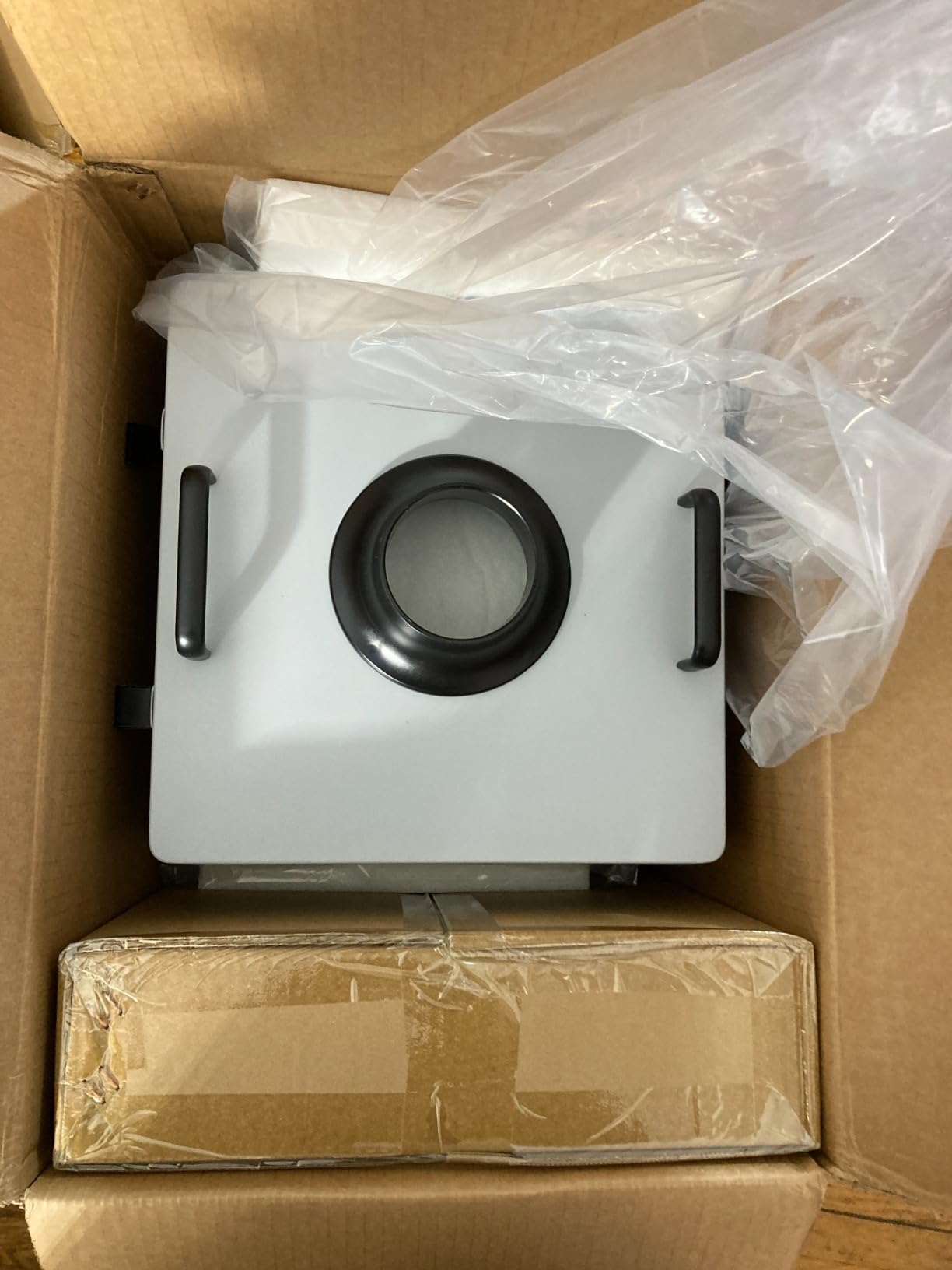
Verify the filter cartridge size with the seller before ordering, because mixed sizing is the most common source of returns in the feedback. The package does include ten spare pre-filter cottons and two hoods, which buys you a long first season before you touch the main stack.
Plan your noise strategy. If the unit lives in the same room as you, run it on a middle speed and accept slightly reduced capture, rather than running it flat out and resenting it. Position the hood 10 to 15 cm from the work and keep the hose seal tight.
4. KQZ 150W Fume Extractor: Remote Control and a Clog Monitor That Earn Their Keep
KQZ Laser Fume Extractor for Under 40W Laser Engraver with Display & Remote
150W brushless motor
280 m3/h airflow
H13 HEPA and 1000 iodine carbon
About 55 dB
Pros
- Clears wood smoke even on the lowest speed
- Remote and smart panel avoid walking back to the unit
- Filter clog monitor with adjustable threshold
- Handles pungent odours and 3D printing fumes
- Dual hose kit seals well to enclosed machines
Cons
- Manual is poorly written and translated
- Main filter life can be short
- Replacement filters hard to source locally
The KQZ is built around workflow rather than raw numbers. A 150W brushless motor moves 280 m3/h, and owners report that it clears wood smoke even on the lowest speed setting, which means you can run it quietly for most jobs and reserve the top end for messy cuts. Three-layer filtration with H13 HEPA and high-iodine carbon handles pungent smells and doubles as a 3D printing extractor.
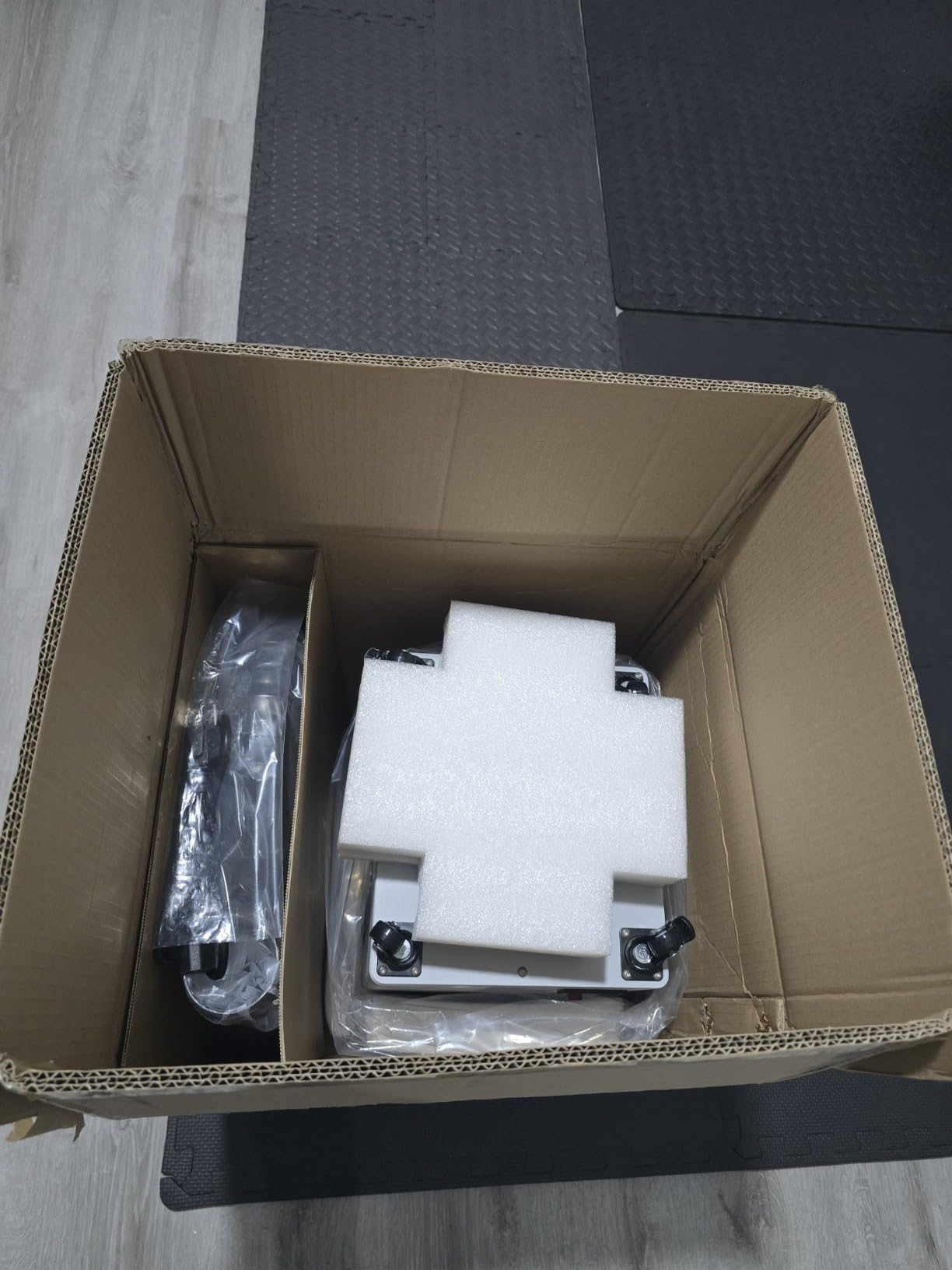
The features that separate it are practical ones. A long-range remote and LED panel let you change speed or start a timer without crawling under the table, and the built-in filter clog monitor with adjustable threshold reduces false alarms. The dual hose kit includes a 50 mm flexible tube and a 1.2 m rigid tube, which gives you options for sealing against enclosed machines.
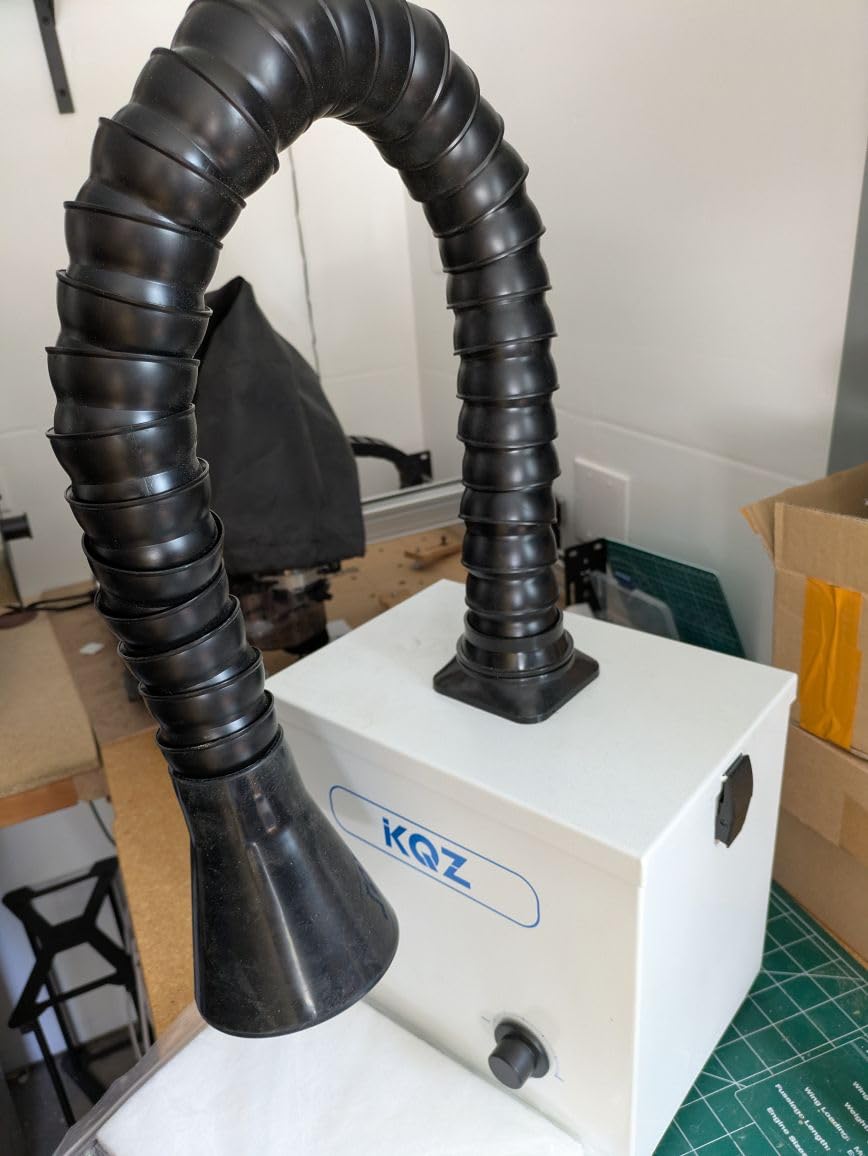
The weaknesses are unglamorous but real. The manual is poorly written and poorly translated, so budget an afternoon of setup. A minority of owners report the main filter failing well ahead of the advertised four to six month life, with replacement filters hard to source locally. Noise at high speed is clearly audible in a quiet room, and 280 m3/h suits general laser work rather than large industrial production.
Who this suits and who it wastes money on
This fits an enclosed engraver owner who wants the unit tucked under a desk and controlled from the front of the machine. It also makes sense if you split time between laser work, soldering and 3D printing, since the three-layer stack handles all three without swapping media.
Skip it if filter supply in your region is uncertain or if you need commercial output. Confirm your local filter replacement route first, because that is the one issue owners most often regret.
What to check before you commit
Measure your port and compare it with the 50 mm tubing in the kit. A rigid 1.2 m tube holds a seal better than a floppy hose, so use it where you can, particularly on enclosed machines with a lid gasket.
Set the clog threshold after your first few jobs rather than leaving it at the factory value. Owners who adjusted it report far fewer nuisance alarms on genuinely dusty plywood cuts.
5. BlazeX 3-Stage Fume Extractor: A Compact Desktop Add-On for Small Machines
BlazeX Air Purifier for M3 & M2 Pro Laser Engraver, 3-Stage Filtration Fume Extractor with HEPA & Active Carbon Filter, High-Efficiency Dust & Odor Removal for Indoor Laser Cutting and Engraving
Three-stage filtration
99.97 percent exhaust gas capture
Brushless motor
Tool-free filter swap
Pros
- Compact desktop footprint for small home studios
- Brushless motor keeps noise low while holding suction
- Tool-free filter replacement speeds up maintenance
- Triple filtration targets odour as well as fine particles
Cons
- Small footprint limits capacity for heavy cutting
- Built primarily as an accessory for specific desktop models
- Only 17 reviews so far
The BlazeX is small, new and neatly built around a single job: keeping haze and odour down on small acrylic and wood jobs. It uses a three-stage configuration of pre-filter, HEPA and active carbon, claims 99.97 percent capture of exhaust gases, and runs a brushless motor that owners describe as quiet while still holding suction. The tool-free filter replacement system is the detail we liked most.
At 2.65 lb and 7.5 by 4.9 by 6.1 inches it disappears onto a shelf beside a small engraver, which makes it realistic for a classroom makerspace or a hobby desk where a floor-standing unit is not going to happen. It is marketed primarily as an accessory for specific desktop laser models, which is worth knowing before you commit.
Who this suits and who it wastes money on
Pick it for small diode machines, light engraving and occasional cutting where your main concern is odour in a shared room rather than volume capture. The brushless motor keeps it civilised next to a desk.
Pass if you cut thick material regularly or run a high-flow machine. The compact footprint limits total filtration capacity, and a small unit simply cannot outrun a large cutter’s exhaust demand.
What to check before you commit
Confirm the unit’s rated machine compatibility against your engraver, since it is designed around specific models. Also check replacement filter pricing, because a small unit means a small and potentially less widely available filter.
Treat the rating with the right amount of context. The owner feedback is consistently positive but the sample is small, so the spec sheet and the machine fit matter more here than the star score.
6. FUMEGO XF250: A Four-Stage Stack for 10W to 40W Desktop Machines
FUMEGO Laser Fume Extractor Compatible with 10 to 40W Laser Engravers S1/M1/Vista, 150W Power & 280 m³/h Low-Noise Smoke Extractor, Laser Air Purifier with HEPA+Carbon 4-stage Filtration System-XF250
150W motor and 280 m3/h
Four-stage HEPA and dual carbon stack
Fits 50 to 75 mm ports
30 lb
Pros
- Four-stage stack with dual-layer carbon targets odour and particulate
- Long gooseneck and 1.5 m hose seal against most exhaust ports
- Brushless motor and soundproofing keep it usable at home
- Rated for 10 to 40W machines including S1 and M1
Cons
- New listing with a small review base
- Heavy 30 lb unit needs floor or bench space
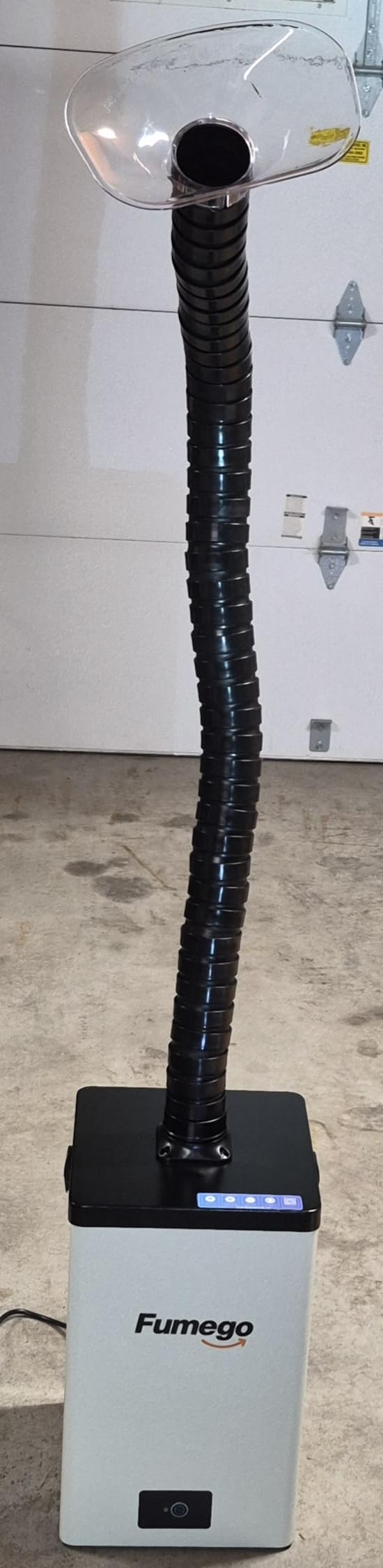
The XF250 is the most complete filtration stack you can get in a machine this size. Four stages, an upgraded pre-filter that is three times thicker than standard, HEPA rated at 99.97 percent for 0.3 micron particles, and two layers of odour media: 1000 mg/g high-iodine activated carbon plus an ultra-dense carbon mesh. The claimed odour removal reaches 95 percent, and the carbon layers are exactly what acrylic and leather work demand.
It is rated for 10W to 40W engravers including the S1, M1, Vista and LX2, and the connection kit is unusually well thought out. A 1.2 m flexible gooseneck arm and a 1.5 m hose that fits 50 to 75 mm exhaust ports mean you can reach the port and hold a tight seal without improvising. Early owners report clean capture on wood, metal and leather with genuinely low noise.
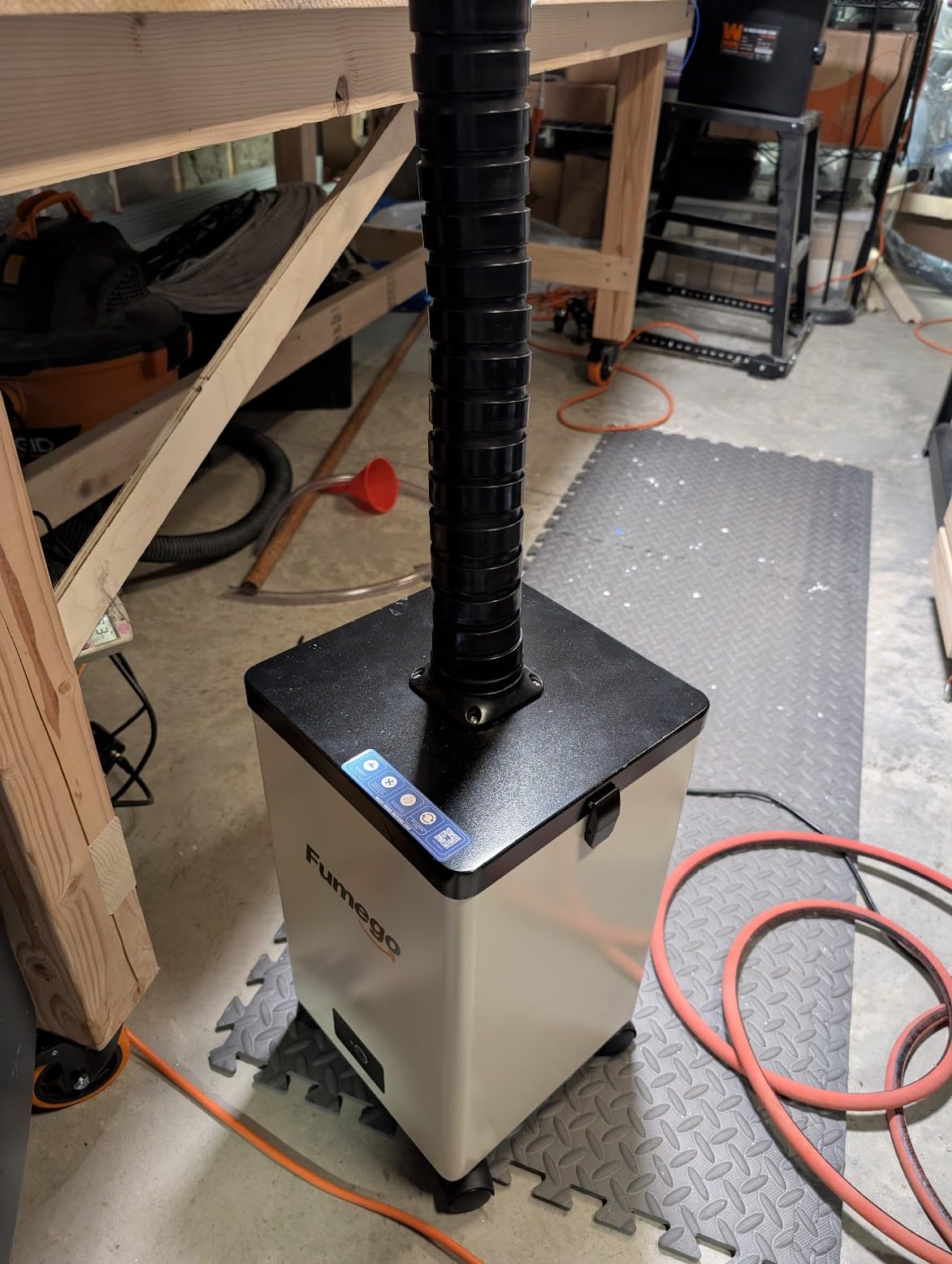
The caution is straightforward. This is a recent listing with a small review base, so long-term durability and filter life are not yet proven by anyone. The rating distribution is unusually clean, with no one or two star reviews at all and a high share of five-star ratings, which is encouraging but not the same as a long track record. At 30 lb it is a floor or low-bench unit, not a desktop one.
Who this suits and who it wastes money on
This suits a 10W to 40W desktop engraver owner who wants better odour control than a two-stage unit gives without buying a floor-standing machine. The thick pre-filter also means less frequent filter swaps, which is the quiet benefit most owners notice first.
Look elsewhere if you run a 100W tube or a large CO2 cutter, or if you need something you can carry between rooms easily. It is built to sit in one place.
What to check before you commit
Measure your exhaust port and confirm it falls in the 50 to 75 mm band the hose covers. If your machine uses a larger port, budget for a reducer before you order, not after.
Ask the seller about replacement media availability. With a new listing, filter supply is the thing most worth confirming in writing, because a four-stage stack is only as good as the last stage you can replace.
7. G-WEIKE 300W Smoke Purifier: Metal Body and Casters for Multi-Machine Shops
Smoke Purifier for gweikecloud Pro/Basic/RF/NOX, 300W Strong Suction Fume Extractor with 3-Stage Air Filter, 99.97% Purification Rate Air Purifier for Most Laser Cutters Engravers Soldering Stations
300W motor
Three-layer filter stack
55 dB or quieter
Sealed metal body
160 lb on four casters
Pros
- High 300W power with adjustable speed for demanding work
- Sealed full metal body reduces smoke leakage
- Quiet at 55 dB or below with internal noise cotton
- Two handles and four casters move it between machines
- Washable primary filter cotton lowers ongoing cost
Cons
- Very heavy at 160 lb
- Coarser 3 micron particle retention than HEPA units here
- Only 4 reviews so far
The G-WEIKE is the most physically substantial unit here. A sealed full metal body with two handles and four caster wheels means you can roll it from one machine to another rather than rebuilding an extraction setup every time. The 300W motor with adjustable speed handles demanding cutting and engraving work, and internal noise reduction cotton holds the rating at 55 dB or lower.
The filter is a three-layer stack of premium filter cotton, extended HEPA and premium activated carbon, claiming 99.97 percent purification of harmful gases and impurities below 3 microns. That 3 micron figure is coarser than the HEPA-based units in this roundup, so treat it as a genuinely good particle filter rather than a fine-particulate specialist. The primary cotton is washable and reusable, which lowers the ongoing cost considerably.
Who this suits and who it wastes money on
Pick it for a small shop or makerspace running more than one machine and already working on a floor-level footprint. Being able to roll the unit between a cutter and an engraver is the feature that pays for itself. It is also listed as compatible with several gweikecloud machines including the Polar.
Skip it for a single desktop engraver in a small room. At 160 lb it is not a unit you carry up stairs or reposition daily, and the coarser particle retention gives you less margin on fine dust than a HEPA-based design.
What to check before you commit
Confirm your machine’s exhaust port against the connection hardware before ordering. Filter kits are sold separately, so price the refill supply up front rather than assuming the washable cotton covers everything.
Read the rating with the review count in mind. Four reviews with no low scores is encouraging but thin, so weight the 300W motor and the metal body more heavily than the score.
8. OMTech 60W 2-Stage Fume Extractor: The Simple Bench Option for Dust Control
OMTech 60W Fume Extractor, 2 Stage Air Filter System for Laser Engraver, 100 m3/h Smoke Absorber for Soldering Station Laser Engraving Machine, Air Purifier with Cotton HEPA Activated Carbon Filters
60W motor and 100 m3/h
99.95 percent of 0.3 micron particles
HEPA and carbon stack
55 mm hose
Pros
- Effective particle capture at modest airflow
- Knob control with no menu to learn
- Two-stage cotton plus HEPA and carbon is easy to service
- Support coverage across three regions
Cons
- Only two filtration stages with no dedicated carbon bed
- Included hose and adapter may not match every port
- Small 9-review base
The OMTech 60W does one job honestly. The motor moves 100 m3/h, which is 58.9 cfm, and the two-stage cotton pre-filter plus HEPA and activated carbon composite captures 99.95 percent of particles larger than 0.3 micron. Buyers report solid dust and particle capture for engraving and soldering, with a high share of five-star ratings and no low scores.
Control is a single airflow adjustment knob, which some owners prefer to a menu-driven panel. The package includes a 2.6 inch pipe adapter and a 2.2 inch exhaust hose, and support runs from three regions for setup and troubleshooting. For a shared soldering and engraving bench, that combination covers both jobs without a second machine.
Who this suits and who it wastes money on
This fits a hobbyist doing light engraving on a small machine, or a bench that doubles as a soldering station. Simplicity is genuinely the selling point here, so if you do not want to think about filter stages, two is easier to manage.
Do not rely on it for odour. There is no dedicated high-iodine carbon stage in this design, and that is exactly what acrylic, leather and vinyl fumes demand. If odour is your main complaint, spend the difference on a unit with a proper carbon bed.
What to check before you commit
Check your port size against the included 55 mm hose and 65 mm adapter. They cover common configurations but not every machine, and a reducer is a cheap fix if you find out before you order rather than after.
Plan for more frequent pre-filter changes than you would with a thicker stage. That is the trade for the simpler stack, and it is a reasonable one at this size.
9. Creality Falcon AP1 Mini: Smart Sync and a PM2.5 Readout
Creality Falcon AP1 Mini Smoke Purifier for A1 series Laser Engraver, 174m³/h High Airflow, HEPA & Activated Carbon Filter, 99.9% Smoke & Odor Removal, Quiet 56dB, Compact Desktop Fume Extractor
174 m3/h airflow
1300Pa suction
99.9 percent purification
PM2.5 display
56 dB
Pros
- 360 degree intake and 1300Pa suction capture smoke well
- Pleated filter offers 2.1 m2 of area for longer life
- Syncs with the engraver and starts and stops automatically
- PM2.5 display gives real air quality feedback
- Tool-free filter swap and 56 dB operation
Cons
- Only 8 reviews so far
- Optimized primarily for the Creality A1 series
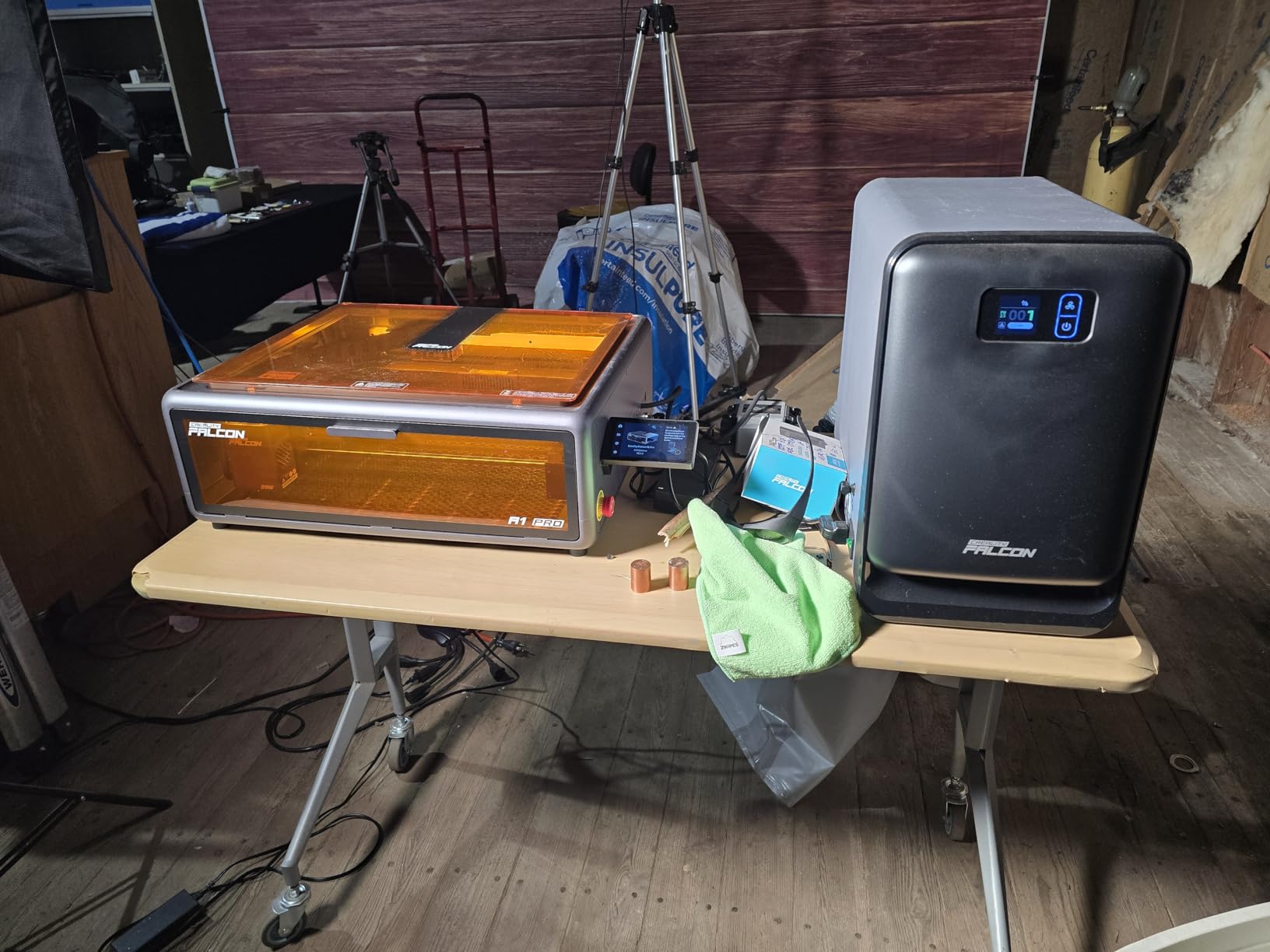
The Falcon AP1 Mini is the smallest unit here that still reads like a proper extraction device rather than an accessory. A 360 degree intake with a brushless motor, 1300Pa suction and 174 m3/h airflow pulls smoke effectively out of a compact desktop box, and the sealed multi-layer filtration stack claims 99.9 percent purification while absorbing VOCs and gases.
The two details that stand out are the pleated filter, which offers 2.1 m2 of filtration area and roughly doubles what a standard filter gives you, and the built-in PM2.5 display. That readout is genuinely useful because it lets you verify the unit is doing something instead of guessing. App control and engraver synchronisation handle automatic start and stop, and the whole thing runs at 56 dB with a tool-free filter swap.
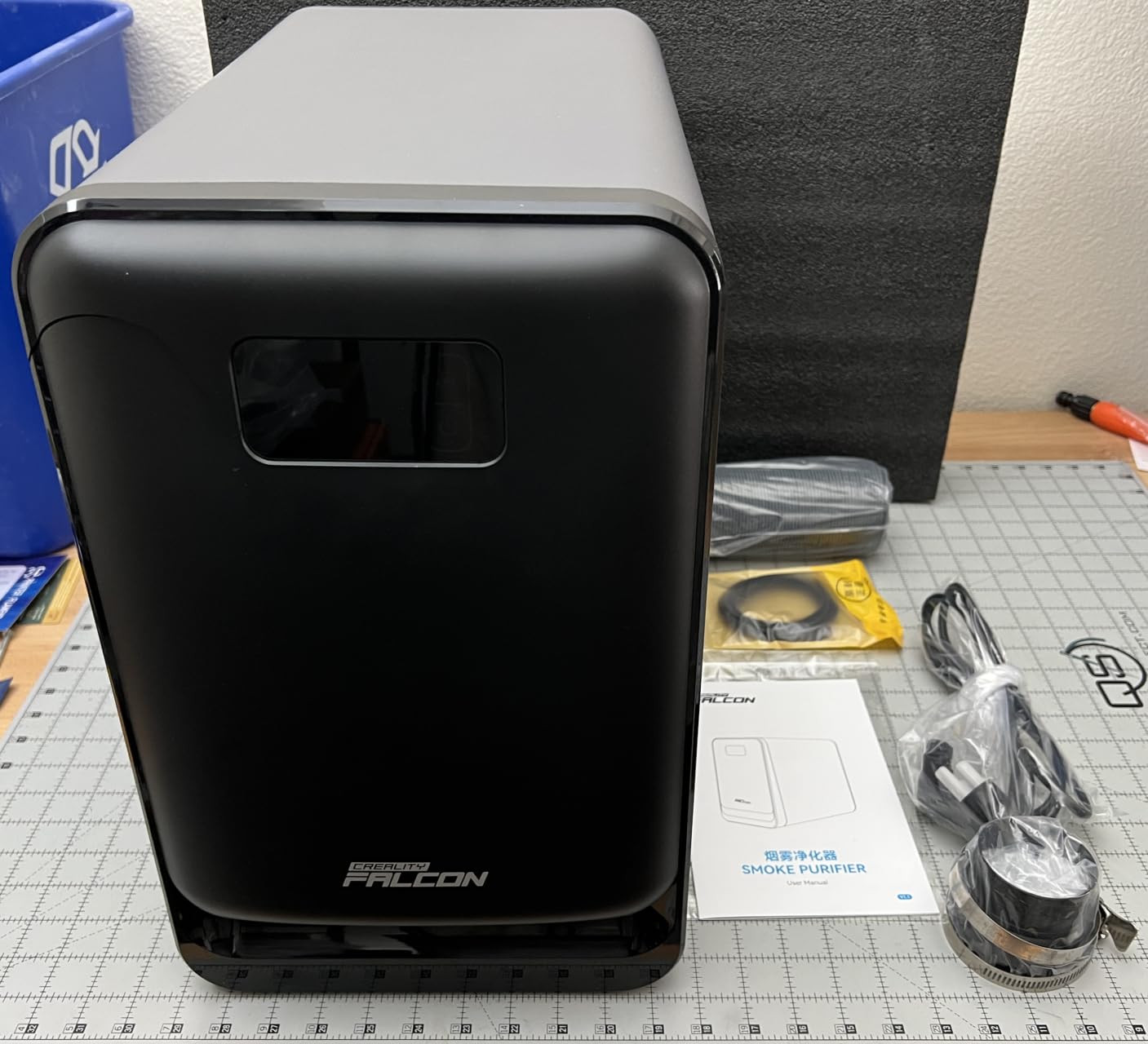
Owners are enthusiastic, with every review currently at five stars. The honest framing is that there are only eight reviews on a recent listing, so read that score as early enthusiasm rather than a settled record. It is also optimised primarily for the Creality A1 series, which narrows the appeal if you run something else.
Who this suits and who it wastes money on
This suits a Creality A1 owner who wants the machine to start and stop the purifier automatically and wants visible confirmation that air quality is improving. For desktop engraving and light cutting in a home studio or classroom, the 174 m3/h figure is genuinely adequate.
Look at a floor unit if you cut thick plywood, run a CO2 tube or work in a production schedule. At 9.92 lb and 11 inches square, this is a desktop companion rather than a shop extraction system.
What to check before you commit
Confirm the sync features work with your exact Creality model, since the optimisation is platform-specific. Confirm filter replacement pricing and availability too, because a proprietary footprint is only convenient while the refills are easy to get.
Use the PM2.5 display during your first few jobs. Running a job with the lid open and watching the reading climb is the fastest way to learn whether your capture distance is right.
10. OMTech 300W 4-Stage Fume Extractor: The Deepest Stack for Large CO2 Cutters
OMTech Fume Extractor with 4 Stage Filtration, 300W 467 m3/h Smoke Absorber with Remote Control 1-300 min. Timer, 10 Speed Wheeled Smoke Purifier for Laser Engravers Cutters Welding Soldering Station
300W motor, 467 m3/h
Four-stage carbon and HEPA stack
10 speeds plus timer
Three hose adapters
Pros
- Very high 467 m3/h airflow on an 80W CO2 laser
- Ten speed levels and a timer match extraction to the job
- Deepest four-stage filtration stack in the roundup
- Four locking casters and two handles for moving between machines
- Adapters cover most laser exhaust port sizes
Cons
- Only a single review exists
- Owner added extra carbon to reduce smell further
On paper this is the most capable unit here. A 300W DC motor moves 467 m3/h, which is 275 cfm, and the filtration stack runs four stages: cotton, polypropylene, activated carbon and HEPA. A verified owner running an 80W 28 by 20 inch CO2 laser reports it extracting smoke and fumes quickly, and even added an extra carbon sheet to knock down additional smell, which tells you the base odour control is good without being complete.
Control is thorough. A digital panel offers ten speed levels and a one to 300 minute timer, a remote control is included, and 360 degree swivel tubes let you position the intake. Four locking caster wheels and two built-in handles make it movable, and three adapters covering roughly 2.6 inch, 4.7 inch and 5.9 inch ports cover most machines you will meet.
Who this suits and who it wastes money on
This suits someone running a large CO2 cutter or a busy small production shop where capture volume is the priority. At 467 m3/h it comfortably outruns a high-demand exhaust, and the ten speeds let you back off the noise when the job does not demand full suction.
Skip it for a desktop engraver. You would be paying for capacity you cannot use, and the unit is large enough that footprint becomes a real consideration in a home setup.
What to check before you commit
Treat the rating carefully here. A five-star average from one review carries essentially no evidential weight, so judge this on the 467 m3/h figure, the four-stage stack and the build, with the single owner report as a useful signal rather than proof.
Match your port to one of the three included adapters before ordering, and plan where the casters will sit. A unit this size needs floor space and a route to roll it, which is the main thing enthusiasts tend to underestimate.
How to Choose a Fume Extractor for Laser Engraving in 2026
The differences between these ten units are mostly engineering trade-offs. The section below covers the five factors that actually change how a unit performs in your workshop, plus the material guide that determines how often you will be replacing filters.
Airflow and static pressure: why the spec sheet number overstates performance
Every product here publishes a free-air airflow figure, and every one of those figures is measured with nothing attached to the outlet. Connect a four metre hose to a laser exhaust port and that number drops, sometimes by half, because the fan is now pushing air through a restrictive duct. This is the single most misleading specification in the category, and it is the reason a nominally strong unit can leave a room hazy.
Two rules follow. First, size for your machine’s rated exhaust flow and add roughly 50 percent headroom, because machines that advertise high output often have high peaks. Second, favour a unit with a rigid or arm-mounted tube over one with only a soft hose, because a rigid run holds a seal and resists collapse. The FC-2004 at 420 m3/h and the OMTech 300W at 467 m3/h have the deepest reserves in this roundup; the 100 m3/h OMTech and the 174 m3/h Creality are sized for desktop machines and should be matched to them.
Filtration stages: pre-filter, HEPA and carbon each do a different job
Three media types are doing the work in every unit here, and confusing them leads to wrong purchases. The pre-filter is a cheap dust stage that catches the bulk particulate and protects everything downstream. The HEPA stage captures fine particles down to around 0.3 micron. The activated carbon bed is the only stage that adsorbs gases and volatile organic compounds.
This distinction matters more than most guides admit. HEPA captures particulates, not gases, so a HEPA-only purifier can leave a room visually clear and still full of chemical vapour. Acrylic, leather, vinyl and any PVC work need real carbon volume. The units with two carbon layers, such as the FUMEGO XF250 and the xTool SafetyPro AP2, give you the margin that heavy acrylic cutting demands.
Noise: what the dB number means in a small room
Published decibel figures are measured at a fixed distance in a lab and say nothing about your room. What matters is the gap between the dB rating and the background noise of the space. In a basement with a quiet background, a 55 dB unit running on a low setting is noticeable but workable, while the same unit on high is intrusive.
Owners repeatedly single out sound level as the top complaint on powerful machines, which is the expected outcome: airflow and noise scale together. The practical approach is to buy more airflow than you strictly need and then run the unit on a middle setting. That also cuts filter loading, since lower flow rate pushes less particulate through the media.
Hose diameter and port adapters
Port sizing is the most common blocker in this category and the easiest to solve before you order. Common machine exhaust ports sit around 50 mm, 75 mm or 100 mm, while some desktop units use 2.5 inch shop vacuum fittings. Measure the port on your machine and compare it against what the unit ships with before you commit to anything.
Most units here include adapters, and some cover several sizes at once. The Genmitsu ships with an expandable hose and adapters for 2.5 inch and 3 inch hose, the FUMEGO hose fits 50 to 75 mm ports, and the OMTech 300W includes three adapters. Anything outside those ranges needs a reducer, which is inexpensive and far easier to source in advance.
What each material does to your filters
Wood and plywood are mostly a particulate problem with a glue odour on top. The carbon bed handles the smell; the pre-filter will need regular attention because sawdust loads it fast. Cardboard and paper are similar, with less odour and a heavier dust load.
Acrylic is the odour test for any extractor. It produces a sharp, persistent smell that a thin carbon layer will not hold, and it is the reason we rank units with a high-iodine or dual carbon stage higher. Leather adds organic odour plus fine dust, so it benefits from the same combination.
Vinyl and PVC deserve a hard warning rather than a recommendation. Cutting PVC releases chlorine gas, which no consumer fume extractor is designed to handle and which is genuinely hazardous in a closed room. Never cut PVC on a laser engraver, and if you work with vinyl in any form, check that the material is laser-safe before it goes anywhere near the bed.
When outdoor exhausting beats a filter unit
Some owners argue, and reasonably, that a filter unit is the wrong answer for a dedicated workshop. An enclosure combined with a fan exhausting outdoors removes the fumes completely, needs no filters, and runs much quieter. That argument comes up repeatedly in owner discussions and it holds up on cost, maintenance and noise.
The caveats are equally real. It requires a wall or window to vent through, and a user raised a safety question that deserves a straight answer: drawing air across a laser ignition point raises the same fire concerns as the laser itself. Keep the duct clear of the beam path, keep the machine’s own air assist running, and never route extraction ducting where it can contact moving parts or hot surfaces. For a basement with no exterior wall, a filtered unit is usually the only practical option, which is why nine of the ten units here exist.
Frequently Asked Questions
What is the best ventilation system for laser engraving?
The best ventilation setup is an enclosed laser with its exhaust ducted through a wall or window to the outside, using a fan rated for the machine’s exhaust flow. Where that is not possible, a filtered fume extractor with a pre-filter, HEPA stage and an activated carbon bed is the practical answer, positioned close to the exhaust port with a tight hose seal.
What is the best fume extractor?
The xTool SafetyPro AP2 is the strongest all-round choice in our roundup because it combines a six-layer SuperCyclone stack with the largest body of owner feedback we found. For desktop machines on a tight budget the Genmitsu five-layer purifier is the value pick, and for a 20W to 80W machine needing real suction the FumeClear FC-2004 leads on airflow.
How effective are fume extractors?
They are effective on particulates and, when the carbon bed is large enough, on most laser odours. They fall short when the unit is undersized for the machine, when the hose does not seal, or when the carbon stage is exhausted. One owner of a premium unit reported it did not fully remove the smell while still clearing visible haze.
Do I need a fume extractor for my laser engraver?
If you run any CO2 or diode laser indoors without exhausting outdoors, yes. Laser work vaporises material and releases fine particles plus chemical vapours that spread through the whole room. A household air purifier is not a substitute, because it lacks activated carbon volume and source capture.
Can I use a solder fume extractor for laser engraving?
Generally no. Solder fume extractors are built for low-volume, point-source capture and typically lack the airflow to keep up with a laser’s exhaust demand, so their filters clog faster and odour control suffers. If a unit is rated at 150 m3/h or more with a real carbon stage it can work, but a laser-specific unit is the safer purchase.
How often do laser fume extractor filters need replacing?
Pre-filters usually need checking weekly and replacing every few weeks with heavy cutting. The main carbon and HEPA stages typically last several months depending on how much you cut and which materials. Acrylic and plywood work load filters far faster than leather or cardboard, and units with thicker pre-filters such as the FUMEGO XF250 extend main filter life.
The Verdict on the Best Fume Extractors for Laser Engraving
After comparing ten dedicated units, the xTool SafetyPro AP2 comes out ahead of the best fume extractors for laser engraving for most makers. Six filtration stages, a washable cyclone pre-separation stage, a 55 dB rating and by far the largest body of owner feedback in the category make it the safest all-round choice, with the caveat that its smart features only pay off on xTool machines.
Different setups deserve different winners. The Genmitsu five-layer purifier is the sensible pick when you have a small machine and no floor space. The FumeClear FC-2004 is the suction answer for 20W to 80W machines. The OMTech 300W four-stage unit covers large CO2 cutting, and the Creality Falcon AP1 Mini pairs neatly with the A1 series.
Whichever you choose, measure your exhaust port before ordering, confirm replacement filter availability, and remember that no filter unit makes cutting PVC safe. Our reviews of the best fume extractors for laser engraving will be updated as 2026 brings new models through.