

Framing punishes a circular saw in ways finish carpentry never does. You are pushing a spinning blade through wet dimensional lumber, at full depth, for hours, with one hand on a trigger and the other on a handle that has no second chance at a second cut. The saw that feels fine on plywood can stall halfway through a 2×8 header.
We spent weeks comparing ten of the most widely used battery circular saws against the same list of framing jobs: breaking down wall panels, crosscutting stacks of studs, ripping header stock, and following a staircase stringer layout. The short answer is that a 7-1/4 inch rear-handle saw with a brushless motor is the right default for framing, and a 6-1/2 inch sidewinder is the right answer when you are already deep inside a 20V or 18V platform and mostly breaking down material.
Before the individual saws, here is the framing question that comes up most often: what size circular saw do you need for 2×4 lumber? A 6-1/2 inch saw cuts 2x material at both 90 and 45 degrees and handles a single 2×6 comfortably. A 7-1/4 inch saw with 2-9/16 inches of depth is the one to buy if you ever expect stacked material, laminated headers, LVL, or a full-depth cut in 3x lumber. This guide covers both, plus everything in between, and updates for 2026.
Table of Contents
Top 3 Cordless Circular Saws for Framing (October 2026)
These three came out of the framing jobs ahead of the field. The DEWALT DCS578B is the strongest all-rounder, the DCS565B wins on weight and control, and the Makita XSH03Z delivers the best balance of speed, size and platform reach.

DEWALT DCS578B 60V MAX…
- 5800 rpm brushless motor
- 2-9/16 inch cut depth at 90 degrees
- 57 degree bevel with positive stops

DEWALT DCS565B 20V 6-1/2 in
- Brushless motor
- Electric blade brake
- Bright LED and rafter hook
- Tool-free 0-50 degree bevel lever

Makita XSH03Z 18V LXT 6-1/2 in
- 5000 rpm brushless motor
- Automatic Speed Change
- 7 pounds
- 24-tooth blade included
The 10 Best Cordless Circular Saws for Framing at a Glance in 2026
All ten saws below are real, currently listed models, and every one of them can be made to frame. They differ on cut depth, weight, bevel range and how much battery you have to carry. Here is the full lineup with the framing-relevant numbers for each.
| Product | Specs | Action |
|---|---|---|
| DEWALT DCS578B 60V MAX 7-1/4 in |
|
Check Latest Price |
 Milwaukee 2631-20 M18 7-1/4 in Milwaukee 2631-20 M18 7-1/4 in |
|
Check Latest Price |
 Makita XSR01Z 18V X2 7-1/4 in Makita XSR01Z 18V X2 7-1/4 in |
|
Check Latest Price |
 CRAFTSMAN CMCS551B V20 7-1/4 in CRAFTSMAN CMCS551B V20 7-1/4 in |
|
Check Latest Price |
 SKIL CR5429B-20 2x20V 7-1/4 in SKIL CR5429B-20 2x20V 7-1/4 in |
|
Check Latest Price |
 Milwaukee 2630-20 M18 6-1/2 in Milwaukee 2630-20 M18 6-1/2 in |
|
Check Latest Price |
| Makita XSH03Z 18V LXT 6-1/2 in |
|
Check Latest Price |
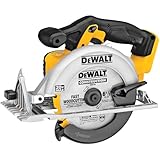 DEWALT DCS391B 20V 6-1/2 in DEWALT DCS391B 20V 6-1/2 in |
|
Check Latest Price |
| DEWALT DCS565B 20V 6-1/2 in |
|
Check Latest Price |
 RYOBI PBLCS300B 18V HP 7-1/4 in RYOBI PBLCS300B 18V HP 7-1/4 in |
|
Check Latest Price |
1. DEWALT DCS578B 60V MAX 7-1/4 Inch – The Framing Saw We Kept Reaching For
DEWALT FLEXVOLT 60V MAX* Circular Saw with Brake, 7-1/4-Inch, Tool Only (DCS578B)
5800 rpm brushless motor
2-9/16 inch depth at 90 degrees
57 degree bevel
Electric blade brake
Pros
- Up to 47 percent more power than the DCS575
- Stops the blade the instant the trigger is released
- 2-9/16 inch depth handles stacked and 3x material
- Positive bevel stops at 22.5 and 45 degrees
Cons
- Integrated LED is blocked by the bevel adjust knob
- Metal shoe plate feels rough against lumber
- Weighs 8.2 pounds bare
- Runs best on large FLEXVOLT packs
Out of the ten saws we put through framing work, the DCS578B is the one we picked up first every morning. Its 5800 rpm brushless motor has the free speed to keep its blade moving in dense stock, and 2-9/16 inches of depth at 90 degrees means a 3x wall laid flat gets cut in a single pass with no flipping the board.
Owners consistently describe the electric brake as the feature they notice most. The blade stops the moment the trigger is released, which matters on a framing saw because you take that trigger off dozens of times an hour and you do not want a spinning blade beside your leg while you reach for the next stud. The rafter hook also lets the saw hang off a ladder or a scissor lift without a hand free.
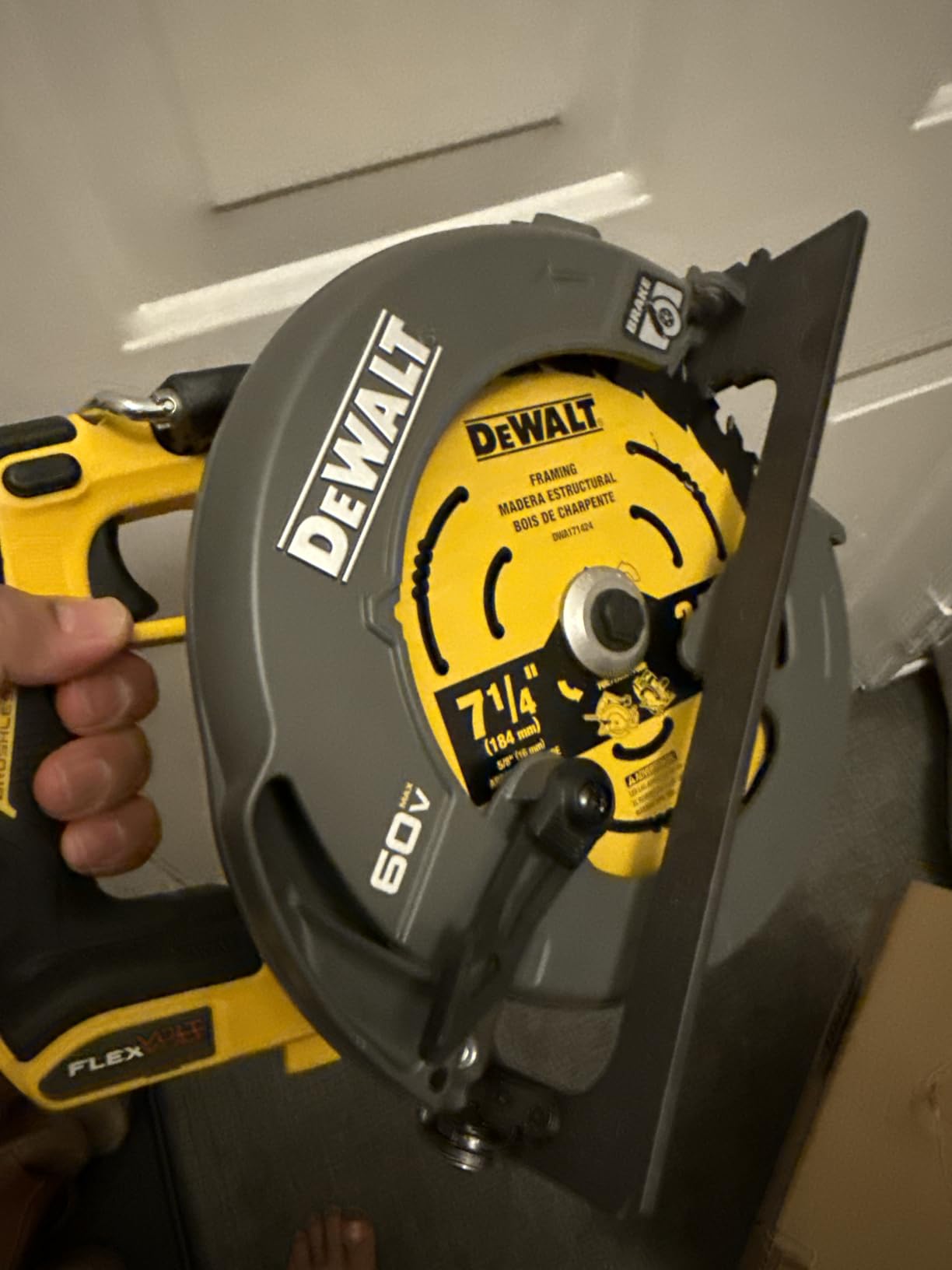
The bevel range is where this saw separates itself for roof work. A 57 degree maximum with positive stops at 22.5 and 45 degrees covers everything from a standard rake to the steeper cuts found on complex roof geometry, and the stops mean you are not eyeballing the angle on every piece.
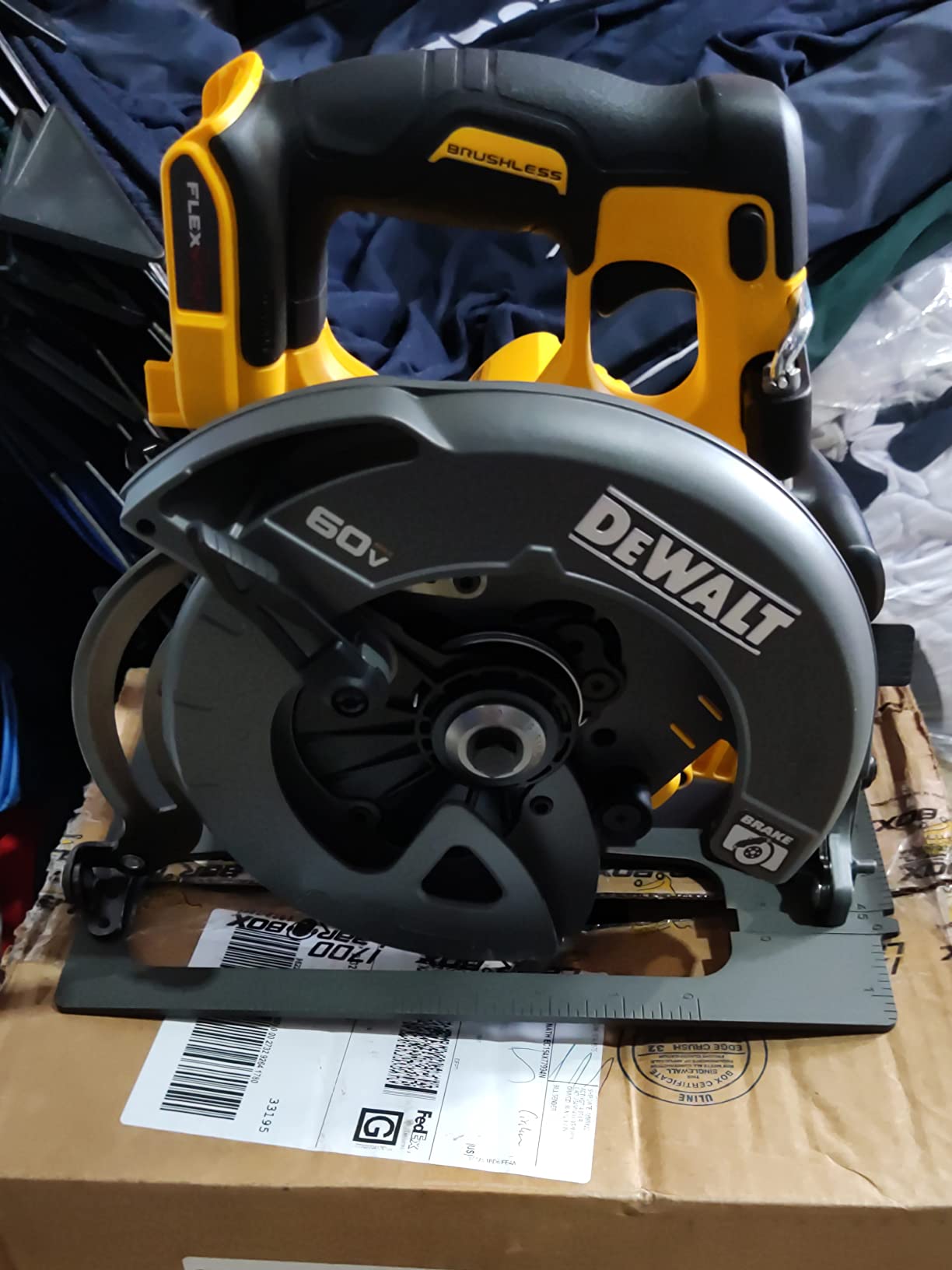
Two things kept it from a perfect score for us. The integrated LED is aimed where the bevel adjust knob is, so it lights very little of the work area, and the metal shoe plate has a noticeably grippy surface compared with smoother plates, which you feel when ripping long stock across the grain. The 8.2 pound bare-tool weight is manageable, but it grows with a high-capacity battery in the back.
Why framers pick this saw over lighter options
The 2-9/16 inch depth is the deciding number. When you are cutting headers, rip cuts on wide stock, or anything that would require a second pass on a smaller saw, this one keeps going. Long-term owners of the FLEXVOLT platform also report batteries that survive years of carpentry use, which protects the value of the whole setup.
If you already run FLEXVOLT packs on a jobsite, the platform decision is already made and this is the natural top-end saw to add. If you are starting fresh, the 60V requirement is the thing to think through before you commit.
Where the DCS578B is not the right tool
It is not the lightest saw in this group, and reviewers of the platform note that weight for a bare tool. On a long day of overhead work in an awkward position, 8.2 pounds plus a large battery adds up, and a 7 pound sidewinder is easier to control for trim and repetitive breakdown cuts.
Users who prefer the blade on the opposite side of the motor housing should also know the orientation here suits the other handedness. Right-handed users get the cleanest sightline; the reverse is true for the opposite hand. That matters on a framing saw because the cutline is the difference between a square stud and a stud you have to fix later.
2. Milwaukee 2631-20 M18 7-1/4 Inch – The Proven M18 Workhorse
Milwaukee M18 BRUSHLESS 7-1/4″ CIRCULAR SAW – BARE
M18 brushless motor
Magnesium upper and lower guards
Rafter hook and dust port
LED and electric brake
Pros
- Brushless motor with magnesium guards for durability
- Dust port and rafter hook for jobsite use
- LED light and electric brake for accuracy and safety
- Proven across a large M18 owner base
Cons
- Bare tool
- so runtime depends entirely on existing M18 packs
- Listing shows a blade length figure that does not match the shipped 7-1/4 inch blade
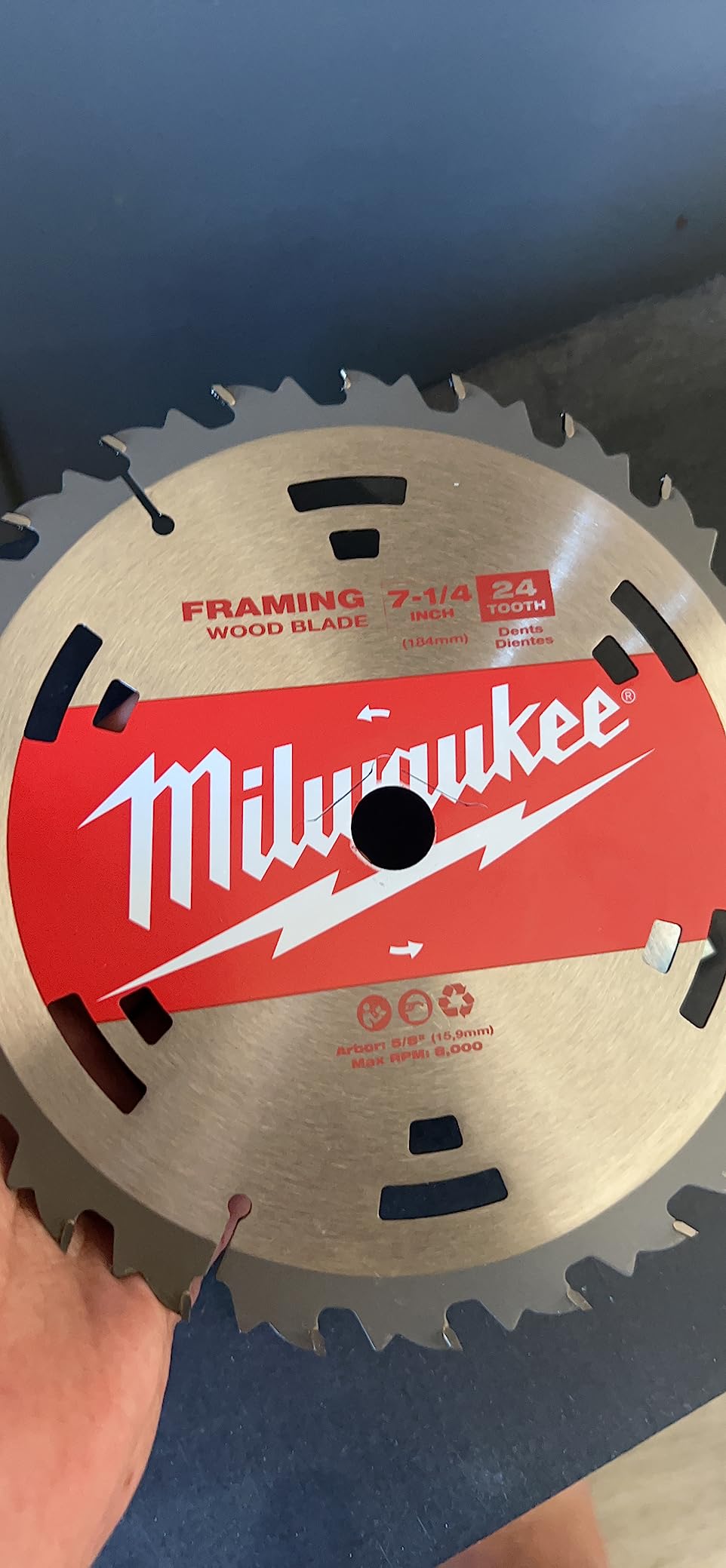
This is the saw we recommend to anyone already running M18 packs. It is a 7-1/4 inch brushless saw with magnesium guards, an integrated dust port, a rafter hook, an LED and an electric brake, which is close to a complete feature list for framing work.
The magnesium upper and lower guards are the detail that matters most over time. Framing lumber is full of knots, splinters and stray nails, and guards that survive that treatment keep the blade from being pinched. The integrated dust port is a smaller win but a real one on site, since a shop vac on the guard clears the cutline better than a blower alone.
Owners repeatedly frame this as a dependable daily tool rather than an enthusiast purchase, and the consistency of feedback across categories is the strongest signal here. It is not exotic, but it does the things a framing saw is supposed to do without asking you to adapt your technique.
The one thing to plan for is batteries. This ships as a bare tool, so runtime on site is entirely a function of the M18 packs you already own. If you are starting a platform rather than adding to one, that changes the calculus completely, and the cost of a starter battery plus charger is a real line item in the decision.
Why M18 owners keep buying it
The installed base is the argument. Batteries are widely available, the platform is mature, and a framer who already owns six M18 tools can drop this saw into the bag and start cutting the same afternoon. That familiarity shows up in how owners describe it, as a tool they trust without thinking about it.
For wall layouts and standard stud crosscuts, it is more than adequate. For very dense stock or stacked material, the 7-1/4 inch format gives you room to grow into heavier work without changing tools again.
Where it falls short
As a bare tool it does nothing for a buyer with no M18 batteries, and a 6-1/2 inch saw in the same platform costs meaningfully less. If you are buying your first M18 tool, the smaller platform saw is often the smarter starting point, and this one makes more sense as a second saw for someone already committed.
Be aware of the listing detail: the published blade length figure does not reflect the 7-1/4 inch blade the model actually ships with. Verify the blade size on the tool itself rather than trusting the spec sheet on a screen.
3. Makita XSR01Z 18V X2 7-1/4 Inch – Twin Battery Power With Electronic Management
Makita XSR01Z 36V (18V X2) LXT® Brushless Rear Handle 7-1/4″ Circular Saw, Tool Only
36V from two LXT batteries
5100 rpm with Automatic Speed Change
2-9/16 inch capacity
0-53 degree bevel
Pros
- Dual battery platform powers through 3x lumber in a single pass
- Automatic Speed Change tunes speed and torque mid-cut
- Die-cast magnesium base and guard
- Up to 558 cuts in 2x4 SPF on two 5.0Ah packs
Cons
- Heaviest saw here at 12.1 pounds
- Tool only so two batteries and a charger are extra
- Fixed 24-tooth blade limits finish work
The XSR01Z is the only saw in this group that runs two batteries at once, and that is exactly why it lands here. The twin 18V LXT setup delivers 36V, and Makita rates it at up to 558 crosscuts in 2×4 SPF and 291 in 2×10 SPF on two 5.0Ah packs. Those are the only published cut-count figures in this group that come from a major manufacturer, and they are the numbers we use when we talk about a full framing day.
The electronic brushless motor produces 5100 rpm and uses Automatic Speed Change to adjust cutting speed and torque during the cut. In practice this is the feature that keeps the blade from bogging in the middle of a crosscut through stacked material, where a fixed-speed motor would already be at its limit before the blade exits the far side.
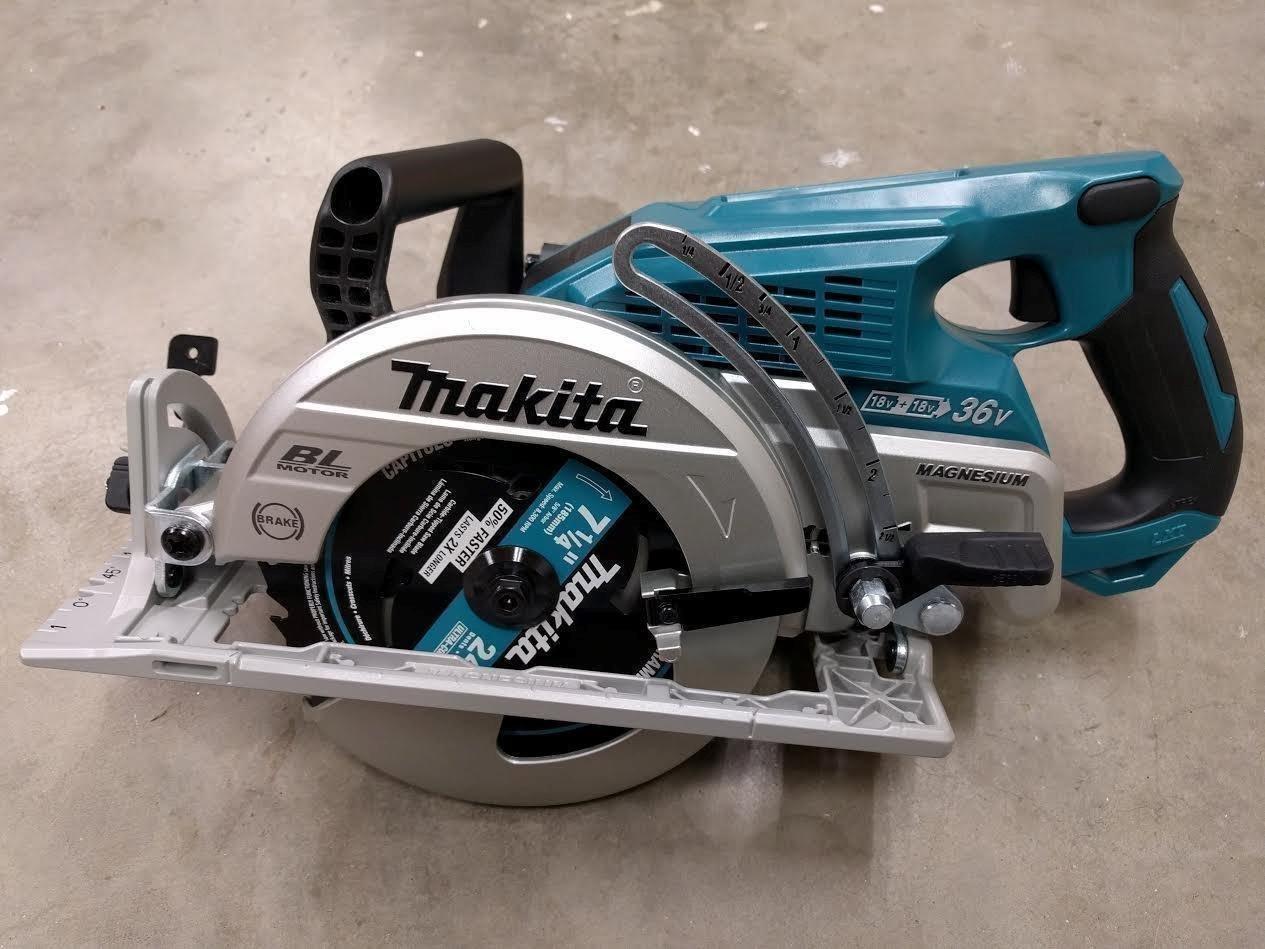
Construction is a step above the rest of this field: die-cast magnesium base, die-cast magnesium blade guard, and a die-cast aluminum blade cover and motor housing. On a saw that gets dropped off ladders and dragged through rough lumber, that extra material in the high-impact areas is a meaningful difference over a stamped or mostly plastic chassis.
The electric brake and a 0-53 degree bevel with stops at 22.5, 45 and 53 degrees round out a genuinely capable framing package. Owners describe cutting ability that reaches into worm-drive territory for a battery saw, which is the right comparison for anyone wondering whether battery can replace a corded framing saw outright.
Who this saw is built for
The 2-9/16 inch capacity cuts 3x material in a single pass, and that is the headline. Wall layouts, stacked headers and laminated stock are exactly the work that forces you to flip a board or run two passes on a smaller saw. This one does it once.
It is also a strong choice for anyone whose 18V LXT collection is already deep, since the second battery slot uses a pack you likely already own. Makita covers the tool with a 3-year limited warranty.
Where the extra power costs you
At 12.1 pounds this is the heaviest saw we tested, and that is not a small penalty on a framing day. Users report wrist fatigue over long stretches of repetitive cutting, and the figure is a bare-tool number before batteries go in.
Owners also flag the acquisition cost: two 18V batteries and a charger are bought separately, and the supplied 24-tooth blade is a framing blade, so anything finer needs an aftermarket disc. If you are weight-sensitive or working overhead for hours, a lighter 7-1/4 inch sidewinder is a better tool even though it cuts less.
4. CRAFTSMAN CMCS551B V20 7-1/4 Inch – Brushless Power at the Value Tier
CRAFTSMAN V20 RP Cordless Circular Saw, 7-1/4 inch, Tool Only (CMCS551B)
Brushless motor with up to 75 percent more power
56 degree bevel
LED cutline light
Metal upper guard
Pros
- Brushless motor delivers a real power jump over brushed V20 models
- Metal upper guard handles rough framing abuse
- LED illuminates the cutting line and worksurface
- 7-1/4 inch blade with 56 degree bevel covers most framing cuts
Cons
- Bare tool
- so a V20 RP+ battery and charger are required
- Heavier than most 20V competitors at 9.3 pounds
- Smaller installed base than the big three power tool brands
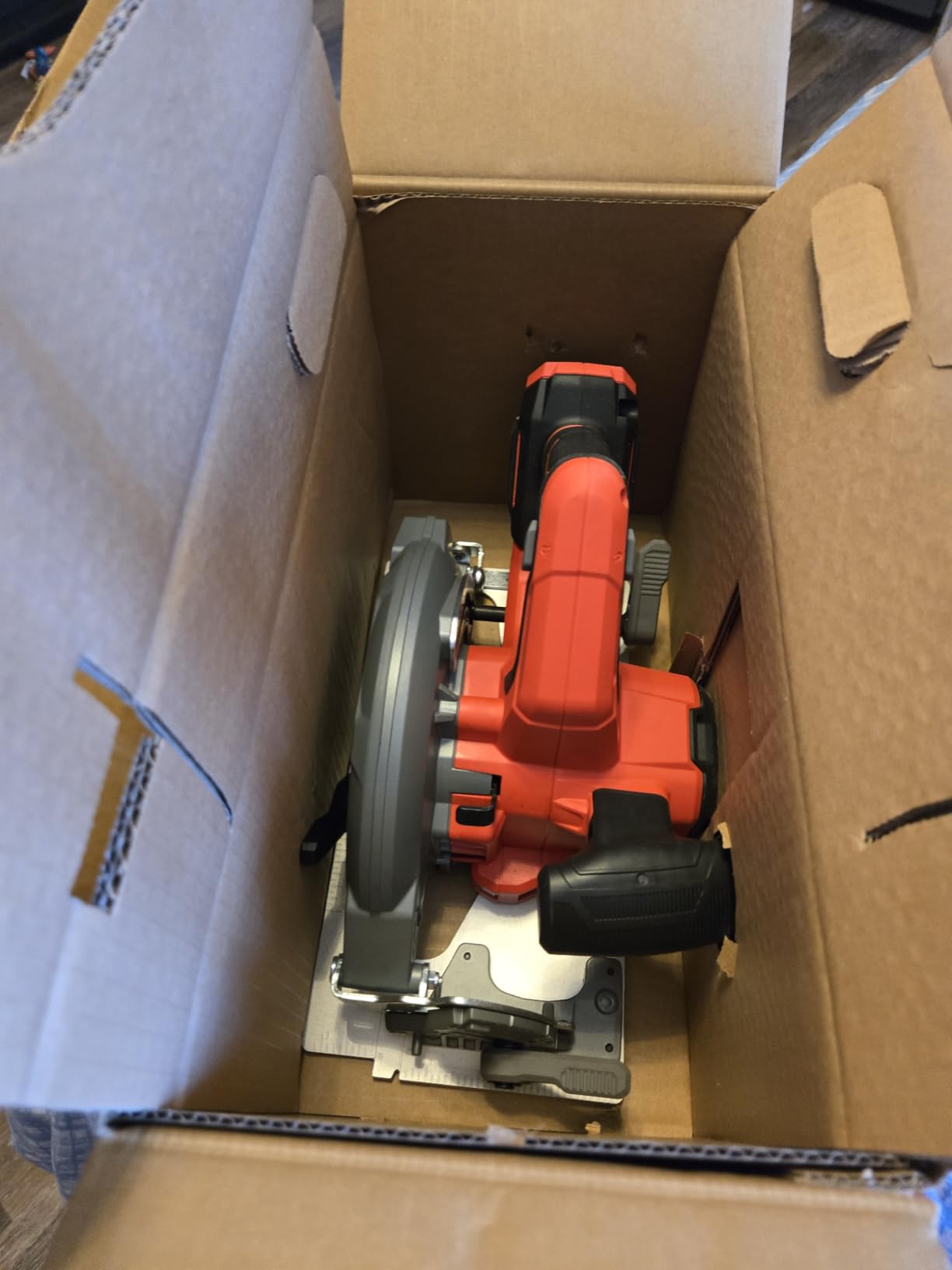
The CMCS551B does something most value-tier saws do not: it puts a brushless motor in a 7-1/4 inch body with a metal upper guard. CRAFTSMAN rates the motor at up to 75 percent more power than the brushed models it replaces, and in framing lumber the difference in how hard the saw works is obvious.
The LED is worth calling out because it is aimed at the cutting line and the worksurface, which is the correct target on a framing saw. Nothing makes a stud layout faster than seeing the mark, and several competitors in this group put their light somewhere less useful.
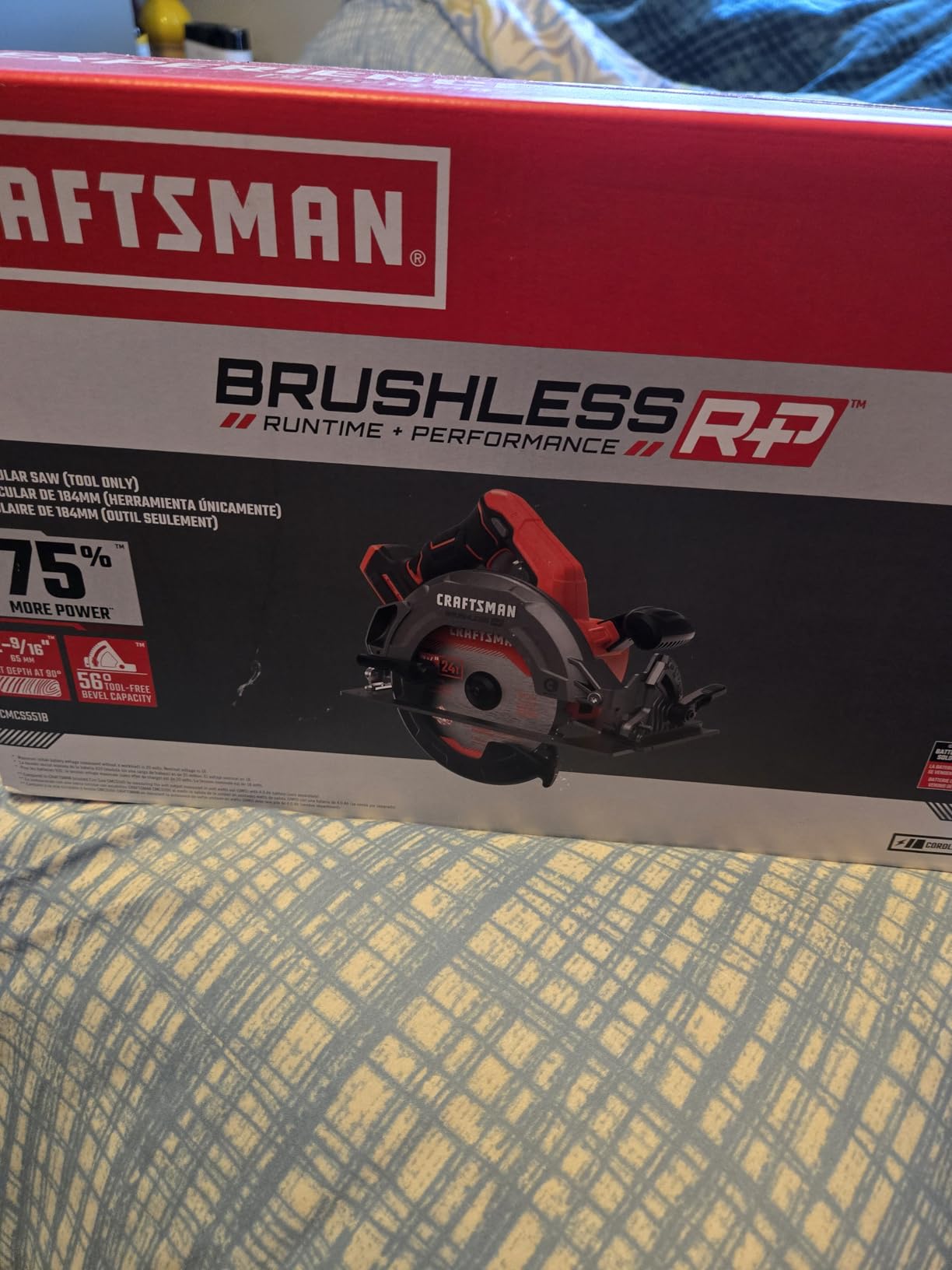
Bevel capacity is 56 degrees with positive stops at 22.5 and 45. That covers nearly everything a crew will do on a standard stick-framed wall and most roof rake cuts, and the stops save time when the same angle repeats all day.
Owners are generally satisfied with the trade this saw offers. The most common friction is not performance but logistics: it is a bare tool, so a V20 RP+ battery and charger are required before the first cut, and the 9.3 pound weight is on the heavy side for its voltage class.
Why it is worth considering for framing
You get full 7-1/4 inch capacity, a brushless motor, a metal upper guard and a cutline light at a tier where most competitors are still shipping brushed sidewinders. For a framer cutting dimension lumber all day, the motor and guard are the two components that matter, and both are upgraded here.
Buyers who already own V20 RP+ batteries benefit the most, since the platform cost drops to the tool itself and there is a large existing base of compatible packs.
Where it is not the answer
The weight works against it on overhead and ladder work. At 9.3 pounds for a bare tool, it is one of the heavier saws here despite running on a 20V class battery, and users note the load clearly on long repetitive cut days.
Service and parts access is the other factor. The installed base is smaller than the big three power tool brands, which means fewer shops carry packs and blades when something fails. If you are a working framer rather than a weekend homeowner, that ecosystem gap is worth weighing against the price difference.
5. SKIL CR5429B-20 2x20V 7-1/4 Inch – The Only Kit That Ships Ready to Cut
SKIL 2x20V PWR CORE 20 Brushless 7-1/4” Rear Handle Circular Saw Kit Includes Two 5.0Ah Batteries and Dual Port Auto PWR Jump Charger-CR5429B-20, Red
Up to 600 cuts in 2x4 SPF
2-9/16 inch cut depth
Two 5.0Ah batteries and dual port charger
Electric brake
Pros
- Cuts 3x material in one pass from two 20V packs
- Fast 15 minute quick charge and sub-hour full charge
- Batteries and charger included so it works out of the box
- Dust port in the auxiliary handle clears the cutline
Cons
- Battery degradation is the most common complaint
- Short standard warranty and limited support recourse
- Heavy at 10.2 pounds
- Lowest rating in this group at 4.2
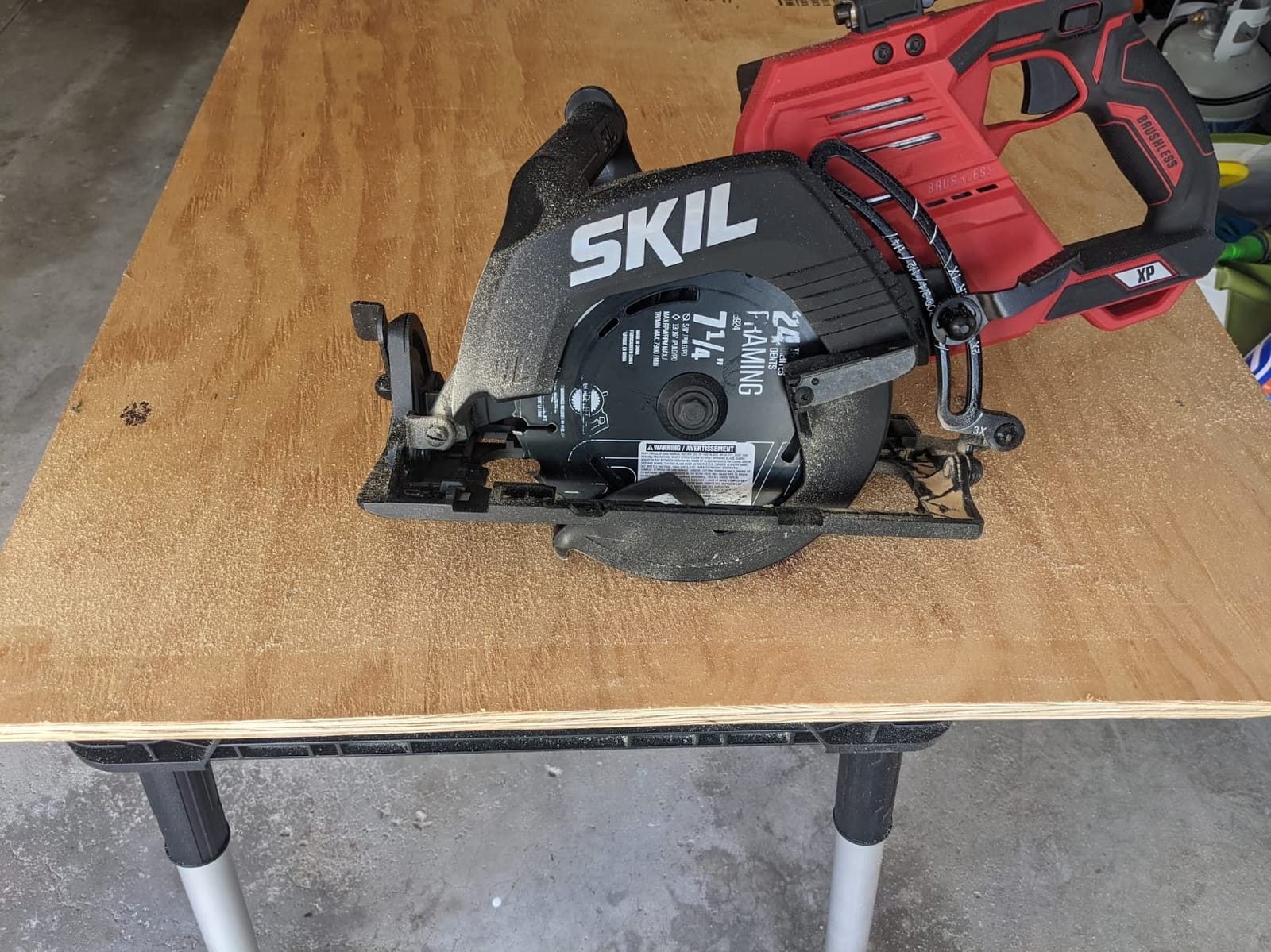
The SKIL CR5429B-20 is the one saw on this list that arrives with two 5.0Ah PWR CORE 20 batteries and a dual port charger in the box. For a framer starting a platform, that removes the single largest startup cost and the waiting around that goes with it.
SKIL rates it at up to 600 cuts per charge on 2×4 SPF crosscuts, which puts it alongside the Makita XSR01Z in the only two manufacturer cut-count figures we could verify. It cuts 3x material in one pass with 2-9/16 inches of depth, and the digital brushless motor manages power intelligently under load.
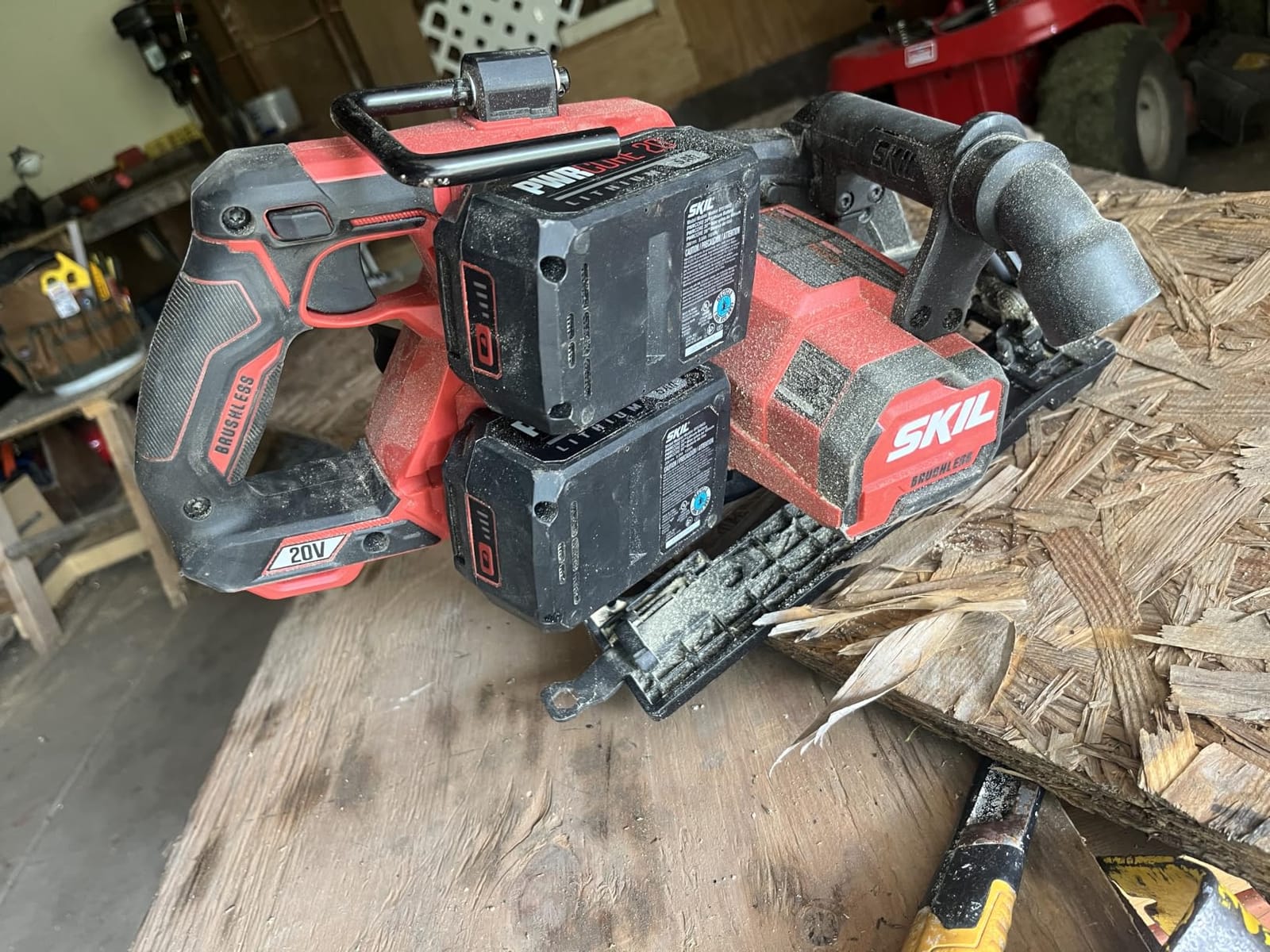
The charging system is genuinely useful on site. The Dual Port PWR JUMP charger takes both batteries from a quarter charge to usable in 15 minutes and fills them in under an hour, which matters when you are resetting for a second framing package in the same day.
Two design details are worth noting. The dust port sits in the auxiliary handle and directs sawdust away from the work area, and the electric brake cuts the time lost waiting for a spinning blade to stop between cuts. Both are small features that add up over a full day of production cutting.
Why the kit format changes the decision
Everything else on this list, with the exception of nothing, requires you to buy batteries separately. Two packs and a charger are the hidden cost that turns a tool-only price into a real one, and this is the only option where that is already paid. A first-time buyer without any platform batteries can cut on day one.
Users calling the cutting performance competitive with premium brands at a lower outlay is the dominant sentiment in reviews, and the cut-through-3x-in-one-pass capability is the headline framing claim.
Where owners report problems
Battery longevity is the recurring complaint. Owners report packs losing capacity after a period of storage, and the standard warranty plus customer support experience leaves limited recourse when a pack fails. That is the single biggest reason this saw sits at the bottom of our rating group despite strong cutting feedback.
It is also heavy at 10.2 pounds, and users note it feels heavier still with both batteries installed. If you already own a mature battery platform, that weight and the warranty concern outweigh the convenience of the kit.
6. Milwaukee 2630-20 M18 6-1/2 Inch – The Dependable Budget M18 Saw
M18 Cordless Lithium-Ion 6-1/2″ Circular Saw – 2630-20 – ( MILWAUKEE ) – BARE TOOL
3500 rpm cutting speed
Aircraft aluminum shoe
Magnesium upper and lower guards
Soft-grip handle
Pros
- Huge M18 installed base with broad battery availability
- Aircraft aluminum shoe gives a durable and precise base
- Magnesium guards protect the blade on rough work
- Easy second saw for M18 owners
Cons
- Brushed design with 3500 rpm
- below newer brushless rivals
- 6-1/2 inch class limits capacity on stacked material
- Bare tool only
- so existing M18 batteries are required
The 2630-20 has been on sale for years and it is still the saw a lot of M18 owners reach for when they want a second tool in the truck. The aircraft aluminum shoe is the standout component: it is light, it resists the corrosion that wrecks sheet-metal plates, and it holds a consistent reference for accurate rip cuts.
Milwaukee rates it for 3500 rpm, and the magnesium upper and lower guards add real durability when the saw is used on framing lumber rather than clean trim. The soft-grip handle is comfortable enough for long sessions and gives good control on crosscuts.
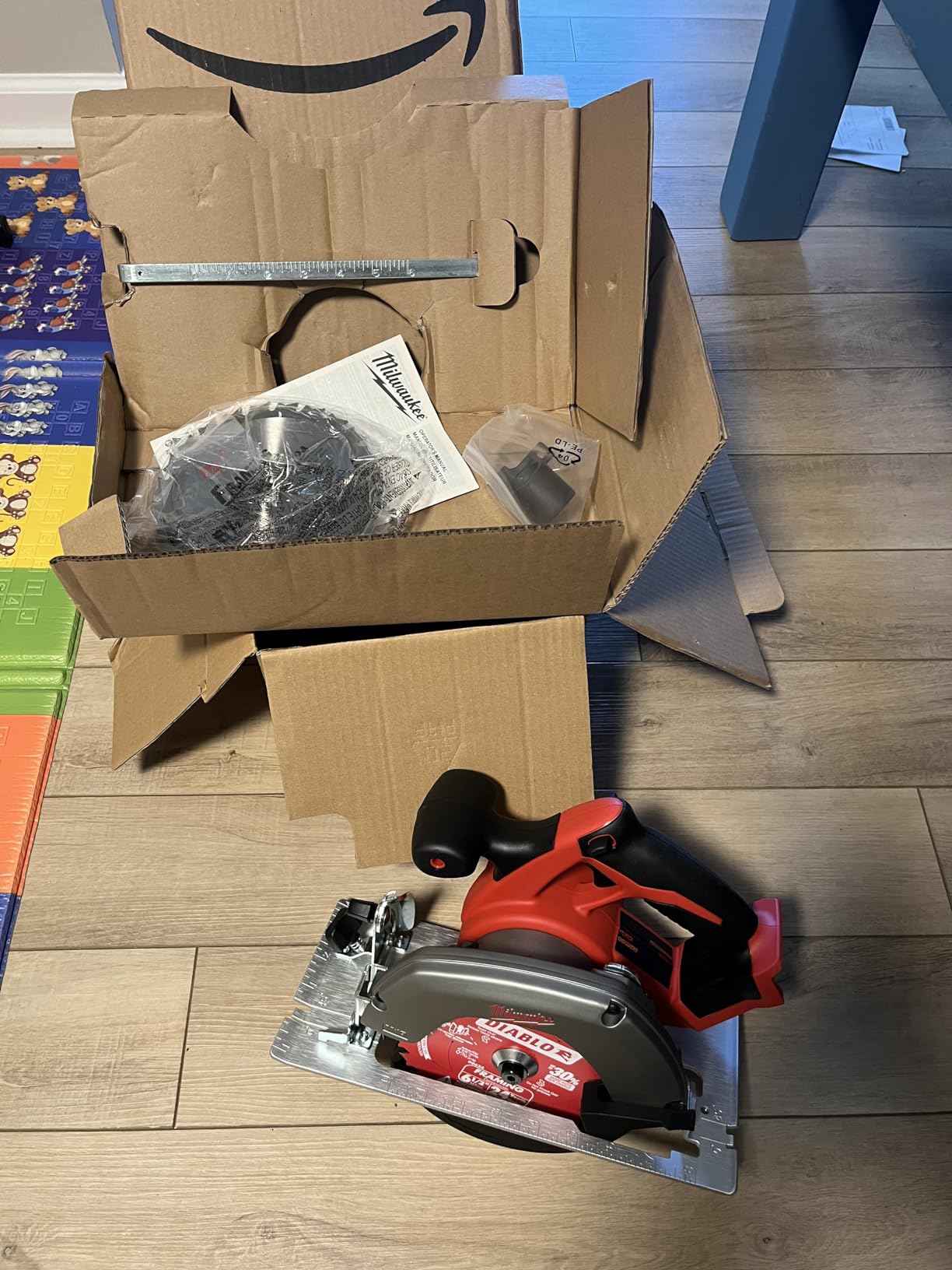
What changed since this saw launched is everything around it. Newer brushless saws spin at roughly 5000 rpm and carry electric brakes, so this one works harder on the same cut. Owners are candid about that, and it is the main reason it is no longer the default choice within the platform.
For the jobs it is still well suited to, that matters very little. Breaking down dimensional lumber, cutting headers where a single pass is not required, and general carpentry are all well within its capability.
Where this saw still makes sense
The best argument for it is that it costs little and requires nothing you do not already have. If you own M18 batteries, this is a cheap way to have a dedicated framing saw in the truck without wearing out the finish saw you use for trim.
Its 1712 ratings and consistently positive feedback across categories suggest a saw that keeps working. For a remodeler cutting dimensional lumber on a weekly basis, that reliability is worth more than peak rpm.
Where it is behind
It is a brushed design at 3500 rpm. Newer brushless saws in the same and higher classes run close to 5000 rpm with an electric brake, and reviewers note this saw is no longer cutting-edge against them. Dense or wet stock shows the difference first.
The 6-1/2 inch class format also limits capacity on stacked or 3x material, which is exactly the work that pushes a framer toward a 7-1/4 inch saw. If your framing involves laminated headers, look past this one.
7. Makita XSH03Z 18V LXT 6-1/2 Inch – Lightest Full-Size Saw We Tested
Makita XSH03Z 18V LXT® Lithium-Ion Brushless Cordless 6-1/2″ Circular Saw, Tool Only
5000 rpm brushless motor
Automatic Speed Change
7 pounds
24-tooth carbide blade included
Pros
- 5000 rpm brushless motor cuts far faster than brushed 18V saws
- Automatic Speed Change holds torque under load
- Lightest full-size option in this group at 7 pounds
- Includes a 24-tooth carbide-tipped blade
Cons
- 6-1/2 inch blade limits cut depth versus 7-1/4 inch framing saws
- Tool only
- so an 18V LXT battery and charger are extra
- Product record blade length field is inconsistent
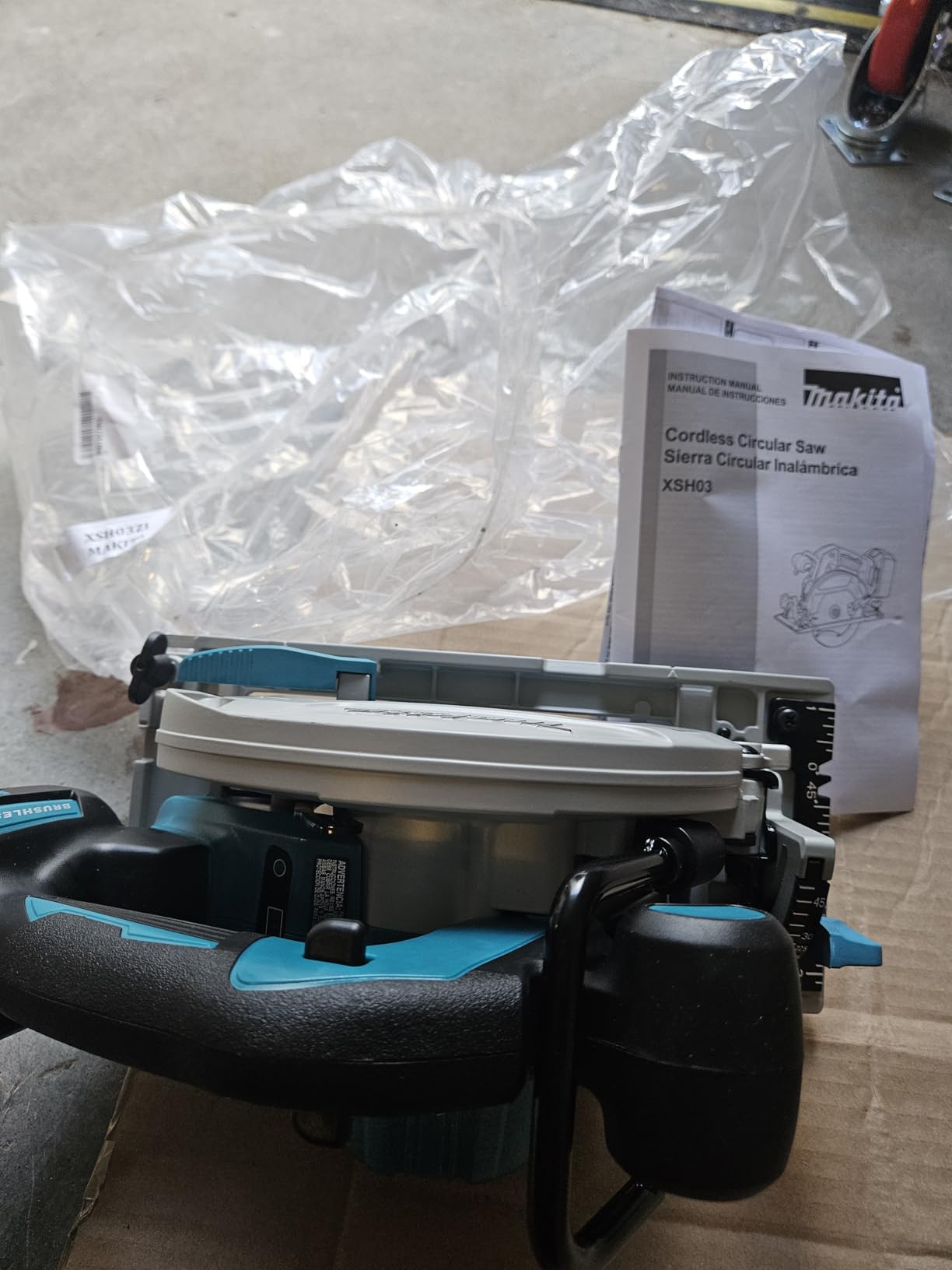
At 7 pounds, the XSH03Z is the lightest full-size saw in this group, and after a full day of framing that is the number you feel. The 5000 rpm brushless motor is a significant step over brushed 18V saws of the same size, and Automatic Speed Change adjusts speed and torque during the cut to keep it from bogging.
Makita states up to 50 percent longer run time per charge from the electronically controlled motor, and owners confirm strong runtime numbers in practice. The supplied 24-tooth carbide-tipped blade is a framing-appropriate disc straight out of the box, which is more than several bare tools in this list offer.
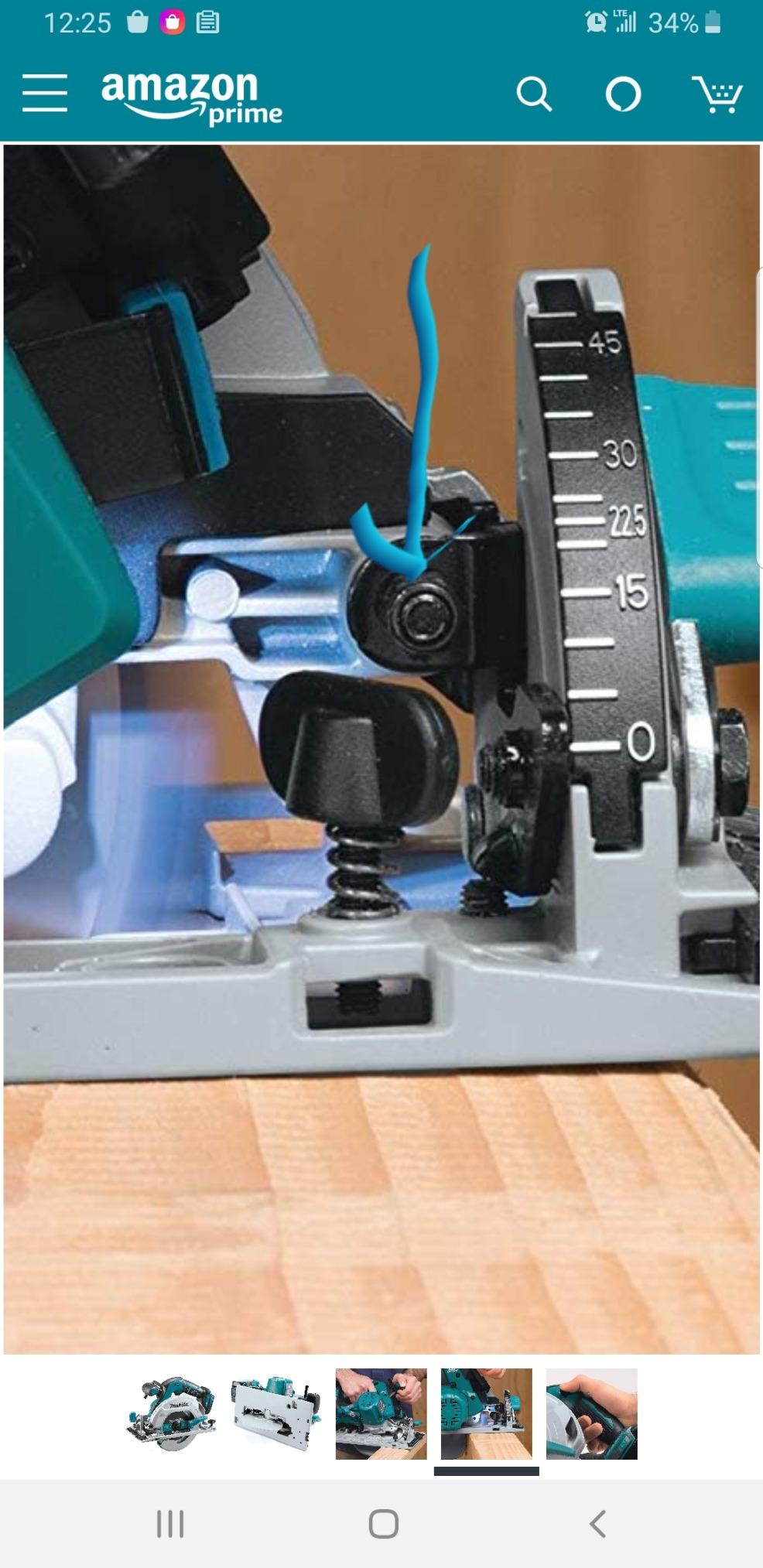
Owners consistently describe this as a fast, light and reliable 18V LXT saw. It handles ripping and crosscuts well, and the 3-year limited warranty is a meaningful term for a tool that will live on a jobsite.
The limitation everyone mentions is the same one: a 6-1/2 inch blade caps the cut depth. It is a sidewinder format, so this is not a saw you would use for laminated headers or 3x material. For dimensional lumber breakdown and framing cuts at 90 and 45 degrees, it is more than enough.
Why this is our value pick
It is the combination of weight, motor speed and platform reach. A 7 pound saw with a 5000 rpm brushless motor and a 24-tooth carbide blade included is a hard combination to find, and it is the one we would grab for a long day of repetitive crosscuts and overhead work.
For anyone already on 18V LXT, the platform depth makes it an easy addition. Makita packs are among the most broadly available batteries in the trade, and a single pack format means you are not carrying two different battery types.
Where it will not replace a 7-1/4 inch saw
Depth is the hard limit. The 6-1/2 inch class is built for 2x lumber, plywood and sheet goods, and the day you need a through cut in stacked material it simply runs out of capacity. Plan on a second, larger saw for those jobs rather than fighting this one.
One small note: the product record’s blade length field is listed inconsistently with the stated 6-1/2 inch blade, so confirm the diameter on the tool when it arrives. Owners are otherwise happy with what the package includes.
8. DEWALT DCS391B 20V 6-1/2 Inch – The Best-Selling Saw in the Category
DEWALT 20V MAX Circular Saw, Cordless Sidewinder Style Portable, 6-1/2-Inch Blade, 5150 RPM, 0-50 Degree Bevel Capability, Battery Not Included (DCS391B)
5150 rpm motor
2-1/8 inch depth at 90 degrees
0-50 degree bevel
Magnesium shoe and keyless blade change
Pros
- Largest review base in the category with a huge 20V MAX owner base
- 5150 rpm handles demanding rip and crosscut work
- Lightweight magnesium shoe holds cut accuracy over time
- Keyless blade change with spindle lock speeds blade swaps
Cons
- Brushed motor lacks the efficiency of newer brushless saws
- 2-1/8 inch depth at 90 degrees is shallow for stacked material
- 18-tooth blade leaves a coarser finish
- No battery or charger included
More than eleven thousand ratings say this saw is not going anywhere, and the DEWALT 20V MAX base is one of the largest in the trade. If you are entering the platform at all, the odds are high that you already own at least one compatible battery.
The 5150 rpm motor is genuinely quick for a brushed design, and it handles demanding rip and crosscut work in framing lumber and sheet goods. The magnesium shoe is the part that earns its keep over years: it stays flat, so your fence stays square and your rips stay straight.
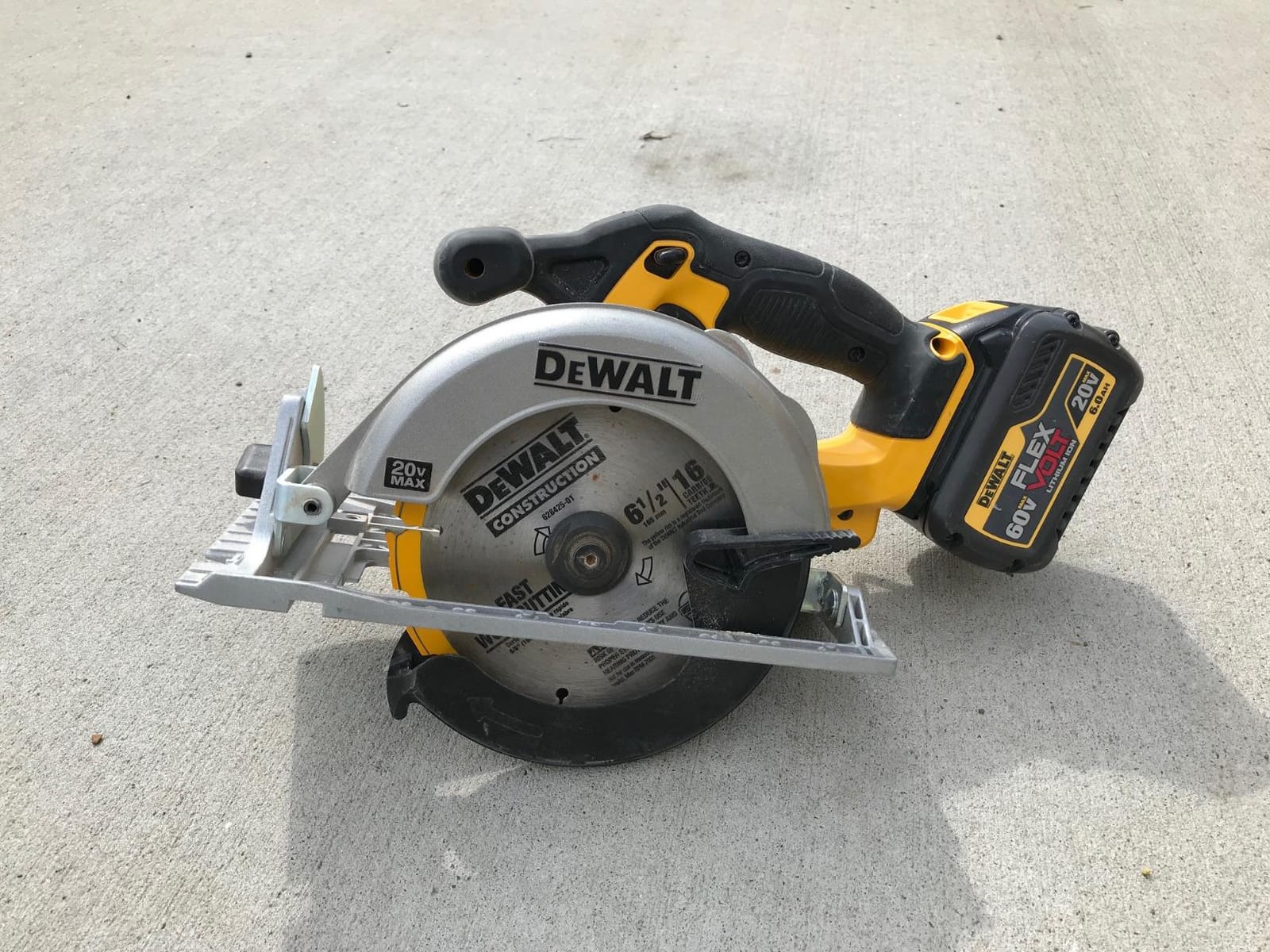
The keyless blade change with a spindle lock is a small quality-of-life feature that matters more on a framing saw than it does anywhere else, because you change blades constantly. A framing disc, a rip disc and a finish disc in and out all day is tedious with a wrench and painless with a spindle lock.
The bevel range is 0-50 degrees with a screw pivot, which is adequate for standard framing and most rake work but stops short of the deeper angles found on complex roof geometry.
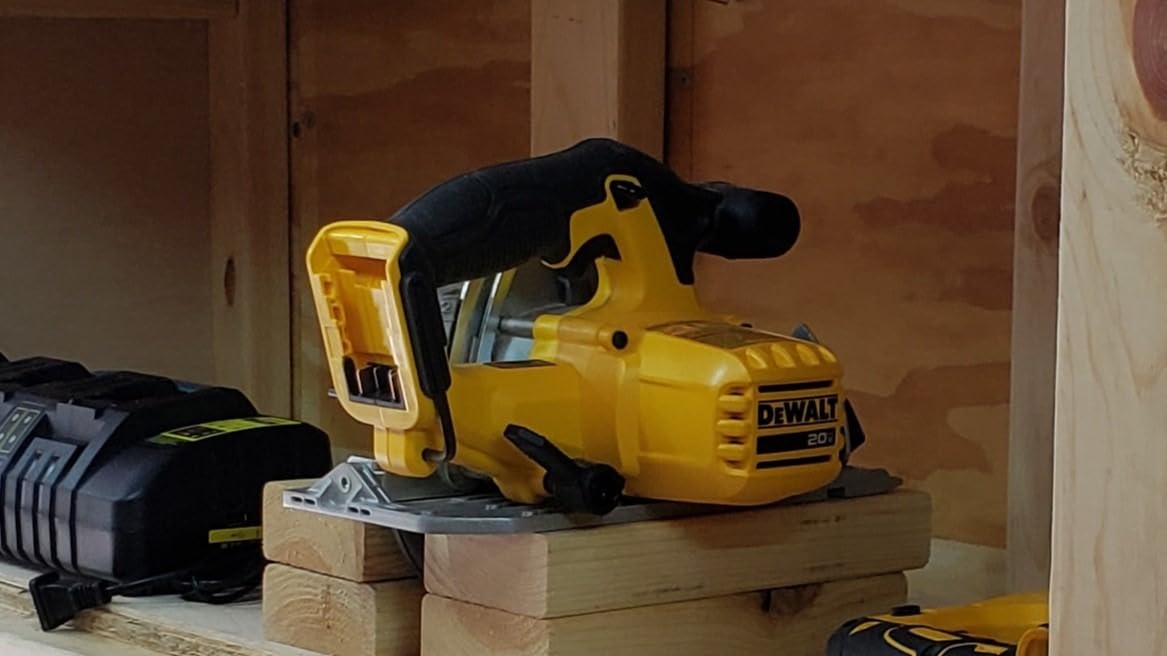
Why it stays in the conversation
The consensus across thousands of reviews is that the saw does what it says at a cost that suits a first platform purchase. The 6-1/2 inch 18-tooth blade cuts 2x material at both 90 and 45 degrees, which is the core of wall-framing breakdown work.
Owners also value the optimized rubber over-molded grip for balance and control, and the 3-year limited warranty is a solid term for a tool at this tier.
Where the brushed design shows
Compared with the brushless saws in this group, the motor is less efficient and produces more heat under sustained load. The 2-1/8 inch depth at 90 degrees is the practical limit, and it is shallower than any 7-1/4 inch saw here.
The 18-tooth blade is coarse for finish work, and the brushed motor means more battery per cut. If you are framing daily and expect to hit stacked lumber, a brushless 7-1/4 inch saw is the better long-term purchase. For a first 20V tool or a reliable site backup, this is still hard to argue with.
9. DEWALT DCS565B 20V 6-1/2 Inch – Light, Brushed-Free and Platform Flexible
DEWALT 20V MAX* Circular Saw, 6-1/2-Inch, Cordless, Battery and Charger Included (DCS565P1)
Brushless motor
Electric blade brake
Bright LED and rafter hook
Tool-free 0-50 degree bevel lever
Pros
- Brushless motor cuts smoothly with good power on 2x4 and 2x6
- Lightest DEWALT option here at 6.3 pounds
- Electric brake and bright LED improve safety and accuracy
- Works with both 20V MAX and FLEXVOLT batteries
Cons
- 6-1/2 inch blade limits depth on thicker or stacked material
- Isolated report of blade stall on timber with a full battery
- No battery or charger
- dust chute is an optional accessory
The DCS565B is the step up from the brushed saws most people start with, and its 4.7 rating reflects how cleanly it lands. The brushless motor delivers smooth, efficient cutting with good power on 2×4 and 2×6, which covers the bulk of a standard framing package.
At 6.3 pounds it is the lightest DEWALT option here and easy to carry in a crowded work truck or up a ladder. For overhead work and repetitive breakdown, the low weight is the feature you will notice every day.
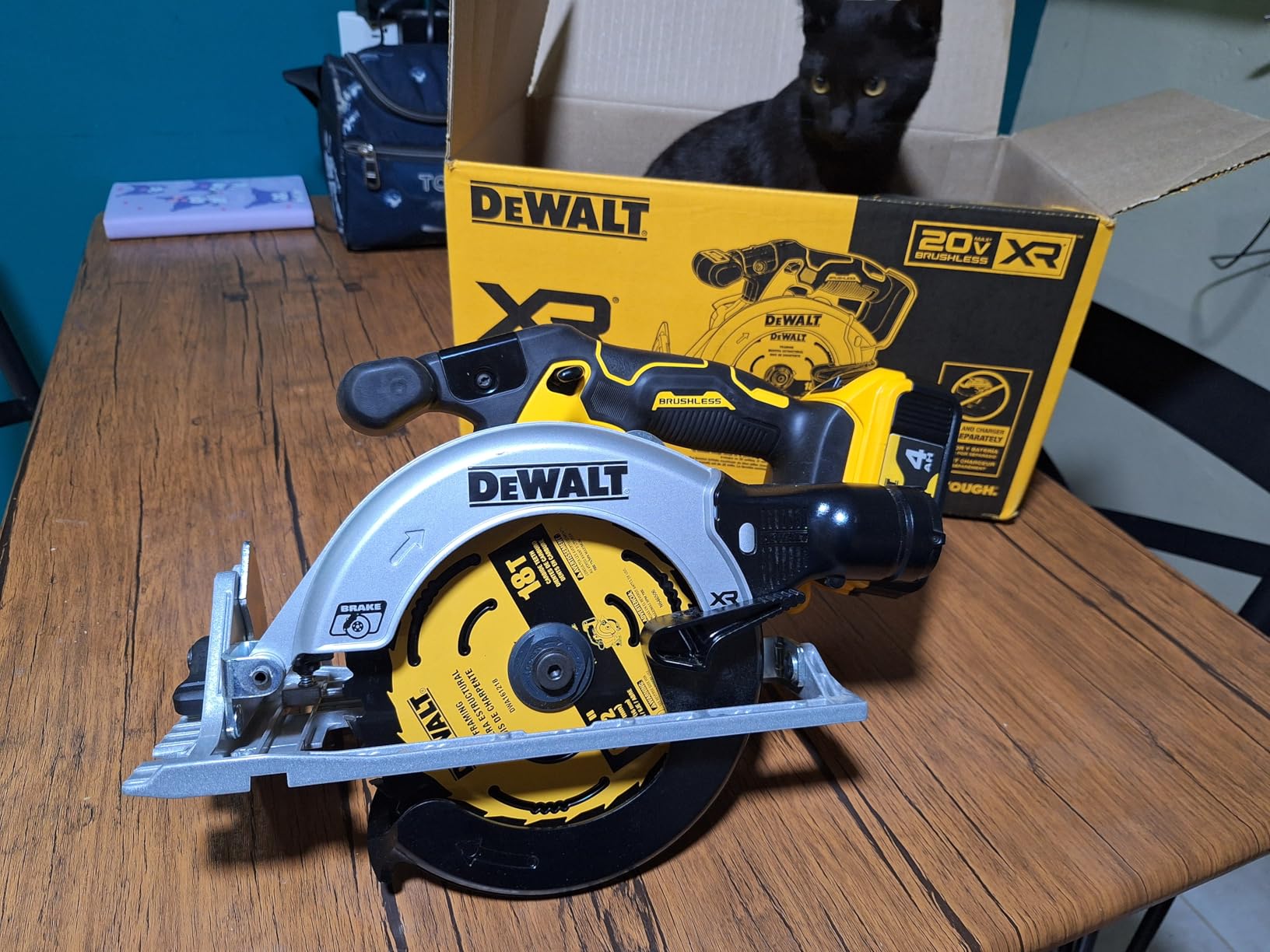
The electric brake and bright LED are the two things framers actually ask for, and both are here. The LED is well aimed, and the tool-free bevel lever makes angle changes fast, which matters when you are cutting a run of identical rafters and the last thing you want is a screw pivot slipping mid-batch.
It is also compatible with both 20V MAX and FLEXVOLT batteries. That is a real convenience if your battery collection spans platforms, and it lets you use a higher capacity pack on a lighter saw when you need a long runtime offsite.
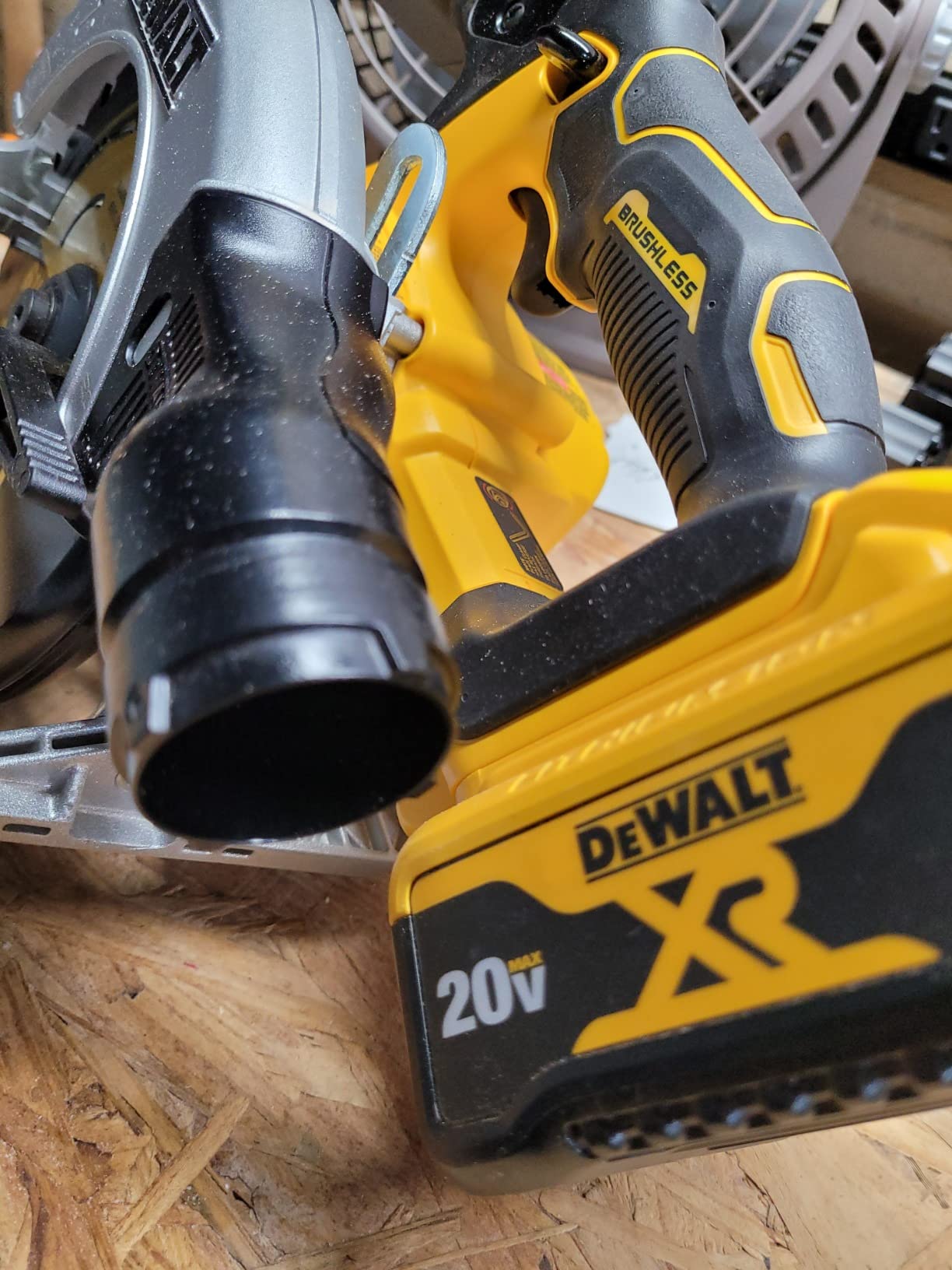
Why this ranks so high with contractors
It delivers the safety and lighting features of a flagship saw in a compact sidewinder format, and it does so with a motor that has the efficiency to make the platform batteries last. The optional dust chute accepts either a DEWALT airlock system or a standard 35 mm extractor, which is one of the better dust collection options in this group.
For a remodeler or a framer who needs one saw for framing, trim and sheet goods, the versatility of a 0-50 degree bevel with a tool-free lever is hard to beat at this weight.
Where it stops short of a framing saw
The 6-1/2 inch blade is the constraint. It is comfortable in 2x lumber and plywood, but anything thicker, stacked, or laminated needs a bigger saw. Plan this as your all-around saw rather than your dedicated framing saw.
There is also one isolated report of a blade stall on timber with a fully charged battery. It is a single account rather than a pattern, but it is worth a test cut on your own material before you rely on it for a critical header.
10. RYOBI PBLCS300B 18V HP 7-1/4 Inch – Full Size Capacity on a Budget Platform
ONEAND HP 18V BRUSHLESS Cordless 7-1/4 in. Circular Saw Tool ONLY
18V brushless motor with soft start
7-1/4 inch blade
56 degree cutting angle
Quiet operation
Pros
- 7-1/4 inch blade is a real capacity upgrade over 6-1/2 inch saws
- Brushless motor with soft start handles 2x6 framing lumber
- Long runtime reported on a 4Ah high-output battery
- Quiet operation noted by owners
Cons
- Ships without battery
- charger
- or even a blade
- Only a 30 day warranty
- Weighs 7.5 pounds
- which some find heavier than expected
The PBLCS300B is the rare budget saw that comes with a 7-1/4 inch blade, and that alone puts it ahead of most 18V-class tools for framing. The brushless motor has a soft start, which is why owners describe it as quiet and why it feels controlled when you break down a stack of studs.
Users with a high-output 4Ah battery report long runtime, cutting many sheets of plywood per charge. The 56 degree cutting angle covers standard framing bevels, and the blade sits 4.5 inches from the edge of the shoe, a geometry that makes straightedge-guided sheet-goods work predictable.
The soft start is more relevant to framing than it sounds. On a saw without it, breaking into fresh dimensional lumber means a sudden load spike, which staggers the cut and jams the shoe. Ramping into the cut instead keeps the kerf clean and the blade tracking straight.
The catch is what arrives in the box. This is a bare tool, and owners report the surprise of receiving no battery, no charger, and no blade at all. Budget accordingly, and do not plan a framing day around arriving and cutting immediately.
Who this saw works for
If you already own RYOBI 18V tools, this is one of the few budget options that gives you full 7-1/4 inch capacity. The platform is interchangeable with the rest of the 18V range, and owners with existing packs report the fit works without fuss.
For a homeowner framing a shed, a small addition or a basement wall once, the cutting capability is genuinely sufficient. The 2×6 performance draws positive comments from owners, and quiet operation matters in a residential setting.
Where the budget shows
The 30-day warranty is the shortest in this group by a wide margin. On a tool intended for framing work, that is thin protection, and buyers should weigh it against the fact that a bare tool arrives with nothing to start cutting.
It also weighs 7.5 pounds, which some users find heavier than expected, and the installed base is the smallest of the ten saws here, so parts and pack availability are less certain. Some owners also report it working harder than a corded saw on 2x material, which is a reminder that a single-battery saw is still working against a corded comparison.
Blade Size for Framing: 6-1/2 Inch vs 7-1/4 Inch
A 7-1/4 inch saw is the right choice for framing. A 6-1/2 inch saw is the right choice for a lighter, faster saw that already shares your battery platform and only ever sees single-layer dimensional lumber.
The difference shows up as cut depth. A 6-1/2 inch saw in this group measures 2-1/8 inches at 90 degrees on the DEWALT DCS391B, which handles 2x lumber and most sheet goods but not anything stacked. Every 7-1/4 inch saw here carries 2-9/16 inches of depth, which cuts 3x material in a single pass.
Beyond depth, the 7-1/4 inch format brings higher no-load speeds across the board, from 5000 rpm on the Makita XSR01Z to 5800 rpm on the DEWALT DCS578B, against 4950 to 5150 rpm on the 6-1/2 inch class. Higher speed plus more depth is what lets one of these saws replace a second pass with a flip of the board.
Weight runs the other way. The 7-1/4 inch saws in this group span 7.2 to 12.1 pounds, while the 6-1/2 inch saws sit between 6.3 and 7 pounds. If you are doing overhead work or a full day of repetitive breakdown, the smaller saw will keep you fresher.
Rear Handle vs Sidewinder for Framing
A rear handle saw is better for framing. Sidewinders are better for sheet goods, finish work, and anyone who needs to keep one hand on the saw for balance.
The rear-handle layout puts both hands on a grip behind the blade, which is how a corded framing saw has always been built. That gives you leverage to push through a cut in 2×8 or laminated stock, and it keeps your body out of the blade’s line. The saws in this group built on that format include the DEWALT DCS578B, the Milwaukee 2631-20, the Makita XSR01Z, the CRAFTSMAN CMCS551B, the SKIL CR5429B-20 and the RYOBI PBLCS300B.
Sidewinders put the motor beside the blade and a single handle behind it, which makes them narrower, lighter and more stable on sheet material where you are pushing through a wide panel. Every 6-1/2 inch saw in this roundup is a sidewinder, as are a few heavier options sold as rear-handle 7-1/4 inch models.
Worm drive saws sit apart from both. A worm drive turns the blade more slowly with higher torque, and corded worm drives are the traditional choice for wet lumber. Among the battery saws here, the Makita XSR01Z and SKIL CR5429B-20 are the two that owners describe as reaching into that class of cutting ability, with 2-9/16 inch depth through 3x material in a single pass.
Battery Platforms and Cut Counts for a Framing Day
Only two saws in this group publish cut counts, and they are the two most useful numbers available for planning a day of framing. The Makita XSR01Z is rated at up to 558 crosscuts in 2×4 SPF and 291 in 2×10 SPF using two 5.0Ah batteries. The SKIL CR5429B-20 is rated at up to 600 cuts per charge on 2×4 SPF crosscuts from two 5.0Ah packs.
Read those as an upper bound. Crosscut counts in 2×4 SPF are the most favorable test a saw will face. Crosscutting a stack of studs, ripping 2×10 headers, and working in wet pressure-treated lumber all cut the number dramatically, which is why crew experience on platforms with high-capacity packs is a better guide than a spec sheet.
Platform spread across this group is wide. DEWALT 20V MAX and FLEXVOLT appear on three saws, Milwaukee M18 on two, Makita 18V LXT and 18V X2 on two, and CRAFTSMAN V20 RP, SKIL PWR CORE 20 and RYOBI 18V HP on one each. Lock-in is the single largest factor in this decision, and the cheapest saw is rarely the cheapest setup if you already own packs.
One cross-platform note: the DEWALT DCS565B runs on both 20V MAX and FLEXVOLT batteries, which makes it the flexible option if your battery collection already spans both.
Best Blades for Framing Lumber
A 24-tooth framing blade is the right default for dimensional lumber. An 18-tooth blade cuts faster and leaves a coarser edge, and higher tooth counts are for finish work you are not doing with a framing saw.
Six of the ten saws here ship with a 24-tooth blade, including the Makita XSR01Z, the CRAFTSMAN CMCS551B, the SKIL CR5429B-20, the Makita XSH03Z and the RYOBI PBLCS300B. The DEWALT DCS391B ships with an 18-tooth carbide-tipped blade, which owners note leaves a rougher finish than a 24-tooth disc.
Change the disc when the material changes. Rough framing lumber takes a coarse blade, sheet goods take a fine one, and a blade that is too fine for green lumber will heat up and stall. The keyless blade change and spindle lock on the DCS391B is worth copying, because swapping discs is otherwise an annoying daily task.
How to Choose a Cordless Circular Saw for Framing
Check these eight things before you commit, in this order. Cut depth comes first, platform second, and everything after that is refinement.
Cut depth at 90 degrees. Below 2-9/16 inches and you will be flipping boards for stacked material. The 7-1/4 inch saws here all reach 2-9/16 inches.
Battery platform you already own. Nine of these ten saws are bare tools. If you have packs, the platform decides the answer for you.
Bevel range. Standard wall framing rarely exceeds 45 degrees. Complex roof geometry wants 53 degrees or more, which rules out the 50 degree saws in this group.
Weight. Overhead work and long cut days punish weight. 6.3 to 7 pounds is comfortable; 12 pounds is a commitment.
Electric brake. A blade that stops the instant you release the trigger is the single most requested safety feature on a framing saw.
Cutline visibility and LED aim. A light that illuminates the line and the worksurface is useful. One blocked by a bevel knob is not.
Guard and shoe material. Metal upper guards and metal shoes survive rough lumber and dropped tools better than their stamped alternatives.
Rafter hook and dust port. Small features, but they decide whether the saw hangs safely on a ladder and whether you can see the line on a dusty site.
If you already own batteries, stop at step two. The right saw is almost always the strongest one in the platform you have, and buying a second platform to chase one feature is how crews end up carrying two chargers and two battery types.
If you are starting fresh, plan on a high-capacity pack rather than the smallest one. Runtime is what ends a framing day, and a saw that pauses every forty minutes costs more time than a slightly lighter tool that runs longer.
Frequently Asked Questions
What is the best circular saw for framing?
A 7-1/4 inch rear-handle brushless saw is the best choice for framing because it combines 2-9/16 inches of cut depth at 90 degrees with enough torque for stacked material. Our top pick is the DEWALT DCS578B, with the Makita XSR01Z close behind for anyone already running twin-battery platforms.
What size circular saw is best for cutting 2×4 lumber?
A 6-1/2 inch saw cuts 2×4 and 2×6 lumber easily at both 90 and 45 degrees, and it is lighter. A 7-1/4 inch saw is better for framing overall because its 2-9/16 inch depth handles stacked material and 3x lumber in a single pass.
What brand makes the best cordless circular saw?
DeWalt, Milwaukee and Makita cover the most ground, with large battery ecosystems and broad service networks. Best value models come from CRAFTSMAN, SKIL and Ryobi, which offer brushless motors and 7-1/4 inch blades at lower tiers.
What is the best cordless circular saw for the money?
The Makita XSH03Z pairs a 5000 rpm brushless motor, a 7 pound weight and a 24-tooth carbide blade at a low entry point, and it suits anyone already on 18V LXT. The SKIL CR5429B-20 is the value option if you need batteries and a charger included.
Do I need a rear handle circular saw for framing?
Yes, for most framing work. A rear handle puts both hands behind the blade, which gives you leverage to push through dense stock and keeps your body clear of the cut. Sidewinder saws are lighter and better suited to sheet goods and finish work.
How many cuts per charge does a cordless circular saw make?
Published figures vary widely. The Makita XSR01Z is rated at up to 558 crosscuts in 2×4 SPF and 291 in 2×10 SPF on two 5.0Ah batteries, and the SKIL CR5429B-20 is rated at up to 600 cuts in 2×4 SPF. Real-world counts fall well short when cutting wet or stacked material.
What blade should I use for framing lumber?
A 24-tooth framing blade is the best general choice for dimensional lumber. An 18-tooth blade cuts faster but leaves a coarser edge, and higher tooth counts suit finish work. A blade that is too fine for green lumber will heat up and stall.
Is a cordless circular saw powerful enough for framing?
Yes. The DEWALT DCS578B, Makita XSR01Z and SKIL CR5429B-20 all cut 3x material in a single pass with 2-9/16 inches of depth, and owners report worm-drive-class performance from the twin-battery models on wet lumber.
Final Verdict for Framers
The DEWALT DCS578B is the best cordless circular saw for framing in 2026. Its 5800 rpm brushless motor, 2-9/16 inch depth, 57 degree bevel and electric brake cover everything a framing crew throws at a saw, and the FLEXVOLT platform is one of the most established in the trade.
Choose differently when your work says so. On M18 batteries, the Milwaukee 2631-20 gives you a proven 7-1/4 inch saw. On twin-battery platforms, the Makita XSR01Z is the deepest-cutting option here. If weight is the problem, the 7 pound Makita XSH03Z or the 6.3 pound DeWALT DCS565B will keep you fresher on an overhead day.
Whichever you choose, buy it with the batteries you actually need. A framing saw is only as good as the runtime behind it, and the cut counts above tell you how far a full day really goes.