
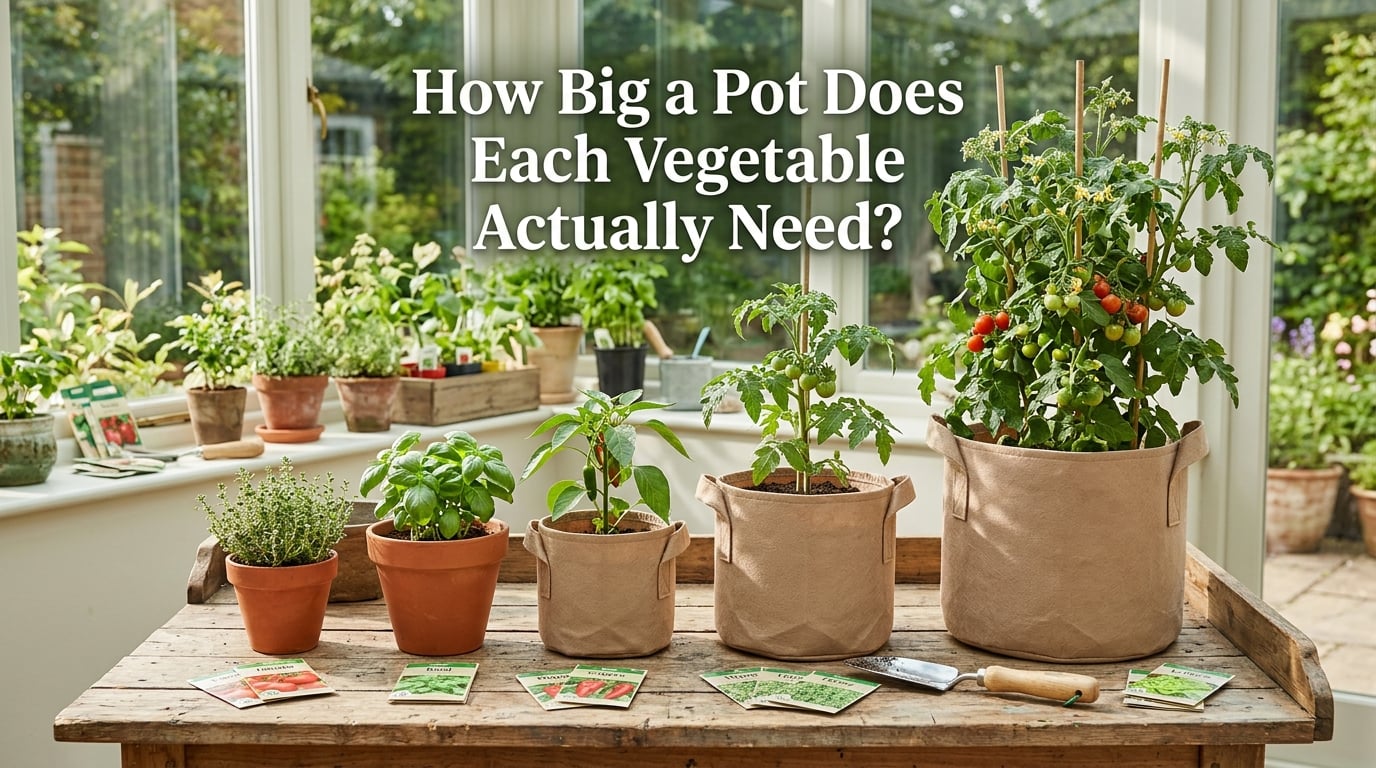
Most vegetables need between 1 and 15 gallons of container volume, and the exact pot size for each vegetable depends on its mature root depth and how big the plant grows above ground. Leafy greens and herbs thrive in 1-2 gallon pots, fruiting crops like tomatoes and peppers need at least 5 gallons, and large vining crops like squash and melons want 10-15+ gallons. As a quick rule: when in doubt, size up.
Table of Contents
The Master Vegetable Container Size Chart
Use the chart below as your quick-reference for every common garden vegetable. We list the minimum container size in gallons and inches, the minimum soil depth in inches, and the number of plants per pot. If a vegetable you want to grow is not on the chart, fall back on these sizing tiers: 1 gallon for herbs and microgreens, 2-3 gallons for shallow-rooted leafy crops, 5 gallons for compact fruiting plants, 10 gallons for full-size tomatoes and cucumbers, and 15+ gallons for squash, melons, and potatoes.
| Vegetable | Min Container Size | Diameter | Min Depth | Plants per Pot |
|---|---|---|---|---|
| Basil, cilantro, parsley, thyme | 1 gallon | 6-8 in | 6 in | 1-3 |
| Green onions / scallions | 1 gallon | 6 in | 6 in | 4-6 |
| Lettuce, spinach, arugula | 1-2 gallons | 6-8 in | 6 in | 3-5 |
| Radishes | 1-2 gallons | 6-8 in | 6-8 in | 5-8 |
| Strawberries | 2-3 gallons | 8-10 in | 8 in | 2-3 |
| Beets | 2-3 gallons | 8-10 in | 10 in | 4-6 |
| Swiss chard, kale | 2-3 gallons | 8-10 in | 8-10 in | 2-3 |
| Bush beans | 2-3 gallons | 8-10 in | 8-10 in | 2-3 |
| Carrots (short varieties) | 2-3 gallons | 8-10 in | 8-10 in | 10-12 |
| Peppers (compact) | 3-5 gallons | 10-12 in | 10-12 in | 1-2 |
| Eggplant (compact) | 3-5 gallons | 10-12 in | 10-12 in | 1 |
| Cucumbers (bush) | 5 gallons | 12 in | 10-12 in | 1-2 |
| Cherry tomatoes (compact) | 5 gallons | 12 in | 12 in | 1 |
| Full-size tomatoes | 10 gallons | 14-16 in | 12-14 in | 1 |
| Zucchini / summer squash | 5-10 gallons | 14-18 in | 12 in | 1 |
| Cucumbers (vining) | 10 gallons | 14-18 in | 12 in | 1-2 |
| Potatoes | 10-15 gallons | 14-18 in | 14-16 in | 2-3 seed potatoes |
| Winter squash, pumpkins | 15+ gallons | 18-24 in | 14-18 in | 1 |
| Watermelon, cantaloupe | 15-20 gallons | 20-24 in | 16-18 in | 1 |
| Corn | 15+ gallons | 18-24 in | 12 in | 4-6 (block) |
For the full per-vegetable breakdown with companion-planting tips and balcony-friendly tier sizing, scroll down through the sections below.
Why Pot Size Matters for Vegetables
Pot size controls four things at once: root depth, water retention, nutrient availability, and plant stability. When a container is too small, roots circle the bottom, dry out fast, and cannot pull enough water or nutrients to support top growth. The result is exactly what beginner gardeners complain about on Reddit and in the CalgaryGardening Facebook group: stunted plants, blossom-end rot on tomatoes, and constant daily watering in summer.
Larger pots hold more soil volume, which means more water stays available between waterings, more nutrients are buffered, and roots have room to spread out. A 5-gallon container of moist potting mix holds roughly 4 to 5 times the water of a 1-gallon container, which translates directly into fewer watering trips and bigger harvests. Bigger pots also stabilize tall or top-heavy plants so they do not tip over in wind on a balcony or patio.
Conversely, overpotting has its own downside: a 15-gallon pot of wet soil is genuinely heavy on a balcony, and most small vegetables will not use the extra root space. The goal is the smallest container that still lets the plant reach its full mature size without stress, which is what the master chart above gives you for every common vegetable.
Tier 1: 1-2 Gallon Pots for Herbs, Greens, and Quick Crops
The smallest food-producing pots are 1 to 2 gallons, roughly 6 to 8 inches in diameter and 6 to 8 inches deep. These are perfect for windowsills, kitchen counters, and any indoor vegetable garden pot size where space is tight. In our own testing at home, a single 1-gallon pot comfortably holds three basil plants or one full head of butter lettuce.
What grows well in 1-2 gallon pots:
- Most culinary herbs: basil, cilantro, parsley, thyme, oregano, chives, mint (mint is so aggressive it actually prefers its own container).
- Lettuce, spinach, arugula, and other salad greens – thin to 4-6 inches apart and harvest outer leaves.
- Green onions and scallions – plant in clusters of 4-6 per 1-gallon pot.
- Radishes – especially fast round varieties like ‘Cherry Belle’ that mature in 25 days.
- Microgreens and baby salad mixes harvested at 2-3 inches tall.
A 1-gallon pot is the absolute minimum viable size, and a 2-gallon pot is the safer pick for anything that will grow for more than a few weeks. Mint, in particular, runs through soil fast and dries out quicker than basil in the same pot.
Tier 2: 3-5 Gallon Pots for Bush Beans, Compact Peppers, and Leafy Greens
The 3-5 gallon tier is the workhorse range for most beginner gardeners. A 5-gallon bucket is the unofficial standard container in the container gardening community: cheap, food-safe when bought new, widely available, and big enough for almost anything compact. At 12 inches in diameter and 12 inches deep, it is the sweet spot for patio vegetable gardens and small balcony setups.
What grows well in 3-5 gallon pots:
- Compact pepper varieties like ‘Lunchbox’ and most jalapenos – one plant per 3-gallon pot, or two plants in a 5-gallon.
- Compact eggplant like ‘Patio Baby’ – one plant per 5-gallon pot.
- Bush beans – 2-3 plants in a 3-gallon pot; 4-5 plants in a 5-gallon bucket.
- Swiss chard and kale – 2-3 plants per 5-gallon pot; harvest outer stalks for months.
- Strawberries – 2-3 plants per 3-gallon pot, or use a dedicated strawberry planter.
- Short carrot varieties like ‘Paris Market’ or ‘Chantenay’ – 10-12 plants per 5-gallon pot.
A 5-gallon bucket is also where you cross from “salad-garden” into “real dinner” – fruiting plants that actually feed a family reliably. If you only buy one container size for a beginner vegetable container garden, this is the tier to invest in.
Tier 3: 5-10 Gallon Pots for Tomatoes, Eggplant, and Zucchini
Most fruiting vegetables need at least 5 gallons, and many want 10. This is the tier where the gap between “minimum” and “ideal” matters most, because the difference between a struggling plant and a productive one is often just a few extra gallons of root room.
Tomatoes
For tomatoes, the standard advice across every competitor chart is 5 gallons minimum, but experienced gardeners on r/vegetablegardening report that 10 gallons is what actually delivers full-size harvests. Cherry tomatoes and compact determinate varieties like ‘Patio Princess’ will produce in a 5-gallon container, but full-size indeterminates like ‘Beefsteak’ or ‘Cherokee Purple’ really want 10 gallons.
For depth, 12 inches is the minimum for healthy root development on any tomato – which is exactly the depth of a standard 5-gallon bucket. If you go up to a 10-gallon pot, look for one that is at least 14 inches deep.
Eggplant
Eggplant has the same root architecture as tomatoes and wants the same pot: 5 gallons minimum, 10 gallons ideal. One plant per pot is the rule, because overcrowding eggplant reliably produces tiny, bitter fruit.
Zucchini and Summer Squash
Zucchini is famously productive in containers, but it is also famously hungry. One ‘Black Beauty’ zucchini plant needs at least 5 gallons, and 10 gallons gives you noticeably larger harvests and less wilting in summer heat. Always allow 14-18 inches of diameter so the leaves have airflow and powdery mildew stays at bay.
Cucumbers
Bush cucumbers like ‘Bush Champion’ grow fine in a 5-gallon pot with a small trellis. Vining cucumbers want a 10-gallon container and a tall trellis – they will sprawl everywhere otherwise and the fruit will rot where it touches damp soil.
Tier 4: 10-15+ Gallon Pots for Squash, Melons, Corn, and Potatoes
Once you get into vining crops and heavy feeders, the pot size jumps fast. These are the plants that genuinely fill a container, and trying to grow them in 5 gallons is a recipe for a stunted harvest.
Winter Squash and Pumpkins
Winter squash and pumpkins want 15 gallons minimum, ideally 20. One plant per container, planted in the center, with the vines trained outward or up a sturdy trellis. A 15-gallon fabric grow bag is the most common choice because the handles make it possible to move.
Watermelon and Cantaloupe
Melons are the giants of the container vegetable garden. They want 15-20 gallons and at least 16-18 inches of depth, plus a strong trellis and fruit slings for any melon that gets larger than a softball. Compact varieties like ‘Sugar Baby’ watermelon and ‘Minnesota Midget’ cantaloupe are the realistic picks for containers.
Corn
Corn is wind-pollinated, so it must be planted in a block of at least 4-6 plants for proper kernel development. That requires a 15+ gallon container at minimum, and ideally a 20-gallon half-barrel or grow bag. One stalk per 2-3 gallons of soil is the rule of thumb, and the container should be at least 12 inches deep.
Potatoes
Potatoes are the one crop where depth is more important than diameter. A 10-gallon container 14-16 inches deep holds 2-3 seed potatoes comfortably and lets you hill up soil as the plants grow. Fabric grow bags are especially popular for potatoes because the fabric lets you peek at harvest time and see exactly when the tubers are ready.
Tier 5: Deep Pots for Root Vegetables
Root vegetables break the usual “more gallons is better” rule because what they need is depth, not diameter. A wide, shallow pot will not grow carrots any more than a tall narrow one will grow lettuce.
Carrots, parsnips, and long beets all need at least 10 inches of depth for full-size roots, and 12-14 inches if you want truly long varieties like ‘Imperator’ carrots. The diameter can stay small – 8-10 inches is plenty for a single row of carrots or beets, which is why 2-3 gallon containers work for short varieties.
Onions and shallots are similar: shallow depth for green onions (6 inches is enough) and 8-10 inches for bulb onions and leeks. Plant onions in clusters of 4-6 per 1-2 gallon pot, or thin them to 4 inches apart in a 5-gallon bucket for full bulbs.
Fabric grow bags are particularly good for root vegetables because they air-prune the taproot and prevent the circling that happens in hard-sided pots. Multiple Reddit users in r/containergardening specifically recommend grow bags for carrots and potatoes for this reason.
Container Materials: Terracotta vs Plastic vs Fabric Grow Bag vs Wood
The material your container is made of changes how often you water, how heavy the pot is, and how long it lasts outdoors. Here is how the four common choices compare.
| Material | Pros | Cons | Best For |
|---|---|---|---|
| Terracotta | Breathable, classic look, stable weight | Heavy, dries out fast, cracks in frost | Herbs, drought-tolerant Mediterranean plants |
| Plastic (resin, nursery pots) | Light, cheap, retains moisture | Can tip over when tall plants grow, fades in sun | Balcony gardens, tomatoes, peppers |
| Fabric grow bag | Air-prunes roots, lightweight, foldable storage | Dries out faster, less stable for tall plants | Potatoes, root vegetables, rooftop gardens |
| Wood (cedar planter, half-barrel) | Insulates roots, attractive, long-lasting | Heavy, can rot over time if not cedar/redwood | Permanent patio gardens, large vining crops |
Terracotta is the most breathable material, which is great for herbs that hate wet feet (rosemary, thyme, sage) but a poor choice for thirsty vegetables like tomatoes. Plastic pots retain moisture the longest and are the cheapest option, but they get brittle in sun after a few years and can tip when the plant is tall.
Fabric grow bags have become the most popular choice in recent years because they air-prune roots, weigh almost nothing empty, and store flat in winter. The trade-off is faster drying: in midsummer you may water twice a day in a 5-gallon fabric bag. Wood planters and half-barrels are the most attractive option for a permanent patio vegetable garden and insulate roots from temperature swings, but they are heavy to move once filled.
7 Common Pot-Size Mistakes (And How to Fix Them)
Most container garden failures trace back to one of these sizing mistakes. If you have killed a container vegetable before, the answer is probably on this list.
- Undersizing tomatoes. The single most common error. A 5-gallon bucket works for cherry tomatoes but produces disappointing harvests on full-size varieties. Fix: go to 10 gallons for any indeterminate or beefsteak-type tomato.
- Forgetting depth. Pots that are wide and shallow starv root vegetables. A 6-inch deep window box will not grow a full-size carrot no matter how wide it is. Fix: match depth to the crop’s mature root length, not just its top growth.
- Skipping drainage holes. Containers without drainage holes waterlog the soil and suffocate roots. Fix: drill 4-6 holes in the bottom of any container that does not already have them.
- Overpotting small herbs. A 10-gallon pot for basil is not a kindness – the soil stays wet, the roots rot, and the plant sulks. Fix: 1-2 gallons is plenty for most herbs.
- Ignoring mature size. A tiny seedling in a 1-gallon pot looks fine for two weeks, then hits a wall. Fix: pot up to the container size the plant will need at maturity, not the size it is today.
- Planting too many per pot. Three tomato plants in one 5-gallon bucket will all starve. Fix: one tomato, pepper, or eggplant per 5+ gallon pot, period.
- Buying cheap soil that compacts. Garden soil in a container turns into concrete within weeks. Fix: use a real potting mix with perlite or coco coir for drainage.
Conservatory and Indoor-Friendly Vegetables: A Site-Specific Guide
One thing no competitor chart covers well is which vegetables actually do well indoors, in a conservatory, or on a bright windowsill year-round. After running our own indoor setup for two years, here are the seven easiest vegetables to grow in containers indoors, with the pot size that consistently worked for us.
- Lettuce and salad greens: 1-2 gallon pots on a sunny windowsill, harvest outer leaves continuously.
- Cherry tomatoes (compact varieties like ‘Tiny Tim’): 3-5 gallon pots in the brightest spot you have, ideally with a grow light in winter.
- Herbs (basil, parsley, chives, mint): 1-gallon pots, one herb per pot, rotate to the sunniest window.
- Microgreens: shallow trays 2 inches deep, harvest at 2-3 inches tall every 10-14 days.
- Green onions: 1-gallon pots or even a glass of water – they regrow from kitchen scraps.
- Radishes (round varieties): 1-2 gallon pots, 25-30 days from seed to harvest.
- Hot peppers (compact varieties like ‘Apache’): 3-5 gallon pots in the brightest indoor spot.
The key for indoor vegetable gardens is to size down by one tier from what the master chart recommends. A cherry tomato that wants 5 gallons outdoors will be perfectly happy in 3 gallons indoors because the plant stays smaller with less light, and the smaller pot is easier to rotate under a grow light. For conservatory setups that get full sun through glass year-round, you can follow the outdoor chart more closely.
Pot Size Cheat Sheet: 4 Rules That Always Hold
If you do not want to memorize the full chart, these four rules cover 90% of container vegetable decisions.
- Leafy greens and herbs: 1-2 gallons. Anything you harvest as leaves (lettuce, spinach, kale, basil, parsley) thrives in small pots.
- Bush beans, beets, compact peppers: 3-5 gallons. The most common beginner tier, and where a 5-gallon bucket is genuinely useful.
- Tomatoes, eggplant, zucchini, cucumbers: 5-10 gallons. The minimum for fruiting crops, and 10 gallons is the realistic pick for full-size varieties.
- Squash, melons, corn, potatoes: 15+ gallons. Big plants need big pots, and there is no real shortcut here.
And the universal rule from experienced gardeners: when in doubt, go one size up. A plant that has slightly more root room than it needs will forgive a missed watering; a plant that is cramped will not forgive anything.
Drainage, Watering, and Soil Notes
Three quick notes that apply no matter which container size you choose. First, every container needs drainage holes – 4-6 holes in the bottom is standard, and you can drill additional holes in any plastic or wood pot that does not already have them. Containers without drainage will waterlog and suffocate the roots within a week.
Second, water deeply until it runs out the bottom, then let the top inch dry before watering again. Shallow daily watering encourages shallow roots, which makes the plant less drought-tolerant. For a 5-gallon pot in summer, expect to water every 1-2 days; for a 1-gallon herb pot, every day or even twice a day in heat.
Third, use a real potting mix, not garden soil. Potting mixes contain perlite, vermiculite, or coco coir that keep the soil airy and prevent compaction. Garden soil in a container compacts into a brick within a few weeks and drowns the roots. A 2-cubic-foot bag of quality potting mix fills roughly six 5-gallon pots.
Self-Watering vs Standard Containers
Self-watering containers have a built-in water reservoir at the bottom that wicks moisture up into the soil. They are genuinely useful for thirsty vegetables like tomatoes and for anyone who travels and cannot water daily. The reservoir typically holds 1-3 gallons, which extends the time between waterings by 2-3 days.
Self-watering containers work best at the 5+ gallon tier, where the soil volume is large enough to wick moisture evenly. For herbs and small leafy greens in 1-2 gallon pots, a standard container is usually easier because herbs prefer to dry out slightly between waterings.
Budget Tip: 5-Gallon Buckets and Food-Safe Containers
For gardeners watching the budget, new food-grade 5-gallon buckets from a restaurant supply or hardware store are the cheapest reliable container. They cost a fraction of a comparably sized decorative pot, they are food-safe (look for buckets labeled “food grade” or with the recycling triangle #2 HDPE), and they are exactly the 12-inch diameter, 12-inch deep size that fits so many crops.
Drill 4-6 half-inch drainage holes in the bottom, and you have a perfectly serviceable container for peppers, eggplant, bush beans, compact tomatoes, kale, chard, and most root vegetables. For aesthetics, paint the outside with exterior latex paint or wrap them in burlap.
Frequently Asked Questions
What is the recommended pot size for vegetables?
Most vegetables need between 1 and 15 gallons depending on the crop. Herbs and leafy greens do well in 1-2 gallon pots, peppers and bush beans in 3-5 gallons, tomatoes and zucchini in 5-10 gallons, and squash, melons, and corn in 15+ gallons. Match the pot to the plant’s mature root depth, and when in doubt go one size up.
How deep do containers need to be for vegetables?
Depth depends on the root system. Leafy greens and herbs need only 6 inches, while fruiting vegetables like tomatoes and peppers need at least 12 inches of depth for healthy root development. Root vegetables like carrots and parsnips need 10-14 inches depending on the variety. A general rule: the deeper the pot, the more forgiving the watering schedule.
Is 12 inches deep enough for tomatoes?
Yes, 12 inches is the minimum depth for healthy tomato root development and works well for compact and cherry varieties in a 5-gallon bucket. For full-size indeterminate tomatoes like beefsteak, 14-16 inches of depth combined with a 10-gallon container delivers noticeably better harvests. The diameter matters too – aim for at least 14 inches for full-size plants.
How many vegetables can I grow in a 5 gallon bucket?
A 5-gallon bucket fits one full-size tomato, pepper, or eggplant, two to three bush bean plants, four to five kale or chard plants, or ten to twelve short carrots. The general rule is one large fruiting plant per bucket or several smaller plants spaced 4-6 inches apart. Overcrowding a 5-gallon bucket is one of the most common beginner mistakes.
What is the most common mistake with container plants?
The most common mistake is undersizing the pot, especially for tomatoes and other fruiting crops. Other frequent errors include skipping drainage holes, planting too many vegetables per container, using garden soil instead of potting mix, and forgetting that depth matters as much as diameter for root vegetables. Sizing up by one tier whenever you are unsure is the safest rule.
How much space does each vegetable plant need?
Space per plant depends on the crop’s mature size. Leafy greens and herbs need 4-6 inches between plants, bush beans and beets need 4-6 inches, peppers and eggplant need 12-18 inches (one per 3-5 gallon pot), and full-size tomatoes need 18-24 inches (one per 10-gallon pot). The Plants per Pot column in the master chart above gives the exact spacing for every common vegetable.
The Final Word on Pot Sizes
Start with the master chart above, group vegetables by tier (1 gal, 2-3 gal, 5 gal, 10 gal, 15+ gal), and remember the one rule every experienced gardener repeats: when in doubt, go one size up. A right-sized pot is the single biggest factor in whether a container vegetable garden produces a real harvest or just survives. For indoor and conservatory setups, size down one tier from the outdoor recommendation – the plants stay smaller with less light, and a 3-gallon pot is easier to rotate under a grow light than a 10-gallon one. Print the chart, tape it to the inside of a shed door, and pick your containers before you buy your seedlings.