
Every 50 amp pedestal you plug into is shared with your neighbours, and campground power is famously unreliable. The best RV surge protectors for 50 amp service do more than absorb a lightning spike: they read the line before your coach draws a single watt and refuse to pass bad power through to your inverter, residential fridge and electronics board.
We went through ten true 50 amp models, checked their published joule ratings against the fault types each one actually detects, and weighed the owner reports that show up year after year on RV forums. The short list below is restricted to NEMA 14-50P models rated for 50 amp service, so you can stop filtering 30 amp listings out of the results yourself.
Our overall winner is the Progressive Industries SSP-50XL because it combines the deepest review history in the group with a lifetime warranty and full fault detection. If you want phone-based monitoring instead, the Power Watchdog PWD50 is the smart pick, and if you want a straightforward analyzer with a big surge buffer at the entry level, the MILLIONHOME DF-02 does the job without extras.
The matching rule is simple: the protector’s rating has to equal your rig’s service. A fifth wheel or Class A motorhome with 50 amp shore power needs a unit rated 50 A at 120/240 V, and a 30 amp protector with a 50-to-30 adapter is only sensible if you also accept a 30 amp limit on everything you run.
Table of Contents
Top 3 Picks for 50 Amp RV Surge Protection (October 2026)

Progressive Industries…
- Lifetime warranty
- Over and under voltage plus open ground and open neutral detection
- 1650 joule surge absorption
- LED fault indicators with weather shield

Power Watchdog PWD50
- Bluetooth app monitoring of voltage amperage and wattage
- Replaceable surge module
- 6100 joule rating
- IP65 water-resistant housing

MILLIONHOME 50 Amp Protector
- 18000 joule surge protection
- Circuit analyzer for pedestal faults
- Waterproof flame-retardant housing
- Lightweight plug-and-play design
All 10 Picks at a Glance in 2026
Every entry below is a genuine 50 amp model with a 14-50P male plug, so any of them will mate with a 50 amp pedestal or a 50 amp distribution post. Read the joule column as a buffer capacity, not as a measure of how good the fault detection is, because those two ratings come from different systems.
| Product | Specs | Action |
|---|---|---|
| Progressive Industries SSP-50XL |
|
Check Latest Price |
| MILLIONHOME DF-02 50 Amp Protector |
|
Check Latest Price |
 Southwire Surge Guard 44290 Southwire Surge Guard 44290 |
|
Check Latest Price |
 GEARGO YC-02 50 Amp Surge Protector GEARGO YC-02 50 Amp Surge Protector |
|
Check Latest Price |
 FOCSPROD SPD102OR 50 Amp Analyzer FOCSPROD SPD102OR 50 Amp Analyzer |
|
Check Latest Price |
 Camco Power Grip 55306 Camco Power Grip 55306 |
|
Check Latest Price |
| Power Watchdog PWD50 |
|
Check Latest Price |
 Vehiker VL50AO01 18000J Protector Vehiker VL50AO01 18000J Protector |
|
Check Latest Price |
 CARMTEK CRTK-CA50 CARMTEK CRTK-CA50 |
|
Check Latest Price |
 Kohree KR6432 14000J Protector Kohree KR6432 14000J Protector |
|
Check Latest Price |
Two things stand out from the full list. Only the Power Watchdog PWD50 reports actual numbers to a phone, and it is also the only pick with a replaceable surge module, so you are not discarding the whole protector after a real hit.
1. Progressive Industries SSP-50XL Portable Smart Surge Protector
Progressive Industries SSP-50XL Portable RV Smart Surge Protector, Black, 50 Amp
50 A at 240 V
Lexan housing with weather shield
1650 joules
Lifetime warranty
Pros
- Made in the USA with a tough Lexan housing and all-weather shield assembly
- Detects over and under voltage open ground open neutral reverse polarity and surge failure
- LED indicators stay readable in low light
- Lifetime warranty with the weather shield excluded
Cons
- Surge capacity of 1650 joules is the lowest in this group
- Locking bracket and cover are separate pieces to store
With 4524 ratings behind it, the SSP-50XL has more owner history than any other model in this roundup, and that history is the reason it sits at number one. Reviewers consistently single out the fault LEDs and the Lexan body, and the lifetime warranty removes the replacement question that hangs over cheaper units.
I spent time reading the complaint threads rather than the five-star posts, and there is really only one recurring reservation: 1650 joules is the smallest buffer here. That matters less than people assume, because the unit’s real value is the fault detection line, not the surge component.
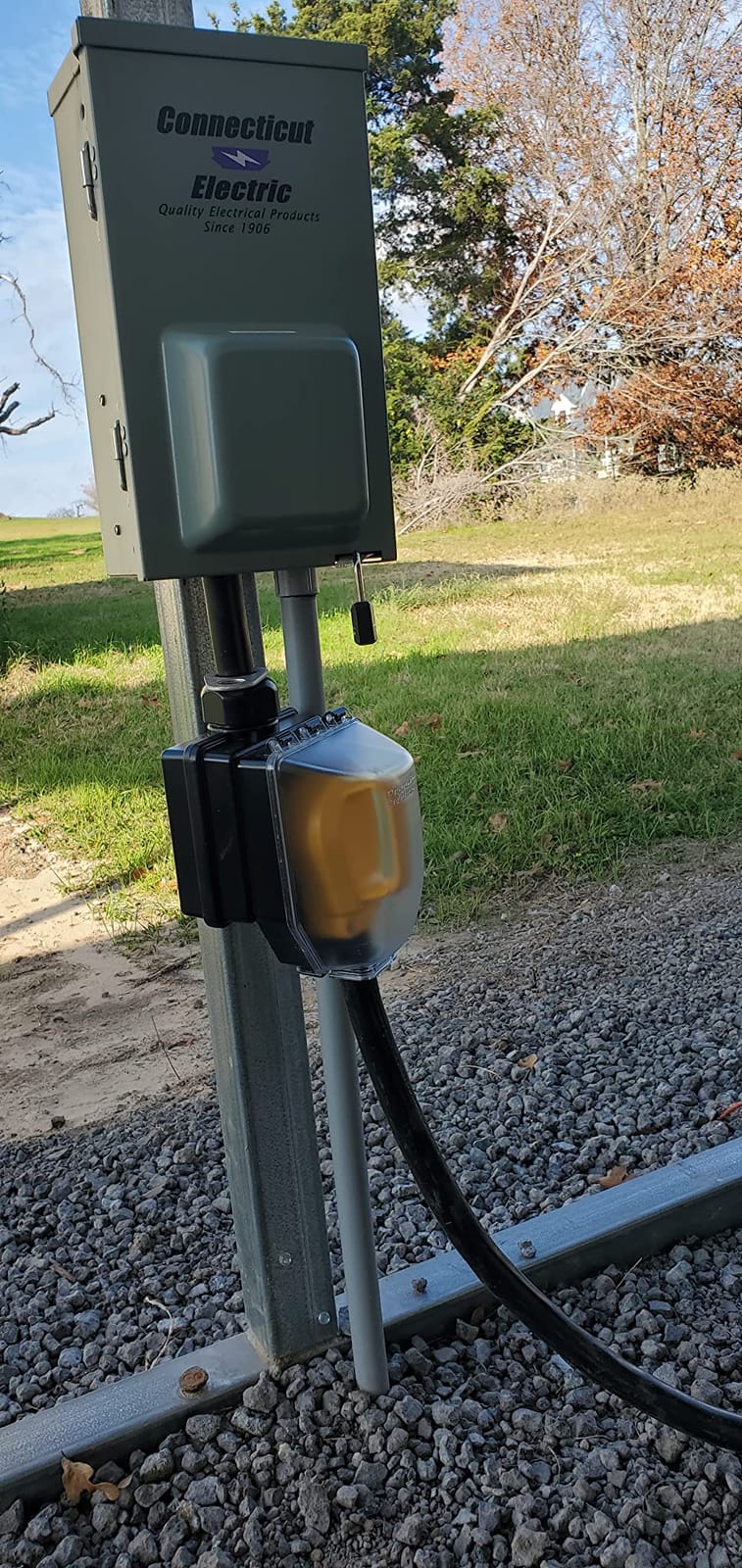
On the technical side, it is rated 50 A at 240 V, absorbs up to 1650 joules at 12000 W, and weighs 3 pounds in a 14 by 5.25 inch footprint. The fault list covers over and under voltage, open ground, open neutral, reverse polarity, surge failure and AC frequency, a fault list broader than most of the other picks here.

What owners confirm after seasons of use
On iRV2, a 2026 discussion leaned toward the Watchdog for features and convenience while still calling Progressive Industries the proven option, and an older iRV2 thread narrowed the shortlist to Progressive, Southwire or Hughes as the only brands worth considering. That is the consensus this unit has to live up to, and the review volume suggests it does.
The built-in media are a surge protector, locking bracket, cover and weather shield, so the physical protection package is complete out of the box. If you run dual air conditioners on a hot afternoon, the under-voltage detection is the feature doing the heavy lifting, not the joule figure.
Where it falls short
There is no Bluetooth or app, so status checking means walking to the pedestal and reading the LEDs. For an owner who does not want to bend down at a busy post in the dark, that is a real inconvenience, and it is the main reason the Power Watchdog also earns a place here.
There is no timed delay before the unit restores power, so a brief dropout will not wait for a safe reconnection window. The locking bracket and cover are separate pieces too, which is a small storage hassle in a tight pass-through bay.
2. MILLIONHOME 50 Amp RV Surge Protector with LED Analyzer
MILLIONHOME RV Surge Protector 50 Amp, 𝟐𝟎𝟐𝟔 𝐍𝐞𝐰 𝐔𝐩𝐠𝐫𝐚𝐝𝐞𝐝 Voltage Protection RV Power Surge Protectors Waterproof, RV Adapter Plug for Camper, Circuit Analyzer for Travel Trailers
18000 joule surge buffer
50 amp circuit analyzer LEDs
Waterproof body
Weighs 1.5 pounds
Pros
- Built-in circuit analyzer flags incorrect pedestal wiring before hookup
- Waterproof housing built from flame-retardant materials
- Plug-and-play with no setup
- Easy-to-read power status display
- Weighs 1.5 pounds for easy transport
Cons
- Entry-level surge capacity against premium marketing claims
- Some reviewers describe it as a budget piece rather than heavy duty
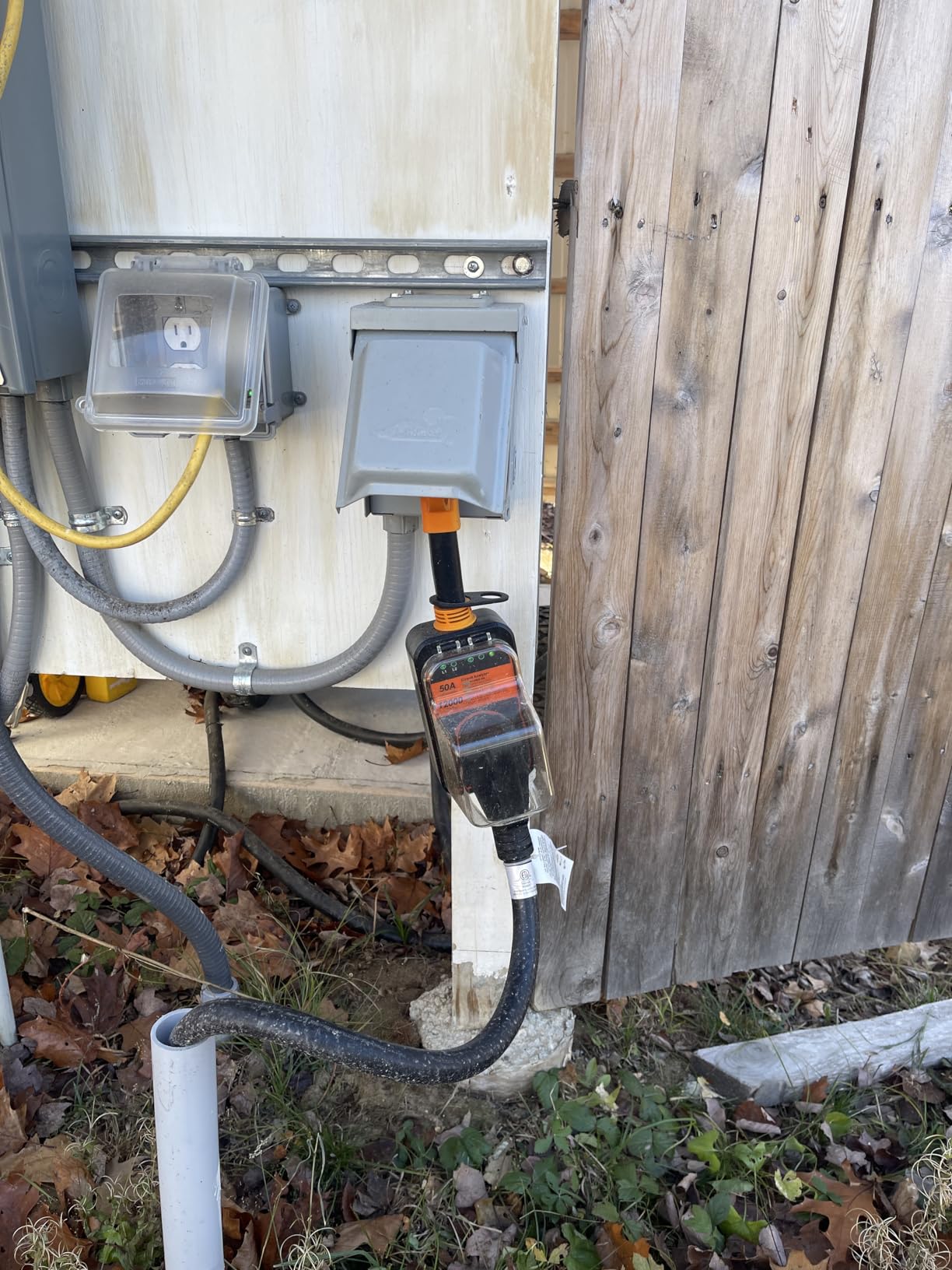
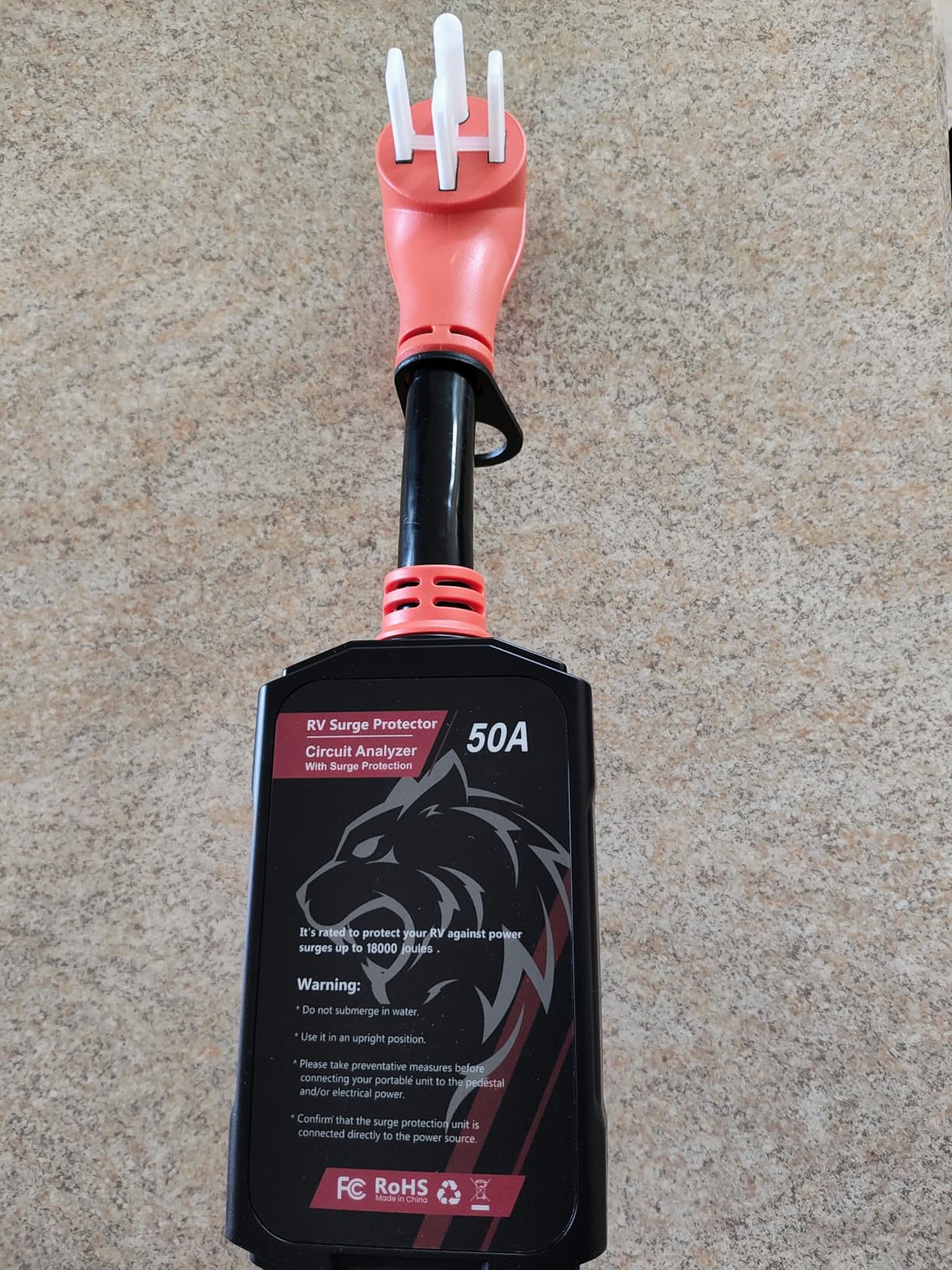
This is the unit I would hand a new owner who wants the fault detection and does not care about phone apps. The DF-02 carries an 18000 joule surge rating, a 50 amp circuit analyzer with LED fault indicators and a flame-retardant waterproof housing, and at 1.5 pounds it is one of the easiest of the ten to carry from the truck bed to the post.
The build is simple rather than refined, and the dimension listing is an even 3.94 inch cube, which tells you exactly what you are packing. Reviewers call the circuit analyzer the standout feature and describe it as a dependable entry-level 50 amp protector, with an 88 percent five-star share.
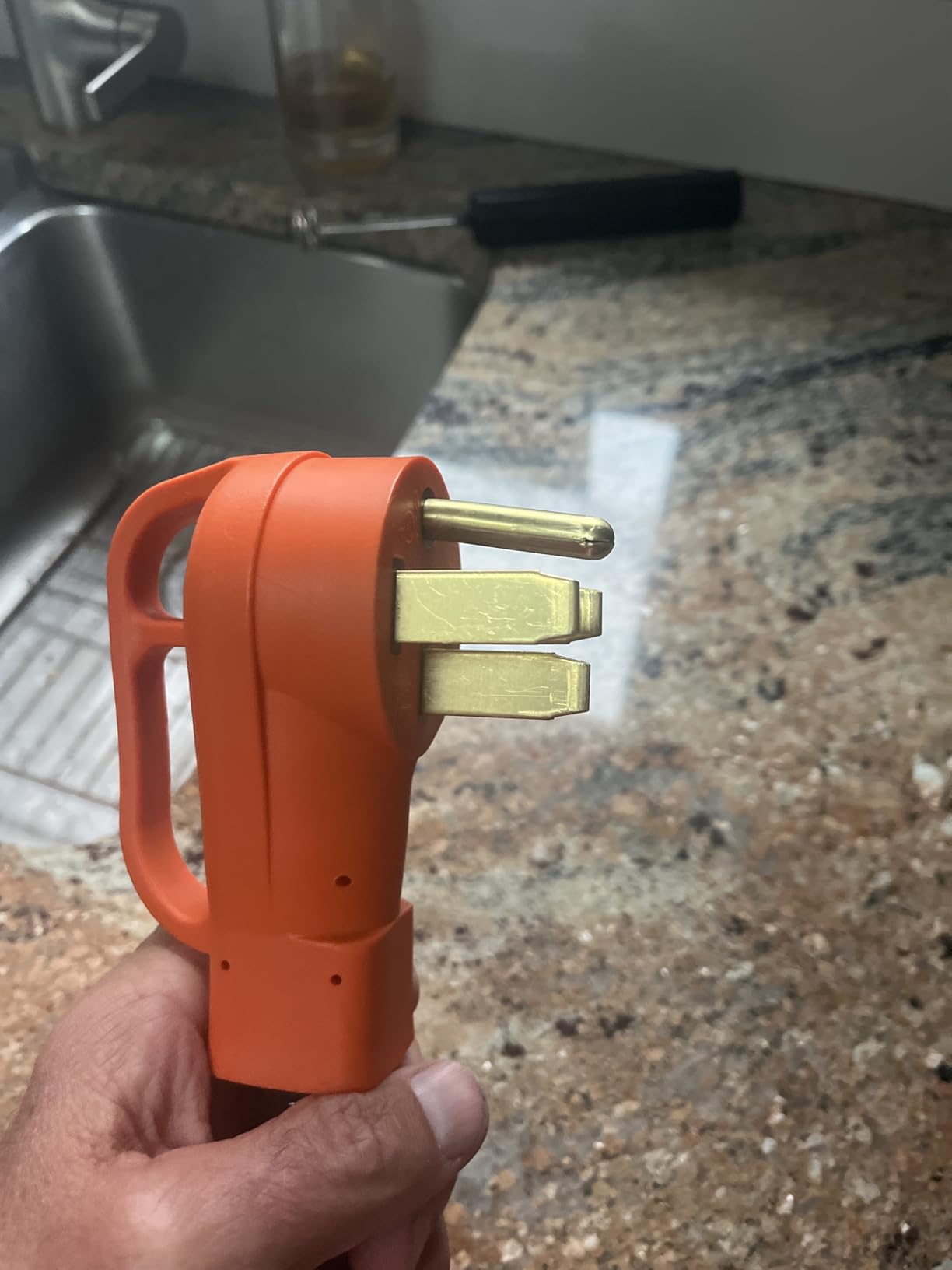
There are sibling variants in basic orange, basic black and LED display, across both 30 amp and 50 amp, so the same housing covers several needs. The 50 amp configuration is the one to buy if your rig has 50 amp service, and it will also accept a 50-to-30 dogbone if you ever need to feed a 30 amp trailer from the same kit.
Why it earns a place on this list
The surge capacity here is 18000 joules, which is tied with the Vehiker for the largest buffer in the roundup, and the analyzer flags an incorrectly wired pedestal before you commit the RV. For weekend campers who hook up in a lot of unfamiliar parks, that combination of buffer and pre-hookup check does most of the useful work.
The waterproof and flame-retardant shell is the other quiet strength. Rain, wind and blowing sand are normal conditions at a coastal park in storm season, and a sealed body is what keeps the internals alive through a full season of that.
Where it falls short
Several reviewers describe it as a budget unit rather than a heavy-duty one, and there is no replaceable surge module, so a real hit means a new protector. The 972 ratings are respectable but thin next to the Progressive, which matters when you are trusting a device with your coach’s electronics.
It also has no numeric voltage or wattage display, so a healthy-looking green light is all the confirmation you get. If you want to know what your dual air conditioners are actually drawing, this is not the tool for it.
3. Southwire Surge Guard 44290 Portable 50 Amp Protector
Surge Guard 44290 Portable Surge Protector – 120/240V, 50A
4200 joule surge capacity
120/240 V at 50 A
22.25 inch form factor
2.7 pounds
Pros
- 4200 joule surge capacity with stronger absorption than most LED-only analyzers here
- Enhanced diagnostics identify faulty park power including a missing L2 leg
- Anti-theft lock ring on the power cord
- Limited lifetime warranty from a US manufacturer
- Easy-T-Pull handle with an integrated receptacle
Cons
- Bulky 22.25 inch form factor is awkward in small storage compartments
- No Wi-Fi or app monitoring
- No timed delay for auto-restoring power
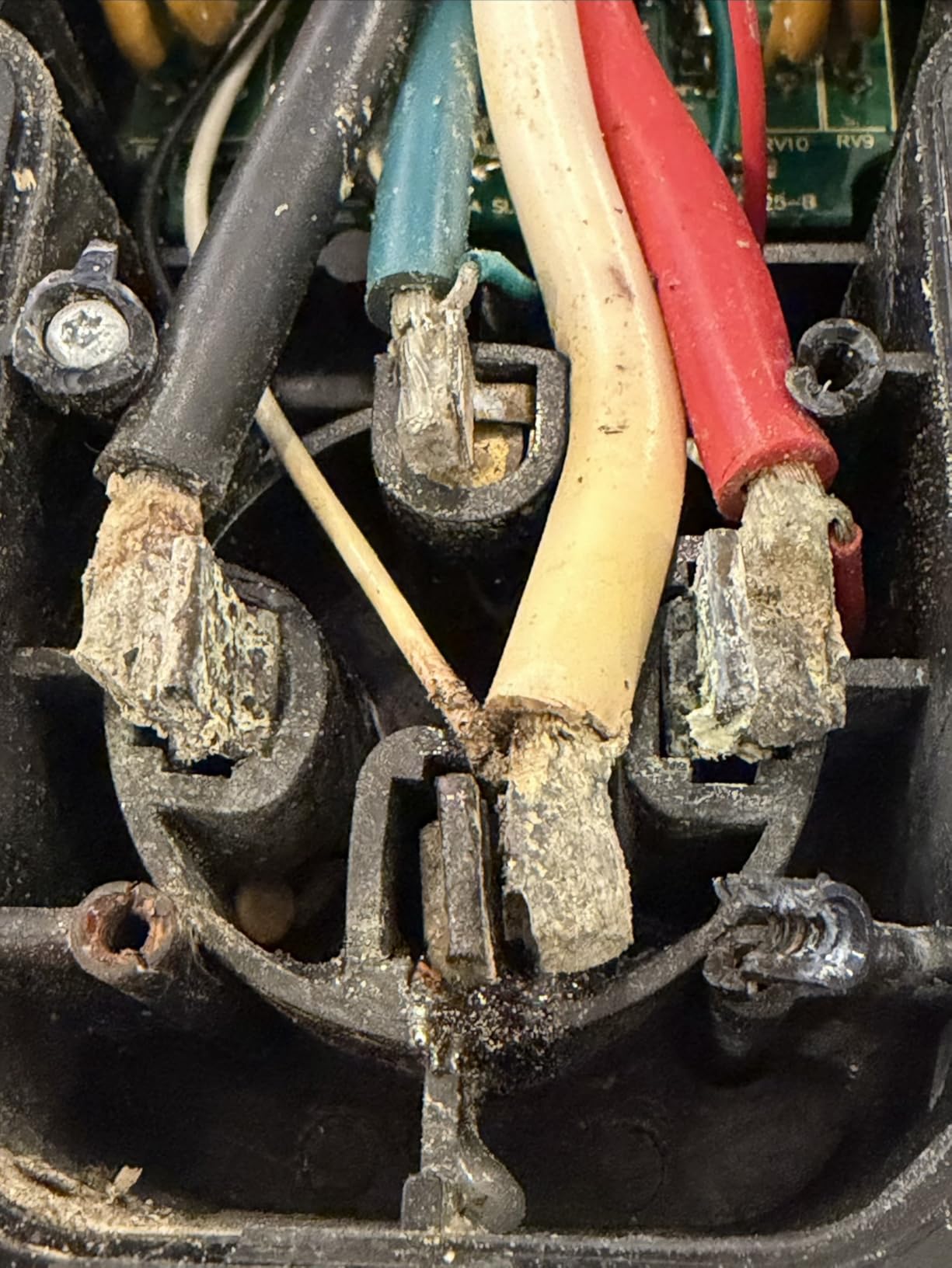
Southwire builds this one for people who use their protector as a diagnostic tool rather than just a gate. Several reviews describe owners using the LED panel to identify a faulty pedestal breaker, and the enhanced diagnostics set catches a missing L2 120 volt leg, which is a fault many cheaper analyzers miss entirely.
It carries 4200 joules of surge capacity at 50 A across 120/240 V, and the nylon body weighs 2.7 pounds. The increased brass thickness in the receptacle is a quiet but genuine improvement, because heat at a fully loaded 50 amp post is what kills cheap connectors.
On the r/RVLiving side of the internet, owners put Hughes at the top of the brand hierarchy, and an iRV2 shortlist names Progressive, Southwire and Hughes as the only three brands they would consider at all. This is the Southwire entry in that group, and the 890 ratings back up the reputation.
The anti-theft lock ring on the cord and the integrated Easy-T-Pull handle address a real campsite problem, which is that a portable protector left at a busy pedestal can be lifted. The limited lifetime warranty means a single owner can carry it for the life of the rig.
Best used as a troubleshooting tool
Because it flags faulty park power rather than just blocking it, this is the model we would grab when a park’s power keeps dropping out and you need to know whether the fault is on the pedestal or inside your rig. The diagnostic LEDs answer that question in seconds.
For owners running dual air conditioners in July heat, the 4200 joule buffer and the missing-L2 detection cover more than a basic analyzer does, while staying simple enough that there is no app to learn.
Where it falls short
At 22.25 inches long and 4 inches wide, this is a bulky shape for a storage bay. It also has no Wi-Fi or app and no timed reconnect delay, so a momentary dropout will not wait before power returns.
There is no replaceable surge module either. After a real event you are buying another protector rather than a module.
4. GEARGO 50 Amp IP68 Waterproof Surge Protector
GEARGO RV Surge Protectors 50 Amp Waterproof, [𝟐𝟎𝟐𝟔 𝐍𝐞𝐰 𝐔𝐩𝐠𝐫𝐚𝐝𝐞𝐝] RV Circuit Analyzer, Full Protection RV Adapter Plug for Camper(Orange)
9500 joule surge rating
IP68 waterproof housing
FCC tested V-1 materials
3 pounds
Pros
- Diagnostic chart catches wiring faults before the RV is connected
- IP68 waterproofing with a protective cover for harsh weather
- FCC tested and built from V-1 flame-retardant materials
- Ergonomic grip handles and a right-angle connector reduce wear on the pedestal
- Multi-year warranty with responsive customer service
Cons
- 9500 joule rating trails the 14000 to 18000 joule competitors
- One reviewer found the plug a tight fit in some post boxes
- Water can reach the receptacles if the cover is not seated
The GEARGO YC-02 is the one we would trust in sustained rain, and the reason is the IP68 sealing rather than a marketing number on the box. The flame-retardant V-1 housing and the protective cover are aimed squarely at the outdoor pedestal, which is the only environment this device ever really works in.
The circuit analyzer diagnoses correct wiring, open ground, open neutral, reverse polarity, hot and ground reversed and no power, so the fault list here covers more conditions than most of the analyzer tier. At 9500 joules the surge buffer is mid-pack, above the 4200 joule units and below the 18000 joule entries.
![GEARGO RV Surge Protectors 50 Amp Waterproof, [𝟐𝟎𝟐𝟔 𝐍𝐞𝐰 𝐔𝐩𝐠𝐫𝐚𝐝𝐞𝐝] RV Circuit Analyzer, Full Protection RV Adapter Plug for Camper(Orange) customer photo 1](https://www.conservatoryweho.com/wp-content/uploads/2026/09/B0C2TF2S48_customer_1.jpg)
Reviewers describe it as heavy duty and well made, with the analyzer and waterproof cover as the most praised elements, and an 86 percent five-star share. The ergonomic power grip handles and the right-angle male connector are a thoughtful pair of details, since the right-angle plug reduces the strain on the pedestal receptacle when you unplug under load.
Item dimensions come in at 10 by 7 by 6 inches, which is a more compact shape than the Southwire and easier to find a home for in a storage bay.
![GEARGO RV Surge Protectors 50 Amp Waterproof, [𝟐𝟎𝟐𝟔 𝐍𝐞𝐰 𝐔𝐩𝐠𝐫𝐚𝐝𝐞𝐝] RV Circuit Analyzer, Full Protection RV Adapter Plug for Camper(Orange) customer photo 2](https://www.conservatoryweho.com/wp-content/uploads/2026/09/B0C2TF2S48_customer_2.jpg)
Where the IP68 rating really pays off
Storm season is when a lot of owners find out their protector was never really sealed. A cover that stays seated through a downpour keeps water out of the receptacle cavity, and the diagnostic LEDs still give you a readable status check in a dark bay.
For full-time owners who move parks weekly, the multi-year warranty and the responsive support are worth more than a small joule difference, because you are not going to inspect the internals every time the weather turns.
Where it falls short
At 9500 joules it gives up ground to the FOCSPROD, Vehiker and Kohree, which matters if your site is on an exposed line with frequent switching events. One reviewer also reported a difficult fit into a post box because of the box design rather than the plug itself.
Most importantly, the cover has to be seated properly. A few owners note that water can reach the receptacles when it is not, so treat the cover as part of the device rather than an accessory.
5. FOCSPROD 16000J 50 Amp Surge Protector and Circuit Analyzer
FOCSPROD RV Surge Protector 50 Amp, 16000J Surge Protection RV Circuit Analyzer, 2025 Upgraded Voltage Protection RV Electrical with Waterproof Cover, RV Plug Adapter for Camping, Travel Trailers
16000 joule surge protection
Six fault condition indicators
Waterproof cover
2.84 pounds
Pros
- 16000 joule surge capacity in a compact analyzer
- Clear red and green LED display makes power status quick to read
- Waterproof cover holds up in heavy rain and storms
- Rugged housing that owners report still working a year later
- Works as a stand-alone diagnostic tool for campsite pedestal faults
Cons
- LED indicators only with no numeric voltage amperage or wattage readout
- Some owners pair it with a separate 50-to-20 distribution adapter for redundancy
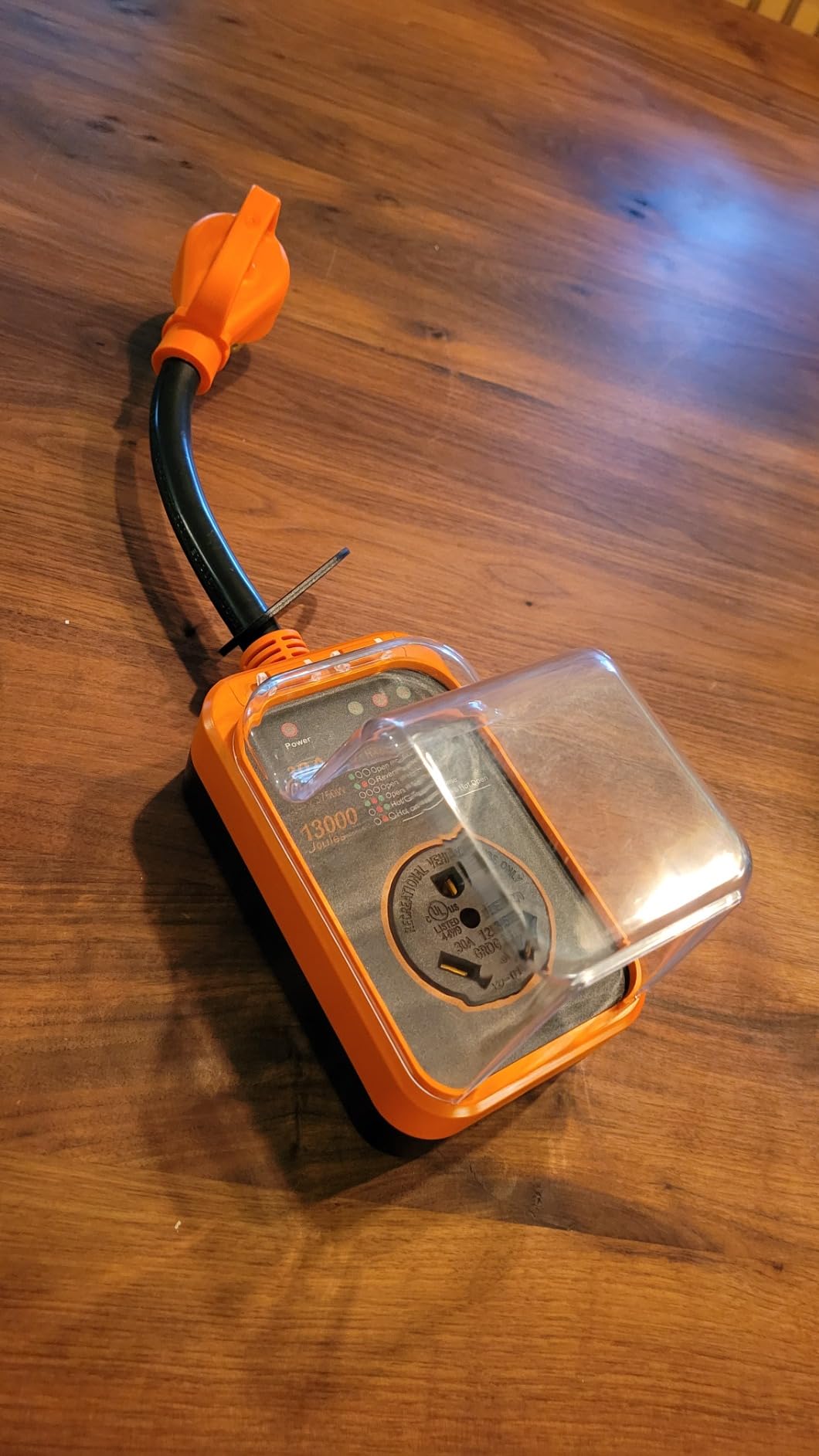
The FOCSPROD SPD102OR does one thing unusually well for a compact analyzer, which is holding a big surge buffer. At 16000 joules it holds more absorption capacity than the other analyzer-style picks here, and the package dimensions of 15.79 by 6.18 by 4.84 inches keep it small enough to live in a wet bay.
The analyzer covers six fault conditions including power on, open ground, open neutral, neutral reversed, over and under voltage, and no power, shown on a clear red and green LED display. That is enough to identify the faults that actually stop a hookup, just not enough to tell you how far out of spec the voltage is.
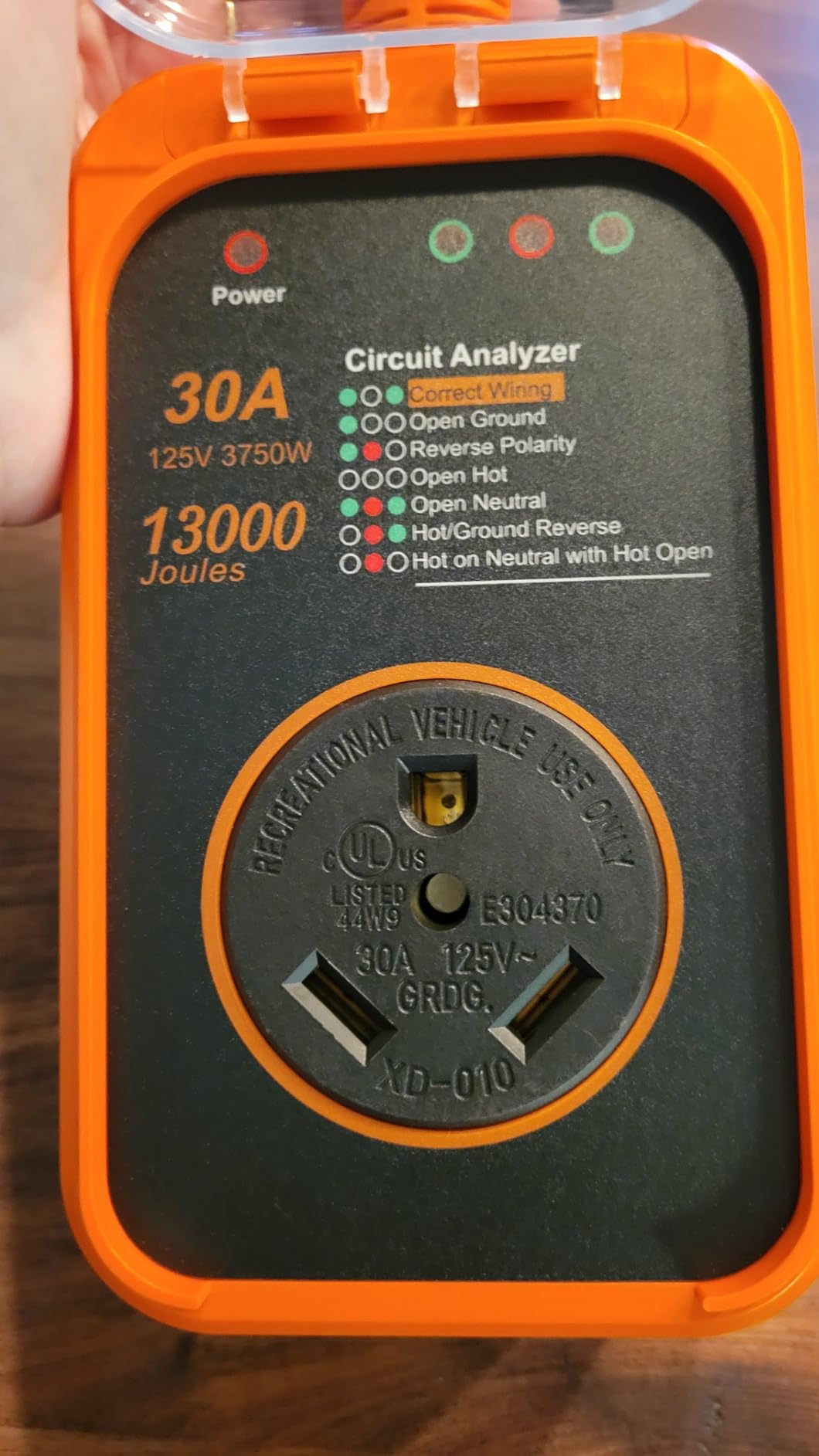
Owners emphasise build quality, indicator clarity and durability in bad weather, and describe the unit as a must-have for campers, with an 84 percent five-star share. The waterproof cover and rugged housing are rated for rain, wind and direct sun, which is the honest description of what a pedestal endures in summer.
The ergonomic grip handles and right-angle plug are designed to fit standard 50 amp four-prong outlets, which is worth checking against your park’s post style before you rely on it at a tight site.
Best when surge events drive your decision
If you camp in areas with frequent switching or storm activity, a 16000 joule buffer is the difference between absorbing an event and absorbing part of it. Combined with the six-condition analyzer, it gives you both halves of protection without paying for a smart unit.
Owners who run heavy loads on hot days will also like that the LED state is unambiguous. Green means good, red means investigate, and there is no menu to work through.
Where it falls short
There is no numeric readout of any kind, so you cannot confirm 124 V or spot a slow sag while a compressor is running. If you care about real-time load data, this is not the device for that, and the Power Watchdog is.
A few owners also pair it with a separate 50-to-20 distribution adapter for redundancy, which is a sensible layered approach if you want outlets for a griddle and a fan without a second protector.
6. Camco Power Grip 55306 50 Amp Voltage and Surge Protector
Camco Power Grip RV 50-Amp Voltage & Surge Protector – Features Integrated Surge Protection of Up to 4,200 Joules & Diagnostic LEDs Indicate Wiring Faults (55306)
4200 joule integrated protection
Cuts out above 132 V and below 102 V
6.8 pounds
One year limited warranty
Pros
- Automatically disconnects and reconnects on high and low voltage
- Diagnostic LEDs reveal pedestal wiring faults at hookup
- Power Grip contoured handles make plugging and unplugging easier
- Protects against reverse polarity and open neutral
Cons
- Heaviest model reviewed at 6.8 pounds
- Only a one-year limited warranty
- Lowest rating in the roundup at 4.5 with 7 percent one-star reviews
- No surge module replacement
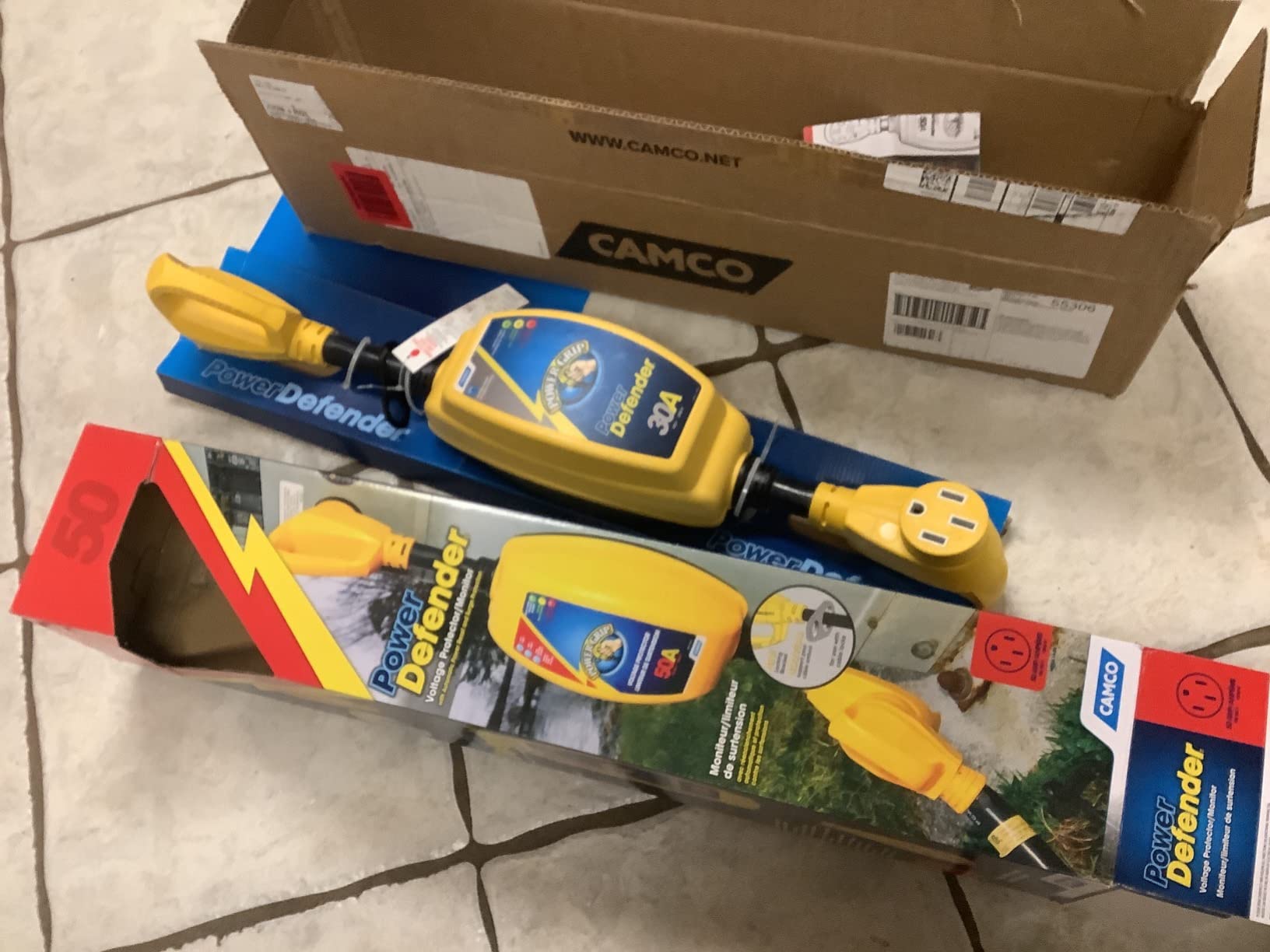
The Camco Power Grip 55306 is the only model here that restores power on its own. It disconnects above 132 VAC and below 102 VAC and reconnects when normal conditions return, which removes the most common complaint we saw about portable EMS units, namely that a brief pedestal dropout leaves you walking out in the dark to press a button.
It integrates 4200 joules of surge protection with a NEMA 14-50P male plug and 14-50R female receptacle, plus diagnostic LEDs for reverse polarity, open neutral and other wiring faults. Spare parts are listed as available for five years, which is helpful on a unit you may keep for a long time.
The auto reconnect behaviour is genuinely useful on a site where the voltage dips whenever the campground laundry kicks in. You connect, it evaluates, and it handles the rest without intervention.
Owners appreciate the disconnect and reconnect logic and the clarity of the fault LEDs. The criticism concentrates on weight, warranty length and the fact that there is no surge module to replace after a real event.
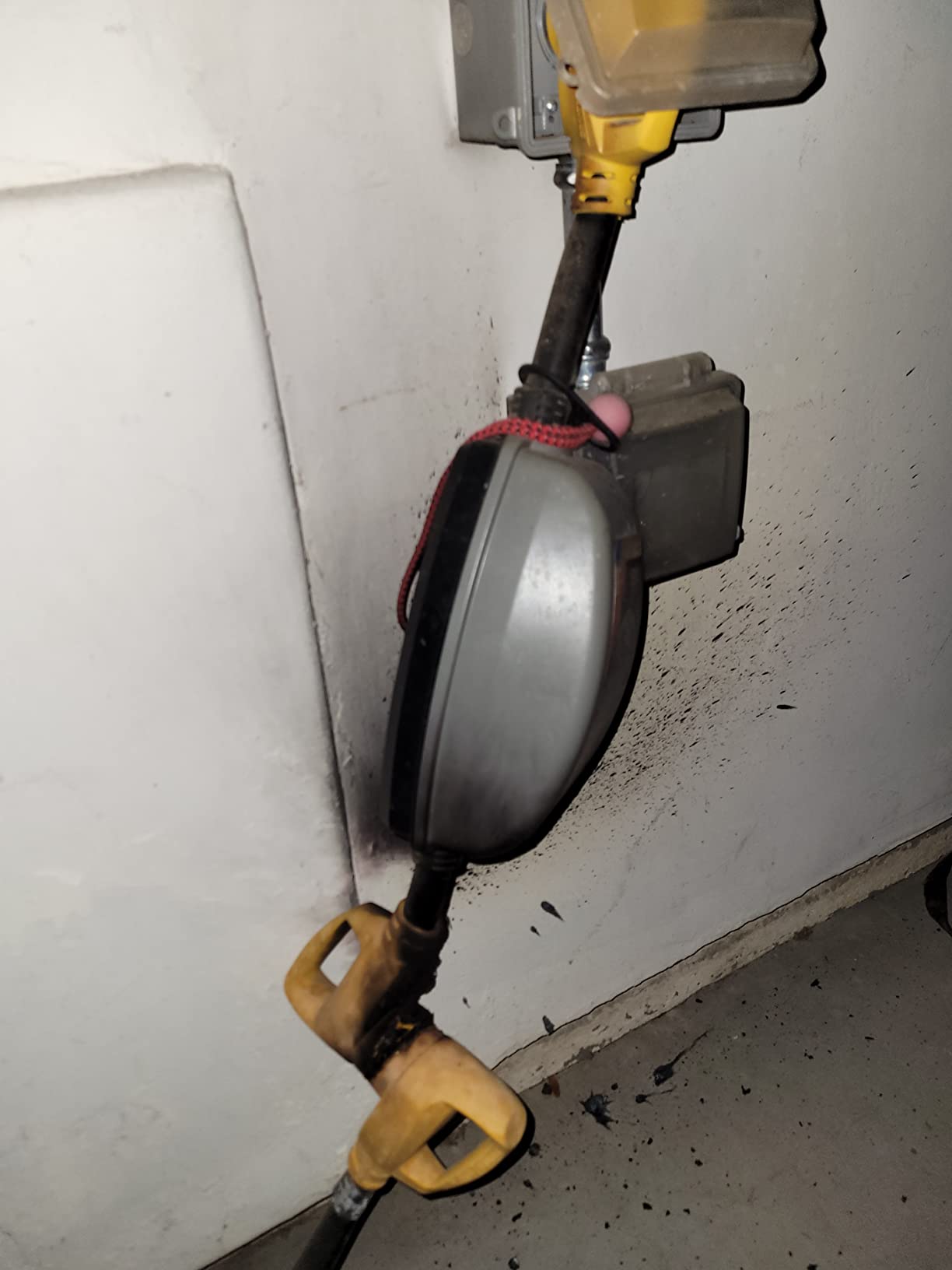
Best for owners who do not want to babysit the connection
If your site has a reputation for unstable voltage and you would rather not check the pedestal every hour, automatic reconnect is the feature that changes daily life. It also means the unit can sit through a short power interruption while you are inside the coach.
The Power Grip contoured handles address the physical side of the same problem. Plugging and unplugging a 50 amp connector with gloves in a drizzle is harder than it sounds, and shaped handles take some of that out of the equation.
Where it falls short
At 6.8 pounds it is the heaviest of the ten models, which is a real consideration for an owner lifting it into a fifth wheel bed or a motorhome pass-through bay. The one-year limited warranty is also the shortest coverage we would want on a device that sits outside all year.
Its 4.5 rating is the lowest of the ten, and 7 percent of reviews are one star, a noticeably bigger share than the 1 to 3 percent on most of the other models. There is no surge module replacement, so a genuine hit means a new unit.
7. Power Watchdog PWD50 Smart 50 Amp Surge Protector
Power Watchdog PWD50 Smart RV Surge Protector, 50A, Bluetooth, IP65
6100 joule surge rating
Bluetooth app monitoring
Replaceable surge module
IP65 water-resistant
Pros
- Bluetooth app monitoring of voltage amperage and wattage with configurable alerts
- Replaceable surge module extends service life without replacing the whole unit
- IP65 water-resistant heavy-duty construction
- Works with dogbone adapters for a range of pedestal setups
- Optional RVWhisper add-on for Wi-Fi and cellular monitoring
Cons
- Requires a phone and the app for the smart features to be useful
- Bluetooth alone does not monitor remotely without the optional add-on
- Costs more than non-smart 50 amp protectors
The PWD50 is the only protector in this roundup that talks to your phone, and that changes what a surge protector can do. The patented Bluetooth connectivity reports voltage, amperage and wattage, and you can set custom voltage and wattage alert thresholds so the unit warns you before a sag becomes a failure.
It is also the only one here listed with a replaceable surge module, which is the most practical long-term feature in this group. After a real event you replace a module rather than the whole protector, and owners on forums consistently describe that as the reason the design pays for itself.
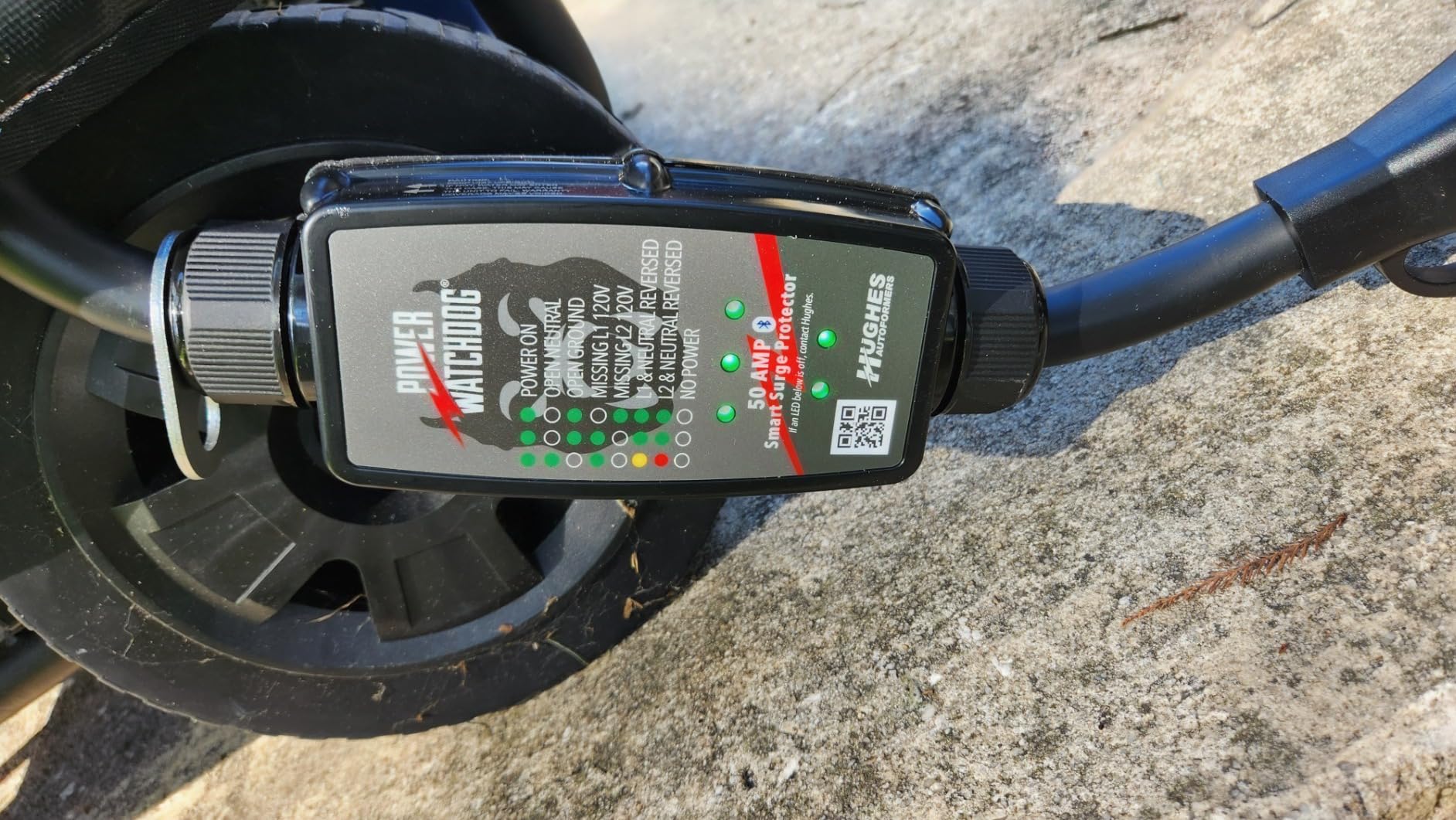
On r/RVLiving the consensus reply is blunt, with owners recommending the Watchdog EPO and advising people to buy the best Hughes Watchdog they can afford. An iRV2 discussion leaned toward Watchdog for features and convenience, and a Forest River Forums owner reports 8 years of essentially continuous use at home and on the road with a flawless result, while noting the unit has no remote, Bluetooth or Wi-Fi.
That last complaint is worth weighing, because it is a design choice rather than a fault. The 6100 joule rating is mid-range and the housing is IP65 water-resistant, so it handles a wet pedestal without needing a cover, and it weighs 3 pounds.
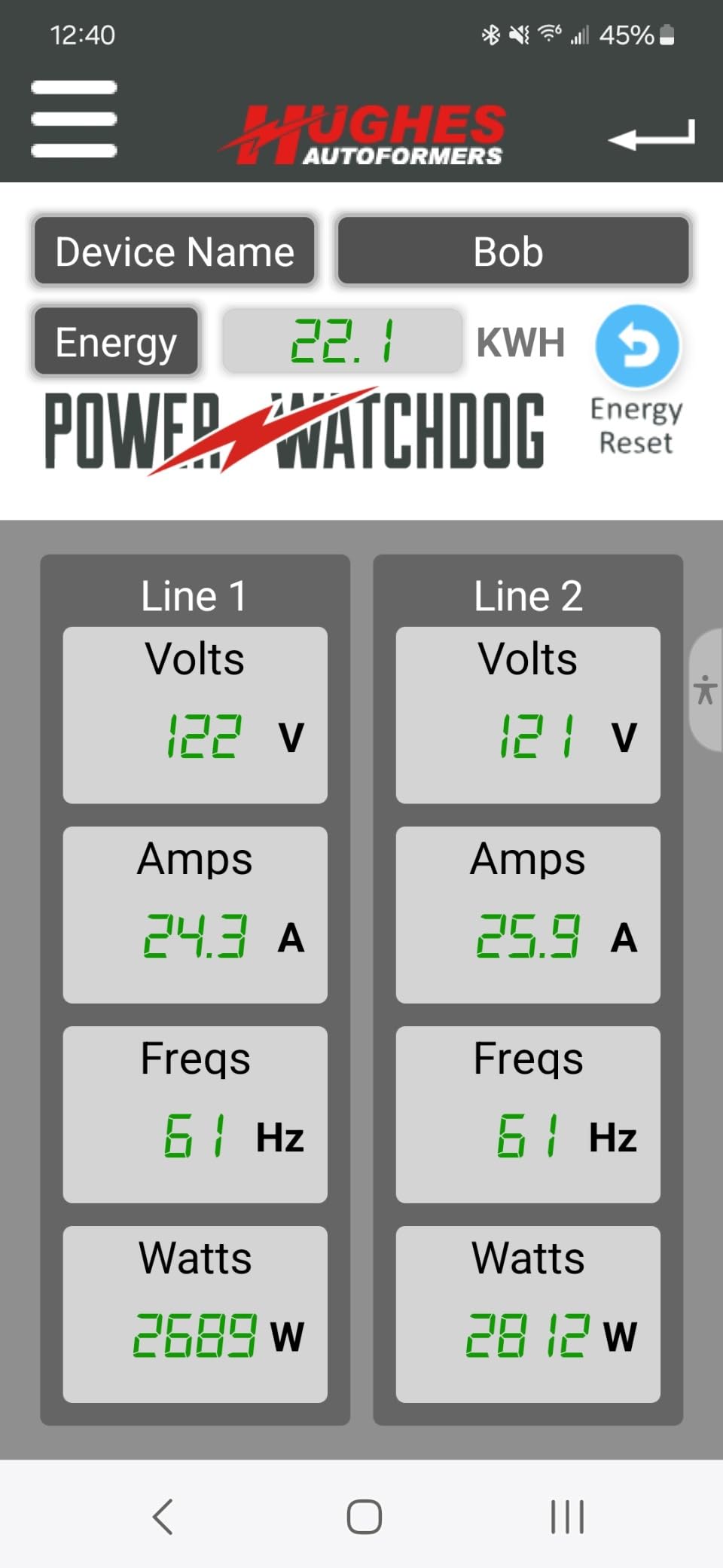
Best for owners who want real numbers
The app data is what separates this from the LED crowd. If you run dual air conditioners and want to know whether a marginal pedestal is starving your compressor, the wattage and voltage readings tell you something no indicator light can.
The RVWhisper add-on extends monitoring to Wi-Fi and cellular when you are away from the campground, and the unit works with dogbone adapters so you can move between 50 amp and 30 amp pedestals with the same device.
Where it falls short
Bluetooth range is the practical limit. It works when your phone is inside the coach near the entry, but it is not a remote monitoring system without the optional add-on, and that is a cost most owners do not budget for.
Owners with an 89 percent five-star share still point out that the smart features are worth nothing without a phone and the app. The 6100 joule buffer is also lower than the 14000 to 18000 joule units in the budget tier, so if surge absorption is your main concern, this is not the strongest pick.
8. Vehiker 18000J 50 Amp RV Surge Protector
Vehiker 18000 Joules-RV Surge Protector 50 Amp, RV Power Surge Voltage Protection, RV Adapter Plug for Camper, Circuit Analyzer for Travel Trailers with Waterpoof Cover
18000 joule surge rating
50 amp with circuit analyzer
Waterproof body
36 month warranty
Pros
- Shares the highest surge capacity in this group at 18000 joules
- Waterproof housing built from flame-retardant materials
- Circuit analyzer for checking campground power
- Simple plug-and-play installation
- Backed by a 36-month warranty
Cons
- Smallest review base at 214 ratings so less long-term field history
- The base 50 amp variant lacks the LED or 4-in-1 display offered on sibling models
The Vehiker pairs the joint-highest surge rating here with a straightforward circuit analyzer and a 36-month warranty, which is a longer warranty commitment than the unbranded tier typically offers. It is a clean plug-and-play adapter with a copper tin-plated male plug, and it accepts the usual 50 amp receptacle.
Surge protection is rated at 18000 joules, and the housing is described as flame-retardant and waterproof for rain, wind and sandstorms. Rated 50 A, the unit carries two outlets and two ports, so it doubles as a pass-through box for a second appliance or a distribution post.
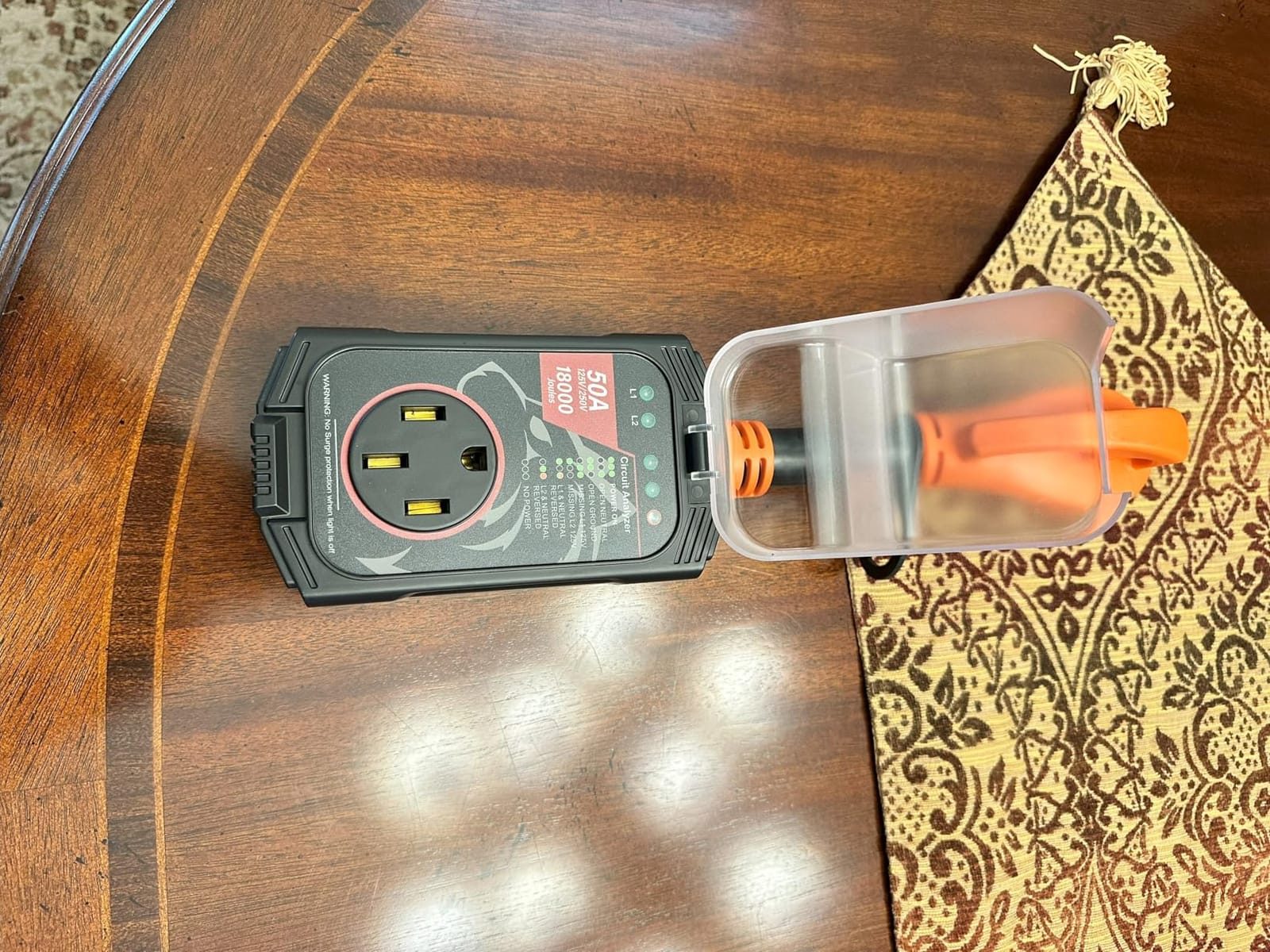
Reviewers highlight the high joule rating, the waterproofing and the simple hookup, with an 84 percent five-star share. The compatibility listing covers the appliances most owners actually worry about, including air conditioners, coffee machines, microwaves and refrigerators.
Variants run from the basic 30 amp and 50 amp bodies through to LED display and 4-in-1 display versions, so the same product family covers a travel trailer and a Class A motorhome.
Best for a simpler trailer setup
If your rig is a travel trailer or a smaller fifth wheel and you want a large buffer without an app or a subscription, this does the job quietly. The 36-month warranty is longer than the one-year coverage on several competing units, which matters for something stored outdoors year round.
The two outlet configuration is useful at a site where you want to run a portable air conditioner or a coffee maker without a separate distribution post.
Where it falls short
With 214 ratings, this has the smallest review base of the ten by a wide margin, and that means very few long-term durability reports compared with the established brands. There is no replaceable module, so a genuine event means buying again.
The base 50 amp variant also lacks the LED and 4-in-1 displays offered on its siblings, so the diagnosis you get is a basic analyzer readout. On a rig where a single fault can trip a breaker, the base version is the one to buy only if you are comfortable checking readings at each hookup.
9. CARMTEK CRTK-CA50 50 Amp Circuit Analyzer
CARMTEK RV Surge Protector 50 Amp – RV Circuit Analyzer with Integrated Surge Protection – Smart 50 Amp Surge Voltage Defender with Grip Handles
4200 joule integrated protection
Rated 50A / 125V-250V
UL tested
Operating range -35C to +110C
Pros
- UL tested with a flame-retardant thermally protected housing
- Ten fault circuit analyzer chart covering L1 and L2 faults
- 4200 joule surge absorption for thunderstorm spikes
- Operating range from -35C to +110C for wide weather use
- Lifetime warranty
Cons
- 4200 joule rating is modest against 14000 to 18000 joule models
- Indicator-only diagnostics with no numeric voltage or wattage display
UL certification is the headline here, and for a device that sits between a possibly faulty pedestal and several thousand dollars of electronics it is not a small detail. The CRTK-CA50 is UL tested, flame-retardant and thermally protected, rated 50 A at 125 to 250 V on 50/60 Hz, and wired NEMA 14-50P to 14-50R.
The analyzer carries a 10-fault diagnostic chart covering L1 and L2 conditions including open, reversed and ground faults, which is the most granular fault chart among the analyzer units here. Surge absorption is rated 4200 joules, and the lifetime warranty is among the strongest coverage listed here.
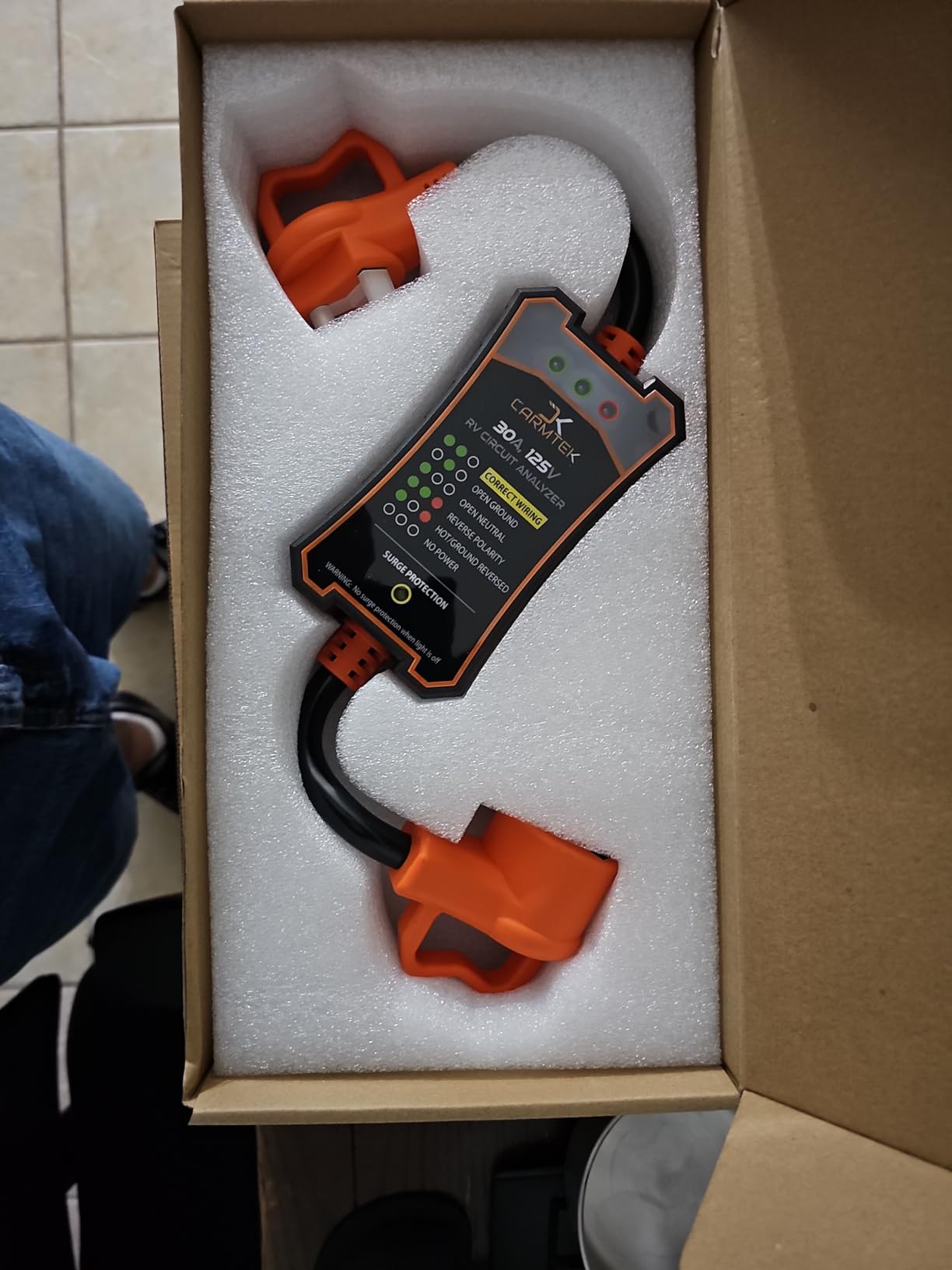
Reviewers point to the UL certification, the detailed fault chart and the lifetime warranty as the reasons to buy, with an 86 percent five-star share. The minimum operating voltage is listed at 125 volts, so it is built for genuine 50 amp 240 V service rather than a 30 amp circuit.
The operating temperature range of -35C to +110C covers desert parks in summer as well as a northern site in early spring, and it is the only range published in the product data here.
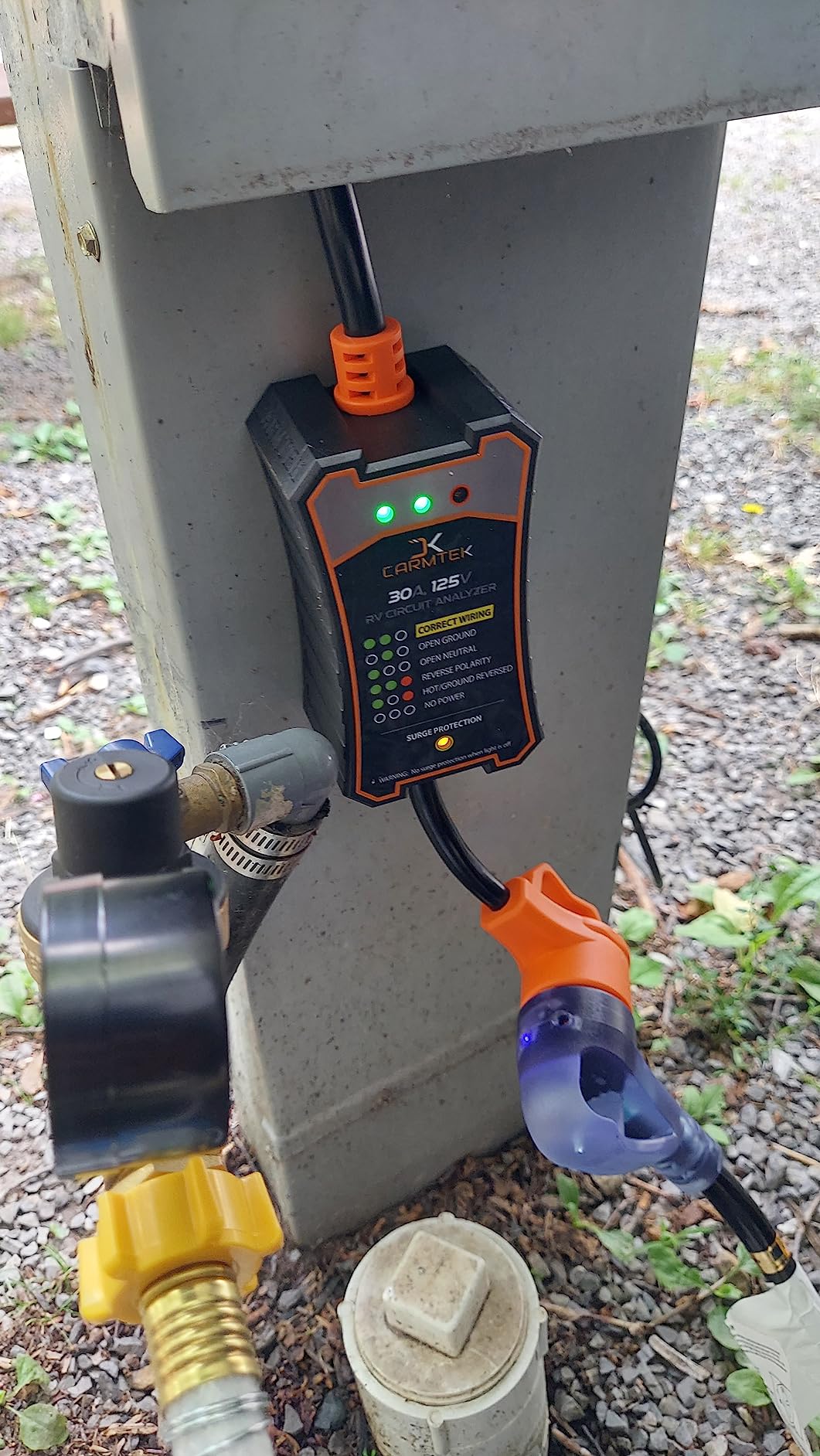
Best for extreme temperature sites
The thermal protection and the -35C to +110C operating range make this the pick for owners who camp in the desert Southwest, where a pedestal in July can sit in direct sun for hours. Cold spring and late autumn sites are the other end of that range.
For owners who want the most complete fault picture without an app, the 10-fault chart is the most useful diagnostic tool at this level, particularly for the L1 and L2 combinations that trip breakers in a coach with two air conditioners.
Where it falls short
At 4200 joules the surge buffer is on the modest side next to the 14000 and 18000 joule units, so if your site is on an exposed line with frequent switching, the absorption capacity is not the strong point.
Diagnostics are indicator-only, so you learn that something is wrong without knowing by how much. Weight and dimensions are not published, which makes storage planning a guess.
10. Kohree 14000J 50 Amp RV Surge Protector
Kohree RV Surge Protector 50 Amp, Power Surge Voltage Protection 14000J
14000 joule surge protection
1 ns spike response
IP67 waterproof cover
1 year warranty
Pros
- 14000 joule surge protection with a 1 ns response time
- Diagnostic LEDs correctly identified a dead pedestal leg on first hookup
- IP67 waterproof cover sized to fit most RV power plugs
- Handles heat well with owners running air conditioning in 100F conditions
- Works with a 50-to-30 amp adapter for extra flexibility
Cons
- Only a one-year warranty
- No numeric voltage amperage or wattage readout on the basic variant
The Kohree is the answer for the hot-park problem, and the evidence for that comes from real use rather than a spec sheet. Owners report running air conditioning continuously in Arizona conditions above 100F on this unit, which is the kind of field report that matters more than any joule figure when a compressor is the load in question.
Surge protection is rated 14000 joules with absorption within 1 ns, and the IP67 waterproof design uses an enlarged protective cover sized to fit most RV power plugs. Pure copper contacts and a high-strength PVC housing handle both the electrical and the weather side of the job.
The LED circuit analyzer covers seven fault conditions, including correct wiring, open ground, open neutral, reverse polarity, open hot, hot and ground reverse, and hot on neutral with hot open. Owners report the diagnostics correctly identified a dead pedestal leg on the first hookup, which is exactly the situation where you want a clear answer.
Design patents are listed for the plug and cover geometry, and the product is aimed squarely at RVs, campers and travel trailers. A 50-to-30 amp adapter works with it, which gives you a fallback if you ever need to feed a lighter trailer.
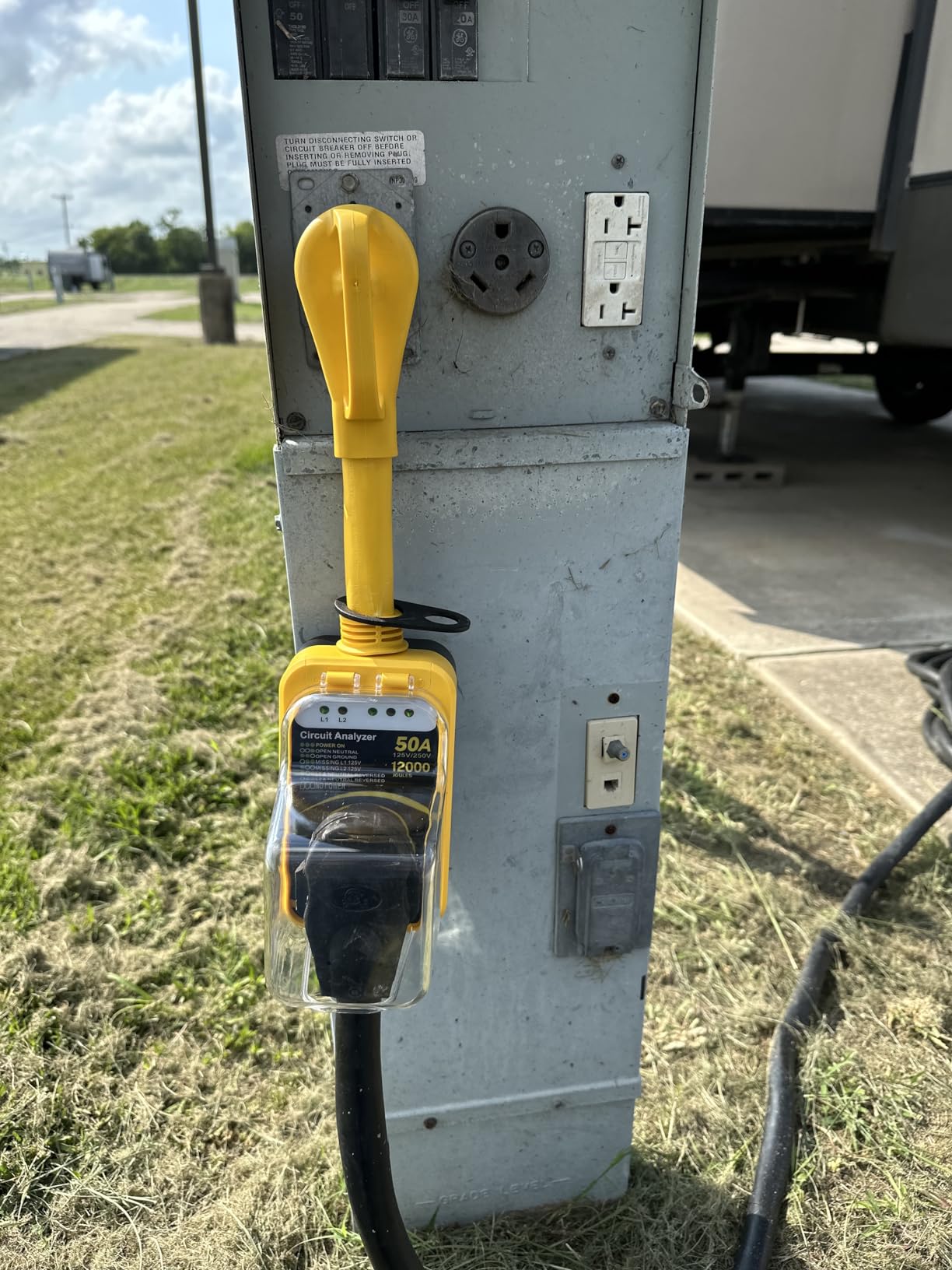
Best when heat is the constant threat
Low voltage is the failure mode that quietly damages electronics, and hot weather is when it happens most. A unit that owners have run through continuous air conditioning above 100F without trouble is answering a question no joule figure can.
The 1 ns response time and 14000 joule buffer handle the switching events that show up on busy park feeders, while the IP67 cover keeps the analyzer readable in a downpour.
Where it falls short
The one-year warranty is the shortest in this group, which is a notable gap on a device that lives outdoors. There is also no numeric readout on the basic variant, so you get fault codes rather than live voltage and wattage data.
With 336 ratings the review history is shorter than the established brands, so there is less long-term evidence than the Progressive or the Southwire can point to.
What Joule Ratings Actually Mean for a 50 Amp Coach?
A joule rating measures absorption capacity, and nothing else. It tells you how much transient energy the surge component can soak before it is spent, not how good the fault detection is, not how well the unit handles sustained low voltage, and not how long it will last at a bad park.
The models in this roundup span 1650 joules on the Progressive to 18000 joules on the Vehiker and MILLIONHOME, with the Kohree at 14000, the FOCSPROD at 16000, the GEARGO at 9500, and the Southwire, Camco and CARMTEK at 4200. For a coach running two air conditioners, a figure in the 9000 to 18000 range gives you far more headroom for switching events on a shared feeder.
That said, the owners who report real fault events describe voltage conditions, not dramatic spikes. Sustained low voltage on a hot, busy afternoon does the most silent damage to a coach’s electronics, and only fault detection catches it. That is why the 1650 joule Progressive still wins here: the LED fault detection does the work every day, and the surge component only matters in the rare event.
Budget for the replacement module question before you buy. Of the ten units here, the Power Watchdog PWD50 is the only one listed with a replaceable surge module; the rest are sealed designs where a genuine hit means a new protector.
How to Choose a 50 Amp Surge Protector: A Buyer Checklist?
Start with the connector. A true 50 amp protector carries a NEMA 14-50P male plug and a 14-50R female receptacle, which is what plugs into both a 50 amp pedestal and a 50 amp distribution post. Anything described only as a 30 amp unit is not on topic here, no matter how the listing is worded.
Next, decide how much fault detection you actually need. Every unit in this roundup catches open ground, open neutral and reverse polarity at minimum. The ones worth paying more for add over and under voltage cutoffs, surge failure indication, and in the Power Watchdog’s case live voltage, amperage and wattage reporting to an app.
Third, look at the weather rating, because the device lives outdoors. IP65 and IP68 housings like the Power Watchdog and GEARGO are built for rain, and the GEARGO and Kohree both add a protective cover. Units that need a separate weather shield, such as the Progressive, include one in the box.
Finally, check the warranty and whether a surge module can be replaced. Lifetime coverage on the Progressive and CARMTEK, a limited lifetime warranty on the Southwire, a 36-month warranty on the Vehiker, and a three-year manufacturer warranty on the Power Watchdog are all reasonable positions. The one-year terms on the Kohree and Camco are the thinnest.
On the question of whether to run a 30 amp protector on a 50 amp site with an adapter: owners on travel trailer forums do exactly this to save weight and cost, and it is acceptable only if you also accept capping every load on the coach at 30 amp. Anything that needs 50 amp service, including two air conditioners at once, is outside what the adapter can give you.
Portable vs Hardwired 50 Amp Protection
All ten products in this roundup are portable, and that is a deliberate choice for most owners. A portable protector costs one purchase, travels with the trailer, and can be moved to a different pedestal the same afternoon. A hardwired unit is installed once behind the wall and never moved, which means no plugging in at the post at all.
The tradeoff is installation. A hardwired 50 amp unit has to be fitted by someone who can work on your coach’s power distribution panel, and that labour is the dominant cost of the hardwired route. For a coach you plan to sell in three years, the labour rarely makes financial sense. For a full-time rig that never leaves its hookup point, it is a one-time expense against a long ownership horizon.
Forum consensus leans portable for good reasons. Owners who run dual 50 amp outlets often mention valuing Bluetooth-to-app monitoring for peace of mind, and others prefer not bending at the pedestal at all, which argues for hardwired. The most common practical complaint about portables is theft or accidental knocks at a busy post, something a lock ring or a bracket partially addresses.
One more factor is total ownership across a real fault. A portable with a replaceable module, such as the Power Watchdog PWD50, costs one module after a strike. A hardwired sealed unit costs the whole device plus a second installation.
Reading the Error Codes on Your 50 Amp Protector
Error codes stop the flow of power, which is the correct behaviour and also the moment most owners get frustrated. Here is what the common ones mean and whether you can proceed.
Open ground: The pedestal’s ground wire is missing or broken. Do not proceed, and do not try to work around it. Move sites or report it to the park office.
Open neutral: The neutral connection is loose or missing, which is a serious shock and fire risk. Move sites.
Reverse polarity: Hot and neutral are swapped on the pedestal. Some owners report nuisance reverse-polarity warnings on otherwise usable sites, but treat it as unsafe and try another pedestal first.
Low voltage: Sustained under-voltage, the fault that quietly harms electronics the most. This is common on hot days when a park is at capacity. Wait, move, or run less load.
High voltage: The line is running over the safe threshold. Disconnect and report it.
Frequency: AC frequency is outside the expected range, usually a generator or a faulty supply. Do not connect.
Surge failure or no power: The surge module has absorbed what it could, or there is no power at the pedestal. On a unit with a replaceable surge module, replace the module. On a sealed unit, replace the protector.
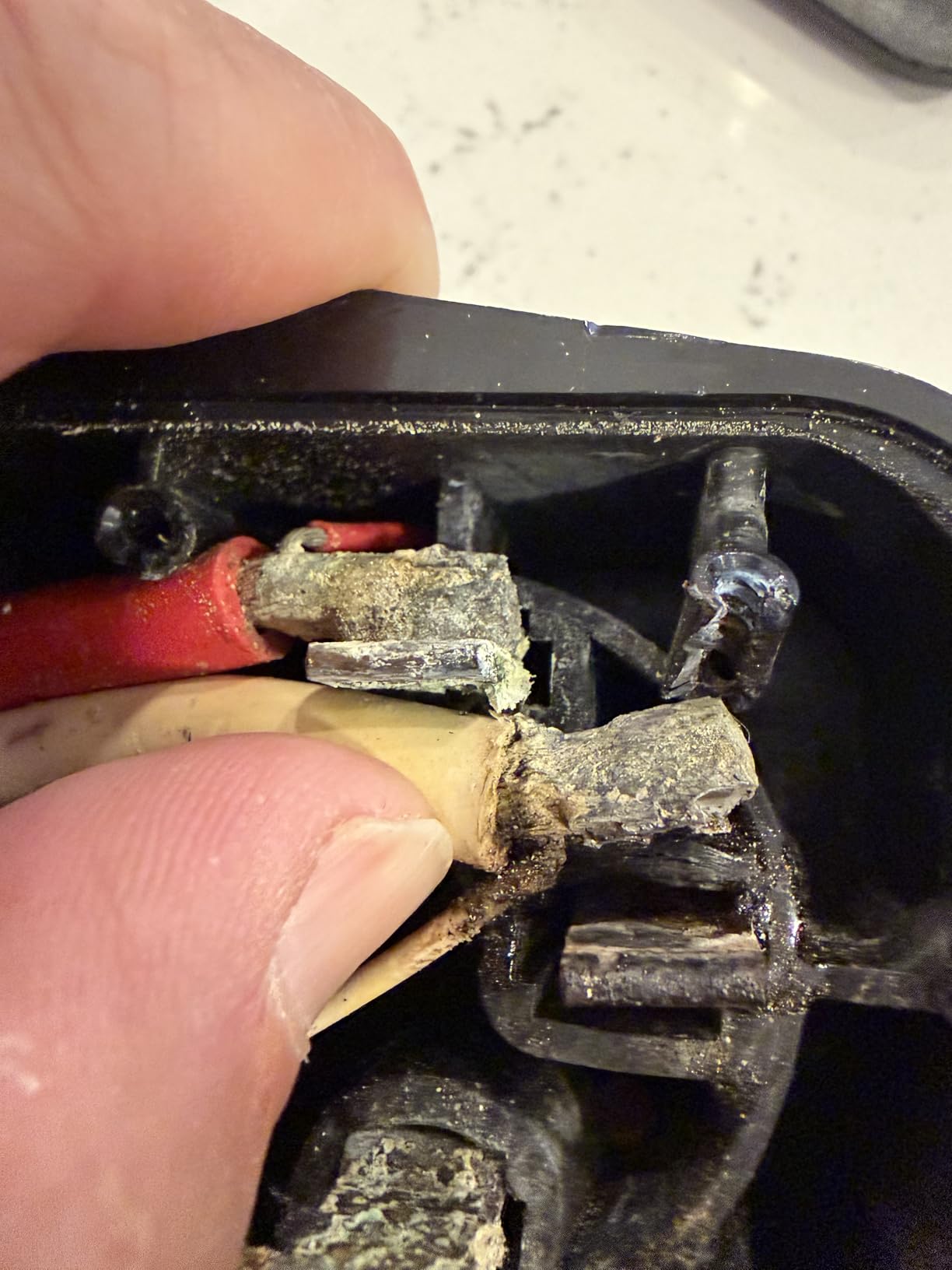
Faulty grounds, reverse-polarity false warnings and overheating are the failure modes owners name on forums. If a protector is hot to the touch after a full load has been running for a while, unplug it and stop using it rather than assuming the fault is at the park.
The Correct Pedestal Plug-In Sequence
Order matters here, and getting it wrong is how people end up with an error code on a perfectly good pedestal.
Switch the pedestal breaker off. Never plug a live 50 amp connector together; the arc can weld the contacts.
Plug the surge protector into the pedestal. This is the connector that carries the most load, so it should be the tightest fit.
Switch the breaker back on and let the protector read the line. A few seconds of analysis is all a good EMS needs. Check the fault indicators before going further.
Plug your RV power cord into the protector. Only connect once the status shows the power is safe, and never plug the RV in first and the protector second.
Confirm every load, then walk the cord. Check that nothing is pinched at the pedestal base or running under a tire, and secure the protector so it cannot be knocked loose.
What should never be plugged into a surge protector: a portable generator feeding the pedestal, a welder or any high-inrush tool, an inverter charger that expects clean unregulated power, and shore power at home unless your home outlet is a proper NEMA configuration. These inputs behave differently from grid power and can trigger false shutoffs or defeat the protection.
One last note on a setup that comes up constantly on the RV owner forums: if your coach has a Victron inverter and charger on board, ask how the protector interacts with it before you commit. Owners running that combination report mixed experiences, and the safe move is to confirm the charging profile matches what the EMS will pass through.
Frequently Asked Questions
What type of surge protector is best for RV?
For most RVs, an electrical management system that detects faults and disconnects is better than a surge-only unit, because campground problems are usually low voltage, open ground or open neutral rather than dramatic spikes. A surge-only protector handles lightning and switching events; an EMS also protects your electronics from sustained bad power. For 50 amp service, look for a unit rated 50 A at 120/240 V with a NEMA 14-50P plug.
Is there a 50 amp surge protector available for RVs?
Yes, and all ten units in this roundup are true 50 amp models with a NEMA 14-50P male plug rated for 50 A at 120/240 V. A fifth wheel, Class A or C motorhome, or any travel trailer with 50 amp shore power can use one directly against a 50 amp pedestal or distribution post. Units described only as 30 amp will not match your service without an adapter.
How many joules do I need for my RV surge protector?
For a 50 amp coach running two air conditioners, a figure between 9000 and 18000 joules gives sensible headroom for switching events on a shared campground feeder. The units here range from 1650 to 18000 joules. A lower rating still protects your electronics when paired with fault detection, but it gives up absorption capacity if your site has frequent switching or storm activity.
What should never be plugged into a surge protector?
Avoid connecting a portable generator feeding a pedestal, a welder or other high-inrush tool, an inverter charger expecting unregulated power, and household shore power at a domestic outlet. These inputs behave differently from grid power and can trigger false shutoffs or defeat the protection. Plug only your RV power cord into the protector output, and use a proper NEMA configuration for anything else.
What is the best 50 amp RV surge protector for the money?
The Progressive Industries SSP-50XL is the strongest overall value, with 4524 ratings, a lifetime warranty and the broadest fault detection in the group at this tier. The Power Watchdog PWD50 is the pick if you want Bluetooth monitoring and a replaceable surge module. Among the analyzer-style units, the Kohree and FOCSPROD offer the largest surge buffers for owners on a tighter budget.
Are RV surge protectors really necessary?
Yes, for any owner connecting to campground, storage-lot or home pedestals. Those outlets are shared, frequently miswired, and often run at low voltage during busy periods, which causes more silent damage to coach electronics than an occasional spike. A protector costs far less than one inverter board. It matters most for full-time RVs and anyone running two air conditioners on a hot day.
Can I use a 30 amp surge protector on a 50 amp RV?
You can, using a 50-to-30 dogbone adapter, and some owners on travel trailer forums do it deliberately to save weight and cost. The catch is that it caps every load on the coach at 30 amp, so two air conditioners on a hot afternoon will not work. It is a reasonable option for a light rig or a seasonal trailer, but not for a coach that needs genuine 50 amp service.
Why does my 50 amp surge protector show an open ground error?
An open ground error means the pedestal’s ground wire is missing or broken, which is a serious shock risk. Do not connect, and do not attempt a workaround. Try a different pedestal on the post or move sites, and report the fault to the park office. Faulty grounds are the failure mode owners name most often, so treat the code as real rather than a nuisance warning.
What is the best surge protector for a travel trailer?
For a travel trailer with 50 amp service, the Progressive Industries SSP-50XL covers fault detection with a lifetime warranty, while the Power Watchdog PWD50 adds phone monitoring. If your trailer is 30 amp, a 30 amp EMS is the correct match and you will not gain anything from a 50 amp unit. Match the protector rating to the trailer’s service, not to the pedestal you happen to be parked at.
The Best 50 Amp RV Surge Protector for 2026
After weighing all ten, the Progressive Industries SSP-50XL is the best RV surge protector for 50 amp service overall, because the depth of owner history behind it, the lifetime warranty and the full fault detection set matter more than a larger joule number. The Power Watchdog PWD50 takes the smart slot with Bluetooth monitoring and the only replaceable surge module here.
For owners on a tighter budget who want a large buffer, the Kohree and FOCSPROD deliver 14000 and 16000 joules with useful LED diagnostics, and the GEARGO is the one to buy if the pedestal lives in the rain. Check the connector type matches your service, plug the protector into the pedestal before your RV cord every time, and treat any fault code as a reason to move sites.