
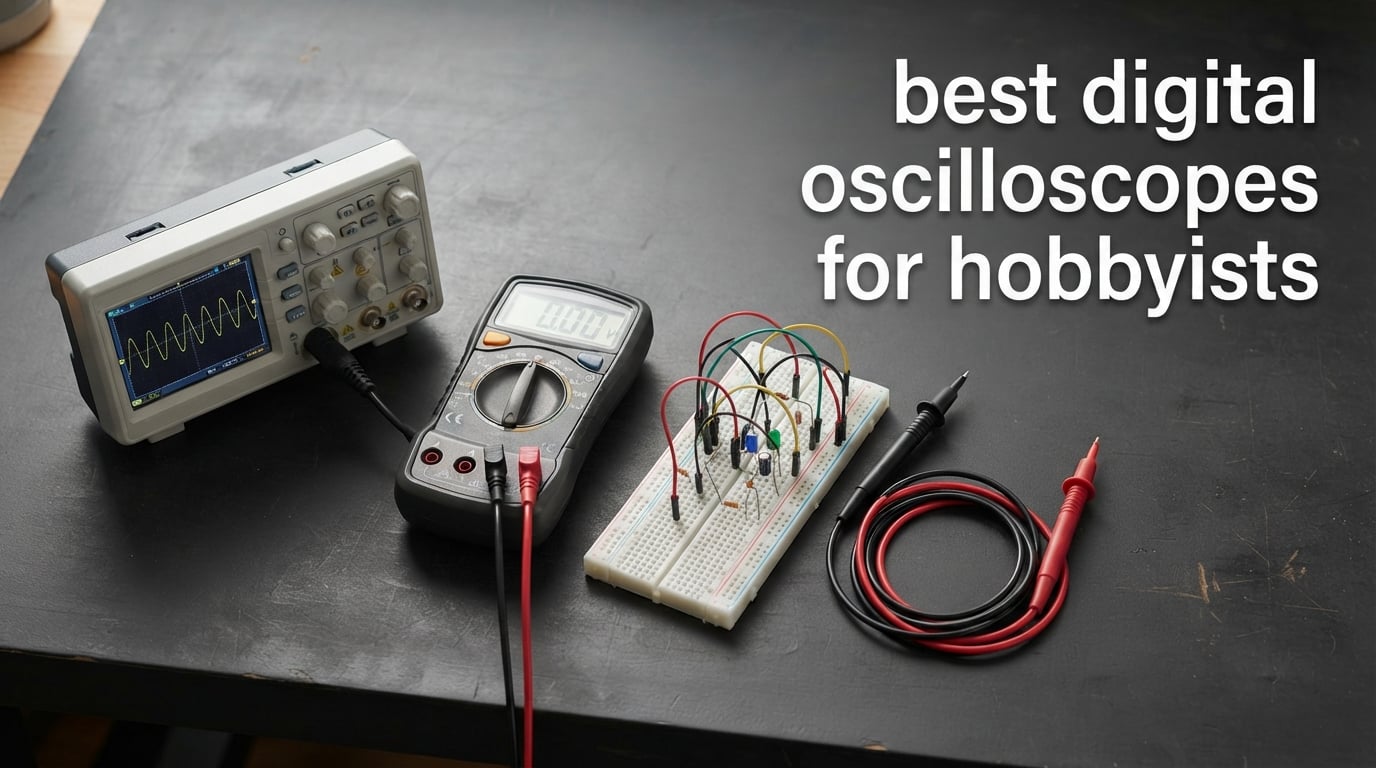
If you have ever watched a multimeter read 5.0 volts while the circuit was plainly misbehaving, you already know why a scope exists. A multimeter gives you one number at one instant. A digital oscilloscope gives you the whole story: how voltage moves over time, how fast edges rise, whether that ripple is 5 mV or 50 mV, and when a signal goes wrong for microseconds at a time.
This roundup covers the ten best digital oscilloscopes for hobbyists in 2026, from pocket handhelds that double as multimeters to four-channel bench units that most people would call a professional instrument. We looked at every unit’s bandwidth, sample rate, memory depth, trigger behaviour and included probes, then cross-checked the shortlist against what makers actually say on forums like the Arduino forum, r/ElectricalEngineering and the EEVblog beginners board.
Two shapes dominate. Benchtop units have big screens, real knobs, deep memory and mains power, and they are what you want if you are building circuits at a desk. Handhelds run on a battery, fold a multimeter into the same box, and go into a toolbox or a car boot. The honest answer to what is a good oscilloscope for a hobbyist is simpler than any spec sheet suggests: 100 MHz of bandwidth, at least 1 GSa/s of sampling, two channels, and 8 Mpts or more of memory will carry you through Arduino debugging, audio, switching supplies and most RF experiments you will realistically attempt.
Where a specification gap exists, we say so. Several of these scopes advertise bandwidth figures their square-wave response cannot support, and two of them have record depths so short that you will miss the very transients you bought them to find.
Table of Contents
Top 3 Picks for Hobbyist Oscilloscopes (October 2026)
Three units carry most of the weight here. The Siglent SDS1104X-E is the one we would buy with our own money, the Rigol DS1054Z is the value benchmark the whole hobbyist market is priced against, and the HANMATEK HO52 is the most convincing handheld for the money.

All 10 Digital Oscilloscopes at a Glance
Bandwidth is the headline number, but it is not the whole story. Memory depth decides whether you can zoom in on a glitch, and trigger stability decides whether the display holds still long enough to read it. The table below lists every scope in this roundup with the specifications that actually separate them.
| Product | Specs | Action |
|---|---|---|
| Siglent SDS1104X-E 100MHz 4-Channel |
|
Check Latest Price |
 Rigol DS1054Z 50MHz 4-Channel Rigol DS1054Z 50MHz 4-Channel |
|
Check Latest Price |
 HANMATEK HO52 Handheld 2-in-1 HANMATEK HO52 Handheld 2-in-1 |
|
Check Latest Price |
 Rigol DS1202Z-E 200MHz 2-Channel Rigol DS1202Z-E 200MHz 2-Channel |
|
Check Latest Price |
 ZOYI ZT-703S Handheld 3-in-1 ZOYI ZT-703S Handheld 3-in-1 |
|
Check Latest Price |
 Hantek DSO2D15 150MHz 2-Channel Hantek DSO2D15 150MHz 2-Channel |
|
Check Latest Price |
 Siglent SDS1102CML+ 100MHz 2-Channel Siglent SDS1102CML+ 100MHz 2-Channel |
|
Check Latest Price |
 FNIRSI DPOS350P 4-in-1 350MHz FNIRSI DPOS350P 4-in-1 350MHz |
|
Check Latest Price |
 Hantek DSO5102P USB 100MHz 2-Channel Hantek DSO5102P USB 100MHz 2-Channel |
|
Check Latest Price |
 FNIRSI 2C53T Handheld 3-in-1 FNIRSI 2C53T Handheld 3-in-1 |
|
Check Latest Price |
1. Siglent SDS1104X-E – Best Overall 4-Channel Scope
Siglent Technologies SDS1104X-E 100Mhz Digital Oscilloscope 4 Channels Standard Decoder, Grey
100 MHz
4 analog channels
1 GSa/s
7 Mpts per channel
7-inch LCD
Ethernet and web server
Pros
- All serial decoders unlocked with no license keys
- Dual-ADC sample rate holds 1 GSa/s on two channels
- Deep 7 Mpts memory per channel
- Built-in web server for remote viewing and control
- Four usable 100 MHz probes with color ID rings included
Cons
- Optional MSO and AWG upgrade modules cost a great deal
- Multifunction select knob overshoots the adjacent menu item
- Fan is audible at close working distance
This is the scope I keep coming back to. The Siglent SDS1104X-E gives you four analog channels at 100 MHz with 1 GSa/s real-time sampling and 7 Mpts of memory per channel, and it weighs 6.6 pounds. That combination sits in a gap where almost nothing else competes: cheaper four-channel units give you 50 MHz, and 100 MHz four-channel units from the big names cost several times more.
What surprised me most was the software. The serial decoders for I2C, SPI, UART/RS232, CAN and LIN are all unlocked in the base firmware, with no option keys and no license server. On a five-year-old EEVblog thread about buying a sub-400-dollar scope, owners named the DS1054Z and the SDS1202X-E as the durable choices, and this Siglent is the same family pushed a generation further.
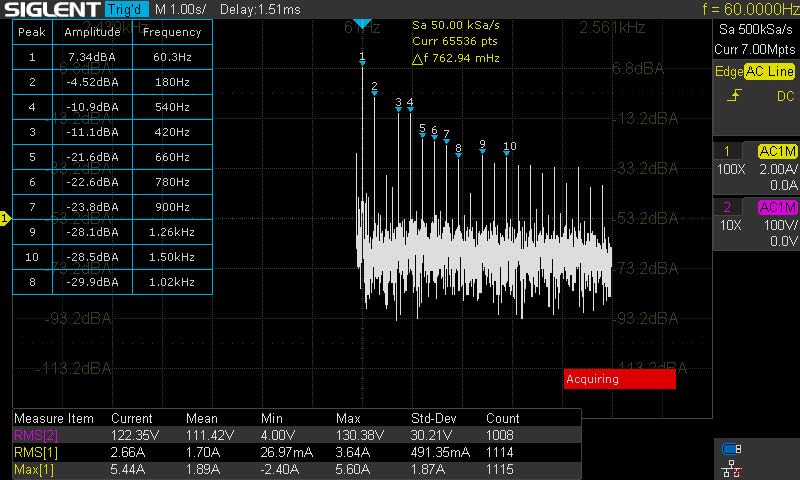
The dual-ADC architecture matters more than the headline sample rate. It holds 1 GSa/s on two channels and drops to 500 MSa/s only when all four are active, which is a far better trade than a single ADC that halves whenever you touch channel two. Memory depth of 7 Mpts per channel also means a long capture stays readable instead of collapsing into a decimated smear when you zoom.
The built-in web server lets you view the screen, capture images and drive the front panel from a laptop browser once the scope is on your network.
What the 1 GSa/s sample rate actually buys you
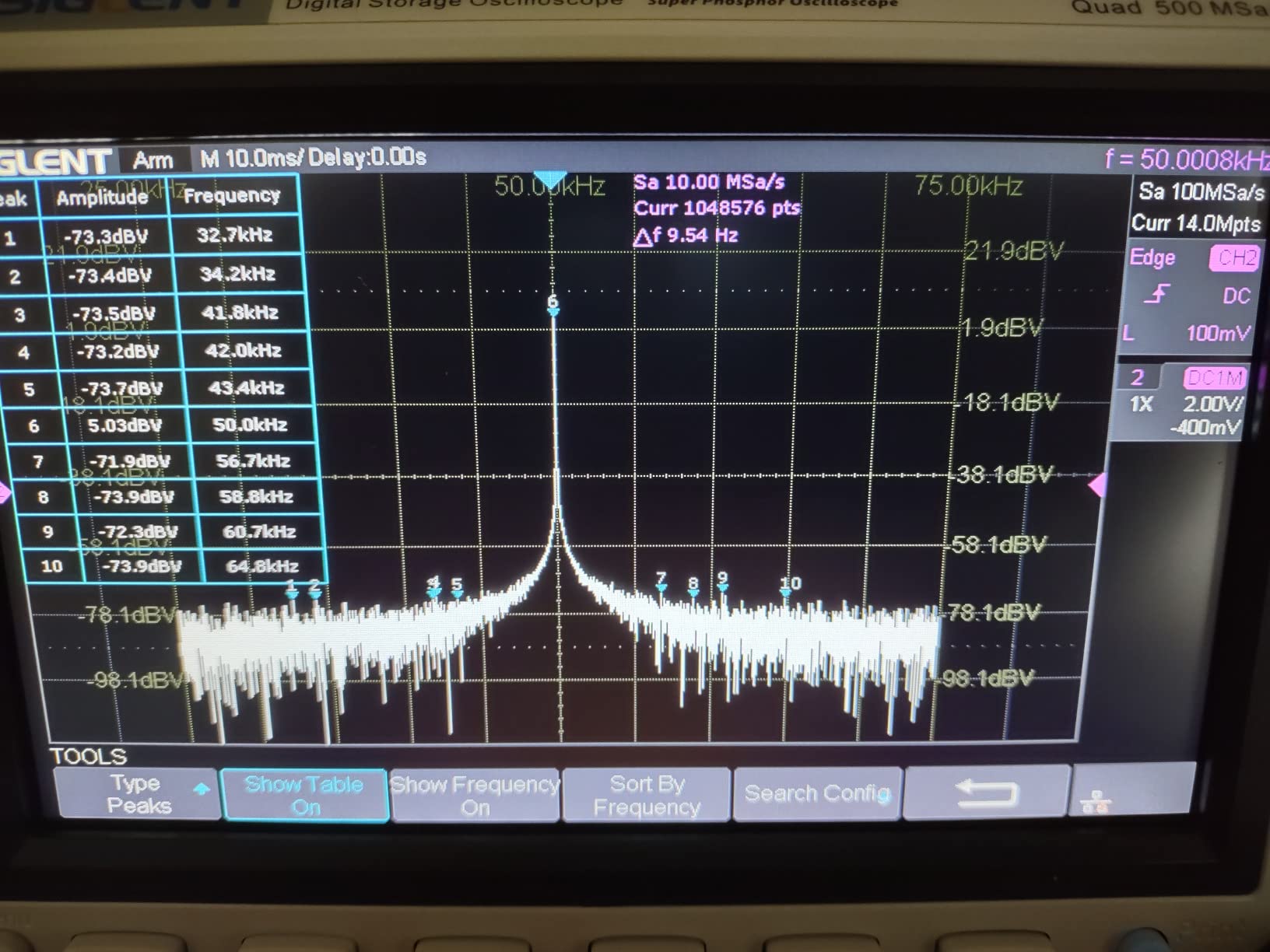
Sample rate is how many readings per second the scope takes. At 1 GSa/s on a 100 MHz bandwidth, you get ten samples per cycle at the bandwidth limit, which is why the display of a fast edge looks like a real edge rather than a triangle. Drop the sample rate to 500 MSa/s and you are at five samples per cycle, and the same edge starts to look artificially rounded.
Where it will frustrate you
The MSO and AWG upgrades are optional modules that cost a serious fraction of a whole new scope, so do not plan on adding them later. The multifunction select knob overshoots into the next menu item when you press it, and the fan is audible if you are leaning over the bench. Trigger response on low-rate serial traffic can also feel sluggish, and the setup and screensaver options do not survive a power cycle.
2. Rigol DS1054Z – Best Value for a Home Lab
Rigol DS1054Z Digital Oscilloscope, 50MHz, 4 Channel, 1GSa/s, Best Value
50 MHz
4 analog channels
1 GSa/s
24 Mpts memory
30,000 wfms/s
USB and LAN
Pros
- 24 Mpts of standard memory is unusually deep for the price
- I2C SPI and RS232 trigger and decode ship in base firmware
- 30000 wfms/s capture with intensity graded display
- Free official firmware upgrades add bandwidth and sensitivity
- Ethernet and USB simplify screen sharing and data capture
Cons
- Cooling fan is noticeably noisy
- Intensity encoder skips a step when pressed
- Channel 2 and 4 trace colors are nearly identical
- Bundled probes are mediocre and hard to tune
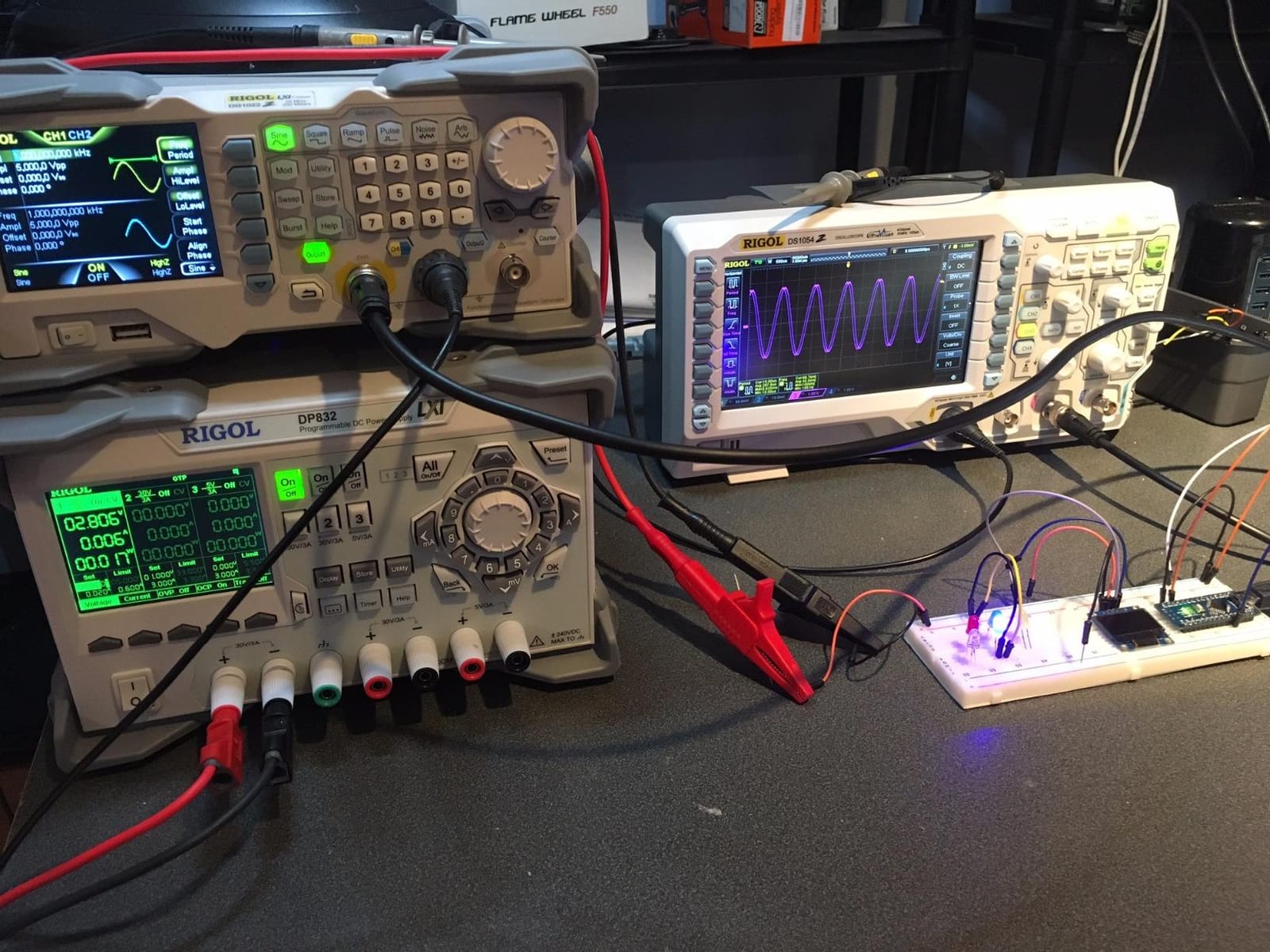
This scope has been the reference point for hobbyists for over a decade, and the DS1054Z is why. Fifty megahertz of bandwidth, four analog channels, 1 GSa/s single-channel sampling and 24 Mpts of standard memory depth for a price that still undercuts most of the four-channel field. It first went on sale in 2014, and the accumulated community knowledge around it is enormous.
The 24 Mpts figure is the headline. Most rivals at this price ship 1 Mpts, which means one zoom level in and the waveform turns into a coarse staircase. Here, zooming into a burst on an I2C line or an occasional spike on a power rail still gives you real data. The 30,000 waveforms per second capture rate with intensity grading is what lets you spot rare events, because the display accumulates density rather than flickering between refreshes.
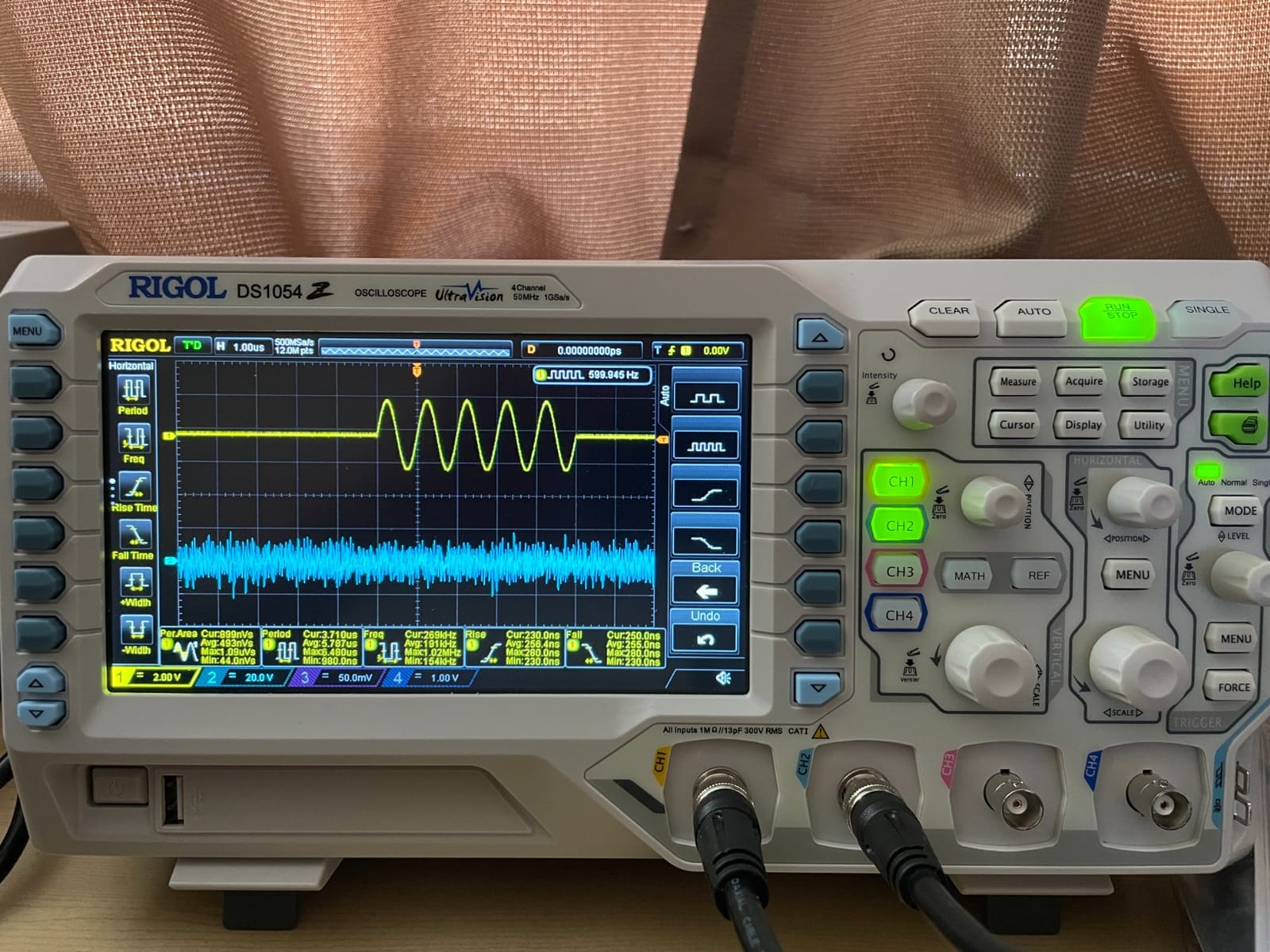
Serial bus trigger and decoding for RS232/UART, I2C and SPI is included in base firmware, and free official firmware upgrades have added bandwidth and sensitivity since launch. That is not a small thing: the same physical unit improves without you buying anything. Ethernet with LXI and both USB host and device ports mean screen sharing, screenshot capture and PC control all work out of the box.
That is the recurring verdict in reviews, and the reason the DS1054Z is the name that appears most often in forum threads about budget four-channel purchases.
Is 50 MHz enough for a home lab
For Arduino and Raspberry Pi debugging, PWM inspection, audio at 20 kHz, and 5 V logic, 50 MHz is genuinely sufficient. It becomes marginal on switching power supplies, where the edges you most want to see are the fast ones, and it is not enough for RF above a few MHz. Know which of those you care about before you settle.
What the reviewers complain about
The cooling fan is the most-mentioned irritation, followed by the intensity and select encoder, which skips a step when pressed and makes option entry error-prone. Trace colors for channel 2 and channel 4 are nearly identical and the channel 4 probe rings do not match the trace colors, which costs beginners real time. The bundled probes are the weak point, and a few owners report USB interface hangs.
3. HANMATEK HO52 – Best Handheld Scope and Meter Combo
HANMATEK Handheld Digital Oscilloscope 50Mhz Bandwidth with 2 Channels HO52 3.5″ TFT Mini Oscilloscope, 2 in 1 Oscilloscope and Multimeter, Backlit Screen, Auto-Calibration Function, Memory Function
50 MHz
2 channels
250 MSa/s
8k record length
true-RMS meter
2.6 lb handheld
Pros
- Two-channel scope and auto-ranging true-RMS meter in one 2.6 lb body
- 250 MSa/s sampling with 10000 wfms/s refresh
- Reference waveform overlay for before and after comparison
- USB Type-C handles charging
- power bank supply and PC export
- Auto-calibration and one-key auto set
Cons
- 3.5-inch screen limits visible waveform detail
- 8k point record length is short for bench capture
- Menu-driven with no dedicated dials for timebase or cursors
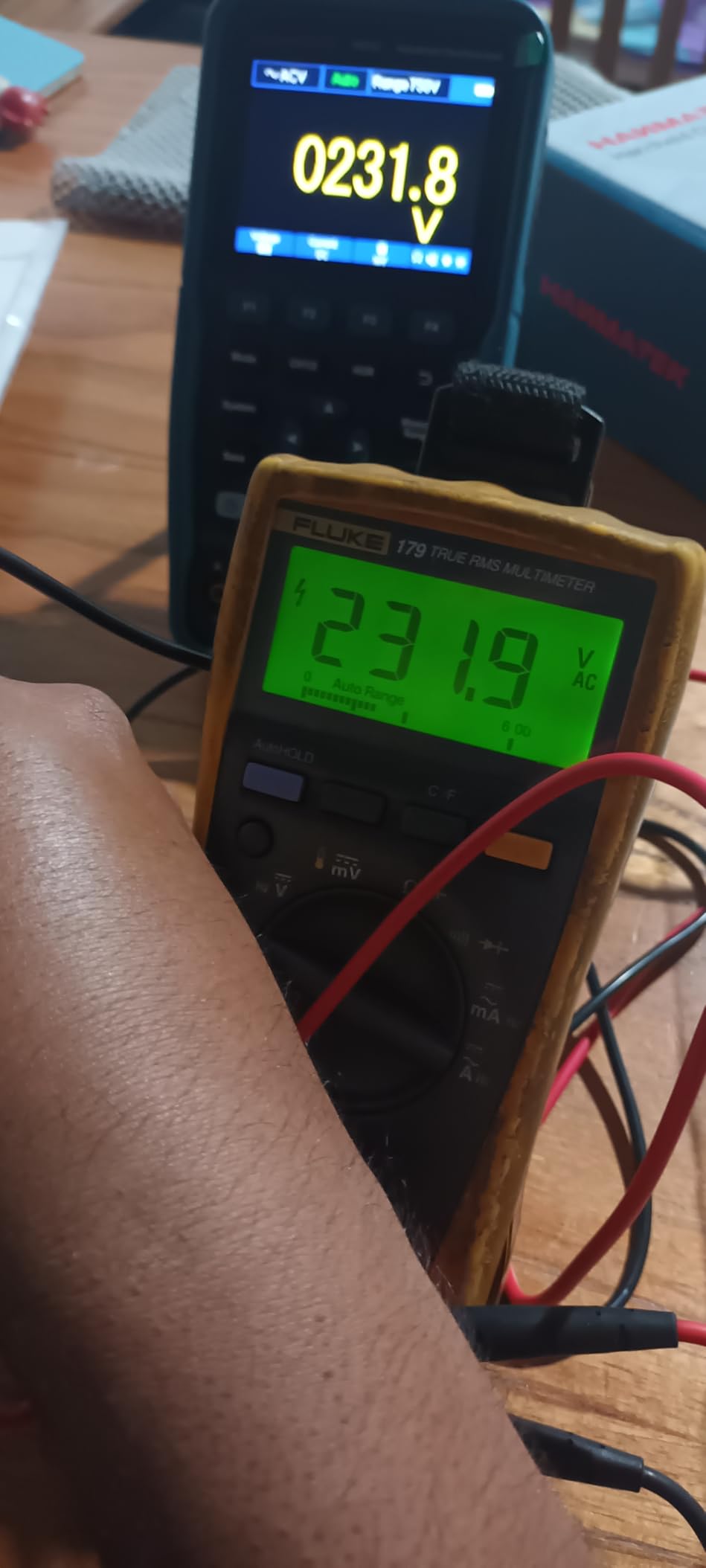
The HO52 is the handheld I would actually carry. It is a two-channel 50 MHz scope with 250 MSa/s sampling and a refresh rate up to 10,000 waveforms per second, bolted to a 4.5 digit true-RMS multimeter that handles AC up to 750 V and DC up to 1000 V, all in 2.6 pounds at 7.83 by 3.94 by 1.54 inches.
That combination changes what a single tool can do. Fault-finding an appliance or a motor controller usually means measuring a voltage, then watching what the circuit does with that voltage. Having both functions in one body with one set of leads removes the whole swap-the-probe ritual. A community owner report on a budget unit of this class compared it against a mid-range Rigol on DC voltage and cursor measurements after a seven-hour session and found it performed well.
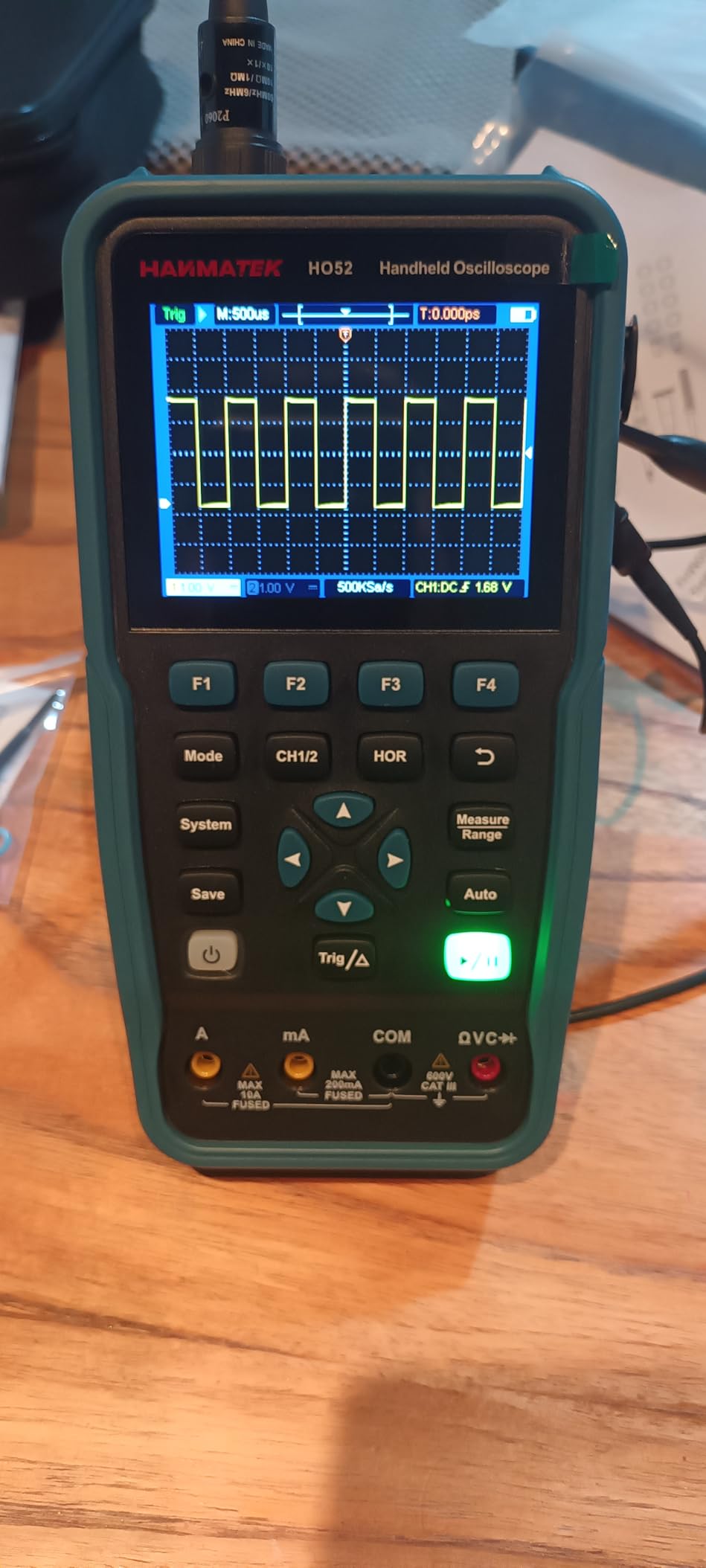
USB Type-C also charges the unit, accepts a power bank supply and exports saved images and CSV waveforms to a computer.
Self-calibration and a one-key auto set get you to a stable display quickly, which is the single biggest factor in whether a beginner keeps using a scope. Cursor measurement and seven automatic measurements cover frequency, period, peak-to-peak and duty cycle without any menu diving.
Where the 8k record length hurts
An 8k point record is fine for a repeating signal, and it is limiting the moment you want to look at a slow transient. Deep memory is what allows a scope to keep high sample-rate detail while stretching the timebase, and at 8k points the display thins out early. If your work involves capturing a startup surge or an inrush spike, this is not the tool.
Handheld trade-offs you should accept upfront
The 3.5-inch backlit TFT is the main constraint. You can read a waveform on it, you cannot read fine detail on it, and daylight readability is marginal. Operation is menu-driven with no dedicated dials for timebase, divisions or cursors, so every adjustment takes more clicks than a bench scope. The listed weight of 16 ounces also disagrees with the 2.6 lb figure in the feature copy, so plan on the heavier number.
4. Rigol DS1202Z-E – Best for 200 MHz Work
RIGOL DS1202Z-E Digital Oscilloscope, 200MHz, 2 Channel, 1GSa/s Sampling
200 MHz
2 channels
1 GSa/s
24 Mpts
7-inch WVGA TFT
60,000-frame playback
Pros
- 200 MHz bandwidth at a price where it was once unheard of
- 24 Mpts deep memory keeps long captures usable
- Large bright 7-inch display with intensity graded color
- Option keys ship unlocked with no extra cost
- Quiet cooling fan and well-weighted build
Cons
- Multifunction knob overshoots the intended selection
- Full 24 Mpts only offloads over slow USB 2.0
- Ultrascope reads downsampled traces not full-resolution data
- Menu depth creates a real learning curve
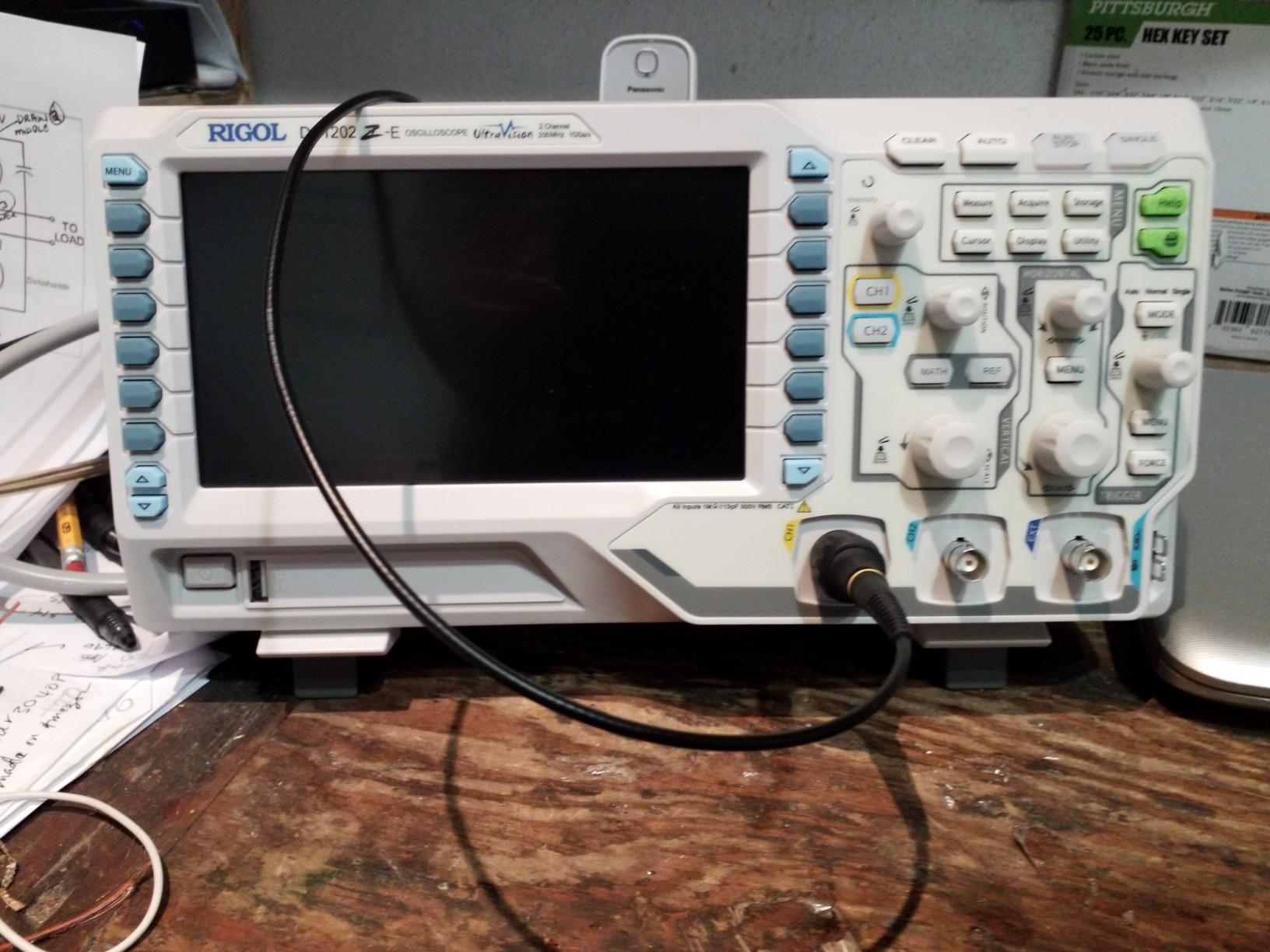
If your signals have fast edges, the DS1202Z-E is the pick. Two hundred megahertz of bandwidth with 1 GSa/s sampling across two analog channels, 24 Mpts of standard deep memory, and a 7-inch WVGA TFT at 800×480 with intensity graded color. It replaces decades-old analog scopes for audio, ham radio and microcontroller work, which is how owners describe it.
The relationship between bandwidth and memory is the reason this one feels so capable. Two hundred megahertz bandwidth paired with only a few megasamples of record length would give you a fast but thin trace. Here 24 Mpts holds a long capture together, and the hardware waveform record and playback feature stores up to 60,000 frames, so you can capture a rare event, walk back through it, and see what preceded it.
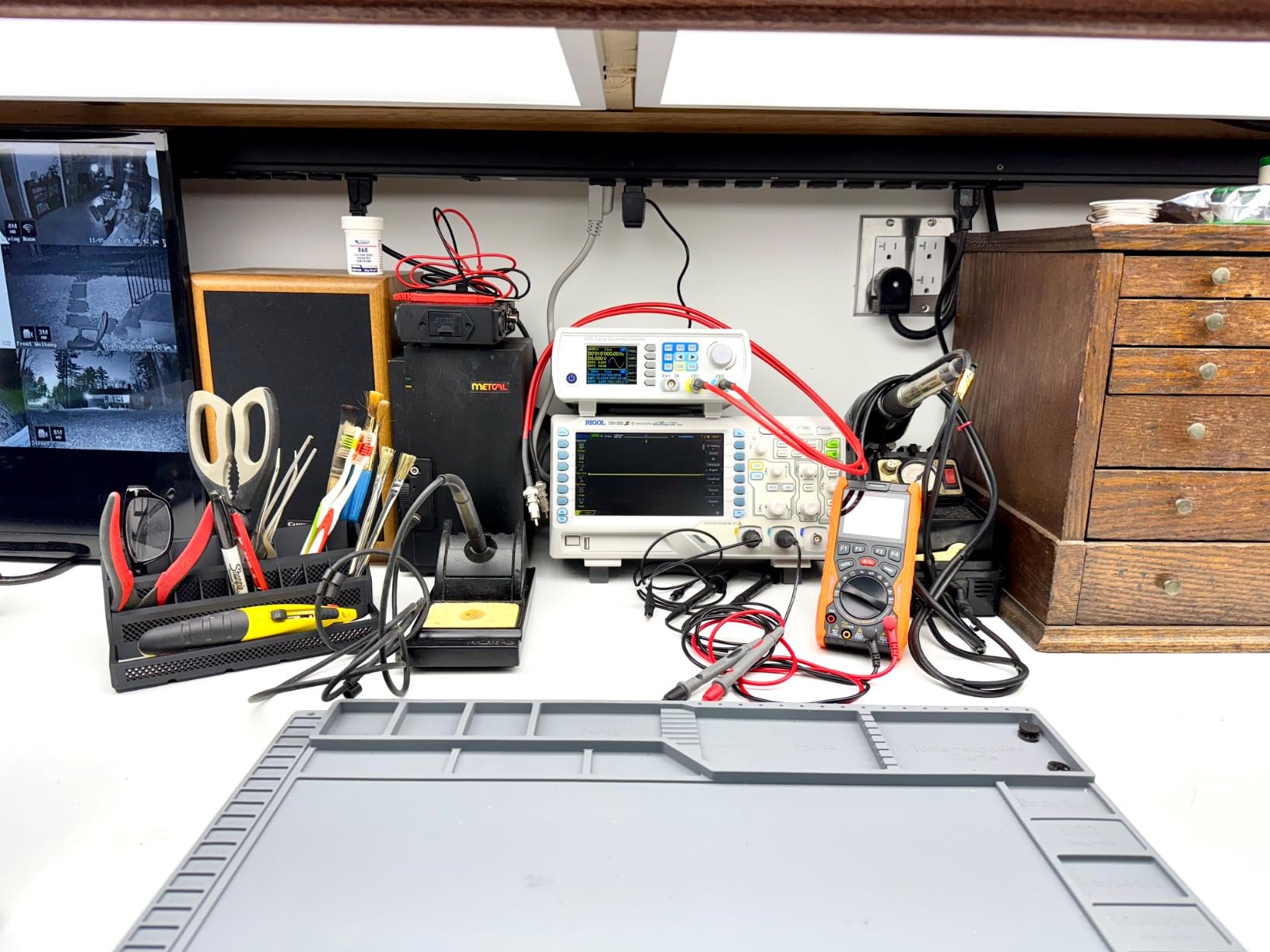
The on-screen measurement suite shows dozens of signal parameters at once, which is why the display size matters more than it would on a two-channel unit. Serial bus trigger and decode for RS232/UART, I2C and SPI is standard, and the option keys ship unlocked, so you get full bandwidth and memory without paying for firmware keys.
It also carries a three-year warranty on the main unit, which is a real advantage over grey-market alternatives with no US support.
When 200 MHz earns its place
Two hundred megahertz is the tier where switching converters, inverter stages, clocked digital rails and amateur radio work stop being a compromise. The 0.35 nanosecond rise time it implies lets you see real edge shape on a fast square wave rather than a smeared approximation. For audio and MCU work at 5 V, you are paying for headroom you may not use.
The honest limitations
The multifunction knob is too sensitive and frequently overshoots the intended selection. Data transfer is the weak point: the full 24 Mpts can only be offloaded over the front USB 2.0 port, so large transfers are very slow, and the Ultrascope software reads downsampled traces and images rather than full-resolution captured data. Large USB flash drives are not recognised, and there is no printed manual.
5. ZOYI ZT-703S – Best Budget Handheld
3 in 1 Handheld Oscilloscope Automotive Dual Channel 50MHz with Digital Multimeter and Signal Generator
Dual channel
30 MHz normal and 50 MHz high-speed
128K depth
25,000-count meter
380 g
Pros
- Genuinely capable 25000-count auto-ranging multimeter
- Replaceable rechargeable battery and USB-C charging
- Large color screen readable at low brightness
- Comes with carry case
- probe set
- test leads and cable
- Solid well-machined feel with pleasant keys
Cons
- No physical dials
- so every adjustment goes through menus
- Square wave edges deform so real bandwidth is lower than headline
- Onboard signal generator limited to probe adjustment duties
- Display sleeps and shuts off quickly
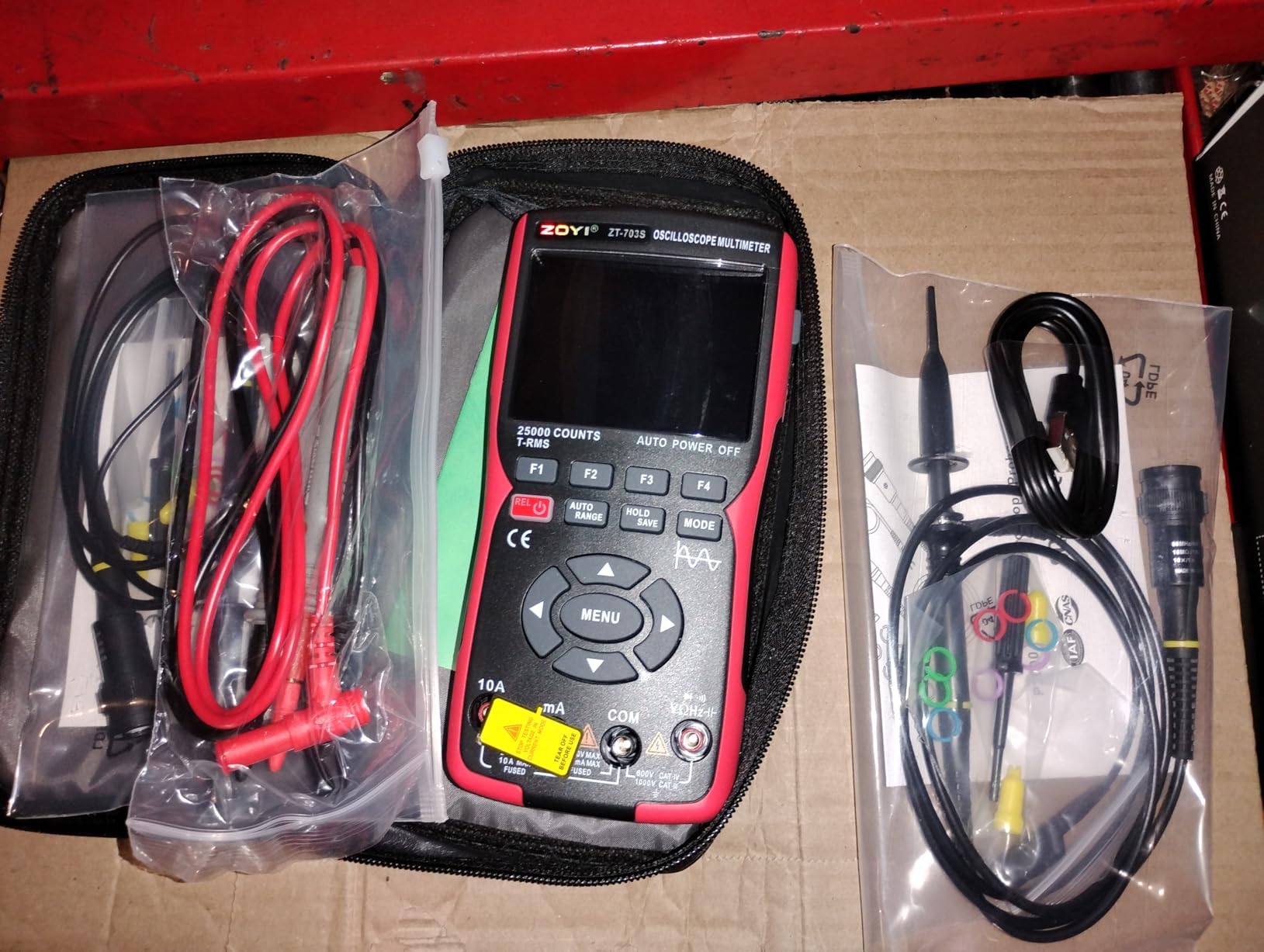
The ZOYI ZT-703S is the cheapest credible entry into this roundup, and it is genuinely useful rather than a toy. In normal mode it samples at 200 MSa/s with a 30 MHz maximum measurement bandwidth; switch to high-speed mode and you get 280 MSa/s at 50 MHz, at the cost of higher power draw. Storage depth is 128K, which is more than most of the compact handhelds manage.
Owners rate it highly as a field and automotive DMM-plus-scope, calling it the best of the compact units they have tried and highlighting build quality, screen clarity and the replaceable battery. The consensus is that it handles sine waves well up to roughly 10 to 20 MHz and does less well on square waves. That is a narrower band than the 50 MHz headline suggests, and it is the first thing to check against your work.
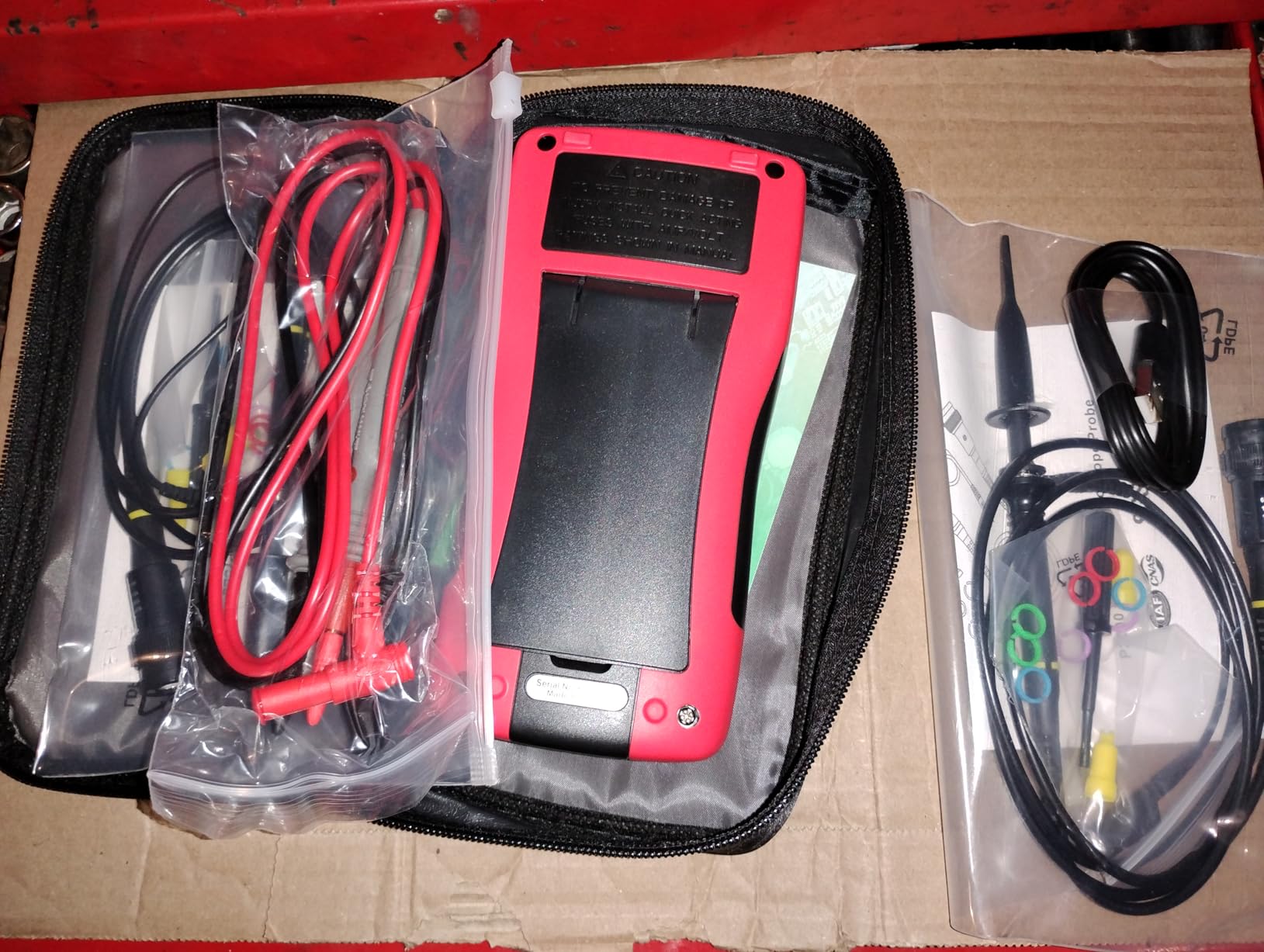
The multimeter section is 25,000 counts with resistance, capacitance, continuity, diode and current measurement, which puts it ahead of most oscilloscope-integrated meters. The signal generator outputs sine, square and triangle with a synchronous display, and AUTO gives you one-key automatic waveform recognition. At 380 g it is heavier than a phone and lighter than a lunchbox.
The large color screen stays readable even with brightness turned down, which matters more than it sounds for automotive work.
When this is the right tool
Reach for the ZT-703S when the work is automotive, appliance or HVAC repair where you are checking a sensor signal or an ignition or switching event, and you need a meter and a scope in the same case. It is also the cheapest way to learn to read waveforms without risking a bench space or a delicate project.
What to watch out for
There are no physical dials, so changing divisions, cursors and timebase means digging through menus, and the learning curve is real. Square wave edges and rise time deform badly enough that the practical bandwidth sits well below the 50 MHz figure. The signal generator is only good for probe adjustment and demonstration, and the display sleep and shutdown timeouts are aggressive with the setting buried in the menu.
6. Hantek DSO2D15 – Best for Arduino and Embedded Work
Hantek DSO2D15 Digital Storage Lab Oscilloscopes150MHz Bandwidth 2CH
150 MHz
2 channels
1 GSa/s
14 trigger modes
5 serial protocol decodes
4.2 lb
Pros
- Full-featured bench scope with 150 MHz bandwidth at a low price
- Five serial protocol triggers and decodes plus 14 trigger modes
- Firmware updates fixed much of the earlier instability
- Internal square wave output for probe calibration
- Color-coded LED buttons and F-buttons matching on-screen menus
Cons
- Slower CPU makes the display refresh sluggish
- Scope can lock up if settings are misconfigured
- Measurements not precise above roughly 5 MHz
- Front and rear USB share the same port hardware
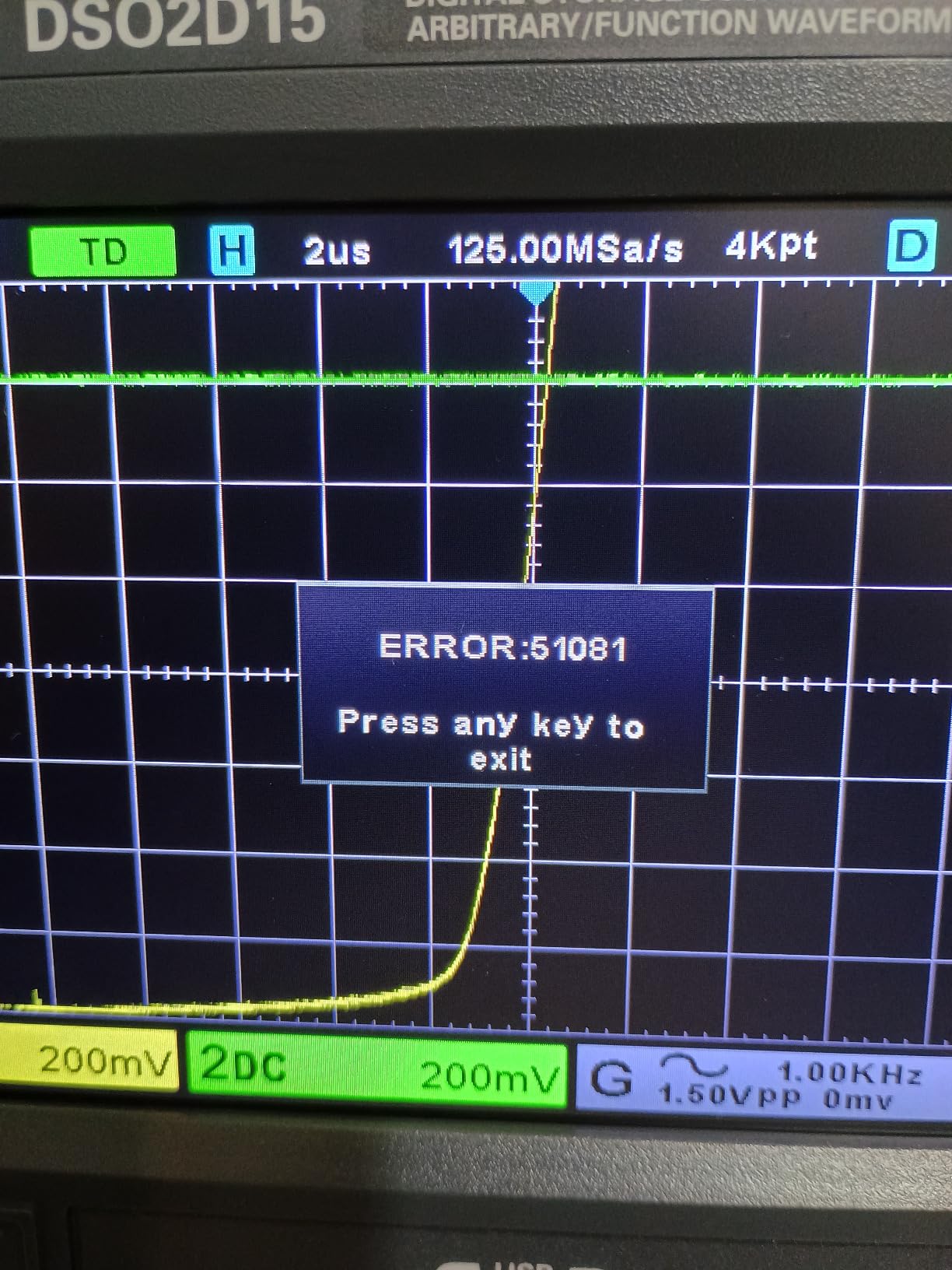
The DSO2D15 is the spec-sheet value pick: 150 MHz bandwidth, two channels and 1 GSa/s sampling on a full bench chassis at 4.2 pounds and 12.44 by 4.33 by 5.91 inches. Owners commonly frame it as a capable full bench scope at an unusually low price, particularly for microcontroller work across Arduino, ESP32 and Raspberry Pi, for university labs, and for ham radio.
What makes it interesting for embedded developers is the trigger and decode set. Fourteen trigger modes plus five serial protocol triggers and decodes are standard, not optional, and firmware updates from the manufacturer have fixed much of the instability reported in earlier revisions. That matters when you are chasing a one-off glitch on an SPI bus rather than looking at a repeating square wave.
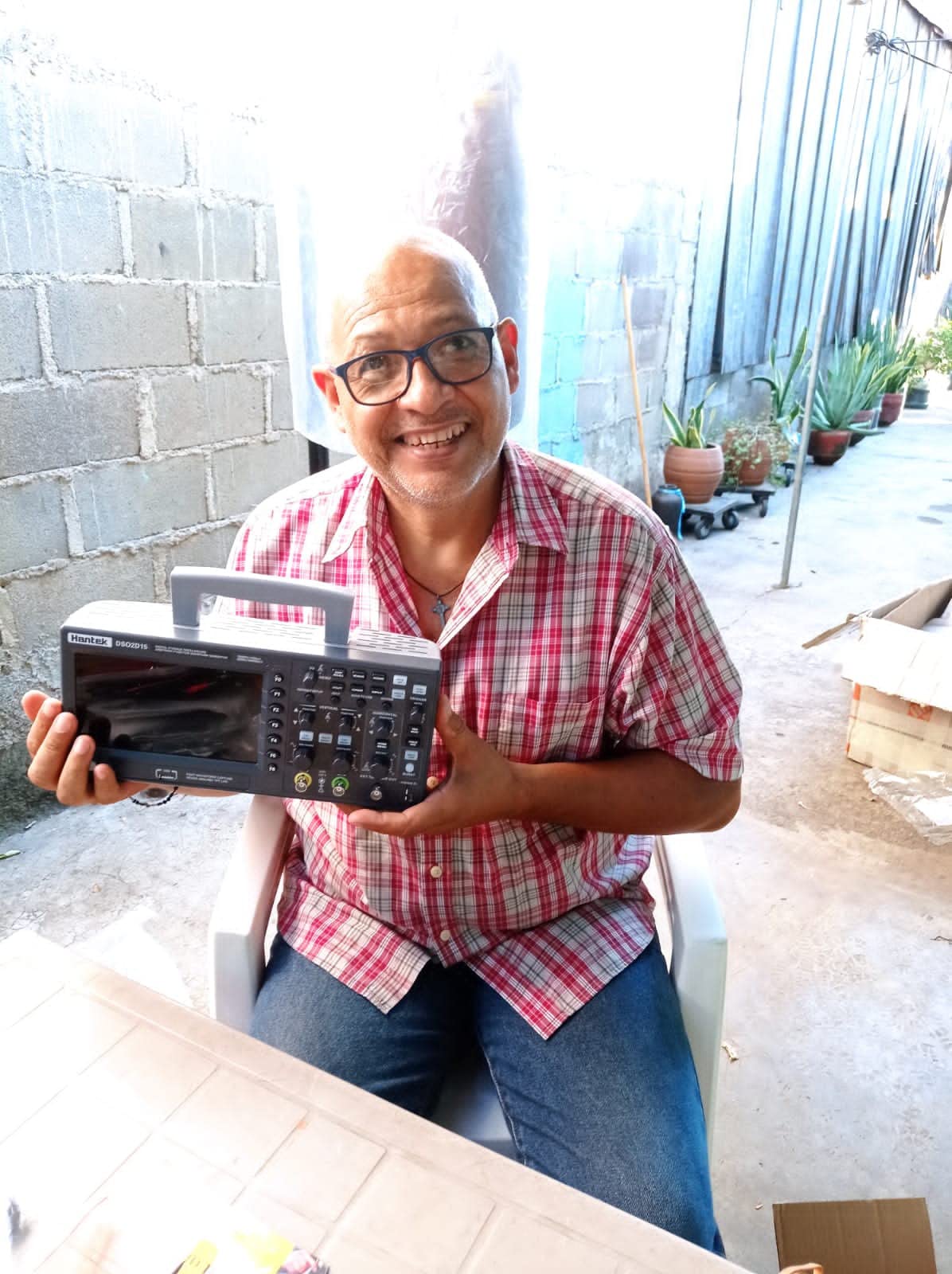
The internal square wave output is stable and adjustable up to 25 MHz for probe calibration, which saves buying a separate generator just to compensate a probe. Owners in ham radio use report it is accurate enough for coax length and FM deviation work, and the color-coded LED buttons with F-buttons that align to the on-screen menus plus a Default Setup button make it approachable.
A downloadable 68-page manual covers the stated use case of communications, embedded, research and education work.
Where the 1 GSa/s stops helping you
The honest ceiling is accuracy, not sample rate. Owners report measurements that are not precise above roughly 5 MHz, and it is hard to sync the waveform reliably on sub-1V signals, with voltage readouts wobbling unless you average. For 3.3 V and 5 V digital signals, where the levels are large and the timing is what you are reading, that is fine. For small analog amplitudes, plan to average and expect noise.
Operational annoyances to plan for
The slower CPU makes the display refresh more slowly than competing scopes, and the scope can be finicky, locking up if settings are misconfigured with a power cycle as the recovery. The rear and front USB connectors share the same port hardware and cannot be used at the same time, and there is no printed instructions, so the manual has to be downloaded.
7. Siglent SDS1102CML+ – Best Two-Channel Starter Bench Scope
Siglent Technologies SDS1102CML+ Digital Storage Oscilloscope, 100 MHz
100 MHz
2 channels
1 GS/s
1 Mpts record length
independent vertical controls
2.2 lb
Pros
- 100 MHz bandwidth and 1 GS/s sampling at a budget price
- Independent vertical controls for each channel
- Auto mode reliably stabilizes signals
- Well calibrated out of the box with two good 100 MHz probes
- Lightweight at 2.2 pounds with smooth controls
Cons
- No serial protocol decoding at all
- EasyScopeX requires installing .NET and NI-VISA first
- Channel 2 readout color is a hard-to-read pink purple
- On-screen measurement area shows only about five values
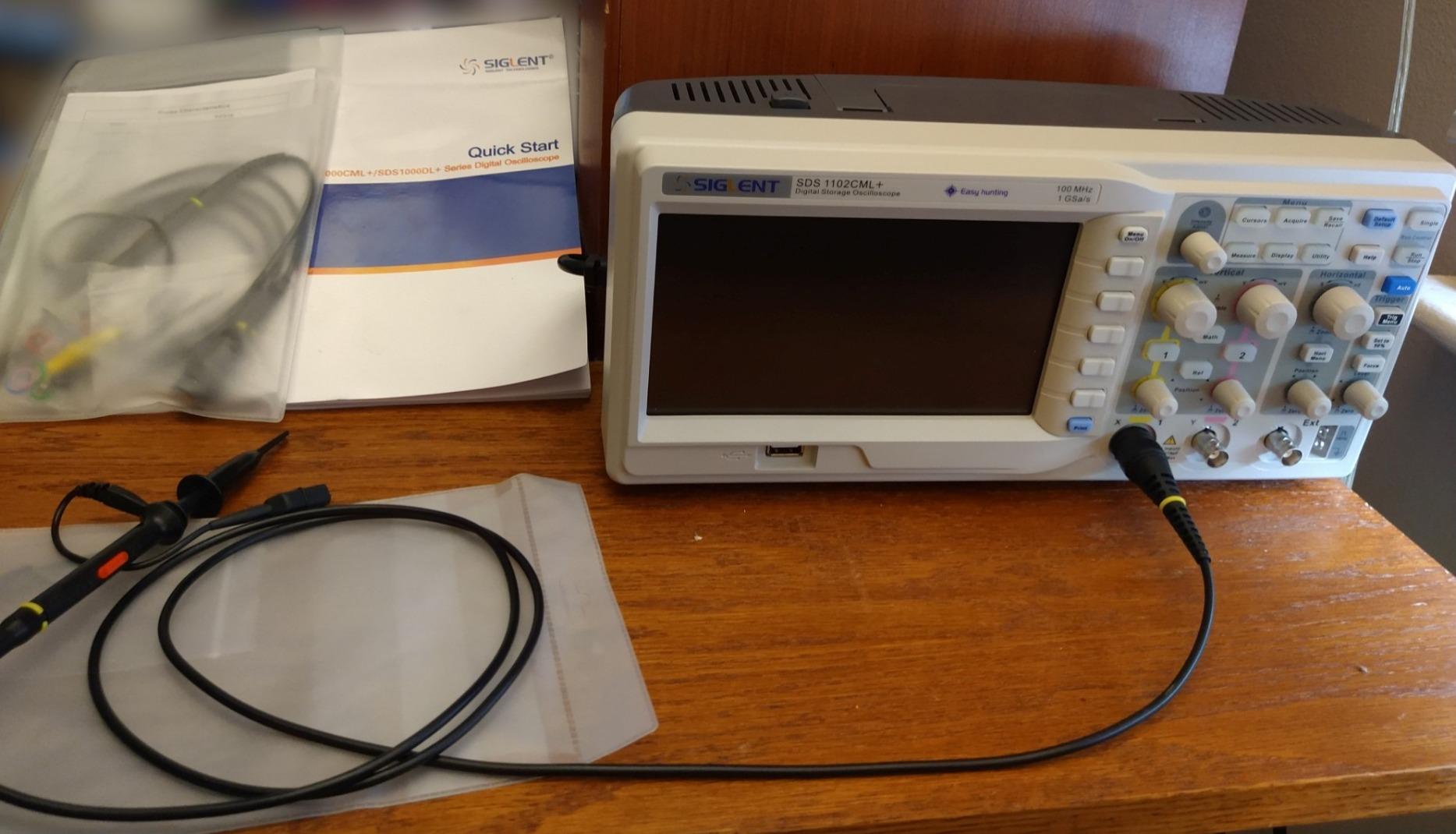
The SDS1102CML+ is a straight two-channel bench scope with 100 MHz bandwidth, 1 GS/s sampling and a 1 Mpts record length in single-channel mode, and at 2.2 pounds it is the lightest thing in this roundup. It is not the most capable unit here, and the 4.4 average from 198 reviews reflects that, but it does the fundamentals cleanly.
Independent vertical controls for each channel is a nice touch at this level, and the revised display offers improved higher resolution over the earlier version. Enthusiastic buyers like the build quality, screen clarity, auto set and the two included 100 MHz passive probes, and several retired technicians report it handles amateur radio and general bench work well. The unit is also well calibrated out of the box, which removes one common beginner source of confusion.
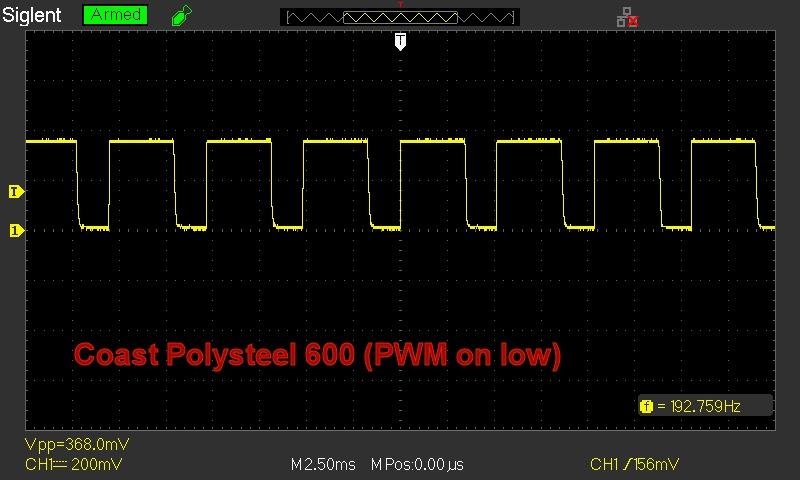
Trigger types cover edge, pulse, video, slope and alt, and acquisition modes include sampling, peak detect and averaging from 4 to 256 segments. Averaging is genuinely useful, since it is the fastest way to pull a clean trace out of a noisy measurement without moving anything. A built-in frequency counter is included, and USB and LAN interfaces pair with EasyScopeX software for screen images and PC control.
Auto mode stabilizing an unfamiliar signal reliably is worth more to a beginner than a deeper menu.
What you give up by skipping decoders
The absence of serial protocol decoding is the gap that matters most, and some buyers treat it as significant. If you intend to debug I2C, SPI or UART traffic, this scope will make you read bit timing by eye from a grid instead. If you are working on analog, audio, power or general timing, the missing decoders cost you nothing.
The software and display rough edges
EasyScopeX requires installing .NET and NI-VISA drivers before it will connect, which is a genuine stumbling block for a first-time PC user. The channel 2 trace and readout color is a hard-to-read pink-purple, the on-screen measurement area is cramped enough to show only about five values across both channels, and the universal select knob has almost no click detent, so mis-selection is easy. Screen captures save as .bmp and USB flash drives are limited to 4 GB FAT32.
8. FNIRSI DPOS350P – Best for Spectrum and Bode Work
FNIRSI DPOS350P 4-in-1 350MHz Digital Oscilloscope 2 Channel, 1 GSa/s
350 MHz
1 GSa/s
2 channels
47 Kpts
FFT waterfall
Frequency response analyzer
8000 mAh
Pros
- Scope
- spectrum analyzer
- frequency response analyzer and DDS generator in one handheld
- 350 MHz bandwidth with 50000 wfms/s and digital phosphor
- 7-inch touchscreen with 2 mV per division sensitivity
- Integrated Bode plot capability without extra gear
- 8000 mAh battery suits field use
Cons
- 47 Kpts record depth is shallow for the bandwidth claimed
- Only 2 channels and no external trigger input listed
- 8 to 16 bit resolution varies with sample rate
- Lowest average rating in this group at 4.1
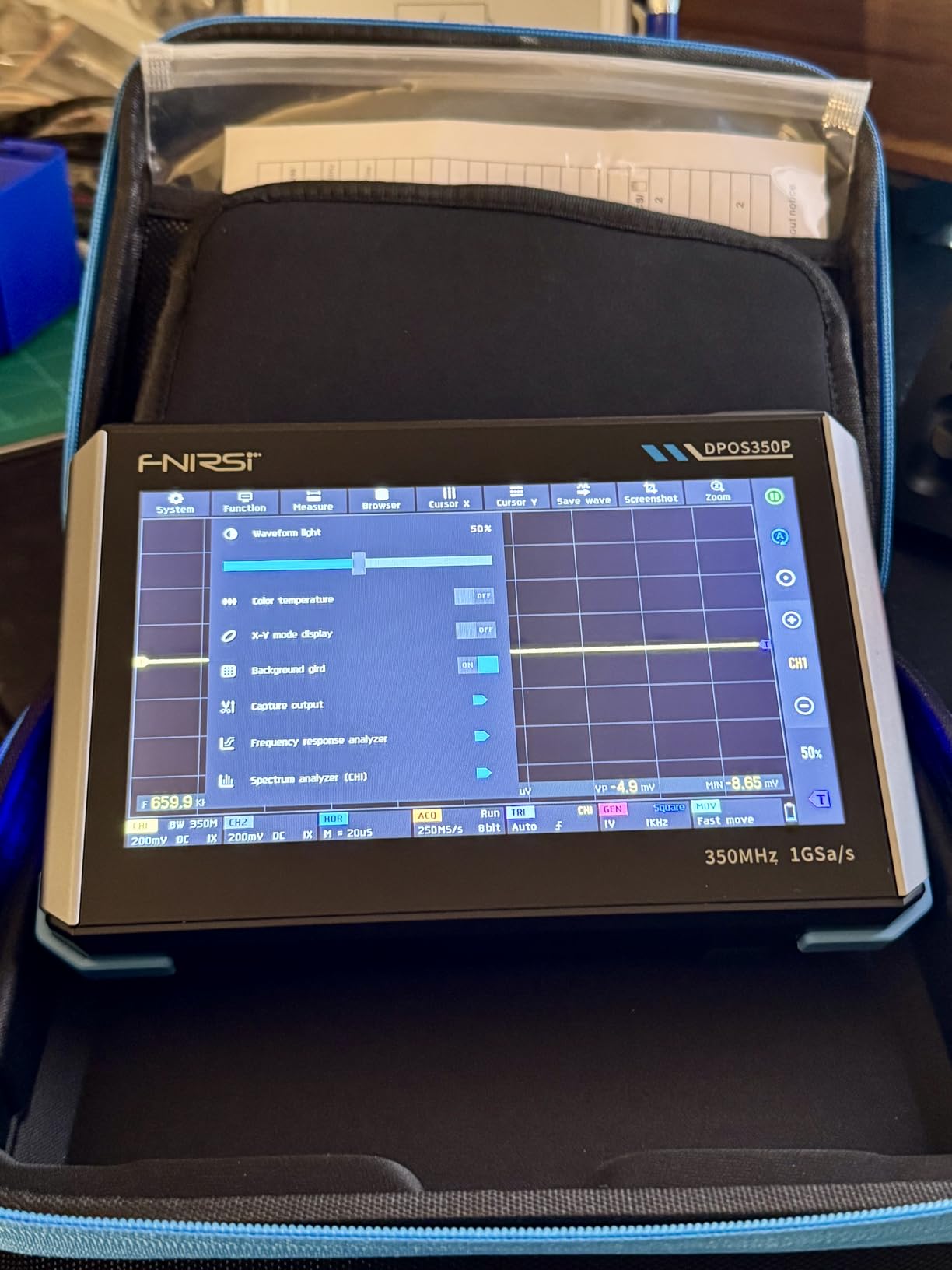
The DPOS350P is the most ambitious instrument in this roundup on paper: 350 MHz bandwidth, 1 GSa/s, two channels, 47 Kpts of record depth, a 50,000 waveforms per second refresh rate with digital phosphor, and a 7-inch touchscreen. It weighs 3.56 pounds and runs on an 8000 mAh battery over USB-C. What it also is, is a four-in-one: scope, spectrum analyzer, frequency response analyzer and DDS signal generator.
The FFT spectrum analyzer covers 200 kHz to 350 MHz with 4K to 32K FFT length, harmonic markers and a 2D and 3D waterfall view, which makes it useful for EMI checks and signal integrity work that a plain scope cannot do. The frequency response analyzer runs 10 Hz to 50 MHz at 0 to 5 Vpp and measures gain, phase and frequency, so you can take a Bode plot of your own amplifier and run loop stability tests without buying separate gear.
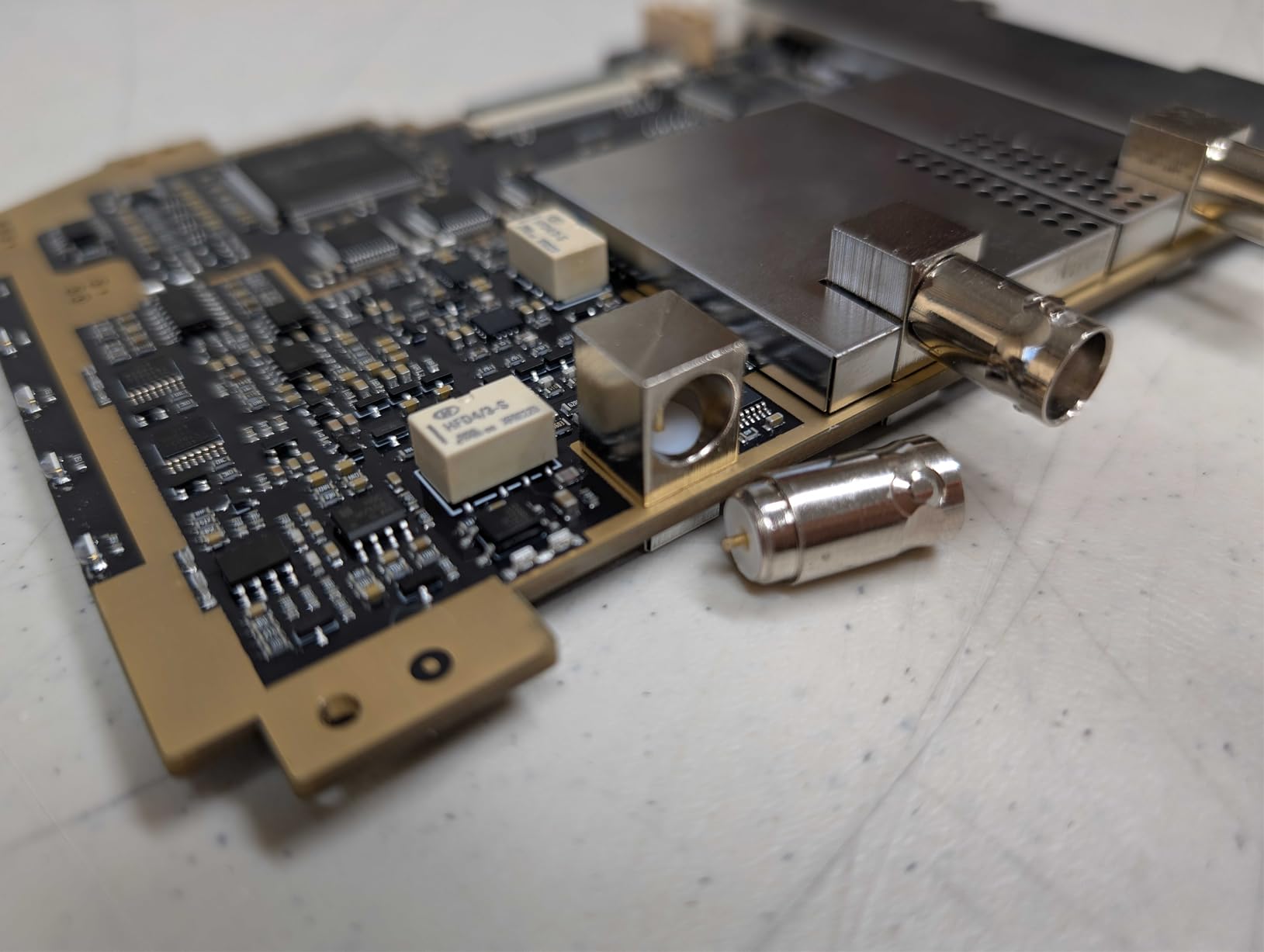
A 150 MHz and 20 MHz hardware bandwidth limiter is fitted, 2 mV per division sensitivity reaches small signals, and there are 12 automatic measurements.
That said, the specification does not equal the experience. At 4.1 across 131 reviews, this is the lowest-rated unit here, with a 14 percent one-star share, so a meaningful group of owners report problems the aggregate data does not detail.
Why 47 Kpts is the number to care about
Record depth is what determines whether the bandwidth figure is usable. At 47 Kpts with 1 GSa/s you capture roughly 47 microseconds, so a 350 MHz scope will show you a very fast edge for a very short window and nothing else. For glitch hunting on repetitive signals with the 50,000 wfms/s refresh that is fine. For a long burst or a settling transient, you will run out of record before the event finishes.
Where the gaps are
Two channels only, and no external trigger input is listed, so synchronising to a different system is awkward. The advertised 8 to 16 bit resolution varies with sample rate, which means true high-resolution capture only happens in the slower modes. The 14 percent one-star share is the number to weigh before buying, because it is far higher than the other nine products here.
9. Hantek DSO5102P – Best for Storing Waveform Records
Hantek DSO5102P USB Storage Oscilloscope Oszilloskope 2 Channels 100MHz 1GSa/s
2 channels
100 MHz
1 GSa/s
7-inch color TFT at 800x480
1000+ stored records
USB storage
Pros
- Two channels at 100 MHz bandwidth and 1 GSa/s sampling
- Large 7-inch 64K color TFT LCD at 800x480
- Stores more than 1000 waveform records internally
- Plug-and-play USB storage plus USB firmware upgrade
- Also measures voltage
- current
- resistance
- diode and continuity
Cons
- No serial protocol trigger or decode listed
- Oldest design in this group
- first available in 2017
- Listed dimensions do not match the stated display
- Memory depth and capture rate are not stated
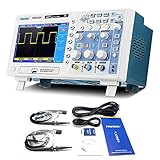
The DSO5102P is the odd one out in this list in a useful way. It is the only unit here whose standout feature is storage rather than raw acquisition: it keeps more than 1000 waveform records internally, and it treats a USB stick as a plug-and-play storage device rather than only a PC connection. At 4.58 pounds with two channels, 100 MHz bandwidth and 1 GSa/s sampling, the instrument itself is ordinary. The archiving is the differentiator.
That matters for anyone doing comparative work. If you are tuning a power supply and want to compare the before and after waveform on a hundred different load changes, or you are characterising a battery pack across a discharge curve, being able to page through stored captures turns hours of work into minutes. The large 7-inch 64K color TFT at 800×480 makes stored records far easier to read than they would be on a 3.5-inch handheld screen.
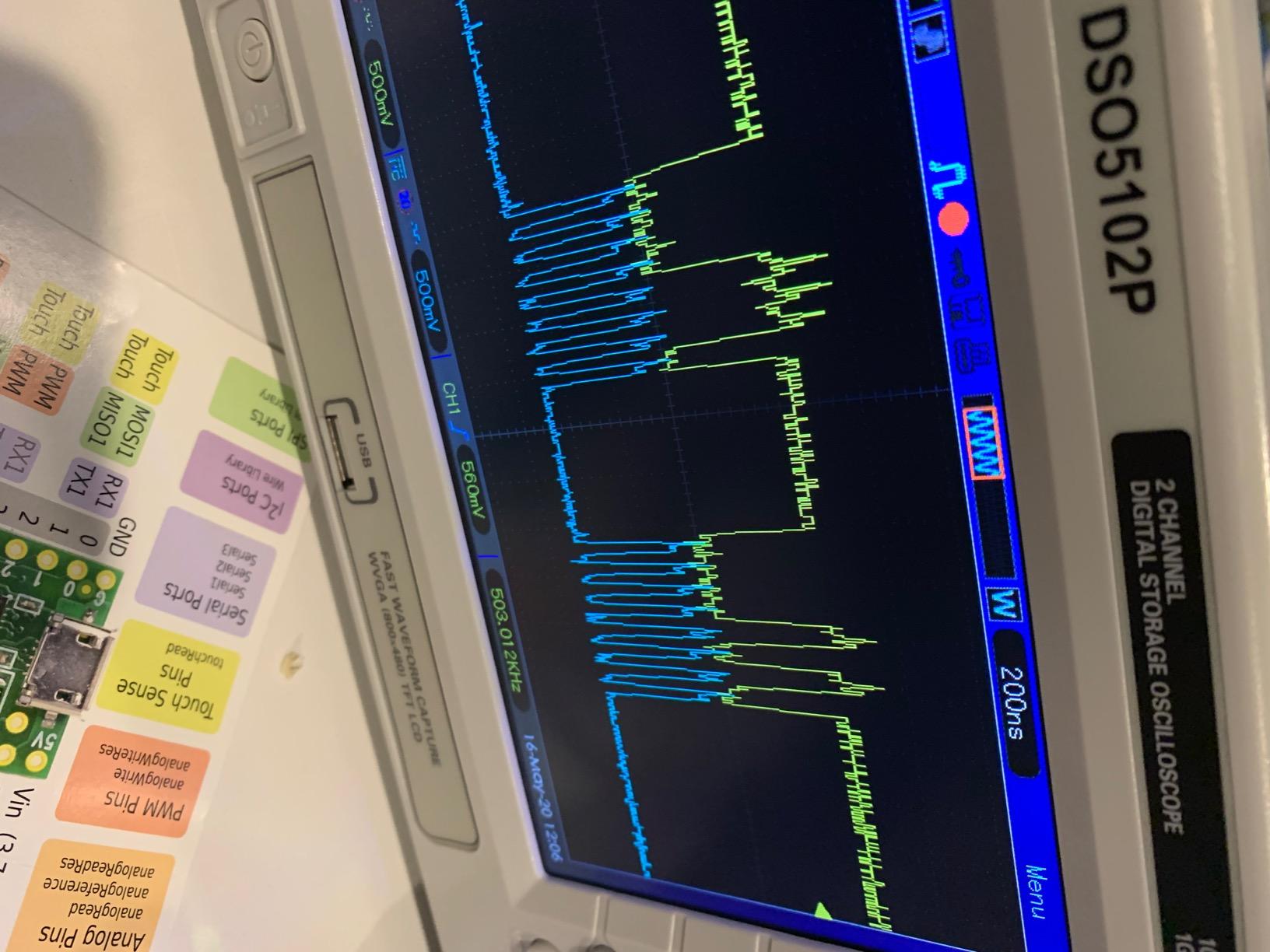
Connectivity is the other strength. USB handles PC communication, remote control, firmware upgrades and storage in one port, and there is an RS232C serial port for older setups or long cables away from a PC. The meter functions cover AC and DC voltage and current, resistance, diode and a continuity buzzer, plus data hold and relative measurement modes.
Firmware upgrade over USB is worth noting given the age of the design, because it means the unit is not frozen at its launch-day behaviour. Support is available through the seller rather than a manufacturer network, which is the main thing to weigh against the newer models.
When archiving beats acquisition
Internal record storage wins in comparative and repetitive tasks: regulator and power supply tuning, battery and supercapacitor characterisation, motor and relay timing across many conditions, and teaching. A scope that captures fewer waveforms per second but lets you keep and compare 1000 of them will answer those questions faster than one that captures more and forgets everything.
What the specification gaps mean
No serial protocol trigger or decode is listed in the feature set, so digital bus debugging is out of scope here. The listed dimensions of 1.23 by 0.56 by 0.43 inches cannot describe a unit with a 7-inch display, so the dimension data is simply wrong and you should ignore it. Memory depth and capture rate are not stated at all, and with a 2017 design date this is the oldest architecture in the roundup.
10. FNIRSI 2C53T – Best Selling Pocket Three-in-One
FNIRSI 2C53T 3-in-1 50MHz 2CH Oscilloscope Multimeter DDS Signal Generator
2 channels
50 MHz
250 MSa/s
1 Kpts
19,999-count meter
3000 mAh battery
Pros
- Most-reviewed unit here at 883 reviews and a best seller in its category
- Three functions in a 400 g handheld at 6.57 by 3.5 by 1.38 inches
- Generous meter ranges including 750 V AC
- 999.9 V DC and 9.999 A current
- FPGA plus MCU plus ADC architecture with high-voltage protection
- Reference waveform overlay and one-click screen save
Cons
- 1 Kpts record depth is very short for capturing transients
- 2.8 inch LCD restricts visible waveform detail
- Signal generator tops out at 50 kHz
- Up to 6 hours standby is short for all-day field work
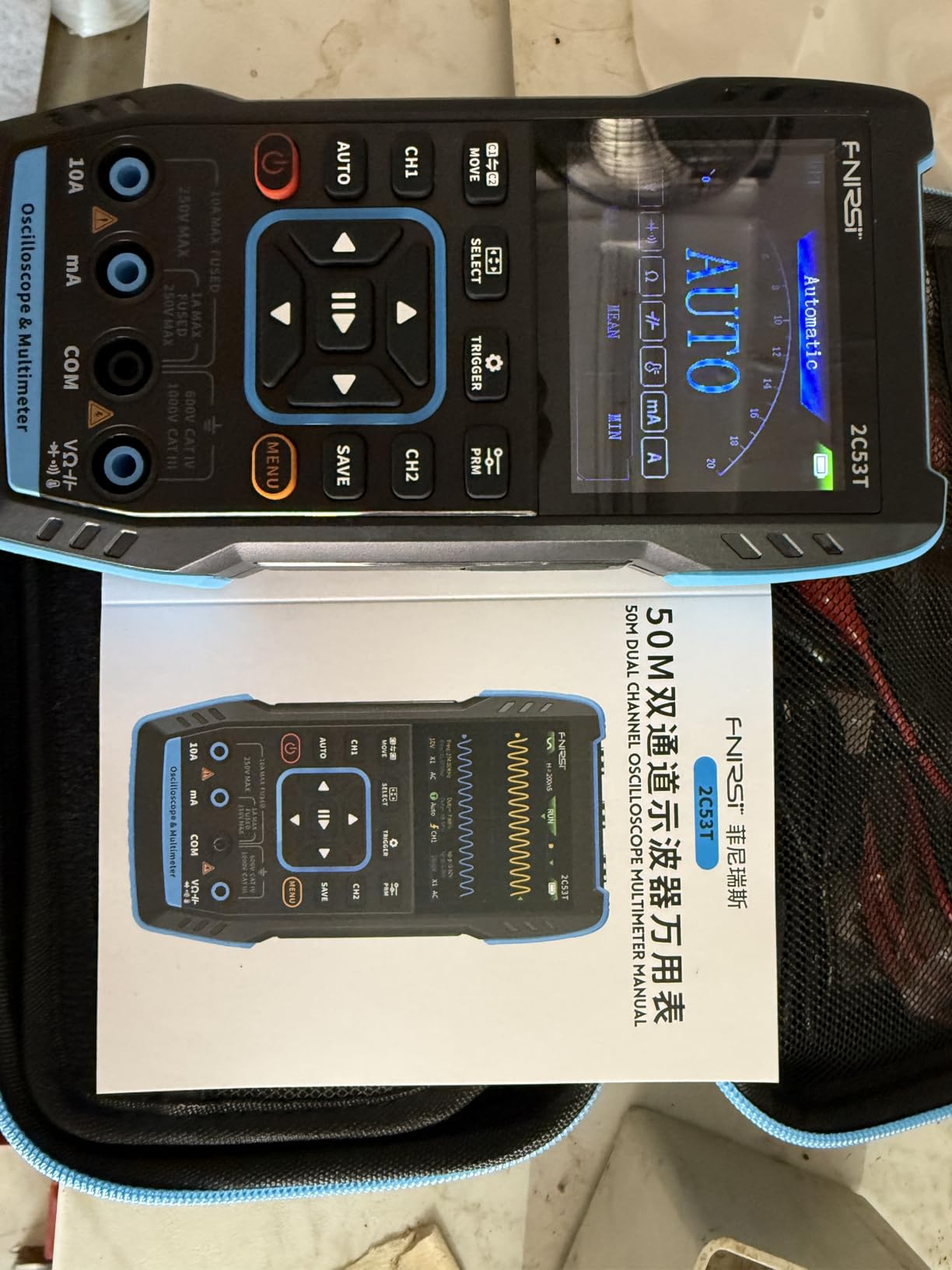
The 2C53T is the most popular unit in this roundup by a wide margin, with 883 reviews and the top seller rank in its category. It is a two-channel 50 MHz scope at 250 MSa/s, a 4.5 digit 19,999 count multimeter covering AC 0 to 750 V, DC 0 to 999.9 V, current 0 to 9.999 A, resistance to 19.99 MOhm, capacitance to 99.99 mF and continuity, plus a DDS signal generator with 13 waveforms up to 50 kHz, all in 400 g.
The meter is the strongest part of the package. Those ranges go well beyond most oscilloscope-integrated meters, and the FPGA plus MCU plus ADC architecture with a built-in high-voltage protection module is a sensible design for a handheld that will get connected to mains-adjacent circuits. Buyers single out the accurate 19,999 count readings, the high-voltage protection and the reference waveform comparison as the reasons it has stayed popular.
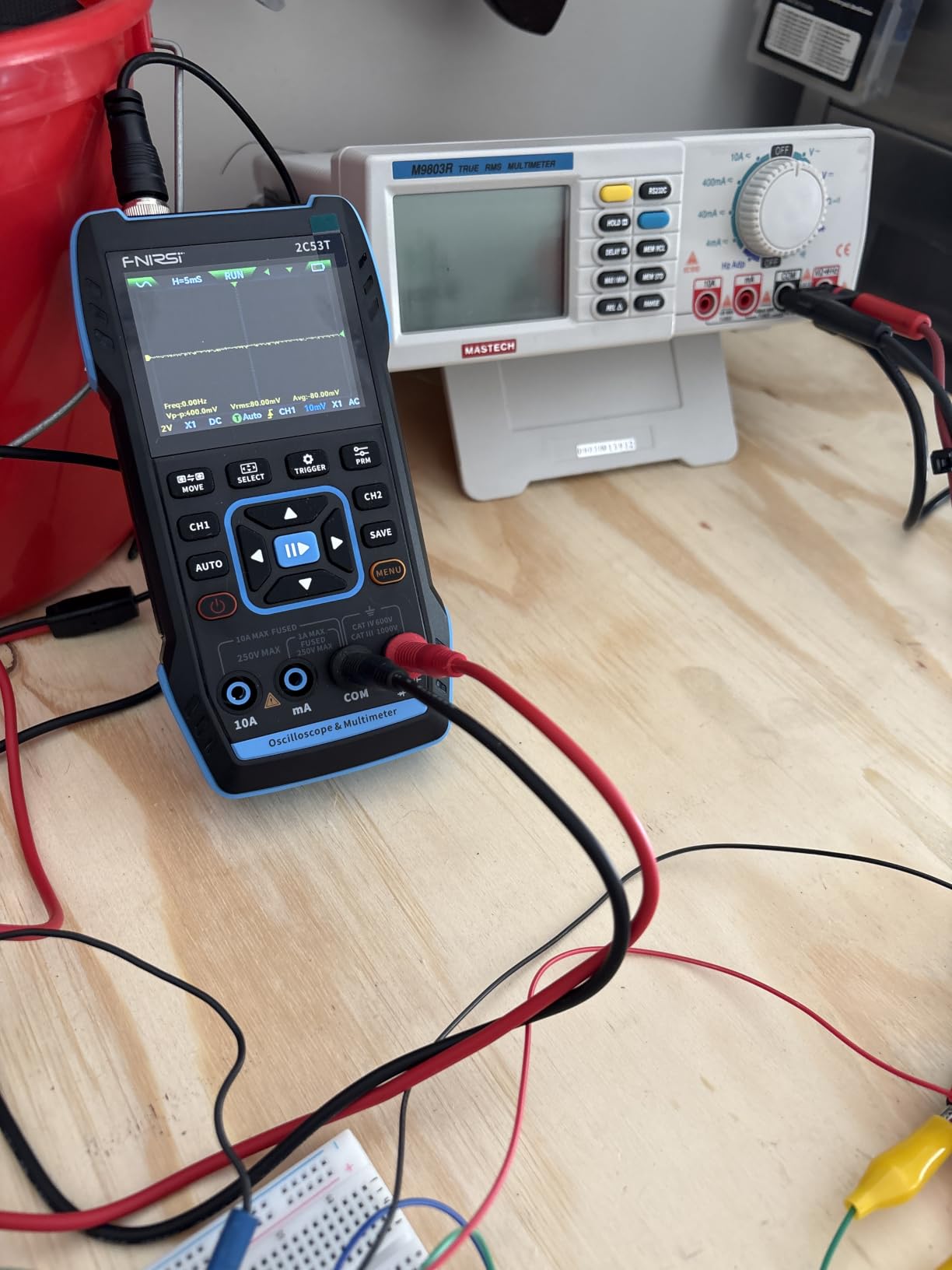
It was upgraded over the earlier 2C23T to add math, cursor, persistence and XY modes, and it includes a one-click screen capture plus PC upload over Type-C, so you can post a waveform into a forum thread and get help. Vertical sensitivity runs 10 mV per division to 10 V per division with a 400 V maximum input, and the box includes a 10x probe, crocodile clip probe, multimeter probe, Type-C cable and a storage case.
The 4.3 average is honest and worth understanding. A 2.8 inch LCD is small enough to be genuinely awkward with a real waveform on it, and the 50 kHz generator ceiling is low for driving circuits.
Why 1 Kpts is the deciding number
A 1 Kpts record length is the shortest in this roundup, and it is the reason a 50 MHz headline means less than it sounds. You get a usable window on a repeating signal, but any transient, burst or non-repeating event can be gone before the display refreshes. It is fine for a quick look at a PWM train and inadequate for the glitch hunting most people buy a scope to do.
Who should buy it and who should not
Buy it if you want one small box for a toolkit, you mostly need the meter, and the scope is the secondary function. The 3000 mAh battery gives up to six hours of standby, and the included storage case makes it easy to keep in a bag. Skip it if waveform detail matters more than portability, because the 2.8 inch screen and 1 Kpts memory will frustrate you, and the rating distribution includes an 8 percent one-star share.
How to Choose a Digital Oscilloscope: 8 Specs That Matter
Spec sheets bury the useful information under marketing. These eight criteria, in order of how much they should influence your decision, are what actually separate a scope you will keep using from one that sits in a cupboard.
Bandwidth: is 100 MHz enough?
Yes, for the overwhelming majority of hobbyist work. One hundred megahertz covers Arduino and Raspberry Pi logic at 3.3 V and 5 V, audio to 20 kHz with room to spare, PWM and motor control, and switching power supply ripple measurement where the edge detail is still meaningful. It is marginal for RF, where you will want 200 MHz or more, and for fast digital rails where the edge times are measured in nanoseconds. Many makers buying their first scope ask whether 100 MHz is enough, and the answer for a bench at home is almost always yes.
Sample rate and the five-times rule
Sample rate is how many readings per second the instrument takes, and the practical guidance is to have at least four to five times the bandwidth you need. That gives enough points per cycle to reconstruct a waveform instead of aliasing it. A 100 MHz scope at 1 GSa/s gives you ten points per cycle at the bandwidth limit, which is comfortable. A 50 MHz scope at 250 MSa/s gives five, which is workable but visibly coarse on fast edges. Fewer than two points per cycle and the display is inventing a signal that is not there.
Channels: two or four?
Two channels covers most projects, and it covers them most of the time. Four channels matters when you need simultaneous visibility, such as watching a PWM output, a current sense signal and two rails at the same time during a bring-up. A frequently asked question on r/ElectricalEngineering is whether a budget four-channel scope is worth it for a home lab, and the consensus answer is that four channels are a requirement rather than a luxury once you own other gear. If you are only adding to an existing bench and mainly debug one rail at a time, two channels with deep memory beats four channels with shallow memory.
Memory depth and why it beats sample rate
Record length is how many samples the scope stores before the display is decimated. It is the most underrated specification in the category, and the reason the Rigol DS1054Z at 24 Mpts feels so much more capable than a 1 Mpts competitor of similar price. Deep memory lets you zoom into a burst without losing detail, and it lets you keep a high sample rate while stretching the timebase. A scope that advertises 1 GSa/s but stores 1 Mpts shows you 1 millisecond of full-rate detail, and everything beyond that is interpolated.
Trigger stability beats feature count
The trigger is the circuit that tells the scope when to start drawing, and it is what makes a display sit still instead of scrolling. An unstable trigger on an intermittent or noisy signal is more frustrating than a missing FFT, because you cannot trust what you are looking at. This is the single most common complaint about the cheapest no-name scopes in this category, alongside the absence of any calibration. A waveform capture rate with intensity grading, where the DS1054Z and DS1202Z-E reach 30,000 waveforms per second, helps because rare events build up visible density rather than being missed between refreshes.
The probe attenuation trap (x1 vs x10)
Nearly every probe ships with a switch on the probe body that sets attenuation to 1x or 10x. Leave it at the wrong setting and every reading on the screen is wrong by a factor of ten, silently, with no error message. The scope cannot detect the mistake. Set the probe to 10x, then set the channel attenuation in the scope menu to 10x as well, and they must agree. This is the most common beginner confusion in the category, and it costs people hours of debugging circuits that were working fine.
Ground loops and phantom noise
If your trace shows 50 or 60 Hz hum that was not there on the multimeter, the scope is usually not broken. The ground clip on the probe creates a second path to earth through your bench, your building wiring and your power supply, and that loop picks up mains interference. Try floating the ground clip through a short jumper, or use a short ground spring instead of the long alligator lead. Checking a circuit while it is connected to mains-powered equipment is also a genuine safety consideration, not a diagnostic trick.
Brands, warranty and grey-market risk
Rigel and Siglent are the two names the entire hobbyist market orbits around, and a five-year-old EEVblog thread still names the DS1054Z and SDS1202X-E as the durable picks, with the Arduino forum making the same point. Hantek, ZOYI, FNIRSI and HANMATEK cover the handheld and budget tiers, and each has a real user community. Two practical cautions: the same SKU from an authorised reseller versus a direct import can differ by 30 to 46 percent, and warranty service on a grey-market import is often handled differently. Buy from a seller who will stand behind the unit in your own country, and be sceptical of listings that are dramatically cheaper than the rest of the market.
Benchtop vs Handheld: Which Shape Fits Your Work
Benchtop scopes win on screen size, memory, physical controls and serial decode. A 7-inch display shows a waveform with enough detail to actually read shape and noise, dedicated knobs let you adjust volts per division without a menu, and deep memory keeps long captures intact. They need a mains outlet and a shelf.
Handhelds win on everything about getting the instrument to the fault. They run on a battery, weigh between 380 g and 1.3 kg in this roundup, and typically combine a true-RMS multimeter with the scope. The cost is screen size, record length and control speed: menu-driven interfaces make every adjustment slower, and screens between 2.8 and 3.5 inches show you a shape rather than a measurement.
Our rule is straightforward. If your projects live on one bench, buy benchtop. If you diagnose equipment in a car, a loft, a customer’s kitchen or an appliance in situ, buy handheld. The battery honesty is worth stating plainly, because marketing implies all day: real-world use on the handhelds here lands closer to a working shift than a full day, and screen readability in daylight is a genuine trade-off rather than a solved problem.
Should You Buy a Used Oscilloscope?
Yes, with a checklist. A used scope is the only route to a 100 MHz four-channel unit with a proper display at a fraction of current cost, and hobbyists discuss used Tektronix and HP digitizing scopes as high-value finds when a specific application calls for them. It is also the fastest way to end up with a paperweight.
Before you buy, check all four channels respond to the same probe calibration square wave at the same amplitude. A dead or degraded channel is the most common failure and is often not visible from the outside. Ask whether the unit has been calibrated recently, and whether the seller can show a certificate; a scope that has drifted out of calibration will confidently report wrong numbers, which is worse than no scope at all.
Then verify trigger stability. Feed it a repetitive signal from a function generator and check the display holds still over several minutes. Intermittent triggering is a frequent fault in older analog scopes and is a strong signal to walk away. Confirm the screen has no burn-in or dead pixels, that every button and encoder responds, and that the power supply runs cool and quiet under load.
Last, factor support. Older Tektronix and HP units need a service manual and a nontrivial component to repair, and parts for a discontinued line can be hard to source. Check that the model has an active user community with a repair archive, and buy a surge-protected supply arrangement if the unit has not been recapped. If the seller’s answers to these questions are vague, that is your answer.
Frequently Asked Questions
What is a good oscilloscope for a hobbyist?
A good oscilloscope for a hobbyist needs 100 MHz of bandwidth, at least 1 GSa/s of sampling, two channels, and 8 Mpts or more of record memory. That specification covers Arduino and Raspberry Pi debugging, audio work, PWM and motor control, and switching power supply ripple. Add serial protocol decoding if you will work with I2C, SPI or UART, and four channels if you need simultaneous visibility across several rails.
Is a 100 MHz oscilloscope enough?
Yes for most hobbyist work. One hundred megahertz handles 3.3 V and 5 V microcontroller signals, audio to 20 kHz, PWM, motor control and switching supply ripple. It is marginal for RF, where 200 MHz or more is better, and it limits the rise time and slew rate you can measure on genuinely fast edges. If your signals are slow, 50 MHz is a perfectly good stopping point.
What are the key differences between Rigol and Siglent oscilloscopes?
Rigol generally leads on memory depth, capture rate and value, and its option keys are usually unlocked. Siglent generally leads on display quality, on-screen help and ease of navigation, and its four-channel units reach higher sample rates per channel. A Rigol DS1054Z gives 50 MHz and 24 Mpts, while a Siglent SDS1104X-E gives 100 MHz and 7 Mpts. Both ship I2C, SPI and UART decoding in base firmware.
Do I need a separate function generator?
Only if your scope does not have one built in. Community reviewers consistently treat the built-in arbitrary waveform generator as the single feature that removes the need to buy a second instrument, because a scope with a generator can power a circuit and measure the response in one place. The Hantek DSO2D15 includes an internal square wave output for probe calibration, while the FNIRSI DPOS350P includes a full DDS generator up to 50 MHz.
Is a used oscilloscope worth buying?
Yes, if you check it properly. Before buying, confirm all four channels show the same amplitude on a probe calibration signal, ask for a recent calibration certificate, verify trigger stability on a repetitive waveform, and inspect the screen and controls. Intermittent triggering and dead channels are the most common faults. Older models also need a service manual and may have tired power supply capacitors, so check a repair community exists for that exact model.
The Best Digital Oscilloscopes for Hobbyists in 2026
The Siglent SDS1104X-E is the best digital oscilloscope for hobbyists in 2026. It pairs 100 MHz of bandwidth with four channels, 7 Mpts per channel and 1 GSa/s sampling, and it ships with every serial decoder unlocked and a web server for remote viewing. At 4.8 across 966 reviews, it has both the highest rating and the deepest owner base in this roundup.
If your budget points elsewhere, the Rigol DS1054Z is the value pick and the benchmark the rest of the market is judged against, with 24 Mpts of memory that nothing else at that level matches. For 200 MHz work, the Rigol DS1202Z-E goes further than anything else here. If you need one box that fits in a bag and also reads volts, the HANMATEK HO52 is the strongest compromise, and the ZOYI ZT-703S does the same job for less again.
Whichever you choose, check the probe attenuation switch matches the channel setting before you trust a single reading, and keep the ground clip short. Those two habits prevent more wasted bench time than any specification on this list.