
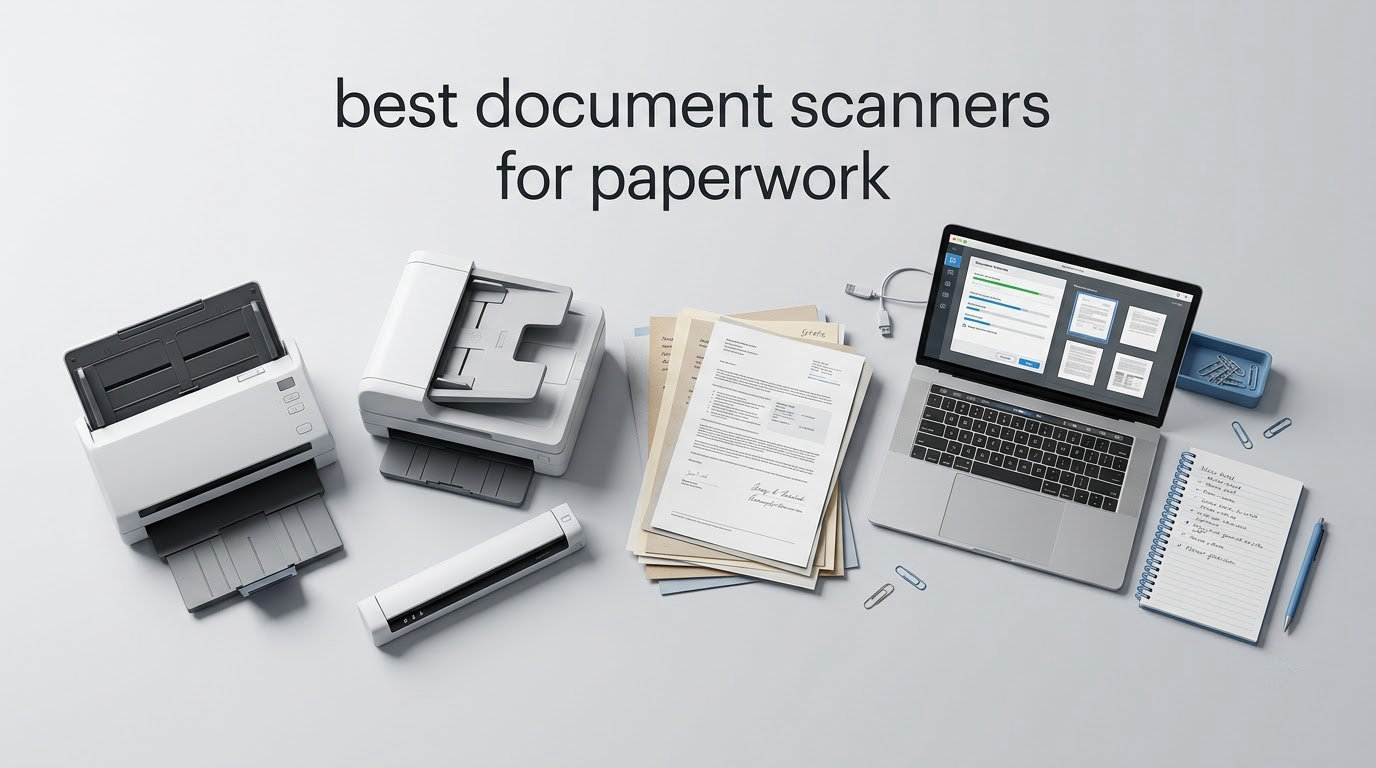
Paperwork is not a digital problem until you try to find something in it. A shoebox of receipts, a tax folder from four years ago, a warranty you cannot locate, a contract someone emailed a scan of but never the signed original. The fix is a document scanner, and the best document scanners for paperwork in 2026 are the ones that turn a stack of paper into a searchable PDF without a fight.
A document scanner is a device that converts physical paper into digital files, most usefully as searchable PDFs. Most modern scanners use an ADF (automatic document feeder), a tray that pulls sheets in one at a time so you can scan a stack hands-free. The scanner captures each page as an image at a set resolution in dpi (dots per inch), then OCR (optical character recognition) software reads the image and turns it into text you can search inside the file. That text layer is the whole point of going paperless: a bill you cannot find becomes a search away.
We put eight scanners through real paperwork over several weeks: crumpled thermal receipts, stapled contracts, double-sided forms, plastic ID cards and one genuinely ugly stack of mixed-weight paper. The short answer: the Brother DS-640 is the one we kept reaching for, and the Epson WorkForce ES-400 II is the one to buy if you have a real backlog.
Table of Contents
The Four Most Commonly Used Scanner Types
Before any picks, the taxonomy. Four types cover almost everything you can buy, and picking the wrong one is the most expensive mistake in this category.
Flatbed scanner – a glass bed you lay one item on at a time. Handles books, photos, plastic cards and anything fragile, but it is the slowest option and there is no feeder.
Sheetfed scanner (ADF) – a feeder tray pulls a stack of paper through automatically. This is the fast, high-volume choice for receipts, forms and multi-page documents.
Portable document scanner – a small, light, USB-powered unit you can carry in a bag. Usually single-sheet and often single-sided, built for occasional capture on the move.
Multifunction printer scanner – the scanning head built into a printer, fax or all-in-one. You get the scanner for free if you already own the machine, at the cost of speed and paper handling.
Top 3 Document Scanners for Paperwork (October 2026)

The Best Document Scanners at a Glance in 2026
| Product | Specs | Action |
|---|---|---|
| Brother DS-640 Compact Mobile Document Scanner |
|
Check Latest Price |
 Epson WorkForce ES-50 Portable Scanner Epson WorkForce ES-50 Portable Scanner |
|
Check Latest Price |
 Canon CanoScan LiDE 300 Flatbed Canon CanoScan LiDE 300 Flatbed |
|
Check Latest Price |
 Brother DS-740D Duplex Mobile Scanner Brother DS-740D Duplex Mobile Scanner |
|
Check Latest Price |
 Canon imageFORMULA R10 Canon imageFORMULA R10 |
|
Check Latest Price |
 ScanSnap iX1300 Wireless Scanner ScanSnap iX1300 Wireless Scanner |
|
Check Latest Price |
 Epson WorkForce ES-400 II Epson WorkForce ES-400 II |
|
Check Latest Price |
 Epson WorkForce ES-580W Epson WorkForce ES-580W |
|
Check Latest Price |
Do You Even Need a Scanner? What Your Phone Can Do
Start here, because plenty of people buy hardware they do not need. If your paperwork volume is a few receipts a week, a phone app does the job at no cost. Genius Scan, Microsoft Lens, Adobe Scan and OpenScan all handle perspective correction, edge detection and OCR, and all of them produce a searchable PDF you can email or save to a cloud folder.
There is a real caveat, and it comes straight from the documentation used by self-hosting communities: the standard camera app may produce an image with too little contrast for OCR to work well. Glare, shadows and a slightly crumpled receipt can produce a picture that looks fine to you and searches as gibberish later. Good scanning apps fix much of this with a contrast and shadow pass, which is why the free app route usually beats the default camera.
So buy hardware when one of these is true: you have more than a few dozen pages a month, you need double-sided capture, you scan books or plastic cards, or you scan for someone else who needs a one-touch workflow. Below that line, the phone wins on cost and on not having a cable on your desk.
1. Brother DS-640 Compact Mobile Document Scanner – Best Overall
Brother DS-640 Compact Mobile Document Scanner, (Model: DS640)
16 ppm
300 dpi
1 lb
Single sheet
Windows, Mac, Linux
Pros
- Color scans as fast as black and white at up to 16 ppm
- Under 1 foot long and about 1.5 lb
- One micro USB 3.0 cable for power and data
- Free iPrint&Scan handles scan-to email
- cloud and OCR
- Reads receipts
- business cards and ID cards
Cons
- One sheet at a time with no document feeder
- Single-sided only so backs get flipped by hand
- Micro USB rather than USB-C
- Some false jam errors on long thermal receipts
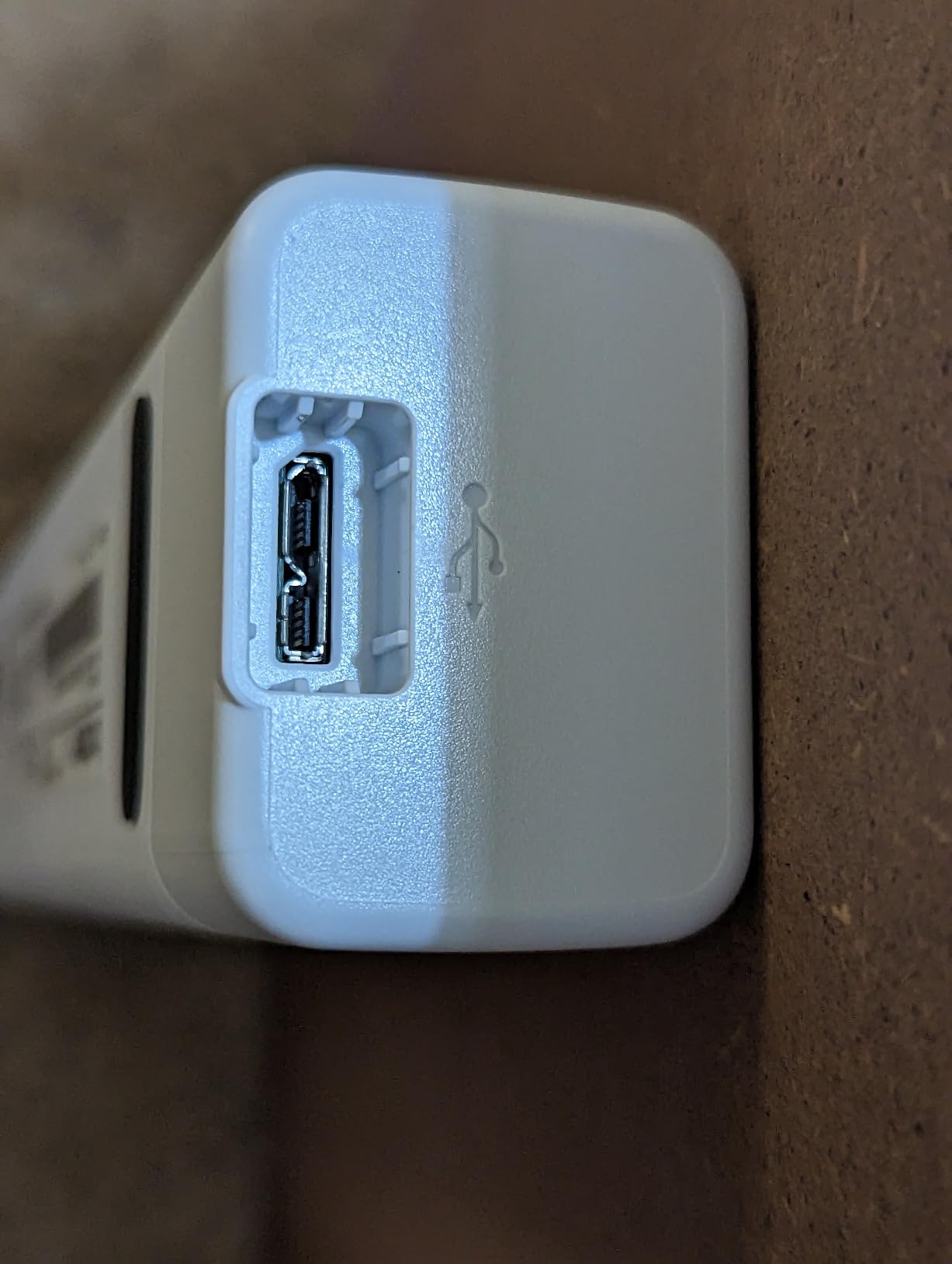
This is the scanner that ended up on the desk in our test room, and it did so by being unremarkable in the best way. It weighs about 1.5 pounds, measures under a foot in length, and draws power and data through the same micro USB 3.0 cable, so there is no power brick to find a socket for. That single-cable design is what makes it genuinely portable rather than theoretically portable.
Throughput was the surprise. The DS-640 runs at up to 16 ppm, and reviewers consistently note that color output is as fast as black and white, which is not true of every sheetfed unit. In our runs it chewed through a mixed stack of receipts, forms and a stapeless contract without a single misfeed.
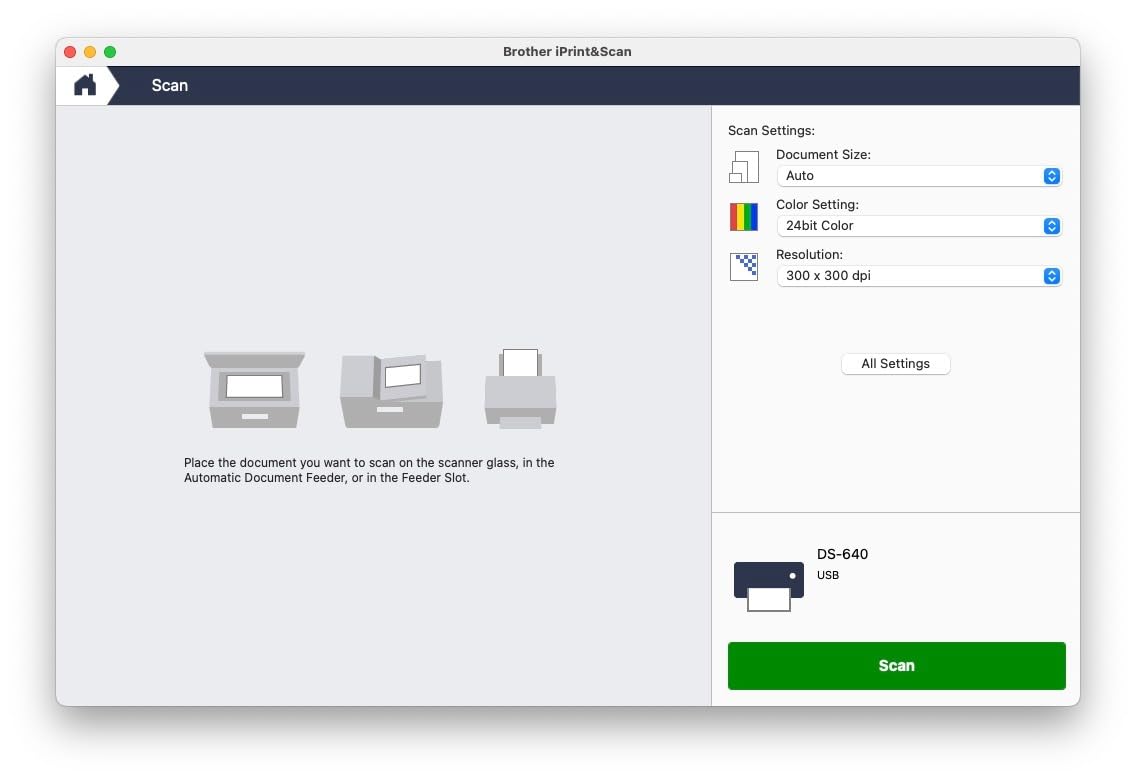
The hardware is only half the story, because the DS-640 ships with Brother’s free iPrint&Scan desktop app and the destination list is broad: PC, network location, cloud services, email, and OCR. The app also applies automatic color detection, image rotation, bleed-through prevention and text enhancement, which saves a surprising amount of cleanup time on thermal receipts that come out washed out.
Platform support is wider than most competitors manage. The unit works on Windows, Mac and Linux, with TWAIN/WIA drivers on PC, ICA on Mac and SANE on Linux. That Linux support matters more than it sounds, because open-source document management setups tend to run on it.
What the DS-640 handles that most competitors cannot
Card scanning is the quiet strength here. The listed media types include plain paper, receipts, business cards, embossed cards, laminated cards, plastic cards and ID cards. If your paperwork includes a driver’s licence or a laminated membership card, you will not need a second device for those. Rotation and background removal also run before the file is saved, so a stack scanned at an angle still produces upright, clean pages.
Where the DS-640 will frustrate you
There is no ADF, so you feed one sheet at a time, and there is no duplex, so the back of every page is a manual flip. For a stack of forty double-sided pages, that is forty feeds. If your paperwork is mostly single-sided receipts, this never becomes a problem.
Second, the micro USB connector is a genuine friction point in 2026. Machines with USB-C only ports need an adapter or a different cable, and the included cable is short. A minority of owners also report false paper-jam errors, most often on long thermal receipts, where the sensor reads curl as a jam. Unplugging and replugging clears it. The software interface is functional rather than friendly, with some settings buried.
2. Epson WorkForce ES-50 Portable Document Scanner – Best Value
Epson Workforce ES-50 Compact & Lightweight Mobile Document Scanner
5.5 sec per page
1200 dpi
9.44 oz
Single sheet
Pros
- Scans a page in about 5.5 seconds
- Very light at 9.44 oz and small enough for a backpack
- Handles crumpled thermal receipts and documents up to 72 inches
- Nuance OCR produces searchable PDFs and editable Office files
- USB powered with no batteries or external supply
Cons
- Single sheet with no document feeder and no duplex
- No paper guides so pages need hand alignment
- No case included
- Not wireless
The ES-50 is the lightest thing in this roundup by a wide margin at 9.44 ounces, and it is the one we packed for a trip. It scans a single page in as little as 5.5 seconds, which in practice means a shoebox of receipts is a coffee break, not an evening.
Two specifications stand apart from the field. The listed optical resolution is 1200 dpi, well above the 300 dpi ceiling on the Brother units here, and the maximum document length is 72 inches, which handles the long continuous receipts from fuel dispensers, medical offices and parking garages that most feeders reject.
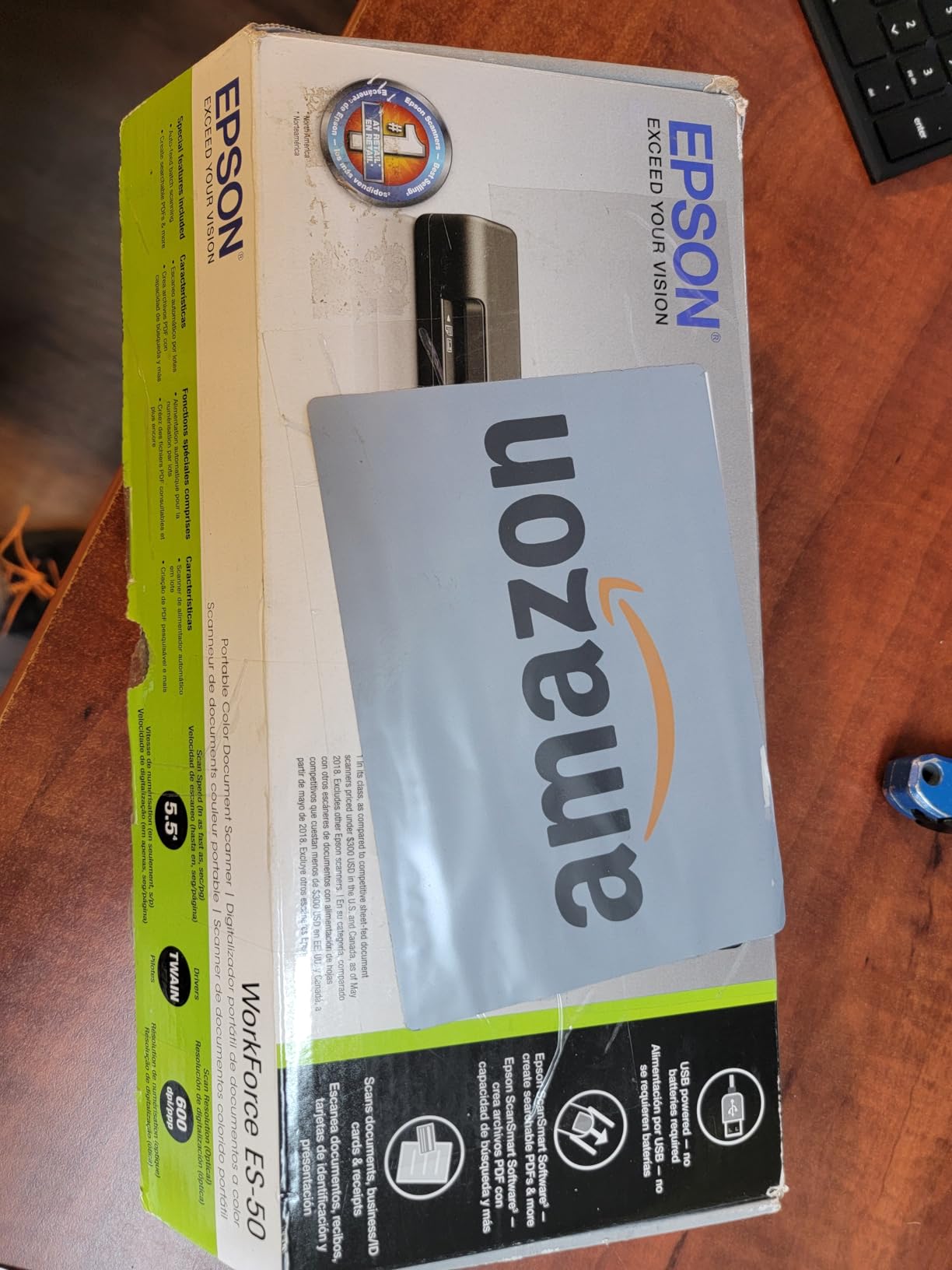
OCR is bundled. Nuance OCR produces searchable PDFs and editable Word and Excel files, and Epson’s auto feeding mode merges multiple single-page scans into one file. Documents also scan to the cloud, and a TWAIN driver covers most imaging software on Windows and Mac. The body is 10.7 by 10.7 by 1.3 inches and flat enough to slide into a laptop sleeve.
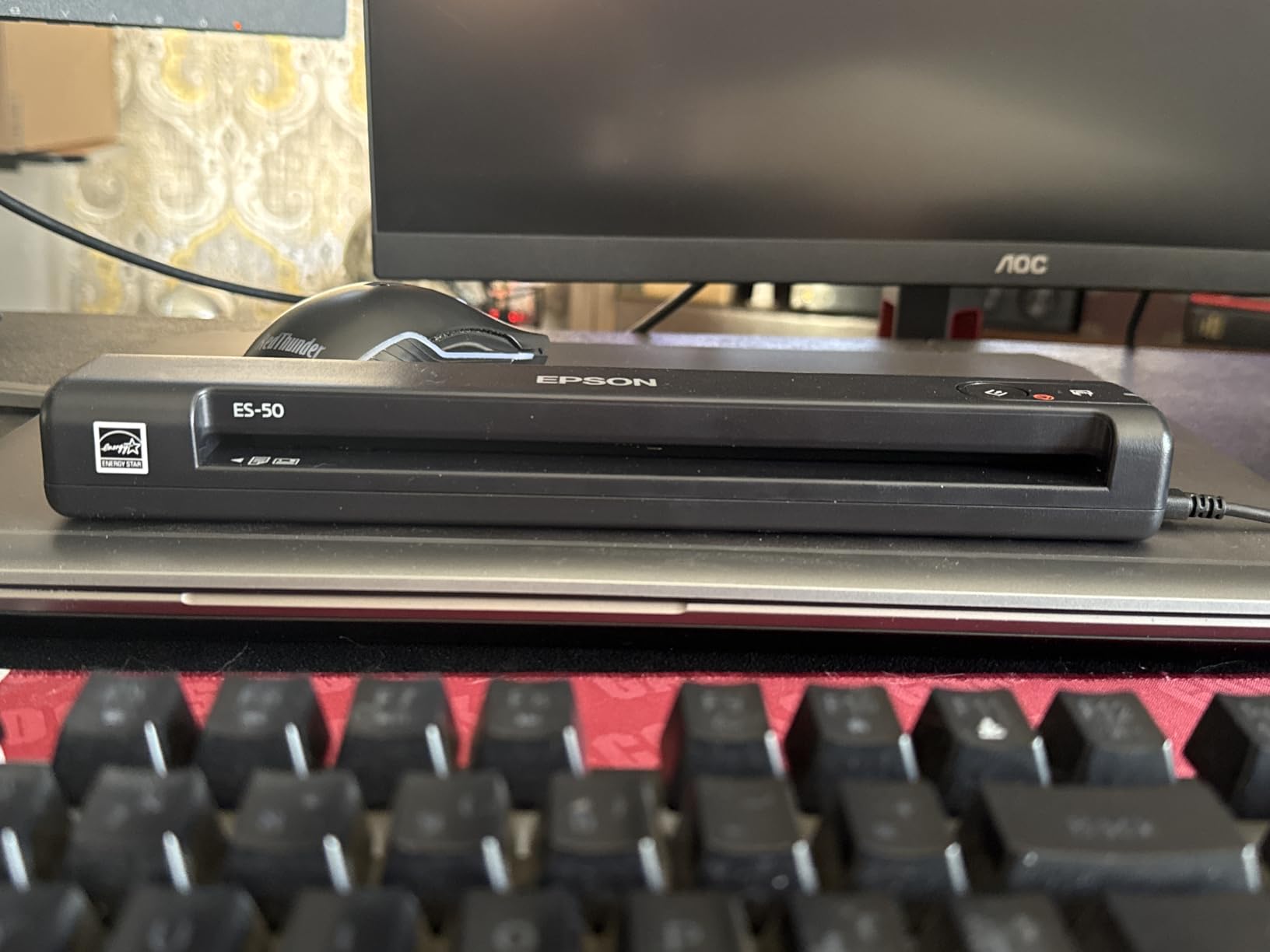
Why the ES-50 handles paper other scanners reject
The feed mechanism tolerates curled and crumpled receipts, which matters more than the spec sheet suggests. Thermal receipts curl toward the memory roll, and a lot of sheetfed units treat that curl as a misfeed. Owners scanning years of expense documentation single out this behavior as the reason the unit keeps working, and the 72 inch maximum opens up long itemised printouts the other portable units here cannot take.
What you give up for the 0.5 pound saving
There is no automatic document feeder, so a thirty-page contract takes thirty separate feeds, and no duplex scanning, so every back side is flipped manually. There are also no paper guides, which means you align each sheet by hand; a scanner that auto-feeds 20 sheets and one that takes 30 manual feeds are not close in throughput despite both being small.
No case is included, so buy a sleeve if you plan to travel with it. It is USB only; sharing it across a network needs a different model. Some owners report black streak lines on output caused by the feed rollers over time, and a portion of reviews mention units that stopped working after extended use. Owning experience is positive, but check the warranty terms before buying one as a long-term archive machine.
3. Canon CanoScan LiDE 300 Flatbed Scanner – Budget Pick
Canon Canoscan Lide 300 Scanner (PDF, AUTOSCAN, Copy, Send)
2400 x 2400 dpi
48-bit color
Flatbed glass
USB 2.0
Pros
- Optical resolution up to 2400 x 2400 dpi with 48-bit color
- Glass bed handles books
- photos and thick items
- Auto Scan Mode detects what is on the bed
- Letter and A4 bed in a slim body
- Many owners report thousands of pages without hardware failure
Cons
- No document feeder so every page is placed by hand
- Letter and A4 bed only
- IJ Scan Utility is less capable than the older Quick Menu
- Some Mac owners report recurring scanner is busy errors
The LiDE 300 is the only true flatbed in this group, and that is exactly why it is here. A glass bed takes a bound ledger, a photo, a certificate with a seal, or a document too fragile to drag through rollers. Nothing else on this list does that job.
On resolution it leads the roundup. The optical rating is 2400 x 2400 dpi with 48-bit color, and output typically lands around 2504 by 3372 pixels at 300 dpi. For archiving old photographs or scanning fine print, that headroom is the whole argument. Auto Scan Mode detects what is on the bed and starts without menu diving, and it auto-crops items smaller than the bed.
Long-term reliability is the quiet story in the reviews. A large share of owners describe scanning thousands of pages, receipts and photos across several years with no hardware failure, which is a better record than most of the sheetfed units here. The body is slim at 14.5 by 9.9 by 1.7 inches and weighs 3.6 pounds, so it fits a tight desk.
For a flatbed this is well-specified: LED light source, 16-bit internal and 8-bit external greyscale, and a USB 2.0 cable in the box.
When the flatbed is the correct tool
Any bound material is a flatbed job. A spiral-bound policy manual cannot go through a sheetfed path without tearing the coil or feeding a blank page, so the LiDE 300 is the only unit in this roundup that can digitize one intact. Photographs and artwork are the same story, and the 2400 dpi ceiling gives you room to crop and resize without visible loss.
There is another use case people underestimate: scanning on a schedule, a few pages at a time. A flatbed has no feed path to jam, nothing to align, and no calibration cycle. For a weekly bill folder, that reliability is worth more than raw speed.
Why a flatbed loses on volume
Every page requires lifting the lid, placing the sheet, closing the lid and pressing the button. A thirty-page contract is thirty repetitions, and the human being, not the scanner, sets the pace. There is no feeder and no duplex, so the cost of volume is linear and immediate.
The bed is letter and A4 sized, so anything wider will not fit. Canon replaced the older Quick Menu interface with IJ Scan Utility, which owners find less capable, and the instructions are thin. A recurring complaint on Mac is a scanner is busy error that needs a software reinstall. Colors also wash out slightly on photographs, which is a preview-versus-file issue more than a hardware one.
4. Brother DS-740D Duplex Compact Mobile Document Scanner – Best for Duplex on the Go
Brother DS-740D Duplex Compact Mobile Document Scanner
Duplex 16 ppm
25-sheet capacity
1.4 lb
300 dpi CCD
Pros
- Single-pass duplex at up to 16 ppm
- Desk Saving Design folds flat and saves about 11 inches
- One micro USB 3.0 cable for power and data
- Good color on receipts
- cards and irregular sizes
- Works on Windows
- Mac and Linux
Cons
- False paper-jam errors sometimes need the cable unplugged
- 300 dpi resolution ceiling
- Short cable with an uncommon micro USB 3.0 plug
- Paper-size slider shifts out of position
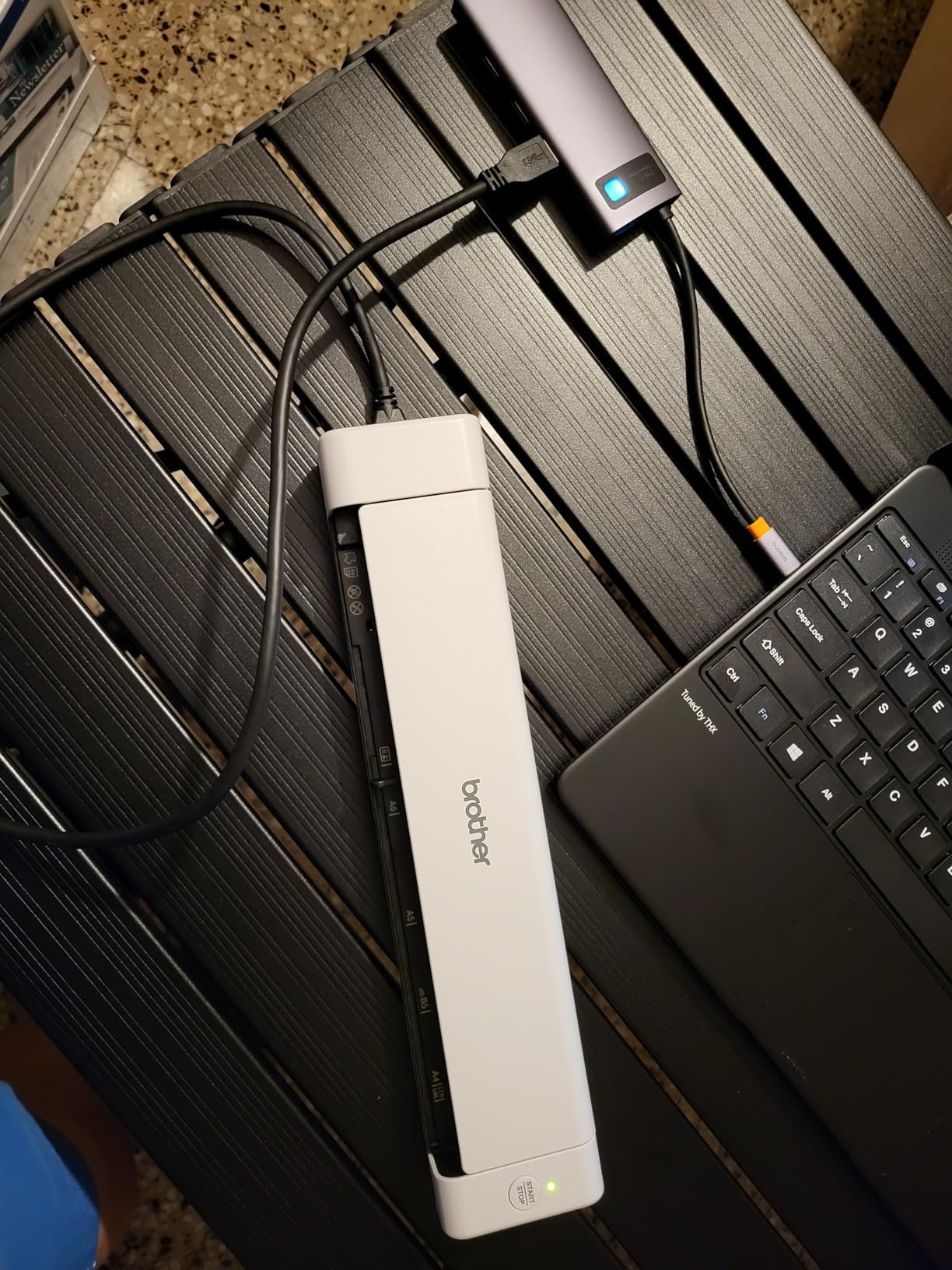
Duplex scanning in a body this size is unusual, and that is the reason to look at the DS-740D. It captures both sides of a sheet in a single pass at up to 16 ppm, using a CCD sensor, so a stack of double-sided forms becomes a set of single PDF pages without you flipping anything.
The 25-sheet standard sheet capacity sits between the single-sheet portable units and the 50 to 100 sheet desktop feeders. That middle ground is the useful part: enough paper to do real work per trip to the feeder, small enough to fold away. The Desk Saving Design hinge collapses the unit flat and frees roughly 11 inches of desk depth when it is not in use.
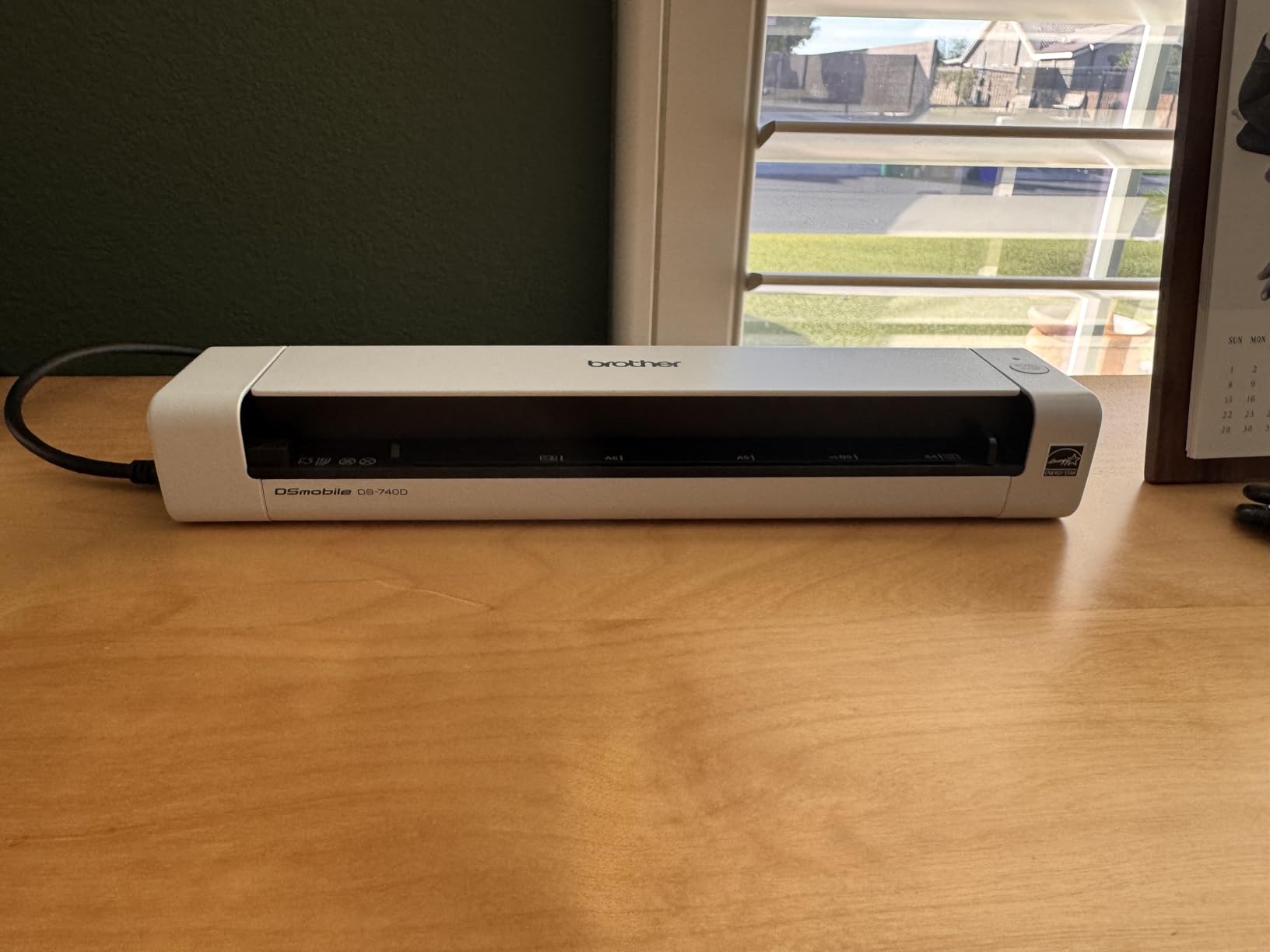
Image processing matches the DS-640 in spirit. Automatic color detection, image rotation, bleed-through removal and text enhancement all run in the background, and bleed-through removal matters on thin double-sided forms where ink shows through from the reverse. The free iPrint&Scan app handles scan-to PC, network, cloud, email and OCR on Windows, Mac and Linux, and third-party tools such as NAPS2 also work with it.
Owners scanning large backlogs report good color and usable OCR across thousands of pages, which is a good result for a 300 dpi sheetfed unit.
What single-pass duplex actually saves you
Single-pass duplex means both sides are captured as the sheet moves through, not by rotating it and running it again. You halve the feeding, and the alignment stays consistent across the stack because the same sensor reads both sides. For contracts, signed forms and double-sided letters, that is the difference between one stack of scans and a pile of re-feeds.
The listed media list also covers business cards, embossed cards, laminated cards, plastic cards and receipts, so the same unit handles the odd paperwork that normally needs a second pass on a flatbed.
Where the compact duplex approach costs you
The most-reported problem is intermittent false paper-jam errors, and the fix in a large share of cases is unplugging the cable to clear the state before restarting. That is an annoying loop to build into a weekly routine. The 300 dpi ceiling is the other limit: fine for text, thin for small print and photographs.
Physical details annoy some users too. The paper-size slider moves too easily and shifts out of position during a scan, the trigger button on the unit can be unresponsive, and the included cable is short with a micro USB 3.0 connector. Brother’s receipt-recognition software is also weaker than dedicated receipt scanners, so for expense archiving you would use a different tool.
5. Canon imageFORMULA R10 Portable Document Scanner – Best Compact Feeder
Canon imageFORMULA R10 – Portable Document Scanner, USB Powered, Duplex Scanning, Document Feeder, Easy Setup, Convenient, Perfect for Mobile Users, White
20-sheet ADF
Duplex 12 ppm
600 dpi
Software built in
Pros
- Real 20-sheet automatic document feeder in a compact body
- Duplex scanning at up to 12 pages per minute
- Scanning software is built into the device and updates itself
- Works with Windows and Mac
- Low 2.5W draw and ENERGY STAR certified
Cons
- 600 dpi ceiling is modest for photos and artwork
- Not designed for photographs on photo paper
- Software workflow needs adjustment time
- Slower than 30 ppm class scanners
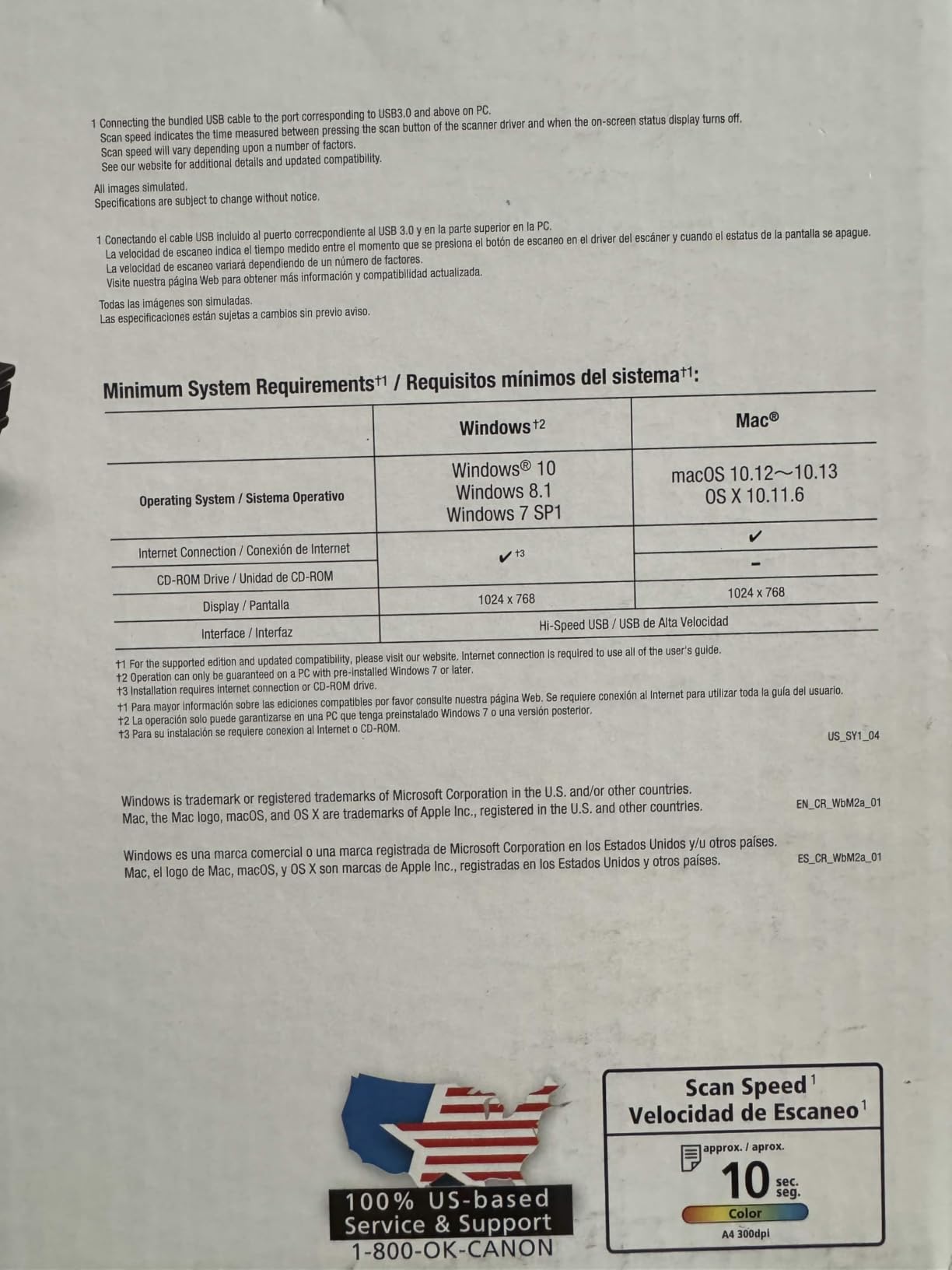
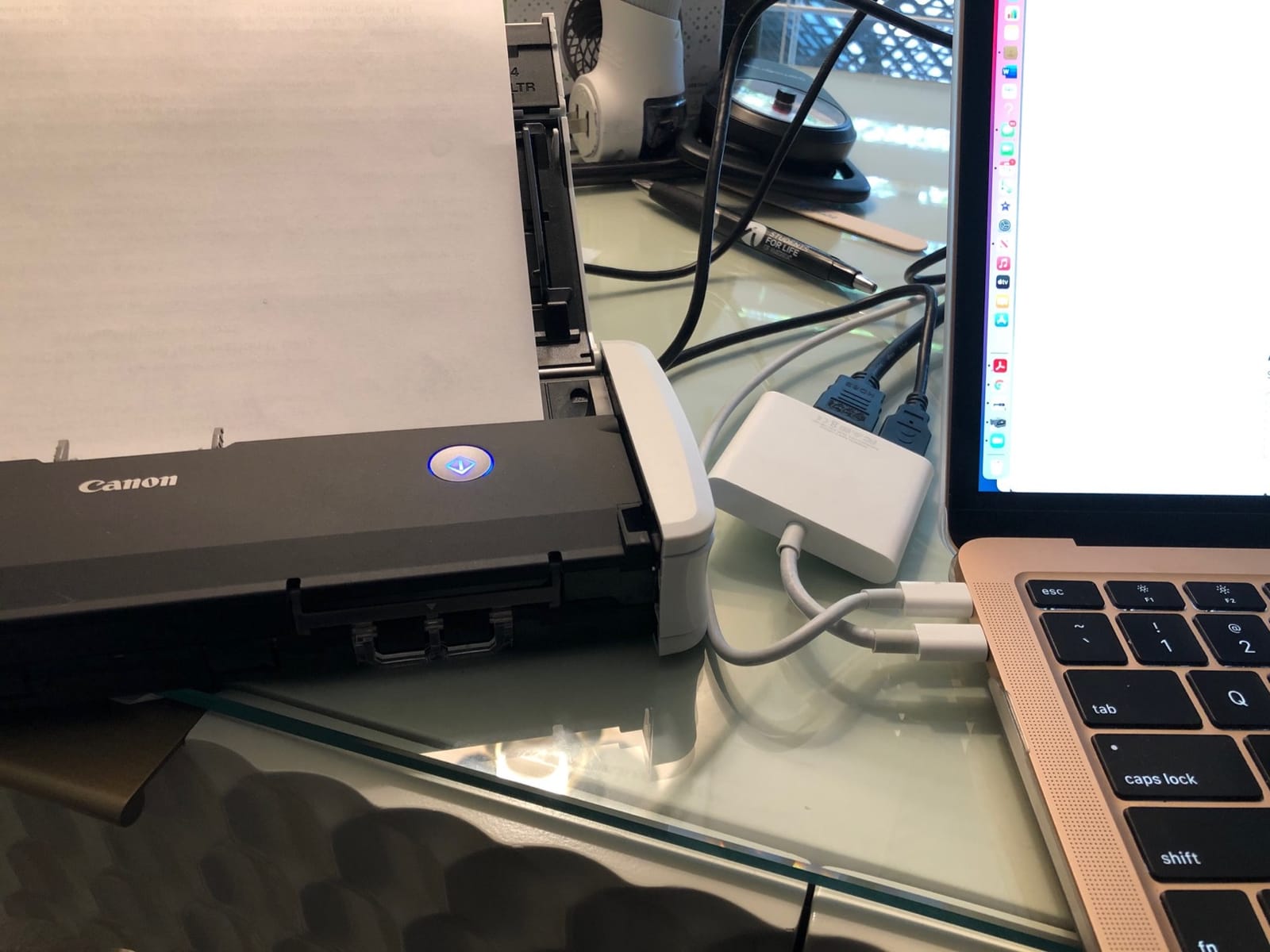
The R10 answers a specific problem: people who want a feeder but do not want a desktop machine. It packs a 20-sheet automatic document feeder and duplex scanning at up to 12 pages per minute into a body 11.22 by 3.74 by 1.57 inches, weighing 998 grams.
Resolution is 600 dpi with 24-bit color using Canon’s camera sensor technology, which puts it above the two Brother mobile units and level with the ScanSnap iX1300. It also produces black-and-white and grayscale output, and grayscale matters: smaller files, faster OCR and a much more workable archive of text-only records.

The feature that changes the experience is the built-in software. Nothing is installed. The scanning interface lives in the device, updates automatically, and lets you edit, straighten and trim files or build buttons with custom settings and destinations. On a shared household computer or a family member’s laptop, that removes the single biggest support call: the install that never completes.
Canon rates this model for a suggested daily volume of 500 scans, which is a strong signal for anyone processing a backlog on a schedule rather than a box of receipts once a year.
Why the install-free software matters more than the spec
Most scanner problems are software problems. A missing driver, an update that needs an admin password, or an account prompt that stalls a non-technical user will stop a scanning routine permanently. Because the R10 needs no installation, the second person to use it in a household can scan without help, which matters for anyone scanning on behalf of a relative who loses documents.
Where 600 dpi and 12 ppm leave you short
A 600 dpi ceiling is modest for photographs and artwork, and Canon states plainly that the unit is not intended for photo paper. If you have a box of prints to digitize, this is the wrong tool and the LiDE 300 is the right one.
At 12 ppm it is also slower than the 30 ppm class of wireless scanners, and it is USB only with no wireless option in this configuration. Owners also report that the software workflow and button shortcuts need a short adjustment period, which is a smaller cost than an install but still a cost.
6. ScanSnap iX1300 Wireless Document Scanner – Best for Wireless Scanning
ScanSnap iX1300 Wireless or USB Double-Sided Color Document Scanner, Black
30 ppm duplex
USB and Wi-Fi
20-sheet ADF
600 dpi
Pros
- USB and Wi-Fi in one unit and can scan without a computer
- 30 ppm duplex with automatic de-skew and blank page removal
- No driver setup
- a single touch starts scanning
- Narrow vertical footprint for a desk
- ScanSnap Home handles documents
- receipts
- cards and photos
Cons
- Paper jams and misfeeds reported by some long-term owners
- Wi-Fi setup and ScanSnap Home take effort on first configuration
- Heavier and higher power draw than compact USB models
- QUICK MENU is unfamiliar to first-time users
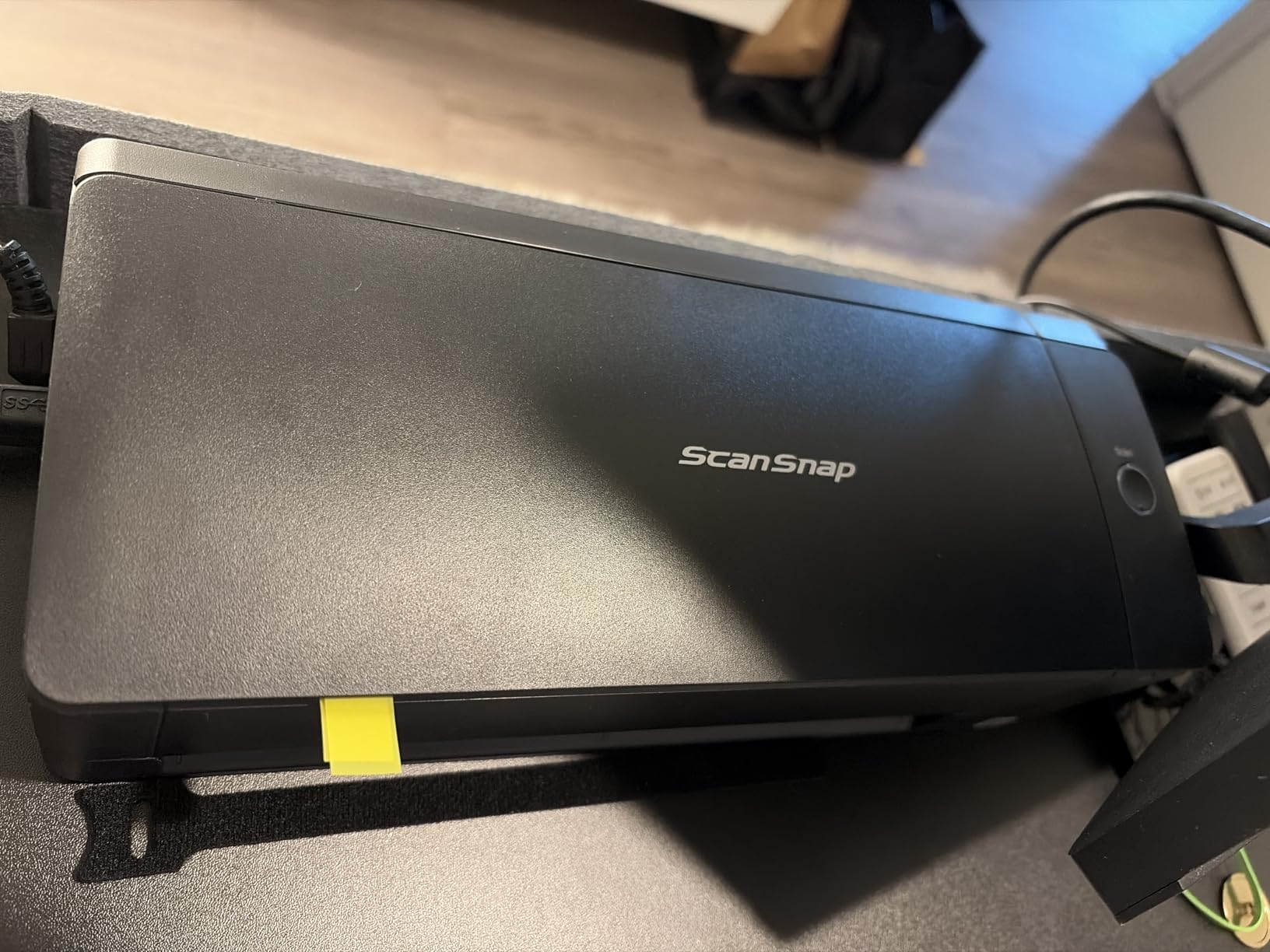
The iX1300 is the most capable unit here, and speed is the headline. It scans duplex at up to 30 ppm with a 20-sheet automatic document feeder, and it applies automatic de-skew, color optimization and blank page removal as it runs. Blank page removal alone can cut a 60-page batch of double-sided forms in half on disk.
Connectivity is the differentiator. It works over USB or Wi-Fi, and it can be used without a computer at all, sending scans to a Mac, PC, mobile device or cloud service. Scan to smartphone, tablet, laptop, Chromebook through the mobile app, Google Drive, Dropbox, OneDrive, Box or SharePoint. ScanSnap Home is the management layer for documents, receipts, business cards and photos.
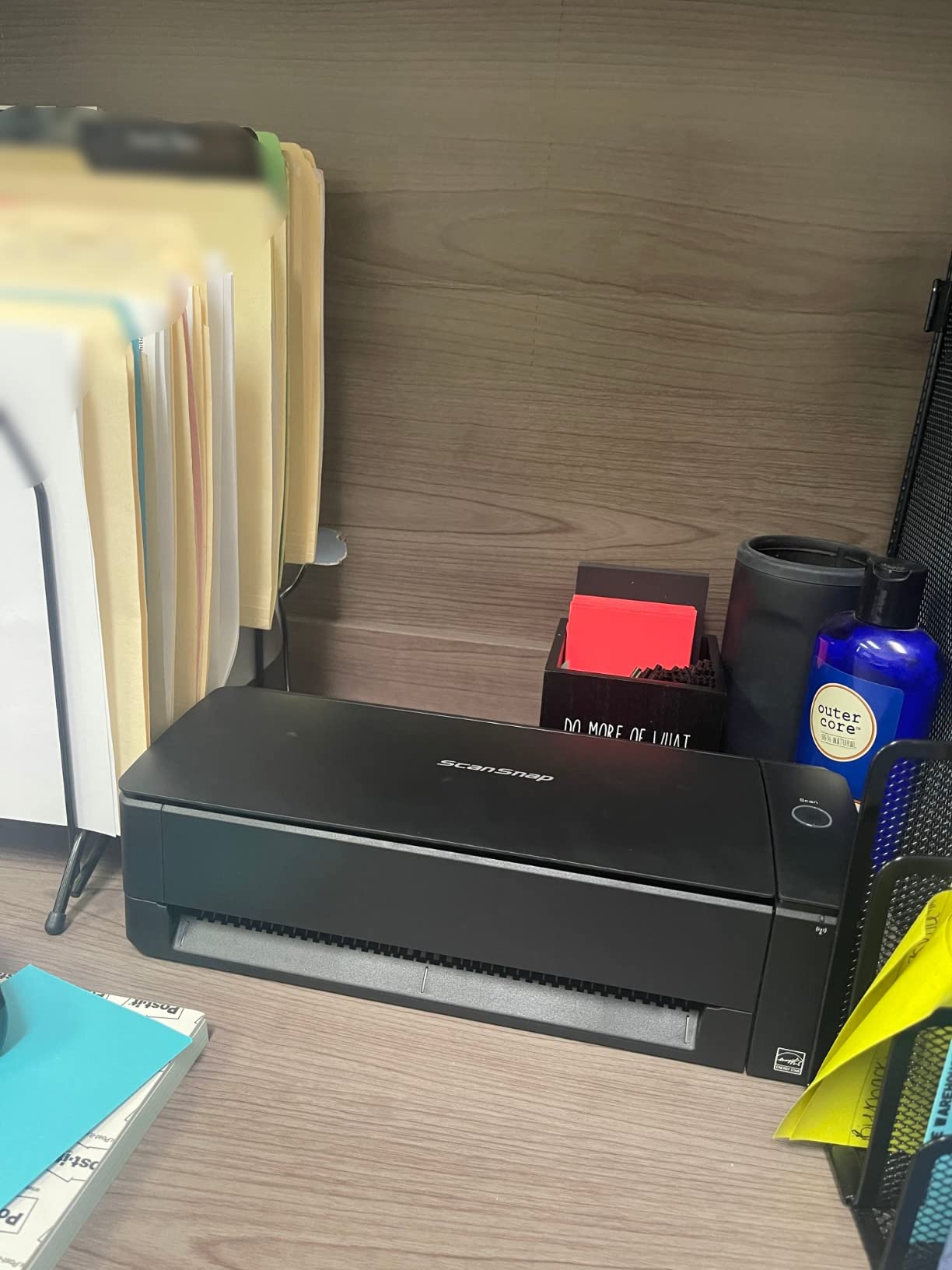
The QUICK MENU interface handles thick items and plastic cards, which widens the media range beyond plain paper. At 600 dpi and 48-bit color, image quality sits at the top of this group, and the vertical space-saving design keeps the footprint narrow.
Users in self-hosting communities single out exactly these two attributes when they recommend a ScanSnap-series unit: the speed and the roughly 50-sheet feeder capacity of the larger models in that family, with both sides captured at once. The iX1300 is the compact entry to that design language, and the reliability record across the series is why so much of the workflow advice on those forums points this way.
What scanning without a computer unlocks
Most competitors need a tethered PC to receive the file, which means the scanner is only useful where the computer is. The iX1300 breaks that link. You can place it in a home office, a shared filing room or a rental space, load paper, and send the file straight to a phone, a cloud folder or an email address.
That is also the answer to the most common server-side question in document management communities. If your system watches a folder for new files, any of these destinations can be that folder. Wireless push, email to an address your automation watches, and direct cloud upload all remove the PC from the loop without needing FTP or SMB support that consumer scanners rarely have. The QUICK MENU interface also handles thick items and plastic cards, and at 600 dpi with 48-bit color the image quality sits at the top of this group.
What the premium tier actually costs you
It is 4.4 pounds and 17 watts, against 1 pound and 2.5 watts for a compact USB unit. That is a real difference if the scanner lives in a bag, and negligible if it lives on a desk.
Setup is the other cost. The Wi-Fi configuration and ScanSnap Home need a first session to set up destinations and profiles, and owners report a learning curve on both. A portion of long-term owners also report paper jams and misfeeds, so allow time for clearing the occasional bad sheet. QUICK MENU is a different interaction model from a one-button scanner, which slows the first week before it speeds up every scan after it.
7. Epson WorkForce ES-400 II Duplex Desktop Scanner – Best for High-Volume Paperwork
Epson Workforce ES-400 II High-Speed Color Duplex Desktop Document Scanner
50-sheet ADF
Duplex
300 dpi
Ultrasonic double-feed detection
Pros
- 4.5 star average across more than 1200 reviews
- 50-sheet automatic document feeder with duplex
- Ultrasonic double-feed detection and dynamic skew correction
- Automatic file naming and OCR cut post-processing
- Scans direct to email
- Dropbox
- Evernote
- Drive and OneDrive
Cons
- USB only with no wireless built in
- 300 dpi resolution ceiling
- Bulkier and heavier than the mobile models
- ScanSmart is less refined than dedicated suites
The ES-400 II is the highest-rated unit in this roundup at 4.5 stars, and the rating reflects a specific kind of reliability rather than flash. Owners describe it as an office workhorse: it loads paper, it scans both sides, and it does that repeatedly without drama.
The 50-sheet automatic document feeder is the number that matters for a backlog. Combined with duplex, a full ream of double-sided forms becomes about twenty feeder loads instead of several hundred individual feeds. Epson’s ScanSmart software adds preview, email, cloud upload and automatic file naming, so a batch arrives as a named set of files rather than a folder of scans2.pdf, scans3.pdf.
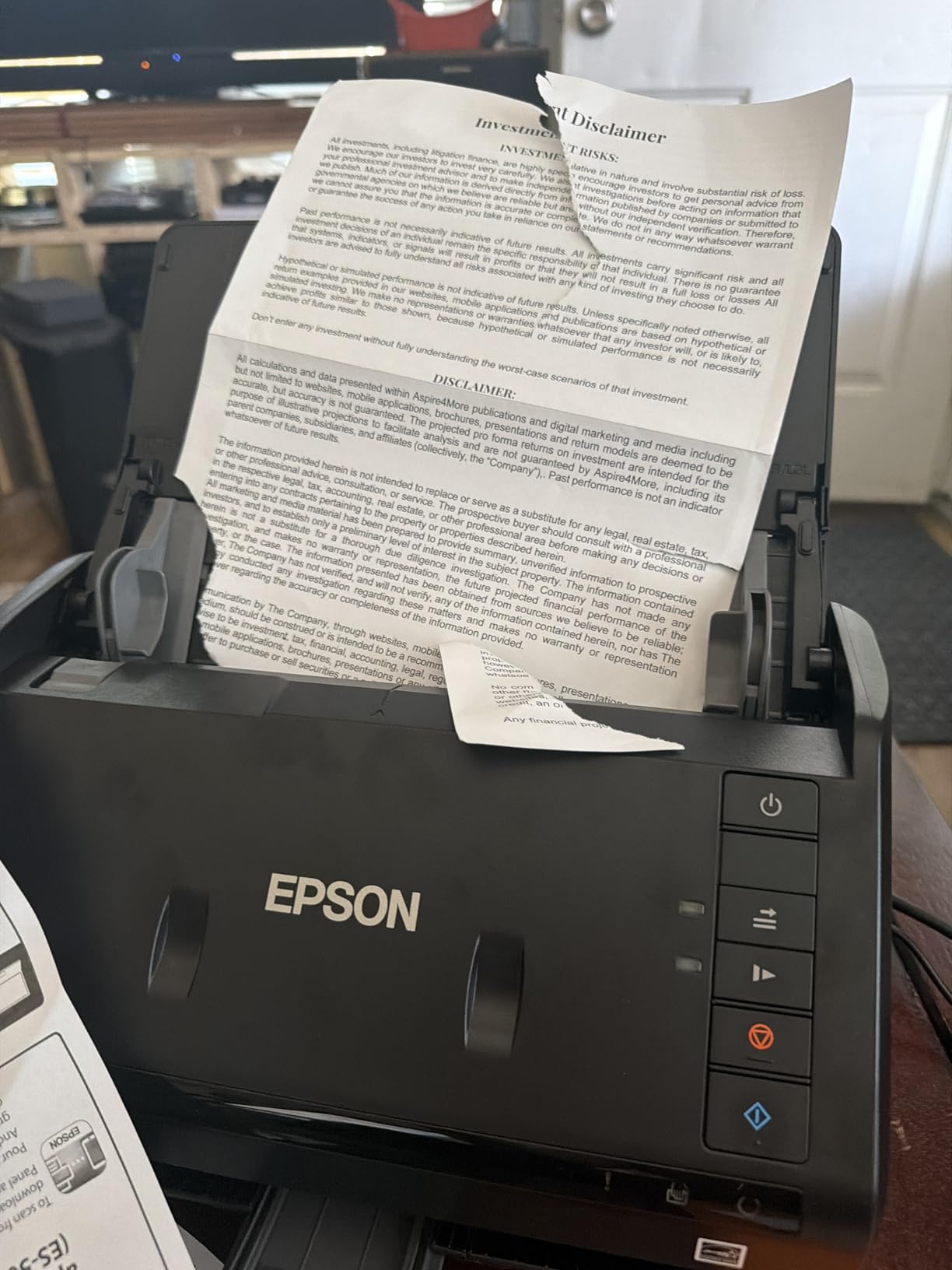
Two reliability features separate it from cheaper feeders. Ultrasonic double-feed detection stops a job when two sheets try to enter together, which protects the order of a document set, and dynamic skew correction straightens pages fed at an angle. That is the pair of features that separate a scanner you can trust with a mixed stack from one you check page by page.
OCR produces searchable PDFs and editable Word or Excel files, and a TWAIN driver lets it feed into document management software directly.
What ultrasonic double-feed detection is worth
Double-feed is the specific failure that destroys an archive. When two sheets enter together, the second page is scanned at the wrong angle or not at all, and in a set of numbered exhibits or a contract with sequential clauses you often do not notice until you need the missing page. Detecting the condition and stopping is much better than producing a quietly incomplete file.
Dynamic skew correction solves the quieter version of the same problem. A stack fed slightly off-square produces pages that drift out of alignment, and a 50-sheet stack can end up a visible fan. Correcting on the way through keeps the output uniform, which also makes OCR more accurate because the text baseline stays straight.
What a desktop workhorse costs you
It is USB only. There is no wireless or network connectivity built in, so a phone cannot pull files from it directly and someone has to be at the computer. If you need wireless access from more than one device, the ES-580W is the same family with a touchscreen and Wi-Fi.
The 300 dpi ceiling covers text well and fine print less well, and the body is larger and heavier than the mobile units at 3.7 kg. ScanSmart is competent but less refined than a dedicated document management suite, so very large rule-based routing workflows are better served elsewhere.
8. Epson WorkForce ES-580W Wireless Duplex Scanner – Best for Large Batches and Shared Use
Epson Workforce ES-580W Wireless Color Duplex Desktop Document Scanner
100-sheet ADF
35 ppm
4.3 inch touchscreen
Wi-Fi
Pros
- Largest feeder here at 100 sheets
- 4.3 inch touchscreen makes destinations easy to pick
- Wireless to phones
- tablets
- computers and cloud
- Save to USB or email with no computer in the loop
- 35 ppm Single-Step duplex with automatic corrections
Cons
- 300 dpi below several 600 dpi models
- Initial wireless setup and touchscreen navigation take time
- Large and heavy at 3.7 kg
- Bundled software is light on advanced post-processing
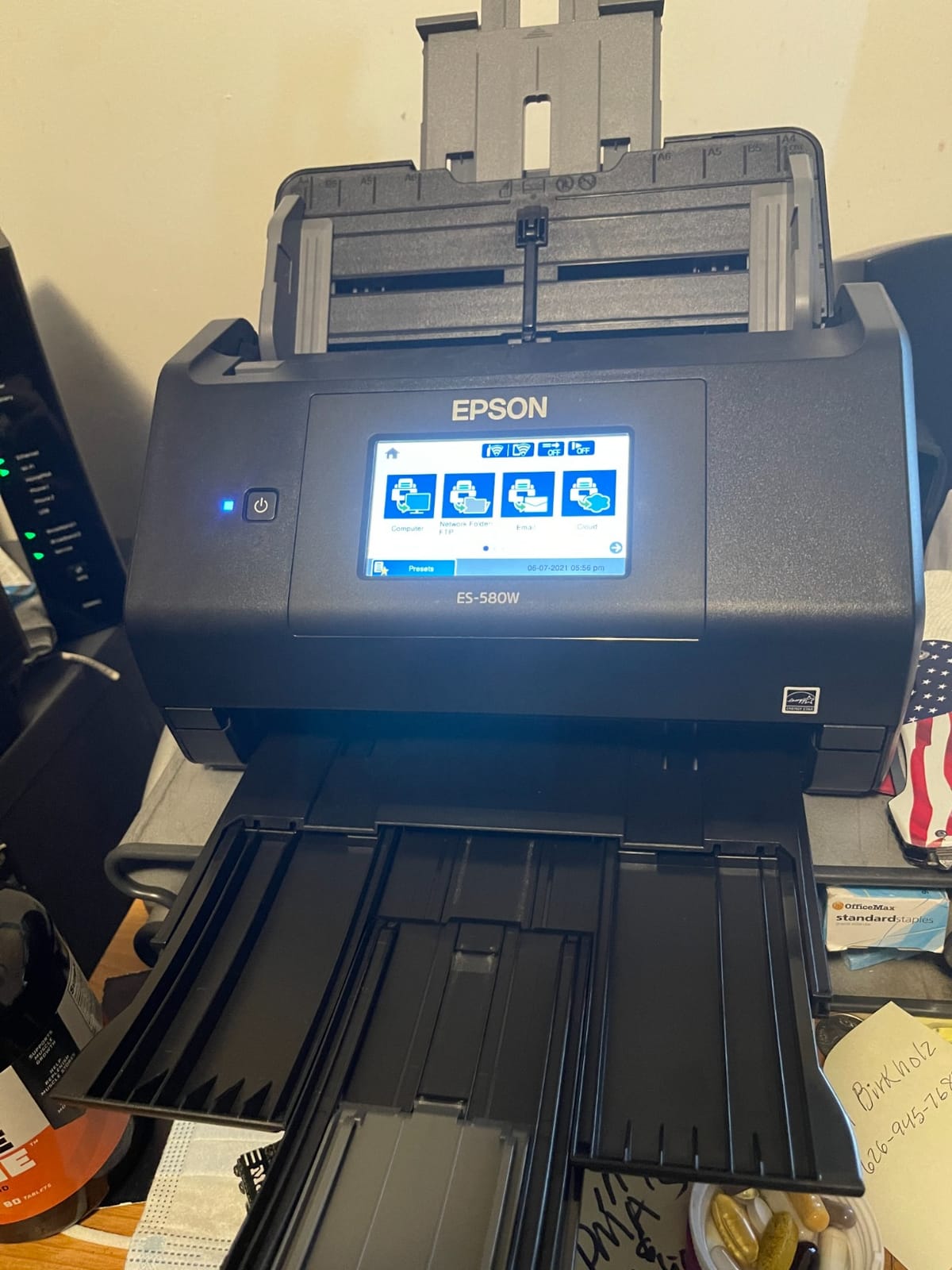
The ES-580W is built for the person who is tired of refilling a feeder mid-task. Its 100-sheet automatic document feeder is the largest in this roundup, and it captures both sides in one pass using Single-Step technology at up to 35 pages per minute.
A 4.3 inch touchscreen is the interface, and that is the feature that changes it from a personal tool to a shared one. You choose the destination on the device itself instead of hunting through desktop software, so a family member or a colleague can scan a document without an account on your computer.
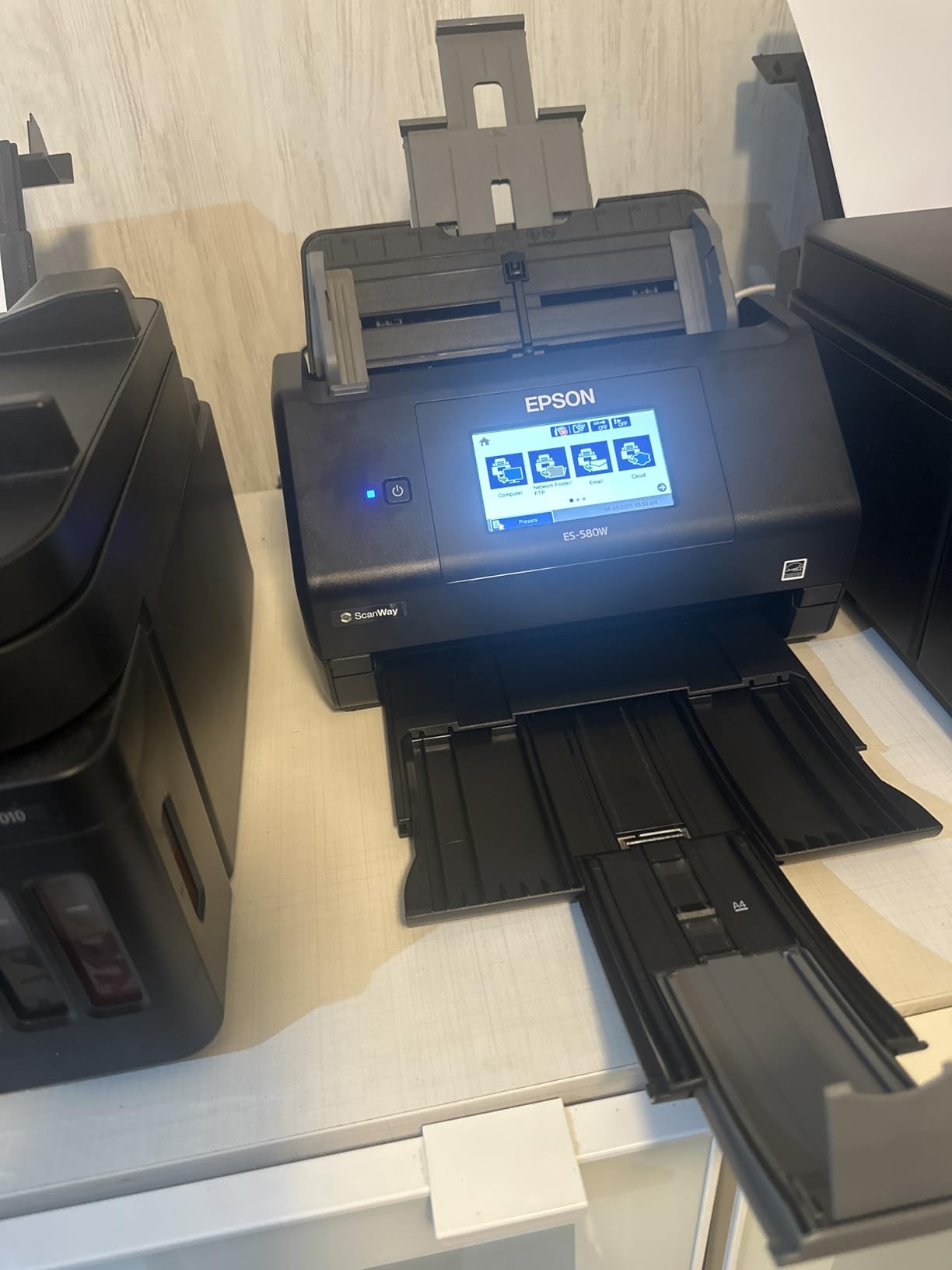
Wireless is native. It sends scans to smartphones, tablets, computers and cloud storage, and it can save straight to a USB stick, an email address or a cloud service with no computer involved. For anyone who already scans for other people, that is the practical difference between a routine that gets used and one that does not.
Image handling is thorough: auto crop, blank page deletion, background removal, dirt detection and paper skew correction, plus OCR for searchable PDFs and editable Word and Excel output.
Why the 100-sheet feeder changes the workflow
ADF capacity is not a bragging number, it is a batching decision. A 20-sheet feeder means you stand by the machine six times for a 120-page job. A 100-sheet feeder means two. On a backlog conversion that is the difference between a morning and a weekend, and it is the single biggest practical upgrade in this roundup.
Combined with 35 ppm duplex, a large box of paperwork moves at a pace where you stop watching each page. Blank page deletion and background removal run automatically, so the finished file is already clean, and the touchscreen lets you set a destination once and repeat it.
What the 300 dpi limit means for you
The 300 dpi optical resolution is below several 600 dpi models available in a similar class, and that shows on small print, pencil handwriting, stamps and anything you intend to crop heavily. For standard forms, contracts and receipts at readable scale, 300 dpi produces a clean, small, searchable file, which is often the better archival outcome anyway.
Initial wireless setup and touchscreen navigation take a session to learn, and at 3.7 kg the body is large and heavy. Owners who need heavier post-processing than the bundled software provides will want a separate OCR or PDF tool in the workflow.
How to Choose a Document Scanner for Paperwork
Start from volume, not from features. Count what you actually scan in a month, then work down through these nine questions. If you answer the first two correctly, the rest is detail.
ADF capacity and scan speed: how many sheets, how fast
ADF capacity is the number of sheets the feeder holds at once. Speeds are quoted in ppm (pages per minute) for one-sided work and ipm (images per minute) for counting both sides of a sheet, so a scanner rated at 30 ppm duplex produces 15 sheets per minute. For a stack of 100 double-sided pages, that is a few minutes of standing and waiting, versus a long evening of manual feeding on a single-sheet unit.
Match the feeder to the job. Twenty sheets covers a weekly bill folder or a client packet. Fifty covers a folder of receipts or a month of statements. One hundred covers a box conversion without interruption. Daily duty cycle is the related limit, and only the Canon R10 publishes a suggested figure at 500 scans per day, which is a useful anchor for anything above household volume.
Flatbed or sheetfed: which paper are you scanning
Sheetfed wins for loose paper, forms, receipts and multi-page documents, because it is hands-free and fast. Flatbed wins for bound books, photographs, artwork, plastic and embossed cards, and anything too fragile to travel through rollers. A flatbed with no feeder is not a compromise, it is a different job. If you have books or photos in the pile, you need glass.
The third option is the hybrid: a sheetfed unit for the bulk plus one flatbed for the awkward items. Most households get through with a single portable unit, and add a flatbed later if the photo box arrives.
300 dpi or 600 dpi: how much resolution do documents need
For standard text, forms, receipts and contracts, 300 dpi is the working standard and it produces files small enough to email and store by the thousand. Move to 600 dpi for small print, handwriting, stamps, receipts with faded thermal text, and anything you plan to crop. Be careful with advertised resolution: optical resolution is real hardware capability, while interpolated or software-upscaled figures are not, and a 2400 dpi flatbed rating is optical while a 1200 dpi portable rating tells you nothing about how it looks on a faded receipt.
OCR, searchable PDF and file size
Optical character recognition is what makes an archive useful, because it creates a text layer you can search inside the file. Every unit here includes OCR, and most also output editable Word and Excel. Two settings change file size more than resolution does: grayscale or black-and-white output, and automatic blank page deletion. Text-only records in grayscale are dramatically smaller and OCR them faster, and users running a document management system frequently report that switching to black and white or grayscale was the change that made the workflow keep up.
PDF format itself matters too. A single searchable PDF per document beats a folder of loose JPEGs, and TIFF is for archival masters rather than everyday reading.
USB, Wi-Fi, or scanning straight to a server
USB is the simple default and the most reliable for a single computer. Wi-Fi plus a touchscreen is what you want when more than one person scans or when you want files on a phone. A third option exists and most shoppers miss it: scanners that can save directly to a USB stick or send to email with no computer in the loop, which is the setup that fits a filing room or a shared household.
On the server question, one thing catches people out. Most consumer scanners cannot push files over FTP or SMB to a network share, and you only discover that after buying. In practice, for systems that watch a folder for new files, the practical routes are email to an address your automation watches, direct cloud upload to a synced folder, or scanning to a computer that moves the files for you. Choose the destination your software can already reach.
Mac, Windows and Linux support
All eight units here work on Windows and Mac, so the platform is rarely the deciding factor. Linux support is the real differentiator, and only the two Brother models advertise it explicitly with SANE drivers alongside TWAIN and WIA. TWAIN is the standard Windows scanning driver, and its presence means the scanner can be driven by document management software rather than only the bundled app.
Reliability: jams, double-feeds and mixed paper
Almost every negative review in this category is about paper handling, so this is where the real differences hide. The recurring causes are mixed paper weights in one stack, curled thermal receipts, staples and paper clips still attached, and folded or damaged corners. The fixes are unglamorous and effective: remove staples and clips before scanning, separate receipts from letter paper into their own run, and clean the feed rollers periodically.
Ultrasonic double-feed detection, which the ES-400 II carries, stops a run when two sheets enter together instead of quietly producing an incomplete document. On a mixed stack of ordinary office paper, any of the units here with a feeder will work. On a stack that includes receipts, plastic cards and thick envelopes in one load, the units with stronger feeder mechanisms earn their price.
Scanner or multifunction printer: which is cheaper overall
If you already own a multifunction printer with a scanner head, you can digitize paperwork today at no extra cost. The trade-offs are speed, paper handling and software. Printer-based scanning typically means one flatbed page at a time unless the machine has a document feeder, and the software tends to be a general-purpose utility rather than a scanning workflow with OCR, naming and routing. For under a few dozen pages a month, the multifunction printer is enough. Above that, a dedicated scanner pays back in saved time within the first year of a tax season or a backlog project.
A note on securing what you scan
A scanned archive of tax records, medical paperwork and contracts is a concentrated copy of your most sensitive information, all of it in one searchable folder. Keep it in a folder that syncs to a second location, restrict access to the account that syncs it, and encrypt the drive or the sync folder. Deleting the paper after verifying the scan is fine, but only after verifying the scan.
Frequently Asked Questions
What is the best document scanner for office use?
For an office handling paperwork every day, the Epson WorkForce ES-400 II is the strongest all-round choice, with a 50-sheet automatic document feeder, duplex capture and ultrasonic double-feed detection at a 4.5 star average. If several people need to scan without touching the same computer, the ES-580W adds a 100-sheet feeder, a touchscreen and wireless sending. For the highest throughput with no computer in the loop, the ScanSnap iX1300 runs at 30 ppm duplex over USB or Wi-Fi.
What is the best way to digitize paperwork?
Work in batches by document type rather than by pile. Remove staples and clips, separate thermal receipts from letter paper, choose grayscale for text-only records, turn on blank page deletion, set OCR to searchable PDF, and use a naming pattern with a date and document type so the file sorts itself. Scan to a folder that syncs somewhere else, then check a few files for readable OCR before you destroy the originals.
What is the best way to scan a lot of documents?
Use a sheetfed scanner with an automatic document feeder, and match the feeder to the job. A 50 to 100 sheet ADF with duplex means a 200 page job takes a handful of feeder loads instead of hundreds of single feeds. Enable double-feed detection if the unit has it, keep mixed paper weights out of the same load, and keep the scanner on a flat surface so skew correction can work.
What are the four most commonly used scanners?
The four most commonly used scanners are flatbed scanners, which use a glass bed for books and photos, sheetfed scanners with an automatic document feeder for fast multi-page work, portable document scanners for single sheets on the move, and multifunction printer scanners, which are the scanning head inside a printer or all-in-one machine.
What is the best scanner for Paperless-ng?
Any scanner that delivers a clean, correctly named file to a folder your system watches will work. Consumer scanners rarely push over FTP or SMB directly, so the practical routes are scanning to a computer that moves files, saving to a USB stick or email that an automation collects, or sending straight to a synced cloud folder. Keep output in grayscale or black and white for text-only records, and use duplex so each sheet produces one page of the document.
What is ADF when scanning?
ADF stands for automatic document feeder. It is the tray on top of a sheetfed scanner that holds a stack of pages and pulls them through one at a time, which means you can scan many pages without touching the machine. A larger ADF capacity means fewer refills, and duplex ADF models capture both sides of a sheet in a single pass.
What is the best ADF document scanner?
The Epson WorkForce ES-580W has the largest automatic document feeder in this roundup at 100 sheets, with 35 ppm single-step duplex, a touchscreen for choosing destinations and wireless sending to phones, computers, USB or cloud. For a more compact desk, the ScanSnap iX1300 does 30 ppm duplex with a 20-sheet feeder over USB or Wi-Fi, and the Brother DS-740D does single-pass duplex at 16 ppm in a body that folds flat.
The Verdict: Which Document Scanner Should You Buy?
The Brother DS-640 wins this roundup. It runs color at up to 16 ppm, weighs about 1.5 pounds, runs off a single USB cable, and carries the deepest review history of any unit here at more than 6400 ratings, which means the long-term reliability picture is well documented. For occasional single sheets, receipts and cards, it is the one we kept picking up.
Match the others to your volume. A Canon CanoScan LiDE 300 handles books, photos and anything fragile at a budget level, with no feed path to jam. A Brother DS-740D adds single-pass duplex for double-sided work on the move, and a Canon imageFORMULA R10 gives you a 20-sheet feeder with software that needs no installing. A ScanSnap iX1300 covers wireless sending and 30 ppm duplex with no computer required. For a genuine backlog, an Epson WorkForce ES-400 II handles a 50-sheet stack with double-feed detection, and an ES-580W nearly doubles the feeder to 100 sheets with a touchscreen for shared use.
Before you buy any of them, try your phone for a month. If the volume never outgrows a free scanning app, keep the cash. When it does, you will know exactly which of these eight fits, and the best document scanners for paperwork in 2026 are the ones that match your stack size rather than the spec sheet.