
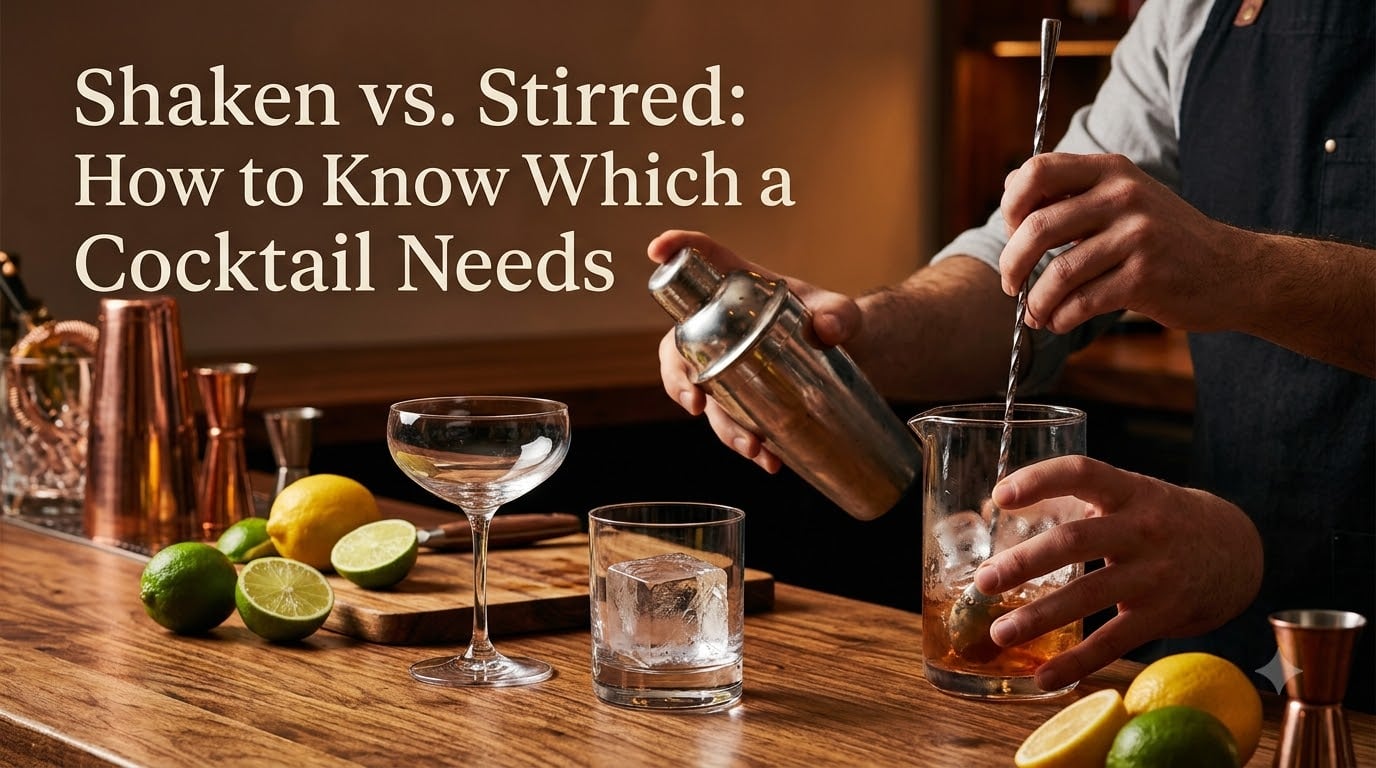
Shaken vs stirred comes down to one rule I trust every time: shake a cocktail if it contains citrus, egg, cream, or any opaque ingredient, and stir it if it is built entirely from spirits, liqueur, and bitters. That single line is the answer 90% of the time, and it is the answer I am going to walk you through in this guide.
Over the years behind our bar, I have watched home bartenders guess randomly between the two techniques, then wonder why their martini turned cloudy or their whiskey sour came out flat. The fix is almost never the recipe. It is the method. Choosing shaken vs stirred changes a drink’s temperature, dilution, texture, and clarity, and getting it right is what separates a passable cocktail from one you actually want to order twice.
In this guide, I will give you the one-line rule that works every shift, explain the science behind why it works, list the classic examples on each side, and flag the exceptions (Caipirinha, lightly shaken martini, dry shake for sours) that trip people up. By the end, you will know exactly how to tell which a cocktail needs before you even reach for the shaker.
Table of Contents
How Do You Know If a Cocktail Should Be Shaken or Stirred?
You know a cocktail should be shaken when it contains citrus juice, egg white, cream, or any opaque ingredient, and you know it should be stirred when it is built entirely from spirits, liqueur, and bitters. If a carbonated mixer like tonic, soda, or champagne is involved, build the drink in the glass instead of shaking or stirring at all.
That rule is the working shortcut most professional bartenders on r/bartenders follow, and it has held up across hundreds of drinks in my own bar. The reasoning is simple: shaking violently agitates ice and forces tiny air bubbles into the liquid, which is exactly what you want when citrus needs to emulsify with spirits or when egg white needs to foam. Stirring glides the spoon around the inside of a mixing glass and chills the drink while keeping it crystal clear, which is exactly what you want when the only ingredients are gin and vermouth.
Here is the rule in scanable form:
- Shake if the drink contains citrus juice, egg, cream, milk, or any opaque juice or puree.
- Stir if the drink is all alcohol: spirits, liqueur, vermouth, and bitters only.
- Build if the drink contains a carbonated mixer like tonic, soda, sparkling wine, or ginger beer.
That single rule is what the rest of this article unpacks. If you only remember one thing, remember that line.
Why Mixing Technique Matters: Chill, Dilute, and Texture
Mixing a cocktail is not just about combining liquids. It is about hitting three targets at once: chill, dilution, and texture. Stirring and shaking are two different tools for hitting those targets, and each one prioritizes them differently.
Chill is the easy one. Both techniques drop a drink from room temperature to near freezing, because the ice is roughly 0°F / -18°C and the water it melts into the cocktail carries that cold with it. Dilution is where the techniques start to diverge. Stirring adds water slowly and predictably over about 25 to 30 seconds, while shaking adds it fast and heavy in about 10 to 12 seconds.
Texture is where the choice really matters. Shaking introduces air, which gives a drink a frothy, velvety, sometimes cloudy appearance. Stirring leaves the liquid glossy and transparent, with a heavier, silkier mouthfeel. Pick the wrong tool and you can flatten a Whiskey Sour or shred a Martini’s texture. That is why the choice of shaken vs stirred is one of the first decisions a bartender makes, right after they read the recipe.
As a side note for the James Bond fans in the room: Bond’s famous “shaken, not stirred” line is a character choice, not a technique endorsement. A Vesper made the way Fleming wrote it would actually be a textbook stirred drink by modern bar standards. I love the line, but the technique is a deliberate quirk, not a rule to copy.
What Shaking Does to a Cocktail
Shaking changes a cocktail in three distinct ways: it aerates it, it chills it fast, and it emulsifies any non-alcoholic ingredients into the base spirit. Understanding each effect is how you know when shaking is the right call.
Aeration happens because ice inside a sealed shaker gets smashed end to end. Those impacts fracture the ice into tiny shards and force microscopic air bubbles into the liquid. The result is a drink that looks a little cloudy, feels lighter on the palate, and holds a thin foam on top. That foam is the signature of a properly shaken cocktail, and it is exactly why a Margarita gets that beautiful pale layer on the surface and why a Whiskey Sour can support a thick meringue-like cap.
Shaking also chills faster than stirring. Because the entire shaker is moving violently, the liquid touches every surface of the ice for the full 10 to 12 seconds, so the drink hits its target temperature quickly. That speed is useful when a recipe includes juice, because juice and spirit blend more thoroughly when the drink is very cold.
Emulsification is the third effect, and it is the one that makes shaking non-negotiable for certain drinks. Citrus oils, egg white proteins, and cream fats all need mechanical force to bind evenly with alcohol. Without that force, the drink separates on the tongue or never develops its signature texture. This is why you shake a Daiquiri but never stir one, and why a Ramos Gin Fizz demands a vigorous shake rather than a gentle swirl.
Reach for the shaker when:
- The recipe includes fresh citrus juice (lemon, lime, grapefruit, orange).
- The recipe calls for egg white or aquafaba.
- The recipe includes cream, milk, or a cream liqueur.
- You want a frothy cap or a velvety mouthfeel.
What Stirring Does to a Cocktail
Stirring is the gentle counterpart to shaking. Where shaking beats air into the cocktail, stirring coaxes it out. Where shaking dilutes fast, stirring dilutes slow. The result is a drink that looks crystal clear, feels heavier in the mouth, and tastes more focused on the base spirit.
A stirred cocktail gets its clarity because the bar spoon moves the liquid in a single smooth rotation around the mixing glass. There is no violent impact, so very few air bubbles get trapped in the liquid. When you strain a properly stirred Martini into a chilled coupe, it should look like glass.
Dilution happens more slowly because the contact between liquid and ice is gentler. Most bartenders stir for 25 to 30 seconds, which adds roughly 25 to 30 percent water by volume. That slower dilution is important for spirit-forward drinks because the extra water opens up the aromatics without flattening the drink. Stir a Manhattan for 20 seconds and you will taste the whiskey and sweet vermouth as a unified whole. Shake it for 12 seconds and the same drink will taste bruised and cloudy.
Mouthfeel is the last and most underrated effect. Stirred cocktails feel heavier, almost silky, on the palate. That weight comes from the dilution being more even at the molecular level, since there is no foam interrupting the liquid. It is also why a stirred Negroni feels more substantial than a shaken one, even when the recipe is identical.
Reach for the bar spoon when:
- The recipe is built only from spirits, liqueur, vermouth, and bitters.
- You want a crystal-clear appearance.
- The drink is served up in a chilled coupe or Nick and Nora glass.
- The aromatics are delicate and you do not want air interrupting them.
Shaken vs Stirred Cocktails: Quick-Reference Table
This is the table I wish someone had handed me on my first bar shift. Print it, screenshot it, pin it to the fridge, and the shaken vs stirred decision becomes muscle memory in about a week.
| Dimension | Shaken | Stirred | |
|---|---|---|---|
| Chill time | 10 to 12 seconds | 25 to 30 seconds | |
| Dilution speed | Fast | Slow and controlled | |
| Final appearance | Cloudy, sometimes foamy | Crystal clear, glossy | |
| Texture | Light, frothy, velvety | Silky, weighty, integrated | |
| Best for | Citrus, egg, cream, opaque juice | All-spirit, vermouth, bitters | |
| Equipment | Boston or cobbler shaker | Mixing glass, bar spoon, julep strainer | |
| Glassware | Coupe, rocks glass, highball | Coupe, Nick and Nora, rocks glass over a large cube | |
| Carbonated | Never | Never | Build instead |
Classic Shaken Cocktails (With Examples)
The fastest way to internalize the shaken vs stirred rule is to learn which classics trigger the shake side. Every cocktail on this list contains either citrus juice, egg white, cream, or an opaque mixer, which is exactly why bartenders shake them.
Daiquiri is the textbook shaken sour: white rum, fresh lime juice, simple syrup. No air, no foam, and the lime juice would never fully integrate without a hard shake.
Margarita follows the same logic with tequila, lime, and orange liqueur. The 10-second shake is what gives a Margarita that signature pale foam on top.
Whiskey Sour is where you meet egg white for the first time. Bourbon, lemon, simple syrup, and an egg white demand both a dry shake (no ice) and a wet shake (with ice) for that thick, glossy foam.
Pisco Sour uses the same dry-then-wet shake technique, swapping bourbon for pisco and adding a few dashes of Angostura bitters on the foam.
Ramos Gin Fizz is the upper limit of what shaking can do. Gin, lemon, lime, cream, egg white, simple syrup, and orange flower water get a 12-second dry shake, then a 60-second wet shake, and the drink ends up nearly opaque with foam rising an inch above the glass.
Cosmopolitan and Tom Collins round out the list as citrus-driven highballs that benefit from fast chill and full integration.
Classic Stirred Cocktails (With Examples)
The stirred side of the menu is shorter and more focused. Every drink here is built entirely from alcohol, which is exactly why stirring (not shaking) is the right call.
Martini is the iconic stirred drink: gin and dry vermouth, stirred with ice and strained into a chilled coupe. A properly stirred Martini looks like glass and carries a silky, weighty mouthfeel that shaking simply cannot match.
Manhattan uses rye or bourbon, sweet vermouth, and Angostura bitters. Stir it for about 30 seconds and the drink integrates smoothly without losing clarity. Shake it and the same recipe turns cloudy, watery, and bruising on the finish.
Negroni is equal parts gin, Campari, and sweet vermouth. The trio is all alcohol, so the drink gets stirred and served over a large ice cube to keep dilution slow as you sip.
Old Fashioned is more built than stirred, but the spirit component (bourbon, sugar, bitters) gets a short stir to dissolve the sugar and chill the whiskey before the large ice cube goes in.
Sazerac is the original American cocktail: rye, absinthe rinse, sugar, and Peychaud’s bitters. It gets stirred to keep the absinthe integration smooth and the appearance clear.
The Third Option: Built Cocktails (No Shaking or Stirring)
There is a third category most guides ignore, and it solves the single most common beginner mistake: shaking something you should never shake at all. Built cocktails are mixed directly in the serving glass, with no shaker and no spoon.
The rule for built drinks is simple. If the recipe contains a carbonated mixer like tonic, soda, sparkling wine, or ginger beer, build it. Shaking carbonation flattens it. A Gin and Tonic shaken for 10 seconds would lose all of its fizz and arrive in the glass tasting like bitter fizzy water. A Mojito shaken too hard would crush the mint and kill the bubbles from the soda water. Both are classic built drinks.
Other built cocktails include the Aperol Spritz, Rum and Coke, Dark and Stormy, and most highballs. The technique is the same: ice in the glass, add the spirit, add the mixer, give it one gentle stir with a bar spoon to lift the ingredients from the bottom, and garnish.
So the full framework is actually three methods, not two: shake when there is citrus, egg, cream, or opaque juice; stir when the drink is all alcohol; build when there are bubbles.
How to Shake a Cocktail (Step-by-Step)
A proper shake takes about 12 seconds and follows a very specific rhythm. Here is the sequence I teach new bartenders in their first week.
- Add all liquid ingredients to the small tin of a Boston shaker or the body of a cobbler shaker.
- Fill the shaker with ice to the top, then cap it firmly.
- Hold the shaker with both hands, one on each tin, and shake it back and forth over your shoulder for 10 to 12 seconds.
- You will feel the shaker get very cold in your hands and the tins will frost over. That is your cue to stop.
- Break the seal with a sharp tap on the side of the shaker, then strain into a chilled coupe, Nick and Nora, or rocks glass using a Hawthorne strainer.
For egg-white cocktails, do a dry shake first: combine the egg white and other liquids with no ice, shake hard for 10 seconds, then add ice and shake again for another 10 seconds. The dry shake builds the foam; the wet shake chills and dilutes. This is the technique that gives a Whiskey Sour its signature cap.
How to Stir a Cocktail (Step-by-Step)
A proper stir takes about 30 seconds and feels almost meditative compared to shaking. The motion is a smooth, controlled rotation, not a frenzy.
- Add all liquid ingredients to a mixing glass packed full of ice.
- Insert a bar spoon with the bowl facing down and the twisted stem between your fingers.
- Stir in a smooth, circular motion, moving the spoon around the inside of the glass for 25 to 30 seconds.
- The drink is ready when the mixing glass frosts on the outside and feels very cold.
- Strain into a chilled coupe or Nick and Nora using a julep strainer, or over a large ice cube in a rocks glass.
The biggest mistake beginners make is stirring too fast or using a stirring motion that splashes. A proper stir is gentle, steady, and almost silent. If you can hear the ice crashing, you are stirring too hard.
Bartender Ratios and Rules Worth Knowing
Two classic ratios show up constantly in bartending forums and they are worth memorizing alongside the shaken vs stirred rule. They give you a way to balance any sour or stirred drink without thinking.
The 2:1:1 rule is the foundation of every sour cocktail. Two parts base spirit, one part sour (citrus juice), one part sweet (simple syrup or liqueur). Apply it to a Whiskey Sour, Daiquiri, Margarita, or Gimlet, and you have a balanced drink every time. This is also why those drinks all get shaken: citrus and sweetener need mechanical force to fully integrate with the spirit.
The 50% rule is a dilution target. By the time a stirred cocktail reaches the glass, the total water added from melted ice should be roughly equal to half the combined volume of alcohol and juice. So if you start with 60 ml of spirit and 30 ml of juice, you are aiming for around 45 ml of melted ice water in the final drink. That is the threshold that opens up aromatics without watering the drink down.
Together, these two rules plus the shaken vs stirred framework give you a complete mental model for building and adjusting any classic cocktail you will encounter.
Common Mistakes When Shaking and Stirring
These are the same mistakes I see every week from new bartenders and from home enthusiasts posting in cocktail Facebook groups. Avoiding them will put you ahead of most beginners within a single night of practice.
- Shaking a Martini. The single most common mistake. Shaking a Martini makes it cloudy, watery, and over-diluted in roughly 12 seconds. Stir it for 30 seconds instead and the same drink transforms.
- Stirring an egg-white sour. No mechanical force means no foam. A stirred Whiskey Sour tastes flat and never develops its signature cap. Use a dry shake followed by a wet shake.
- Shaking carbonated mixers. Tonic, soda, sparkling wine, and ginger beer lose all of their fizz in a shaker. Build those drinks in the glass instead.
- Under-stirring a Manhattan. Twenty seconds is not enough. Stir for the full 30 and the whiskey and vermouth actually integrate instead of sitting on top of each other.
- Over-shaking egg whites. Past 20 seconds of total shaking time, the foam starts to break down and the drink loses its velvet cap. Time your shakes and stop when the tins frost.
- Stirring citrus cocktails. Stirring a Daiquiri or Margarita leaves the juice sitting on top of the spirit. Shake citrus drinks so they emulsify into a unified liquid.
If you remember nothing else from this section, remember this: shake anything with citrus or egg, stir anything that is all alcohol, and never shake anything fizzy.
Equipment Basics: Shakers, Spoons, and Glasses
You do not need a lot of gear to get this right. A basic home bar can cover both shaken vs stirred cocktails with five pieces of equipment.
A Boston shaker is two tins that fit together to form a seal. Most professional bartenders prefer it because it holds more ice, seals tighter, and strains through a separate Hawthorne strainer. A cobbler shaker is a three-piece set with a built-in strainer in the cap, which makes it more beginner-friendly but slightly trickier to open after a hard shake.
A mixing glass is a heavy glass beaker, usually with a Yarai or beaded pattern, used for stirred drinks. Pair it with a bar spoon (a long, twisted-stem spoon designed to glide around the inside of the glass) and a julep strainer for straining into the serving glass.
A Hawthorne strainer is the spring-coiled strainer that fits on top of a Boston shaker, and it is what catches the ice chips when you strain a shaken drink. A fine mesh strainer is a useful upgrade if you want to remove every last ice shard before serving.
Frequently Asked Questions
How do you know if a cocktail should be shaken or stirred?
You know a cocktail should be shaken when it contains citrus juice, egg white, cream, or any opaque ingredient, and you should stir it when it is built entirely from spirits, liqueur, vermouth, and bitters. Shaking aerates and emulsifies those ingredients, while stirring preserves clarity and silky mouthfeel. If a carbonated mixer is involved, build the drink in the glass instead of shaking or stirring.
Which cocktails should be stirred and not shaken?
Cocktails that should be stirred and not shaken include the Martini, Manhattan, Negroni, Old Fashioned, and Sazerac. These are all-spirit drinks built from gin, whiskey, vermouth, liqueur, or bitters with no juice, egg, or cream. Stirring them for about 30 seconds chills the drink and adds controlled dilution while keeping the liquid crystal clear and the mouthfeel silky.
What is the 50% rule in bartending?
The 50% rule in bartending is a dilution guideline: the total water added from melted ice by the time a stirred cocktail reaches the glass should equal roughly half the combined volume of alcohol and juice in the recipe. So a drink built from 60 ml of spirit and 30 ml of juice should end up with about 45 ml of melted ice water. Hitting that target opens up aromatics without watering the drink down.
What is the 2:1:1 rule for cocktails?
The 2:1:1 rule for cocktails is the standard ratio for any sour drink: two parts base spirit, one part sour citrus juice, and one part sweet element like simple syrup or liqueur. Apply it to a Whiskey Sour, Daiquiri, Margarita, or Gimlet and you will get a balanced cocktail every time. Because the recipe always contains citrus, sour cocktails built on this ratio are always shaken, never stirred.
Final Verdict: The One-Line Rule That Will Never Fail You
After a few hundred shifts and a few thousand shaken vs stirred decisions, here is the rule I trust every single time: shake anything with citrus, egg, cream, or opaque juice; stir anything that is all alcohol; and build anything with bubbles.
If you want a starting point, make one stirred drink and one shaken drink tonight. Stir a Martini and shake a Daiquiri. Notice the weight and clarity of the Martini. Notice the integrated, frothy texture of the Daiquiri. That side-by-side tasting is worth more than any guide, including this one.
From there, every time you face a new recipe, ask one question: does it contain juice, egg, or cream? If yes, shake. If no, stir. If it has bubbles, build. That is how to know which a cocktail needs, and once the rule is in your hands, every cocktail behind the bar starts to make sense.