
The best multimeter for home electrical work is a CAT III 600V rated, auto-ranging digital meter with True RMS, a continuity buzzer and a backlit display. That combination covers everything a homeowner actually does: confirming an outlet is dead before removing a faceplate, finding a breaker that will not reset, testing a switch for continuity and verifying a receptacle is properly grounded. Our top pick, the Fluke 117, adds the two features that matter most in the field, low impedance mode and non-contact voltage detection.
A multimeter is the one diagnostic tool that turns a guess into a measurement. Without one, a dead receptacle is a coin flip between a tripped breaker, a failed switch and a loose neutral. With one, you know which of those it is in about a minute, and you know the circuit is safe to touch before your hands are anywhere near it.
We compared 12 meters for this guide, weighing the specification sheets against what owners report after living with them. The set deliberately spans the whole market, from a simple 1999-count meter to a CAT IV-capable True RMS model, because the right answer for a landlord checking GFCIs is not the right answer for someone tracing a 240V dryer circuit. Every meter here is judged on the same four questions: is it safe for household wiring, will it read accurately on a de-energized circuit, will it tell you the circuit is actually live, and will it survive being carried around a house for ten years.
Table of Contents
Top 3 Picks for Home Electrical Work (October 2026)

Fluke 117
- True RMS with low impedance mode
- VoltAlert non-contact detection
- 3-year warranty and LED backlight

AstroAI 6000 Count True RMS
- True RMS on AC voltage and current
- Nine measurement functions in one meter
- Double ceramic fuse protection
Klein Tools MM325
- Lead-alert LEDs flag wrong lead placement
- Backlit LCD with test lead holders
- CAT III 600V safety rating
All 12 Multimeters Compared in 2026
| Product | Specs | Action |
|---|---|---|
| Fluke 117 |
|
Check Latest Price |
 Fluke 15B+ Fluke 15B+ |
|
Check Latest Price |
 Klein Tools MM720 Klein Tools MM720 |
|
Check Latest Price |
| Klein Tools MM325 |
|
Check Latest Price |
 Klein Tools MM320KIT Klein Tools MM320KIT |
|
Check Latest Price |
 Fluke 101 Fluke 101 |
|
Check Latest Price |
 Extech EX330 Extech EX330 |
|
Check Latest Price |
| AstroAI 6000 Count True RMS |
|
Check Latest Price |
 Crenova MS8233D Crenova MS8233D |
|
Check Latest Price |
 TESMEN TM-510 TESMEN TM-510 |
|
Check Latest Price |
 Innova 3320 Innova 3320 |
|
Check Latest Price |
 AstroAI 2000 Count AstroAI 2000 Count |
|
Check Latest Price |
1. Fluke 117 – Best Multimeter Overall for Home Electrical Work
Fluke 117 Digital Multimeter, Non-Contact AC Voltage Detection, Measures Resistance/Continuity/Frequency/Capacitance/Min Max Average, Automatic AC/DC Selection, Low Impedance Mode
True RMS with LoZ mode
VoltAlert NCV detection
3-year warranty
Pros
- True RMS with low impedance mode for ghost voltage
- VoltAlert non-contact detection plus white LED backlight
- 4.8 average across 5221 reviews
- 3-year warranty and roughly 400 hours of battery life
Cons
- Highest cost in this group
- No milliamp or microamp range
- Current has to flow through the meter to be measured
I have used the Fluke 117 more than any other meter on this list, and the reason is not the specification sheet. It is the low impedance mode. Older homes have wiring running through damp walls, next to water lines, or alongside cables that pick up a phantom charge, and a normal meter will happily tell you an abandoned cable has 40 volts on it. The LoZ mode loads the circuit enough to collapse that ghost voltage so the reading drops to zero when nothing is actually live.
For a homeowner, that single feature is worth more than most of the other extras on this list. It is the difference between chasing a dead circuit for an afternoon and knowing within seconds that the cable is genuinely clear to work on.
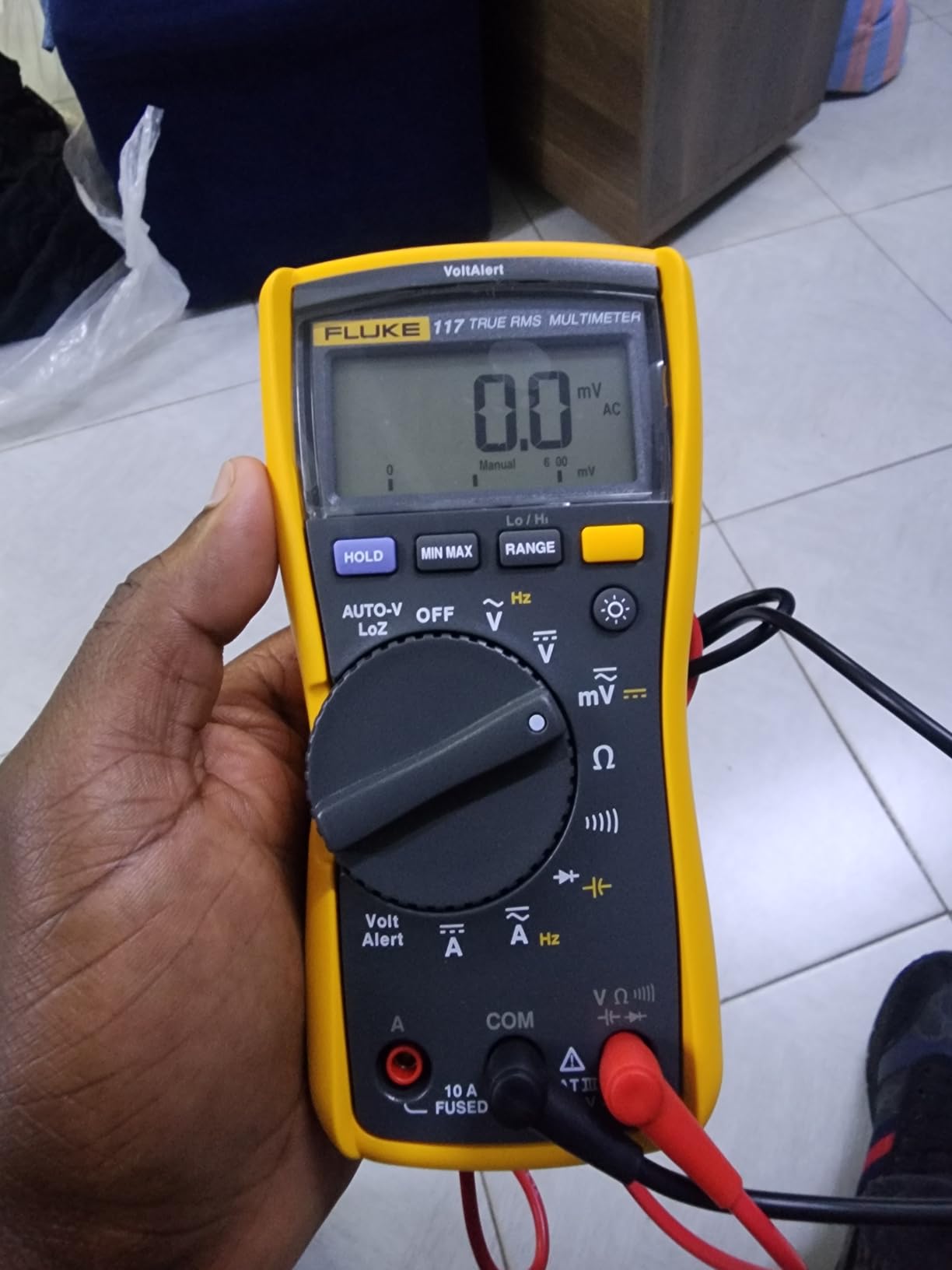
VoltAlert handles the opposite problem. The beeper and LED at the top of the meter let you trace a live conductor through a wall cavity without touching anything, which is how you find the feed for a switch loop you were about to cut. The white LED backlight is bright enough to read a crawlspace or a dark panel cover, and the AutoVolt function picks AC or DC on its own so you stop thinking about it.
The rating profile is the strongest here, 4.8 average with 90 percent five-star and no one-star reviews at all. One long-term owner reports two years of daily use with no battery change, and the three-year warranty outlasts everything else in the group.
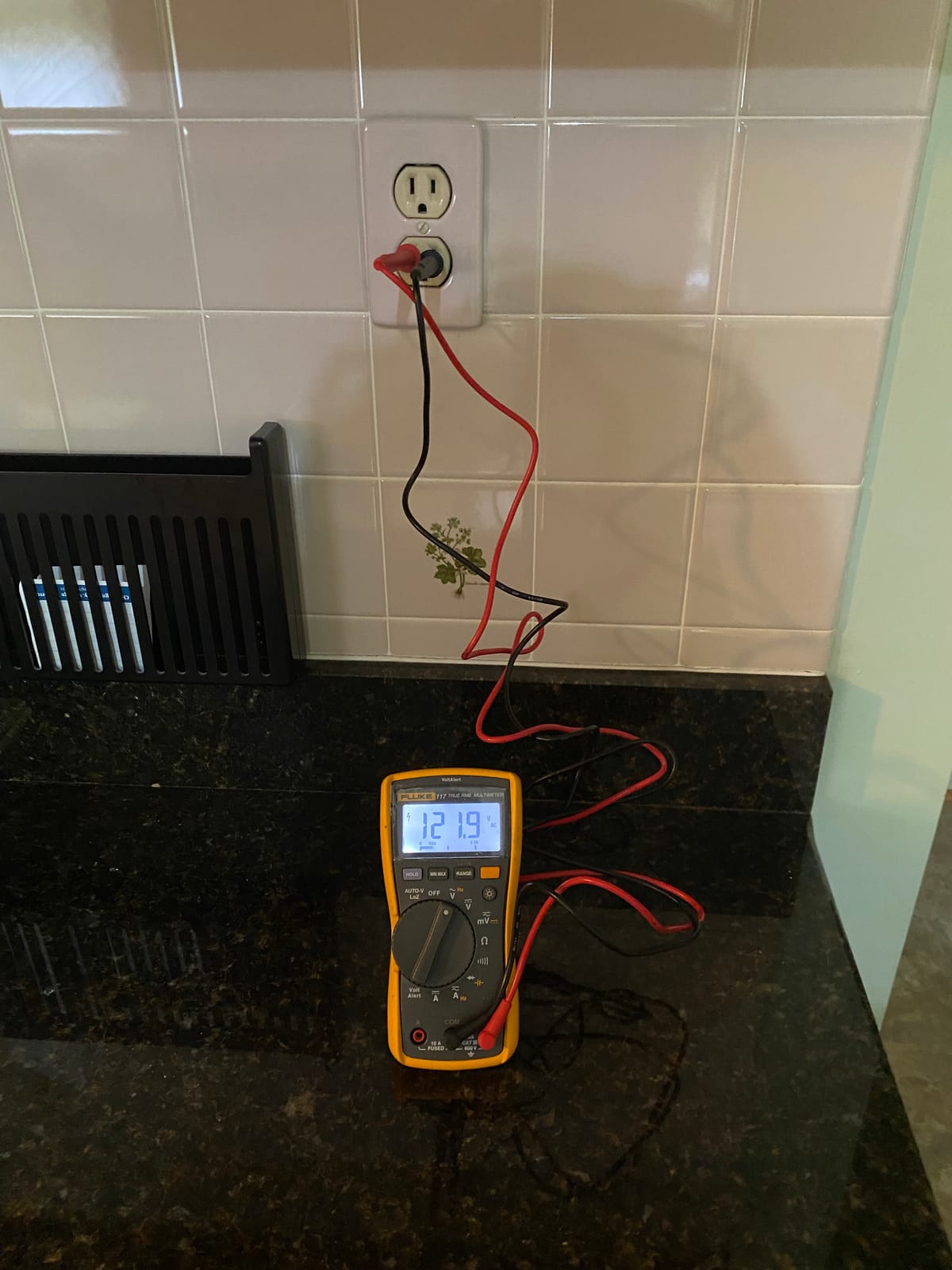
What the Fluke 117 handles that cheaper meters do not
True RMS matters more in a modern house than most sellers admit. LED drivers, dimmers, smart switches and appliance electronics all produce chopped-up waveforms, and a meter that calculates an averaged RMS reading will under-report on them. The 117 reads the true waveform, so if a dimmer is outputting 60V instead of 120V you see 60V, not a flattering 100V.
The min/max/average recording mode is the other quiet win. Set the meter in a junction box, clamp a probe on the wire, walk away for twenty minutes while a load cycles, and the meter holds the peak for you.
Where the Fluke 117 falls short
Current measurement requires the circuit to be broken and current routed through the meter, which is a homeowner-unfriendly way to check amps. There is no milliamp range either, so anyone testing a GFCI or a thermostat control loop will end up buying a second instrument, which is exactly the criticism one long-term reviewer raises after living with it.
It is also the most expensive meter on this list by a wide margin. For most people, that cost is justified by the LoZ mode alone. If you only ever check batteries and fuses, it is more meter than you need.
2. Fluke 15B+ – Best for Panel and 1000V Work
Fluke 15B+ Digital Multimeter, for Electrical Applications, Measures AC/DC Voltage and Current Measurements up to 1000V and 10A, Along with Resistance, Continuity, Diode, and Capacitance Capabilities
1000V AC and DC
CAT III 600V
10A AC and DC
Capacitance
Pros
- 4.8 average rating with 88 percent five-star reviews
- Measures AC and DC up to 1000V and 10A
- Capacitance handles motor run caps and HVAC
- CE CSA ETL IEC 61010-1 and UL certified
Cons
- Costs about twice as much as entry-level meters
- No non-contact voltage detector
- No True RMS on this model
The 15B+ is the meter I would hand to someone who is actually going to open a panel and work on a 240V circuit. Its voltage range goes to 1000V on both AC and DC, and it is rated CAT III 600V, which is the correct category for a residential panel or receptacle circuit. Most budget meters stop at 600V and that is fine, but it leaves no headroom if you ever probe across a feed.
It also measures both AC and DC current up to 10A through a dedicated input, which matters if you are checking whether a 240V appliance circuit is pulling what it should.
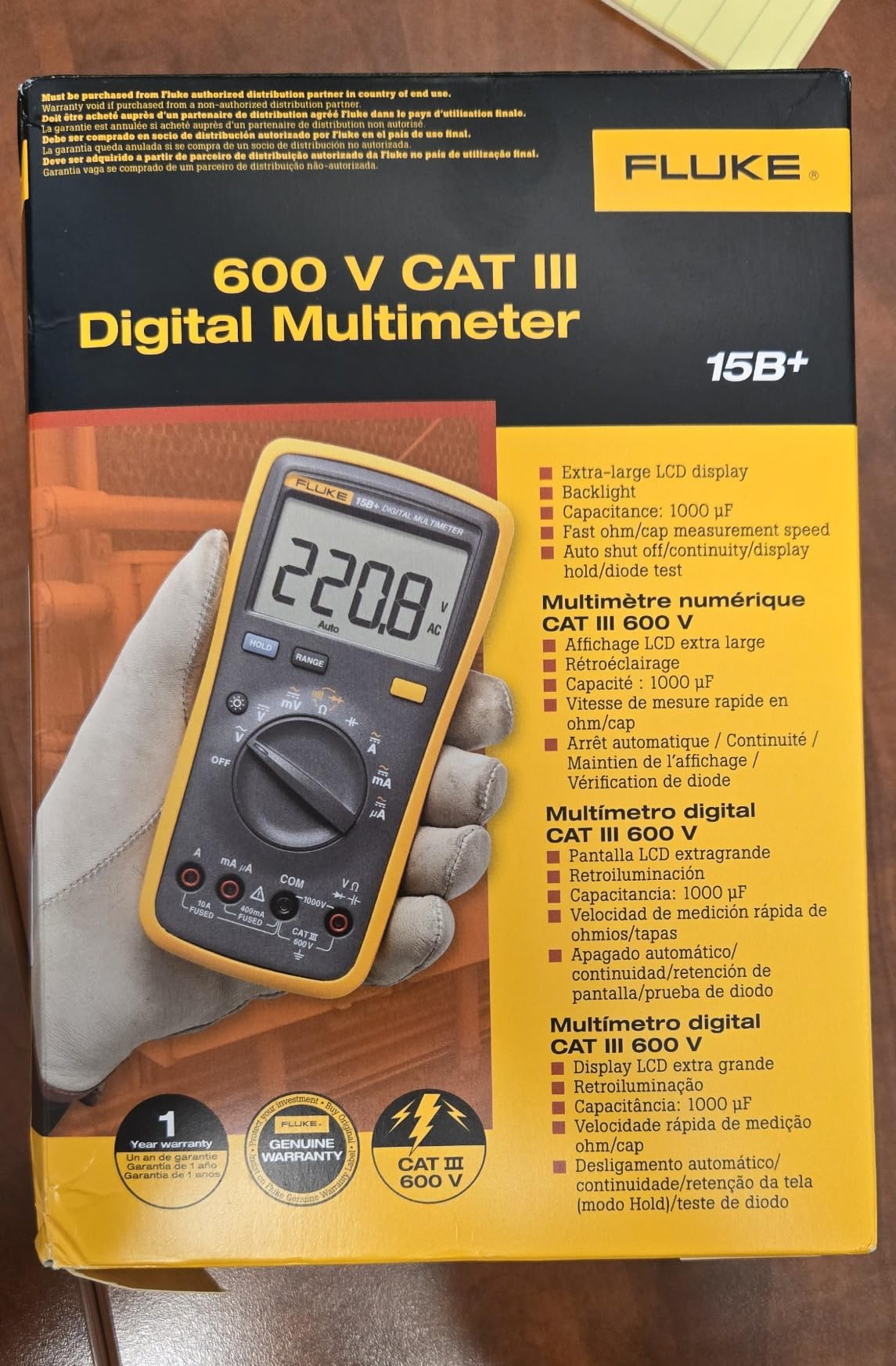
The capacitance function is the sleeper feature. If you have a heat pump, a central air unit or an older condenser with a run capacitor, capacitance is how you tell a failed capacitor from a seized compressor, and very few meters in this price bracket offer it. The 4.8 rating with 88 percent five-star reflects owners who bought it for electrical work specifically and never looked back.
Certification is thorough here, with CE, CSA, ETL, IEC 61010-1 and UL all listed. That matters more than it sounds, because the CAT rating is only as good as the standard it was tested to.
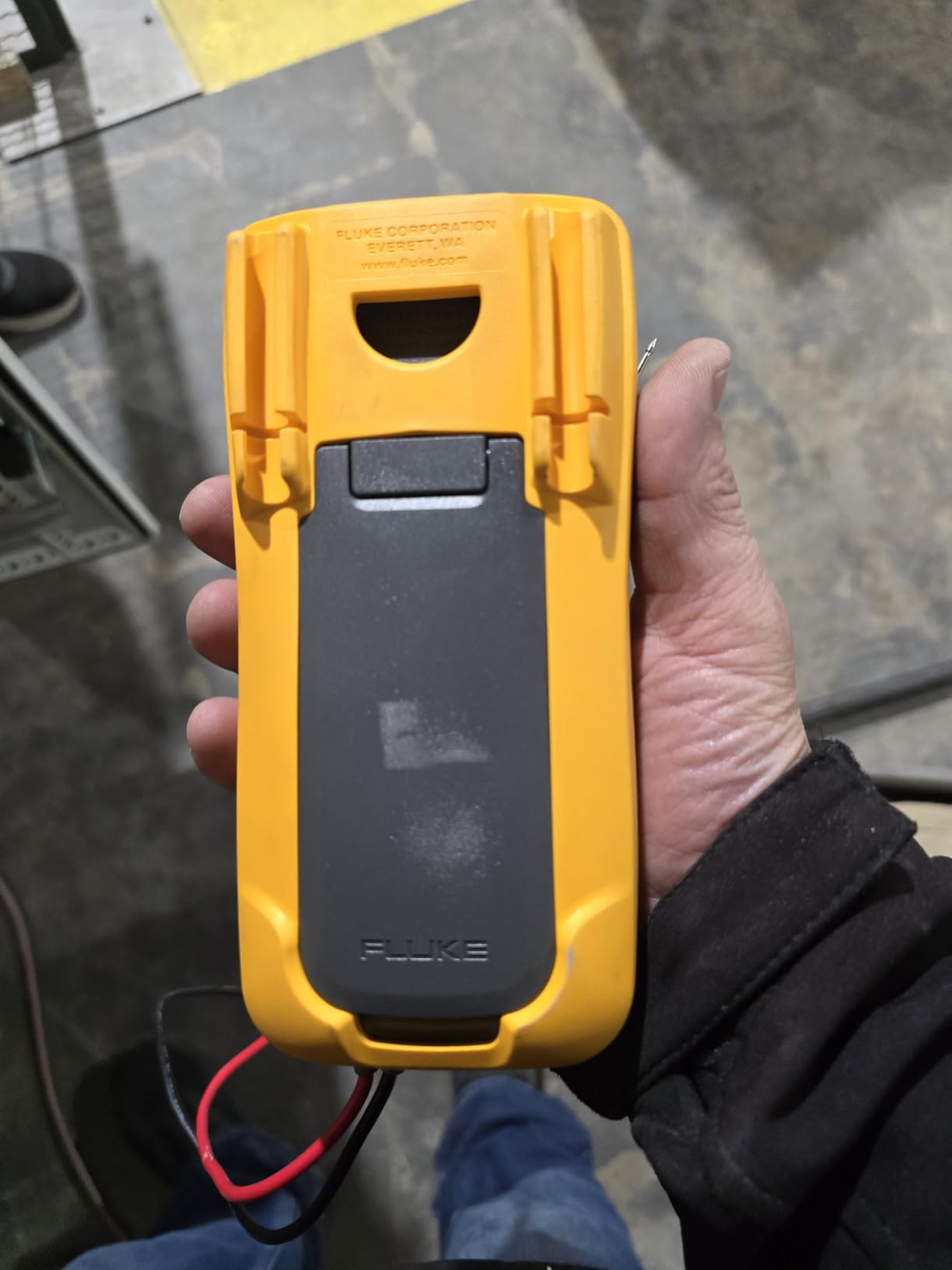
Why the certification list is not marketing filler
A CAT rating is only meaningful if the meter was independently tested to IEC 61010-1 at that category and voltage. Cheap meters routinely print a CAT number on the housing that no lab has verified. When the meter is UL, ETL or CSA listed, the claim has been audited, which is a meaningful difference when you are probing inside a panel that may still have a fault.
For a first-time homeowner this is the meter to buy if you want the most conservative option available.
What you give up compared with the Fluke 117
No True RMS, which means LED and dimmer loads get an averaged reading. No non-contact detection, so you have to physically probe to find a live conductor, and the meter gives you no backlight. It also costs roughly twice what an entry-level meter does without adding the two safety features that reduce risk.
3. Klein Tools MM720 – Best Low Impedance Meter for Dead-Circuit Diagnosis
Klein Tools MM720 Digital Multimeter, Auto-Ranging TRMS, Low Impedance (LoZ), 1000V AC/DC Voltage, 10A AC/DC Current, 60 MOhms Resistance
1000V AC and DC
Low impedance mode
True RMS auto-range
60 MOhm
Pros
- Low impedance mode rules out phantom voltage on de-energized wiring
- Auto-ranging True RMS on non-linear loads
- Reverse-contrast LCD readable in bright and dark
- Adds temperature capacitance frequency and duty cycle
Cons
- Smallest review base here at 396 reviews
- Resistance and current need separate lead jack changes
- Magnetic hanger is a separate accessory
The Klein MM720 brings the same low impedance idea as the Fluke 117 to a meter with a much higher voltage ceiling. It measures up to 1000V on AC and DC, resistance to 60 MOhm, and it is rated CAT IV 600V and CAT III 1000V, which puts it above household requirements entirely.
That LoZ mode is the reason to buy it. When a cable reads 30 volts but you know the breaker is off, the Klein loads the line and the reading collapses, telling you it was capacitive coupling rather than a real feed.
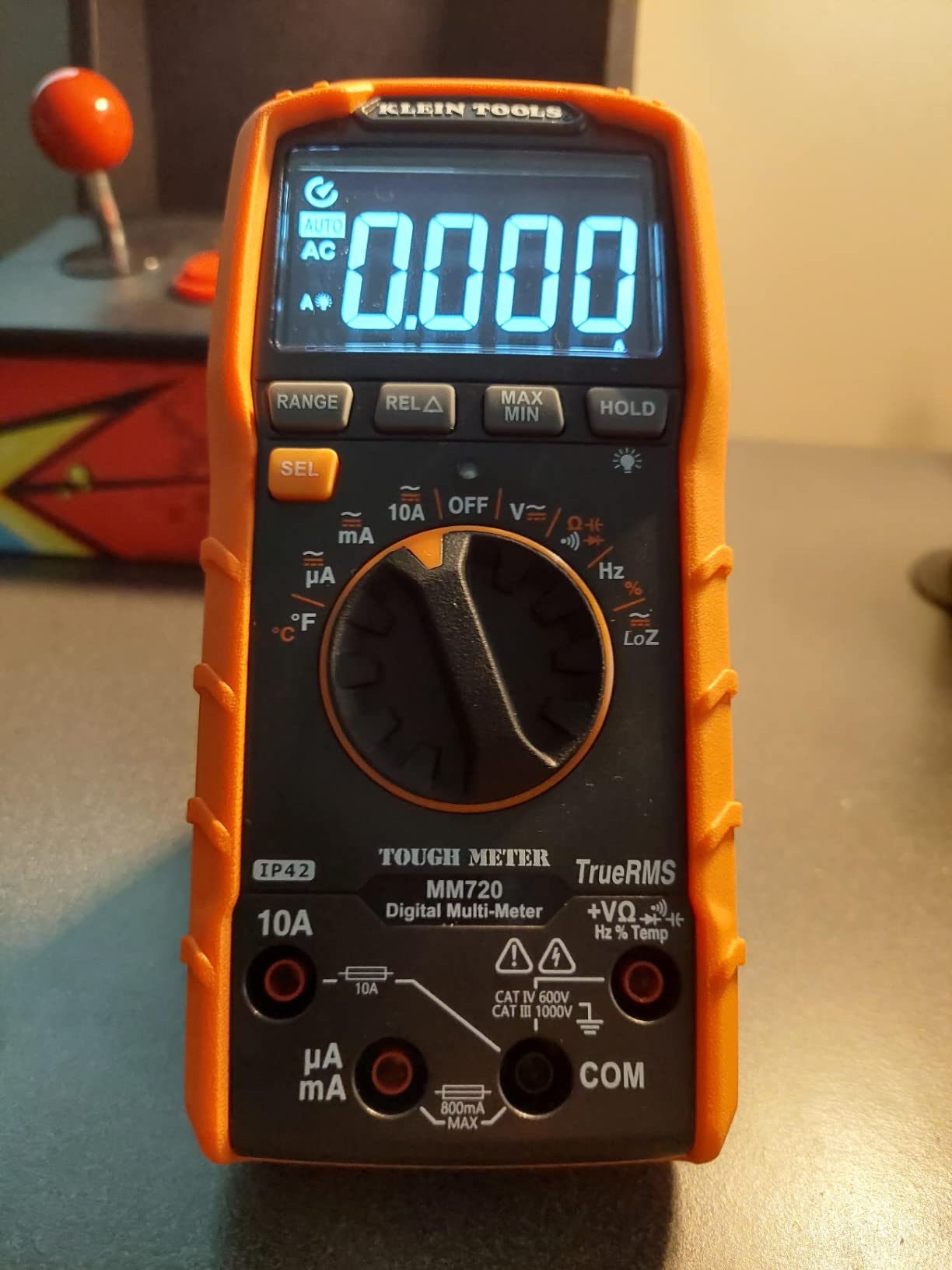
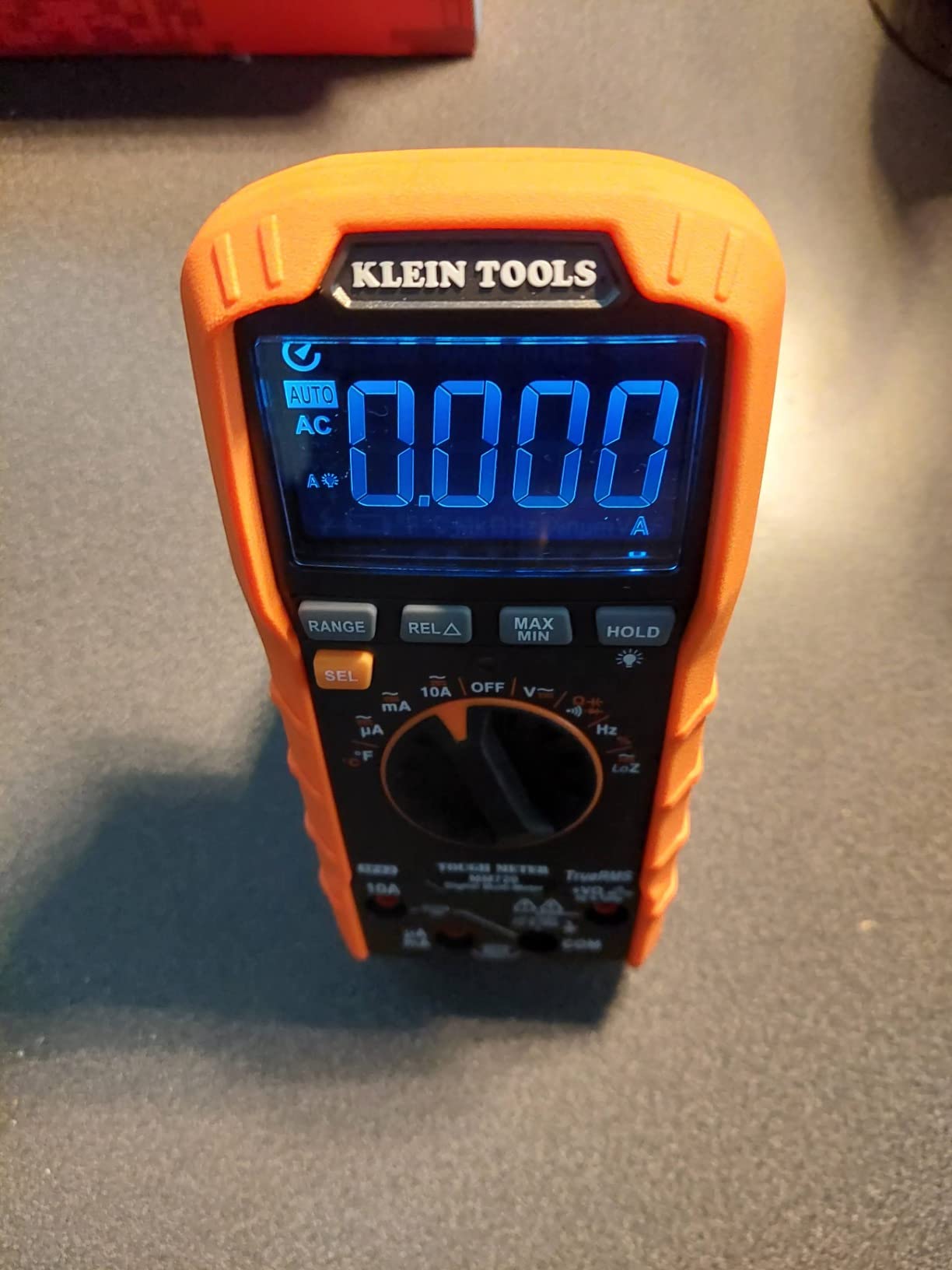
Auto-ranging and True RMS together mean you set the dial to a function and stop thinking about the range. Owner feedback centres on the LoZ mode being genuinely useful and on the reverse-contrast display, which stays readable in a sunlit garage and in a dark attic with the same setting.
Temperature, capacitance, frequency and duty cycle push it past basic household needs, and test lead holders on the back plus a kickstand make it workable with gloves on.
Is CAT IV worth anything in a house?
CAT IV is the category for the point of origin of an installation, which in plain terms means the service entrance and meter base outside the house. You will rarely probe there. What it really tells you is that the meter was built with transients in mind at every range, and that the 1000V ceiling gives you room to work around a service conductors without worrying about the top of the scale.
For pure household work the 600V CAT III figure is what you are buying, and this meter has it in reserve.
What the smaller review base means for you
At 396 reviews this is by far the least proven meter in the group, so long-term durability reports are thin. The extra functions also mean more lead jack changes, since resistance and current sit on separate inputs, and that is one more thing to get wrong when your hands are cold and the panel is dark.
4. Klein Tools MM325 – The All-Round Homeowner Favourite
Klein Tools MM325 Multimeter, Digital Manual-Ranging 600V AC/DC Voltage Tester, Tests Batteries, Current, Resistance, Diodes, and Continuity
Manual ranging
Lead-alert LEDs
Backlit LCD
CAT III 600V
Pros
- Lead-alert LEDs flag wrong test lead placement
- 4.7 rating with 85 percent five-star reviews
- Backlit LCD plus test lead holders and kickstand
- CAT III 600V from an established tool brand
Cons
- Manual ranging on every measurement
- Resistance tops out at 2 MOhm
- Magnetic hanger is sold separately
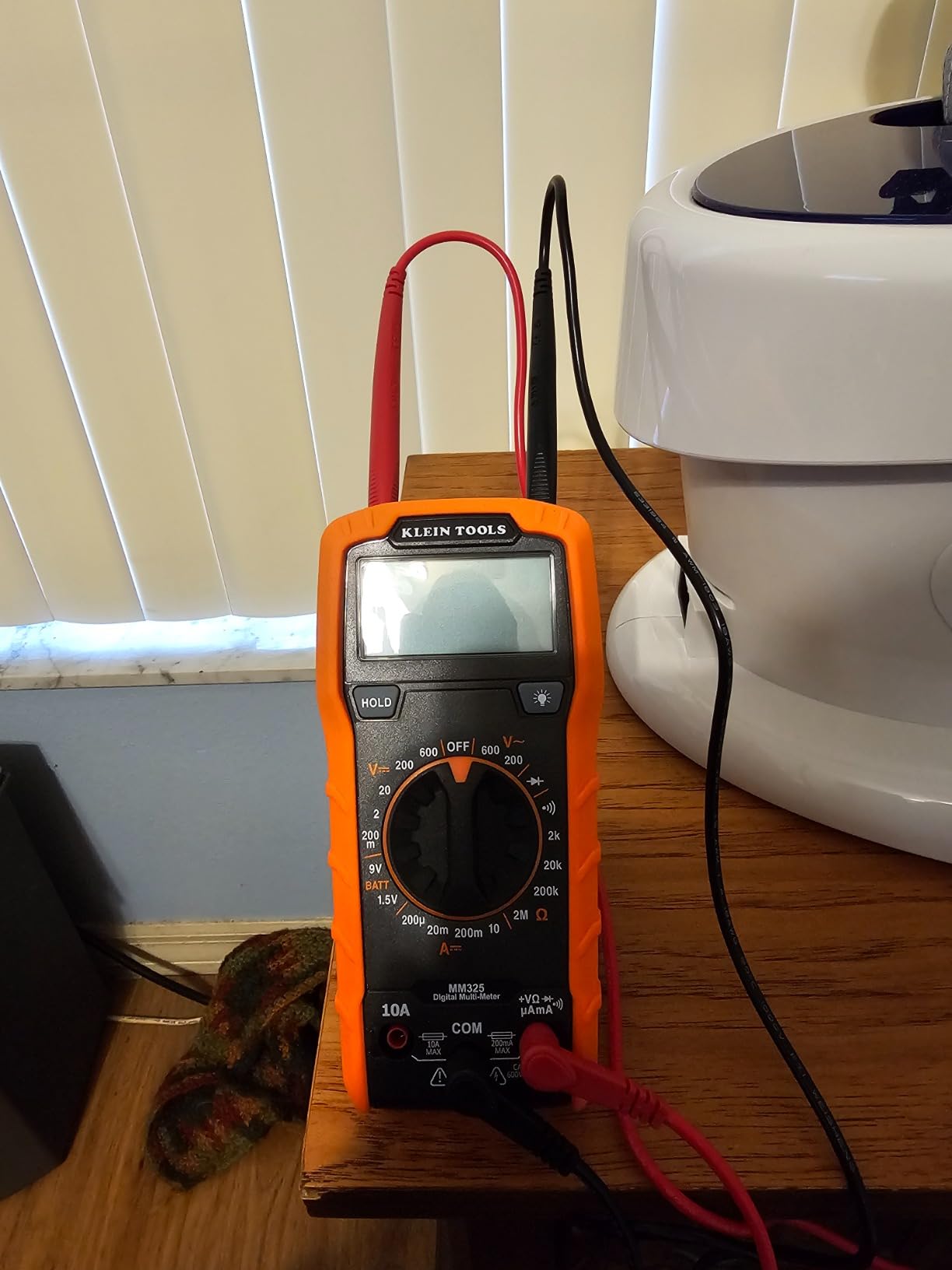
This is the meter I recommend when someone tells me they are new to this. The MM325 covers AC and DC voltage to 600V, 10A of DC current, resistance to 2 MOhm, plus continuity, diode and battery test functions. That is the full core set for household work and nothing surplus.
The lead-alert LEDs are the reason it beats cheaper meters for beginners. Plug the leads into the wrong jacks and the LEDs light up, which prevents the single most common beginner error, probing a live circuit with the leads in the amps input. That is a good way to destroy a meter or yourself.
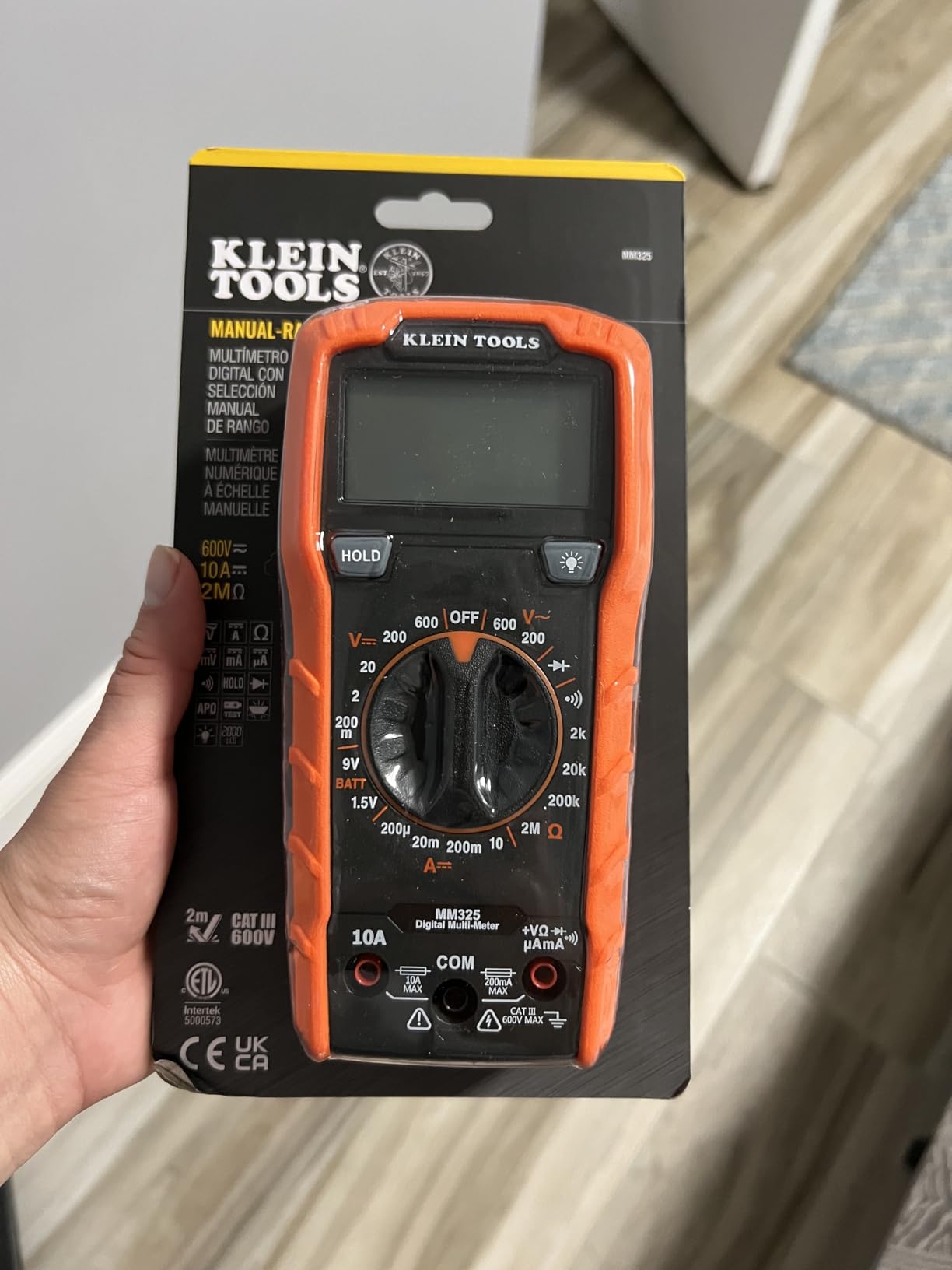
It has a backlit LCD, test lead holders moulded into the back and a kickstand, so you can see the reading and keep the probes in place at the same time. The 4.7 rating with 85 percent five-star and only 2 percent one-star is one of the cleanest rating distributions in the group, and owners repeatedly single out the LEDs and the backlight as the features that make it feel safe to use.
It also carries a CAT III 600V rating from a brand that toolmakers actually specify, which is more than several cheaper options can say.
Is manual ranging a real problem for a beginner?
It is an inconvenience, not a hazard, and the trade-off is honest. You pick the range yourself, so if you are unsure whether a reading is on a 200-ohm or 2000-ohm scale, you read the dial twice. Practice makes it automatic, but if you would rather never think about it, an auto-ranging model is a better fit.
The 2 MOhm resistance ceiling is fine for continuity work and for most electronics, but it will not read high-value resistors, which is irrelevant to household wiring anyway.
What you should know before buying it for a panel
There is no non-contact detection and no low impedance mode. That means you will be probing to find live circuits, and a de-energized cable with a phantom charge may still read a few volts until you pull it. Confirm dead circuits with a tester that is designed for that job rather than relying on a single probe reading.
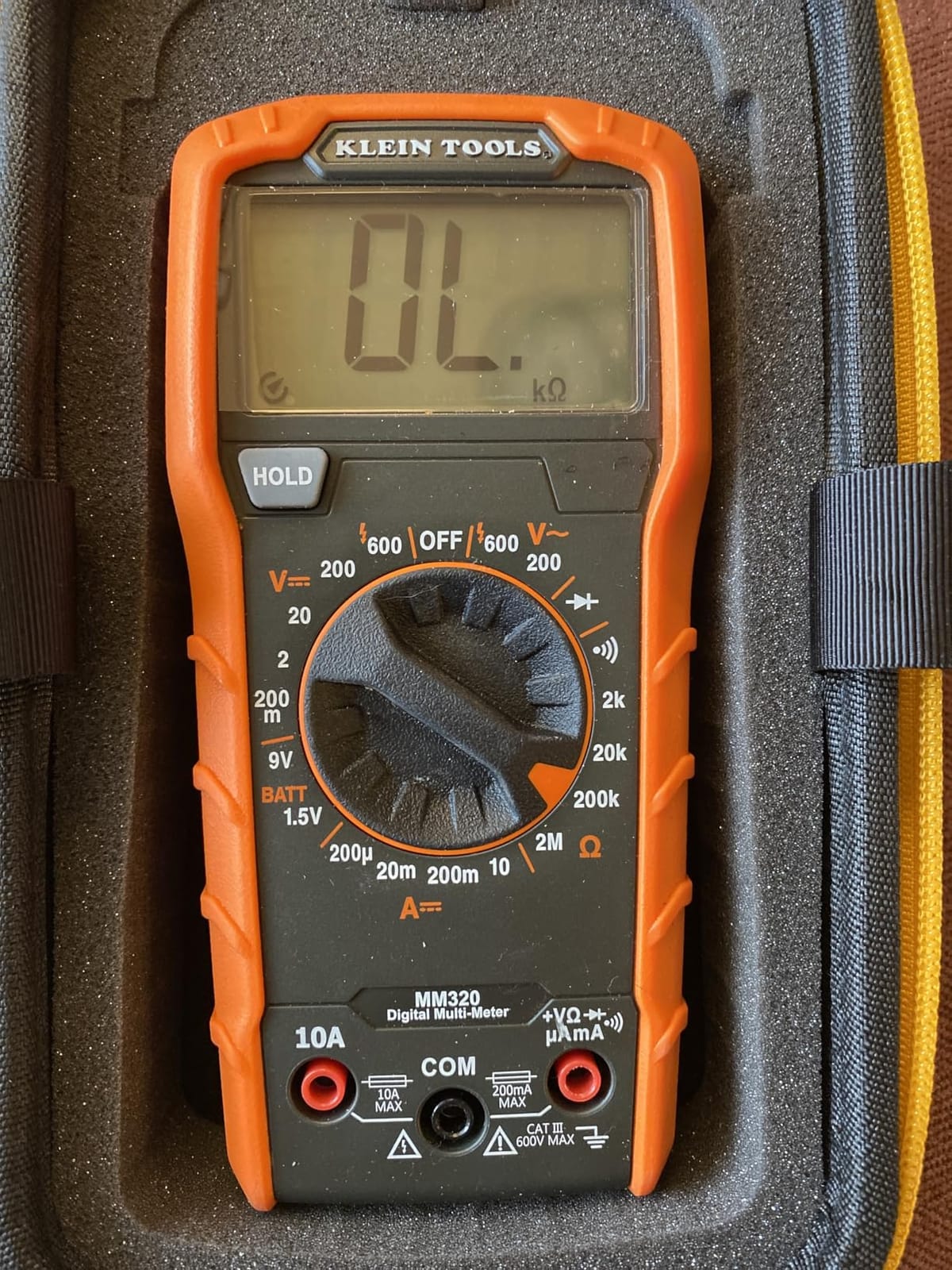
5. Klein Tools MM320KIT – Best All-in-One Kit for Outlet and Wiring Checks
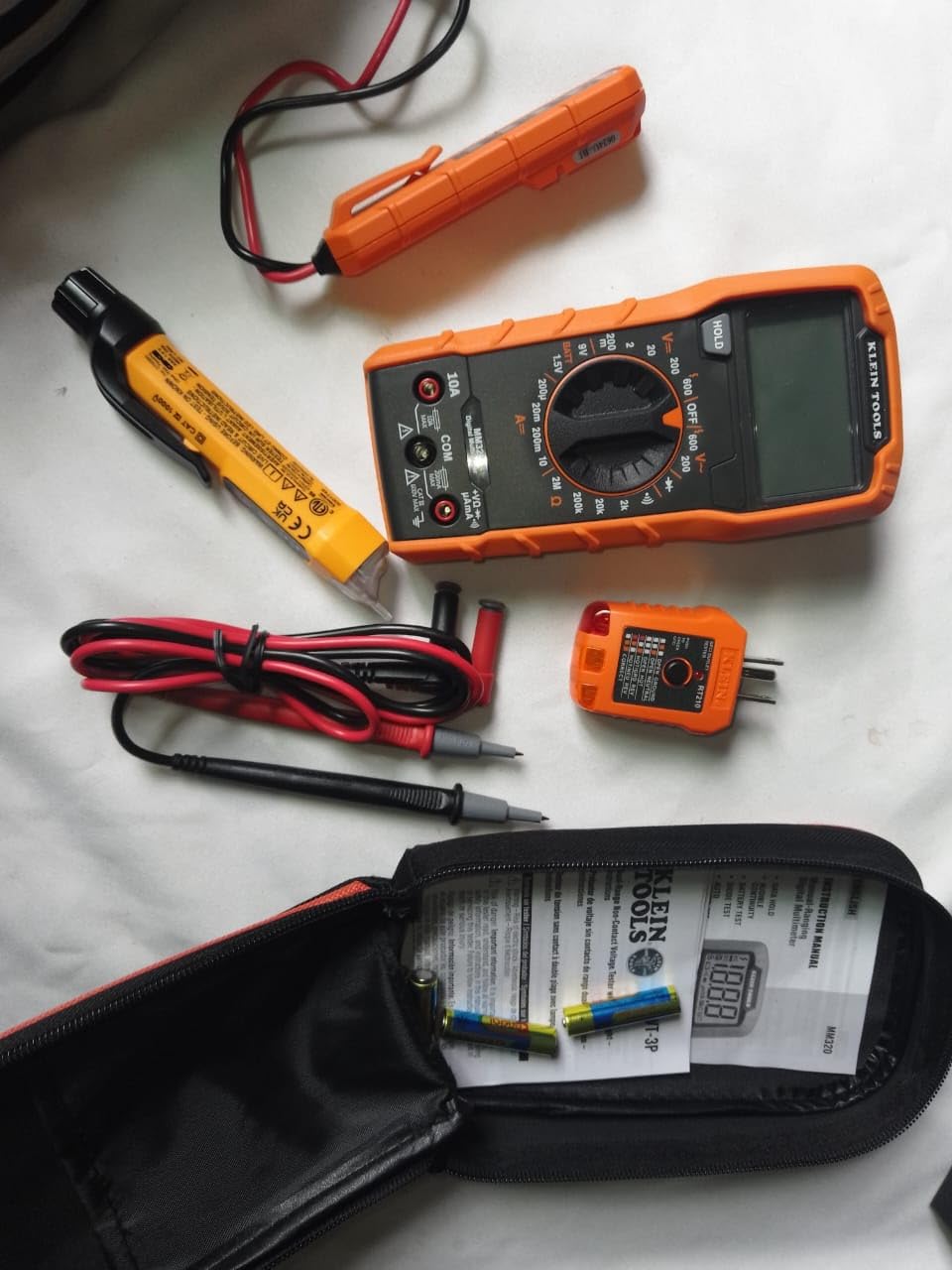
Klein Tools MM320KIT Digital Multimeter Electrical Test Kit, Non-Contact Voltage Tester, Receptacle Tester, Carrying Case and Batteries
Multimeter plus NCVT plus receptacle tester
Carrying case
Pros
- Receptacle tester flags open ground and hot-ground reversed
- NCVT3P voltage tester doubles as a flashlight
- ET45 tester covers 28V-240V AC and 32V-330V DC
- Carrying case and batteries included
Cons
- Included MM320 is manual-ranging
- Resistance range limited to 2 ohm
- Heavier and bulkier than a single meter
Most homeowner toolkits are missing one of three things: a meter, a way to find a live wire without touching it, and a way to know what is wrong with an outlet. This kit is all three in one box, and the 4.7 rating from 2515 reviews reflects people treating it as a single purchase that replaces assembling three tools separately.
The RT210 receptacle tester is the component that earns its keep. It identifies open ground, reverse polarity, open hot, open neutral and hot/ground reversed, on both standard and GFCI receptacles. That single function replaces a lot of guessing when an outlet refuses to power a lamp.
The NCVT3P non-contact tester detects 12-1000V AC and 70-1000V AC and has a built-in flashlight, which is exactly what you want in an unlit basement. The ET45 tester adds AC and DC voltage coverage from 28V to 240V AC and 32V to 330V DC with its own lead holder.
Owners most often cite the receptacle tester diagnostics and the flashlight as the features that come up in daily use, and the case means the whole set lives together instead of scattering.
Is it better to buy the kit or the meter and add tools later?
If your priority is outlet work and live-wire detection, the kit wins because the receptacle tester is cheap to buy standalone but easy to forget. If your priority is resistance, current or anything measured with probes, buy a meter on its own, because the MM320 inside the kit is manual-ranging and its resistance range is limited.
A reasonable path is to start with the kit and add a proper auto-ranging meter once you outgrow the manual dial.
What to watch out for
At 1.6 pounds in a case, this is bulkier to carry than a single meter, and stacking three tools means three things to charge or replace batteries on. The included MM320 is also the older manual-ranging design, so expect to set ranges by hand.
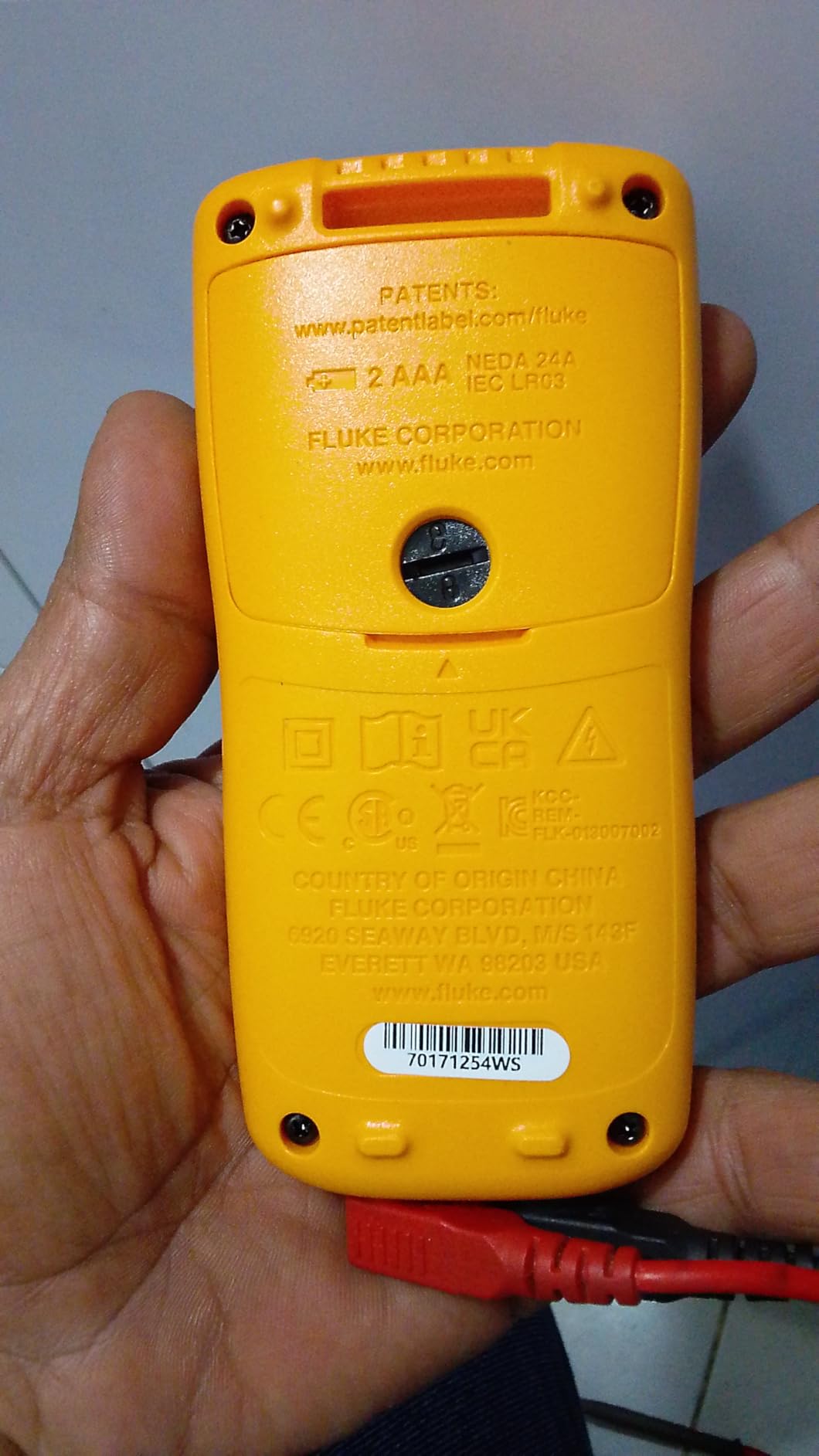
6. Fluke 101 – Best Compact Meter for a Tool Pouch
FLUKE-101 Digital Multimeter
0.5 percent DC accuracy
CAT III 600V
160 g
Continuity buzzer
Pros
- Fluke accuracy in a small one-handed body
- CAT III 600V suited to residential panels
- Diode and continuity buzzer included
- At 160 g it fits a small tool pouch
Cons
- Entry-level feature set with no True RMS
- No display backlight for dark panels
- One-year warranty
The Fluke 101 is the smallest meter here by a wide margin, at 160 g and roughly the length of a screwdriver. If your electrical work happens in tight plenums, under bathtubs and inside cabinets, that footprint is a genuine advantage, and the 4.7 rating across 4391 reviews shows a lot of people bought it for exactly that.
Basic DC accuracy is 0.5 percent, it carries a CAT III 600V safety rating, and it does continuity with a buzzer and a diode test. For checking an outlet, testing a switch or confirming a fuse, that is the whole job list.
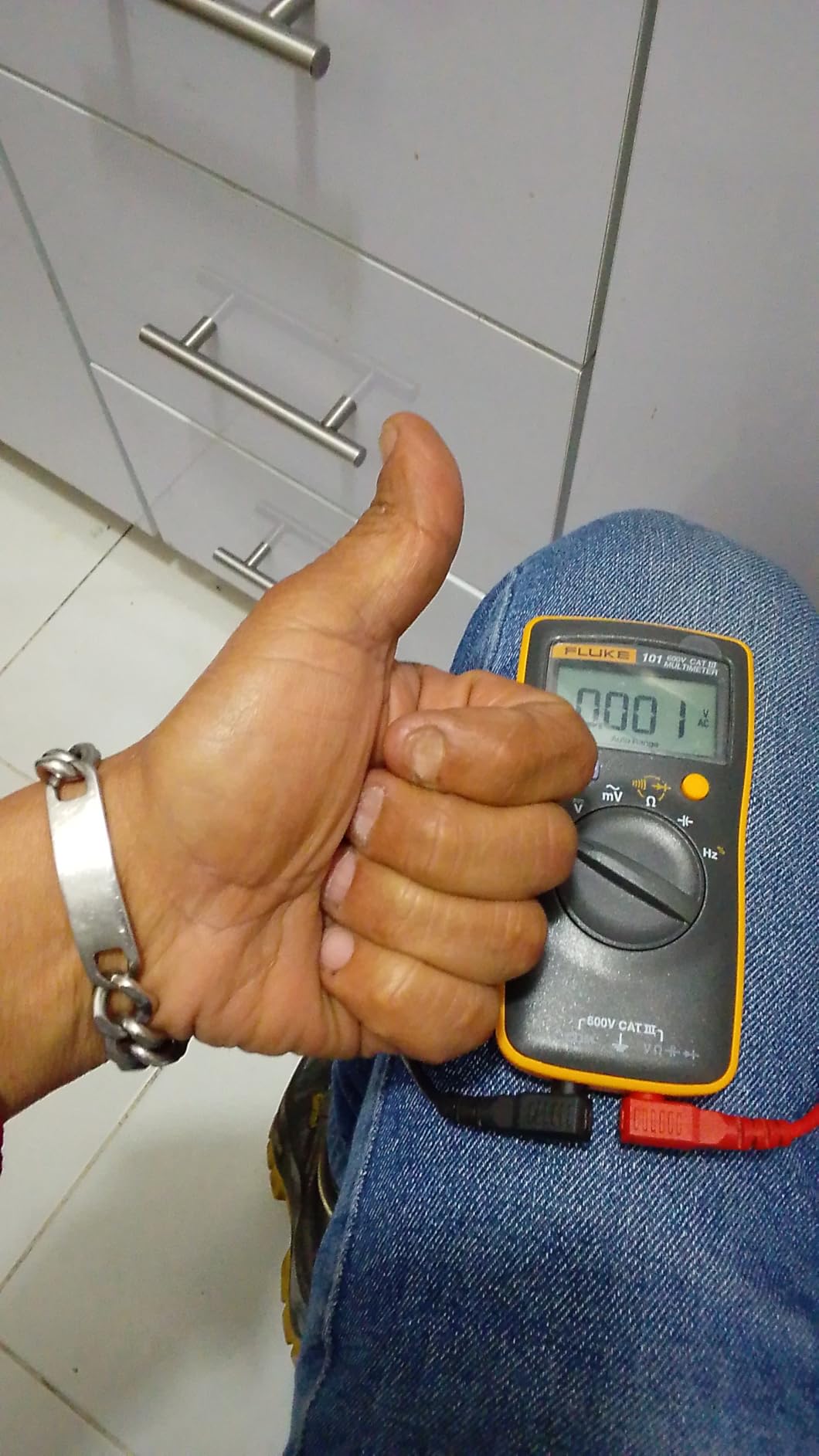
Owners consistently describe it as an introduction to the brand or a secondary meter kept in the car, with confidence in Fluke accuracy paired with the acknowledgement that the feature set is deliberately minimal next to the 117 and the 15B+. That framing is fair. It is a tool for quick confirmation, not for diagnosing an intermittent fault.
It is also the one to buy if you want Fluke build quality without the Fluke price of the top picks.
When a meter this small is the right choice
Reach for the 101 when the work is about access rather than analysis. Probing behind a washing machine, checking a doorbell transformer in a soffit, confirming a dimmer input is live, all of these favour a small body you can hold in one hand while the other hand holds a light.
The single-setting resistance function also means fewer dial positions to misread under pressure.
What the minimal feature set costs you
No backlight, so in a genuinely dark panel you are squinting at an unlit display with a torch in your teeth. No True RMS, no capacitance, no temperature, no NCVT, and a one-year warranty. If you are chasing an LED driver that only misbehaves on a dimmer setting, this is the wrong tool.
7. Extech EX330 – Best for Temperature Checks and HVAC Work
Extech EX330 Autoranging Mini Multimeter, 12-Function, NCV, Type K
4000-count display
One inch tall digits
NCV detector
Type K probe
Pros
- Twelve functions in a compact body
- One inch tall digits on a 4000-count display
- Non-contact AC detector with LED and beeper
- Type K temperature probe included for HVAC work
Cons
- Lowest average rating in this group at 4.4
- Smallest review base of the mainstream picks
- Much lower sales rank than the other meters
The EX330 is the pick if your home has a heat pump, a gas furnace with a condensing unit, or anything where you need to check temperature directly. The included Type K probe means you can check supply and return air temperatures, check an oven thermocouple, or find a cooling coil that is not chilling, without buying a separate thermometer.
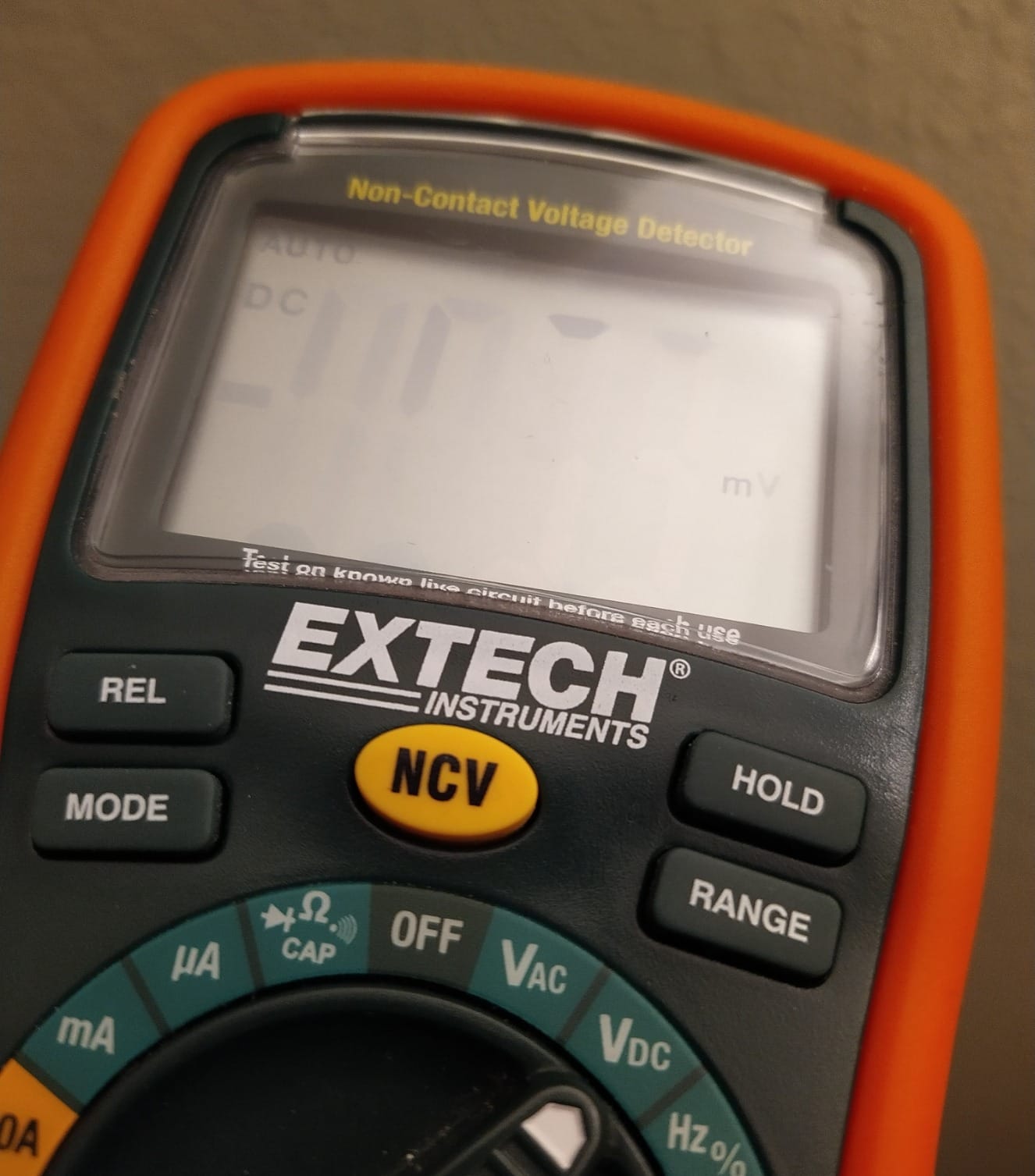
It also does auto-ranging across 12 functions, and the 4000-count display with one-inch tall digits is unusually easy to read for its size.
Owners value the large digits, the mini form factor and the temperature probe, and the rubber holster with integrated tilt stand holds the meter at a readable angle on a floor or a bench. The non-contact AC detector with a red LED and audible beeper is a sensible addition at this level.
Be aware that at 4.4 across 880 reviews this is the lowest-rated and thinnest-reviewed mainstream pick here, with 69 percent five-star, so the ownership experience is more mixed than the Flukes and Kleins in this list.
Is the temperature function worth a lower rating?
If you own an HVAC system, absolutely. A contact temperature reading is the fastest way to tell whether a furnace is actually firing, whether a condenser fan is running when it should be, or whether a thermostat is calling for heat at all. Several meters here have a temperature mode, but this one ships with the probe in the box.
Its sales rank sits far below the other picks, which tells you it is not moving at the same rate, so the review base will stay small for a while.
What you are accepting
It is a 4000-count meter, so resolution is a step below the 6000-count True RMS models, and auto-ranging here is conventional rather than smart, meaning you still choose the function. The looser rating spread suggests some owners hit rougher edges than the rest of the list.
8. AstroAI 6000 Count True RMS – Best Value for Feature Coverage
AstroAI Digital Multimeter, True RMS 6000 Counts Auto-Ranging Volt Meter for Automotive & Home Electrical Troubleshooting, AC/DC Voltage Current Resistance Continuity Capacitance Temperature Tester
True RMS
6000 counts auto-ranging
Capacitance and temperature
Pros
- True RMS on both AC voltage and AC current
- Measures nine quantities including capacitance and temperature
- Double ceramic fuse F400mA/600V and F10A/600V
- Backlit screen with data hold auto shut-off and kickstand
Cons
- Frequency counter upper limit is overstated
- Transistor hFE test reads about half true gain
- Adapter pins arranged C-B-E rather than B-C-E
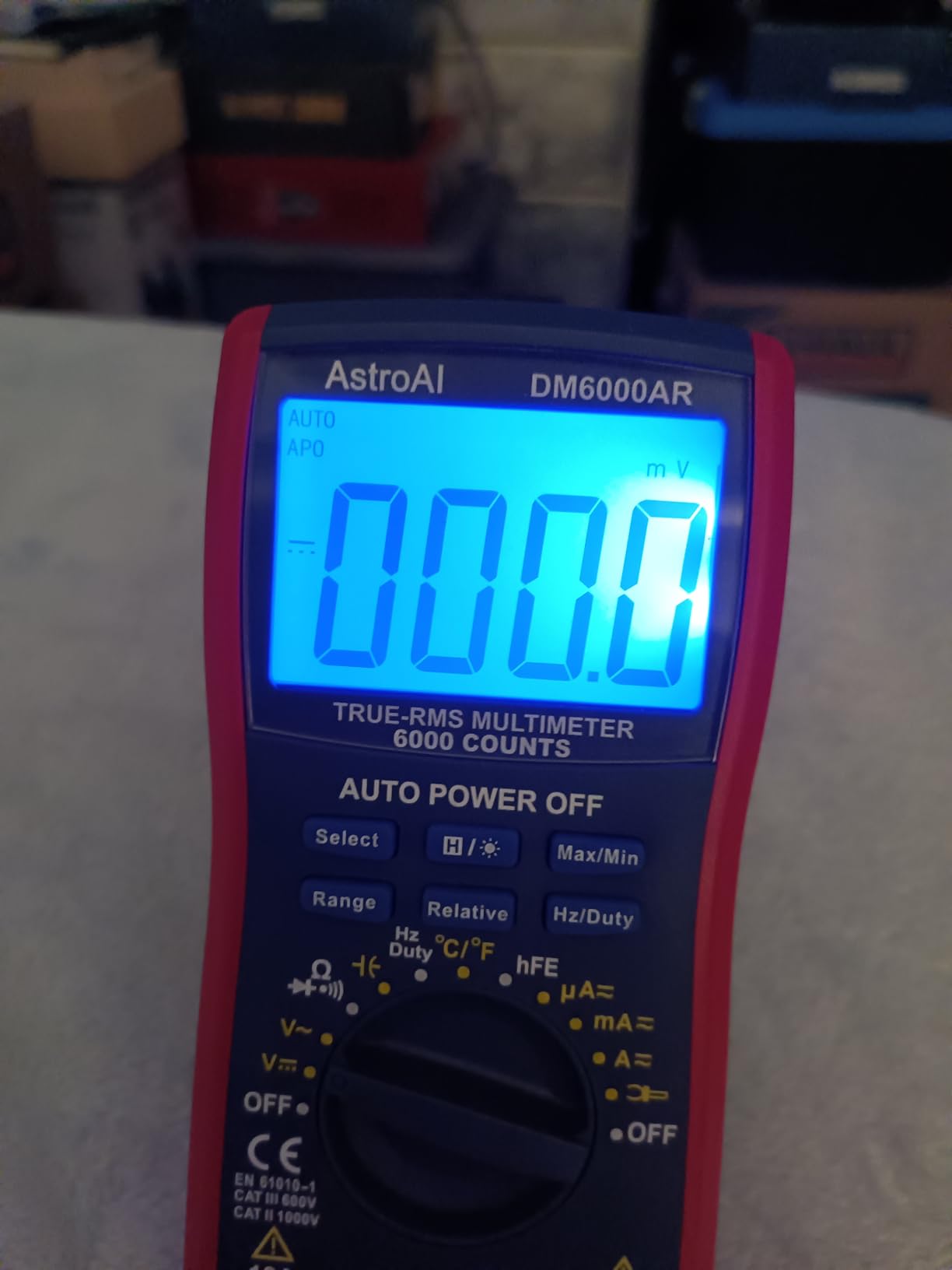
This is the meter I keep reaching for when I want the most capability per pound of wallet. It measures AC and DC voltage, AC and DC current, resistance, capacitance, frequency, duty cycle, diode, continuity and temperature, and it does all of it on a 6000-count auto-ranging display with True RMS on the AC side.
At 20183 reviews and a 4.6 average, it has one of the largest owner bases in the group, and the feedback pattern is consistent: people using it for electronics repair, HVAC work, car audio and general bench use report stable and accurate readings. A technical reviewer validated its DC, AC RMS, resistance, current and diode readings against an Amprobe AM-570 and found them spot on.
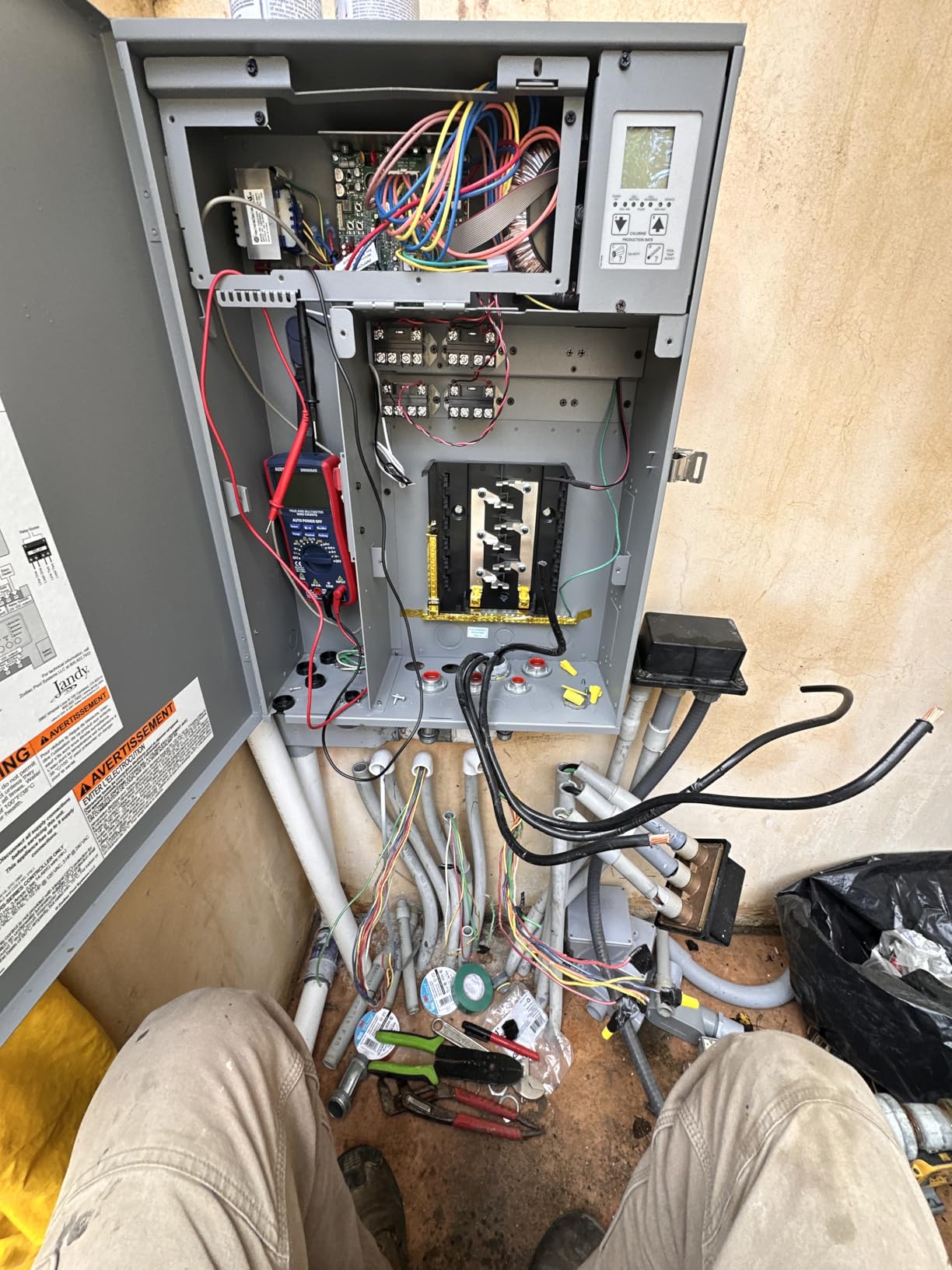
The safety engineering is real rather than nominal. It uses double ceramic explosion-proof fuses rated F400mA/600V and F10A/600V, so a mistake on the current input is far less likely to end the meter’s life than on a cheaper model with a glass fuse.
Auto-ranging removes the dial-guessing entirely, the backlit screen is large, and the kickstand and auto shut-off are the small touches you notice on a long job.
Where the feature list outruns the accuracy
Two functions are weaker than the rest and reviewers say so directly. The frequency counter claims an upper limit that the actual usable range does not reach, and the transistor hFE test uses a very low test current and reads roughly half of the true gain. Neither matters for household electrical work, which is exactly why the meter is a good buy here.
For household jobs you would use voltage, continuity, resistance, diode and current, and those are the functions with the validated readings.
Why the accessory arrangement annoys some owners
The multi-function transistor adapter is wired C-B-E instead of the conventional B-C-E, so testing a TO-220 package is awkward. The magnetic hanging loop is also loose enough to pick up small metal objects. Neither is a household issue, but both are the kind of detail that separates a tool built for hobbyists from one built for a technician.
9. Crenova MS8233D – Best for Live-Wire Checks with a Scaling Buzzer
Crenova MS8233D Multimeter TRMS 6000 Counts Auto-Ranging Live Wire NCV
True RMS 6000 counts
CAT III 600V
Buzzer scales with voltage
Pros
- CAT III 600V rating with two overload protection fuses
- True RMS 6000-count display with bright backlight
- Buzzer rate speeds up as detected AC voltage rises
- Leads alligator clips batteries and case in the box
Cons
- Non-contact detection is a separate mode from live measurement
- Only a one-year warranty
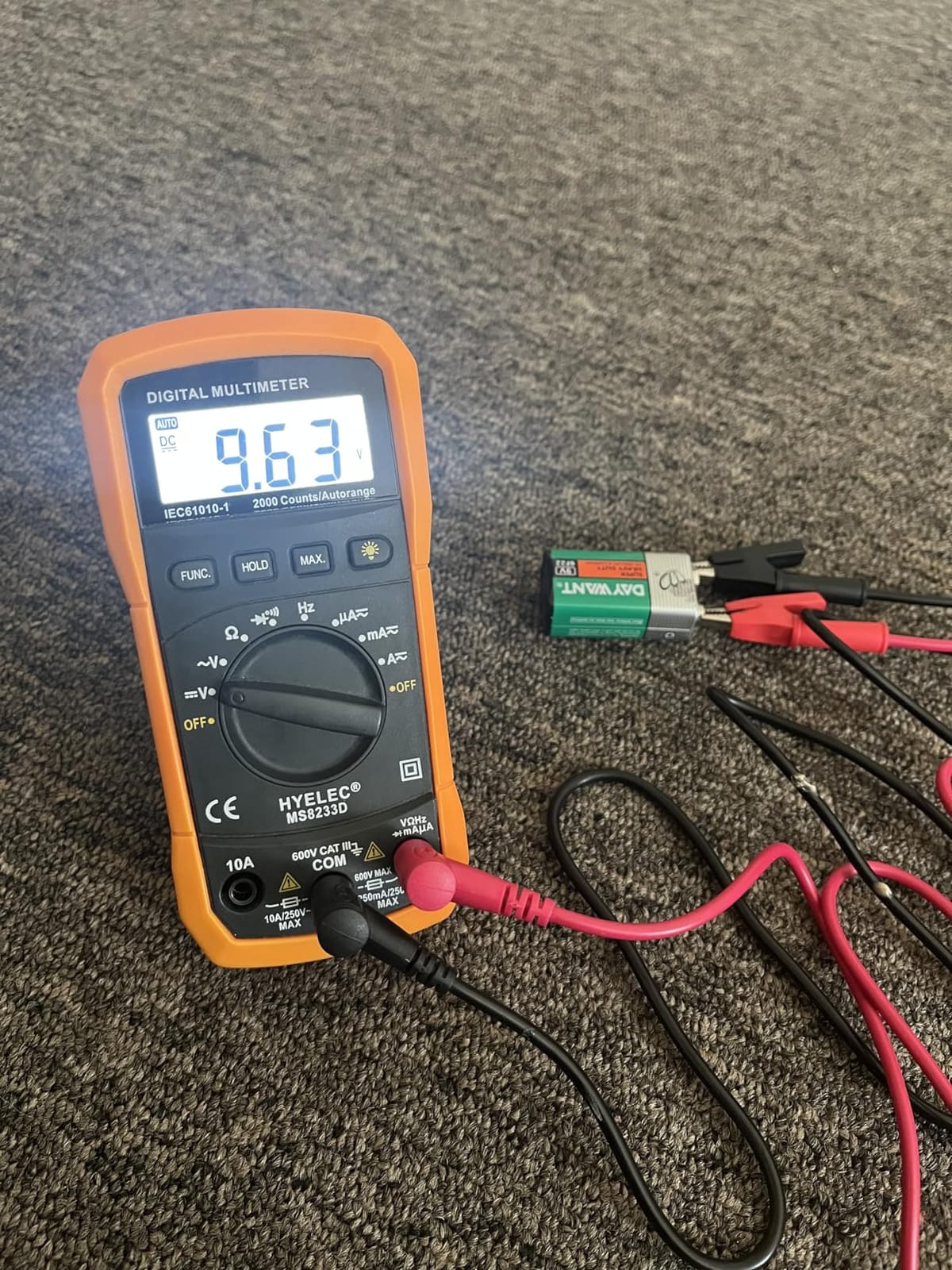
The Crenova MS8233D is a rare thing, a low-cost meter that carries a stated CAT III 600V rating to IEC61010-1 rather than leaving that line blank. That rating is the reason to take it seriously for household work, because it is the category a receptacle or panel circuit actually falls into.
The non-contact detector is the feature that stands out. Its buzzer does not just beep or stay silent, it beeps faster as the detected AC voltage increases, which gives you a rough sense of how close you are to a live conductor. Owners mention this specifically as useful for tracing through a wall or attic.
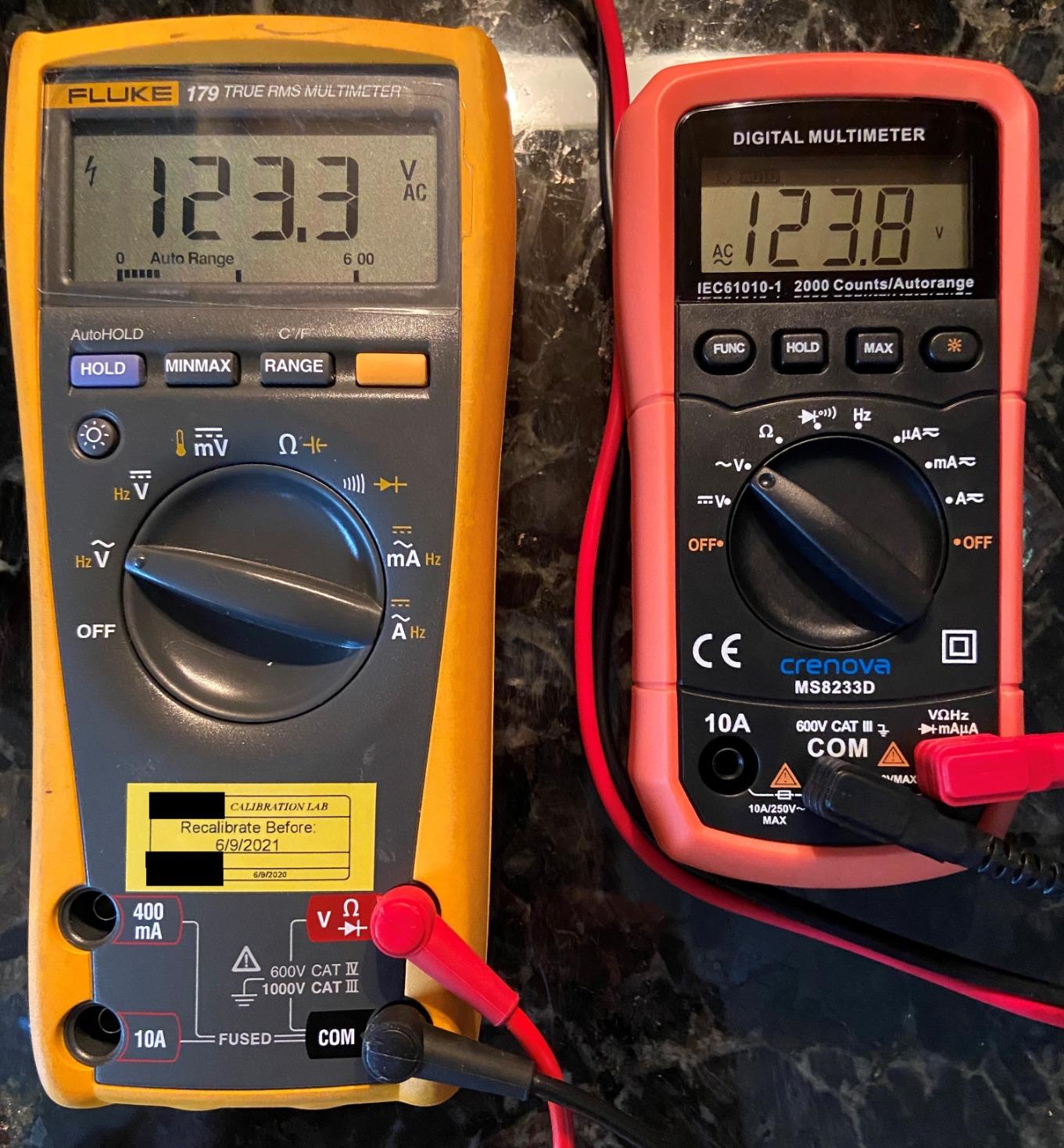
Everything else is competent. True RMS on a 6000-count backlit display, manual and auto ranging you can switch between, max and min value capture, data hold, a low battery indicator and auto power off, with two built-in fuses protecting all ranges. The box includes test leads, alligator clips, batteries and a carrying case, which is more than several rivals include.
At 4.6 with 9127 reviews and 77 percent five-star, it has the strongest star distribution in the group.
How the NCVT buzzer beats a simple beep
A binary non-contact detector tells you yes or no, which means sweeping it across a bundle of cables gives you one answer and no sense of which conductor is closest. A rate-modulated buzzer turns the same sweep into a gradient, so you can follow the strongest source rather than the first cable that trips it. That is a genuine advantage when you are hunting a feed for a room with no working switch.
It is an indication, not a measurement. Always confirm with probes before you touch anything.
The mode split that catches people out
Non-contact detection and live measurement are separate modes on this meter, so you move the dial between them, which means extra lead handling each time you switch. A meter that combines both in one mode saves a step. The one-year warranty is also the shortest in the group.
10. TESMEN TM-510 – Best for Non-Contact Scanning with a Built-in Flashlight
TM-510 Digital Multimeter, 4000 Counts, Smart Measurement, Auto-Ranging Voltmeter; Voltage Tester with Non-Contact Voltage Function, Measures AC/DC Voltage, Resistance, Continuity – Green
Smart auto mode
NCV with alarm
Built-in flashlight
CAT II 600V
Pros
- Smart auto mode picks the function and range for you
- Non-contact detection with audible and visual alarm
- Flashlight and backlit display for dark panels
- Storage bag leads and batteries included
Cons
- CAT II 600V rating sits below CAT III rivals
- Auto mode covers voltage resistance and continuity only
The TM-510 does something none of the other meters here do: a smart auto mode that detects what you are trying to measure and switches itself. Touch the probes across a pair of terminals and it reads voltage. Touch them across a battery and it drops to resistance automatically. In auto mode it falls back to resistance once the detected battery voltage drops below 0.8V.
For a homeowner who has never used a multimeter, that removes the single most intimidating part of the tool, which is the rotary switch and getting the range right.
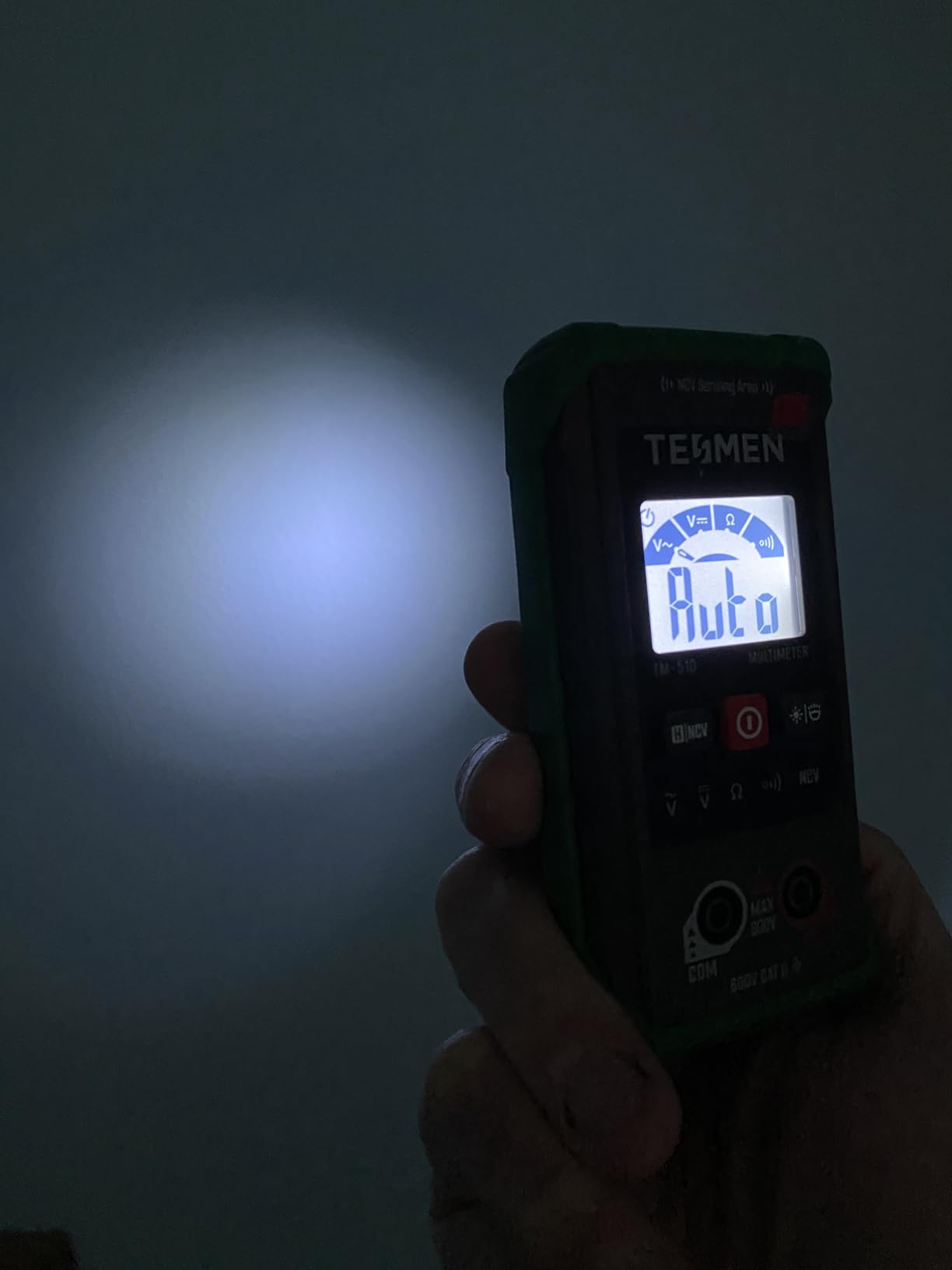
It also has non-contact voltage detection with both an audible and a visual alarm, plus a flashlight built into the meter body. The flashlight is a small thing until you are in a crawlspace with two hands full of probes, which is a real homeowner situation. The 4.6 rating across 13688 reviews with 76 percent five-star reflects a lot of people who bought it for quick household and car checks.
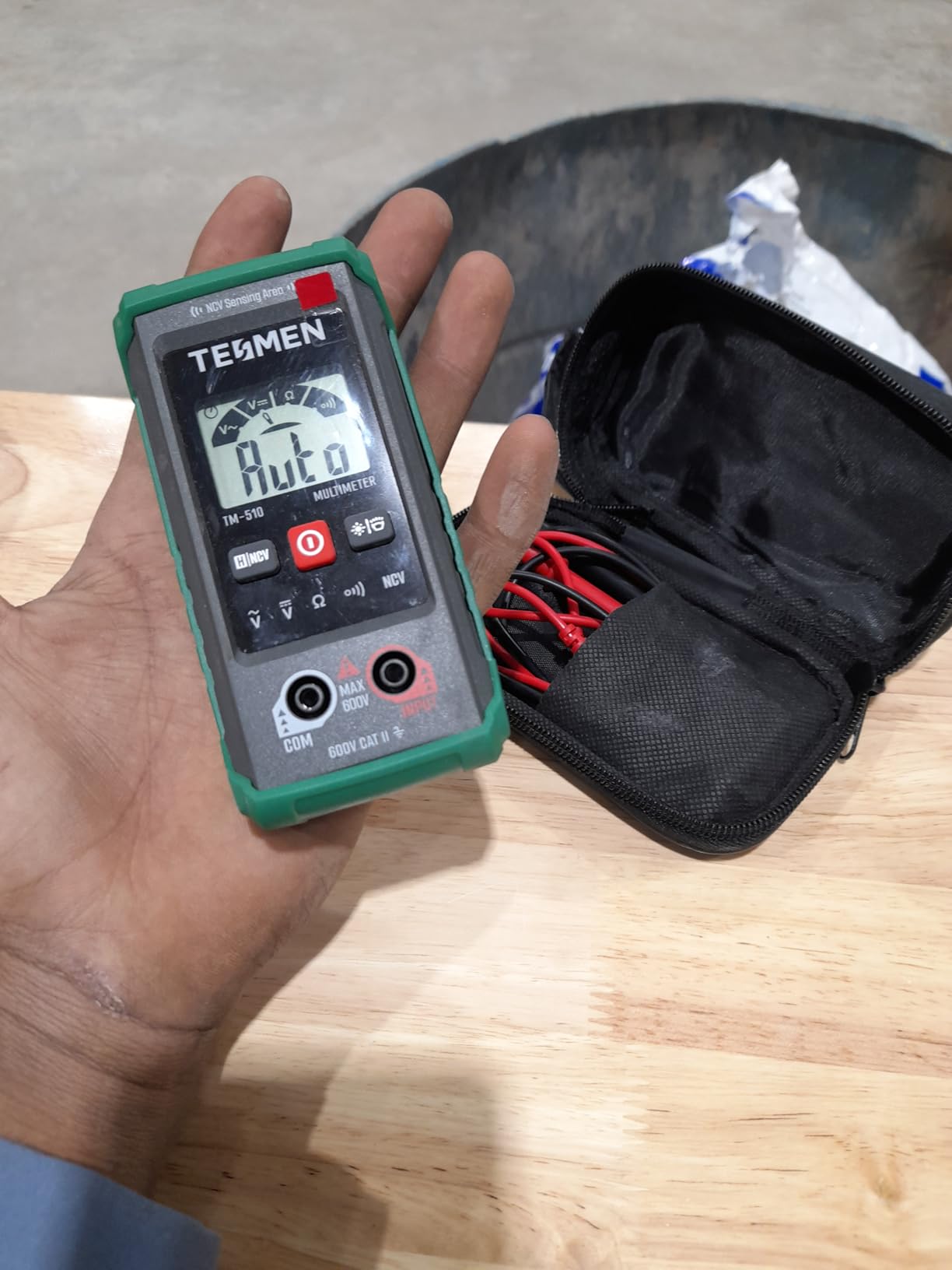
The package includes the meter, two test leads, a storage bag, two AAA batteries and a manual, and the silicone outer cover takes the sting out of a drop.
The CAT II rating is the dealbreaker for panel work
This is the one specification that stops me recommending it for anything inside a panel. CAT II 600V is the right category for a plug-in appliance or a receptacle on its own branch, but household panel work is CAT III territory. If you intend to work at the panel or on a shared circuit, choose one of the CAT III meters in this list instead.
It is also rated for 600V maximum operating voltage with a 0.8V minimum, so it has no headroom above that.
What auto mode does not cover
Auto mode handles AC and DC voltage, resistance and continuity, and that is the limit. Current, capacitance, frequency, temperature and diode all need manual function selection, so as soon as you move past basic checks you are back on the dial. The 4000-count display is also a step down from the 6000-count models.
11. Innova 3320 – Best for Battery Load Testing and Vehicle Electronics
INNOVA 3320 Auto-Ranging Digital Multimeter, Red & Black
Auto-ranging
10 MegOhm input
UL certified
Battery load test
Pros
- 10 MegOhm input impedance safe for vehicle electronics
- Colour coded LEDs run a battery load test
- UL certified design
- At 8 ounces it moves easily between car and garage
Cons
- AC current limited to about 200mA
- No backlight and no carrying case included
- Auto-ranging is inconsistent at very low and very high resistance
The Innova 3320 is the odd one out here because it does a job no other meter in the group does. Its colour coded LEDs run a load test on a battery and tell you the state of charge, which is a genuinely useful thing to know before you spend a Saturday chasing a car that will not start.
The 10 MegOhm input impedance is the other quiet strength. On a vehicle, probing an ECU or a control module with a meter that pulls too much current can damage the module, and this meter’s high impedance is specifically noted as helping prevent that.
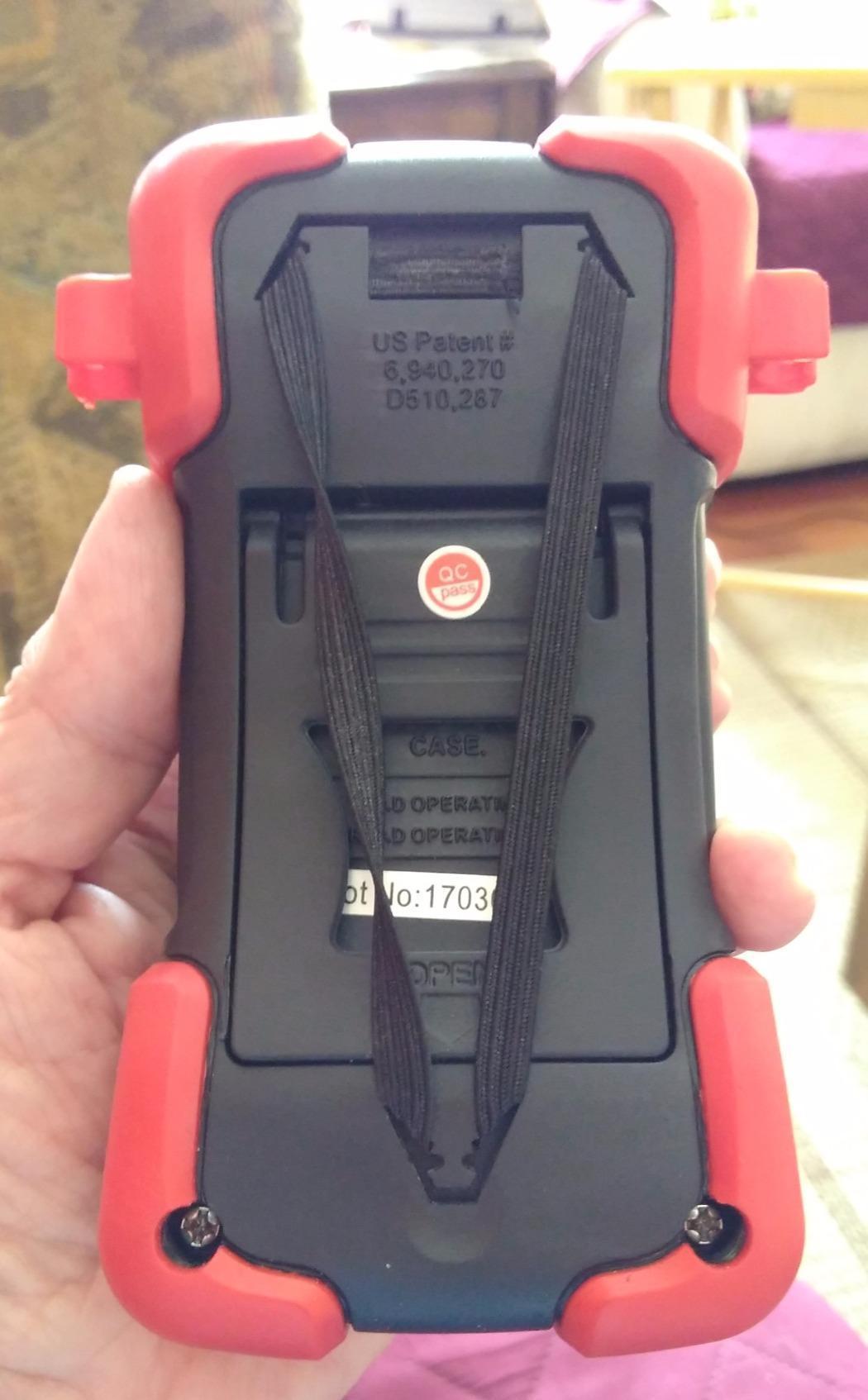
Durability reports are the strongest of any meter here. Long-term owners describe running three or more of these in daily use over six years or more, and the UL certified design adds a level of assurance the budget tier rarely has.
At 8 ounces it is light enough to move between the car, the garage and the house without thinking about it, and the single-setting resistance function for AC and DC voltage keeps the dial simple.
Does the low AC current ceiling matter at home?
For household work, mostly no. AC current on this meter tops out at around 200mA while DC current goes to 10A, so you cannot clamp-style measure anything meaningful on the AC side. DC current to 10A is enough for a small circuit check with the circuit broken.
The more relevant limitation for a homeowner is no backlight, which makes dark-panel work noticeably harder.
Where auto-ranging gets inconsistent
Owners report that auto-ranging can be slow or inconsistent at very low and very high resistance values, so a continuity check across a long cable occasionally takes a moment to settle. Side-by-side comparisons against Fluke 87-5 and Fluke 179 show near-identical DC, current and resistance readings, with the notable exception of low AC voltage, where accuracy drops below standard household levels.
12. AstroAI 2000 Count – Best for Battery, Fuse and Continuity Checks
AstroAI Digital Multimeter Tester 2000 Counts with DC AC Voltmeter and Ohm Volt Amp Meter; Measures Voltage, Current, Resistance, Continuity and Diode, Blue
1999 count backlit LCD
Double fuse design
Continuity buzzer
Data hold
Pros
- Largest owner base here with 56035 reviews
- Double fuse anti-burn overload protection
- 0.6 inch backlit LCD with polarity indication
- Battery test leads and manual included in the box
Cons
- Cannot measure AC current at all
- Manual rotary switch must be set correctly or a reading never appears
- Cannot read AC voltage below 100mV
With 56035 reviews at 4.5, this is the most proven meter in the group by a wide margin, and the feedback is unambiguous about what it is good at. People use it for outlets, fuses, batteries and automotive circuits, and they come back to it because it is simple and it works. Seventy-four percent of owners rate it five stars.
It measures AC and DC voltage, DC current, resistance and diode, with a continuity buzzer and data hold on a 3.5 digit, 1999-count backlit display. The polarity indication includes negative readings, so a reversed probe connection shows a minus sign rather than an error.
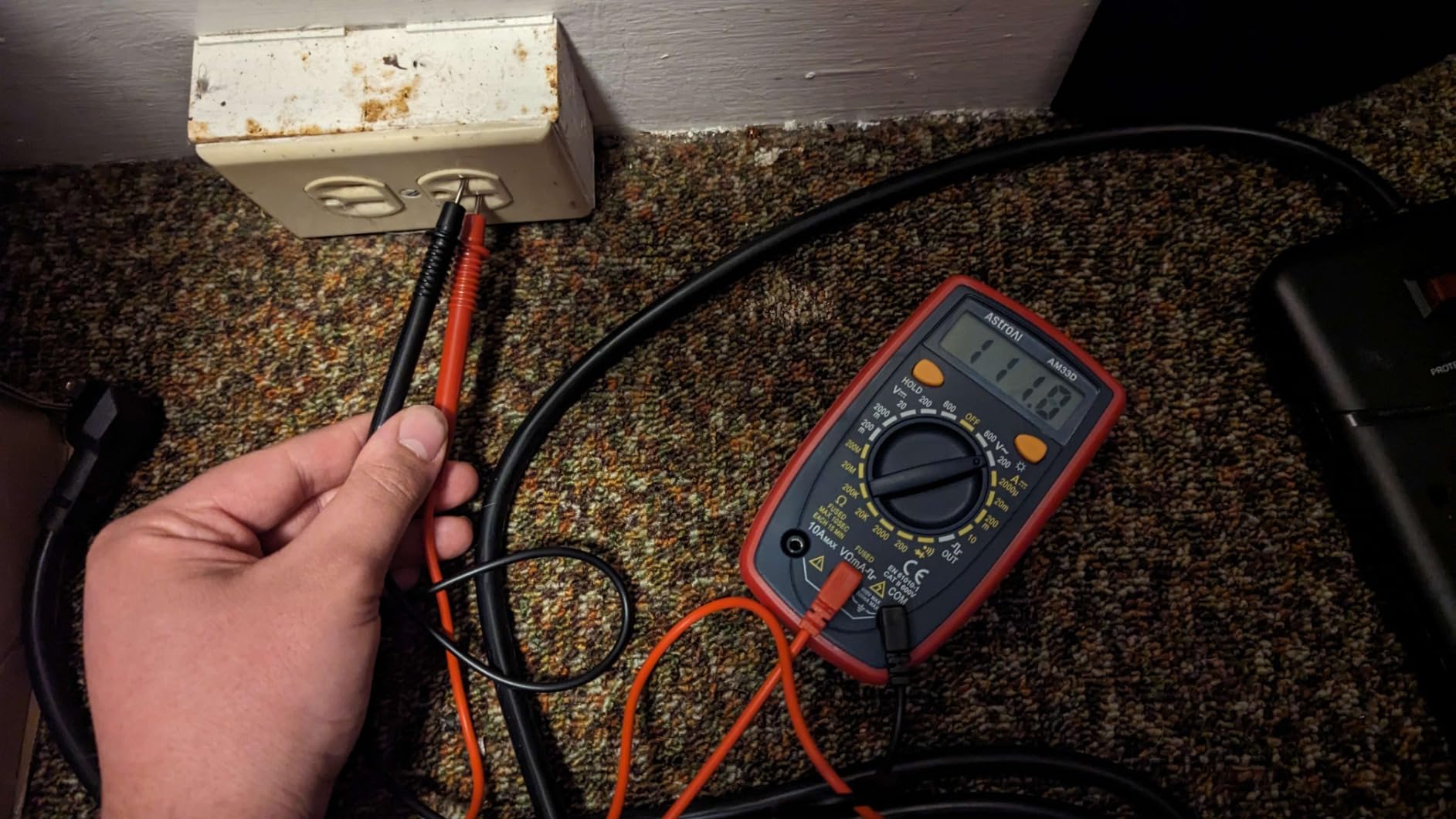
The double fuse anti-burn design protects against overload, which matters more here than the specification suggests, because the most common way to kill an inexpensive meter is measuring current with the leads in the wrong jack. The silicone protective cover handles drops and adds some insulation against shock.
It ships with a 9V battery, test leads and a manual, so there is nothing to buy separately before first use.
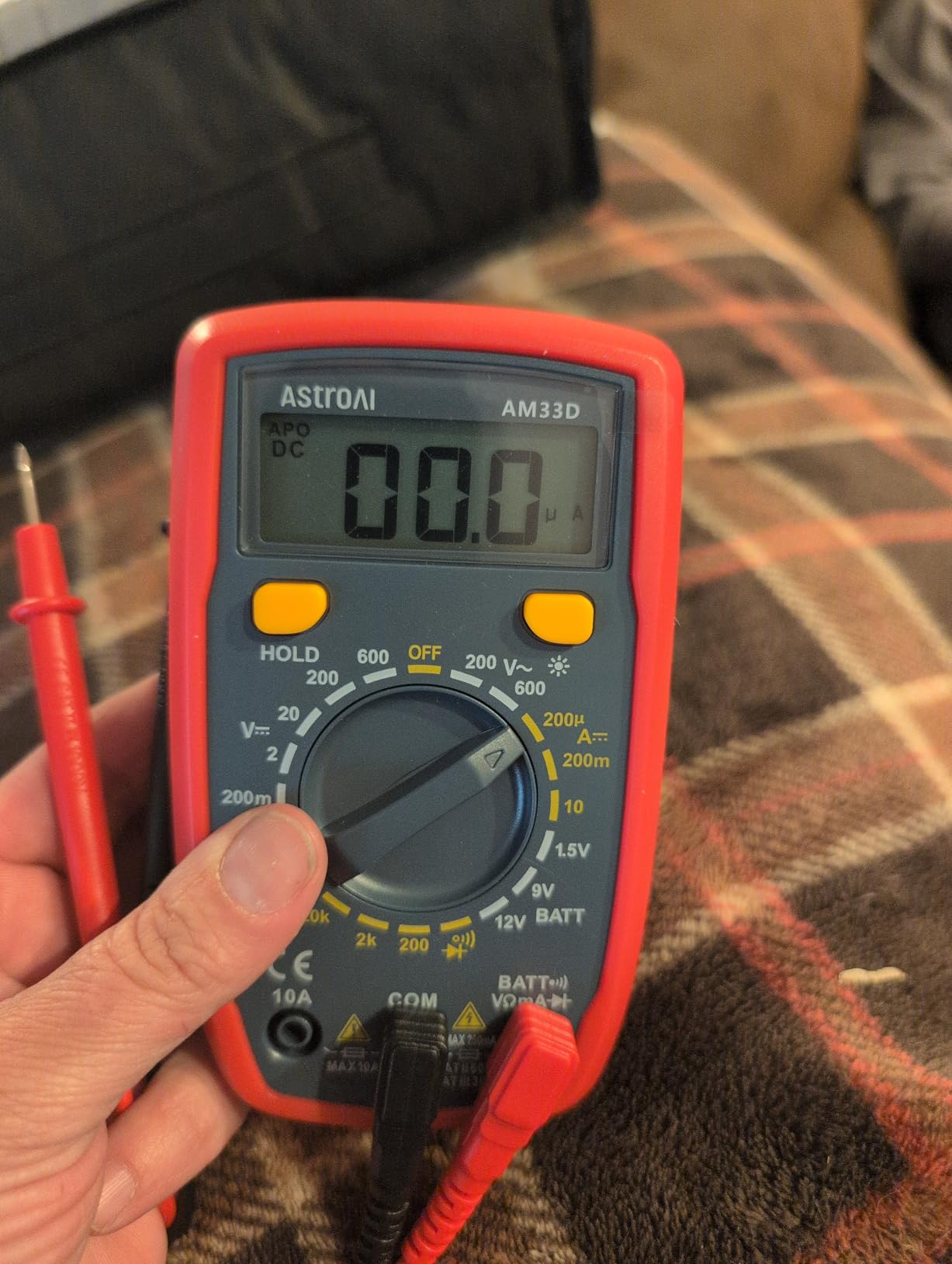
What 1999 counts actually costs you
A 1999-count display gives you three and a half digits, so the finest resolution is 1 unit on a full-scale range. That is adequate for household voltages, ohms and continuity, and it becomes a real limitation only when you are measuring low AC voltage or small currents where the last digit is the only one that matters. If your work is entirely residential wiring, you will not notice.
It also cannot measure AC current at all, so a clamp or current question is out of reach.
Where the manual dial causes real errors
The rotary switch must be set to the right function and range or you get no reading at all, and some owners interpret that as a broken meter. The test lead plugs also have to be fully seated in the correct sockets. Both are fixable in five seconds once you know them, but they are the difference between this meter and an auto-ranging model for a first-time buyer.
How to Use a Multimeter Safely on a Live Home Circuit?
None of these twelve meters will protect you from a circuit that is still energized. The meter tells you what is on the wire. Turning that wire off is your job, and the order matters more than the model you chose.
First, switch off the breaker for the circuit and confirm you switched off the right one by testing an outlet that you know is on that circuit. If the outlet is still live, you have the wrong breaker or a shared circuit, so go back and find it properly rather than assuming.
Second, verify the circuit is dead with two independent methods. Test at the receptacle with the meter set to the highest AC voltage range, and confirm zero. Then use a non-contact voltage tester to scan the cable and box, because a single probe reading can be wrong if a lead has come loose.
Third, use the correct input jacks. The black lead always goes in COM. The red lead goes in the V-ohm jack for anything except current. Only move the red lead to the amps jack when you have physically broken the circuit, and never measure current on a live household circuit without understanding what a blown input fuse means.
Fourth, never work inside a panel cover, and stop and call a licensed electrician if you find aluminium branch wiring, knob-and-tube, damaged insulation, a scorched device or a breaker that trips again immediately after reset.
CAT Ratings Explained: Why CAT III 600V Matters in a House
CAT ratings describe the maximum transient, or brief surge, a meter can survive at a given voltage. Household circuits are not gentle about this, because switching a load off produces a spike far above the steady-state voltage, and a meter without transient protection can pass that spike into your body.
CAT II covers a plug-in appliance or a receptacle on its own branch circuit. CAT III covers fixed installation wiring, which is your panel, your receptacle circuits and your lighting circuits. CAT IV covers the service entrance, the point where the utility supply enters the building.
For home electrical work, CAT III 600V is the rating to insist on. It means the meter is certified to handle the transients of a 240V residential system up to 600V, which is the real environment you are probing in. Several meters on this list stop at CAT II 600V, which is fine for testing an appliance and not fine for a panel.
One caution: a printed CAT number is only worth the certificate behind it. Look for UL, ETL or CSA listing, since those marks mean an independent lab has tested the claim.
True RMS vs Averaged RMS: Do You Need It at Home?
True RMS measures the actual mathematical root mean square of a waveform. An averaged meter assumes the wave is a clean sine and estimates from that assumption, which is accurate for a resistive load and increasingly wrong for anything electronic.
For a 120V incandescent circuit, an averaged meter and a True RMS meter will agree closely, so on older parts of a house the distinction barely matters. It matters on LED lighting, LED drivers, dimmers, smart switches, inverter pumps and any modern appliance with a switching power supply, and there the averaged reading under-reports the true RMS value.
My practical advice: if your home is all incandescent and mechanical controls, an averaged meter is fine. If you have any LED, dimmers or smart devices and you intend to measure those circuits, pay for True RMS. Meters like the Fluke 117, the Klein MM720, the AstroAI 6000-count and the Crenova MS8233D all have it.
Auto-Ranging vs Manual-Ranging: Which Is Easier for Beginners
A manual-ranging meter gives you a rotary switch with fixed ranges, so you decide whether you are on the 200-ohm or 2000-ohm scale. An auto-ranging meter picks the range itself and only asks what quantity you want. For a first meter, auto-ranging removes an entire category of beginner errors.
The trade-off is resolution. Auto-ranging meters usually offer a coarser step count, the 4000 and 6000 counts you see in the specifications. A 6000-count display resolves 1 part in 6000, a 1999-count display resolves 1 part in 1999, so the latter is more precise on a narrow range but you have to select that range yourself.
Our take: buy auto-ranging unless you have a specific reason not to. The Klein MM325 and the AstroAI 2000-count are the two manual-ranging options here, and both work perfectly well once you are used to the dial.
What You Actually Need vs What Is Nice-to-Have
The core list is short. You need AC and DC volts, ohms, continuity with an audible beep, a diode test, and DC current through a fused input. Add a backlit display and a CAT III 600V rating and you have covered essentially all household electrical work.
Everything beyond that earns its place only in specific situations. Temperature matters if you own an HVAC system. Capacitance matters for motor run capacitors. Non-contact detection is a convenience for tracing cables, not a substitute for probing. Min/max/average recording matters if a fault is intermittent. Low impedance mode matters if you work on old wiring. True RMS matters if you measure LED and dimmer circuits. Counts resolution beyond 6000 matters if you are doing electronics rather than wiring.
Buy the core list plus the one or two extras that match your house, and skip the rest. That is how the Fluke 101 stays a defensible recommendation despite being the least featured meter in the top six.
Fluke vs Klein vs Extech: Which Brand Should You Buy?
This is the most repeated question in the search results, and the honest answer is that Fluke builds the most accurate meters, Klein Tools builds the most home-appropriate ones, and Extech fills the gap for compact meters with unusual extras. Forum threads across Electrician Talk and Electricians Forums consistently treat Fluke as the trusted professional tier and Klein as the better value for everyday residential work, which matches what the owner feedback in this list shows.
Fluke meters here score highest, with the 117 and the 15B+ both at 4.8 and the 101 at 4.7. The accuracy claims hold up in comparisons, and the CAT III ratings are properly certified. What you pay for is confidence in the reading and low impedance mode on the 117, which is the feature that most directly reduces risk on old wiring.
Klein Tools dominates the middle of this list with four models, and the pattern is consistent. The MM325 gives you the essentials with lead-alert LEDs. The MM320KIT bundles in a receptacle tester and non-contact tester. The MM720 adds low impedance mode, True RMS and a 1000V ceiling. If you want Fluke-style features on a Klein budget, the MM720 is the one.
Extech earns its place with the compact form factor and the included temperature probe rather than with accuracy or rating spread. Milwaukee does not appear in this roundup, and the forum question comparing it with Fluke comes up often enough to be worth answering directly. Where Milwaukee fits is jobsite durability and its clamp meter and voltage detector lines, which are built to survive being dropped off a ladder. For measurement accuracy in a residential setting, the Flukes and Kleins in this list are the better-documented choices.
Multimeter vs Clamp Meter vs Non-Contact Voltage Tester
A multimeter measures voltage, resistance and current, and it needs contact with the circuit. A clamp meter measures current by encircling a single conductor, so you do not have to break the circuit to see how much current a load is drawing, which is what makes it the right tool for diagnosing a breaker that trips under load or an appliance drawing too much.
A non-contact voltage tester detects the presence of AC voltage through insulation, with no contact at all. It is a screening tool, not a measuring tool, and the limitation worth remembering is that a false positive can come from an adjacent conductor, an ungrounded cable picking up a charge, or a fluorescent and LED ball.
The practical setup is all three. Use the non-contact tester to find candidates, the multimeter to measure, and the clamp meter if you eventually need to know what a running load is actually drawing. The Klein MM320KIT bundles the first two together, and several meters here add their own non-contact mode so you are not carrying a separate tool.
How to Test a GFCI Outlet That Will Not Reset
Start at the receptacle, not the panel. A GFCI that will not reset usually has a downstream outlet in the circuit holding the trip, so test every GFCI and ordinary receptacle on that circuit before assuming the first one is faulty.
Set the meter to AC volts, leads in COM and V-ohm, and measure line to neutral. Then measure line to ground. If line to ground reads roughly 120V with the breaker on and the GFCI refusing to hold, the ground path is intact and the problem is upstream or in the device electronics.
Turn the breaker off, then confirm dead. Switch the GFCI to off, restore power, then press test. A correctly functioning GFCI trips when you press test. If it will not trip when you press test, or will not reset afterward, the device has failed and should be replaced with the same class of device.
If the outlet tests fine and the trip is coming from a wet location such as a bathroom, exterior or kitchen counter receptacle, look for moisture or an appliance that is holding a ground fault. Do not bypass a GFCI to keep a circuit live, and if the fault is not obvious, that is the point to call a licensed electrician.
Older Home Wiring: Aluminum and Two-Wire Circuits
Two-wire aluminium and knob-and-tube wiring changes how you read a circuit, and it is worth knowing what you are looking at before you interpret a result. Aluminium conductors develop a resistive oxide layer at each termination, so a connection that reads fine on the day it is made can read 3 to 5 volts across a joint a few years later. That loose voltage shows up as a flickering light, a warm receptacle face or a breaker that trips, and a meter will show you exactly that drop.
A digital multimeter is genuinely useful here because the fall-off is gradual rather than a clean break. Probe the same conductor at the panel and at the receptacle, compare the two readings, and any difference between them is a bad connection somewhere between the two points.
Two warnings before you proceed. Pigtailing aluminium with copper conductors requires an approved connector and the correct torque, and a loose aluminium-to-copper joint is a fire risk rather than a repair. And if you find knob-and-tube, cloth-covered insulation or a scorched device, stop and call a licensed electrician. A meter tells you what a circuit is doing, but on legacy wiring it should be a diagnostic tool, not an invitation to reterminate conductors.
Frequently Asked Questions
What multimeter do most electricians use?
Most electricians carry a Fluke, and the models on this list reflect that. The Fluke 117 is the most common residential pick because its low impedance mode separates ghost voltage from a real reading, while the Fluke 15B+ covers 1000V and 10A for panel work. Electrician Talk and Electricians Forums threads repeatedly describe Fluke as the professional tier, with Klein Tools treated as the better value for everyday residential work.
What is the best multimeter for household use?
The best multimeter for household use is a CAT III 600V rated, auto-ranging digital meter with True RMS, a continuity buzzer and a backlit display. The Fluke 117 is the strongest all-round choice because it adds low impedance mode and non-contact voltage detection. For a first meter on a tight budget, the Klein Tools MM325 covers the same core functions.
Is a Fluke or Klein multimeter better?
Fluke builds the more accurate meter and Klein Tools builds the more home-appropriate one. Fluke leads on accuracy, certification and low impedance mode, which is why the 117 is our top pick. Klein wins on value and on residential-specific features such as the MM325 lead-alert LEDs and the MM720 low impedance mode. If you want Fluke features on a Klein budget, buy the MM720.
Which multimeter is better, Fluke or Milwaukee?
For measurement accuracy in a residential setting, the Flukes on this list are the better-documented choice, rated 4.7 to 4.8 with high five-star shares. Milwaukee’s strength is jobsite durability and its clamp meter and voltage detector lines, built to survive being dropped rather than to add measurement features. If your work is on live circuits and ladders, Milwaukee durability may matter more than the last decimal place of accuracy.
What is the best multimeter for beginners?
The Klein Tools MM325 is the best first multimeter because its lead-alert LEDs light up when the test leads are in the wrong jacks, which prevents the most common beginner mistake. The TESMEN TM-510 is the alternative for anyone intimidated by the rotary dial, because its smart auto mode detects the measurement type and picks the range. Both are CAT-rated for household circuits.
What CAT rating do I need for a house?
You need CAT III 600V for home electrical work, because fixed installation wiring, which is your panel, receptacle circuits and lighting circuits, falls into the CAT III category. CAT II 600V is only appropriate for a plug-in appliance or a single receptacle on its own branch. Check for a UL, ETL or CSA listing as well, because a printed CAT number is only meaningful if an independent lab tested it.
Is it safe to measure current with a multimeter?
Only with the circuit physically broken and the leads moved to the dedicated amps input. Probing a live circuit in current mode is the most common way to destroy a meter, because the current must flow through the instrument. If you need to measure current on a running circuit, use a clamp meter that encircles a single conductor instead, and never clamp a cable carrying both hot and neutral together.
Our Verdict: Which Multimeter Should You Buy in 2026?
The best multimeters for home electrical work all share three things: a CAT III 600V rating, a fused current input and a continuity beep. Beyond that, they diverge in ways that depend entirely on your house and your hands. Buy the Fluke 117 if you want one meter that handles everything, because its low impedance mode is the single feature most likely to keep you from chasing a fault that is not there.
Buy the Klein Tools MM325 if this is your first meter and you want the least to think about at the start, since its lead-alert LEDs stop you making the classic jacks mistake. Buy the AstroAI 6000-count True RMS if you want the most functions and fused inputs for the least money, and accept that its transistor and frequency functions are not worth using.
Whatever you choose, verify a circuit is dead with two methods before you touch it, keep the leads out of the amps jack unless the circuit is broken, and call a licensed electrician the moment you find aluminium branch wiring, a scorched device or a panel fault. A multimeter is a diagnostic tool, and knowing where its usefulness ends is part of using it well.