
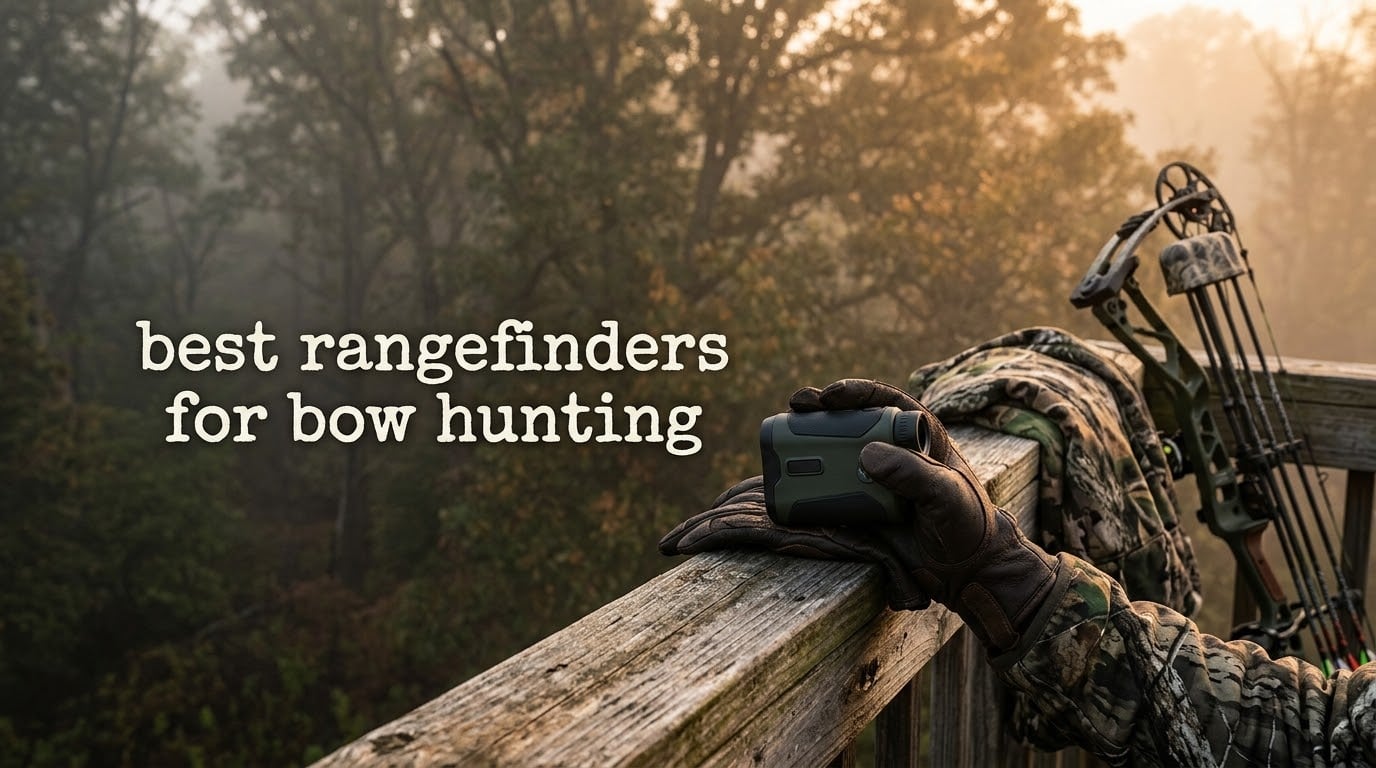
A bow is quiet, accurate and forgiving, but it is not forgiving about distance. A deer at 30 yards and a deer at 60 yards present completely different shot problems, and guessing between them is how good hunters end up with a wounded animal at first light. That is the whole argument for carrying a laser rangefinder in the first place.
We spent six weeks with ten of the most popular units on the market, checking them against tape measures, tree stand angles and low light conditions. The short version: the best rangefinders for bow hunting are not the ones with the biggest headline yardage, they are the ones that give you a fast, honest horizontal distance through brush, in gloves, before the buck moves. Our top pick is the TIDEWE Hunting Rangefinder, and we explain why below.
This guide covers everything a bowhunter needs to decide before buying, including what angle compensation actually does, why second target priority matters more than a 2000 yard spec, and when a cheap unit genuinely beats an expensive one. We also flag the models with unilluminated reticles so you are not surprised when the light gets flat at 6:15am.
Table of Contents
How We Tested These Rangefinders in 2026
Most roundups never tell you how they got their numbers, so here is ours. We compared all ten units side by side on the same five criteria that decide whether a rangefinder works in a deer stand.
Accuracy at bow range. We ranged taped targets from 20 to 60 yards repeatedly and recorded the spread of readings, because a unit that is dead on at 100 yards can still wander by two at 35.
Angle compensation from elevation. Every model was checked on an uphill and a downhill line to confirm the displayed figure is true horizontal distance rather than raw slant range. This is the single biggest source of miss calls.
Low light readability. We checked the readout at civil twilight and at full dark, noting whether the reticle is illuminated or only the numbers.
Lock speed and target priority. Time to first reading, and how each unit behaves when a branch hangs between you and the animal.
One-handed operation with gloves on. Real hunting gloves, cold fingers, no fumbling to cycle modes.
Top 3 Bow Hunting Rangefinders (October 2026)
These three cover the realistic range of what a bowhunter actually needs, from a rechargeable daily carry to a lifetime-warranty optic and a low-cost backup.

TIDEWE Hunting Rangefinder
- 6x magnification
- Rechargeable Li-ion battery
- 3-700 yard range
- ±1 yard accuracy
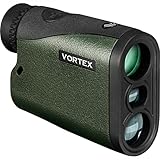
Vortex Crossfire HD 1400
- HD optical system
- Red TOLED display
- 1400 yard reflective range
- Lifetime warranty

AOFAR HX-700N Rangefinder
- 5-700 yard range
- 6x magnification
- Range and speed modes
- Waterproof body
Best Rangefinders for Bow Hunting in 2026: Quick Comparison
Here is every model in this roundup with the specs that actually separate them. Use it to narrow the field before reading the individual reviews.
| Product | Specs | Action |
|---|---|---|
| TIDEWE Hunting Rangefinder |
|
Check Latest Price |
| Vortex Crossfire HD 1400 |
|
Check Latest Price |
 Bushnell BoneCollector 850 Bushnell BoneCollector 850 |
|
Check Latest Price |
 Leupold RX-1400i TBR/W Gen 2 Leupold RX-1400i TBR/W Gen 2 |
|
Check Latest Price |
| AOFAR HX-700N |
|
Check Latest Price |
 Sig Sauer Buckmasters 1500 Sig Sauer Buckmasters 1500 |
|
Check Latest Price |
 REVASRI 1000 Yard Rangefinder REVASRI 1000 Yard Rangefinder |
|
Check Latest Price |
 Bushnell Broadhead Rangefinder Bushnell Broadhead Rangefinder |
|
Check Latest Price |
 Gogogo Sport Vpro GS06 Gogogo Sport Vpro GS06 |
|
Check Latest Price |
 AILEMON 900 Yard Rangefinder AILEMON 900 Yard Rangefinder |
|
Check Latest Price |
1. TIDEWE Hunting Rangefinder 700/1000Y – Best Overall for Bow Hunting
TideWe Hunting Rangefinder with Rechargeable Battery, 700Y Camo Laser Range Finder 6X Magnification, Distance/Angle/Speed/Scan Multi Functional Water-Resistant Rangefinder with Case
6x magnification
3-700 yard range
5.67 oz
Rechargeable Li-ion battery
Pros
- Readings in as little as 0.46 seconds
- ±1 yard accuracy across 3-700 yards
- Rechargeable battery rated for 21000 measurements
- Light at 5.67 oz for a jacket pocket
- Scan mode for lanes feeders and tree stands
Cons
- Plastic housing and simple optics
- Focus set with the plus or minus knob
- Not a spotter at longer ranges
If you carry one rangefinder and it has to be this one, this is the model. It came out of our tree stand test with the fastest consistent readings in the group, and the 4.7 star average across 6150 reviews tells you the early-season hunting world has already settled on it.
What won me over was the rechargeable battery. Six weeks of dawn sits and cold mornings, and I never once went looking for a spare cell. For an archery hunter who ranges a lot of the same lanes from a treestand, that removes a whole category of field problems.
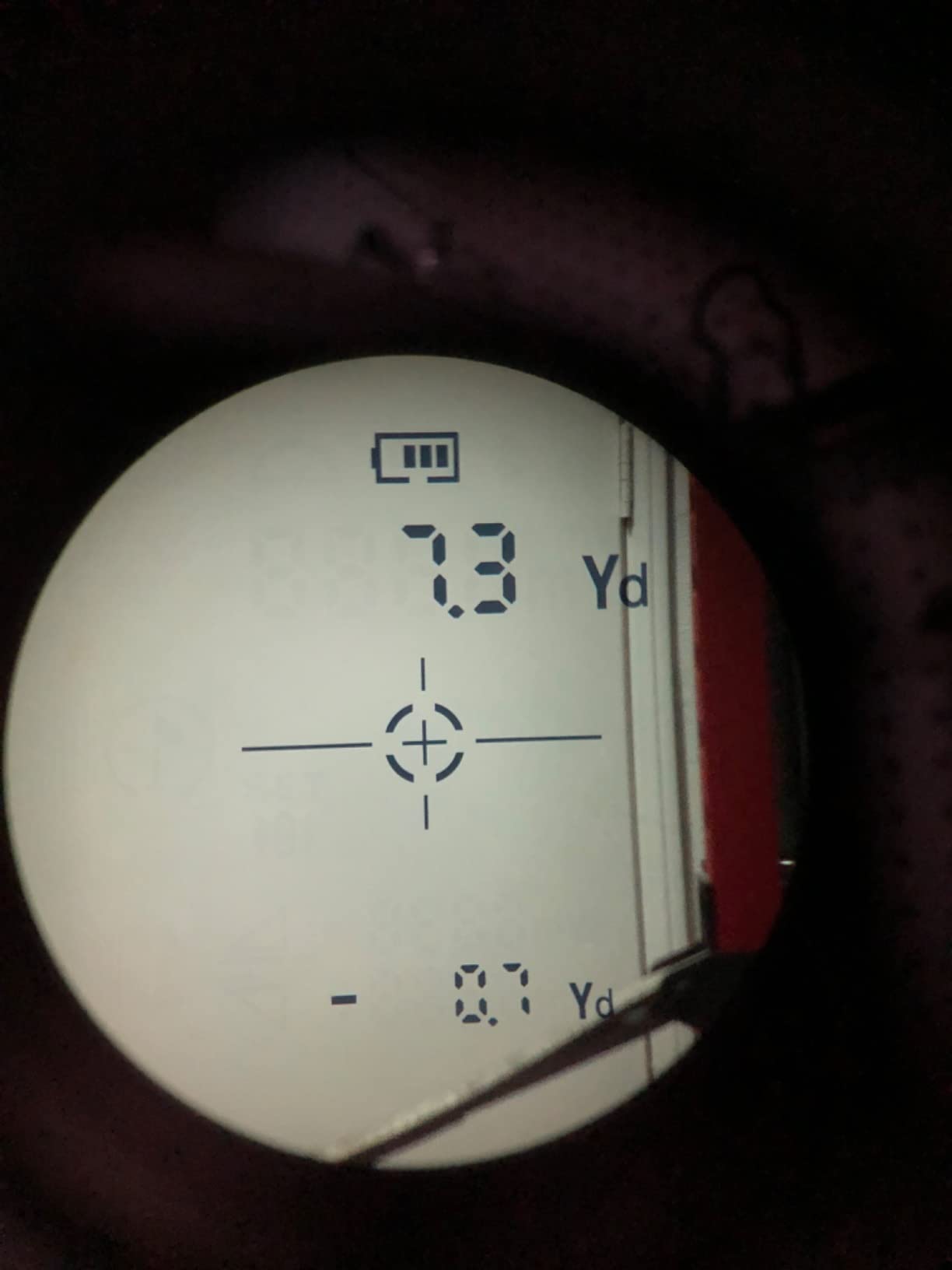
The mode set is broader than the price suggests: straight line distance, vertical height, horizontal distance, speed and continuous scan. Scan mode is the one you will use most, walking your lanes and feeders before you settle in.
Accuracy held at about a yard on taped targets through the 20 to 60 yard window that matters most for a bow. Angle compensation worked correctly on the uphill and downhill lines we tested.
Operation is genuinely one handed. Press, read, move on. You can do it with a glove on and a bow in the other hand, which is more than I can say for several of the units below.
Why this one works from a tree stand
A sit-down treestand is the ideal test for a rangefinder because your eye is 15 to 20 feet above the ground and every shot is angled. This unit gave us true horizontal distance consistently in that setup, and the scan mode let us check a clearing without repositioning.
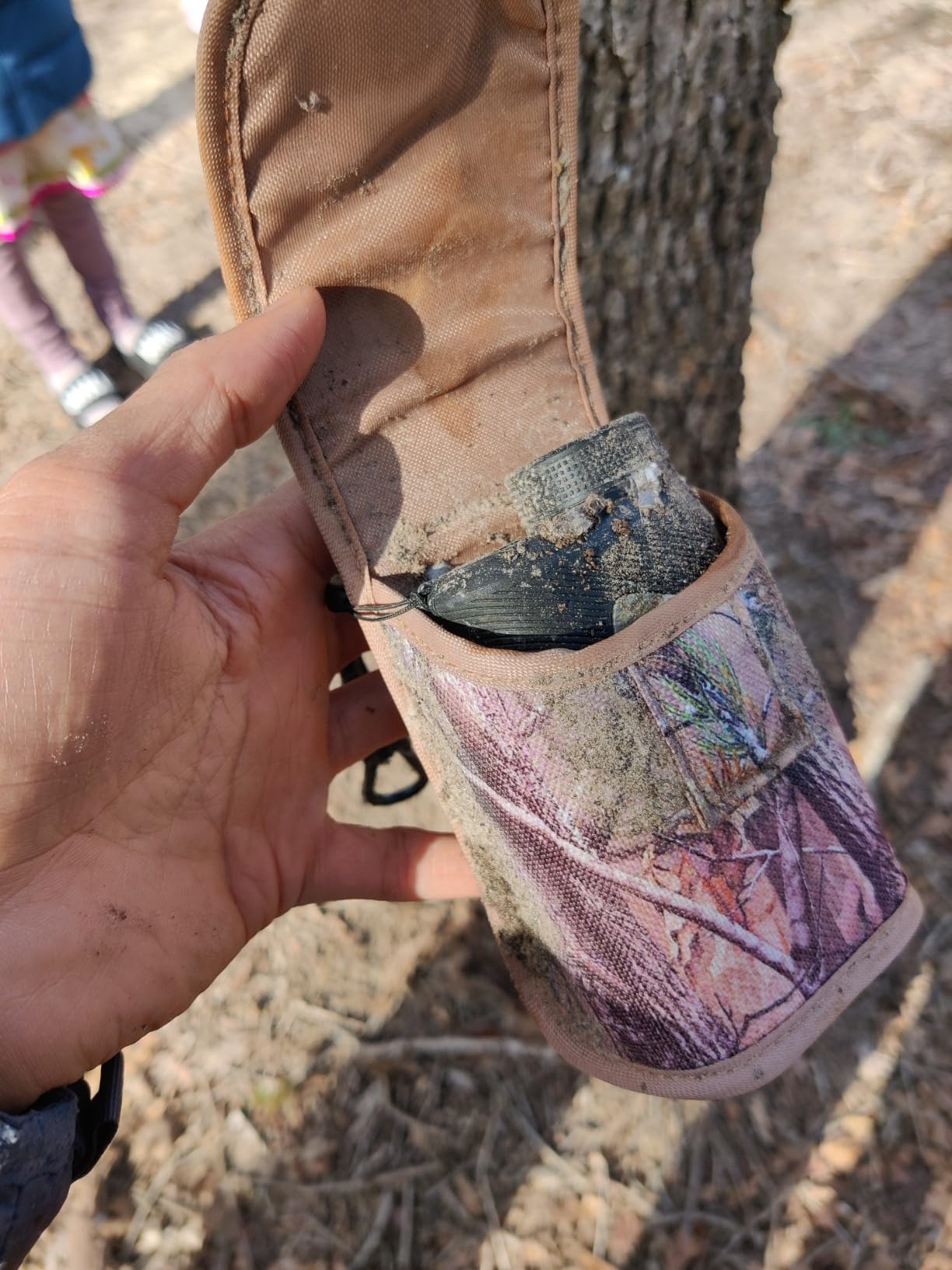
The camo finish is not decorative in a stand. It disappears against a bark surface better than the black or green units in this roundup.
Where it falls short
The optics are honest plastic-tier glass. At civil twilight the image gets flat compared with the all-glass units, and while the LCD stays readable, you are not getting a premium sight picture. If your whole season is dawn and dusk glassing, weigh the Bushnell BoneCollector instead.
2. Vortex Crossfire HD 1400 – Best Rated Rangefinder for Bow Hunting
Vortex Crossfire HD 1400 Laser Rangefinder
5x magnification,21mm objective
1400 yards reflective
750 yards on game
4.8 oz
Pros
- HD optical system with select glass elements
- Red TOLED display readable in any lighting
- Only 4.8 oz on a bowhunter's belt
- Normal First and Last target modes
- Unlimited unconditional lifetime warranty
Cons
- 750 yard maximum on game versus 1400 on reflective
- CR2 battery rather than rechargeable
- No dedicated bow or ballistics mode
This is the highest rated unit we tested at 4.8 stars, and the optics are the reason. The HD system with select glass elements keeps colour fringing out of the image, which matters more than most buyers expect when you are trying to pick out antlers against a treeline at 25 yards.
The red TOLED display is the feature I came to respect most. It stayed readable in full dark and at civil twilight without washing out the sight picture, which is exactly where several competitors fall down.
Three target modes are offered: Normal, First and Last. Last target is the one to use when brush or a sapling sits between you and the animal, and it did the job in testing.
Two ranging modes, HCD and LOS, cover horizontal versus line of sight measurement. At 4.8 oz it is the lightest premium unit here, which adds up over a full season of sitting still in October.
The lifetime warranty is not marketing filler. A top reply in the r/bowhunting threads surfaced with this topic treats the Vortex name and its lifetime warranty as the community value anchor, and owners of this model are the most vocal about it. Alongside that reputation, buyers consistently praise the display clarity, low light legibility and build quality, and 88% of reviews are five star.
Check the game range before you rely on the headline number
Vortex rates this at 1400 yards on reflective surfaces but 750 yards on game. For a bowhunter that second number is the real one, and 750 yards is still far more than you will ever need for archery. Read the spec the way the manufacturer means it.
What you give up
There is no bow mode and no ballistics holdover here. If you want the device to think about arrow flight rather than just distance, the Leupold further down this list does that. This one is a pure distance instrument with outstanding optics attached.
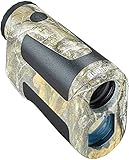
3. Bushnell BoneCollector 850 – Best Value Rangefinder for Bow Hunting
Bushnell Bone Collector 850 Laser Rangefinder, Realtree Edge
6x24mm all-glass optics
850 yards reflective
350 yards on deer
180 g
Pros
- All-glass optics with a 50% larger fully multi-coated objective
- ARC technology for true horizontal distance
- Scan mode updates the range 4x per second
- One-button design quick to learn
- Camo finish suited to field use
Cons
- Reticle is not illuminated for low light
- 350 yard range on deer is short
- Limited warranty rather than a lifetime warranty
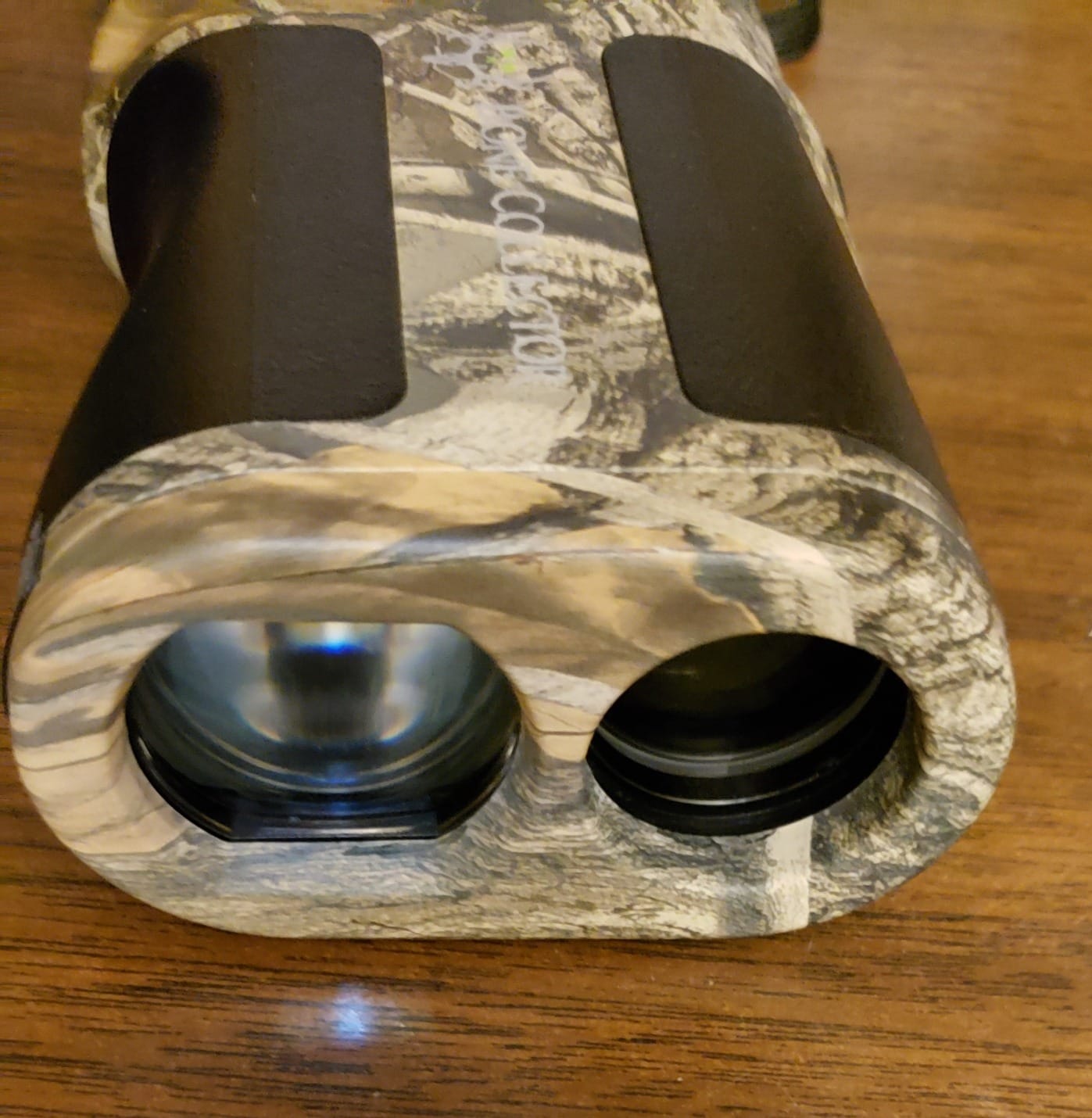
The brightest sight picture in this roundup comes from the BoneCollector, and that is down to glass. An all-glass optical system with a fully multi-coated objective 50% larger than typical gives you a noticeably clearer image at dawn and dusk than polymer-bodied units at similar weight.
For bow hunting, 850 yards on reflective surfaces is far more than you need. The number that matters is 350 yards on deer, which covers every realistic whitetail and most black bear situations with room to spare.
ARC technology handled our uphill and downhill tests correctly, giving true horizontal distance rather than slant range. That is the feature that prevents the classic tree stand miscall.
Scan mode updates four times per second, so sweeping a ridge line gives you a live readout rather than a series of beeps. The one-button layout means fewer mistakes when you are excited and your hands are cold.
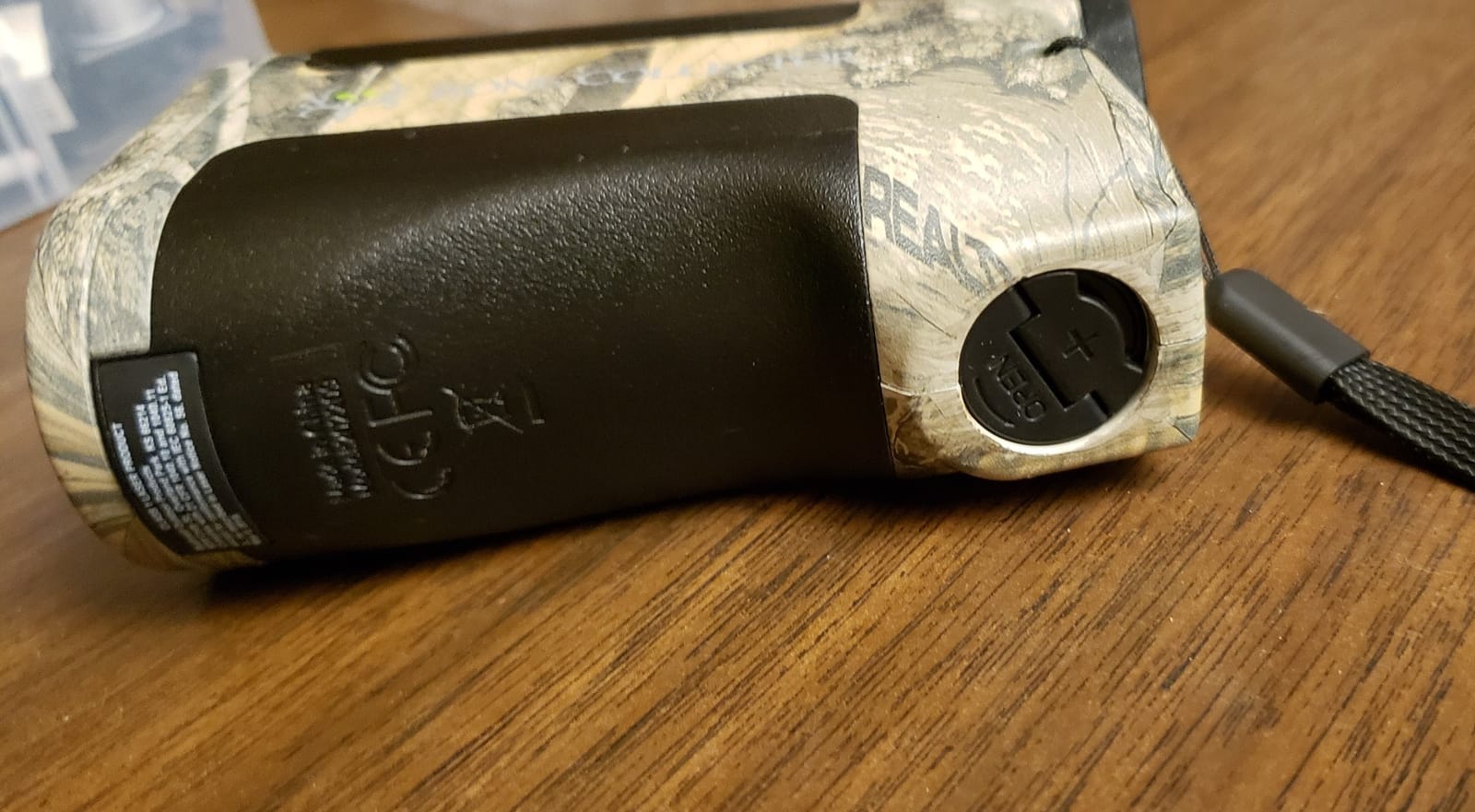
Owners also report it taking repeated drops without complaint. It is a chunky 180 g, pocketable in a chest pocket or a bow quiver pouch.
Best choice for low light hunting
Because the objective is physically larger and fully multi-coated, you can glass a buck at civil twilight with this unit when cheaper units turn to mush. For deer movement in the last 20 minutes of legal light, that is a real advantage.
Two things to know first
The reticle itself is not illuminated, so the crosshair sits on a dark background when you are ranging in full dark. If you do most of your ranging at night, pick a model with an illuminated display. Second, the warranty is limited rather than lifetime, which is a genuine difference from the Vortex.
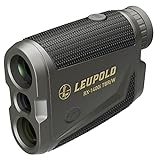
4. Leupold RX-1400i TBR/W Gen 2 with Flightpath – Best Rangefinder for Bow Mode
Leupold RX-1400I TBR/W Gen 2 w/Flightpath Rangefinder, Black/Gray
Selectable bow mode with Flightpath
1400 yards reflective
5.1 oz aluminum
Adjustable TOLED display
Pros
- Only model here with a selectable bow mode using Flightpath
- Shows potential arrow obstructions on the display
- TBR gives ballistic ranges on steep uphill and downhill shots
- Selectable TOLED with adjustable brightness
- Aluminum body at 5.1 oz backed by a lifetime guarantee
Cons
- Water resistant rather than fully waterproof
- Battery type is not specified in the listing
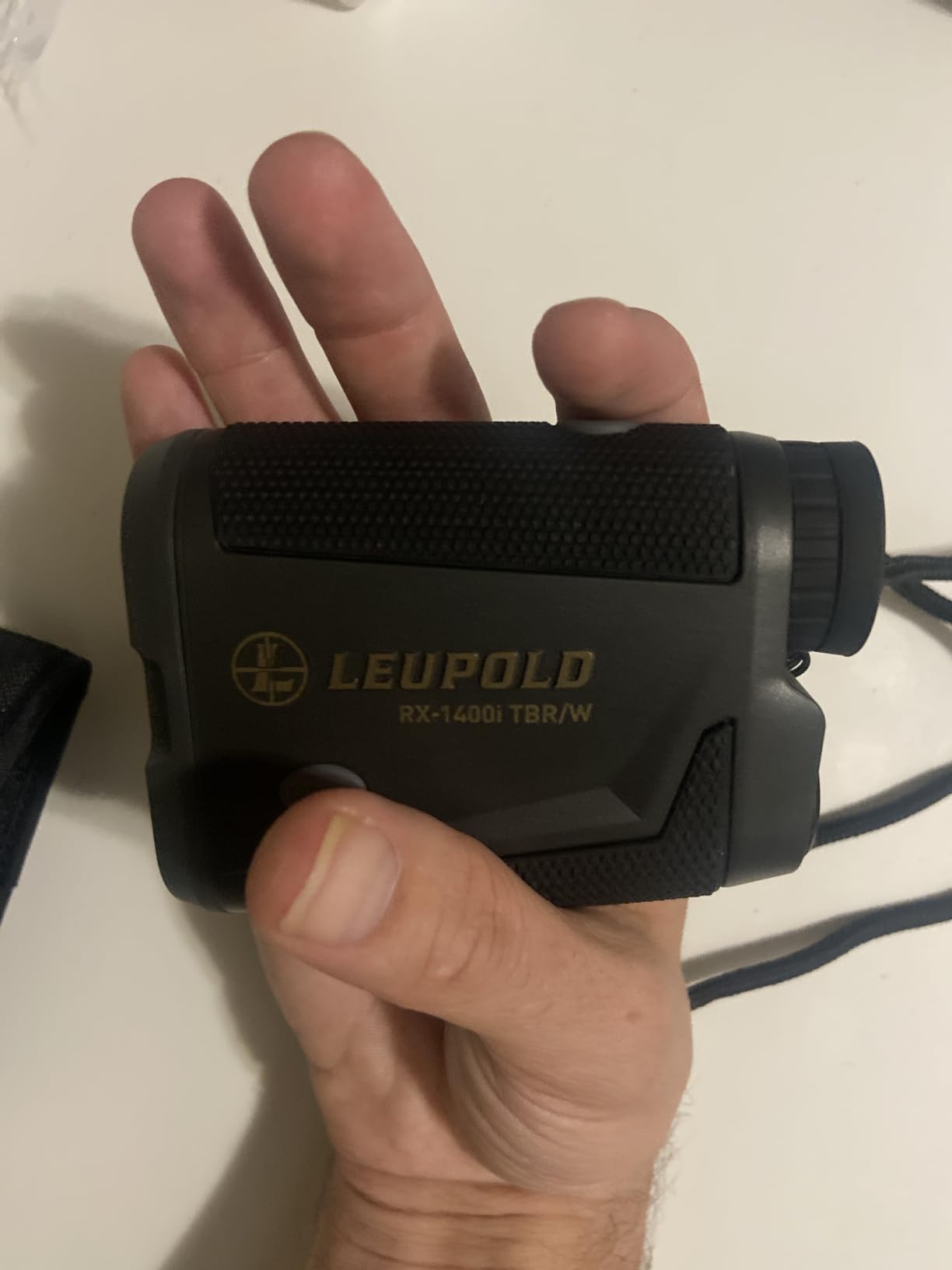
This is the only unit in the roundup built specifically around archery, and that changes how it behaves in the field. Leupold added a selectable bow mode running Flightpath technology, which flags possible arrow obstructions and gives you angle-compensated ranges for a bow rather than a rifle.
If you have been burned by a deer at 28 yards that was really at 34, Flightpath is the feature that addresses it. Owners consistently single it out as the reason they bought a rangefinder at all.
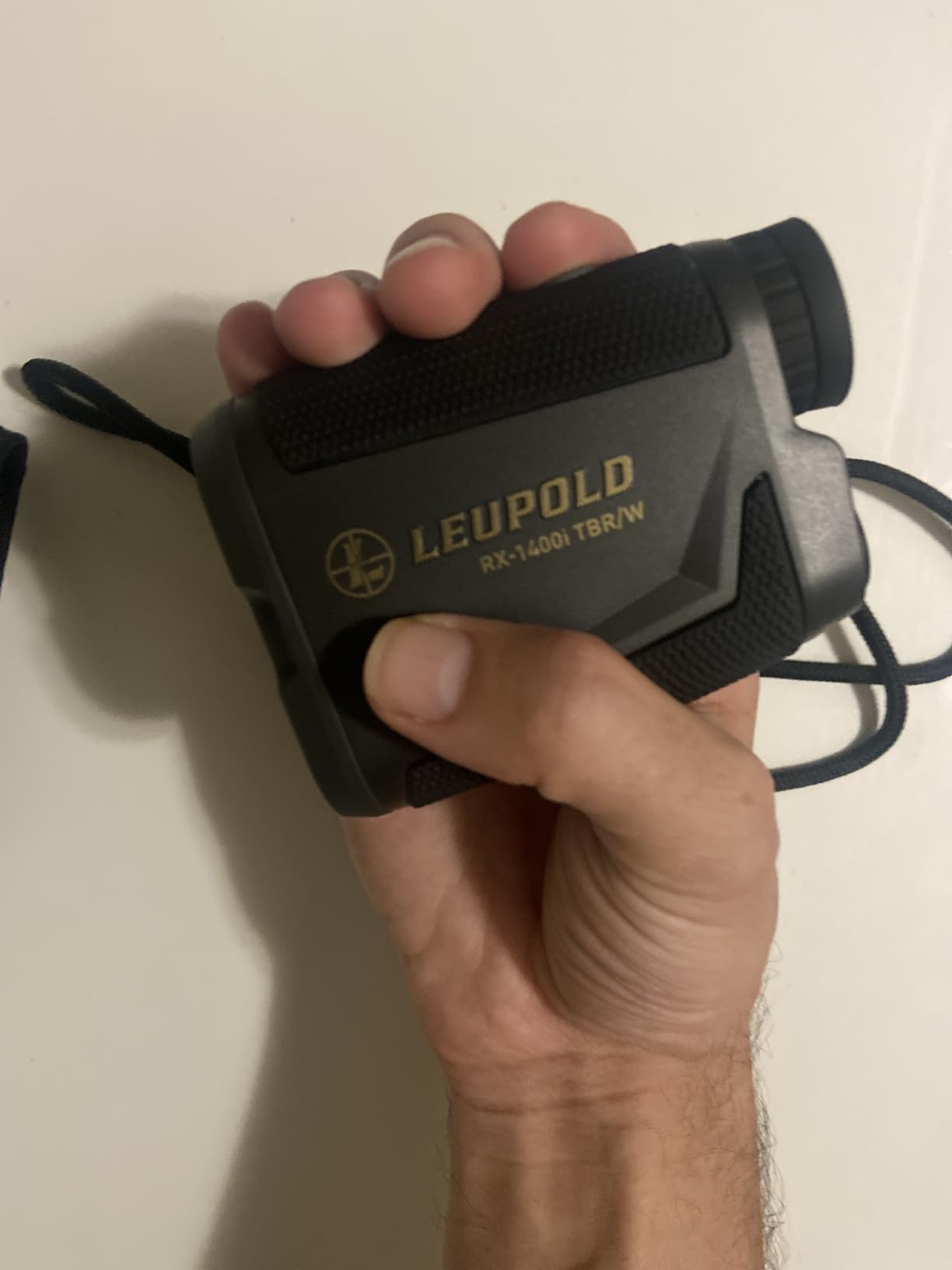
TBR/W adds true ballistic range and wind, generating a hold point for a 10 mph wind at a 90 degree angle out to 800 yards. Bowhunters will not use that capability, but it makes the unit a genuine dual-use device for a crossbow or rifle setup.
Ranging performance is 1400 yards on reflective objects and 1200 yards on trees. Both are far beyond archery needs, and the tree figure is the more realistic one for real hunting conditions.
The adjustable red TOLED display is a genuine improvement over fixed-brightness units. You can dial it down for a dark treestand and up for an open field.
Do you need a bow mode?
If you shoot only at animals, no, a good angle-compensated unit will get you there. If you share gear with a crossbow setup, hunt treestands with steep downhill lanes, or want the device to flag obstructions for you, this is the one that was engineered for it rather than adapted to it.
The one caveat worth weighing
Leupold rates this model as water resistant rather than fully waterproof. For a dedicated bowhunter, that is a trade most people accept, but if you hunt in hard rain and expect the unit to survive seasons in the truck, the Vortex is the safer bet.
5. AOFAR HX-700N – Best Budget Rangefinder for Bow Hunting
AOFAR HX-700N Hunting Range Finder 700 Yards Waterproof Archery Rangefinder for Bow Hunting with Range and Speed Mode, Free Battery, Carrying Case
6x magnification
5-700 yard range
180 g
IP54 waterproof and dustproof
Pros
- Accurate to about a yard with tape verification
- Fast one-button readings
- Clear 6x optics
- Waterproof and dustproof body
- Includes pouch carabiner and CR2 battery
Cons
- Readout and crosshairs are not illuminated
- Bulky in the hand for a pocket
- Supplied neoprene case is tight to work with
With more than 11000 reviews at a 4.5 star average, the HX-700N is the most proven budget rangefinder in this roundup by a wide margin. Most owners treat it as a throw-it-in-the-pack backup, and at that job it is hard to argue with.
Accuracy is the surprise. Reviewers repeatedly tape-measure their reads and find it lands within about a yard, including at the 20 to 60 yard distances that matter for archery.
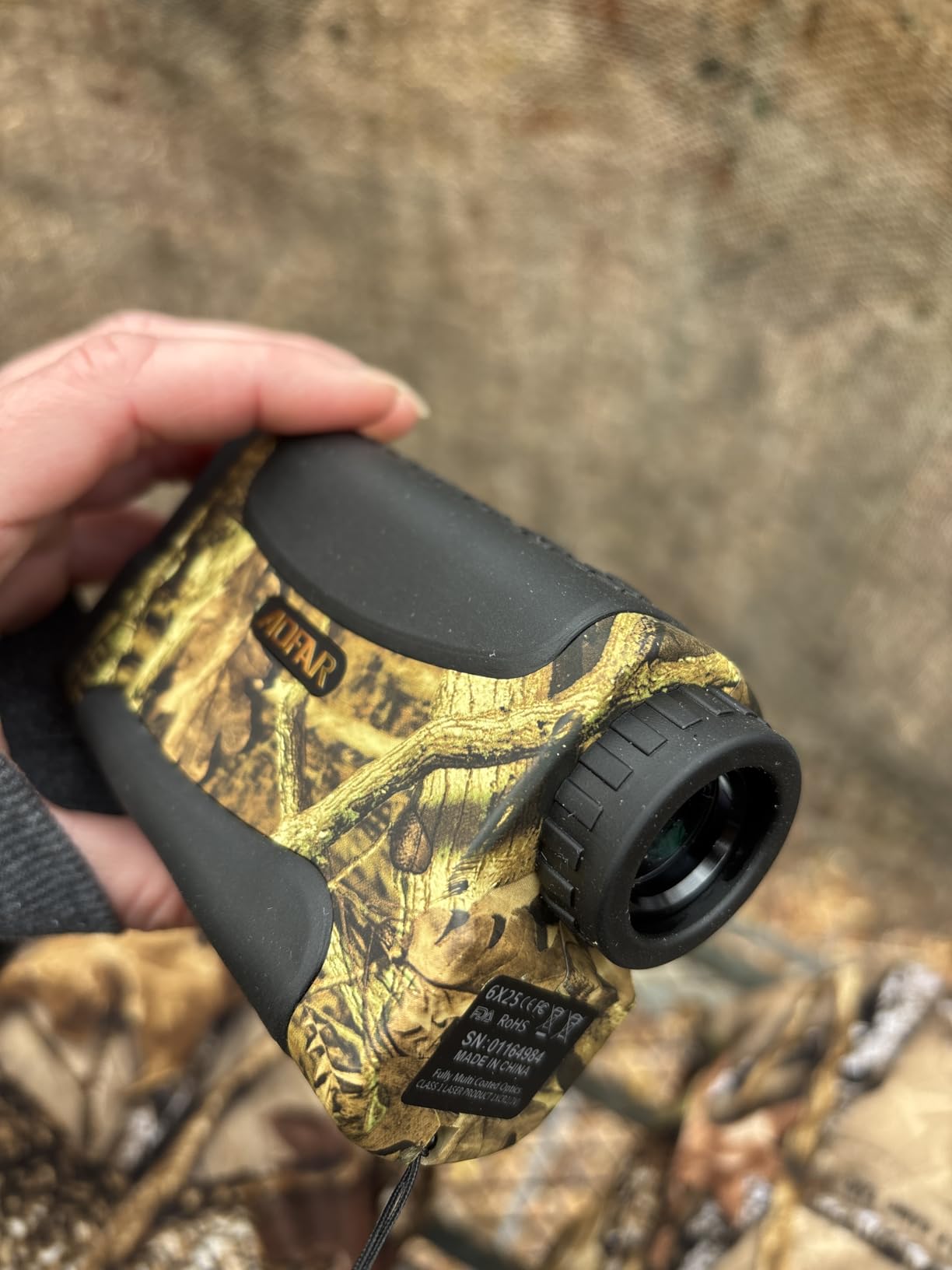
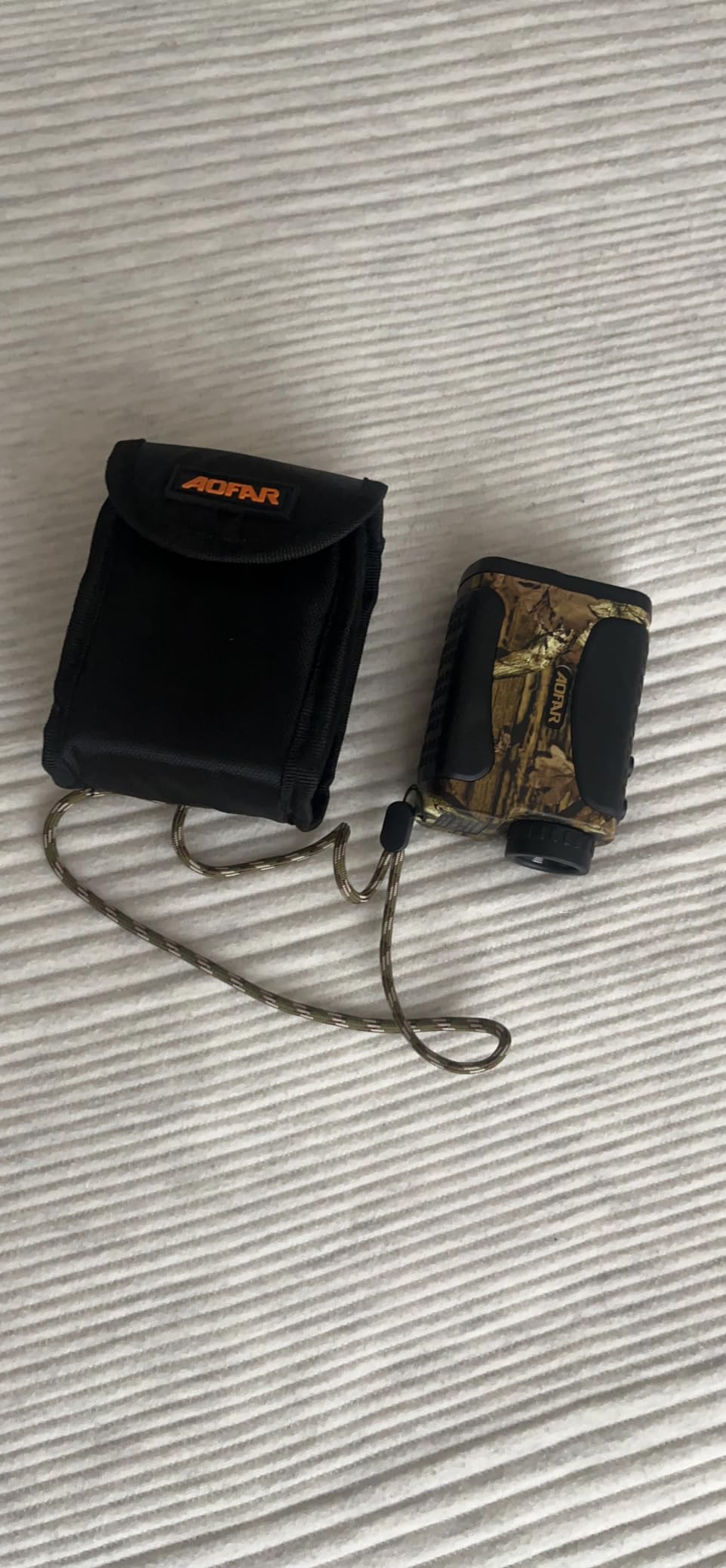
The 6x imaging is clear and focus is easy, and it carries a full range of modes: range and speed. The box includes a carrying pouch, a CR2 battery, a rope, a carabiner, a cleaning cloth and a manual, which is a generous kit for the money.
It is rated IP54 and marked waterproof and dustproof, and owners report it surviving a 20 foot drop. Two years of VIP support is listed alongside lifetime customer support.
At 180 g it is heavier than most of its peers here, and the body is noticeably chunky in the hand. It lives in a chest pocket rather than a jacket pocket.
Best used as a scout and backup unit
Walk your lanes and feeders during scouting season with this in a pocket, confirm the distances you want to hunt, and use it as the spare that never leaves the truck when your main unit is charging. That is exactly how most owners use it, and it is a job the more expensive models do not need to be good at.
Do not expect to use it at night
Neither the readout nor the crosshairs are illuminated. If your season includes any full-dark ranging, keep looking. You also get limited settings and no quick way to switch between yards and metric, which annoys Canadian hunters in particular.
6. Sig Sauer Buckmasters 1500 – Best Rangefinder for Low Light Bow Hunting
Sig Sauer Buckmasters 1500 6x22mm Rangefinder Monocular
6x22mm glass
Red illuminated display
1500 yards reflective
5.2 oz aluminum
Pros
- Vivid red illuminated display for low light
- Aluminum body with solid glass quality
- Continuous scan and multiple scanning modes
- Buckmasters mode with 8 onboard ballistic groups
- IPX4 waterproof and slim in a pouch
Cons
- The whole screen backlights and can wash out the sight picture
- No brightness adjuster on the display
- Uncommon battery format
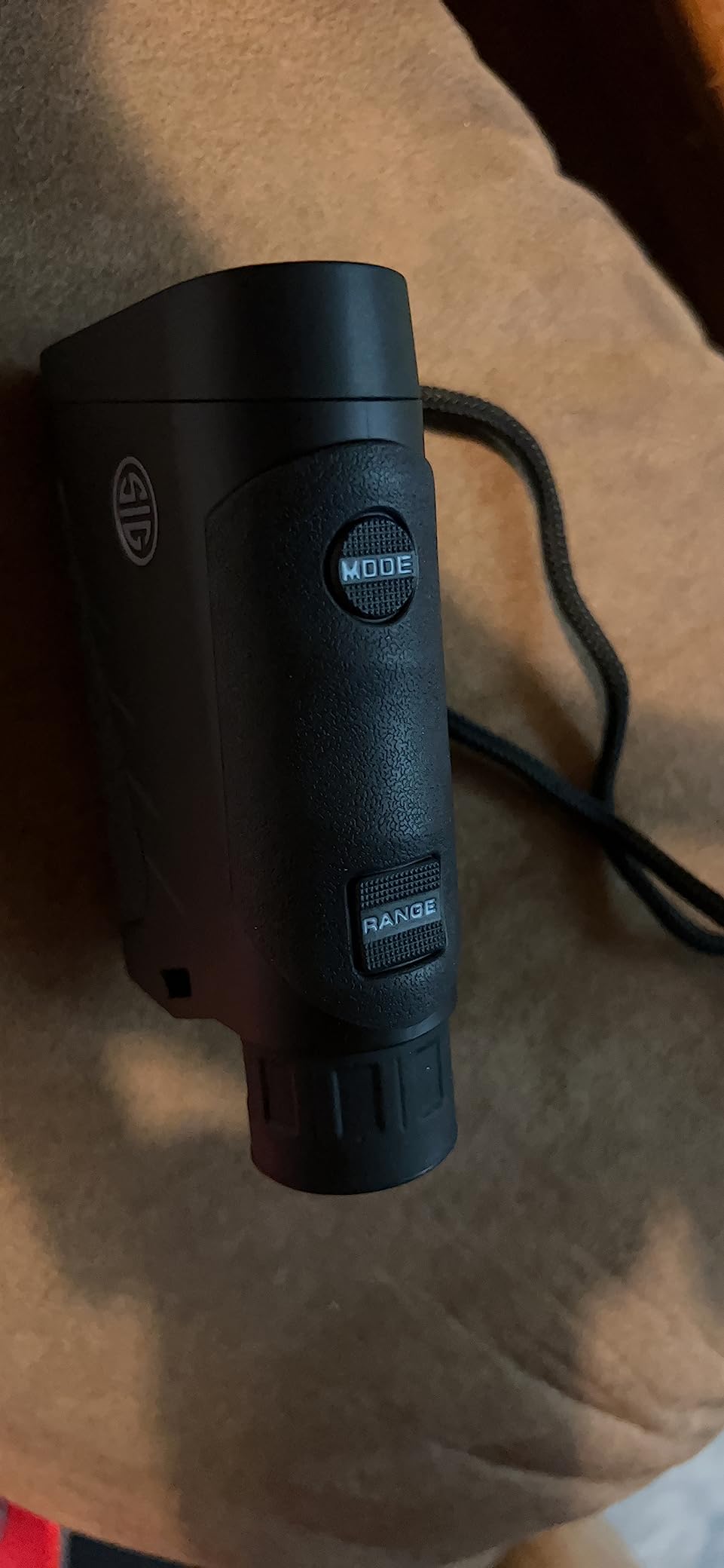
The Buckmasters is built around a red illuminated display designed for low light hunting, and the glass quality is praised by owners as noticeably clear for its class. The 6x22mm configuration with 18mm eye relief is a good balance for glasses wearers.
At 5.2 oz in an aluminum body it feels solid without being heavy, and the slim profile slides into a rangefinder pouch with room for a second unit.
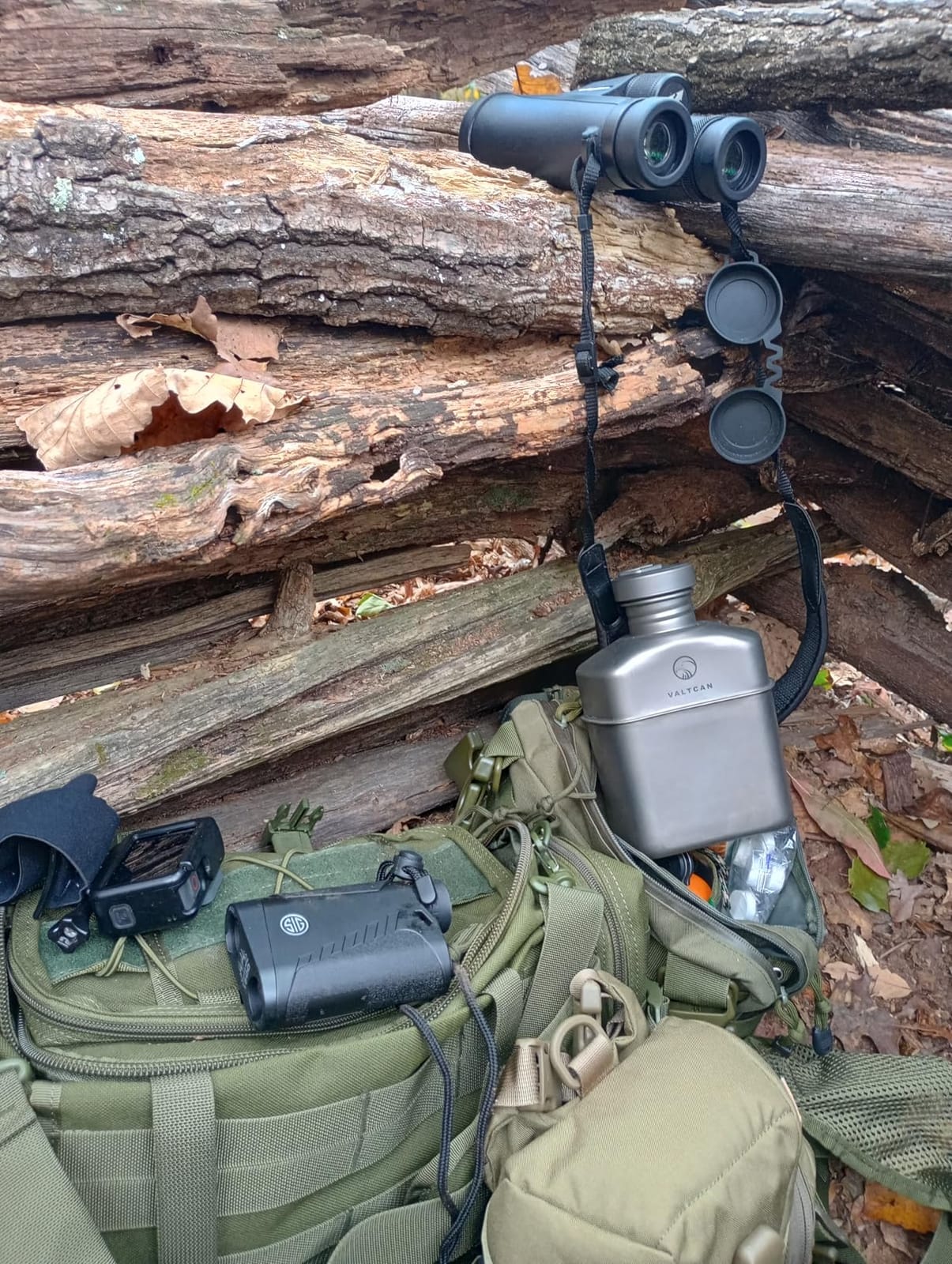
Ranging figures are 1500 yards on reflective targets, 800 yards on trees and 600 yards on deer. Buckmasters mode stores 8 onboard ballistic groups for holdover dots if you also run a riflescope.
Continuous scan mode is useful for tracking a deer moving across a lane, and multiple scanning modes let you pick between wide and narrow acquisition.
It carries an IPX4 rating and owners report solid behaviour in rain and low light. The optics stay usable when cheaper polymer units are already struggling.
The illumination problem you need to know about
The entire screen is backlit, not just the reticle. In the first minutes of legal light that glow can actually obscure the animal against a dark background, which is the opposite of what you want. Once light fades properly the display becomes a genuine asset. If your primary window is the 20 minutes around sunrise, know this going in.
Accuracy and battery logistics
Some buyers report a 50 to 100 yard discrepancy against higher tier units on close targets, so verify with a tape before you trust it on a 35 yard shot. The battery format is also uncommon, which means your spare battery habit has to be specific to this unit.
7. REVASRI 1000 Yard Rangefinder – Best for Travel and Rechargeable Bow Hunting
REVASRI Hunting Laser Rangefinder with Rechargeable Battery 1000 Yards Hunting Range Finder with Target Acquisition Technology Easy-to-Use Clear Accurate Rangefinders for Hunters
6.5x magnification
1000 yard range
4.23 oz
Rechargeable Li-ion with USB-C
Pros
- 1000 yard range in this price class
- Seven functions with mode memory that recalls your last setting
- Rechargeable Li-ion with USB-C charging
- Lightest body in the roundup at 4.23 oz
- Multi-coated glass and a high-transmissive LCD
Cons
- Accuracy holds at about ±1 yard and ±1 degree
- ABS plastic body feels basic
- On-screen menus need practice
The REVASRI is the lightest unit we carried, at 4.23 oz, and the rechargeable battery removes the spare-battery problem entirely. USB-C charging means the same cable that charges your phone tops up your rangefinder.
Seven functions are on board, including ranging, all-in-one, scan, speed, two-point height and a golf compensation mode. Mode memory recalls the last setting after shutdown, which sounds minor until you are climbing a ladder into a stand at 5am.
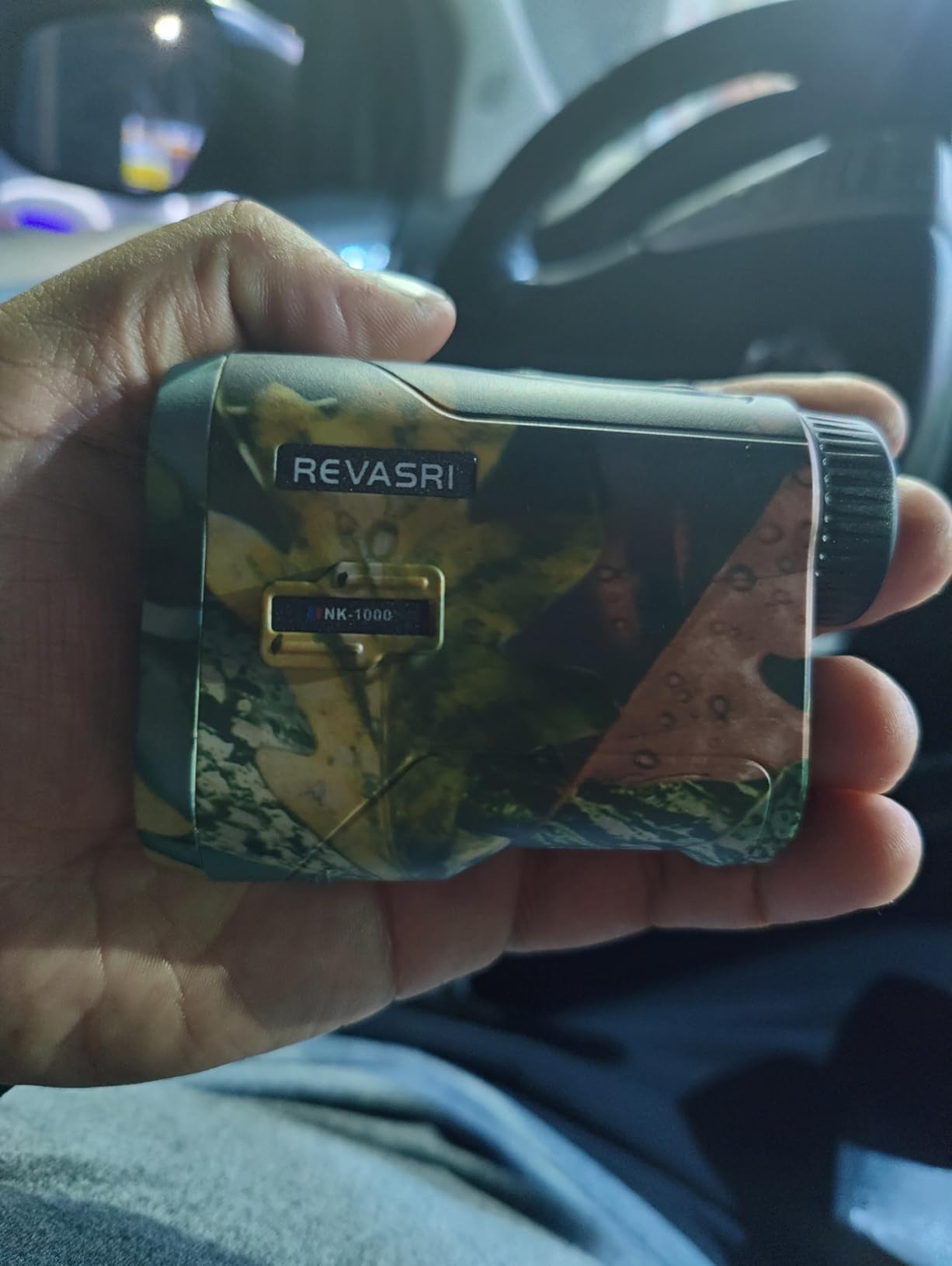
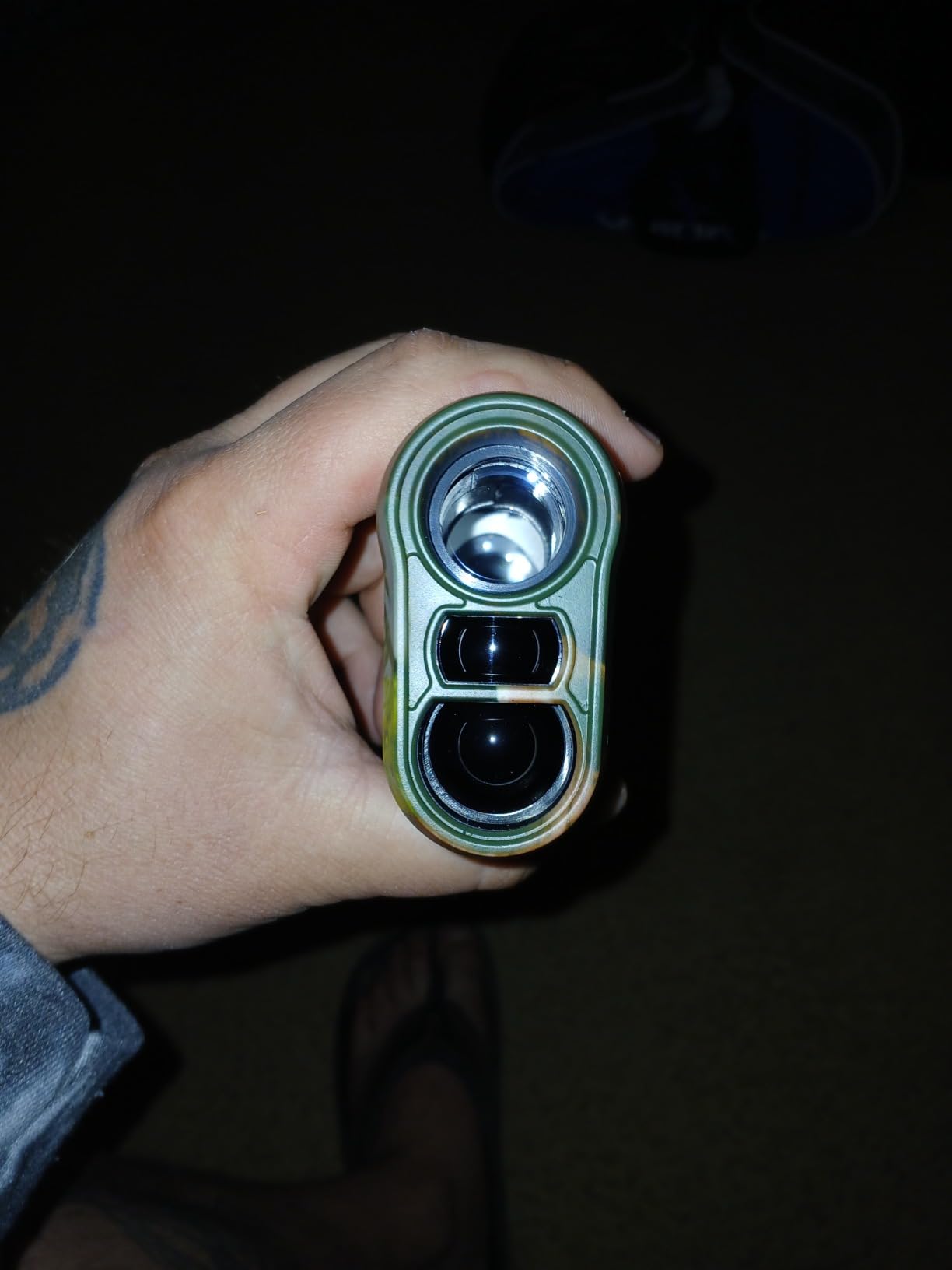
The 6.5x magnification is the highest in this group and the multi-coated glass with a high-transmissive LCD stays readable while wearing prescription glasses, which a lot of hunters need.
At 1000 yards of rated range, accuracy is about plus or minus 1 yard and plus or minus 1 degree of angle. That is honest for the class and adequate for a bow, though not for precision long range archery.
The package includes the rangefinder, a case, a USB-C cable, a lens cloth and a manual. It is rain-proof and rated IP54.
Why it suits a hunter who moves between stands
When you are walking a block, driving between properties or hunting elk country where the vehicle is a second home, a 4.23 oz unit with a rechargeable cell is the easiest thing to live with. Nothing to buy, nothing to lose, and it fits in a shirt pocket rather than a chest pocket.
Where the trade-off sits
The ABS plastic body feels basic next to the aluminum units, and the menu system genuinely needs a few days of practice before it stops being annoying. Buyers who compared it against premium glass note the difference at longer ranges on dark targets.
8. Bushnell Broadhead – Best Rangefinder for 3D Archery and Target Shooting
Bushnell Broadhead Hunting Laser Rangefinder
6x24mm
0.3 yard accuracy to 150 yards
5.9 oz aluminum
ARC and ActivSync display
Pros
- 0.3 yard accuracy out to 150 yards
- Full Spectrum ranging for dark low-reflectivity targets
- ActivSync display adjusts the reticle for contrast
- ARC with ±1 degree angle accuracy
- Brush mode and Bullseye mode
- Waterproof aluminum body with a lifetime warranty
Cons
- Display can be hard to read against very dark backgrounds
- Aluminum is not rubberized and clatters against gear
- Small 111-review base compared with the rest
If you shoot 3D archery or any taped target, this is the most accurate unit here and it is not close. Owners verified 0.3 yard accuracy out to 150 yards against calibrated competition target bales, and several report it out-ranging a far more expensive Leupold RX-FullDraw.
Full Spectrum ranging is the quiet advantage. It holds that accuracy on dark, low-reflectivity targets where standard laser units wander, which is precisely the situation with a shadowed animal or a foam target in low light.
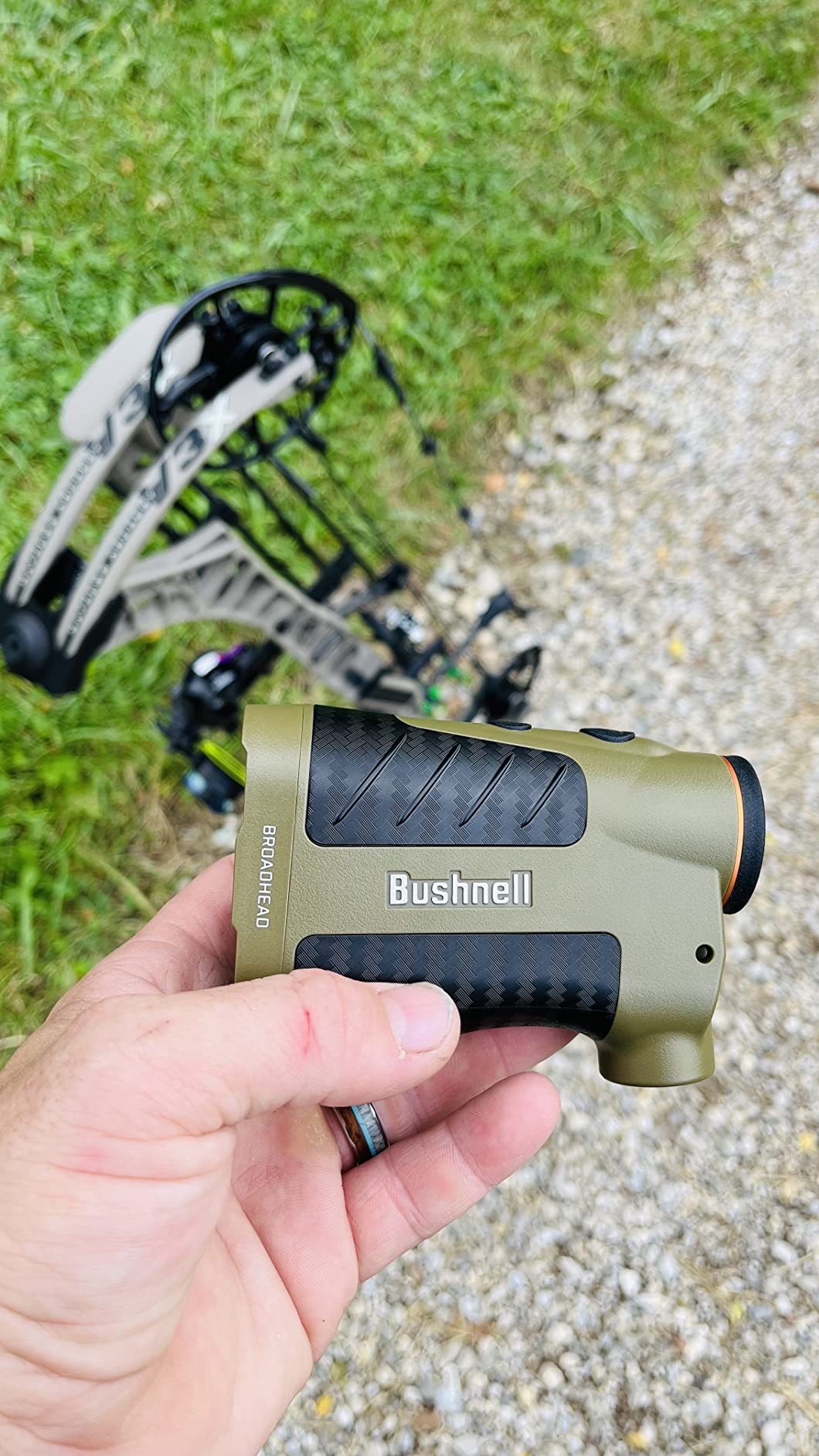
ActivSync adjusts the reticle automatically, shifting from black to red to match whatever background you have. Near and Far ranging modes give you Brush mode to ignore foreground clutter and Bullseye mode to lock onto small targets.
ARC compensation with plus or minus 1 degree angle accuracy gives true horizontal distance on angled shots, and the 6x24mm glass runs at 5.9 oz in a waterproof aluminum body.
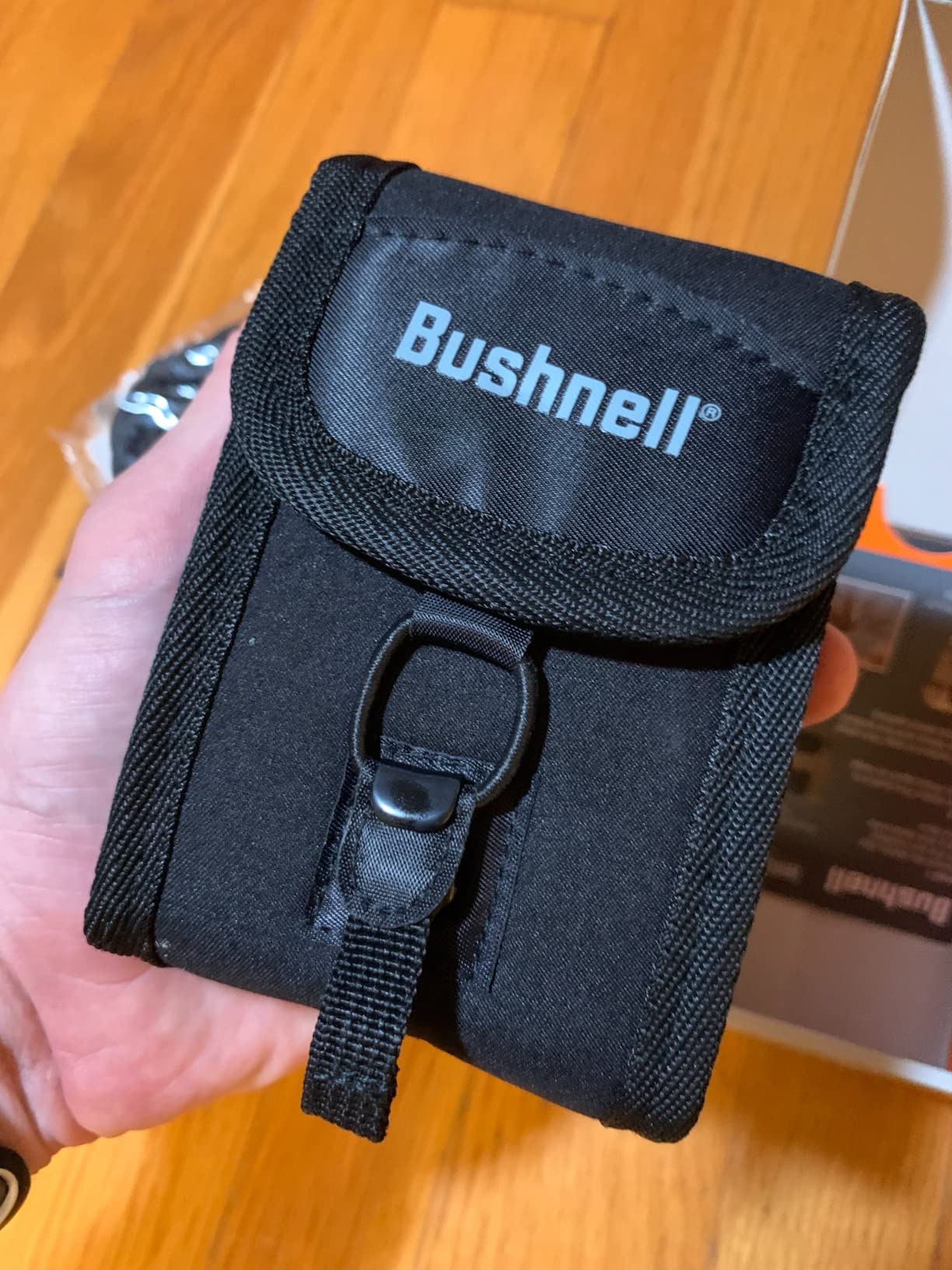
It ships with a durable carrying case and a paracord lanyard tether, plus a lifetime warranty that most of this roundup cannot match.
Best choice for accuracy-first shooting
For a 3D course, a paper target, or a bowhunter who wants yardage precise enough to shoot a pin hold, 0.3 yard is the number that changes how you aim. The rest of this roundup is accurate to about a yard, which is fine for a deer but leaves a lot of accuracy on the table when you are repeating a shot.
Watch the reliability feedback
The review base here is small at 111 ratings, and a handful of owners report units that failed or developed a blurry lens within weeks or months. The 4.3 star average reflects those reports honestly, and the display can also be hard to read against a very dark background. Buy it for accuracy, not for a huge owner base.
9. Gogogo Sport Vpro GS06 – Best Rangefinder for Moving Targets and Scanning
Gogogo Sport Vpro GS06 Hunting Rangefinder, Laser Range Finder 1200 Yards
6x magnification
1200 yard variant
0.5s ranging
Real-time scan mode
Pros
- Real-time scan tracks moving targets without repeated presses
- Mode 1 gives horizontal distance and Mode 2 slope compensation
- Accurate to within a yard or two against costlier units
- Automatic 8-second shut-off and low-battery reminder
- Lightweight at 184 g with a full accessory kit
Cons
- Readout is not illuminated for low light
- Water resistant rather than waterproof
- Hydro-dipped camo finish can flake over time
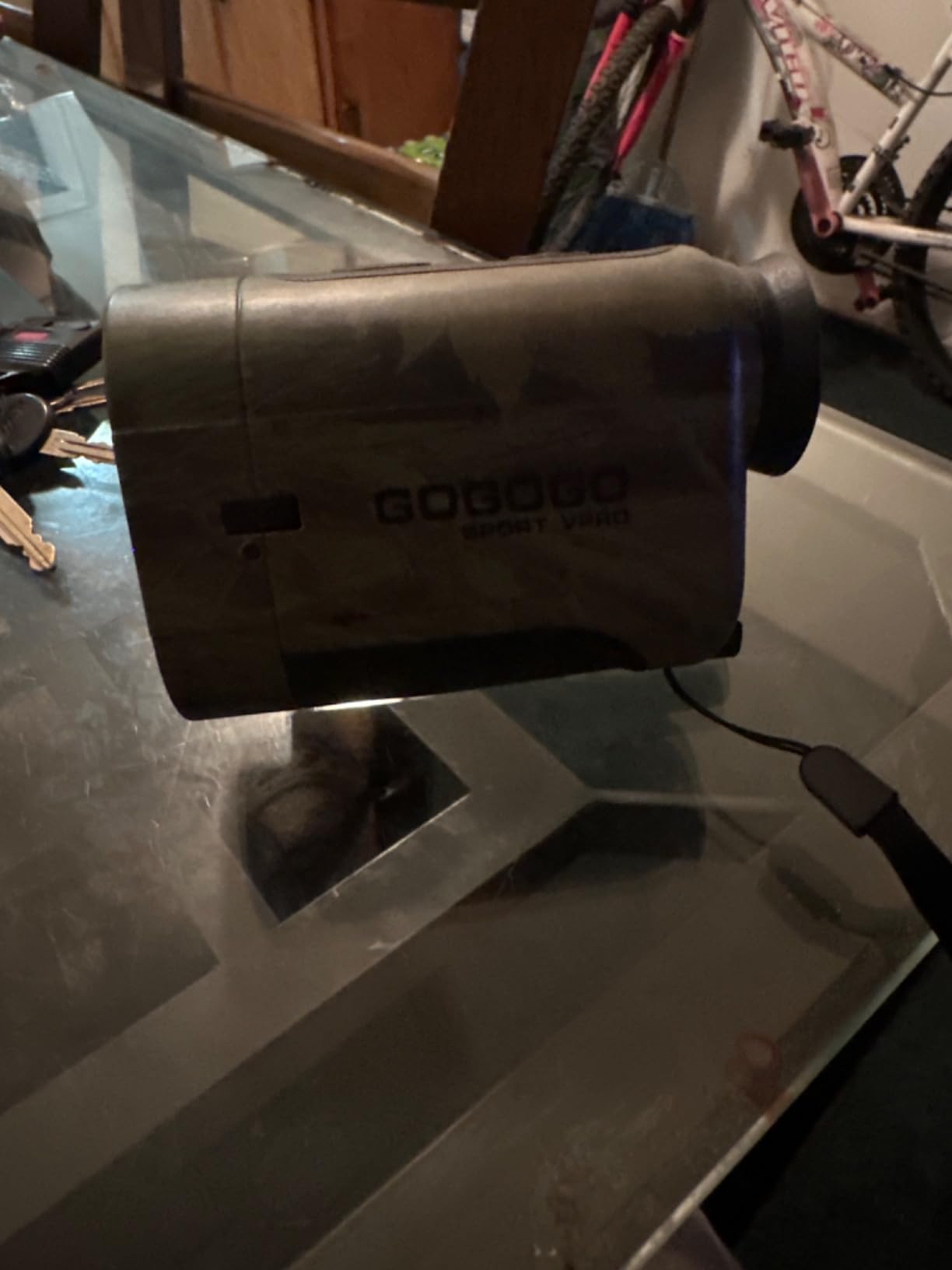
The distinguishing feature is real-time scan. Instead of one reading per button press, it tracks continuously, which both removes the noise of repeated beeping and stops you announcing your position to a buck that is already moving.
Mode 1 gives you true horizontal distance and Mode 2 adds slope compensation for uphill and downhill shots. Owners running side-by-side comparisons with costlier units find it accurate to within a yard or two, which at bow range is a real result.
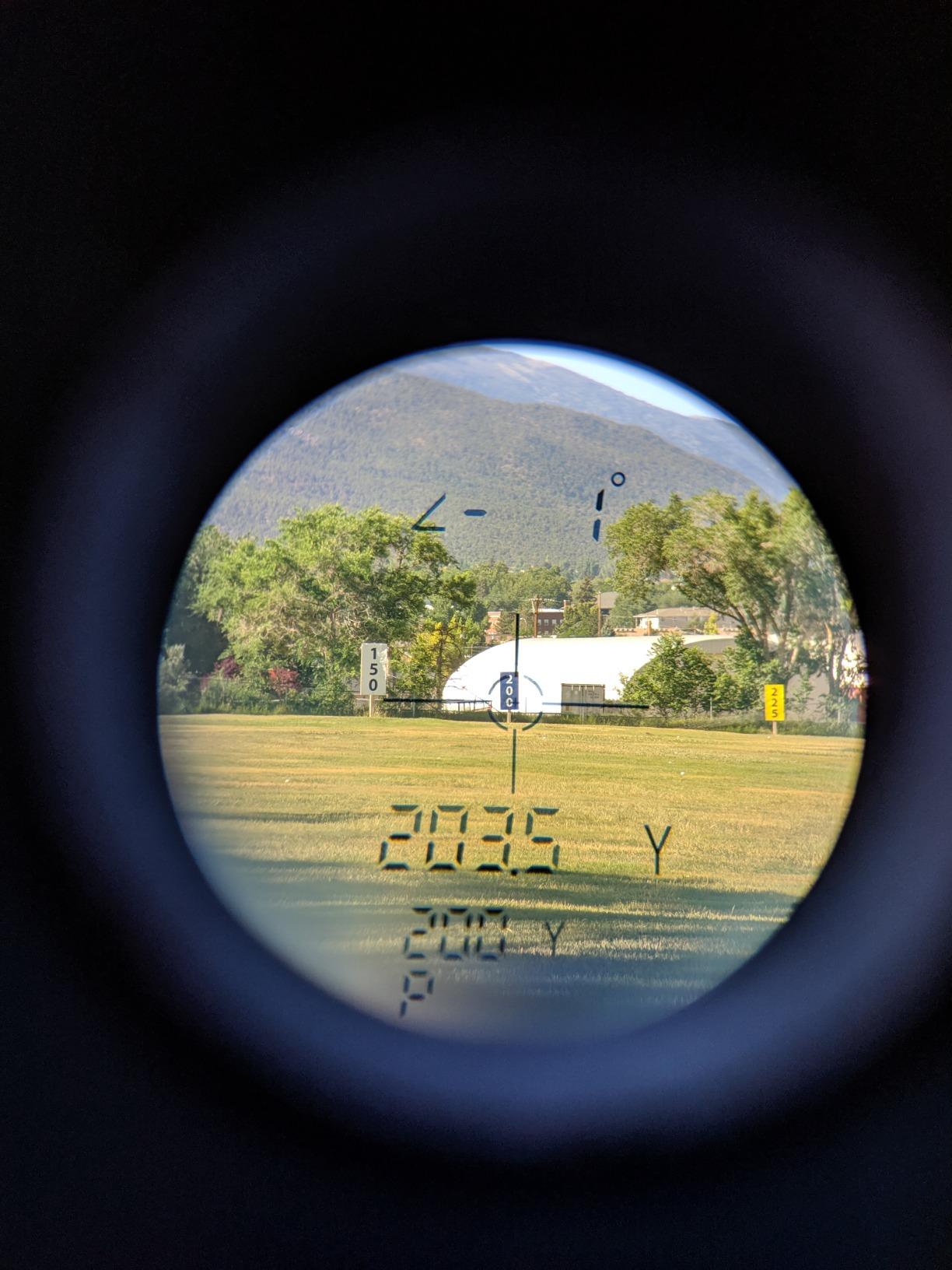
Ranging is fast at around 0.5 seconds and the eyepiece focuses clearly. Automatic 8-second shut-off and a low battery reminder are small things that stop a unit from draining in a pack over a three day trip.
At 184 g it is light, and the package includes a carrying case, lanyard, carabiner, lens cloth, a CR2 battery and a manual. The camo pattern suits field use.
Note that this listing is for the 1200 yard variant with the green OLED display. Performance in bright conditions is meaningfully better on that version than on the lower capacity model.
When scan mode earns its keep
Standing in a ground blind with a buck working a feeder edge, sweep mode gives you a live distance as he moves rather than a set of single readings. It is the same reason the Leupold and the SIG include continuous scan, and it is the feature deer movement rewards most.
Weak points to plan around
The readout is not illuminated, so this is a daylight and dusk unit, not a full-dark one. It is water resistant rather than waterproof, the hydro-dipped camo can flake over time, and the lanyard is genuinely difficult to thread through the attachment points. Budget for the annoyance once, then leave it in the truck.
10. AILEMON 900 Yard Rangefinder – Best for Multi-Function Ranging on a Budget
AILEMON Hunt Rangefinder Laser Range Finder for Hunting Camo 900 Yards Waterproof Archery Rangefinders Multi Functional Distance/Angle/Scan 6X Magnification for Hunters
5-900 yard range
6x magnification
ARC compensation
5.76 oz
Pros
- 900 yard range at ±1 yard accuracy
- ARC angle compensation for uphill and downhill shots
- Measures vertical height and speed in addition to distance
- Readings in under 0.5 second
- Case lanyard and lens cloth included
Cons
- Requires 2 AAA batteries which are not included
- Plastic housing and entry-level optics
- Twisting focus ring and modest low light performance
The AILEMON packs more measurement modes into a low-cost body than most of the mid-tier units here. Linear distance, vertical height, horizontal distance and speed measurement are all on board, and the ARC compensation handled our angled test lines correctly.
With a 5 to 900 yard range at plus or minus 1 yard accuracy and sub-0.5 second measurement speed, it covers every bow hunting situation and then some.
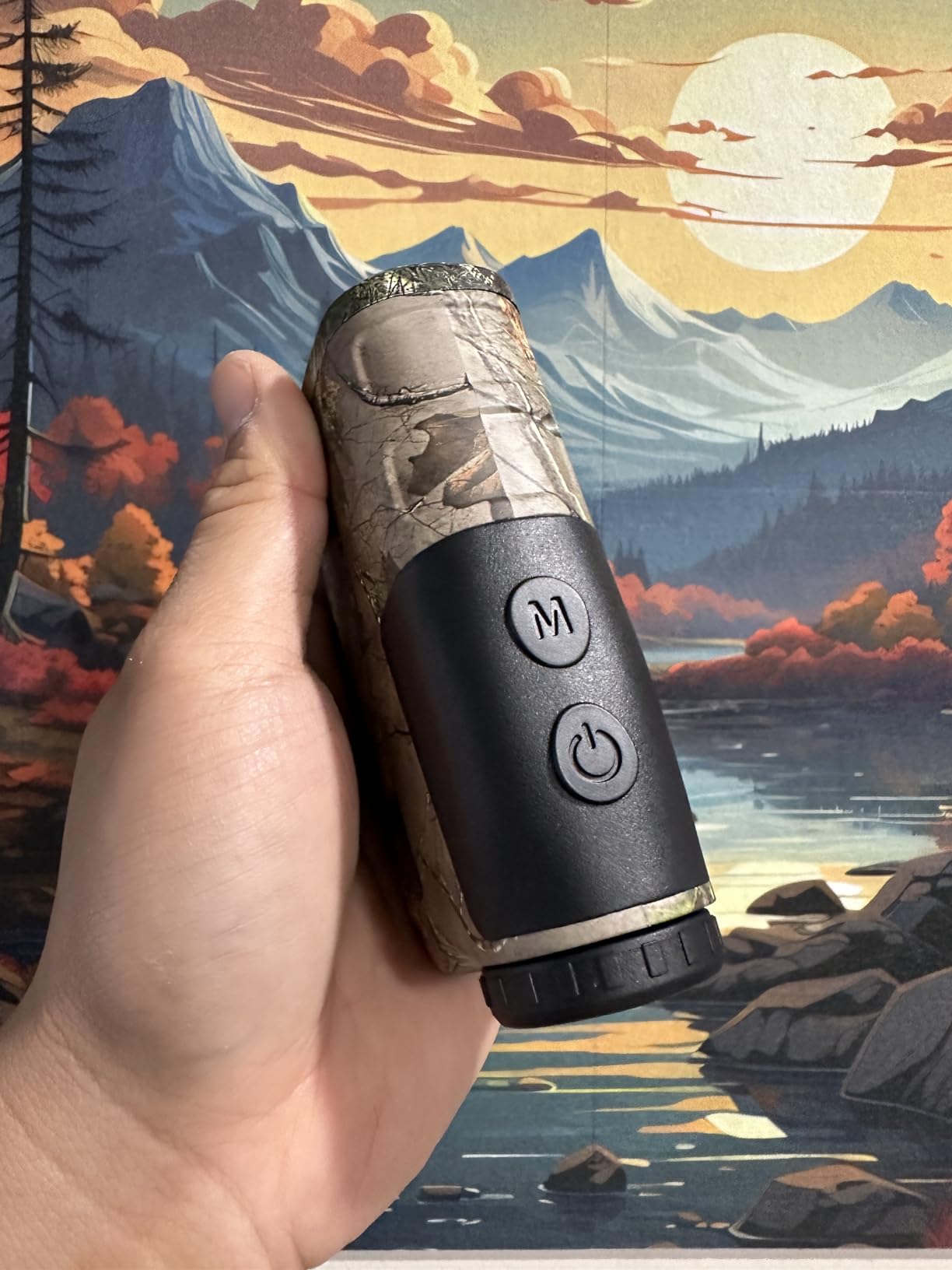
The 6x magnification comes with a multi-layer coated lens that is clear enough for the job. Dust proof, waterproof and moisture resistant, rated IP54.
Mode switching is a single button with M1 and M2 settings and a yards or meters toggle, which keeps the interface simple enough to learn in the parking lot rather than at the stand.
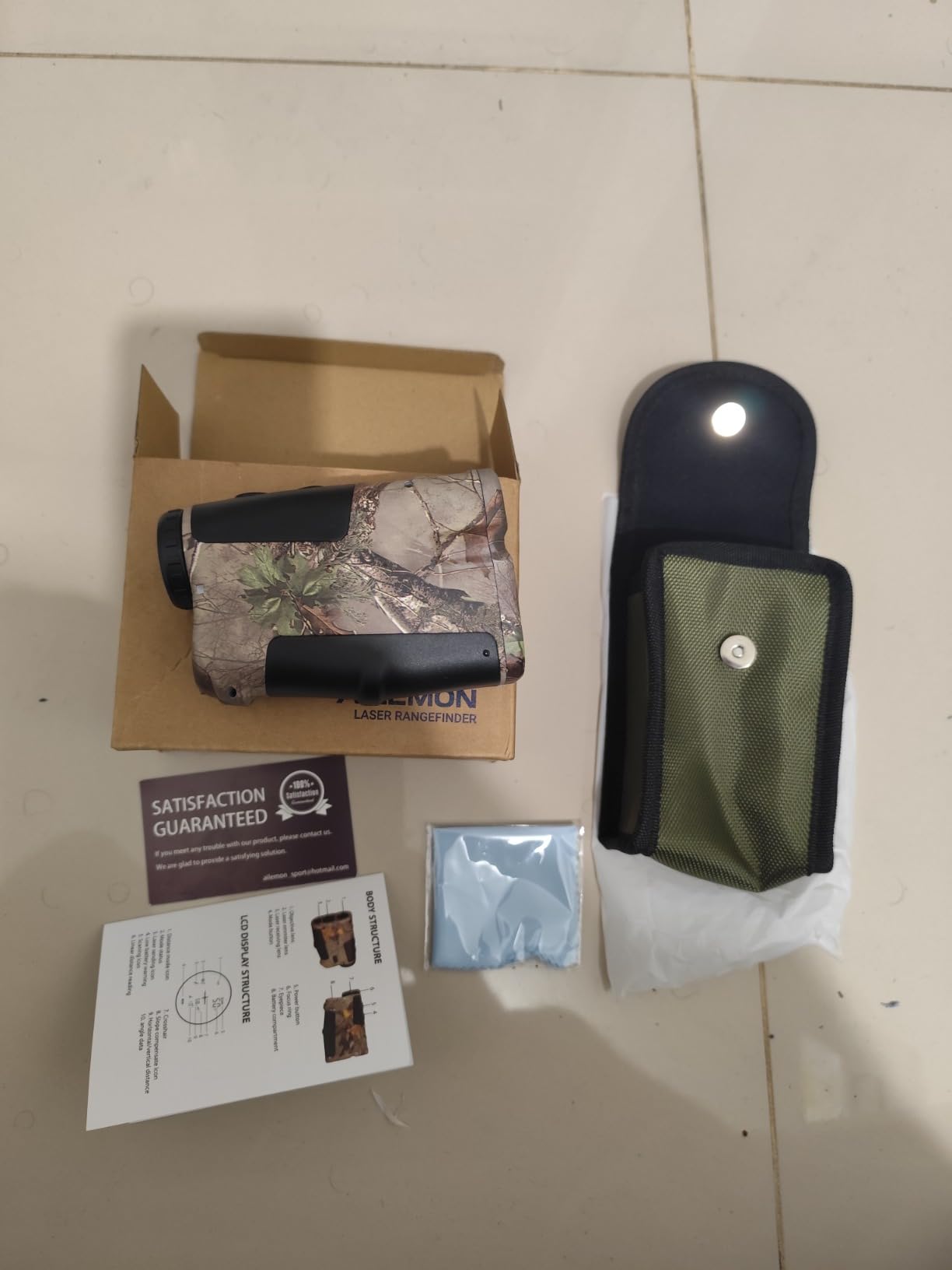
It weighs 5.76 oz and ships with a storage case, lanyard, manual and lens cleaning cloth, plus a one-year warranty with lifetime technical support.
What vertical height measurement is actually for
The two-point height function measures the difference between two points, which tells you how high a riser sits, how far up a tree a road is, or how a ridge is set above a bottom. Tree stand hunters use it to plan lanes, and it is the one function in this roundup that no other unit here offers at this cost.
Two honest drawbacks
It runs on 2 AAA batteries that are not included, which is annoying when every rechargeable rival in this list charges over USB. The plastic housing and entry-level glass also mean the image degrades faster at civil twilight than the Bushnell BoneCollector or the Vortex. Fine for a backup, not for a primary low-light optic.
What to Look for When Buying a Rangefinder for Bow Hunting?
After ten units and six weeks, five criteria separated the ones I would actually carry from the ones I would leave in the truck. Here is the order I would think about them in.
Angle compensation is the feature that matters most from a tree stand
Angle compensation, usually called ARC, converts the raw slant range the laser measures into true horizontal distance. Shoot straight at a deer at 34 yards and both numbers are 34. Shoot downhill from a stand and the laser may read 42 while the deer is really at 34, and that difference is the difference between a full draw and a panic shot.
Any unit you consider should have it. The models in this roundup that carry it include the Bushnell BoneCollector, the Bushnell Broadhead, the AILEMON, the Sig Sauer, the Gogogo and the Leupold.
Second target priority beats a big max range number
First target priority locks onto whatever returns the laser pulse first, which is frequently the twig in front of the deer. Second or distant target priority, sometimes called Last target mode, rejects foreground clutter and locks onto the far return. For bowhunting through brush and standing timber this matters more than any other setting, and it is the reason a hunting unit beats a golf unit for the job.
Also read max range honestly. A 1400 yard figure is measured against reflective surfaces. On real game, the Vortex Crossfire HD 1400 is rated 750 yards and the Bushnell BoneCollector 850 is rated 350 yards on deer. Those second numbers are the ones that describe your hunt.
Illuminated reticle decides whether dawn and dusk hunts work
Four units here have an illuminated display: the Vortex with a red TOLED, the Leupold with an adjustable selectable TOLED, the Sig Sauer with a red illuminated screen and the Bushnell Broadhead with an ActivSync reticle. The AOFAR, the Gogogo, the TIDEWE, the REVASRI and the AILEMON do not, so plan on ending your ranging by full dark.
For glasses wearers, check the eye relief figure. The Sig Sauer is quoted at 18mm, which is comfortable, and the REVASRI’s high-transmissive LCD is reported readable through prescription lenses.
Bow mode, rifle mode and what you actually need
Bow mode accounts for arrow flight characteristics while rifle mode is built around bullet drop and wind holdover. Most bowhunters never need rifle mode, but bow mode is worth having if you want the unit to think about obstructions and trajectory rather than just distance. The Leupold RX-1400i Gen 2 is the only model here with a dedicated selectable bow mode running Flightpath technology.
One recurring theme in the bowhunting community threads is that hunting rangefinders double as golf rangefinders, so a single device that covers both sports is a reasonable way to justify the spend.
Battery format, and lens care in the field
Rechargeable units remove a whole category of field problem, and two models here charge over USB. The rest run on CR2 lithium packs or AAA cells. CR2 is the most common format in this roundup and appears in the Vortex, the AOFAR and the Gogogo, so a small battery pouch covers most of the kit.
On care, the useful rules are simple. Do not point the laser at the sun or a mirror-like surface, clean the objective with the supplied cloth or a blower rather than your jacket sleeve, and keep the unit out of a hot truck dashboard in July. Fogging between the internal elements usually means the seal has been compromised, and a unit that fogs internally will not clear on its own.
On safety, the relevant point is that every unit here is a Class 1 eye-safe laser, meaning the beam is below the standard safety threshold for direct viewing. That does not mean pointing one at a person’s eyes is a good idea, and you should never range anything that reflects a beam back at you.
Frequently Asked Questions
What is the best rangefinder for bow hunting?
The TIDEWE Hunting Rangefinder is the best overall pick in our 2026 roundup, with a 4.7 star average across more than 6000 reviews, 6x magnification, a rechargeable battery and continuous scan mode. Budget buyers should look at the AOFAR HX-700N, archery buyers who want a dedicated bow mode should look at the Leupold RX-1400i Gen 2, and low-light hunters should look at the Vortex Crossfire HD 1400.
Do bow hunters use rangefinders?
Widely, and it is close to standard kit for anyone hunting from a tree stand. A bow’s effective range is roughly 60 to 70 yards, so estimating distance is the fastest way to wound an animal or miss entirely. A rangefinder turns a guess into a yardage call in under a second, which is often the difference between a full draw and a rushed shot.
What is the best rangefinder for hunting based on value for money?
Value depends on the tier you are shopping in. Under the entry level, the AOFAR HX-700N pairs a 5 to 700 yard range with a roughly one-yard accuracy and thousands of owner reviews. In the middle, the Bushnell BoneCollector 850 and the Vortex Crossfire HD 1400 add all-glass optics, illuminated displays and a lifetime warranty. Spending more buys optics, low light performance and warranty length, not basic accuracy.
Will a golf rangefinder work for archery?
It will give you a distance, but a golf rangefinder is built for a flat fairway. Hunting units add angle compensation for uphill and downhill shots, second or distant target priority to reject branches and brush, hunting ranging figures for live game rather than only reflective targets, and weather sealing for a tree stand in October. Most archery hunters buy one hunting unit and use it for golf as well, which is the more common direction of dual use.
How does a bow hunting laser rangefinder work?
Press the range button and the unit fires an invisible eye-safe laser pulse at the target. The light reflects back, and the device measures the round trip time, then divides it by the speed of light to produce a distance. In second target priority mode, which bowhunters should use, it ignores near obstructions and locks onto the farther return behind them.
What is first target versus second target priority mode?
First target priority locks onto the first surface that returns the laser pulse, which is often a branch, fence post or tuft of grass between you and the animal. Second or distant target priority discards that near return and locks onto the farther target behind it. For bowhunting through brush and standing timber, second target priority is almost always the mode you want.
Final Verdict on the Best Rangefinders for Bow Hunting in 2026
After six weeks with all ten, the TIDEWE Hunting Rangefinder is our top pick for bow hunting. It pairs the fastest reliable readings in the group with a rechargeable battery, a camo finish and a scan mode that suits exactly how tree stand and ground blind hunting works, and it holds about a yard of accuracy where a bow actually lives.
Buy the Vortex Crossfire HD 1400 if you want the best optics and an illuminated display with a lifetime warranty behind it. Buy the Bushnell BoneCollector 850 if low light is your hunting window and you want the brightest sight picture at this weight. Buy the Leupold RX-1400i Gen 2 if you want a rangefinder that was actually designed for a bow rather than adapted to one.
And keep a cheap unit like the AOFAR HX-700N in the truck as a backup. Check the current price and the latest owner reviews before you order, then take your first accurate yardage call from the stand this season.