
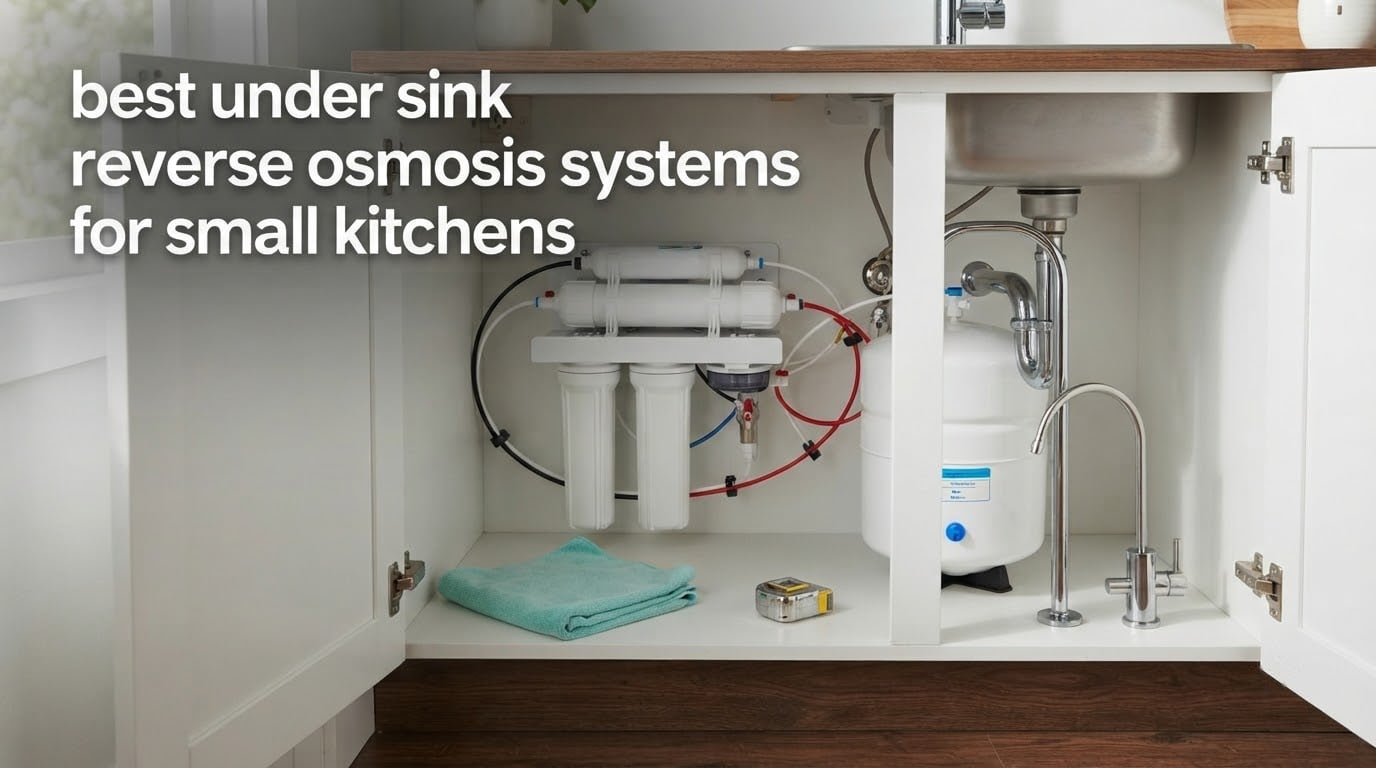
If you have ever crouched in front of an under-sink cabinet with a tape measure, you already know the real constraint here. It is not taste, it is not price, and it is rarely even filtration performance. The question is which body will actually clear the trap door, the garbage disposal, and the shelf you use for cleaning supplies. That is why the best under sink reverse osmosis systems for small kitchens are not the biggest-capacity units on the market, even though that is what most listings push.
We spent weeks comparing the ten systems on this page across the things that break an install: published dimensions, whether a tank eats the cabinet, whether you need an electrical outlet you do not have, how much countertop drilling is required, and what the replacement filters cost once the honeymoon is over. Several of the highest-rated units on Amazon are poor fits for a small kitchen precisely because nobody posts the footprint.
Two things drive everything below. First, a tank-based system stores finished water in a pressurized vessel that sits on the cabinet floor, which is why a narrow cabinet can eat a surprising amount of usable space. Second, a tankless system needs a power outlet to run its pump, which is a hard blocker in a lot of apartments and older rental units. Whichever side of that tradeoff you land on, you end up with more usable cabinet space and lower filter costs than most buyers assume they can get.
Table of Contents
Quick answer: the best under sink reverse osmosis systems for small kitchens
Best overall, and it needs no power at all: iSpring RCC7AK-BN, a 6-stage NSF/ANSI 58 certified system at 15.5 by 16 by 18 inch that runs on line pressure alone.
Best for the narrowest cabinet: APEC ROES-50, whose tank is only 5.25 inch wide and the full assembly is just 17 inch tall.
Best tankless pick: Waterdrop G3P600, an 18.12 by 5.67 by 17.72 inch 600 GPD unit with a smart faucet and tool-free filter swaps.
Best compact tankless with mineral water: Frizzlife PD600-TAM3, the shortest 600 GPD body here at 14.7 by 5.3 by 15.5 inch.
Best when your cabinet is short on height: VIOMI V6, only 12.8 inch tall and still rated at 600 GPD.
Best for low line pressure: iSpring RCC7P-AK, the only pick with a built-in booster pump that keeps flow up in older homes.
Best lowest-water-waste pick: Waterdrop G2, running a 1:1 pure-to-drain ratio.
Everything below is measured against the same criteria, and every dimension quoted comes from the manufacturer listing or the certification record rather than a marketing roundup.
Top 3 Picks for Small Kitchens (October 2026)

iSpring RCC7AK-BN
- 6-stage alkaline RO
- NSF/ANSI 58 certified whole system
- No power needed
- 15.5 x 16 x 18 inch

APEC ROES-50
- Slim 5.25 inch tank width
- NSF/ANSI 58 and 372 certified
- 50 GPD
- 15.5 x 5.25 x 17 inch

Waterdrop G3P600
- 600 GPD tankless
- 2:1 pure-to-drain
- Smart TDS faucet
- Tool-free filter changes
All 10 Systems Side by Side in 2026
Sort this table by the column that matters in your kitchen. If there is no outlet under the sink, the tank-based units are the only viable rows. If the cabinet floor is crowded, look at tankless first.
| Product | Specs | Action |
|---|---|---|
| iSpring RCC7AK-BN |
|
Check Latest Price |
| APEC ROES-50 |
|
Check Latest Price |
| Waterdrop G3P600 |
|
Check Latest Price |
 Frizzlife PD600-TAM3 Frizzlife PD600-TAM3 |
|
Check Latest Price |
 Waterdrop G2 Waterdrop G2 |
|
Check Latest Price |
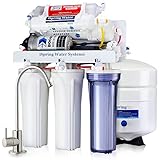 iSpring RCC7P-AK iSpring RCC7P-AK |
|
Check Latest Price |
 NU Aqua 5-Stage NU Aqua 5-Stage |
|
Check Latest Price |
 Express Water ROALK10D Express Water ROALK10D |
|
Check Latest Price |
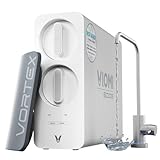 VIOMI V6 VIOMI V6 |
|
Check Latest Price |
 COMFEE’ CMP10 COMFEE’ CMP10 |
|
Check Latest Price |
1. iSpring RCC7AK-BN – Best Certified System That Needs No Power
iSpring RCC7AK-BN NSF Certified, 75 GPD, Alkaline 6-Stage Reverse Osmosis System, pH+ Remineralization RO Water Filter System Under Sink Patented Top-Mounted Faucet Design for Easy Installation
75 GPD tank-based
6-stage alkaline RO
No power needed
15.5 x 16 x 18 inch
Pros
- NSF/ANSI 58 certified for the whole system
- Transparent first-stage housing shows filter condition
- Top-mounted faucet fastener installs from above the counter
- Alkaline pH+ stage for a mineral taste
- Responsive US-based technical support
Cons
- Needs roughly 40-45 psi incoming pressure
- Included tubing is often too short for a typical run
- Membranes need an extended purge after install
- 2:1 to 3:1 wastewater ratio
The iSpring RCC7AK-BN is the best under sink reverse osmosis system for a small kitchen when there is no convenient outlet, because it runs entirely on your household line pressure. It holds a 4.6 star average across more than 21,500 reviews, which makes it the most thoroughly owner-tested system on this list by a wide margin.
What stands out first is the certification. This is NSF/ANSI 58 certified across the entire system rather than just the membrane component, which is the distinction buyers most often miss when comparing listings. Reduction claims cover TDS at 93 to 98 percent, PFAS at 96 to 99 percent, chlorine at 95 to 99 percent, and fluoride above 97 percent.
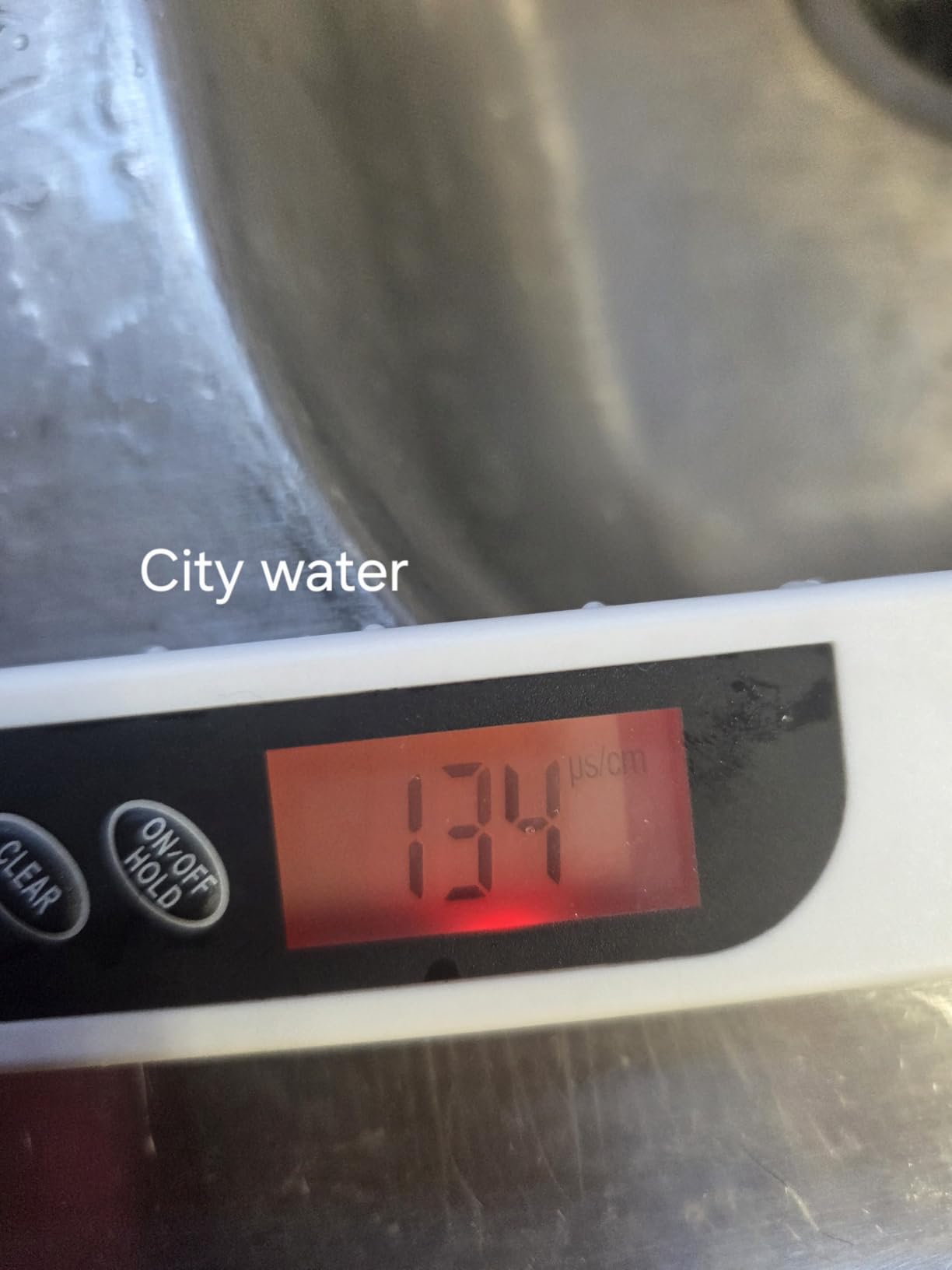
The physical shape works in tighter cabinets than most certified tank-based units. At 15.5 inch long by 16 inch wide by 18 inch tall it is not tiny, but the vertical dimension is where cabinet space usually runs out, and 18 inch clears most standard 19 inch under-sink voids without tipping the unit.
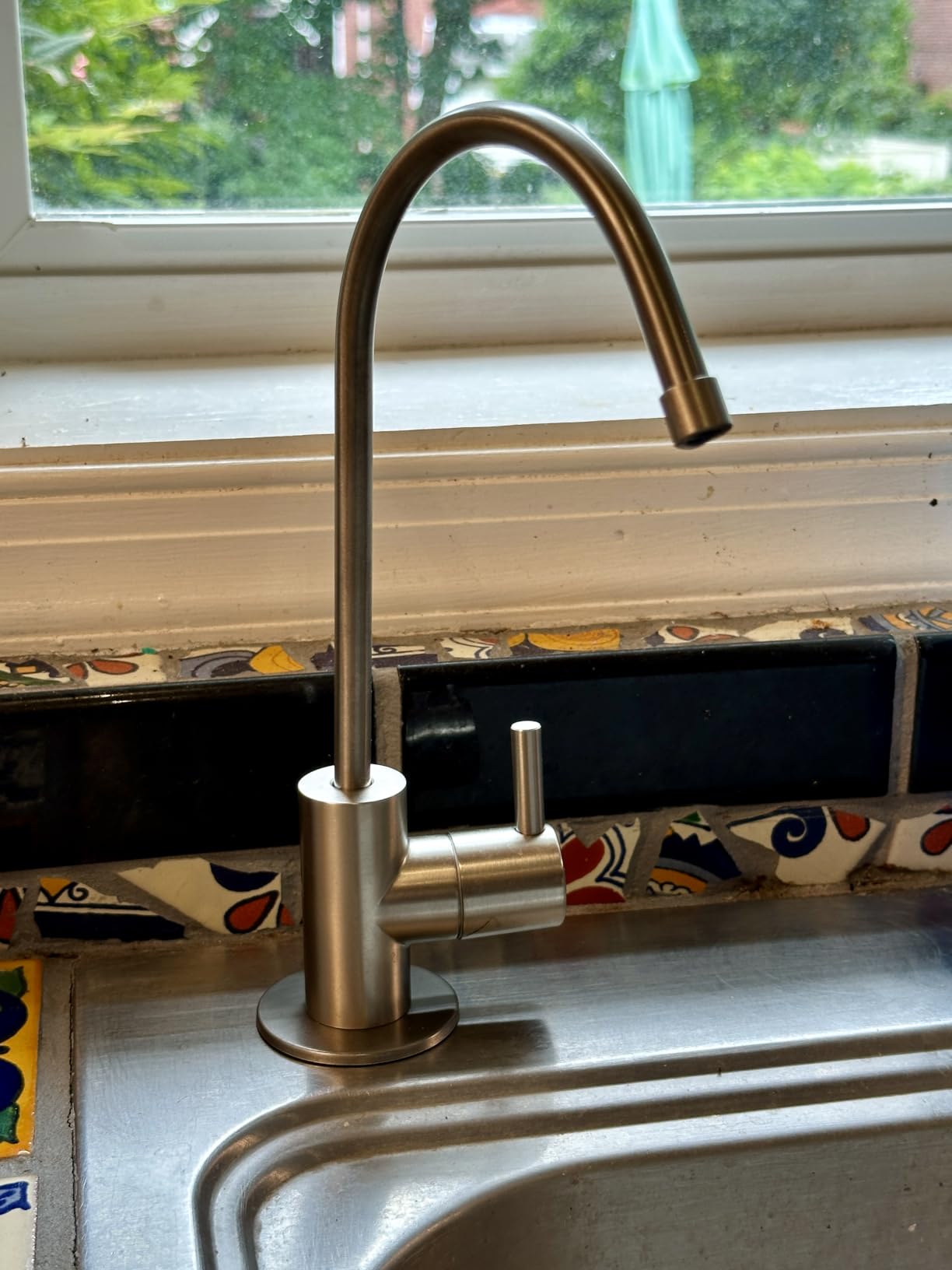
The clear first-stage housing is a small detail that pays off. You can see sediment and rust loading instead of guessing when the pre-filter is spent, which removes the most common complaint about sealed housings. The top-mounted faucet fastener means the whole faucet installs from above the counter, so you are not contorting under the sink with a wrench.
What we like about the fit and the paperwork
Owners consistently report a smooth install with good video guides, and the alkaline pH+ stage keeps the water from tasting flat, which is the single most common complaint about reverse osmosis output. iSpring also lists a one-year manufacturer limited warranty and US spare part availability for three years, so consumables should not become an orphan-parts problem.
For a small kitchen specifically, the fact that this unit needs no power means it can go on a countertop-adjacent cabinet with no electrical work at all. That single feature removes the most common install blocker in rentals and older homes.
Where it falls short
It needs roughly 40 to 45 psi of incoming pressure, and if your home sits below that, output falls off and the taste suffers. The included plastic tubing runs are frequently reported as too short for a typical cabinet run, so budget for a few feet of extra line and some fittings.
The wastewater ratio runs about 2:1 to 3:1, which is normal for a non-pumped tank-based unit. Reviewers also warn that the membranes and post-filters need an extended purge after installation before the water runs clear, so plan on flushing it for a while before your first drink.
2. APEC ROES-50 – Best Slim Tank-Based Unit for a Narrow Cabinet
APEC Water ROES-50, 5-Stage Under Sink Reverse Osmosis System, 50 GPD
50 GPD tank-based
5-stage RO
5.25 inch tank width
15.5 x 5.25 x 17 inch
Pros
- NSF/ANSI 58 and 372 certified whole system
- Only 5.25 inch tank width suits tight cabinets
- Quick-connect fittings and color-coded tubing
- Filter intervals of 6 to 24 months
- Built and tested in-house by APEC
Cons
- 50 GPD is modest for a larger household
- Requires at least 40 psi incoming pressure
- Flow rate is slow next to pumped units
The APEC ROES-50 is the pick if your problem is width rather than height. Its tank is only 5.25 inch across and the full assembly stands 17 inch tall, which is the most compact certified tank-based package we found. It carries a 4.5 star average across more than 9,400 reviews.
It is also the only unit in this group that pairs full NSF/ANSI 58 certification with NSF/ANSI 372 lead-free material certification, and it handles feed water up to 2000 ppm TDS, the highest ceiling listed among the tank-based options here. APEC designs and tests its own systems in-house rather than sourcing white labels.
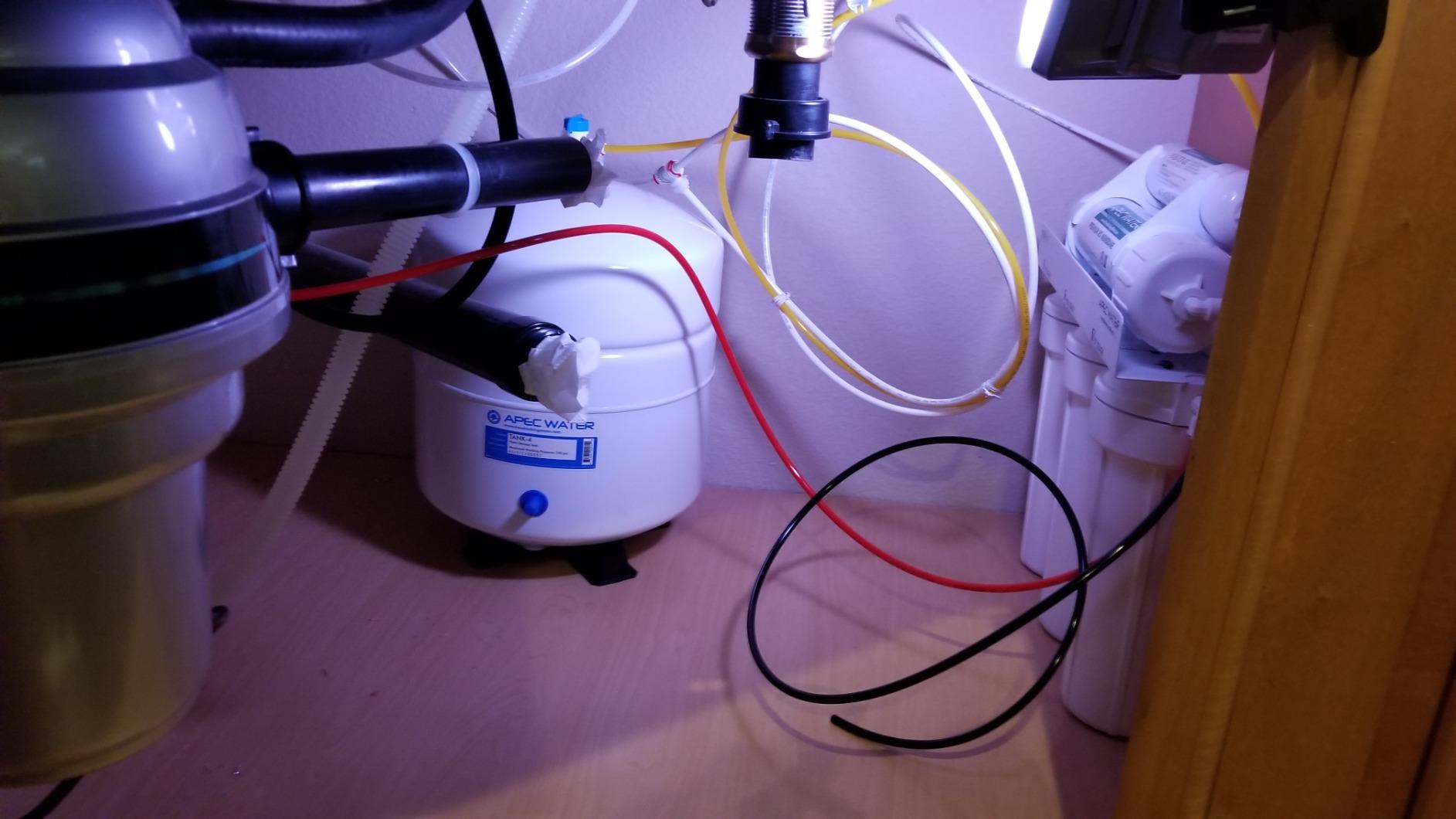
The 5-stage process targets arsenic, chlorine, lead, fluoride, heavy metals and a claimed 1,000-plus impurities, with published claims for PFAS and microplastics reduction. The included Filter-Max-ES50 cartridge set and the brushed nickel faucet are both part of the box, along with the tank and install kit.
Installers like the color-coded tubing because the routing is hard to get wrong on a first attempt. Replacement filter intervals of 6 to 24 months mean you are not swapping cartridges four times a year, and this is one of the few systems here where finding a replacement cartridge later is genuinely straightforward.
Why the slim profile matters in a small kitchen
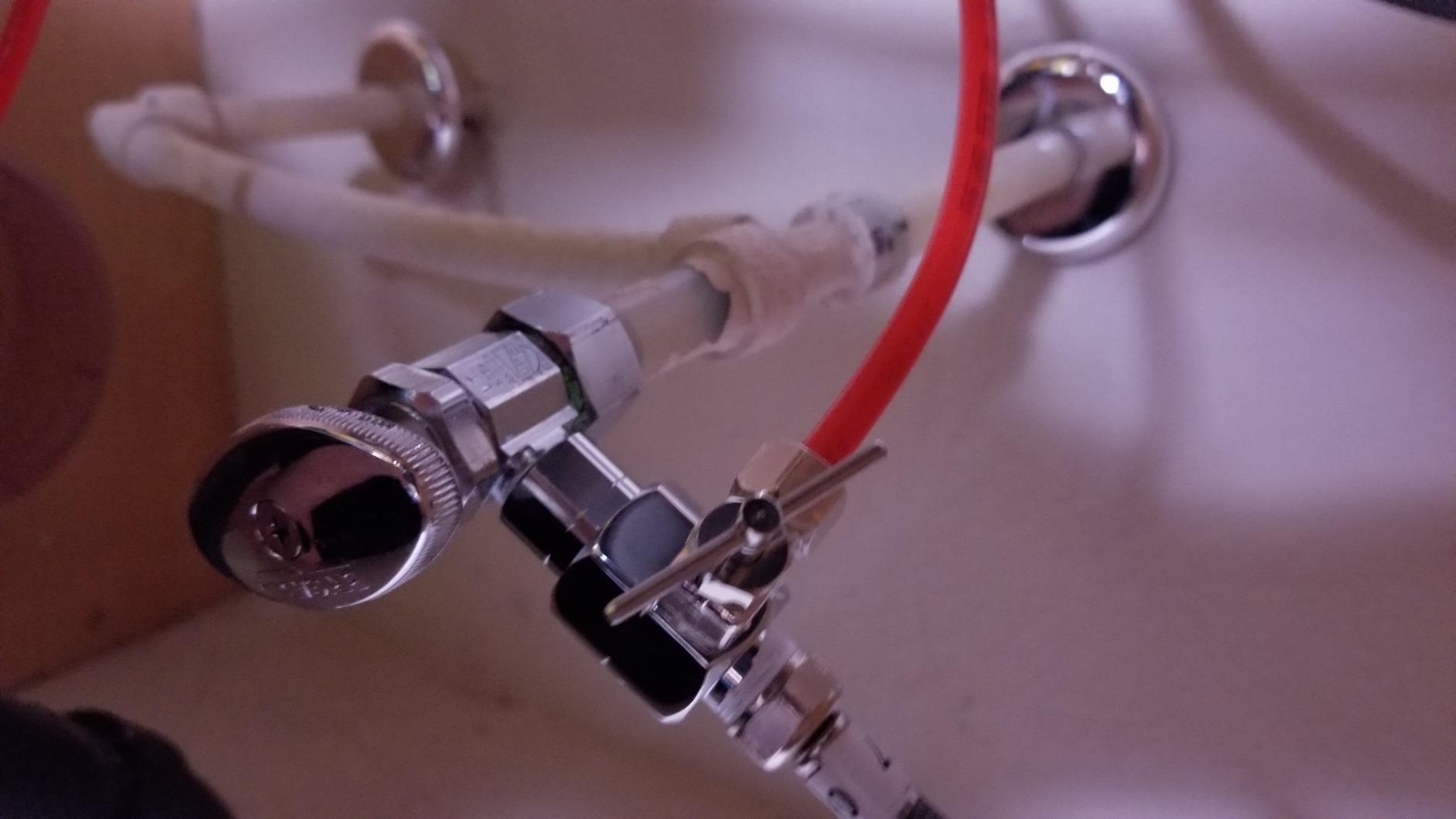
Where most tank-based units force a choice between the RO housing and the storage tank, the ROES-50 lays out narrow enough to sit against a cabinet wall. That leaves usable floor space for cleaning supplies, which is the thing renters in small kitchens most often miss until after the install.
Because it needs no electrical outlet, it is also one of the few options that works in a kitchen where the only receptacle is a switched garbage disposal on a different wall. That is a small thing until you are the one holding a drill.
Where it falls short
50 GPD is genuinely modest. In a one or two person home that is plenty for drinking and cooking, but if you plan on filling pots, making ice regularly, or connecting a refrigerator, you will feel the limit. Reviewers note the 0.03 gpm flow rate is the slowest of any unit on this list.
It still needs at least 40 psi of incoming pressure, and there is no booster pump to compensate. On low-pressure supply you get slower output and a lower effective rejection rate, which is the one weakness reviewers repeat most often.
3. Waterdrop G3P600 – Best Tankless System With a Smart Faucet
Waterdrop G3P600 Tankless Reverse Osmosis Water Filter System, 600 GPD
600 GPD tankless
8-stage RO
2:1 pure-to-drain
18.12 x 5.67 x 17.72 inch
Pros
- Tankless design frees about 70 percent of cabinet space
- Front filters twist out in roughly three seconds
- Smart faucet shows live TDS and filter life
- 2:1 pure-to-drain cuts water waste
- NSF/ANSI 42
- 53
- 58 and 372 certified
Cons
- Requires a live electrical outlet under the sink
- Replacement filters cost more than most rivals
- Built-in TDS meter can lag after a filter change
- 18.12 inch body is longer than most slim tankless units
The Waterdrop G3P600 is the best under sink reverse osmosis system for a small kitchen if you can supply power and want the freed cabinet space. It is a 600 GPD 8-stage tankless unit rated at 0.42 gpm, filling an 8 oz cup in about eight seconds, and it holds a 4.5 star average across more than 4,100 reviews.
The cabinet math is where it wins. Waterdrop claims the tankless layout frees roughly 70 percent of under-sink space, and in a kitchen where you currently have a tank taking up the floor, that reclaimed area is the entire reason to switch. A commenter on r/WaterTreatment who runs a Waterdrop G3 under the sink describes exactly this, citing the tankless footprint and solid TDS drop as the deciding factors.
Certifications are the strongest on this list. It is certified to NSF/ANSI 42, 53, 58 and 372, with third-party lab testing through SGS, and the eight stages address TDS, chromium, PFAS, radium, fluoride, arsenic, iron and chlorine. Operating pressure is listed at 87 psi and the maximum feed TDS is 1500 ppm.
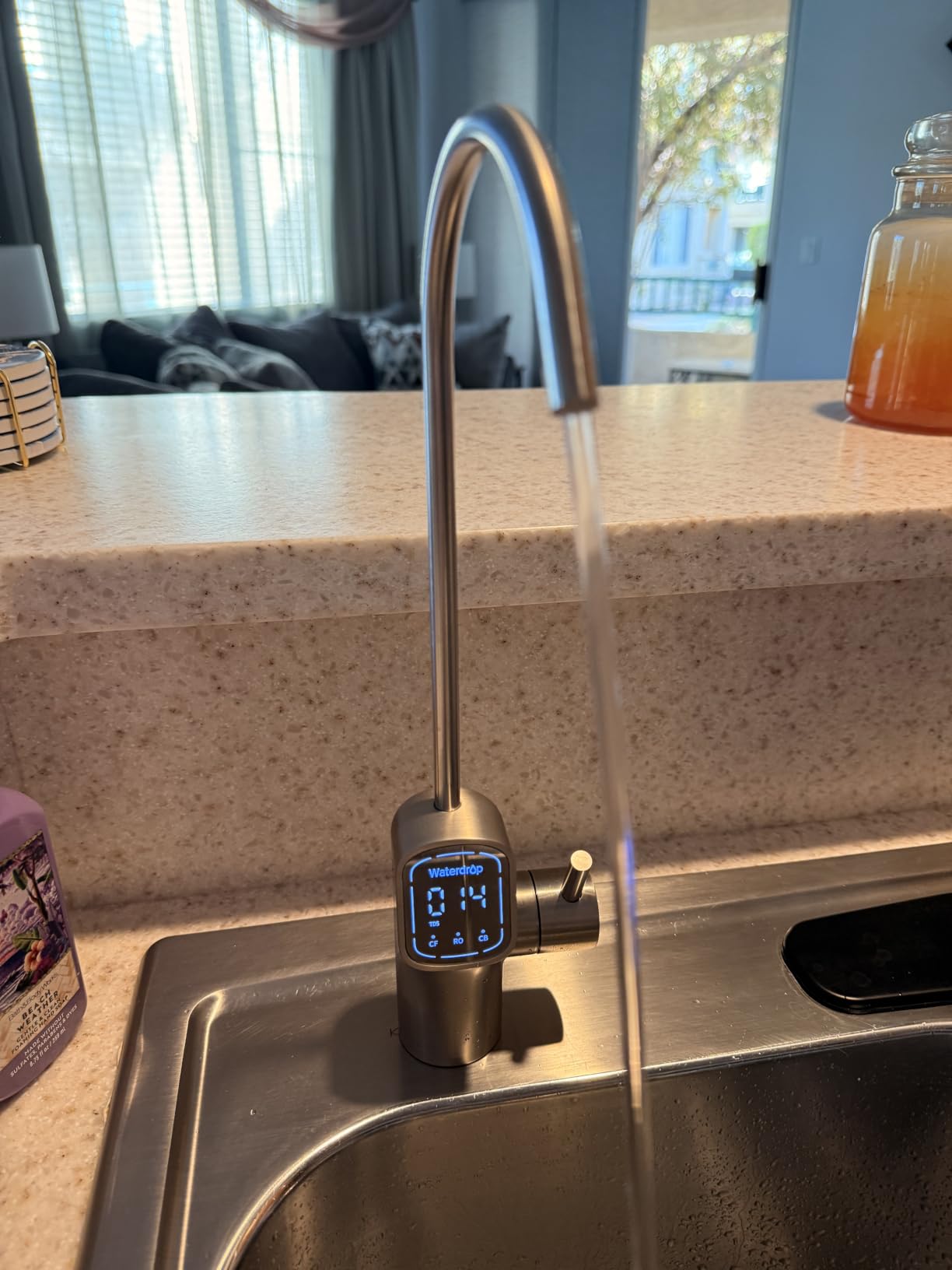
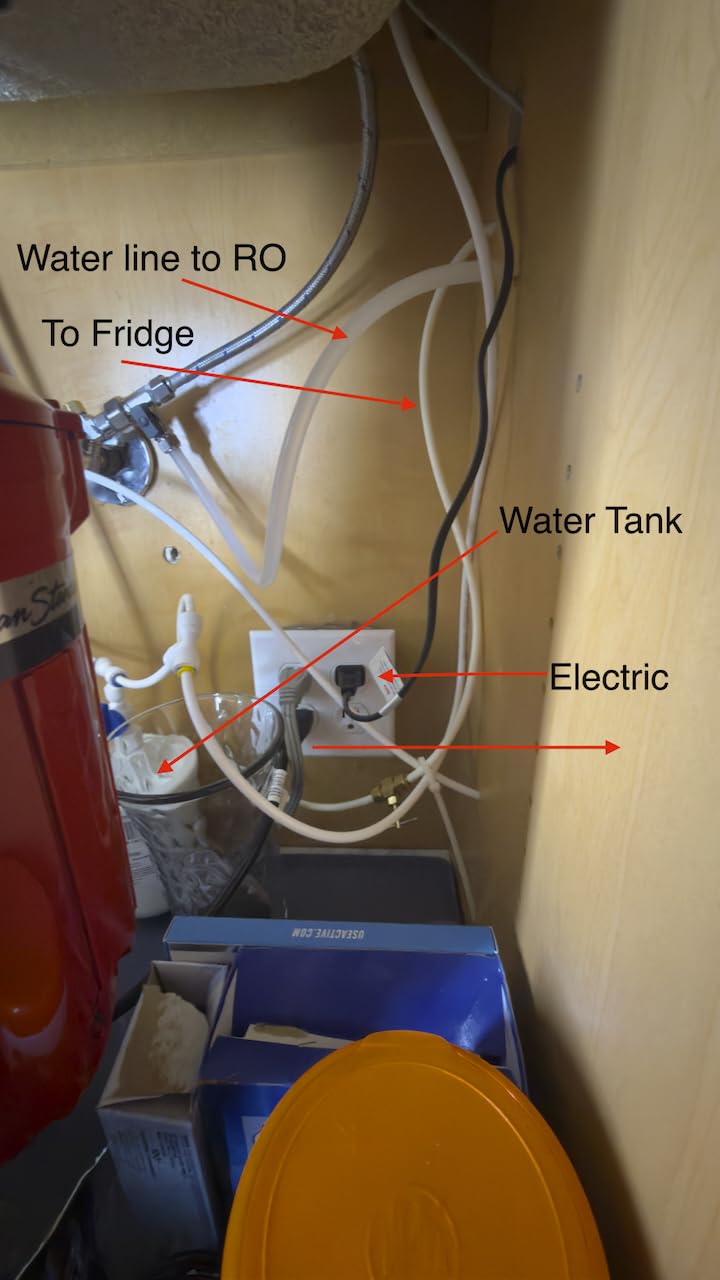
The maintenance story is good too. All three pre-filters are pre-installed and the front-facing cartridges twist out in roughly three seconds with no tools, which means you can change a filter in a narrow cabinet without pulling the unit forward onto the kitchen floor. The smart faucet shows live TDS readings and remaining filter life, so you are not guessing.
What makes it the premium tankless pick
The 2:1 pure-to-drain ratio is the efficiency headline. A conventional tank-based system commonly wastes two to three gallons per gallon produced, and this one runs at two, which matters more in a small apartment where the water bill is the same per gallon and the waste goes straight down the sink drain.
Owners with two years of use report steady flow, quiet operation and a large measured TDS drop. If you already own an older tanked system, this is the cleanest swap we list, and the filter changes stop requiring cabinet clearing entirely.
Where it falls short
It needs an always-live electrical outlet under the sink. In a rental, a kitchen with no receptacle, or a cabinet with the disposal switch and nothing else, that is a genuine blocker rather than a minor inconvenience.
Ongoing filter expense runs higher than many competing systems, which partly offsets the water savings. Reviewers also note the built-in TDS display sometimes disagrees with an external meter for a while after a filter change, so verify with a separate TDS meter before you assume a cartridge has failed.
4. Frizzlife PD600-TAM3 – Best Compact Tankless Unit That Produces Alkaline Water
Frizzlife Reverse Osmosis Water Filter – Alkaline Mineral pH+, NSF/ANSI 58&53&42&372 Standard, 600GPD Tankless RO Reverse Osmosis System, Under Sink, 2:1 Pure to Drain, Reduce FPAS/PFOA, PD600-TAM3
600 GPD tankless
Alkaline pH+ stage
2:1 pure-to-drain
14.7 x 5.3 x 15.5 inch
Pros
- Third alkaline stage raises pH above 7.5
- Short 14.7 inch body for a 600 GPD unit
- 2:1 pure-to-drain ratio saves water
- Smart LED panel shows TDS and filter life
- PFAS and PFOA reduction claims
Cons
- Listed item weight of 0.45 g is a cataloging error
- Still needs a dedicated under-sink outlet
- Lower review volume than the category leaders
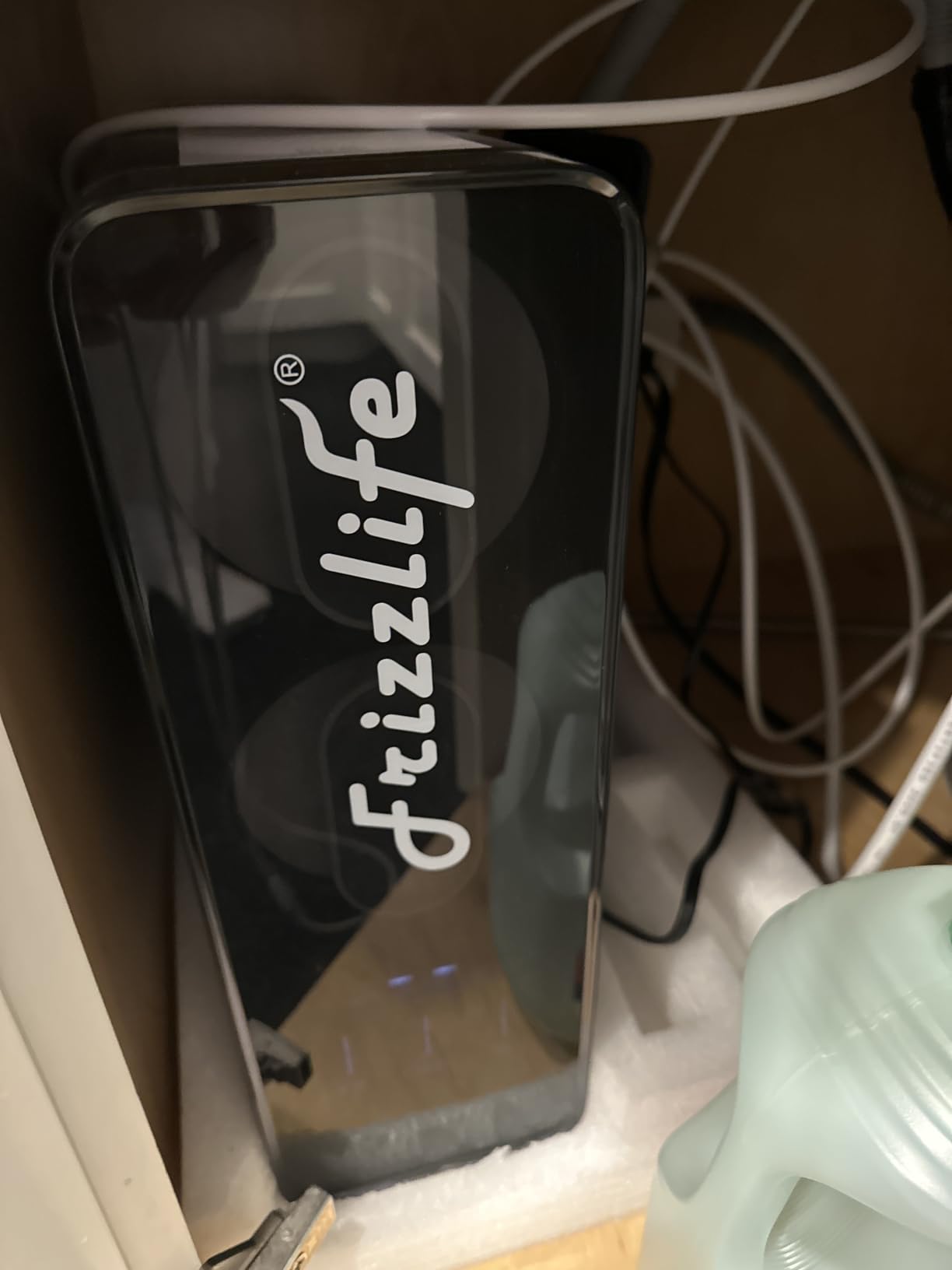
The Frizzlife PD600-TAM3 is the smallest 600 GPD tankless system on this list at 14.7 by 5.3 by 15.5 inch, and that footprint is why it earns a place on a small-cabinet shortlist. Rated flow is 0.41 gpm, filling a 330 ml cup in about ten seconds, with a 4.6 star average across roughly 2,400 reviews.
What separates it from the other 600 GPD units here is the third-stage alkaline filter. The mineral cartridge raises pH above 7.5 and restores minerals stripped by the membrane, which is the fastest way to fix the flat, acidic taste that turns people off reverse osmosis water. Owners consistently mention better-tasting output as the reason they picked it.
Certifications match the best in the group, covering NSF/ANSI 58, 53, 42 and 372, and the claimed reductions include PFAS and PFOA. The box contains the CP filter, the 600 GPD RO membrane, the TAM3 alkaline filter and a brushed nickel faucet.
Like the Waterdrop G3P600, it runs a 2:1 pure-to-drain ratio, with a claim of saving up to 450 percent water versus conventional systems. The smart LED panel displays real-time TDS and remaining filter life, which means the cabinet does not need to be opened to check cartridge status.
Why a short body changes the decision
Cabinet height is the silent killer in small kitchens. A tankless unit that is 15.5 inch tall clears a low cabinet shelf where an 18 inch body does not, and a lower body also means the faucet stem and supply lines have more vertical room to work with. In a cabinet that also houses a garbage disposal, that difference decides the install.
The alkaline stage is worth paying attention to for taste reasons rather than filtration reasons. If you are filtering water to drink straight, or to make coffee and tea, the mineral stage is what keeps it from tasting like rain.
Where it falls short
The product record lists an item weight of 0.45 g, which is plainly a cataloging error, so the real shipping weight is unclear. Ask for the packed dimensions before you commit in a cabinet with almost no tolerance.
It still requires a dedicated under-sink electrical outlet, and long-term owner commentary is thinner here than on the higher-volume competitors. With a 4.6 rating on about 2,400 reviews, the track record is good but shorter than the top sellers.
5. Waterdrop G2 – Best Tankless System for the Lowest Water Waste
Waterdrop G2 Reverse Osmosis System, 400 GPD Tankless RO Water Filtration
400 GPD tankless
7-stage RO
1:1 pure-to-drain
17.3 x 5.9 x 14 inch
Pros
- 1:1 pure-to-drain
- the lowest waste ratio here
- Tankless body saves more than 70 percent of space
- Twist-and-pull filters swap in about three seconds
- Integrated circuit layout cuts leak points and noise
- Mechanical faucet keeps cost below smart-display models
Cons
- Requires an under-sink outlet and countertop drilling
- 400 GPD is half the output of the 600 GPD models
- No TDS display or filter reminders on this version
The Waterdrop G2 is the pick if water waste bothers you more than raw output. Its 1:1 pure-to-drain ratio means roughly one gallon down the drain for every gallon you drink, the lowest of any system on this page, and the brand claims it still conserves about 300 percent more water than typical tanked units. It rates 4.5 stars across more than 2,100 reviews.
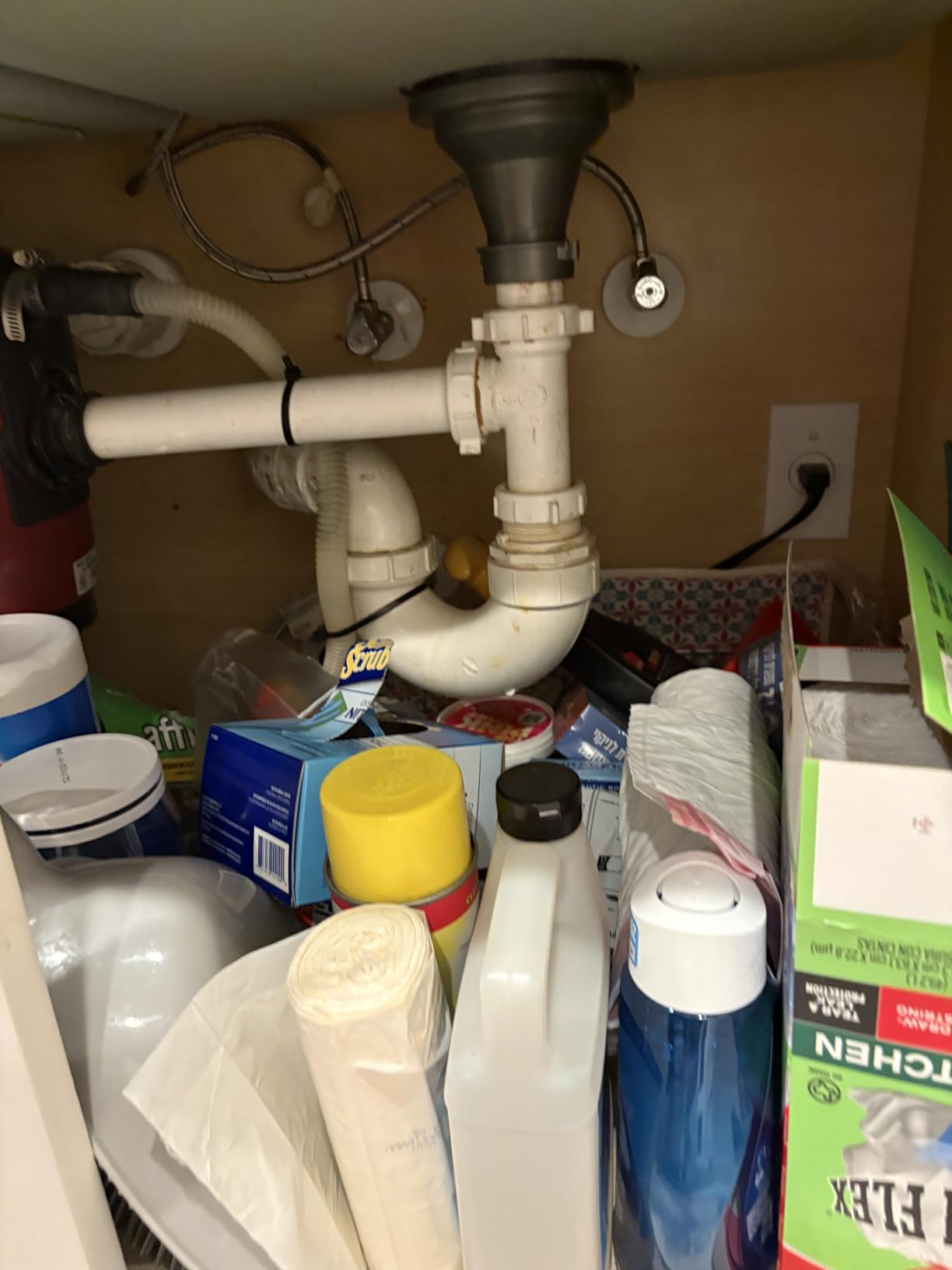
At 17.3 by 5.9 by 14 inch, the body is tall but shallow, and the 14 inch height is a genuine advantage under a low cabinet shelf. Installation is quoted at under 30 minutes, and filter replacement is tool-free, which matters when your working space is a single cabinet with a door that barely opens.
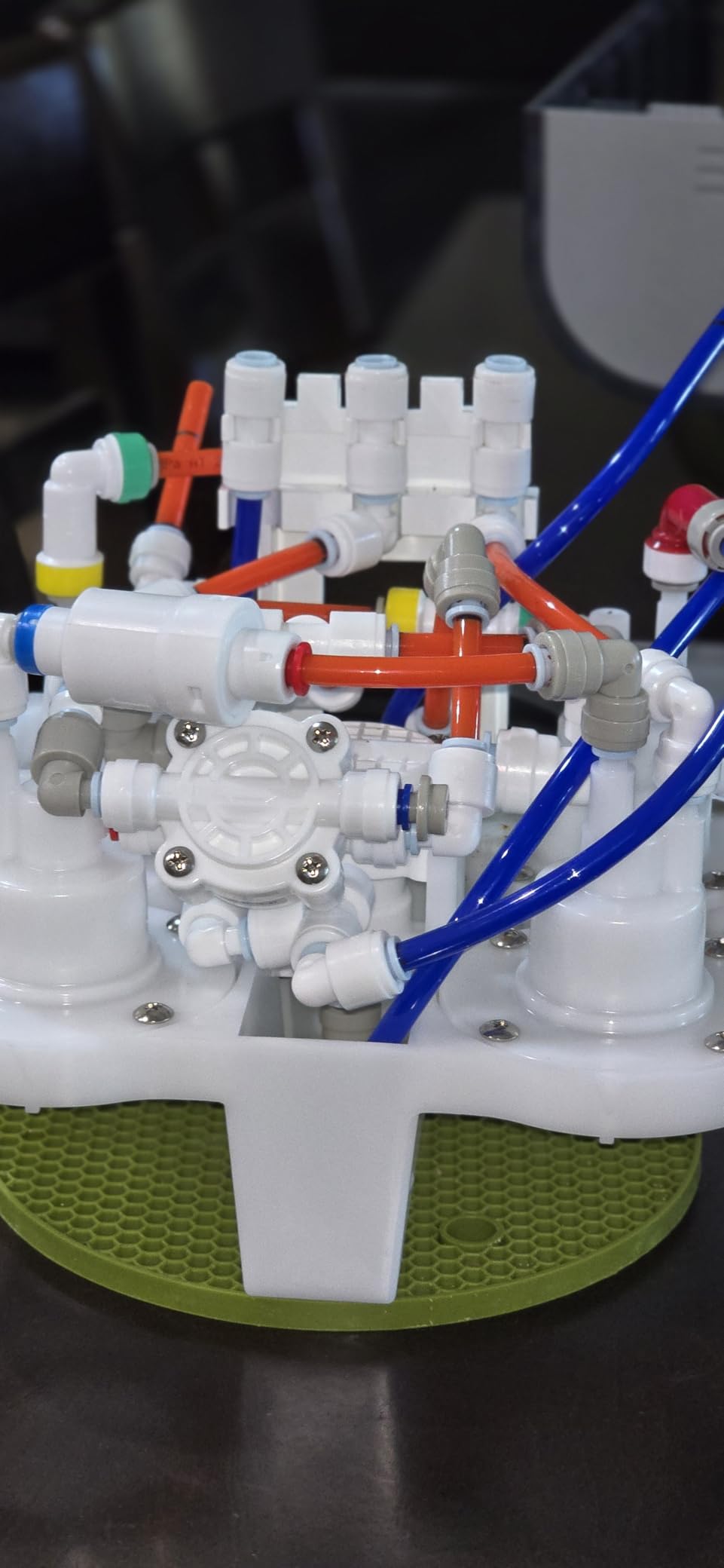
Filtration is 7 stages with composite media, rated at 400 GPD or about 0.28 gpm, which works out to roughly 12 seconds per cup. The materials carry NSF/ANSI 372 lead-free certification, and the feed water ceiling is listed at 300 ppm TDS, which is lower than several other units here and worth checking against your local water report.
One design choice deserves credit: the electrical and water circuit paths are laid out together rather than crossing, which reduces both the number of leak points and the operating noise. Owners mention the layout as a reason leaks have not been an issue.
Where the 1:1 ratio really pays off
Compare the numbers directly. A conventional 50 or 75 GPD tanked unit pushing 3 gallons per gallon of purified water sends three gallons down the drain for every one you keep. This one sends one. Over a year of drinking and cooking water in a one-person home, that is a meaningful difference on the water bill and on the volume going into your waste line.
There is a second benefit that is easy to miss. Low recovery systems put more stress on the drain line and the membrane, and a 1:1 ratio simply moves less water through the whole loop per gallon produced.
Where it falls short
400 GPD is about half the output of the 600 GPD models, and it still needs an under-sink outlet plus a drilled countertop hole. If you are feeding an ice maker or filling pots regularly, that capacity ceiling shows up fast.
This mechanical-faucet version has no built-in TDS display and no filter life reminders, so you are relying on a calendar rather than the faucet. A white 600 GPD variant exists if you need more output, but the waste ratio and feature set are not identical to what we reviewed here.
6. iSpring RCC7P-AK – Best Pumped System for Low Line Pressure
iSpring RCC7P-AK, 6-Stage Reverse Osmosis System Under Sink Alkaline Water Filter and Pump, RO Drinking Water Filtration System, Patented Top-Mounted Faucet Design for Easy Installation
75 GPD tank-based
6-stage with booster pump
15 x 8 x 18 inch
20 pounds
Pros
- Booster pump holds performance on low line pressure
- Highest average rating here at 4.7 stars
- Alkaline sixth stage restores minerals
- Pump cuts wastewater volume versus non-boosted units
- Universal 100-240V power adapter
Cons
- Pump needs an under-sink outlet and adds noise
- 20 pounds and 18 inch tall
- one of the largest in this lineup
- Likely needs a wider cabinet opening than slim models
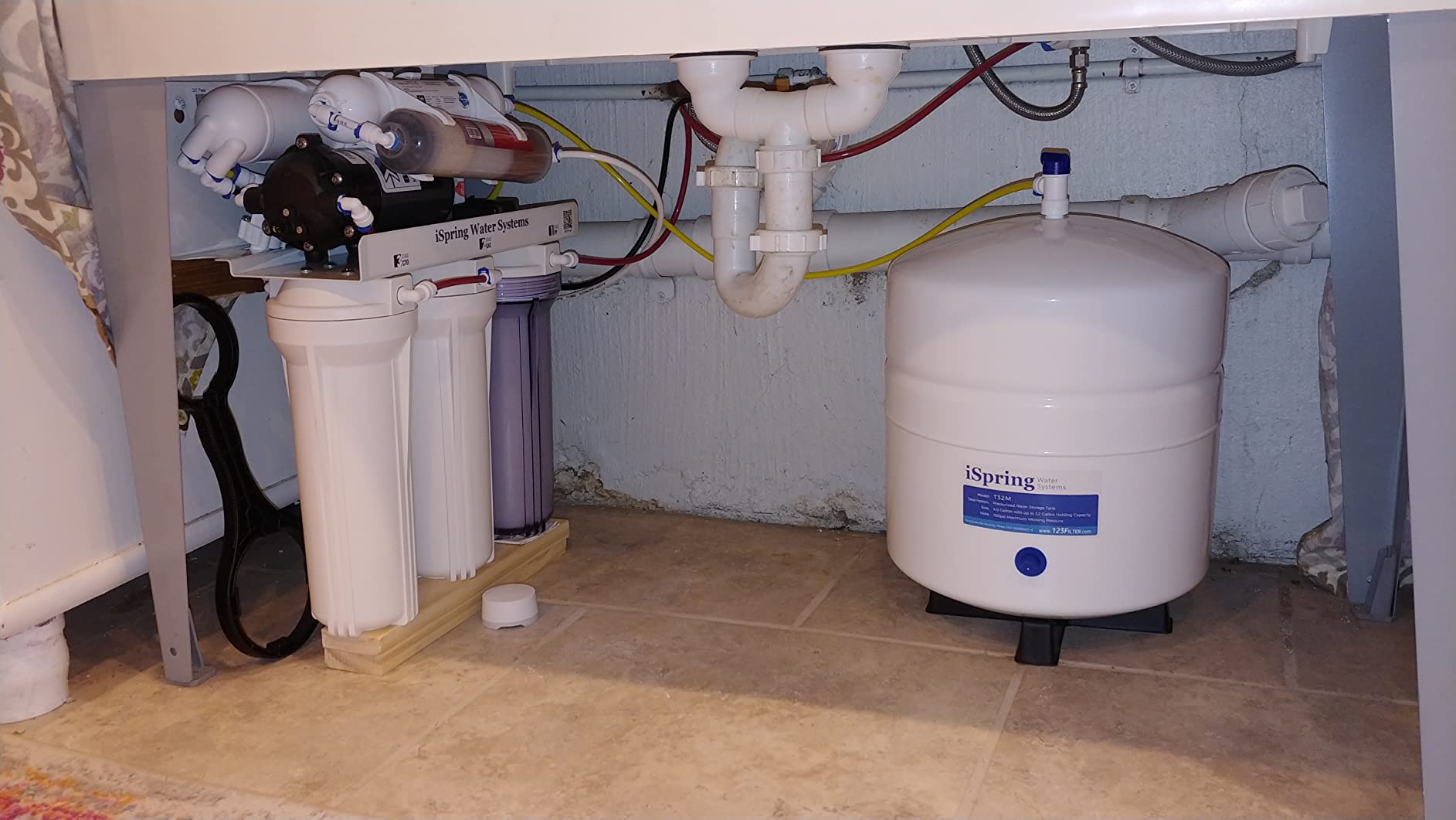
The iSpring RCC7P-AK is the best under sink reverse osmosis system for a small kitchen where water pressure is the problem, because it is the only pick here with a built-in booster pump. It posts the highest average rating in the group at 4.7 stars across more than 1,600 reviews, and the pump is the reason most owners single it out.
In an older home, a second floor unit, or any kitchen where the supply pressure sags when the dishwasher runs, a non-pumped membrane underperforms and the water tastes worse. The pump keeps flow consistent regardless of incoming pressure, and it also reduces the wastewater volume compared with non-boosted units.
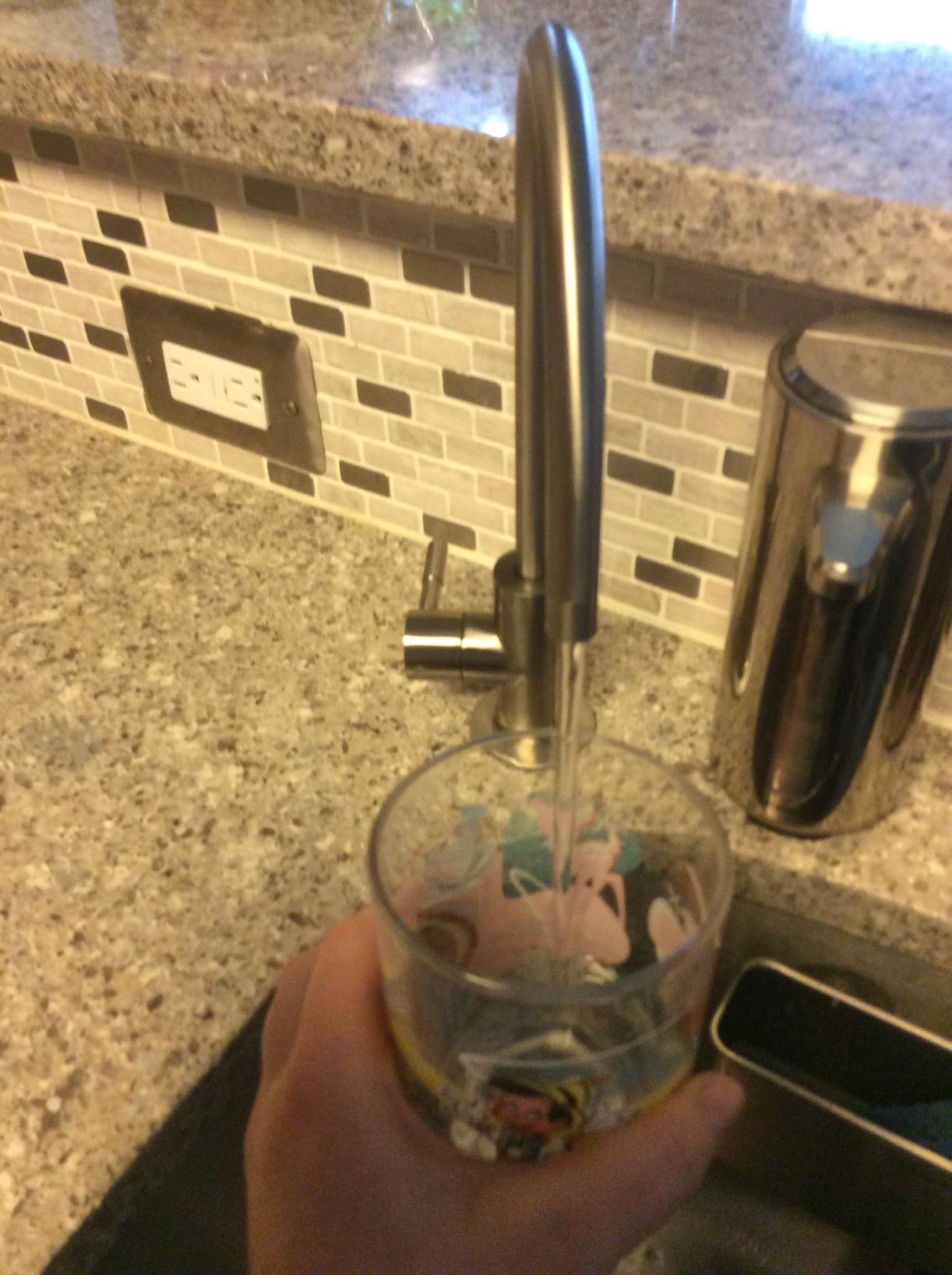
Removal claims reach up to 99 percent of more than 1,000 contaminants including lead, chlorine, fluoride, arsenic, PFAS and asbestos. The sixth stage is alkaline remineralization, the first-stage housing is transparent for condition monitoring, and the power adapter is a universal 100-240V unit at 50/60Hz, so it works across household supply configurations.
Maximum feed TDS is listed at 2000 ppm, one of the higher ceilings here, and iSpring provides lifetime technical support from Atlanta, Georgia. That matters more than it sounds if you are four years in and the original cartridge codes have changed.
When a pump is worth the extra bulk
Buy this one if you have measured low pressure, not just if you suspect it. A cheap pressure gauge at the cold tap under the sink settles the question in five minutes, and if you are under 40 psi at rest, most non-pumped units on this list will underperform exactly as their specifications warn.
The pump also helps in tall buildings where pressure drops during peak evening demand. Owners in those homes describe the difference between a system that produces well and one that trickles, and that difference is what the pump buys you.
Where it falls short
This is the bulkiest option here at 15 by 8 by 18 inch and 20 pounds, and reviewers are candid that it likely needs a wider cabinet opening than the slim tankless models. In a small kitchen that is a real space claim to pay for a feature you may not need.
The pump also requires a nearby under-sink outlet and introduces mechanical noise during operation, which is worth thinking about in an open-plan apartment. And with a one-year limited warranty upon registration, the coverage is shorter than the NU Aqua on this list.
7. NU Aqua 5-Stage 100 GPD – Best Tank-Based Unit for Higher Daily Output
NU Aqua 5-Stage Under Sink Reverse Osmosis Water Filter System – 100 GPD RO
100 GPD tank-based
5-stage RO
15 x 5.5 x 17.5 inch
20 pounds
Pros
- 100 GPD doubles the output of a 50 GPD unit
- HydraCoil membrane with higher carbon absorption
- Complimentary PPM meter and stainless faucet
- 120-day home trial and 3-year warranty
- Double O-ring sealed housings
Cons
- No booster pump in the base configuration
- Occasional reports of cloudy output from a new filter set
- One reviewer reported a sulfur smell from the optional alkaline stage
- Written instructions can be confusing
The NU Aqua 5-Stage at 100 GPD is the answer when a tank-based system is your only option but 50 GPD feels thin. It doubles the output of a standard 50 GPD unit, needs no power at all, and is rated for feed water up to 500 ppm TDS. It holds a 4.4 star average across more than 870 reviews.
At 15 by 5.5 by 17.5 inch it is a similar footprint to the APEC unit but with twice the membrane capacity, and it ships with a dedicated stainless steel faucet, a complimentary PPM meter and a leak detector. That meter matters, because it lets you confirm the membrane is actually reducing solids instead of trusting taste alone.
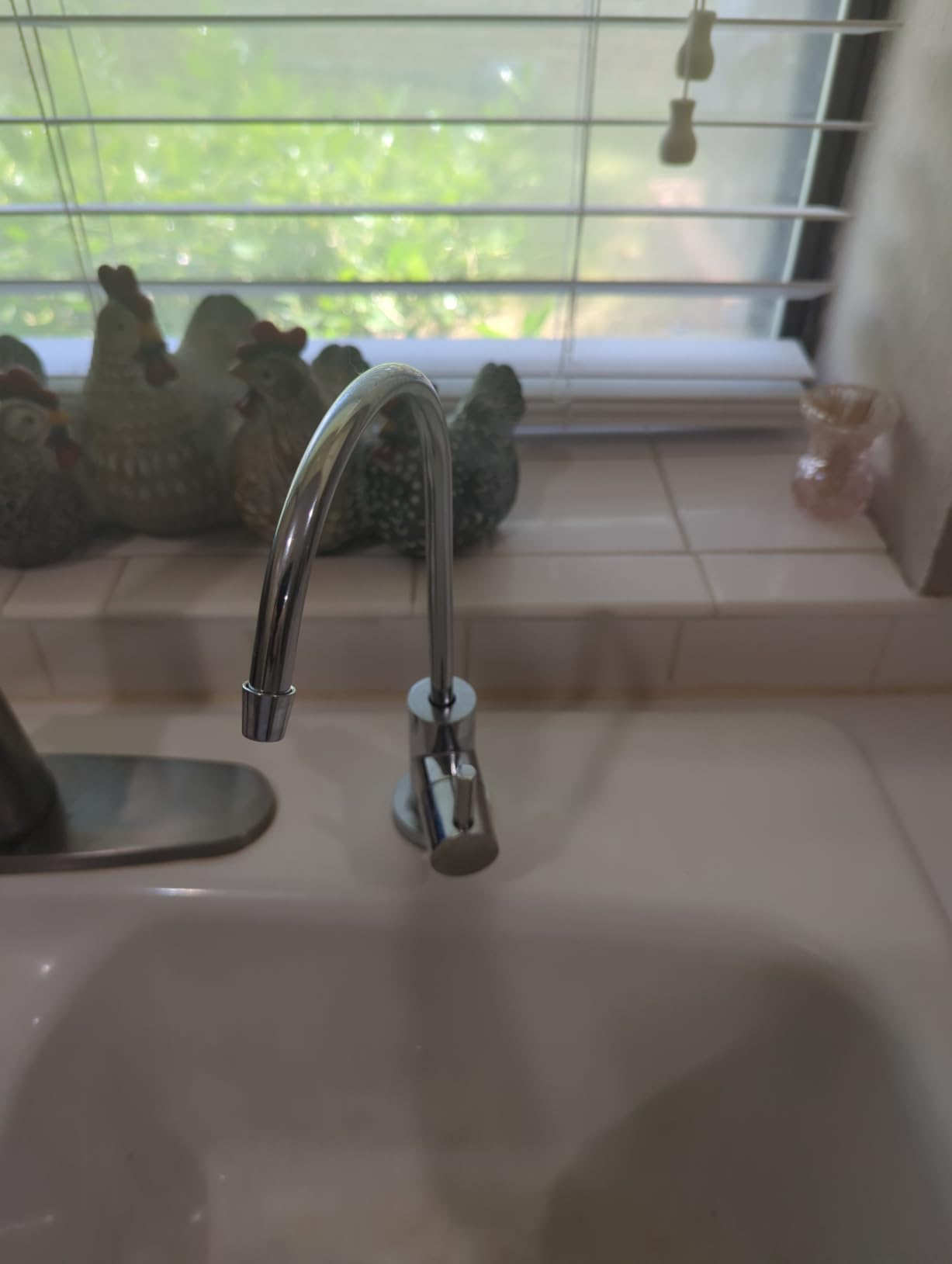
The HydraCoil composite membrane is marketed as producing up to 50 percent cleaner output than competing membranes, and the five stages claim up to 99 percent rejection of more than 1,000 total dissolved solids. Color-coded tubing and quick-connect fittings make the routing readable even for a first install.
Long-term ownership is the strongest part of this record. Reviewers describe owning multiple units over many years with no leaks, which is exactly the durability signal a small kitchen buyer should want, since a leak under the sink damages cabinetry quickly. The warranty is three years with a 120-day home trial, the longest on this list.
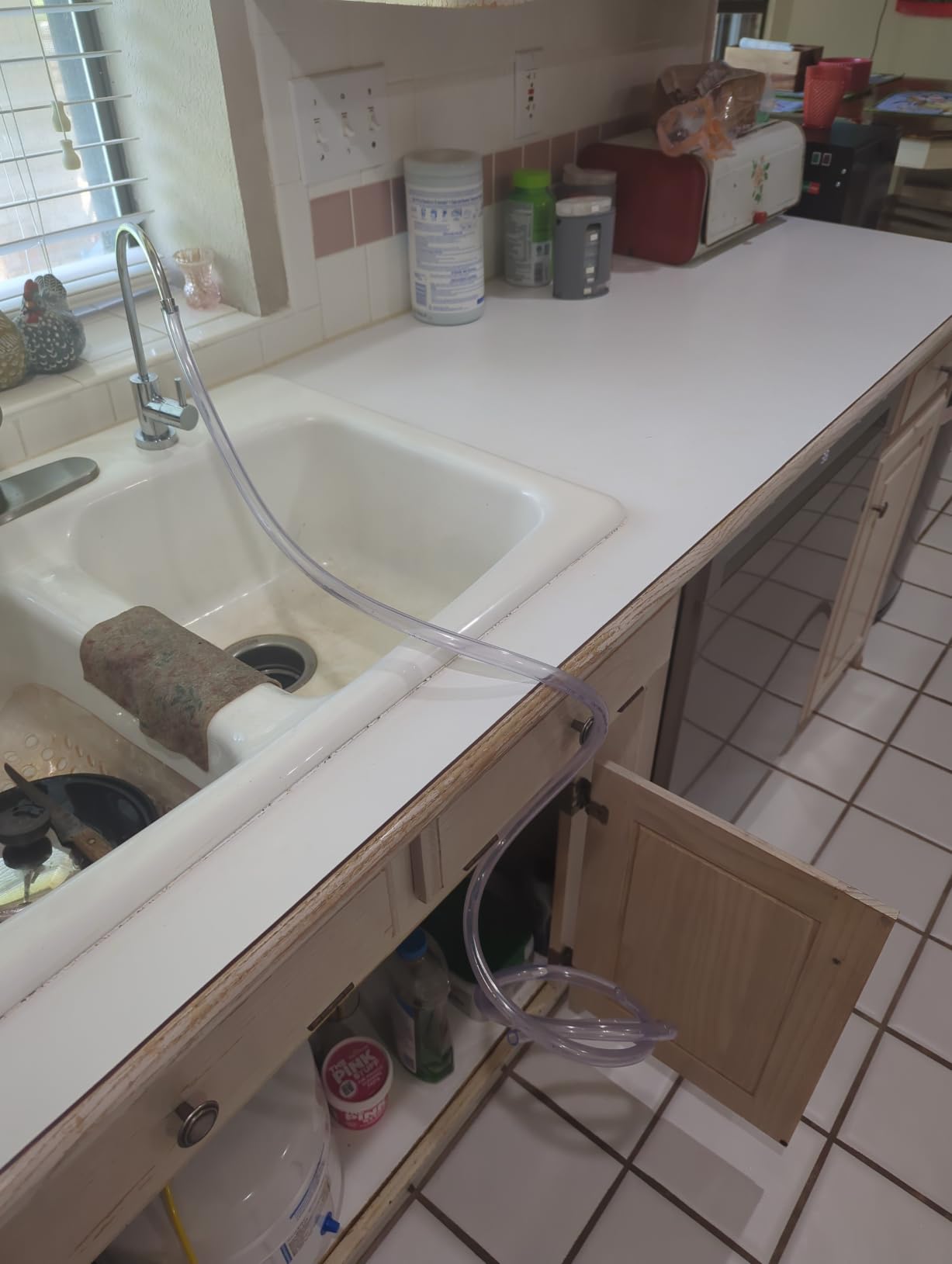
What the included meter and warranty are worth
A free PPM meter changes how you maintain the system. Once you know the number on day one, every later reading tells you whether the membrane is loaded or the feed water has changed, and you stop guessing from taste alone. For an owner keeping a system for a decade, that is the cheapest feature on the box.
At 100 GPD, a two-person household has room to cook with it, and the household is not waiting on a trickle to fill a kettle. If you are staying with a tank-based layout, this is the highest capacity in that group.
Where it falls short
There is no booster pump in the base configuration, so low line pressure limits performance the same way it does on the APEC. If your pressure is marginal, this is the wrong pick and the pumped iSpring is the right one.
There is also an isolated 1-star report of cloudy, sediment-laden output from a brand-new filter set, and one reviewer reported a sulfur-like smell from the optional sixth alkaline stage. Several buyers found the written instructions confusing and relied on video walkthroughs instead, so budget time for that.
8. Express Water ROALK10D – Best 10-Stage System With an Automatic Leak Shutoff
Express Water ROALK10D, 10-Stage Under Sink RO System, Alkaline, 100 GPD
100 GPD tank-based
10-stage alkaline
15 x 5 x 17 inch
27 pounds
Pros
- Ten stages including an alkaline mineral stage
- Emergency leak stop detector shuts off flow
- Claimed 99.99 percent reduction for lead and arsenic
- BPA-free parts and NSF/ANSI 372 certification
- Modular design accepts UV or deionization stages
Cons
- Heaviest system here at 27 pounds
- Large footprint in cabinets with a disposal
- Only around 100 reviews for long-term durability
- Pedal feed valve gets mistaken for a normal valve
The Express Water ROALK10D is the pick if your dominant fear is water damage rather than taste. It is the only system on this list with an emergency leak stop detector that shuts off flow when moisture is detected, and in a small kitchen where cabinetry is tight against the unit, that protection is worth real money.
Filtration runs ten stages at 100 GPD, with an alkaline mineral stage that adds calcium, potassium and magnesium. Claims reach up to 99.99 percent removal of lead, chlorine, fluoride, nitrates, calcium and arsenic, and the water-contacting parts are BPA-free with NSF/ANSI 372 lead-free certification.
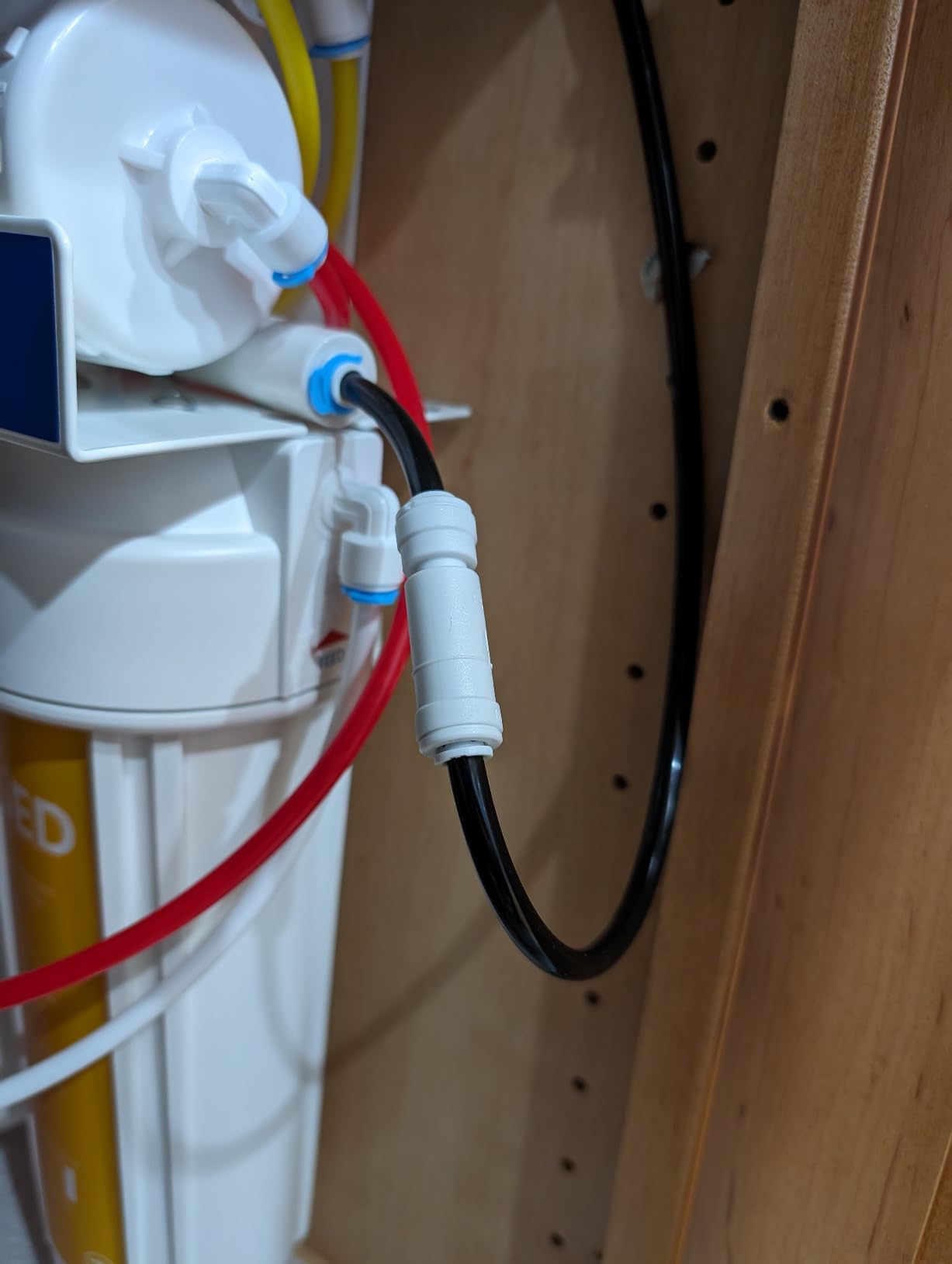
At 15 by 5 by 17 inch the footprint is unremarkable, but at 27 pounds it is the heaviest unit we reviewed, and that is worth factoring into whether you can lift it into a high cabinet shelf. The design is modular, so a UV or deionization stage can be added later without replacing the system.
Owners mention replacing a ten-year-old system with this one as a straightforward job, which suggests the mounting pattern and connections follow familiar conventions. Maximum feed TDS is listed at 1000 ppm, and the warranty is one year.
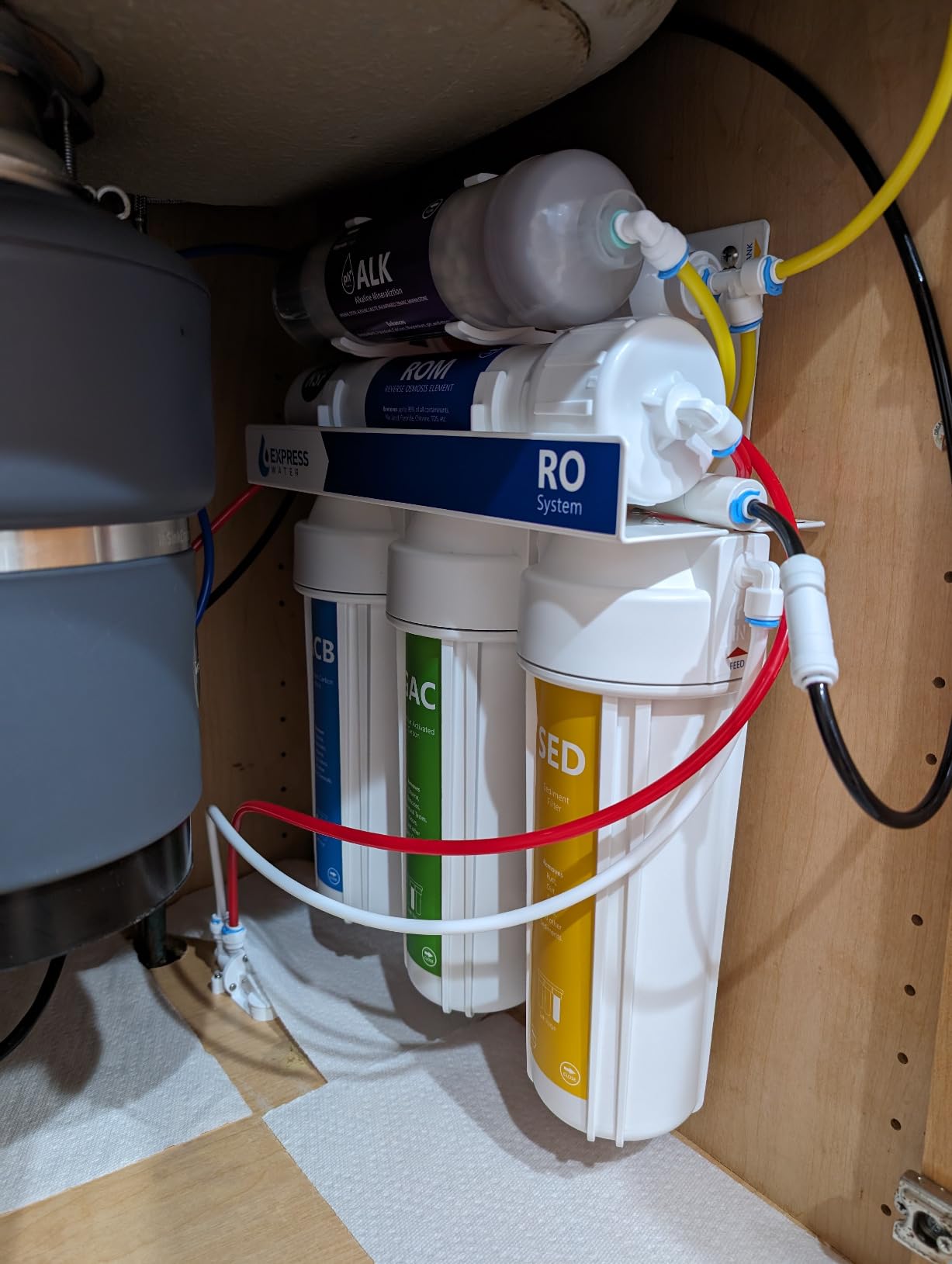
Why leak protection matters more in a small cabinet
When a tank-based system sits in a cabinet with a wooden or particleboard base, the margin between a slow drip and a destroyed cabinet floor is thin. An automatic shutoff turns a slow leak into a non-event, and in rentals that is the difference between keeping your deposit and losing it.
The alkaline mineral stage also makes this a good drinking-water pick. Ten stages with minerals added back is closer to the taste profile people actually want than a bare five-stage membrane.
Where it falls short
It is the heaviest system in this comparison at 27 pounds, and reviewers describe the footprint as tight in cabinets that also house a garbage disposal. The pedal-style feed valve is also routinely mistaken for a conventional valve switch, which produces confusion and unnecessary service calls.
With only around 100 reviews, long-term durability is less well documented than the units with tens of thousands of reviews, and there is an isolated 1-star report of leaks on assembly. If longevity is your priority over stage count, the NU Aqua on this list has the longer warranty and better-documented ownership.
9. VIOMI V6 – Best 600 GPD Tankless Unit When Vertical Clearance Is Tight
VIOMI V6 600GPD Under Sink Tankless Reverse Osmosis Water Filtration System
600 GPD tankless
9-stage RO
16.3 x 5 x 12.8 inch
20.1 pounds
Pros
- Shortest 600 GPD body at 12.8 inch tall
- Two cartridges cover up to 48 months of service
- Front-access filter swaps with no tools
- Smart LED faucet signals replacement
- NSF/ANSI 42
- 53 and 372 certified
Cons
- Works only with the included faucet
- no fridge hookup
- Needs two drilled holes
- an outlet and 2 to 3.9 inch rear clearance
- One reviewer reports PCB filter life nearer six months
- Occasional defective fittings and gaskets
The VIOMI V6 solves the hardest clearance problem in this group. At 16.3 by 5 by 12.8 inch it is the shortest 600 GPD tankless body we found, freeing roughly 65 percent of under-sink space, and it holds a 4.3 star average across about 265 reviews.
Its second advantage is filter economics. Two cartridges cover up to 48 months of service, with a 24-month PCB filter and a 48-month RO filter, which produces a lower long-term filter cost than any other unit on this list. Owners replacing older tanked systems highlight the space savings and never running out of water as the deciding factors.
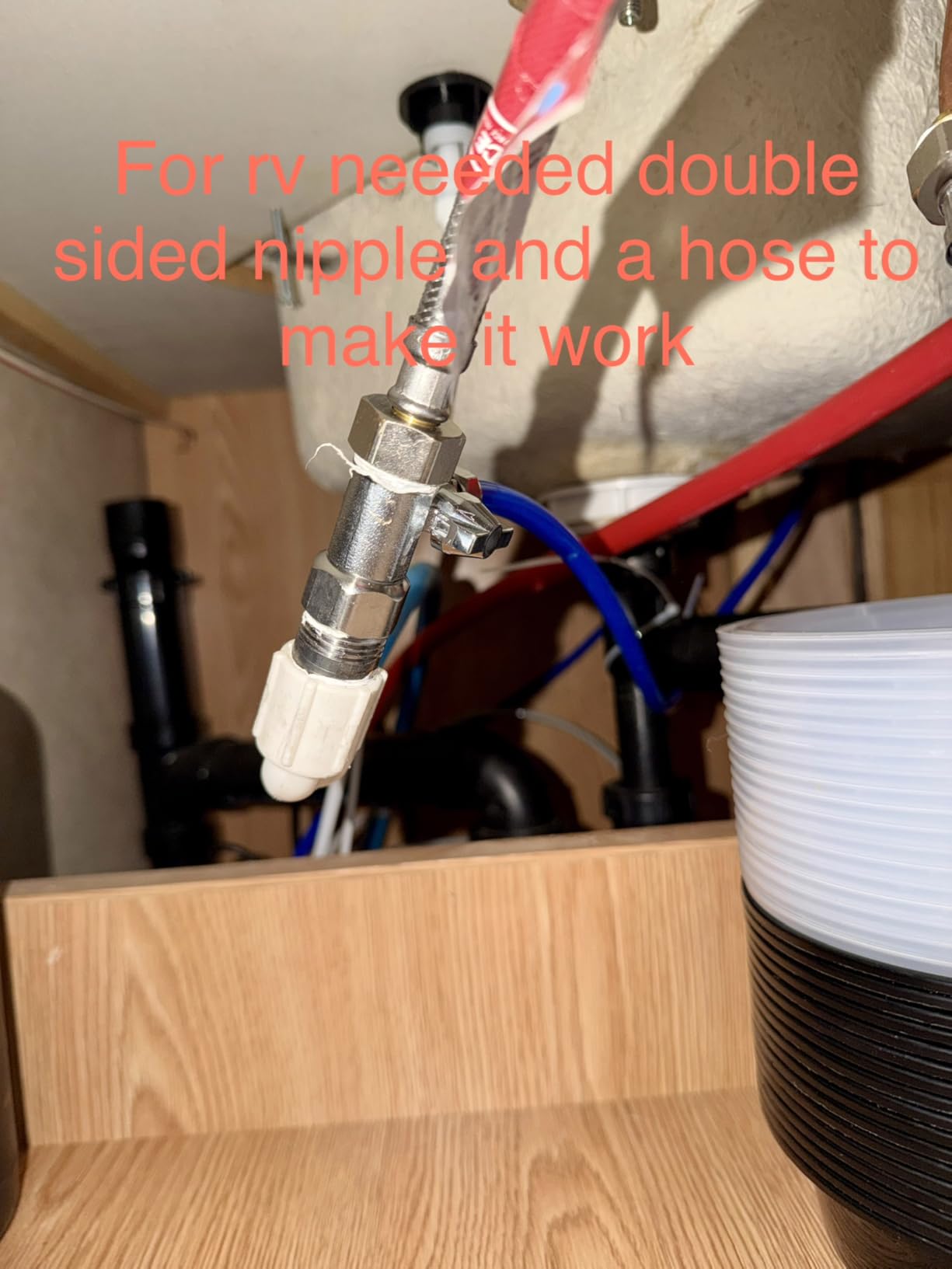
Filtration is nine stages with a 0.0001 micron membrane at a 3:1 pure-to-drain ratio, certified to NSF/ANSI 42, 53 and 372. Reduction claims are specific, with TDS up to 94.75 percent, PFOS over 99.88 percent and PFOA over 99.6 percent. Installation is quoted at 20 minutes through a four-step video guide.
The smart LED faucet turns orange to signal filter replacement, so the maintenance reminder does not depend on remembering a schedule. The one design limitation that matters most is that it works only with the included faucet and cannot feed a refrigerator or ice maker.
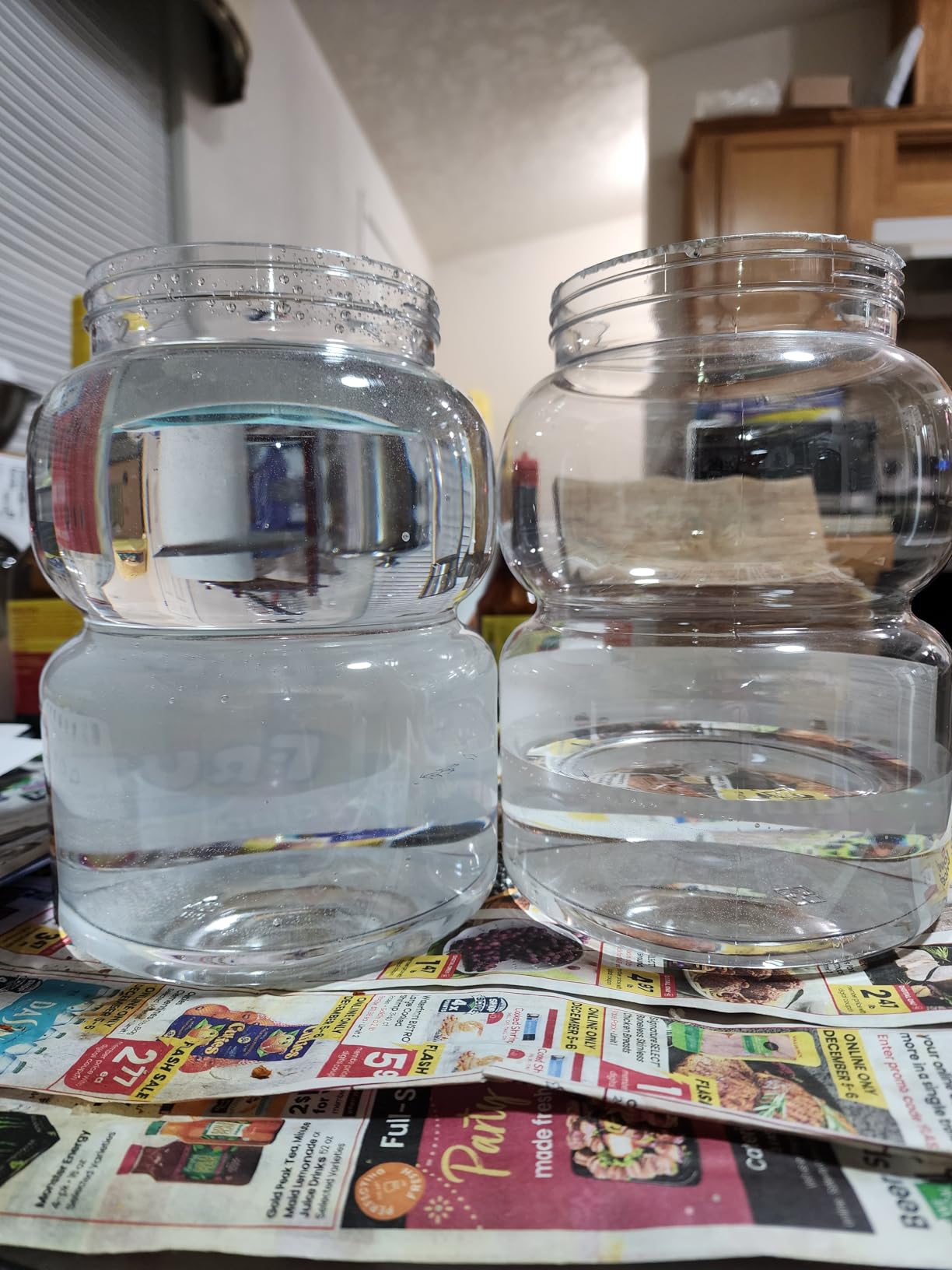
When 12.8 inches is the difference
If your cabinet has a low shelf or an unusual trap configuration, height is the dimension that decides everything. A 12.8 inch body leaves far more room for the drain trap and the supply lines than an 18 inch unit, and it is the reason this model earns a slot despite a lower review count than most of the list.
The 48-month filter interval is the quiet financial win. In a small kitchen the cost you care about is the annual one, and a two-cartridge system that runs four years is meaningfully cheaper to own than a three-stage system that needs new pre-filters twice a year.
Where it falls short
Install requirements are the strictest here. It needs two drilled countertop holes, a dedicated under-sink outlet, and 2.0 to 3.9 inches of rear clearance behind the unit, so measure the back wall before ordering.
One reviewer reports the PCB filter lasting about six months rather than the claimed year, and some units arrived with a faulty T-bracket cold water connector and a faucet gasket that would not tighten. Quality control complaints like those are the main reason this model sits at 4.3 rather than 4.5.
10. COMFEE’ CMP10 – Best Entry-Level Pick on a Tight Budget
COMFEE’ CMP10 5-Stage Reverse Osmosis Under Sink Water Filter System
75 GPD tank-based
5-stage RO
4.9 inch wide tank
16 x 4.9 x 14 inch
Pros
- Narrow 4.9 inch tank among the slimmest here
- Double O-ring housings and quick-fit connectors
- 0.0001 micron filtration across 5 stages
- American-based customer support
- Clear installation steps and tutorial video
Cons
- Lowest rating here at 4.1 stars with 12 percent one-star reviews
- No NSF/ANSI 58 whole-system certification
- Output drops near 50 GPD at low pressure or cold water
- 3 gallon tank and 18 pound weight add bulk
- Listing mixes newer and older product iterations
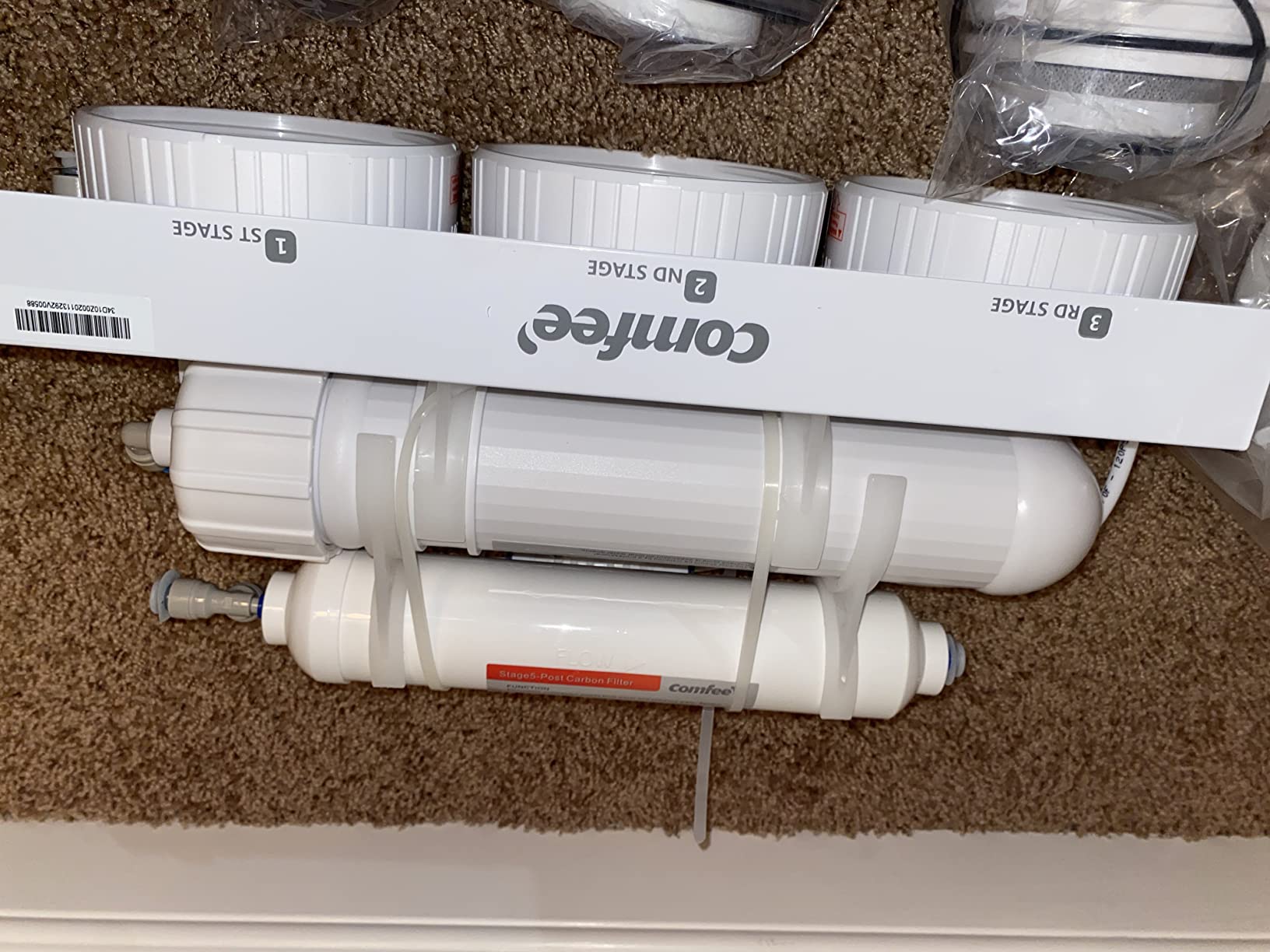
The COMFEE’ CMP10 is the budget entry point, and the reason it works in a small kitchen is the 4.9 inch wide tank, which is among the slimmest in this comparison. At 16 by 4.9 by 14 inch it is also one of the shortest assemblies here, and it carries a 4.1 star average across more than 530 reviews.
It is a 75 GPD five-stage system with a 3 gallon storage tank, filtering at 0.0001 micron precision against heavy metals, organic matter and a claimed 1,000-plus impurities. The water-contacting parts carry NSF/ANSI 372 lead-free materials certification, and COMFEE’ is a Midea brand with a US-based support team.
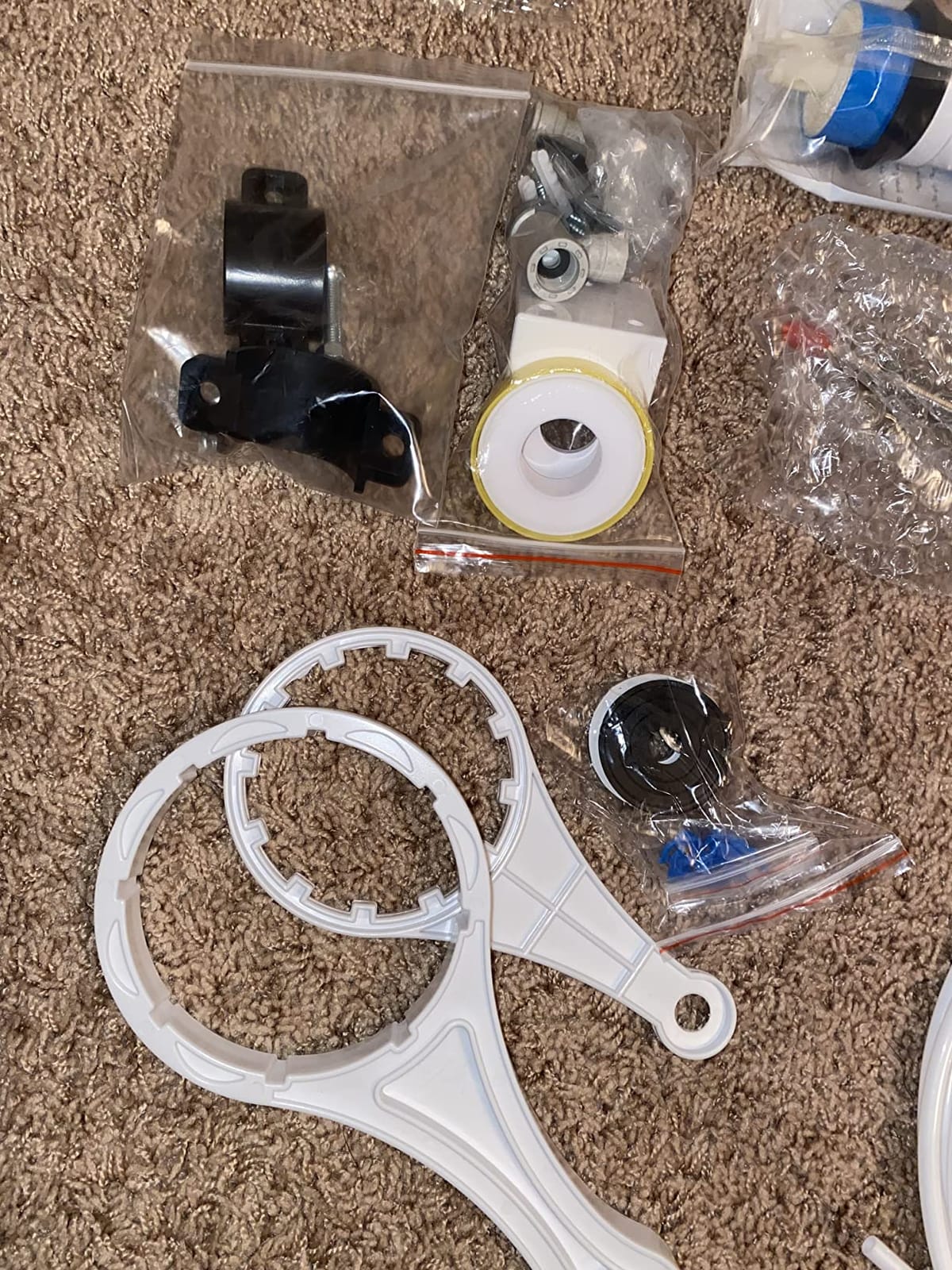
Mechanically it is unremarkable in a good way. Double O-ring sealed filter housings and quick-fit leak-free connectors address the two failure modes that ruin cheap installs, and the brand publishes installation steps alongside a tutorial video so a first-timer can follow along.
It is rated for feed water up to 600 ppm TDS and operates with an adapter power source, though the RO process itself is pressure-driven. The listing describes quiet operation, which matters if the cabinet is open-plan.
When the lowest option is the right one
Choose this if the budget is genuinely the deciding factor and your pressure and TDS are in range. The narrow tank width and short overall height let it fit where a 3 gallon tank usually cannot, and the leak-free fittings reduce the most common first-install mistake.
It also suits a secondary drinking tap in a guest suite or a rental where you want a certified-material system without committing to a higher tier. At 75 GPD, one or two people is the realistic ceiling on daily use.
Where it falls short
It has the lowest average rating in this group at 4.1 stars, with about 12 percent of reviews at one star, and the complaints cluster around inconsistent shipped iterations. The listing mixes new and older product versions, with transparent and opaque housings shipped without a clear choice, which is a good reason to check what arrives.
There is also no NSF/ANSI 58 whole-system certification, only lead-free material certification, so the reduction claims are not independently certified the way the iSpring and APEC units are. Output drops to roughly 50 GPD when pressure is under 0.25 MPa or the water is below 25 degrees C, and at 18 pounds with a 3 gallon tank the assembly is bulkier than the dimensions suggest.
Buying Guide: Fitting an Under Sink RO System Into a Small Kitchen
How to measure your cabinet before you order
Most failed under-sink installs are measurement failures, and they are cheap to avoid. Take four measurements before you compare models, and compare the results against the published dimensions of every system you are considering.
Cabinet height from the floor to the underside of the sink or shelf. This is the number that eliminates the most candidates. Anything under 17 inch of usable height rules out the iSpring RCC7P-AK and the iSpring RCC7AK-BN, and points you toward the VIOMI V6 at 12.8 inch or the COMFEE’ CMP10 at 14 inch.
Cabinet width between the two side walls. The width of the storage tank matters more than the width of the filter housing. Both the APEC ROES-50 at 5.25 inch and the COMFEE’ CMP10 at 4.9 inch give you back usable floor space that a standard 6 inch tank does not.
Depth from the cabinet back wall to the door, and the space the P-trap occupies. The trap is usually the real depth limit, not the unit. The VIOMI V6 additionally needs 2.0 to 3.9 inches of rear clearance behind the housing, so measure to the wall and not to the trap.
Distance from the cold water shutoff to the counter and the faucet hole diameter. Longer runs mean more tubing, and tubing length is the single most common complaint in the reviews on this page. Most faucet stems need a hole in the 0.25 to 0.375 inch range, but measure your existing hole before assuming a match.
Add the height of the sink itself if it drops below the cabinet frame, and check the countertop thickness against the faucet stem length. A faucet stem that bottoms out on a thick countertop is a hard stop, and it is the failure point that shows up only after the hole is cut.
Tankless or tank-based: which one fits your cabinet
That is the whole tradeoff, and it is not really about taste. A tank-based system uses your line pressure to push water through the membrane, stores the finished water in a pressurized tank, and needs no electrical outlet. A tankless system uses a pump to move water on demand, stores nothing, and needs power.
No outlet under the sink: you are limited to the tank-based group. That is the iSpring RCC7AK-BN, the APEC ROES-50, the NU Aqua 5-Stage, the Express Water ROALK10D, and the COMFEE’ CMP10. Treat the tank footprint as a permanent feature of the cabinet and measure around it.
Outlet available and the cabinet floor is crowded: tankless wins on space. The Waterdrop G3P600, the Frizzlife PD600-TAM3, the Waterdrop G2, and the VIOMI V6 free up to about 70 percent of the cabinet volume compared with a tanked layout.
Low line pressure: either add a pump, as the iSpring RCC7P-AK does, or accept slower output. Every non-pumped unit on this list is specified with a minimum incoming pressure, and falling short costs you flow rate and consistent taste.
Open-plan kitchen where noise matters: avoid pumped units, and note that a pump is the main noise source. Tank-based systems without a booster pump are effectively silent during use.
One caveat on tankless: the first draw of water after a period of stillness can carry higher TDS as water sits in the membrane housing, a pattern buyers call TDS creep. Running the faucet for around 30 seconds before filling a glass handles it, and units with a smart faucet make the settling obvious instead of mysterious.
How much GPD a 1 or 2 person household actually needs
Most listings push 800 to 1600 GPD at households of two, which is capacity you will never use and that adds size, cost and filter expense. Match the number to the household instead.
One person, drinking and occasional cooking: 50 to 75 GPD is comfortable. That is the APEC ROES-50 and the COMFEE’ CMP10 range.
Two people, or one person who cooks a lot: 75 to 100 GPD covers normal use and still fills a kettle without a long wait. The NU Aqua 5-Stage and the Express Water ROALK10D sit here.
Two people plus an ice maker or refrigerator hookup: 100 to 200 GPD removes the constraint, and this is where a tankless unit starts to make more sense than a small tank.
Anything above 400 GPD: worth it only for heavy daily use, shared housing, or frequent pot filling. The 400 to 600 GPD tankless units here, the Waterdrop G2, Frizzlife PD600-TAM3, Waterdrop G3P600 and VIOMI V6, all deliver an 8 oz cup in under 12 seconds.
The GPD figure is also a waste figure. A system that idles with a full tank wastes more water than one that only makes what you need, which is a large part of why the 1:1 and 2:1 tankless ratios matter in a small home.
What the NSF/ANSI numbers on the box mean
Certification is the part of this purchase most worth getting right, because reduction claims are otherwise unverifiable marketing. Consumer Reports is not a certification body, and no testing organization is. Look for the standard number, then confirm the exact model in the NSF or IAPMO database rather than trusting a listing.
NSF/ANSI 42: aesthetic claims only. Chlorine taste and odor, sediment and rust. It says nothing about dissolved contaminants.
NSF/ANSI 53: health-related claims, including lead and cryptosporidium reduction.
NSF/ANSI 58: the RO-specific standard, covering TDS reduction on the membrane. Certification of the whole system rather than the component is a meaningful distinction, and only the iSpring RCC7AK-BN and the APEC ROES-50 here carry full-system 58.
NSF/ANSI 372: lead-free compliance of the wetted components, not a filtration claim. Several units here hold 372 only, which is a material standard, not a performance one.
The Frizzlife PD600-TAM3 and the Waterdrop G3P600 hold 42, 53, 58 and 372 together, the broadest set on this page. The Waterdrop G2 and the COMFEE’ CMP10 carry 372 material certification without a 58 performance claim, which is worth knowing before you compare reduction percentages.
What installation asks of your countertop and drain
Every unit on this list is a DIY job with quick-connect fittings, and most describe a sub-30-minute install, but the plumbing requirements are the same. A tee valve splits your cold supply, the filtered line runs to a dedicated faucet, and the reject water goes to the sink drain through a separate line.
Countertop drilling is the step that stops people in rentals. It needs a hole sized to the faucet stem, typically in the 0.25 to 0.375 inch range, and it is effectively permanent because the hole is visible from every seat in the kitchen. If you cannot drill, your realistic choices are the two tank-based units with a top-mounted faucet fastener that installs entirely from above the counter, such as the iSpring RCC7AK-BN.
Plan the drain line with two to four inches of vertical drop to the waste pipe, and check that a leak detector is somewhere in the run if the cabinet base is wood. The Express Water ROALK10D is the only pick with an automatic shutoff built in.
Installing RO in an apartment or rental
Yes, you can put a reverse osmosis system in an apartment, and for a small kitchen it is often the single biggest quality-of-life upgrade available. The constraints are lease terms and drilling, not plumbing, since the supply valve and drain are already under the sink.
Three practical rules keep it reversible. First, ask your landlord in writing before drilling a new hole, and treat a refusal as a signal to choose a no-drill faucet option or skip the install rather than risk your deposit. Second, choose a tankless model only if a live outlet already exists in the cabinet, because adding a new receptacle is electrical work a tenant should never do. Third, use quick-connect fittings and a leak detector, and keep the manufacturer instructions, because a fully reversible install is one you can undo in twenty minutes.
For an apartment, the best fits are the tank-based units, the iSpring RCC7AK-BN or the APEC ROES-50, if there is no outlet, and the compact tankless models, the Frizzlife PD600-TAM3 or the VIOMI V6, if there is one and you have rear clearance. For a shared building where the landlord wants a single solution, the same logic applies at building scale: the constraint that decides the model is outlet availability, not filtration.
What it costs to run and how often filters change
The recurring cost is where systems separate most sharply, and it is the number that determines the cheapest system over five years rather than the first year. Two filters a year on a budget tanked unit can cost more than a two-cartridge system that runs for four years, even if the cartridges are priced higher.
Ask three things before you buy: the total cost of one full filter set, the published service life of each stage, and whether third-party cartridges exist. The VIOMI V6 has the longest published interval here at 48 months on the RO cartridge, and the Waterdrop G3P600 has the most expensive ongoing filter expense according to its owners.
Water waste is the other running cost, and the ratios differ by a factor of three. A 3:1 tanked system sends three gallons down the drain per gallon kept, the 2:1 tankless units halve that, and the Waterdrop G2 at 1:1 is at the efficient end of what you can buy for an under-sink install.
Frequently Asked Questions
Who makes the best under-sink reverse osmosis system?
For a small kitchen, the iSpring RCC7AK-BN is the strongest all-round pick because it is NSF/ANSI 58 certified for the whole system, needs no electrical outlet, and is one of the most thoroughly owner-tested units available. If your cabinet has a live outlet and the floor space is tight, the Waterdrop G3P600 is the better tankless choice, while the Frizzlife PD600-TAM3 is the shortest 600 GPD body and adds an alkaline mineral stage.
Is an under-sink reverse osmosis system worth it?
For most households, yes. Reverse osmosis is the only common household treatment that removes dissolved contaminants such as PFAS, fluoride, nitrates and heavy metals, none of which a carbon filter addresses. In a small kitchen the case is stronger, because a tankless model reclaims most of the cabinet volume a storage tank would occupy and cuts the water wasted per gallon produced.
Can you put a reverse osmosis system in an apartment?
Yes, and in a small apartment it is often the best upgrade available, since the supply valve and drain are already under the sink. The real constraints are lease terms and drilling. Confirm with your landlord in writing before cutting a countertop hole, only use a tankless model if a live outlet already exists, and use quick-connect fittings with a leak detector so the install can be reversed in minutes.
What is the best reverse osmosis system for an apartment?
For an apartment with no outlet under the sink, the APEC ROES-50 or the iSpring RCC7AK-BN are the practical choices, because both run on line pressure alone and their tank footprints are narrow. With a live outlet, the Frizzlife PD600-TAM3 fits the tightest cabinets at 15.5 inch tall. Avoid units needing two drilled holes or more than three inches of rear clearance in a shallow rental cabinet.
Do tankless reverse osmosis systems need an electrical outlet?
Almost always, yes, because the pump that moves water on demand needs power. Tankless systems such as the Waterdrop G3P600, the Frizzlife PD600-TAM3, the Waterdrop G2 and the VIOMI V6 all require a live under-sink outlet. Tank-based systems like the iSpring RCC7AK-BN, the APEC ROES-50, the NU Aqua 5-Stage, the Express Water ROALK10D and the COMFEE’ CMP10 use only your line pressure and need no power at all.
How much space does an under sink RO system need?
Measure four things: cabinet height to the underside of the sink, width between the side walls, depth from the back wall accounting for the P-trap, and the distance from the cold shutoff to the counter. Compare the results against the published footprint of each unit. As a guide, anything over 17 inch tall needs at least 19 inch of cabinet height, and tankless bodies of 12.8 to 15.5 inch are the ones that clear low shelves.
What is a major downside of reverse osmosis water?
The major downside is taste and mineral content. The membrane strips dissolved solids along with contaminants, so untreated RO water can taste flat and slightly acidic. A remineralization or alkaline stage adds minerals back, which is why the iSpring RCC7AK-BN, the iSpring RCC7P-AK, the Frizzlife PD600-TAM3 and the Express Water ROALK10D include one. Water waste is the second drawback, since conventional systems discard two to three gallons per gallon kept.
Is tankless reverse osmosis better than a tank system?
Tankless is better when you have an outlet and the cabinet floor is crowded, because it stores nothing and frees roughly 70 percent of the space while running at a 1:1 to 2:1 pure-to-drain ratio. A tank system is better when there is no outlet, because it needs no power, is silent, and costs less. Tank-based systems also deliver a steady stream from stored water rather than waiting on a pump, and they cannot run out mid-glass.
Our Verdict for Small Kitchens in 2026
After comparing all ten on footprint, power requirements, certifications and running cost, the iSpring RCC7AK-BN is our pick for the best under sink reverse osmosis systems for small kitchens. It is the rare unit that combines whole-system NSF/ANSI 58 certification, an alkaline remineralization stage, no electrical requirement, and the deepest owner-review history in the category, at 4.6 stars across more than 21,500 reviews.
If you have a live outlet and the cabinet floor is the problem, go tankless and pick the Waterdrop G3P600 for its certifications and smart faucet, or the VIOMI V6 if the cabinet is short on height. Measure the cabinet, check the outlet, and then order. Those two checks eliminate more bad installs than any amount of spec reading.