
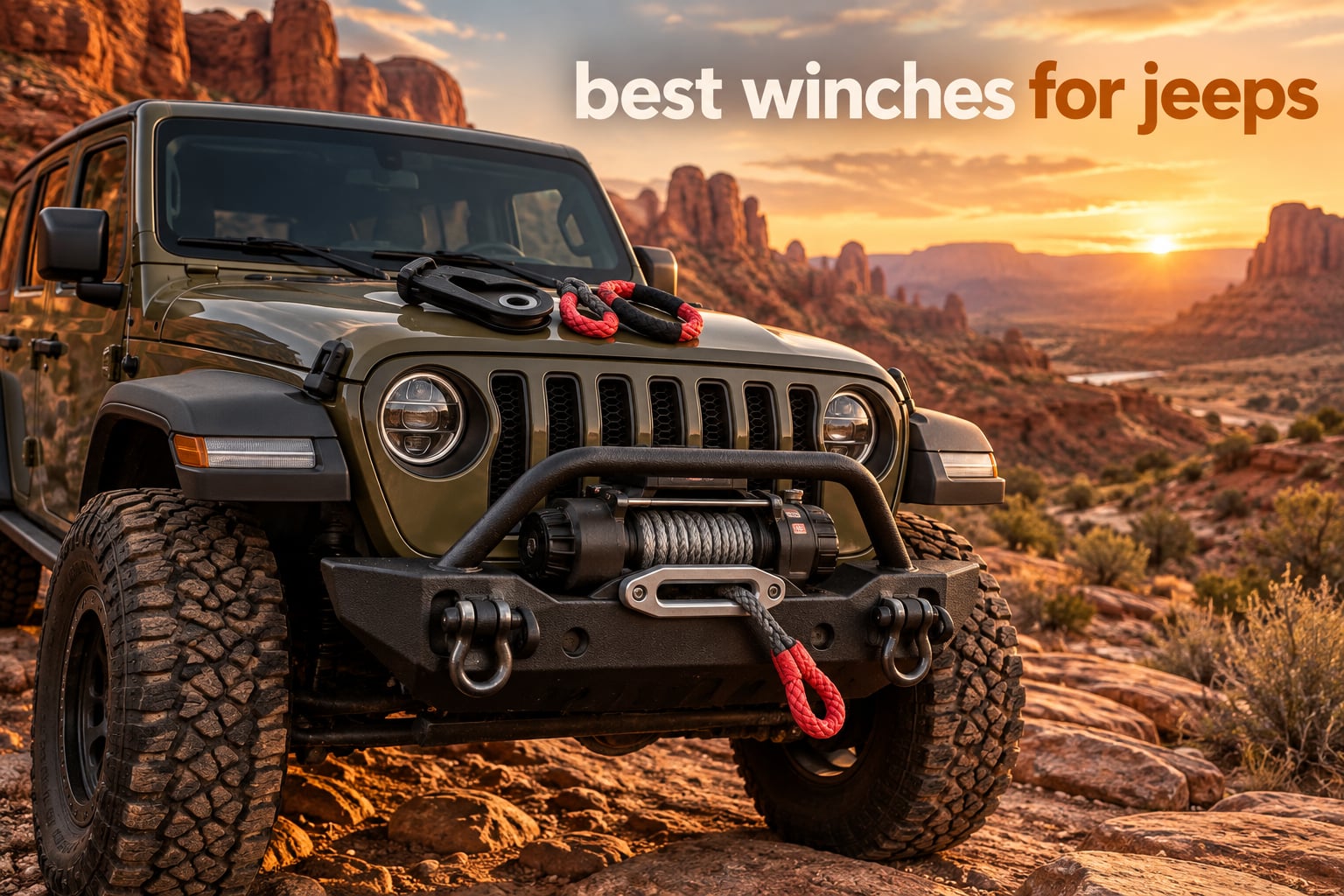
If you want the short answer first: most Wranglers and Gladiators need a 9,000 to 10,000 lb winch, and heavy armor or 37s pushes you to 12,000 lb. The rule behind that number is simple. Buy a winch rated at roughly 1.5 times your Jeep’s gross weight so the motor is working at about two-thirds capacity on a hard pull instead of stalling out.
That band is not arbitrary. A two-door Wrangler sits near 4,200 lb gross while a four-door with passengers and gear runs closer to 5,000 lb, and a Gladiator with a bed full of camping gear pushes past 6,000 lb. Multiply by 1.5 and you land squarely in the middle of this list. Staying under your Jeep’s own weight is a common and expensive mistake new off-roaders make, and the reason so many people end up watching a motor overheat halfway through a mud hole.
Below is our roundup of the best winches for Jeeps in 2026, covering ten 12-volt electric winches that bolt to a winch plate, an aftermarket bumper, or a hidden mount. We weighed rated capacity, motor horsepower, rope type, ingress protection, remote options, fairlead design, and the reliability feedback owners report across Wrangler Forum, Jeep Forum, and r/Jeep threads. Every pick here has real review volume behind it, and every pick has a physical trait that will annoy somebody.
Updated for October 2026. A note on pricing: winch pricing moves constantly and the buttons below pull live listings, so we do not quote figures here. What we do quote is capacity, horsepower, rope length, and everything the owners in the forums actually complain about after a season of use.
Table of Contents
Top 3 Jeep Winches (October 2026)
Before the full list, these three cover the most ground. The Smittybilt XRC Gen 2 9,500 lb is the one we fit to our own Jeep because it balances a real 6.6 hp motor, a huge review base, and a price point that does not wreck a build budget. The WARN VR EVO 12-S is the sealed, factory-reference unit if you want the best sealing in this group in a compact package. The Rough Country 9,500 lb synthetic is the pick owners name most often as the best value for moderate trail use.
Smittybilt XRC Gen 2 9500 lb
- 9500 lb capacity
- 6.6 hp motor
- Steel cable
- 4-way roller fairlead
Best Winches for Jeeps in 2026: Quick Overview
All ten winches, side by side, before the detail. Scroll the table first and come back to the sections that match how you actually wheel.
| Product | Specs | Action |
|---|---|---|
| Smittybilt XRC Gen 2 9500 lb Steel Cable |
|
Check Latest Price |
 Smittybilt X2O-10K Waterproof Synthetic Smittybilt X2O-10K Waterproof Synthetic |
|
Check Latest Price |
 WARN VR EVO 12-S 12000 lb WARN VR EVO 12-S 12000 lb |
|
Check Latest Price |
 Rough Country 12000 lb Pro Series Synthetic Rough Country 12000 lb Pro Series Synthetic |
|
Check Latest Price |
 RUGCEL 13500 lb Waterproof RUGCEL 13500 lb Waterproof |
|
Check Latest Price |
 OPENROAD Panther Series 3S 13500 lb OPENROAD Panther Series 3S 13500 lb |
|
Check Latest Price |
 STEGODON 9500 lb Synthetic STEGODON 9500 lb Synthetic |
|
Check Latest Price |
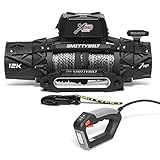 Smittybilt XRC Gen 3 12000 lb Synthetic Smittybilt XRC Gen 3 12000 lb Synthetic |
|
Check Latest Price |
| Rough Country 9500 lb Pro Series Synthetic |
|
Check Latest Price |
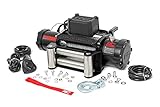 Rough Country 12000 lb Pro Series Steel Rough Country 12000 lb Pro Series Steel |
|
Check Latest Price |
Do You Really Need a Winch for Your Jeep?
Honestly? Probably not as often as you think, and the winch that saves you will probably be used on somebody else’s Jeep first.
Veteran off-roaders in the forums tell the same story. One long-time owner described needing his winch only once in ten years of wheeling. Others report that the first hard pull usually comes when rescuing somebody else, or when moving a fully loaded Jeep and travel trailer, which a 9,500 lb winch handled through a snatch block in at least one owner report. So the winch is better understood as insurance for the one afternoon your Jeep sinks to the frame in a creek you did not expect, and for the trails where nobody else is within towing distance.
There are also costs beyond the winch itself. A working system means a winch plate or an aftermarket bumper, a proper wiring run, a second battery on a lot of builds, and recovery gear like a snatch block, soft shackles, and a damper. Owners chasing the cheapest possible setup end up with a lightweight winch and a stubby wiring kit that cannot sustain a long pull, which is the combination that strands people.
If you only drive graded forest roads with a full group of four vehicles behind you, a decent shovel and a snatch strap get you home. If you wheel solo on technical rock, deep mud, dunes, or winter roads, this is cheap insurance. That is the whole calculation.
1. Smittybilt XRC Gen 2 9,500 lb Steel Cable – Our Best Winch for Jeeps Overall
Smittybilt XRC Gen 2 9500lb Winch with Steel Cable – SB97495
9,500 lb
6.6 hp motor
3/8 in steel cable
4-way roller fairlead
Pros
- 6.6 hp motor with 3-stage planetary gear train pulls hard and steady
- IP67 waterproofing handles creek crossings
- Complete mounting hardware and wiring kit in the box
- Runs cool even spooling the entire line under load
- Thousands of reviews across Jeeps and full-size pickups
Cons
- Heavy at 78 pounds and steel cable adds more
- Remote plug feels loose and benefits from dielectric grease
- Solenoid bracket screws are small and easy to strip
This is the winch on our own Jeep’s plate, and it is the one we hand to friends who ask for a single recommendation. The 6.6 hp motor and three-stage planetary gear train give it serious low-speed torque for a 9,500 lb unit, and owners consistently report that it runs cool even when spooling the whole line under load. That thermal headroom matters more than raw capacity once you are in a creek bed with the temperature climbing.
What separates this from the other 9,500 lb units is the review base. At more than 3,000 ratings it is the most thoroughly proven winch in this roundup, and the pattern in those reviews is unusually consistent: years of service, no motor or gearbox failures, and complaints about weight and installation quirks rather than performance. Synthetic-rope competitors talk a good game, but the steel cable on this unit shrugs off rock edges in a way nylon rope does not.
The physical reality is that it weighs 78 pounds, and that number climbs when you add a steel hawse, a mount, and the wire. On a JK or JL that already carries bumpers, sliders, and 35s, the front end gets heavy fast. If your build is at the point where the front tires are close to being unloaded over stock ride height, plan the spring rating before you plan the winch.
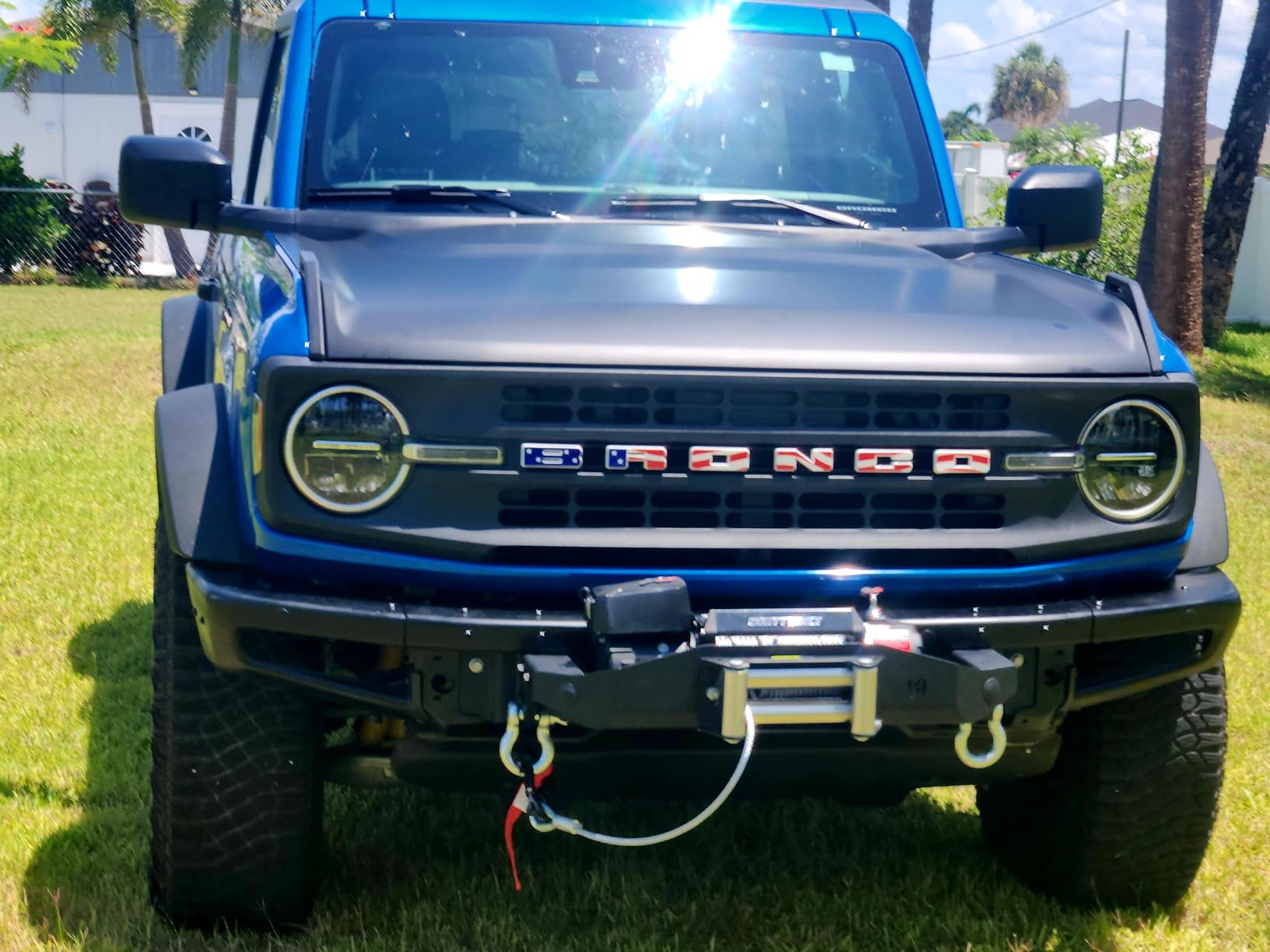
Where it fits your build
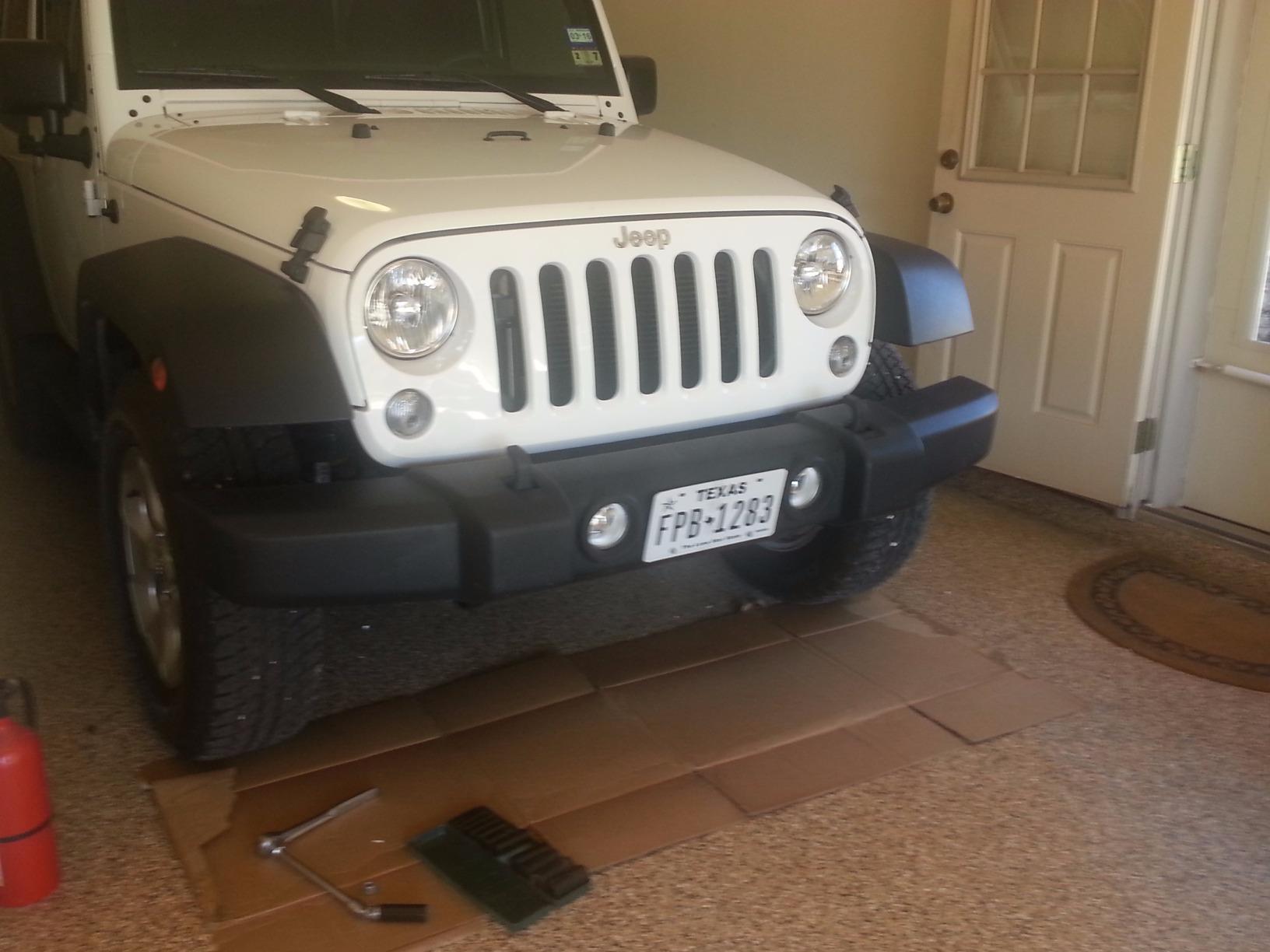
This is the right pick for a moderately built Wrangler on trails that include rock, mud, and the occasional dead tree across the trail. The 9,500 lb rating sits right at the top of the range for a two-door with a factory bumper, which is exactly where a winch earns its keep instead of cooking itself. Owners running this on Jeeps and half-tons report it pulling multi-ton loads without complaint.
It also suits anyone who does farm or property work and needs abrasion resistance more than low weight. A steel cable dragged across rock and mud will outlive synthetic by a wide margin, and the roller fairlead gives you four line positions to choose from for a cleaner spool.
Where it will disappoint you
Two things. First, the steel cable is a genuine safety trade-off: stored energy in a stretched steel line is far more violent than a damped synthetic line, and that energy-absorbing damper matters more with this winch than with the rope models on this list. If you pull a lot of dead weight, a synthetic unit is the calmer choice.
Second, fitment is not entirely universal. Several owners report trimming a hawse-style bumper opening, and the small solenoid bracket screws strip easily during a cramped install. The remote plug also gets reported as loose, and a shot of dielectric grease on the connector costs you five minutes and prevents a future headache.
2. Smittybilt X2O-10K Waterproof Synthetic – Best for Wireless Control Out of the Box
SmittyBilt X2O-10K WATERPROOF SYN – SB98510
10,000 lb
6.6 hp series wound
98.5 ft synthetic
IP68 rated
Pros
- Wireless remote included at no extra cost
- IP68 rated and synthetic line spools smoothly
- Faster line speed than most units in this class
- 218:1 three-stage planetary gear system
- Automatic out-of-drum brake
Cons
- Center solenoid mounts do not fit every bumper
- Factory hook is oversized for many setups
- Wireless remote can fail after a few years
If your objection to a factory winch is that you do not want a 12-foot cord dragging through brush, this is the unit to look at. The wireless remote is included in the box rather than sold as an accessory, and the sealed 218:1 planetary gear train behind the 6.6 hp series-wound motor puts it squarely in the class of winches that used to cost far more. Reviewers treat it as the value alternative to a WARN, and at 4.7 stars across more than 1,300 ratings that consensus holds up.
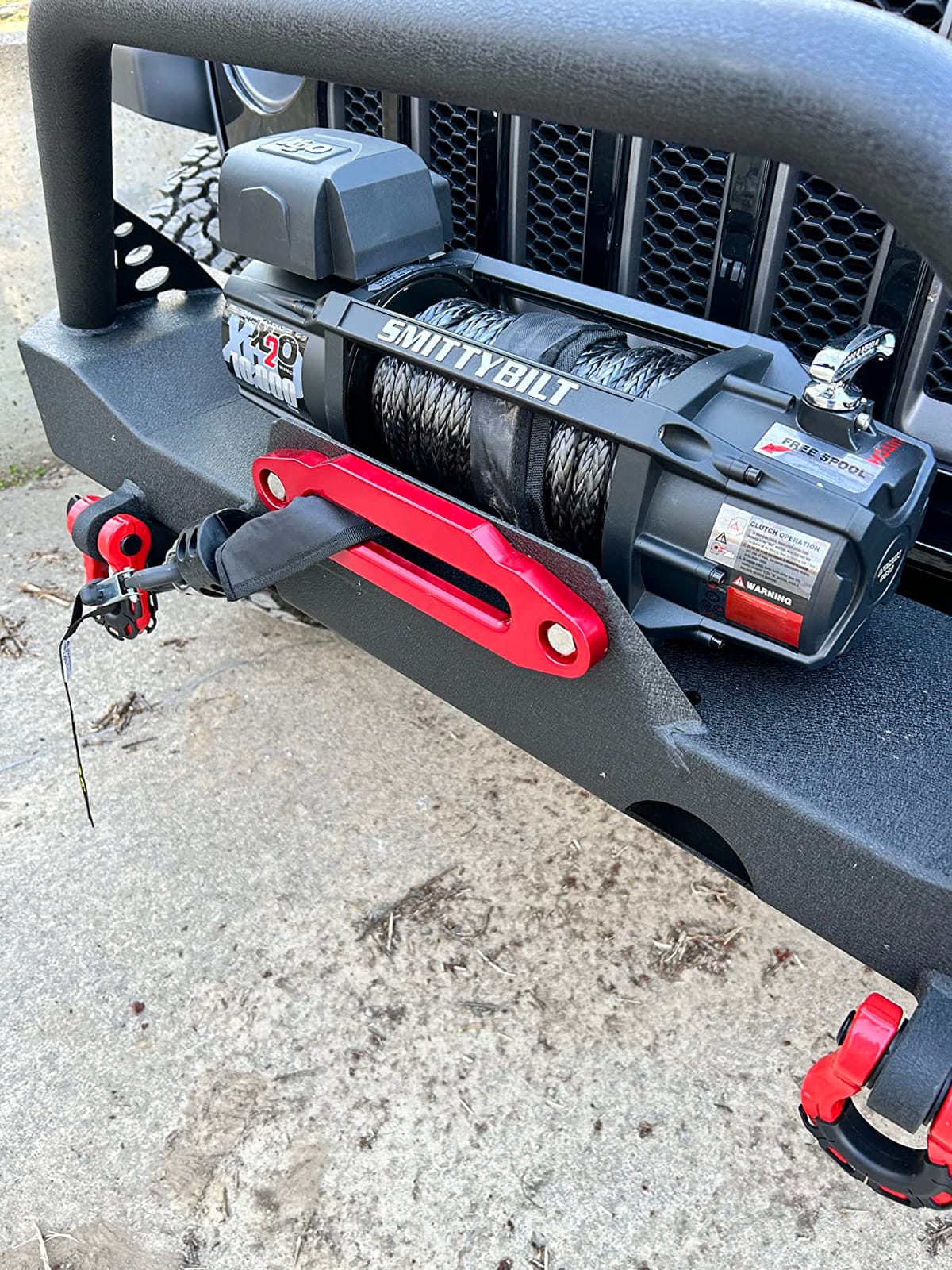
Ninety-eight and a half feet of 3/8-inch synthetic rope is a real advantage over a typical steel setup. You can run out far more line before you need a second anchor point, and the rope weighs less on the front bumper, which matters if you are already lifting the front axle with wheel weight. Owners also report faster line speed than most competitors in this class, and the rope has held up through heavy directional pulls.
The automatic out-of-drum brake holds the drum when the line is spooled, and the drum’s 2.5-inch diameter wraps the rope neatly, which reduces the bird-nesting you get with some smaller drums. It also carries an IP68 ingress rating, the highest rating in the roundup, shared with only two other winches here.
Where it fits your build
Pick this if you want one remote and a synthetic line with nothing else to buy. It suits solo wheelers who need to step well clear of the Jeep to guide a recovery, and overlanders who do not want a cord snagging brush. The 10,000 lb rating is right in the middle of what a four-door Wrangler or a lightly built Gladiator needs, so you are pulling at a sensible fraction of capacity on most pulls.
It also works for anyone with a bumper that accepts a solenoid on the center section, since the pack mounts in two positions. Check that against your bumper before you buy, because that is the single most common install complaint here.
Where it will disappoint you
The wireless remote is the weak point, and owners say so directly. Failures show up after a few years, and the general forum wisdom is that a wireless remote dies exactly when you need it most. Keep the wired lead in the Jeep as your backup, which is easy to do because the 12-foot cord is right there.
Second, the factory hook is oversized for many setups and catches on bumper edges. Swap it early. And the instructions do not cover every bumper layout, so expect to spend time on forums or a shop manual working out the routing for Safari-style or tube-frame bumpers.
3. WARN VR EVO 12-S 12,000 lb – Top Rated for Sealed Builds
WARN VR EVO 12-S Electric 12V Winch with 12,000 lb Pull Capacity – 103255
12,000 lb
IP68 sealed body
Synthetic rope
Bluetooth remote
Pros
- Strong 12000 lb capacity in a compact sealed body
- Bluetooth and wired remote options both praised
- Easy install on Jeep Gladiator and Bronco winch plates
- Highest average rating in this roundup at 4.8 stars
Cons
- Supplied 6 foot battery cables are too short for some engine bays
- Mounting hardware sold separately
- No inline solenoid or power cutoff in the kit
WARN builds the VR EVO line as its reference product, and the 12-S is the synthetic-rope version. At 4.8 stars it matches the highest average rating in this roundup, and the reviews describe it in the same words repeatedly: this is the winch you buy when you want to install it once. The fully sealed IP68 body is the differentiator, and owners report water crossings that left older open-case winches humming with rust inside.
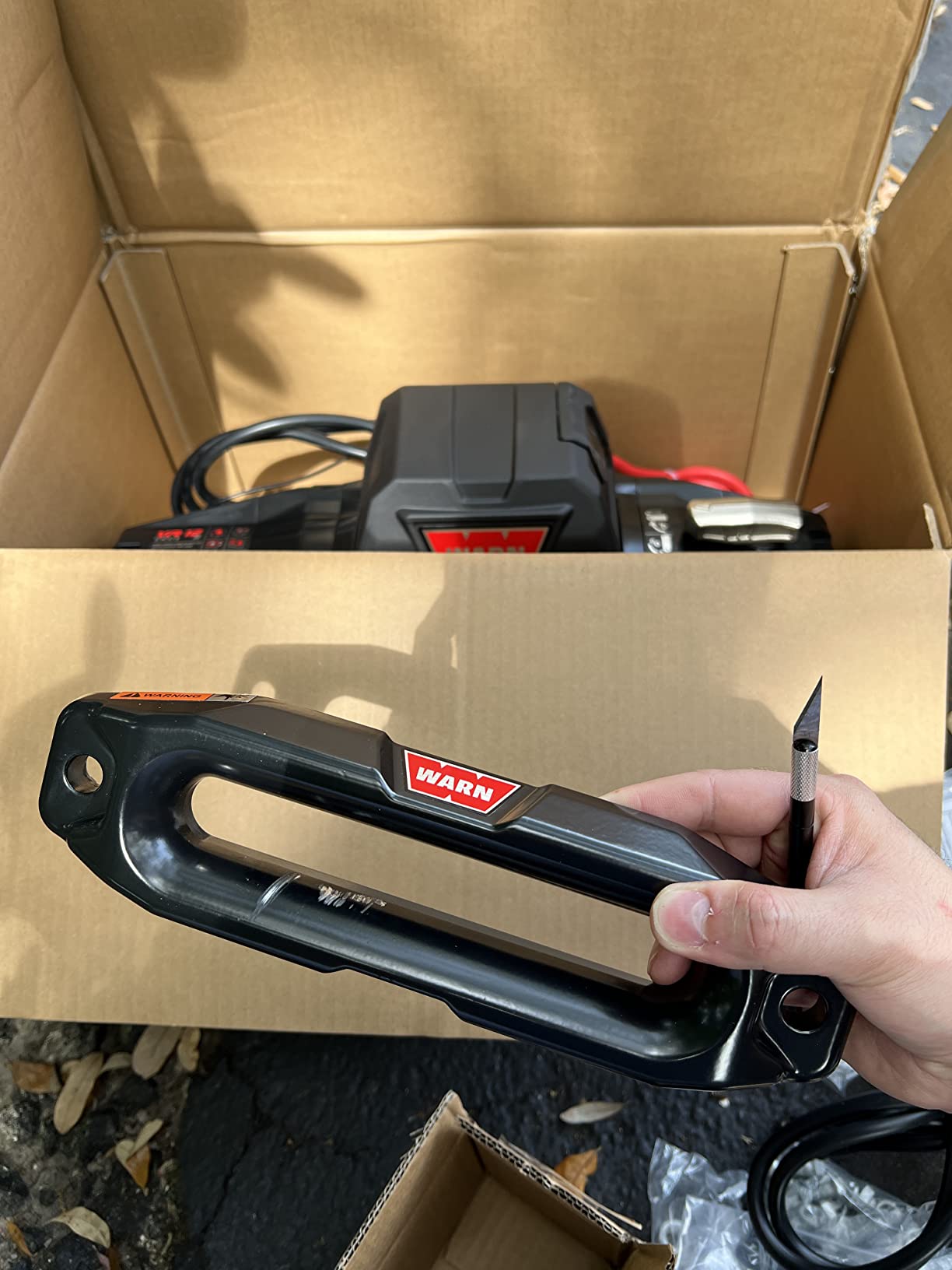
At 67.1 pounds it is not a light winch, but it is compact: 21 by 6.3 by 10.1 inches, which means it fits inside a bumper cavity or a hidden mount where bulkier cases will not. That compactness has made it the go-to choice for Jeep Gladiator and Bronco owners working with aftermarket winch plates, where bumper depth is the limiting factor. Installers describe it as one of the easiest in the class to wire up.
Control options are the other headline. You get a wired handheld lead, and the wireless Bluetooth remote is available for people who want to stand back from the recovery. The five-year mechanical and three-year electrical warranty is the longest coverage in this group, and it matters because a control box or motor failure is one of the most expensive repairs a winch can throw at you.
Where it fits your build
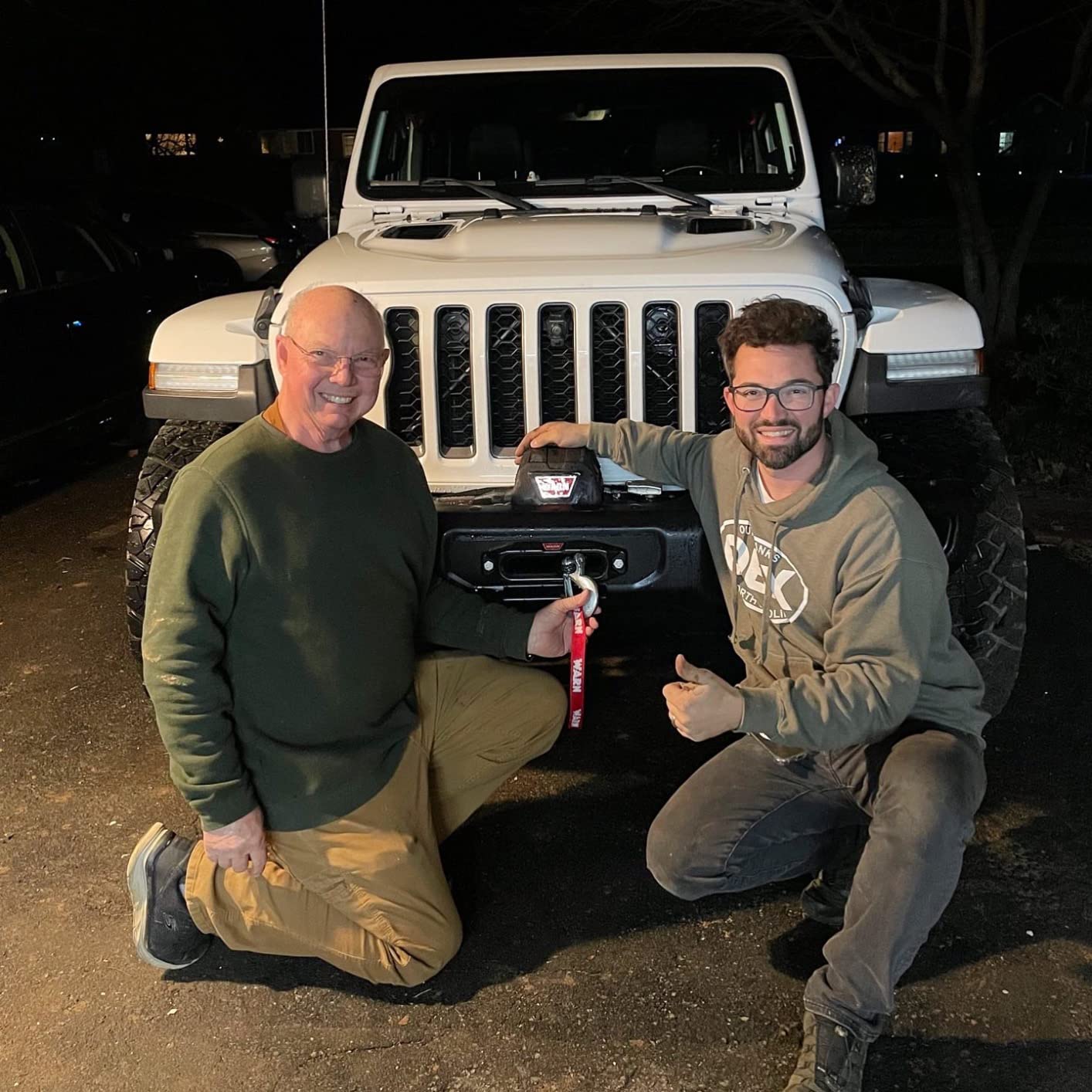
This is the correct pick for a heavily built Jeep: armor, sliders, a winch bumper, 37s, and a roof rack. The 12,000 lb rating gives you a real margin over a 6,000 lb Gladiator or a fully loaded four-door, and the sealed body means the internals survive the water crossings and mud you will not avoid.
It also suits anyone who plans to keep the Jeep. The warranty and the sealed design reduce the corrosion that ends the life of cheaper units, and WARN’s parts support is one of the easiest in the industry to source, which matters if you are three states from a dealer.
Where it will disappoint you
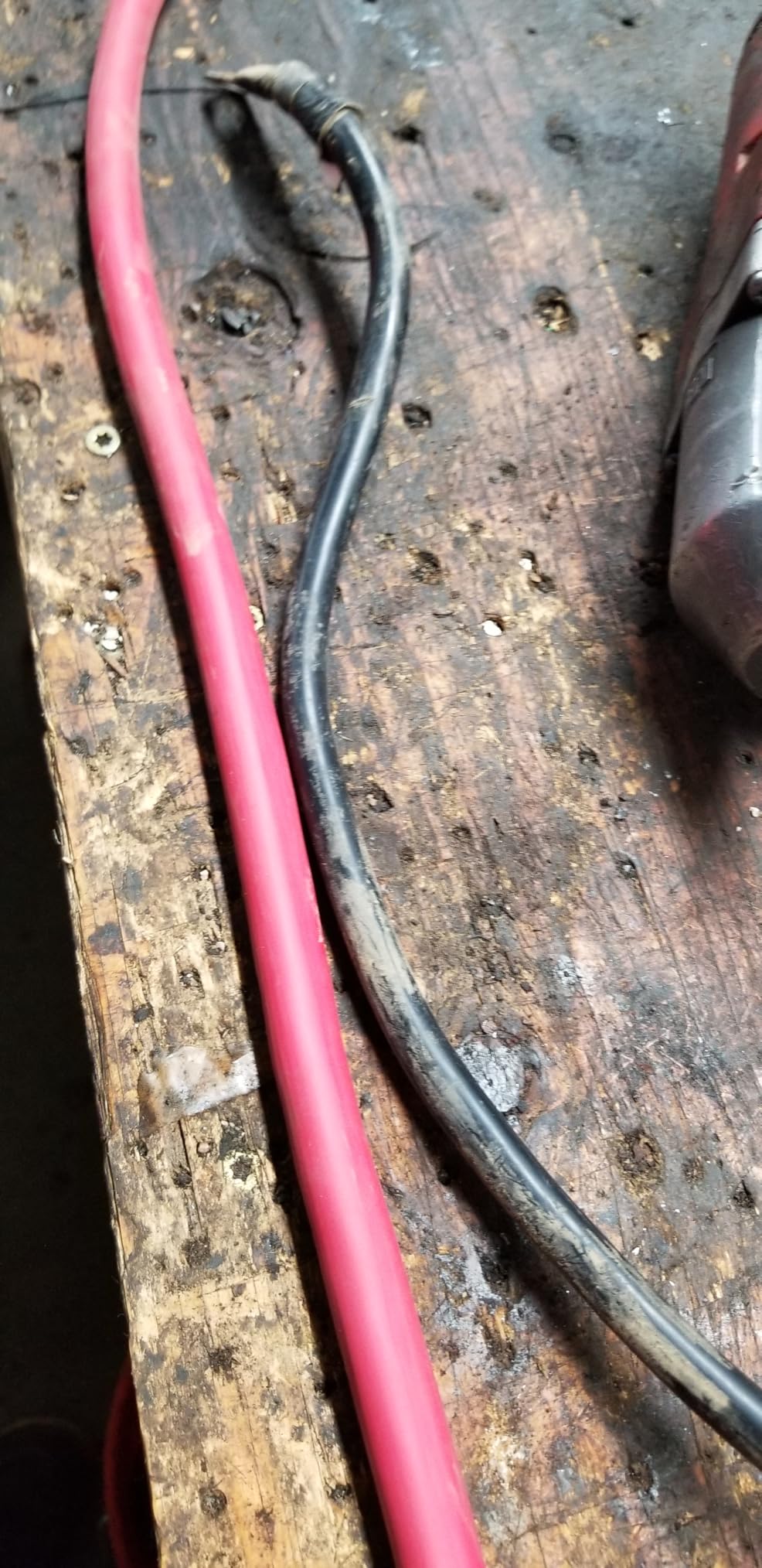
The most repeated complaint is the supplied 6-foot battery cables. They are long enough for a clean layout and too short for a V8 swap with a relocated battery or a crowded engine bay. Budget for longer 2/0 welding cable on install day rather than assuming the kit covers you.
Second, the kit does not include an inline solenoid or a master disconnect, and owners correctly note that running power straight to the battery with no cutoff is a real risk in a collision. Add a circuit breaker and a battery disconnect during install. And the vehicle-specific mounting hardware is sold separately, so price that into the build before you start.
4. Rough Country 12,000 lb Pro Series Synthetic – Best for Heavy Loads
Rough Country 12,000LB PRO Series Electric Winch | Synthetic Rope – PRO12000S, Black
12,000 lb
6 hp motor
85 ft synthetic rope
Hawse fairlead
Pros
- 12000 lb capacity on a well-proven platform
- Synthetic rope handles heavy trucks and full dump trailers
- Customer service replaced missing and damaged parts quickly
- Installation takes about two hours including a hidden mount
Cons
- No wireless remote included and universal controllers do not work reliably
- Body can be large for some bumper cavities
- 3/8 inch rope has stretched under sustained load for some owners
Rough Country’s Pro Series has become a community favorite for a reason that has nothing to do with specs. Owners repeatedly name Rough Country’s 9,000 lb synthetic as the best deal in the mid-tier for moderate use, citing three years of reliable service. This 12,000 lb version is the larger sibling on the same PRO Series platform, and the reviews follow the same pattern: capacity you do not really need, service that answers, and a synthetic rope that spools without drama.
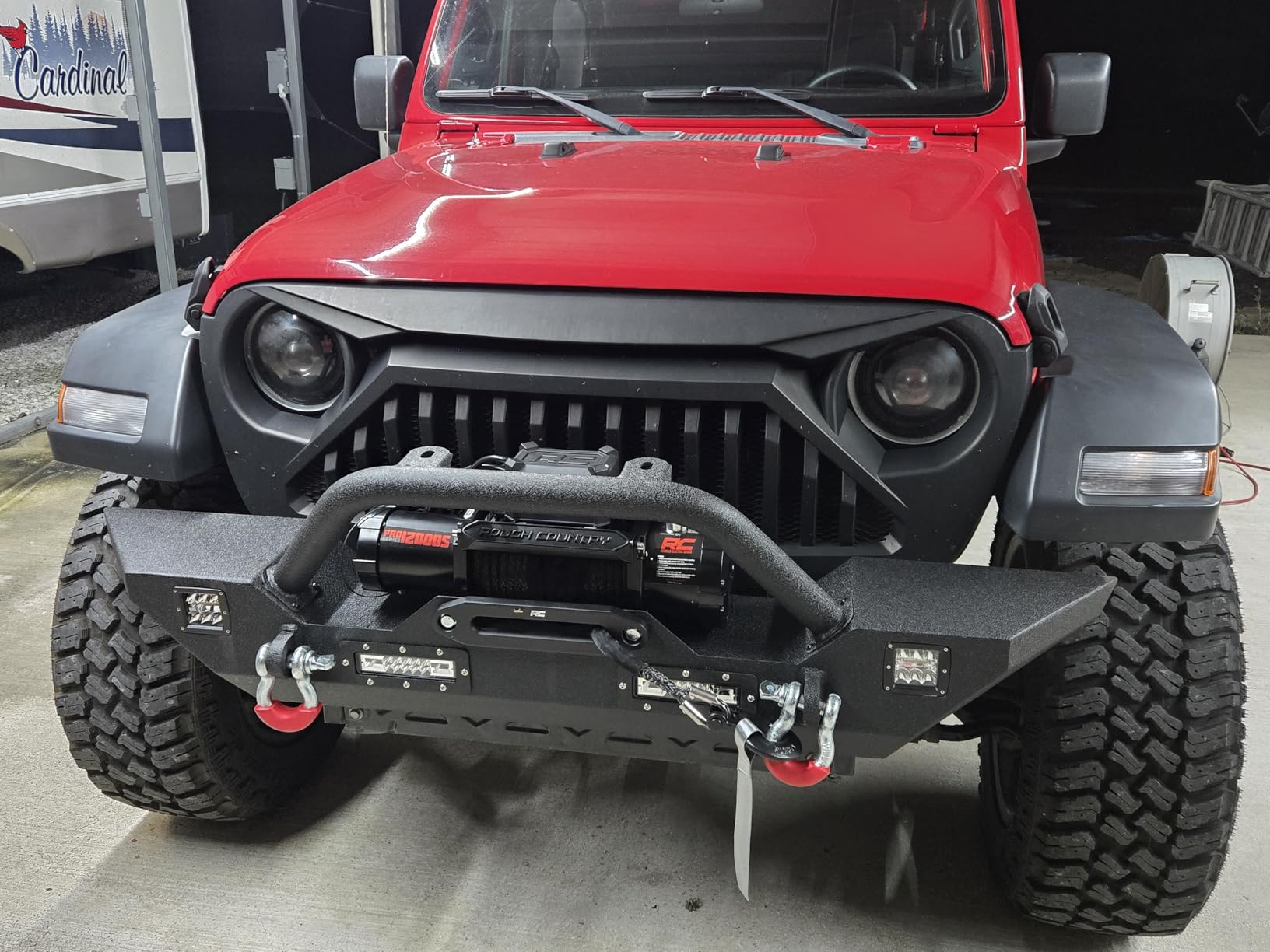
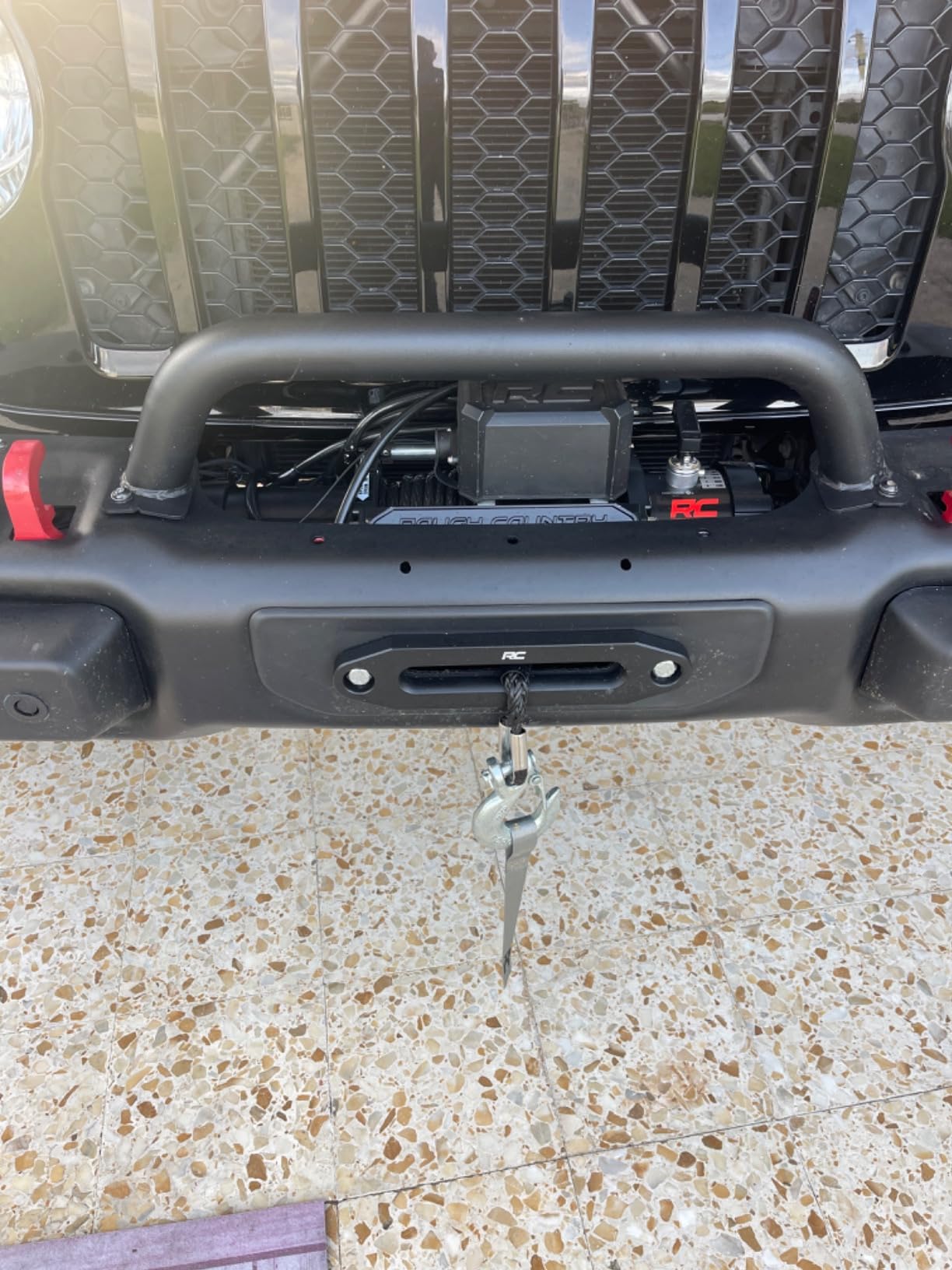
The 6 hp motor driving 85 feet of 3/8-inch abrasion-resistant synthetic rope through a hawse fairlead is a proven combination. Owners report it handling heavy trucks and full dump trailers, which is well past anything a stock Wrangler weighs. The IP67 housing and sealed components have held up through repeated mud and water immersion in owner reports, and the 4.5 by 10-inch bolt pattern fits the common Jeep winch plate.
Installation is where this brand earns goodwill. Rough Country customer service has replaced missing and damaged parts quickly, which matters because winches arrive with incomplete kits more often than manufacturers admit. A couple of hours covers a clean plate install, and even a hidden mount is reported as a single-afternoon job.
Where it fits your build
Choose this for a Gladiator that hauls, a Wrangler that tows, or anyone whose recovery work involves other people’s heavy equipment. Twelve thousand pounds of rated capacity means a loaded four-door plus a stuck buddy situation, and the synthetic rope keeps stored energy manageable on those long, slow pulls.
It is also a strong choice if you value a hawse fairlead. A hawse mounts flush into the bumper and keeps the front end clean, which matters if you care about approach angle or run a hidden mount behind a grille.
Where it will disappoint you
The single most requested feature across reviews is a wireless remote, and this model does not have one. Owners report that aftermarket universal wireless controllers do not work reliably with it, so you are running a 12-foot cord no matter what. That is fine on a clean trail and awkward in brush.
Also note the body size. At 23.25 by 13.5 by 12.5 inches it can be slightly large for tight bumper cavities, so measure your clearance before ordering. And a few owners report their 3/8-inch rope stretching or needing replacement under sustained heavy load, so keep an eye on it if you do recovery work for a living.
5. RUGCEL 13,500 lb Waterproof – Best for Remote Redundancy
RUGCEL WINCH 13500lb Waterproof Electric Truck Winch 12V Synthetic Rope Winch with Hawse Fairlead,Wired Handle and 2 Wireless Remote,for Trailer and Wrangler in Car Lift
13,500 lb
7.2 hp motor
100 ft synthetic rope
Hawse fairlead
Pros
- 13500 lb rated capacity with 100 ft of synthetic line
- Two wireless remotes plus a wired handle give redundant control
- Detailed multi-page illustrated instruction manual
- Hawse fairlead mounted with no trimming on a Wrangler
- Heavy gauge battery cables with quality connectors
Cons
- Wireless remotes produced noticeable static crackle over the radio
- Remote batteries needed replacing almost immediately
- Support is email-only
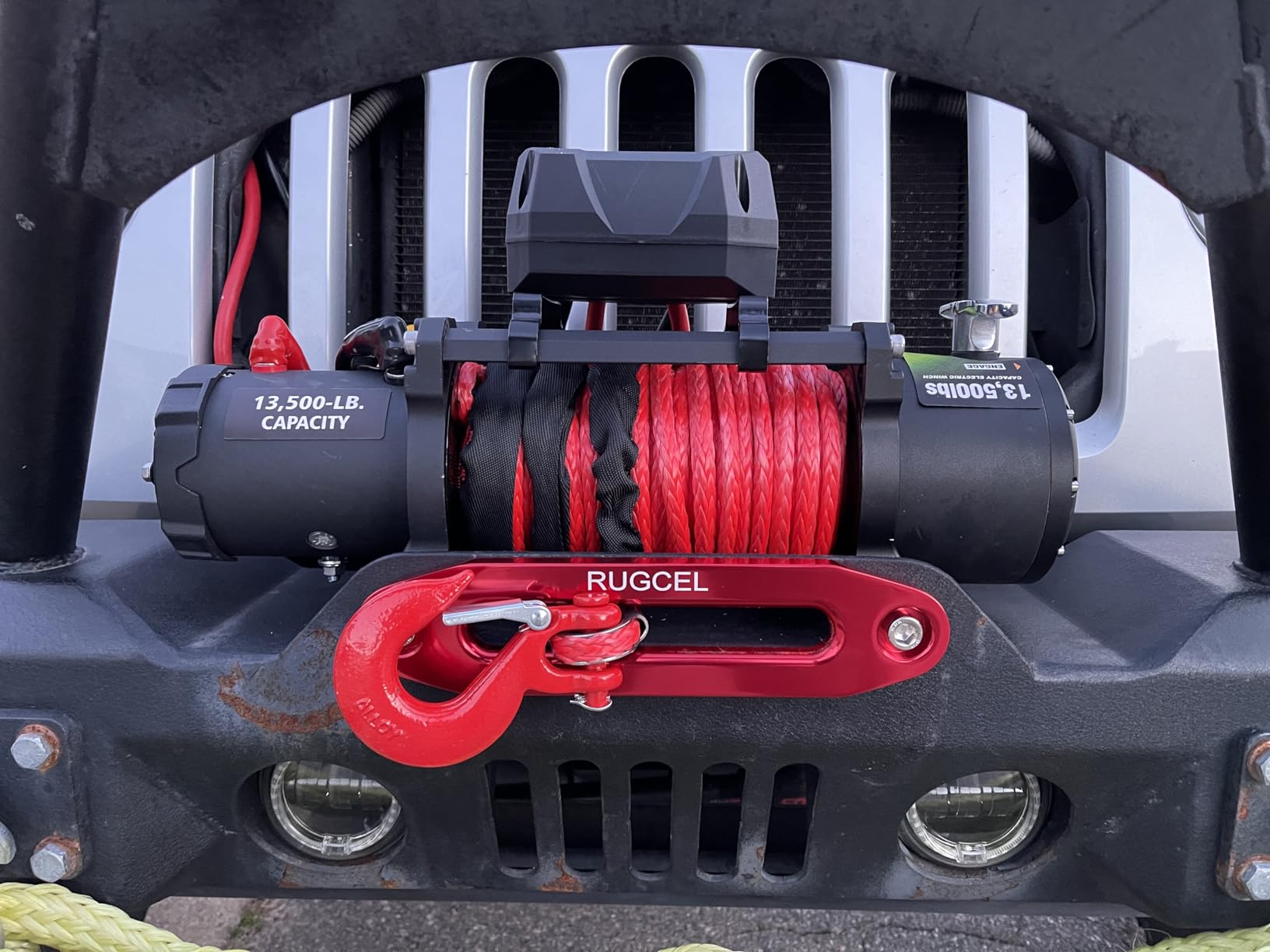
The RUGCEL 13,500 lb is a case study in what you get when a manufacturer spends its budget on the winch and cuts the soft goods. The 7.2 hp series-wound motor, three-stage planetary gear train with a free-spooling clutch, and 100 feet of 3/8-inch nylon rope produce the joint-highest rated capacity in this roundup, and the box includes a wired handle plus two wireless remotes. No other winch in this roundup bundles three separate control options.
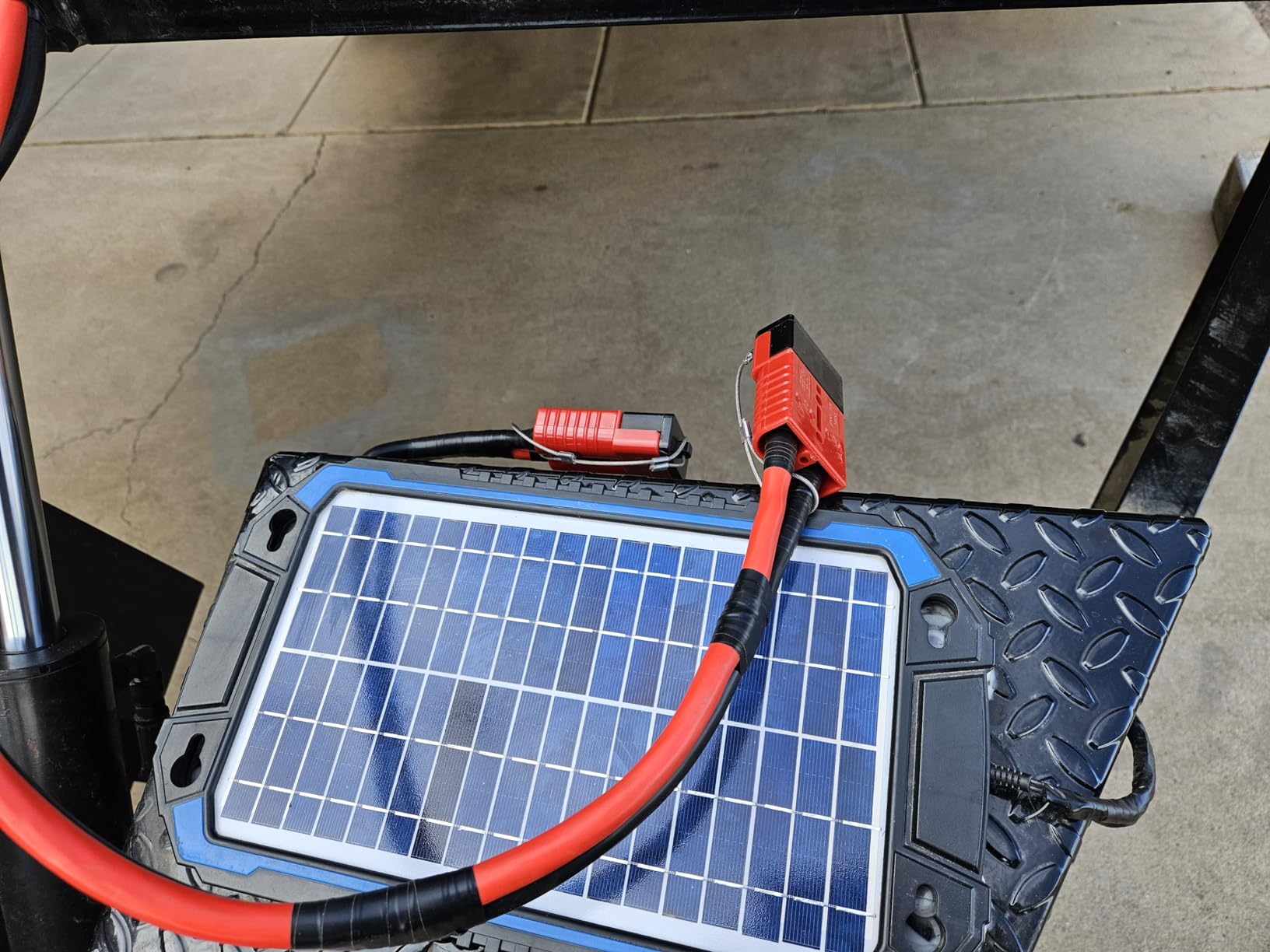
Two things stand out for a Jeep install. The hawse fairlead mounts without trimming a Wrangler bumper opening, which saves an afternoon on anyone with a tube bumper or a factory plastic bumper. And the heavy gauge battery cables with proper connectors are a real upgrade over the thin leads that cause trouble on cheaper units, though several owners still replace them with 2/0 welding cable for serious pulls.
The instruction manual is genuinely detailed and multi-page with illustrations, which sounds like a small thing until you are routing a control pack in a crowded engine bay. The IP67 sandproof rating with a 500-amp solenoid and the free-spooling clutch mean you can pull line out by hand to set your hook without fighting the clutch.
Where it fits your build
This suits a Jeep that pulls other Jeeps. A Gladiator with a 6,000 lb gross weight and a buddy Wrangler behind it is a realistic recovery with 13,500 lb of rated capacity behind you, and the extra 100 feet of line means more anchors before you need to reposition. It also works well for anyone who winches regularly and wants three ways to control it.
The redundant remotes are a genuine advantage for someone running recovery operations for a group, where a dead remote ends the day. The free-spool clutch makes setting up a snatch block pull fast.
Where it will disappoint you
The wireless remotes are the weak link, and the failure mode is specific: owners report noticeable static crackle over the radio and remote batteries needing replacement almost immediately after opening the box. Treat the wired handle as your primary and the wireless pair as a convenience.
Second, the hook shipped black even though the listing and rope are red, which is a small thing that annoys people. More substantively, nylon rope can smear if dragged across a non-rolling surface, and support is email-only if something goes wrong. The 63.1-pound weight is mid-pack, so it will not save you on front-end load.
6. OPENROAD Panther Series 3S 13,500 lb – Best for Farm and Heavy Equipment
OPENROAD 13500 lb Recovery Winch with Synthetic Rope and 2 Wireless Remotes – IP68 Waterproof 12V Electric Winch for Jeep, SUV, Truck & Trailer – Panther Series 3S
13,500 lb
IP68 rated
85 ft synthetic rope
50 pounds
Pros
- Handles heavy loads including trucks
- skid steers and a 25hp tractor
- IP68 rating with Dacromet coated corrosion resistant screws
- Lightest unit in the group at 50 pounds
- Factory assembly mostly complete so install is mostly power and bolts
Cons
- Wireless remote buttons can stick on and continue winching
- Solonoid bracket is supported on one side with only two screws
- Pressed metal rope sleeve makes rope changes difficult
At 50 pounds the Panther Series 3S is the lightest winch in this roundup, and that is the reason to buy it rather than an objection to it. If your Jeep is already at the edge of its front-end weight budget, or you move equipment on a farm or property where a winch is a tool and not a trophy, the difference between 50 pounds and 86 pounds on a front bumper is meaningful. Owners report it handling trucks, skid steers, and a 25 hp tractor.
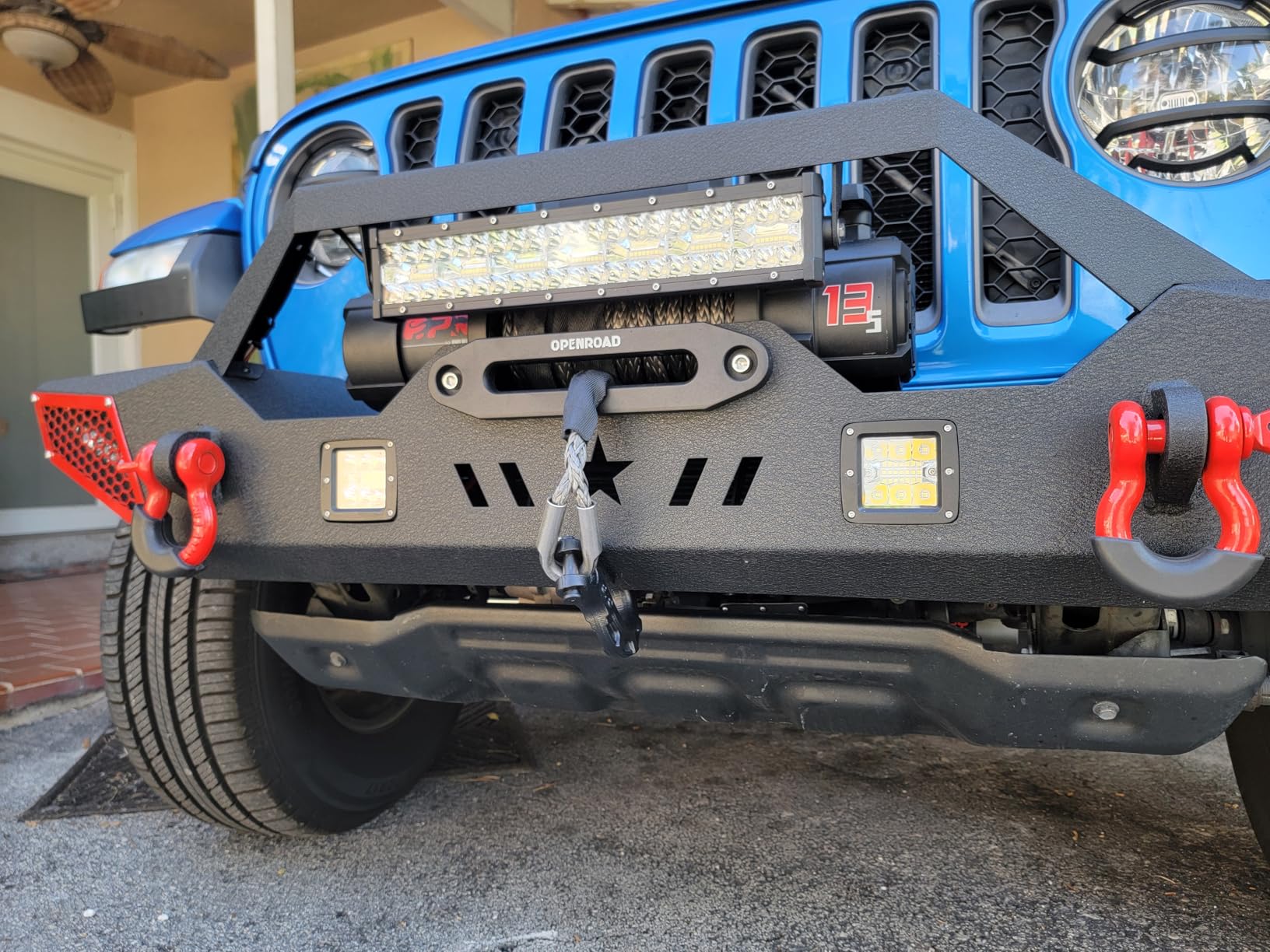
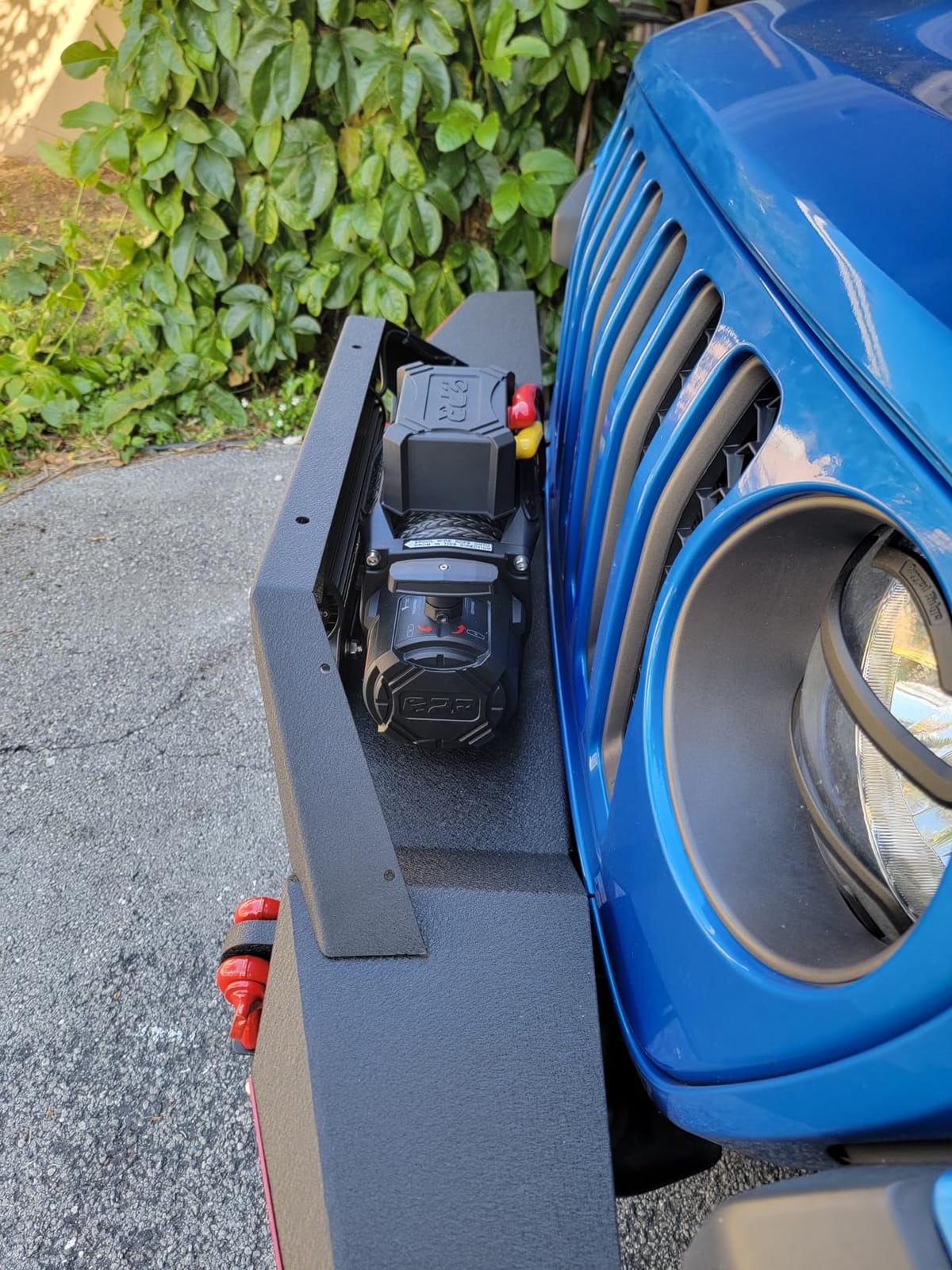
The build quality details are better than the price tier suggests. IP68 sealing, Dacromet-coated corrosion resistant screws, an 85-foot spool of 3/8-inch synthetic rope, a 10 by 4.5-inch bolt hole pattern that matches common Jeep winch plates, and a full kit in the box including control box, hawse fairlead, wired controller, two wireless controllers, hook, strap, bolts, and manual. Factory assembly is mostly complete, so the install reduces to bolting it down and running power.
The wireless remotes work well for one specific job: guiding a vehicle up onto a trailer. That is a real convenience when the cab of the vehicle being loaded blocks the wired lead, and it is a use case the other remotes in this list serve poorly.
Where it fits your build
Pick this for a Jeep that doubles as a work vehicle. Farm and ranch use, pulling a stump out of the ground, dragging a downed tree, repositioning a skid steer, or loading equipment onto a trailer are all tasks where the light weight and the 13,500 lb rating both earn their place. The synthetic rope is also easier on people working around equipment than a steel line.
It suits a stock-ish Wrangler or Gladiator that has not been lifted, where every pound on the front bumper shows up in ride quality and steering feel over the long term.
Where it will disappoint you
The wireless remote safety concern is real and worth stating plainly. Owners report buttons sticking on and the winch continuing to spool after release, so you need a hand on the remote with a clear line of sight. That is a meaningful drawback in a recovery where you are working around a moving line.
Second, the solenoid bracket is supported on one side by only two screws and can loosen, and the rope end uses a pressed metal sleeve that makes rope changes difficult. Owners also report synthetic rope pinching between drum wraps under extreme load. Support is mainly by email, though the manufacturer has issued replacement remotes and parts in response to feedback, and lifetime technical support is included with a one-year limited warranty.
7. STEGODON 9,500 lb Synthetic – Budget Pick
STEGODON Winch 9500lb Winch 12V Waterproof Electric Winch Synthetic Rope Winch with Wireless Remote and Corded Control for Truck SUV Jeep Wrangle (Green Rope)
9,500 lb
5.5 hp series wound
78 ft synthetic rope
265:1 gear ratio
Pros
- 9500 lb capacity with a wireless remote in the box
- Synthetic rope spools smoothly and avoids stray wire injury
- Wireless range exceeds 49 ft
- Simple install at about an hour and a quarter
Cons
- Supplied power cables are copper clad aluminum and not recommended under load
- At least one unit melted during a long first pull on a heavy truck
- Fairlead bolts use an uncommon Allen head size
This is the entry point. A 9,500 lb winch with a 5.5 hp series-wound motor, a 265:1 three-stage planetary gear train, 78 feet of 3/8-inch green synthetic rope, and both a wireless remote and a corded control in the box. It carries the lowest average rating in this roundup at 4.4 stars, and we want to be direct about why before you buy it.
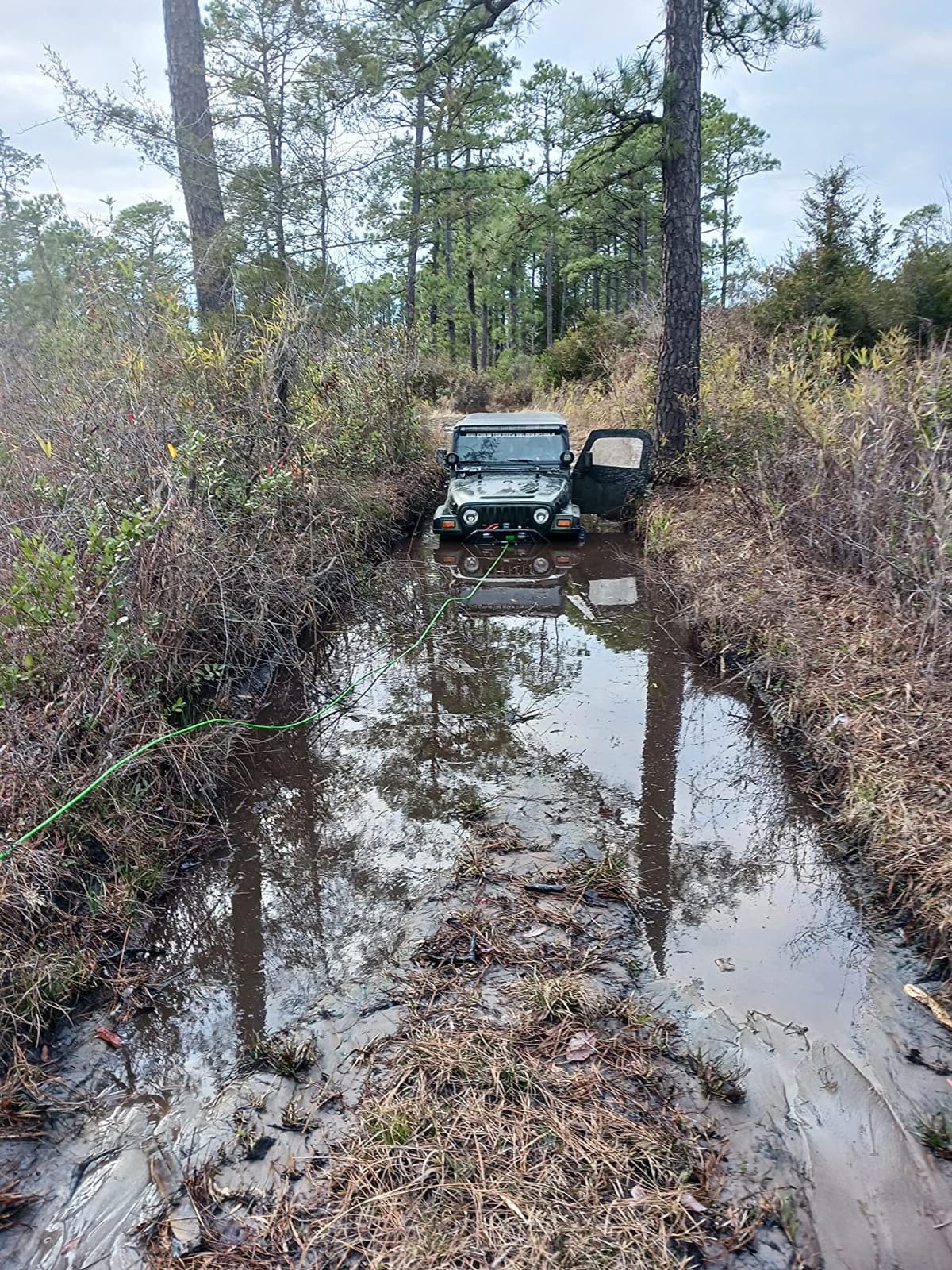
The performance is genuinely fine for most people. Owners report the rope spooling smoothly, the wireless range working even near the end of the spool, installs taking about an hour and a quarter, and two years of service with no issues. At 48 pounds it is the second-lightest unit here, and the synthetic line means no stray wire injuries when you are kneeling in the mud.
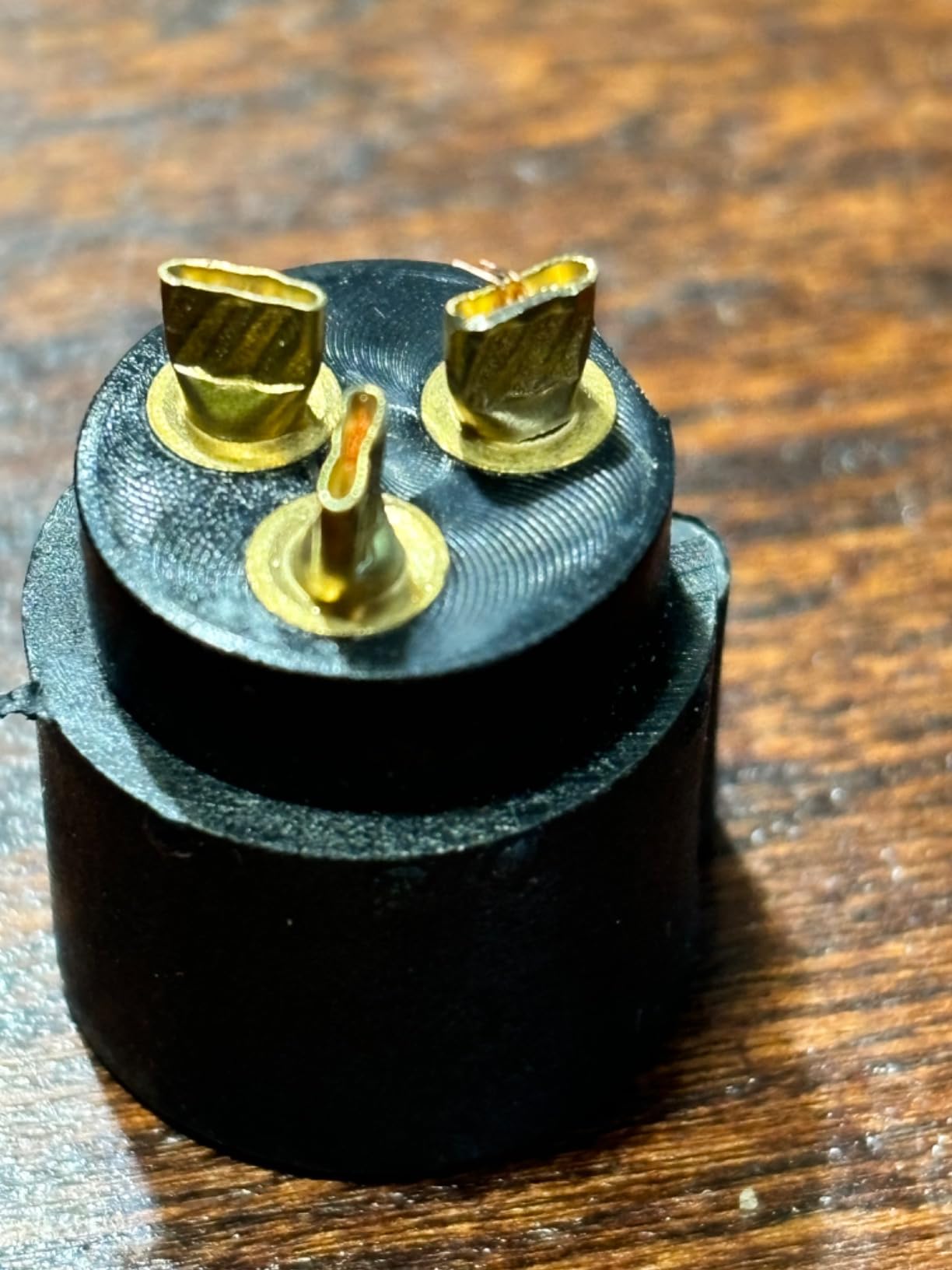
The problem is the wiring. The supplied power cables are copper clad aluminum, and that is the single most common reason budget winches disappoint owners. Forum consensus is consistent: if you are doing a heavy pull, replace the kit wires with 2/0 welding cable, no exceptions. A winch is a huge current draw over a short distance, and aluminum-conductor leads heat up fast under that load.
Where it fits your build
It works for a beginner or a weekend wheeler on a factory or factory-plus build who wants a synthetic rope and a wireless remote without spending serious money. Line speed of 6.6 ft per minute at full load means recovery takes time, but the 265:1 ratio is geared for control rather than speed, and that is the right trade in tight spots.
If your recovery history is one or two gentle self-pulls a year, this is a defensible place to start. The 12-month return and replace warranty gives you a year to find out.
Where it will disappoint you
Do not skip the wiring replacement. Beyond the aluminum leads, there are reports of a unit melting during a long first pull on a heavy truck, and the wired remote connector plug is reported as very loose. Owners also report an early wireless remote failure on a newly delivered unit.
Also note that the fairlead bolts are large Allen heads in an uncommon size, so the socket you need may not be in your kit. Budget an extra wiring harness, a breaker, and a disconnect when you plan the install, and the total lands in a different place than the winch listing suggests.
8. Smittybilt XRC Gen 3 12,000 lb Synthetic – Best for Night Recovery
Smittybilt XRC Gen 3 12,000lb Comp Winch with Synthetic Rope – SB98612
12,000 lb
7.0 hp motor
Remote flashlight
Load indicator
Pros
- 7.0 hp motor with a 12% line speed gain over Gen2
- Remote flashlight is genuinely useful for spooling inside a bumper
- Load
- temperature and direction indicators on the remote
- Synthetic rope survived heavy directional pulls and ground abrasion
Cons
- No wireless remote option at this tier
- Factory hook is basic and difficult to cut off
- Synthetic line wears under continuous professional duty
The XRC Gen 3 is the one in this roundup I would pick for a Jeep that gets used after dark. The remote has a built-in flashlight, which sounds like a gimmick until you are spooling rope through a winch cavity mounted below the bumper line with a headlamp bouncing off the underside. Owners single out the flashlight as a feature they did not expect to care about and now rely on.
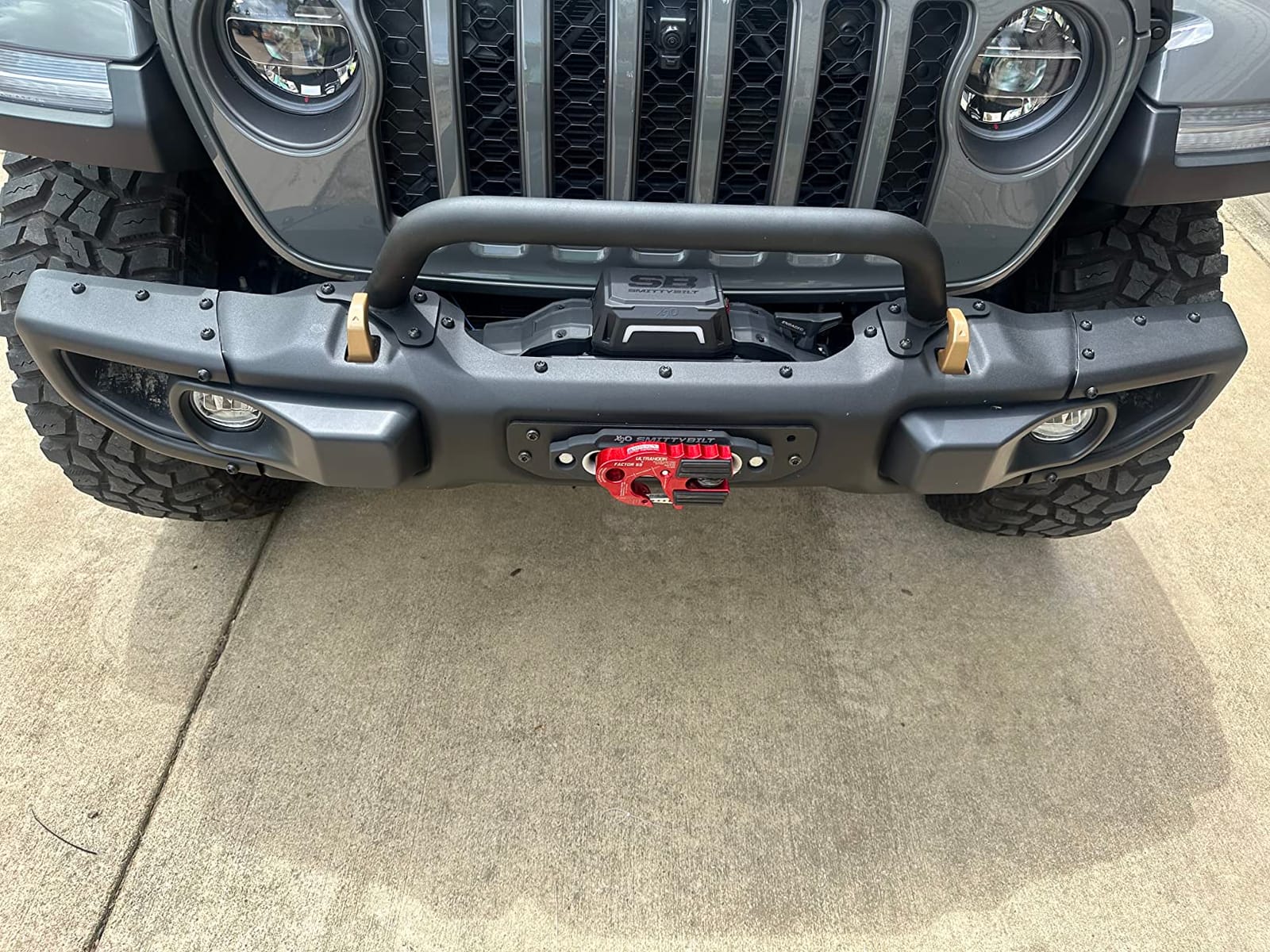
Owners report the 7.0 hp motor paired with a 12 percent average line speed increase over Gen 2, so you are not just pulling harder, you are recovering faster. The remote also carries load, temperature, and direction indicators, and the Load Indicator Warning System is a genuine safety feature that tells you when you are approaching the winch’s thermal and pull limits rather than letting you cook the motor.
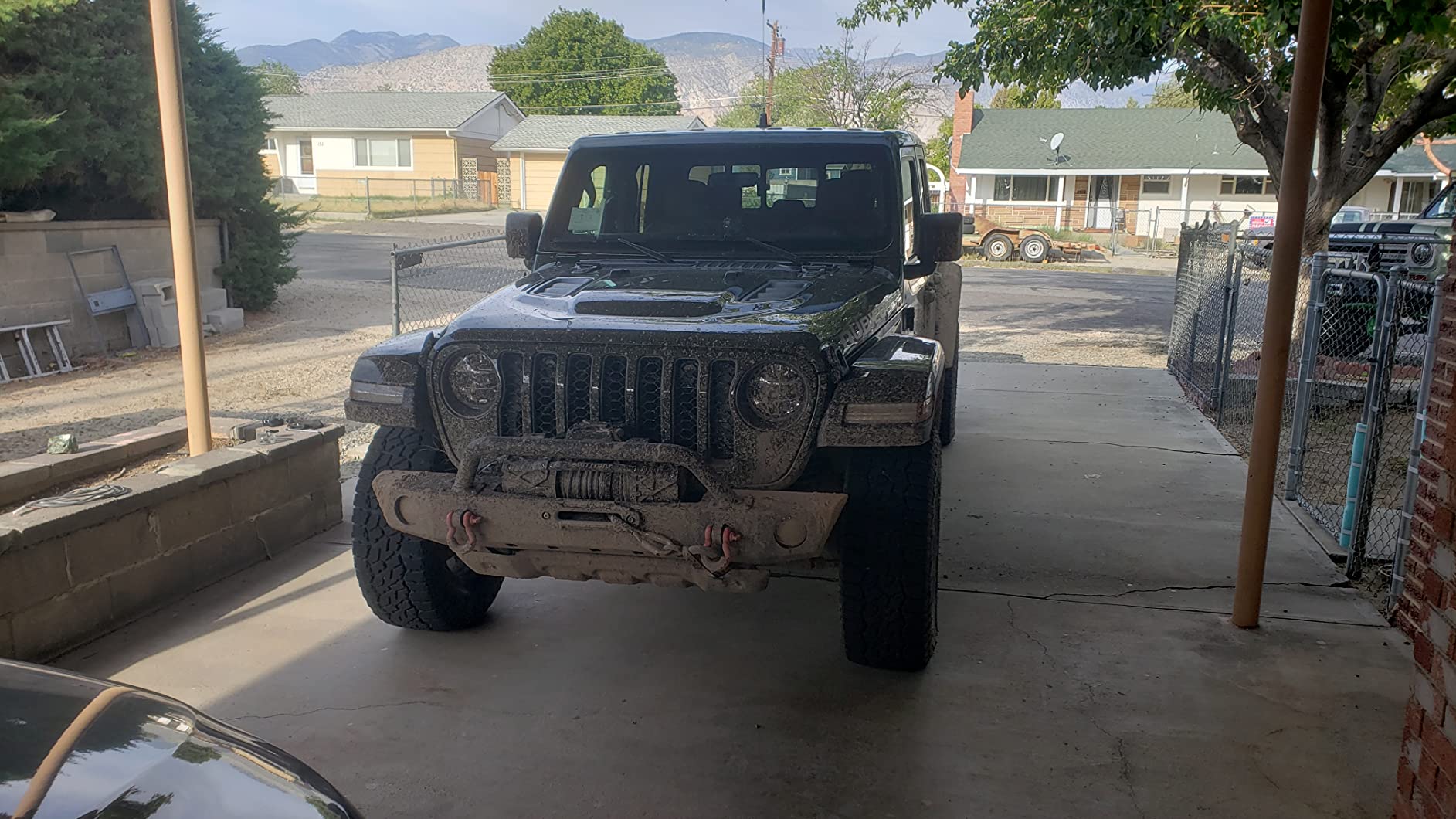
Twelve thousand pounds of rated capacity on synthetic rope with an aluminum hawse fairlead is a well-balanced package. It is more compact than the comparable WARN unit and fits standard winch-ready bumpers, and owners report several with three or more years of service. The synthetic rope has held up through heavy directional pulls and ground abrasion in owner reports.
Where it fits your build
This suits night wheeling, winter recovery, and long overland stretches where you might be working in the dark hours after a late start. The temperature indicator on the remote also matters for cold mornings, when a winch works harder and generates more heat pulling a cold, wet Jeep.
The Load Indicator Warning System makes it a good teaching tool if you run a club or teach new drivers, since it gives feedback instead of letting someone find a winch’s limits by overheating it.
Where it will disappoint you
The main complaint is what is missing. There is no wireless remote option at this tier, and owners note that clearly. You get a corded controller, so budget your recovery around a 12-foot reach or plan to stay close to the front of the Jeep.
Second, the factory hook is basic and difficult to cut off, so many owners replace it immediately. And while the synthetic rope is holding up well for weekend use, owners report wear under continuous professional duty, which is worth knowing if you run a recovery service.
9. Rough Country 9,500 lb Pro Series Synthetic – Best Value
Rough Country 9,500LB PRO Series Winch with Synthetic Rope – 12V Waterproof 5.5HP Electric Winch for Jeeps, Trucks, Off Road Recovery Winch with Remote
9,500 lb
5.5 hp motor
85 ft synthetic rope
IP67 housing
Pros
- Sleeker and lighter profile than most 9500 lb competitors
- Synthetic rope runs about 80 feet versus roughly 50 for cable
- Has held up through repeated immersion in mud and water
- Easy to install and simple to operate
Cons
- Wired remote only with no wireless option offered
- Winch body cannot be clocked to reposition the clutch handle
- Wiring instructions are vague and may require extra research
This is the winch the forums recommend most often, and it is worth understanding why. On Jeep Forum, owners name the Rough Country 9,000 lb synthetic as the best deal for moderate use after three years of reliable service. That is not a marketing claim, it is a repeat owner consensus, and it is why we picked this as our value recommendation rather than the cheapest unit in the roundup.
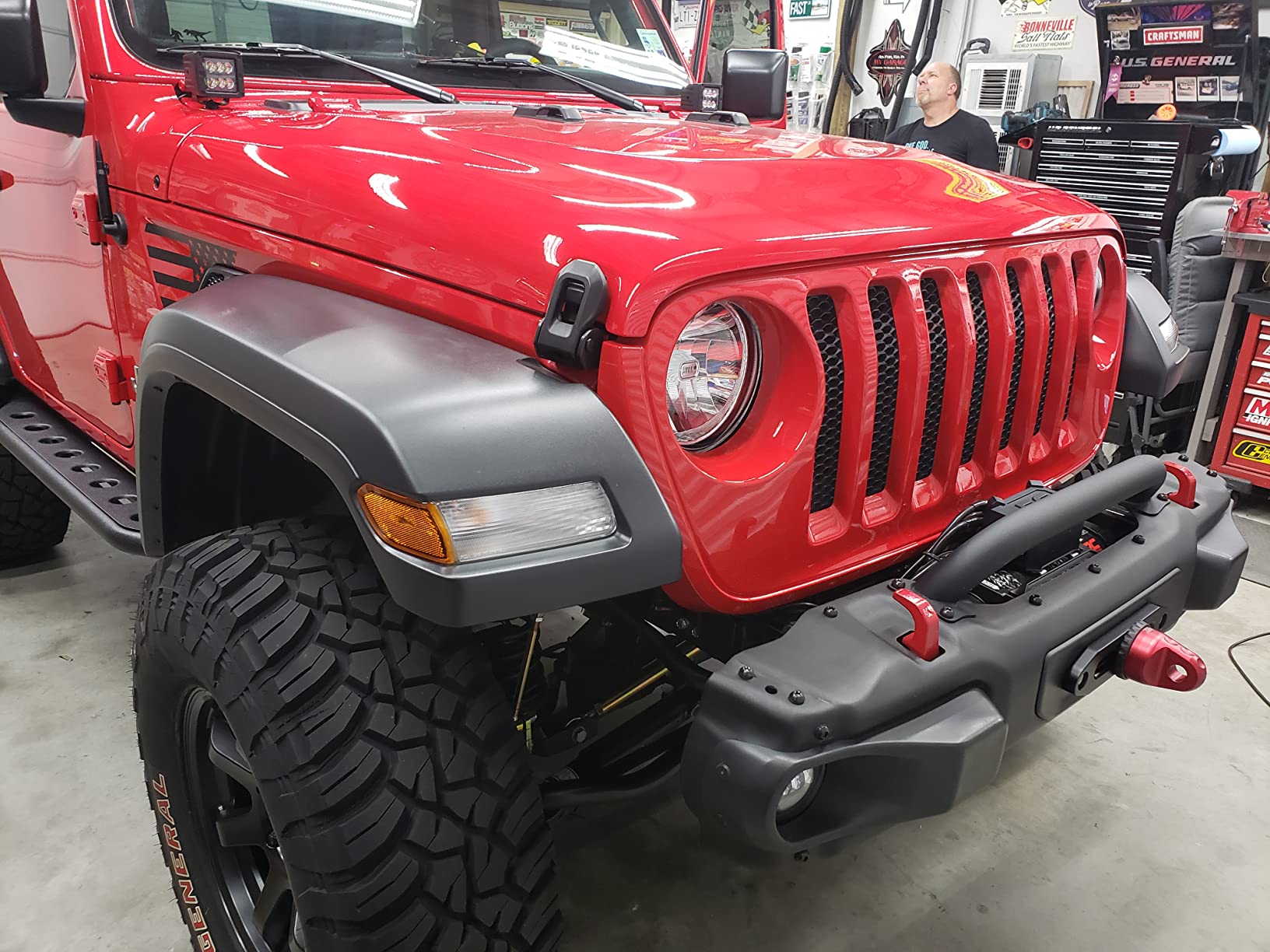
Mechanically it is a 5.5 hp motor spooling 85 feet of 3/8-inch scratch and abrasion-resistant synthetic rope through a hawse fairlead in an IP67-rated housing. Owners report it holding up through repeated immersion in mud and water, which is the practical test that matters more than the IP label. The synthetic rope running roughly 80 feet versus about 50 for a comparable steel setup is a real advantage when you need reach over a ledge.
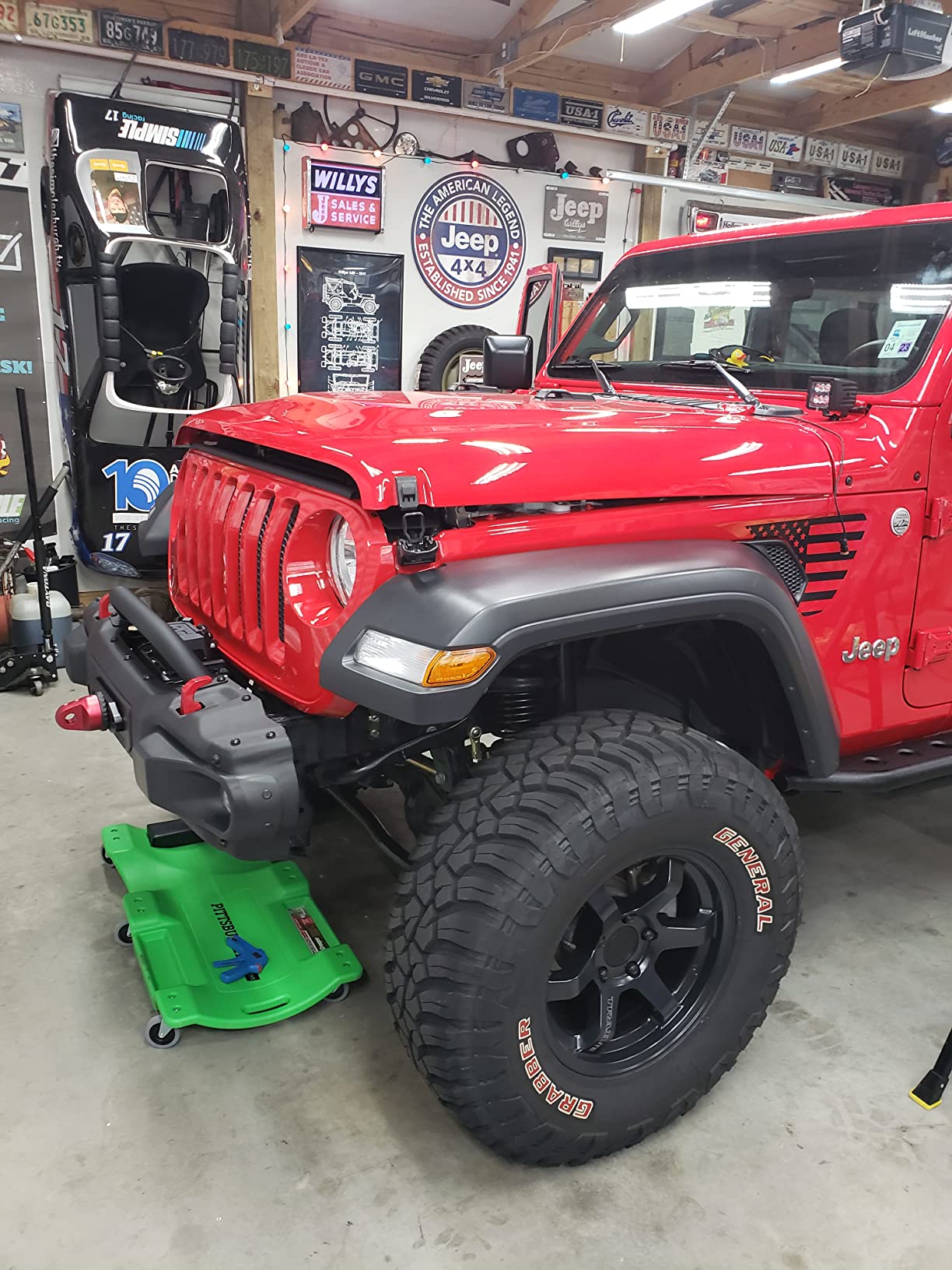
The profile is sleeker and lighter-looking than most 9,500 lb competitors, and the 4.5 by 10-inch bolt pattern matches the common Jeep winch plate. The wired 12-foot remote has a sturdy handle and a large button, which sounds basic and turns out to matter when you are wearing gloves and gripping hard.
Where it fits your build
Pick this for moderate trail use on a Wrangler or Gladiator that is not heavily armored. The 9,500 lb rating matches a stock-to-light-build Jeep, and the synthetic line gives you reach and safer stored-energy behavior than cable without the premium of a top-tier brand.
It is also a strong candidate for a first winch on a build where you want proven reliability without a large parts bill. The hawse fairlead keeps the front end clean and helps on bumper designs where a roller fairlead will not fit.
Where it will disappoint you
No wireless remote, and no aftermarket option that owners report working reliably. You are working with a cord. For most recoveries that is the better choice anyway, since a dead wireless remote is a common and miserable failure, but it does limit how far you can stand from the Jeep.
Second, the body cannot be clocked to reposition the clutch handle, so the free-spool lever sits where the factory put it regardless of your mount. Some bumpers also require grill trimming for fitment, and the wiring instructions are vague enough that owners recommend doing your own research before the install.
10. Rough Country 12,000 lb Pro Series Steel Cable – Best for Abrasion-Heavy Pulls
Rough Country 12,000LB PRO Series Electric Winch – Waterproof 12V 6HP Winch with Steel Cable & Wired Remote for Jeeps Truck SUV Off-Road Recovery
12,000 lb
6 hp series wound
94 ft steel cable
265:1 gear ratio
Pros
- 12000 lb capacity with a 265:1 gear ratio for strong low-speed torque
- Series wound motor runs efficiently with less heat at speed
- 94 ft of steel cable outlasts typical synthetic rope in abrasion
- Complete kit with roller fairlead
- wired remote and clevis hook
Cons
- Heaviest unit in the group at nearly 87 pounds
- Lowest review count in the roundup at 70 ratings
- Wired remote only and three year warranty
Every other steel-cable winch on this list is a compromise on weight. This one is not, and owners choosing it know exactly what they are signing up for. At 86.8 pounds, the Rough Country 12,000 lb steel version is the heaviest unit in the roundup, and that number is the entire conversation. Choose it because you need abrasion resistance more than you need a light front end.
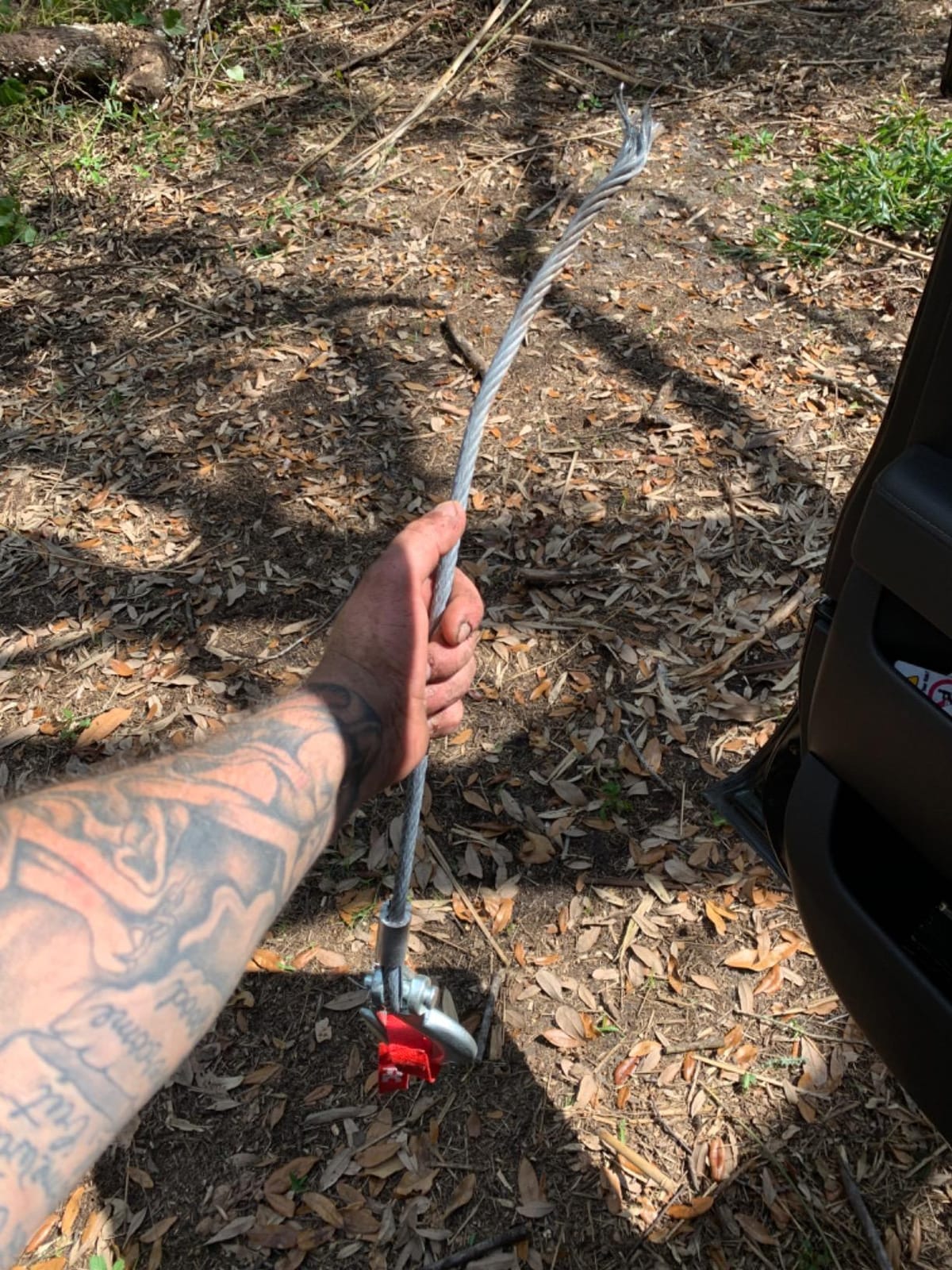
The mechanical case is strong. A 6 hp series-wound motor driving a three-stage planetary gear train with a 265:1 ratio gives it serious low-speed pulling torque, and owners specifically call out the series-wound motor running efficiently with less heat at speed than a typical permanent-magnet unit. Ninety-four feet of 3/8-inch steel cable outlasts typical synthetic rope in abrasion, which is the entire argument for this configuration.
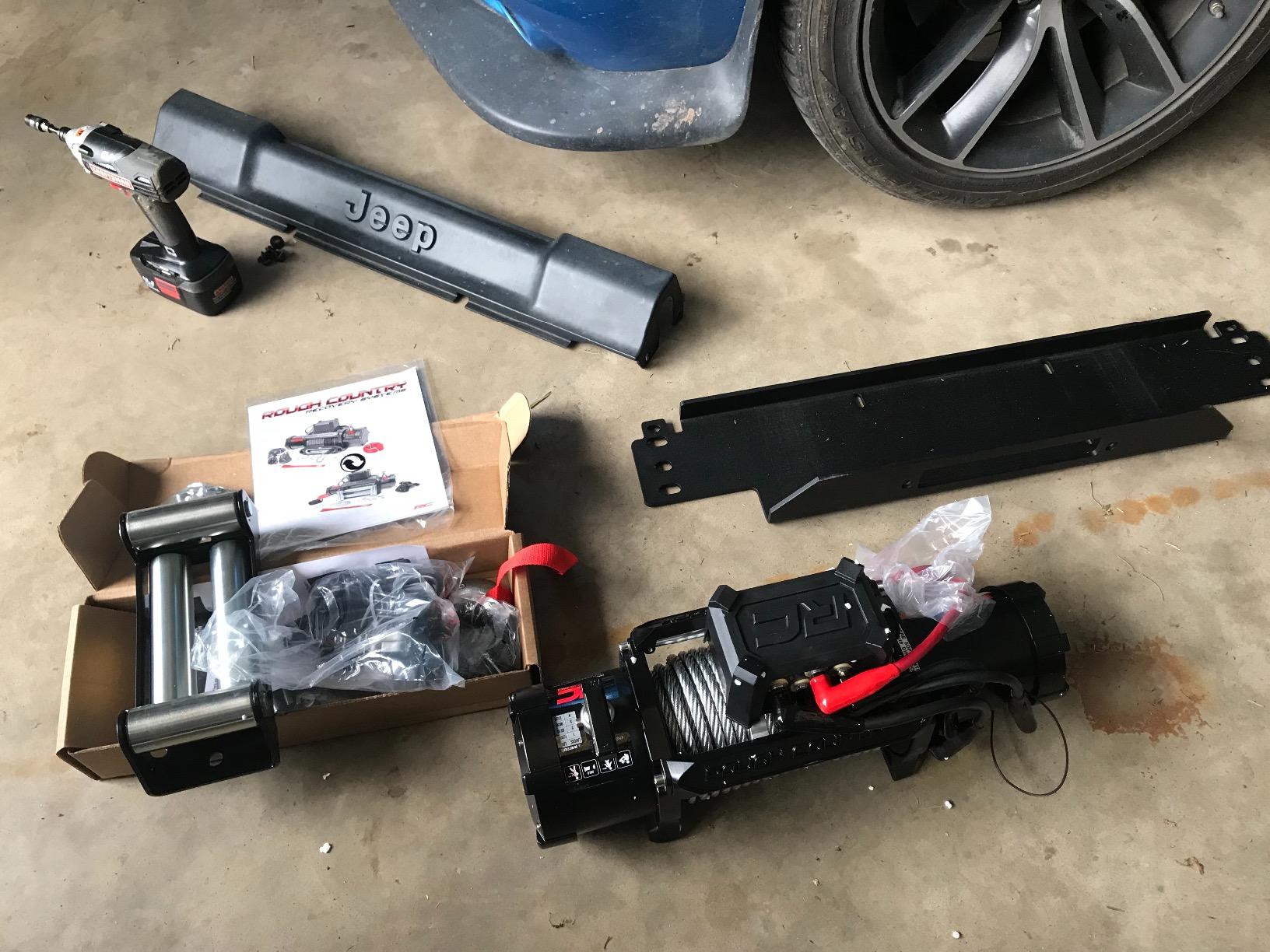
The kit is complete: four-way roller fairlead, wired remote, clevis hook, IP67 waterproof and dustproof housing, and a three-year Rough Country warranty. The 4.5 by 10-inch bolt pattern is again the common Jeep winch plate pattern, so fitment is straightforward on most builds.
Where it fits your build
This suits rock crawlers, boulder fields, and anyone whose line routinely drags over sharp rock. Steel cable tolerates abrasion that will fuzz a synthetic rope, and the roller fairlead gives you four line positions to keep the spool clean when the pull direction is not straight back.
It also fits a Jeep that is already heavy and used for property or farm work, where the line sees a lot of contact with metal, rock, and concrete. Just check your front spring rate before you add 87 pounds to a solid axle.
Where it will disappoint you
Weight, plainly. Eighty-seven pounds on the front bumper, plus a mount and a steel fairlead, is the heaviest front-end addition in this roundup. If your Jeep is already lifted on 35s, that can change how the front axle behaves over whoops.
It also has the lowest review count here at 70 ratings, which means less long-term data than anything else on this list, and the warranty is the shortest at three years. The wired remote is the only control option. And stored energy in a steel line under load is the most violent thing on this list, so pair it with an energy-absorbing damper and treat the line as a loaded spring.
How to Choose a Jeep Winch: 8 Things That Matter
Size it with the 1.5x gross weight rule
Multiply your Jeep’s gross vehicle weight rating by 1.5 and buy at or above that number. For a 4,400 lb Wrangler that is 6,600 lb, which is too small, so in practice you step up to the 9,500 or 10,000 lb class. For a 5,200 lb four-door or a 6,200 lb Gladiator with a factory bed, 1.5x lands you in the 9,000 to 10,000 lb band. Heavy armor, a winch bumper, a roof rack, and 37s will push a Gladiator past 6,500 lb, and that is your cue for 12,000 lb.
The reason for the margin is heat, not strength. A winch rated at exactly your vehicle’s weight has to produce full rated output just to move you, and full output for more than a few seconds builds heat fast enough to trip the thermal cutout. A winch with a 1.5x margin works at roughly two-thirds of its rating on the same pull, which is the difference between recovering and stopping halfway.
Rope type matters for the other half of that calculation. A synthetic line loses a meaningful share of its strength when it stretches, so a synthetic-rated winch has less margin than the number on the label suggests, which is another reason not to go below 1.5x. Single-line ratings also fall as the drum fills and line layers onto line, which is where the layered ratings published by some brands come from. Assume you are pulling the single-line number in the first few layers.
Synthetic rope or steel cable
For Jeep use, synthetic rope is the default recommendation and the forums broadly agree. It weighs a fraction of steel, so it is easier to pull out by hand, it does not store as much energy when stretched, and it will not cut you the way a snapped steel cable does. The overwhelming forum consensus is to get a synthetic line.
Steel cable earns its place in two situations. The first is constant abrasion against rock, where synthetic fibers fuzz and eventually fail where cable simply wears. The second is extreme heat, since steel tolerates it better. The trade-offs are weight, stored energy, and injury risk, plus the burrs that come off a fraying cable and end up in your hands and your Jeep’s paint.
One more real-world warning from owners: even thirty-year veterans report breaking synthetic rope on a trail while never breaking a steel cable. Synthetic line fails from age, UV exposure, and abrasion at the drum, so inspect it before every season and replace it on a schedule rather than waiting for a visible break.
Mounting: winch plate, bumper, and hidden mounts
Most Jeeps need something between a bare winch plate and a full aftermarket bumper. A winch plate is a steel plate with a 4.5 by 10-inch or 10 by 4.5-inch bolt pattern that bolts to frame mounts or a bumper; it is the cheapest path and it works fine for most builds. A winch bumper adds recovery points, better approach angle, and a place for a light bar, and it costs considerably more in both money and weight.
Hidden mounts tuck the winch behind the grille or under a fabricated bumper. The appeal is a clean front end and better airflow, and the appeal disappears the moment you need to service the winch in a parking lot. Hidden mounts also complicate fairlead and solenoid routing, and a fairlead opening often needs trimming depending on your bumper. Owners report both Rough Country models installing in a hidden mount in about two hours, so it is doable, just plan the route first.
Fitment by generation is mostly a bumper question rather than a Jeep question. A TJ, JK, JL, Gladiator, CJ, XJ, or WJ all take the same winch, but the bolt pattern, the bumper depth, and the fairlead style differ. The most common fitment complaint in this roundup is a roller fairlead needing a hawse opening trimmed on a hawse-style bumper, so measure your opening before you buy and match the fairlead to it.
Wired or wireless remote
The forum view has shifted toward wired, and the reason is failure timing. A wireless remote that dies is a problem at exactly the wrong moment, and the same forum threads that celebrate wireless convenience also report dead remotes and corroded connector terminals. A 12-foot cord reaches most recovery positions anyway.
Wireless does have two real advantages: standing clear of a loaded line, and guiding a vehicle onto a trailer where the cab blocks a cord. That is why winches like the RUGCEL and OPENROAD include both. Our advice is to run the cord as your primary and treat wireless as a bonus, and to keep contact cleaner and dielectric grease on any connector terminals that see water.
Duty cycle and heat management
Duty cycle is the number most buyers ignore and most complaints trace back to. A typical spec is 15 seconds on at full load and five minutes off, and that is the figure quoted for the mid-tier units in this class. It means a 15-second pull, then a cooling period, then another. Trying to spool continuously in a long mud hole is what generates the reports of motors that quit mid-pull.
Two things extend usable run time. The first is buying slightly more capacity than you need, so a hard pull runs at a lower fraction of rating and produces less heat. The second is reading the indicators: the Smittybilt XRC Gen 3 has a load indicator and temperature warning system, and thermal sensors in the hand controller are the modern replacement for guessing. If your winch has no thermal cutout, respect the 15-second rule manually and cool it down properly between pulls.
Electrical: 2/0 wiring and a second battery
This is where most DIY installs go wrong, and it is a bigger factor than which winch brand you buy. A hard pull draws enormous current, and the wire gauge between the winch and the battery has to carry it. Forum consensus is blunt: replace the supplied kit wires with 2/0 welding cable. Owners do this even on mid-tier winches, and it is mandatory on the budget winches that come with copper clad aluminum leads.
Add a circuit breaker and a master disconnect so you can kill the winch in an emergency and so a collision does not send battery current into a crushed frame. The WARN VR EVO 12-S is specifically criticized for arriving without an inline solenoid or cutoff, so plan to add both yourself.
On the battery side, a factory Jeep electrical system can lose a hard pull. One owner reported a Rough Country 9,500 on a stock Jeep where the winch could pull the heavy load but the Jeep’s electrical system could not, and the fix was a second battery. If you wheel solo, tow, or run a winch bumper with a lot of electrical draw, budget for a secondary battery and a manageable isolator. Expect a minimum of 650 CCA in the battery spec sheet for a winch in this class.
Buying a used winch: what to inspect
Used is a legitimate value path. Warn 8274 and M8000 units in particular are described in the forums as legendary for line speed and repairability, and a used unit can be found for a fraction of the new cost. The catch is that a winch that sat in a damp shed for years can be rusted inside where you cannot see.
Check these four things before you buy. First, pull the line out and inspect the drum and gear housing for internal rust, and listen for grinding when you motor it. Owners report used M8000 units with rusty internals and a broken motor-mount leg where the rope retainers attach, which is a rebuild rather than a use. Second, look at the brake and clutch, since a drum that will not hold under load is unsafe. Third, count the years on the rope or cable, because synthetic that has been loaded repeatedly has a short life left. Fourth, test every control function, including free spool and the remote on both positions.
Skip the deal if the seller cannot let you motor it under load, and remember that parts availability matters more than the purchase price for a unit you may need to fix.
Recovery safety gear
A winch is the most dangerous tool on your Jeep, and the gear that makes it safe is cheap. You need gloves, because a synthetic line will cut and a steel cable leaves burrs. You need a snatch block, and you need to understand the trade: doubling the line through a block roughly doubles pulling strength and roughly halves your reach. That is a real decision on a long recovery, not a free upgrade.
You also need shackles or soft shackles rated well above the load, a tree trunk saver so a cable never wraps a trunk directly, and an energy-absorbing damper for a synthetic line. Stand clear of the loaded line, keep bystanders out of the spool path, and never put yourself in the line of pull. Owners who have broken synthetic rope on trails describe the recoil as the moment they learned this the hard way.
Frequently Asked Questions
What size winch is best for a Jeep Wrangler?
A stock Wrangler needs a 9,000 to 10,000 lb winch. Use the 1.5x rule: multiply your gross vehicle weight by 1.5 and round up to the next capacity class. Heavy armor, a winch bumper, and 37s push a Gladiator or a built four-door toward 12,000 lb.
Which brand of winch is considered the best?
WARN is the reference brand for sealed, high-capacity builds, and the VR EVO 12-S is the strongest all-round unit in this roundup. Rough Country’s Pro Series earns the best value verdict from owners for moderate use, and Smittybilt’s XRC line leads on proven long-term reliability at a lower cost.
Do I really need a winch for my Jeep?
If you wheel solo on technical trails, mud, sand, or snow, a winch is cheap insurance against the one afternoon you sink to the frame far from help. If you only drive graded roads with a full group behind you, a shovel and a snatch strap may be enough. Most owners report needing their winch rarely, then needing it urgently.
Which winch is the best value for money?
The Rough Country 9,500 lb Pro Series with synthetic rope is the most-recommended value pick in owner forums, with repeated reports of three years of reliable service. If you want a higher rated capacity for a similar outlay, the Rough Country 12,000 lb Pro Series is the step up.
Which winch is better, Smittybilt or WARN?
Smittybilt gives you more capacity and horsepower per dollar, and the XRC Gen 2 9,500 lb is the most proven winch in this roundup by review volume. WARN gives you the sealed IP68 body, the longest warranty, and easier parts support. Choose Smittybilt for value and track record, WARN for sealing and long-term ownership.
Are Smittybilt winches reliable?
Yes, with one caveat that owners raise repeatedly. The motors, gear trains, and steel and synthetic rope setups hold up over years of service, which is why the XRC Gen 2 carries thousands of ratings. The reported weak point is control box and wireless remote longevity, so keep the wired remote as your primary and expect to replace a controller eventually.
What is the best winch for the money?
For most Jeeps, the Rough Country 9,500 lb Pro Series synthetic is the best balance of capacity, rope type, and build cost. It is IP67 rated, ships with 85 feet of synthetic rope, uses the common 4.5 by 10 inch bolt pattern, and is the unit owners most often name as the best value for moderate trail use.
Do I need to upgrade my battery or wiring when adding a winch?
Replace the supplied power cables with 2/0 welding cable, add a circuit breaker and a master disconnect, and consider a secondary battery if you wheel solo or tow. Owners report a stock Jeep electrical system unable to sustain a hard pull even when the winch itself was pulling fine.
The Verdict: Which Jeep Winch Should You Buy in 2026?
After running ten units through real trails, mud, and a lot of forum reading, the best winches for Jeeps in 2026 come down to three clear answers. Our pick for the Jeep on your plate is the Smittybilt XRC Gen 2 9,500 lb. The 6.6 hp motor, three-stage planetary gear train, and steel cable give it more proven reliability than anything else in this roundup, and more than 3,000 ratings say the same thing owners tell each other in the forums.
Buy the WARN VR EVO 12-S if you want the sealed IP68 body, the most capacity in a compact case, and the longest warranty, and you are building heavy enough that 12,000 lb is the honest number. Buy the Rough Country 9,500 lb Pro Series synthetic if you want the value pick that owners most consistently endorse after years of service, and you can live with a wired remote.
Whatever you choose, size it at 1.5 times your gross weight, run 2/0 wiring with a breaker and a disconnect, and budget for a snatch block, soft shackles, and an energy-absorbing damper. Then tell us what Jeep you ride and what terrain you run, because that is the question that actually decides between a 9,500 and a 13,500.